Author Archives: M.A.D. LIGAYA
The Hardest Choice
(Were We Ever Meant to Be – Part 7)

Two days later, Kath asked that we not speak over the weekend. Her church had an important Sunday activity, and she needed time alone to think.
I gave her the silence she asked for, but filled it with visions of the life I believed we would finally claim. By then, I understood that Jay was not the greatest obstacle between us. Something far more powerful had already begun calling her back.
Kath called on Sunday night. Her eyes were swollen.
Her laptop was on the study table again, not on the bed. The change was small but deliberate. She had moved our conversation away from the place where we had surrendered to desire, as though furniture and distance could help her recover the boundary we had erased.
“I’m not all right,” she said. “The sermon struck me again.”
She told me that every service since our affair became serious had felt directed at her. Every time we undressed for each other, every time she chose my call over Jay’s, she felt the distance between her desire and her faith widening.
Her Christianity was not a convenient device she discovered at the end of our affair. It had shaped the marriage she chose to repair, the community in which she served, and the understanding of herself she wanted to preserve. Loving me had not erased those commitments. It had divided her against them.
“Doesn’t what we’re doing trouble you?” she asked.
I believed in God, though I was not devout in the way she was. I had asked for forgiveness and understanding, but desire had thrown my conscience aside. All I wanted was Kath.
“We love each other,” I said. “That is what matters.”
“Stop using love to make this right. It isn’t right. Are we supposed to live permanently in sin?”
“Would it be less sinful to remain with people we do not love?”
Kath wiped her eyes. “You keep speaking as if Anna and Jay are merely mistakes standing between two rightful lovers. They are people, Marco. We made promises to them. Our children did not choose this. Love does not make them disappear.”
I had no answer that did not return to what I wanted.
Even as I said it, I heard the convenience in my reasoning.
“It has to end,” she said. “Before Jay, Anna, or anyone else discovers us.”
“Kath—”
“I am not choosing between you and Jay. I am choosing between what is right and what is wrong.”
The sentence was not a denial of her feelings. That was why it hurt. If she had stopped loving me, I could have blamed time or distance. Instead, she was refusing precisely because the love remained powerful enough to destroy what she believed she was called to protect.
There it was: the rival I could not charm, outwait, or defeat.
“We can still be friends,” she continued. “We can exchange messages occasionally, but no more calls.”
“Let me call sometimes.”
“We both know what will happen. If you call, I will block you. If you use your phone, I will block your number. Please help me do this. I have grown used to your presence, and you know how weak I am when it comes to you.”
I had pushed against every boundary she had drawn because I believed persistence was proof of love. Now the only loving act left to me was the one I least wanted to perform: allow the boundary to remain.
“Jay will call soon,” she said. “I asked him to. Instead of talking to you, I should be talking to my husband.”
The words hurt more than I expected.
“Is there anything else you want to say?”
I shook my head.
“Then let me say this one last time. I love you, Marco. But I have to learn to forget you. I hope you understand why.”
“I love you too, Kath.”
“Goodbye. Please try to love Anna. I wish both of you well.”
The screen went dark.
For several minutes, my own reflection remained on the screen. The apartment was unchanged: the cup beside me, the winter lights outside, the empty room waiting for another film or another sleepless night. Yet the space felt altered because I had allowed Kath’s presence to occupy it so completely.
I thought of Anna, who had forgiven betrayals I would have struggled to forgive and still remembered to ask whether I had eaten. I thought of Kenneth, whose failure to answer my call I had dismissed so easily, without considering how much of his life I had already missed. I thought of Jay at sea, trusting that his wife would be there when he called. For the first time since Kath’s birthday, I understood that what we had called our private story had never belonged only to us. We had made it private by pushing everyone else beyond its borders, even though they would have borne the consequences of every choice we made.
I had spent all that time thinking of Jay as my rival. But I had not lost Kath to him. In the end, she had not chosen one man over another.
She had chosen her faith—and the person she still wanted to be.
It was difficult to compete with God.
Against Him, I never had a chance.
Perhaps Kath had been right all along.
Perhaps we were never meant to be.
— END —
If you could relive one year of your life, which one would it be?



If I could relive one year of my life, I would choose not a calendar year but a twelve-month period: March 2012 to March 2013. Those months were among the most difficult, uncertain, and ultimately transformative of my life.
In March 2012, I resigned from my position at a public tertiary institution because of irreconcilable differences with my fellow school administrators. My resignation took effect in May. Until then, I had planned to spend the remainder of my career in my country’s public school system. The position was good, and the long-term security it offered was difficult to surrender, but the working environment had become too toxic for me to remain.
Even so, I did not leave the public institution without making a meaningful contribution. While concurrently serving as dean of the college and chair of its Education program, I spearheaded the effort to secure from the Commission on Higher Education (CHED) the permit required to offer Mathematics as a major in the program.
My wife was deeply unhappy with my decision, and her reaction was rooted in our previous experience. Before joining the public institution, I had spent nine years as an administrator at a private college. The school deducted a monthly contribution from our salaries for its retirement fund. Employees who left before completing ten years of service could recover only the amounts deducted from their own salaries; completing ten years would have entitled me to receive the institution’s share as well. My wife therefore urged me to remain for one more year. Financially, she was right. However, I had already become deeply unhappy because of my disagreement with the college president over how she managed the school and treated the people within the organization. Another year felt like a price I was no longer willing to pay, so I resigned and forfeited the institution’s contribution.
Understandably, when I decided to leave the public institution after serving there for only about a year, my wife feared that I was repeating the same pattern—walking away from another stable position without knowing what would come next. Her fears were eased on June 1, the first day I was officially unemployed, when I received a call from a representative of a Pakistan-based international school system that had acquired an existing basic education school in the Philippines. They offered me the position of school principal, with a salary considerably higher than what I had previously earned. The workload was also lighter because my duties were primarily supervisory and carried no required teaching load. However, after spending so many years in education, I could not divorce myself entirely from the classroom. I therefore accepted a part-time teaching position at a tertiary institution in a nearby locality.
Despite that apparent good fortune, I was unhappy.
Some longtime employees had hoped that the school’s new owners would appoint one of them as principal. They had served the institution for years, while I was a newcomer. Their unspoken question was understandable: Why him? As a result, I encountered doubt, indifference, and resistance. At the same time, years of professional turbulence finally caught up with me, and burnout set in. It did not help that I was also struggling with personal demons of my own making.
One day, I realized that I had fallen into depression.
Still, I resolved not to be defeated. I stood my ground, confronted what was draining me professionally, and began dealing with the personal problems I had helped create. More importantly, I searched for a way to begin again. That search led me to apply for a teaching position in South Korea.
There was one complication: accepting the position in South Korea meant leaving the school approximately one month before its graduation ceremonies. The foreign representatives of the Pakistan-based international school system tried to persuade me to stay. However, I had never signed an employment contract—not because the organization intended to withhold one, but because the person responsible for preparing and sending it repeatedly forgot to do so despite my constant reminders. The absence of a binding agreement allowed me to leave without fear of legal repercussions for breaching a contract.
Still, the decision was painful. I had grown attached to my students, and it saddened me to leave without seeing the Grade 6 and fourth-year students graduate. In the end, however, I had to choose between sentiment and my well-being. I could feel my depression worsening, and I knew that remaining merely to participate in the graduation ceremonies could cost me the opportunity to begin again.
On March 2, 2013, I flew to South Korea and began working as an ESL teacher.
Fourteen years later, I am still here in the Land of the Morning Calm. Coming to South Korea was one of the best—if not the best—decisions I have ever made. The country has had a genuinely calming effect on me. In many ways, it tamed my spirit—not by extinguishing the fire within me, but by teaching me where and how to direct it.
I arrived strong-willed, restless, and accustomed to resisting environments that I believed were unhealthy or unjust. South Korea gave me something I had long needed: stability, order, and enough quiet space to breathe, reflect, and rebuild myself. Here, I learned that strength does not always have to announce itself through confrontation. I could disagree without being disagreeable, remain ambitious without being consumed by ambition, and enjoy solitude without feeling isolated. The same intensity that once left me exhausted gradually found more constructive outlets—in teaching, research, writing, physical well-being, and continuous self-improvement.
This country has given me opportunities for tremendous personal and professional growth. It allowed me to rediscover myself not merely as an administrator, but as a teacher, researcher, writer, and lifelong learner. South Korea did not change the essential person I was; it helped me become a calmer, more disciplined, and more purposeful version of him.
I am reminded of something that happened when the school where I served as principal underwent FAPE recertification. Securing that recertification was important because the school needed it to remain eligible for the government assistance administered through the program. During the evaluation, one of the accreditors asked why, after spending nine years at one college, I had transferred to a public institution only to leave after about a year. She also noticed that I had previously worked at three other schools.
One of her fellow accreditors remarked, “Perhaps he has not yet found his niche under the sun.”
Perhaps she was right.
If I could relive those twelve months, I would not return because they were happy, nor would I return to change what happened. I would relive them so that, amid the uncertainty, pain, and apparent failures, I could recognize that they were leading me toward the place where I truly belonged.
Now I have found my niche under the sun.
It is South Korea.
Beyond the Screen
(Were We Ever Meant to Be – Part 6)

After that, we spoke almost every night. If our affair were a voyage, we had sailed so far from shore that neither of us could see where we had begun—or decide whether we still wanted to return.
Our conversations developed rituals. I messaged first to ask whether the children were asleep. She checked whether Anna might call. We used earphones, lowered our voices, and deleted exchanges that could expose us. Secrecy itself became intimacy: every precaution reminded us that there was an us important enough to hide.
One evening, Kath returned to the claim she had never completely believed.
“You still expect me to believe that you lived without sex for eight years?”
“I already told you. I never paid anyone, and I never found a girlfriend.”
“Not even once?”
“Not even once.”
“Then how did you manage?”
“A selfie,” I said, making her laugh. “Twice a week. I tell myself regular release is good for a man’s health.”
“Do you need stimulation?”
I admitted to visiting adult websites.
“Disgusting,” she said, although she was still laughing.
“They would become unnecessary if I had something better to look at.”
Her laughter disappeared. “Don’t start, Marco.”
“I haven’t started anything.”
“Your voice changes whenever you want something.”
“And you recognize it.”
“Unfortunately.”
Then I asked whether she ever touched herself.
“No. Jay and I once tried doing something online when he first returned to sea, but it didn’t work for me. We never tried again.”
“Perhaps it wasn’t the distance.”
“What do you mean?”
“Perhaps it was the person on the other side of the screen.”
She stared at me without answering.
The conversation changed the air between us. Her teasing smile faded, but she did not look away. I heard her breathing through my earphones, each quiet breath making the thousands of kilometers between us seem less real.
“What’s wrong?” she asked.
“Nothing.”
“Tell me.”
“I feel like taking a selfie.”
She understood. “Then take one.”
“I need inspiration.”
“Visit one of your disgusting websites.”
“I would rather look at you.”
Silence.
I removed my shirt first. Beneath it, I was wearing a white undershirt. Kath shook her head, but the faint smile at the corner of her mouth betrayed her.
“You are shameless.”
“Your turn.”
“No.”
“Then why haven’t you ended the call?”
She could have. Her finger hovered near the touchpad, and for several seconds I believed she would make the choice neither of us had been strong enough to make. Instead, she leaned back.
Her hand moved slowly over her chest, almost unconsciously at first, then stopped when she realized I was watching.
“Marco, what is happening to me?”
“Nothing you don’t want.”
“Don’t pretend you know what I want.”
“Then tell me to stop.”
“I have been telling you that from the beginning.”
The answer should have ended everything. Instead, neither of us moved.
“Please,” I whispered.
Kath closed her eyes. When she opened them again, fear and desire occupied the same expression.
“Why are you so difficult to resist?”
She carried the laptop to her bed. I did the same. Before setting it down, she changed into a thin undershirt and returned beneath the sheet.
“This is all you are going to see,” she warned.
“For now.”
“Don’t push me.”
But she remained.
The two rooms, thousands of kilometers apart, became one private space of restrained movements, uneven breathing, exposed shoulders, and whispered names. We watched each other without touching, yet every movement seemed answered by another on the opposite side of the screen.
Kath hesitated several times. Each pause gave us an opportunity to stop; each time, I asked her whether she wanted to continue. Sometimes she said no while remaining in front of the camera. Once she covered herself completely, and I thought the moment had ended. Then her face reappeared.
When she finally chose to continue, the surrender was mutual, but it was not free of pressure, guilt, or fear. The screen protected us from physical touch while permitting us to pretend that what happened through it was somehow less real.
That night, we crossed the boundary Kath had refused to cross eight years earlier.
It was not the last time. Soon, many of our late-night calls ended the same way. We began our conversations sitting at desks and finished them in bed. What we called friendship had become impossible to defend, even to ourselves.
Afterward, Kath sometimes covered herself quickly and avoided my eyes. At other times she laughed with the shy happiness of the younger woman I remembered. I preferred those moments. Her guilt threatened the future I was constructing, so I answered it with assurances: no one had forced us, our marriages were already incomplete, and love could not be evil simply because it arrived at the wrong time. The arguments comforted me because they began with the conclusion I wanted.
Yet the more we possessed of one another through our screens, the less sufficient the screen became. I wanted to return to the Philippines. I wanted to hold her without glass, pixels, or distance between us.
One night, Kath asked, “What exactly do you intend to do about us?”
I had waited for that question.
“First, answer something. Whom do you love more—Jay or me?”
“That is a ridiculous question.”
“Why?”
“Do you remember the crisis Jay and I went through before you left for Korea?”
I nodded.
“You were the reason. I told him everything about us. He asked whom I loved more, and I answered honestly: you. He threatened to leave me. That was why I came to you that day. I expected warmth, some sign that you still wanted me. Instead, you advised me to reconcile with him. You pushed me back into his arms.”
Her revelation rearranged eight years of memory. I had believed Kath chose Jay because she loved him more or because what existed between us had been insignificant to her. Now I learned that she had once approached me on the edge of choosing—and I, absorbed by my own crisis, had failed to recognize it. The lost possibility became more intoxicating than any future we could realistically build.
Had I known, I thought, I might never have boarded the plane to Korea.
“When Jay apologized and promised to help me forget you, I accepted. But did he erase you? Look at me, Marco. I talk to you instead of him. I want to see you all the time. You ask whom I love more?”
“I understand.”
“No. Say it.”
“You love me more.”
“You fool. You are the only man I love. I needed Jay because you were not there. I was learning to love him. Then you returned.”
She began to cry.
“Perhaps we decide whether we are meant to be,” I said. “Leave Jay. I will leave Anna. Come with me.”
Kath lifted her tear-streaked face.
“And my children?”
“I will accept them as my own.”
We discussed separation, secrecy, scandal, custody, and sacrifice. She had far more to lose than I did, but I was confident she would choose me.
I proposed that we keep our relationship hidden even after separating from our spouses. If Jay discovered that I was the reason Kath left, he might fight for custody or prevent the children from seeing her. Anna would have to face another betrayal, Kenneth would have to understand why his parents’ marriage ended, and both families would endure gossip and anger. I spoke of these consequences as obstacles we could manage, not wounds other people would suffer.
Kath listened, but the practical future made her quieter than the romantic one. It was easy to say she would leave everything for love while we were safely separated by thousands of kilometers. It was harder to imagine telling her children that the man on her laptop would replace the father they knew.
“Give me time,” she said. “I love you, but I don’t know what to do.”
I heard only the words I wanted to hear: I love you. I treated everything that followed as uncertainty time would eventually overcome.
PART 7 – The Hardest Choice
Thinking First
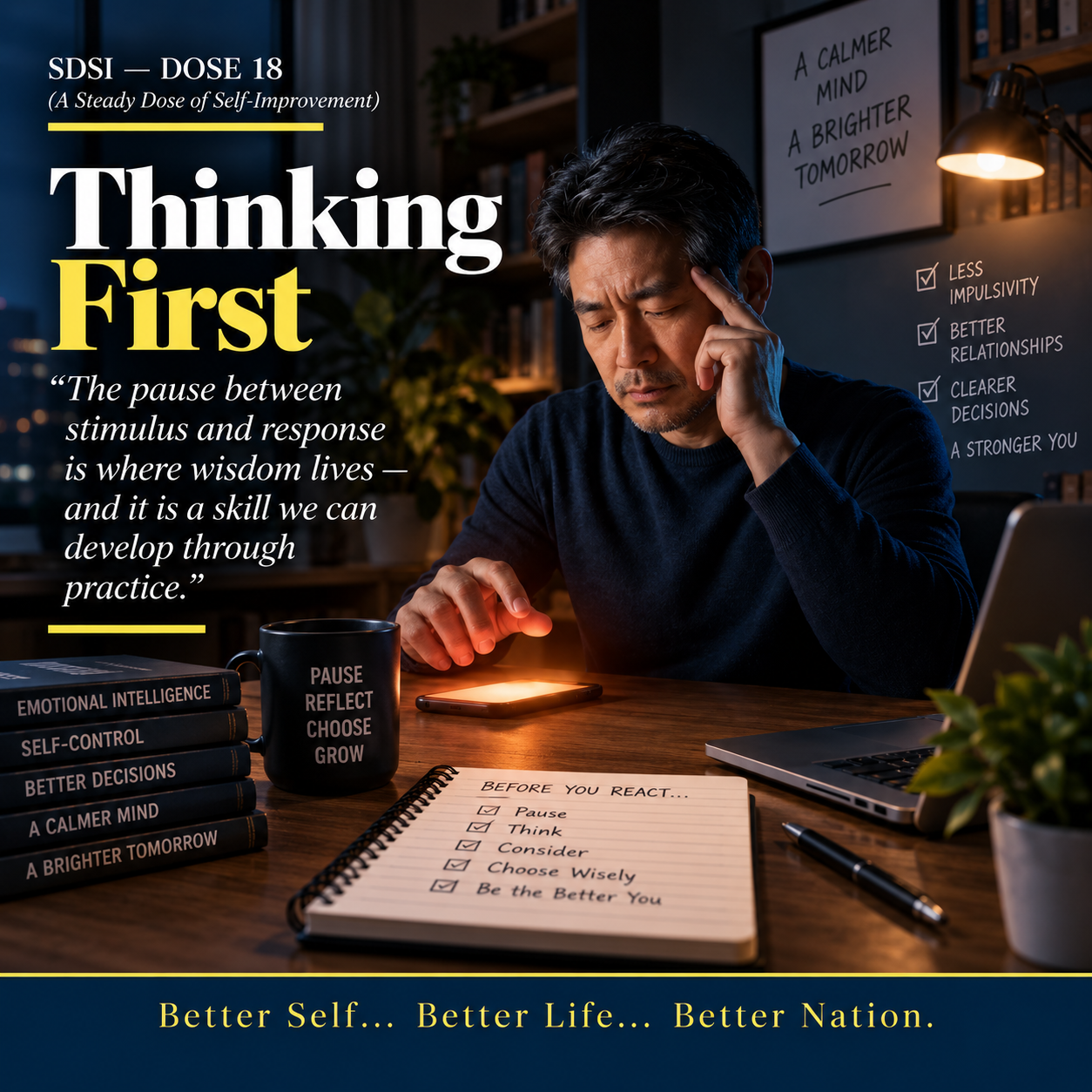
The pause between stimulus and response is where wisdom lives—and it is a skill we can develop through practice.

Every word you have regretted saying and every action you have wished you could take back probably began the same way: you reacted before you thought.
When something angers, frightens, embarrasses, or offends us, emotion can rise with remarkable speed. Before we have fully understood what happened, harsh words may already have escaped our lips, an impulsive message may have been sent, or an action may have been taken that cannot easily be undone.
This does not mean that we are helpless victims of our emotions. Emotional reactions may come quickly, but they do not always have to determine what happens next. We can learn to create a small but crucial space between what we feel and what we do.
A statement often associated with Viktor Frankl describes this space as the place where our freedom to choose resides. Although the exact wording cannot be reliably traced to Frankl, the principle reflects one of his central teachings: circumstances may influence us, but we retain some freedom in choosing how we respond to them.
Even a brief pause can allow us to consider what an impulsive reaction might overlook: Did I understand the situation correctly? Will my words solve the problem or worsen it? Am I responding to what actually happened—or merely to what I felt?
Abraham Lincoln understood the value of such restraint. When deeply angered or disappointed, he sometimes wrote what became known as “hot letters.” He poured his frustration onto the page but did not immediately send what he had written. One famous example was his strongly worded letter to General George Meade after the Battle of Gettysburg. Lincoln placed it aside, and it remained unsigned and unsent. The letter released his anger without letting it control his final action.
We may never write to generals or make decisions affecting an entire nation, but we face smaller versions of Lincoln’s choice every day. We decide whether to answer an insulting remark, send an angry message, confront someone immediately, or wait until we can speak with greater clarity.
Thinking first does not mean suppressing emotion or refusing to defend ourselves. It means giving reason enough time to join the conversation. Sometimes two seconds will be enough. At other times, we may need two minutes, two hours, or even two days.
The important thing is to build the habit while the stakes are low. Then, when the stakes are high, the pause will already be there.
Pause and Reflect
Think of the last thing you said that you wish you could take back. What might have changed if you had paused before saying it?
One Step Forward
The next time you feel a strong reaction rising, pause and count slowly to two before responding. Notice whether your first reaction still feels like your best response.
Explored in full in Chapter 10 — Thinking First of A Holistic Approach to Self-Improvement.
Better Self… Better Life… Better Nation.
It Has Always Been You
(Were We Ever Meant to Be – Part 5)
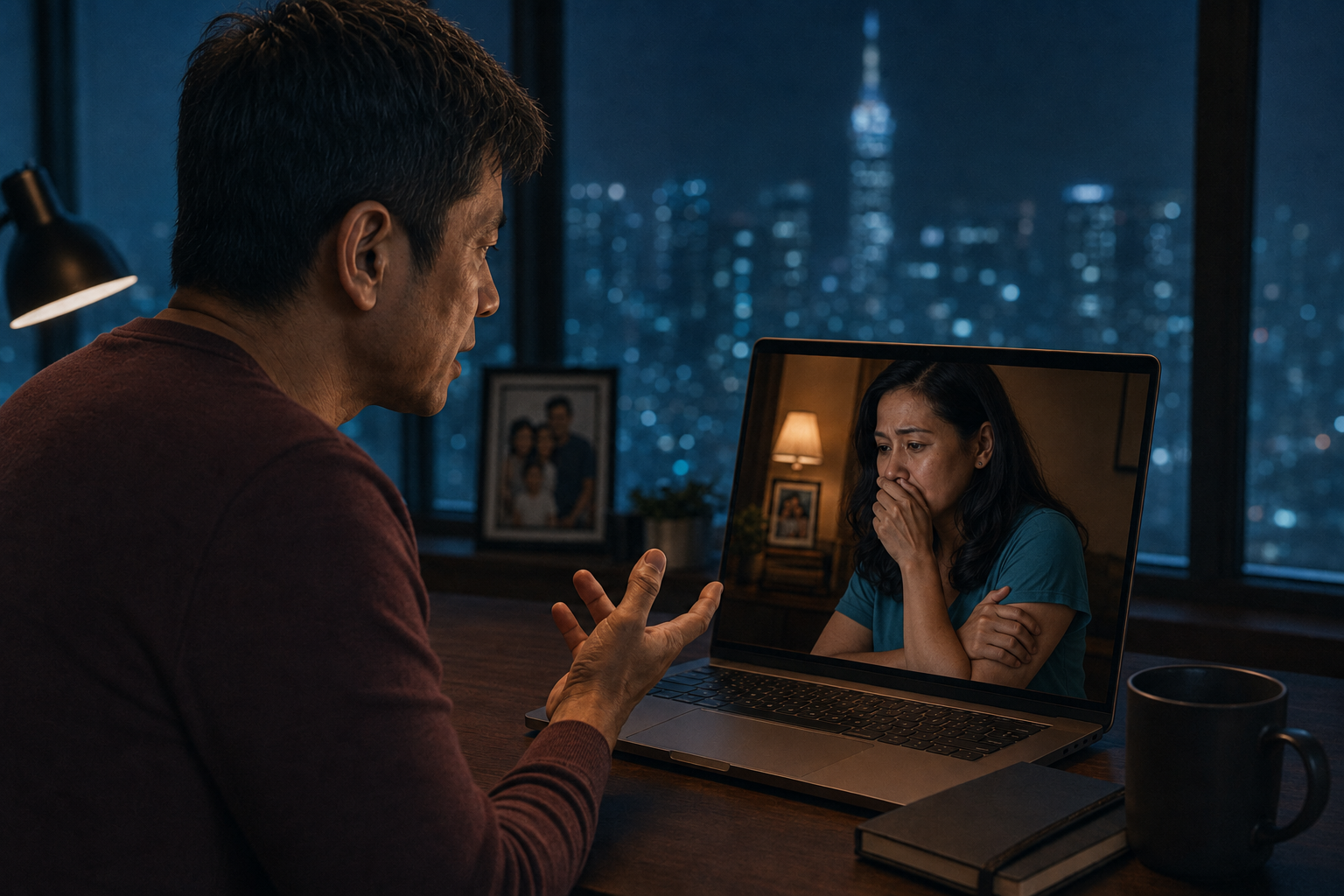
“It’s you, Kath. It has always been you.”
“Stop, Marco.”
“I should have waited. I should never have rushed into marriage with Anna. I should not have listened to my mother. I should have taken you to Cebu.”
“I said stop.”
“I stayed with Anna because there was nowhere else to go. There was no Kath waiting for me. If I ever love someone again, it can only be you. I never stopped loving you.”
Kath stood and moved away from the laptop. When she returned, she looked shaken.
“Do you know what you are doing?”
“I’m being honest.”
“No. You are disturbing my peaceful life. You did it before, and you are doing it again.”
She ended the call.
For a moment, clarity pierced my certainty. She had entered my office years ago wanting nothing more than to begin a career. I had allowed her feelings to deepen while knowing I was married and held authority over her future. Now, after she had built a family and repaired her marriage, I had returned carrying the same disruption.
Kath had not been innocent, but neither was she merely an equal reflection of me. I sent the birthday greeting, insisted on the first video call, revived the old questions, and pushed every answer toward the conclusion I wanted. Each time she said friendship, I searched for a way to make the word contain romance. Each time she asked me to stop, I treated the request as fear to overcome rather than a decision to honor.
Yet even as I recognized the harm, part of me wondered only whether I had moved too quickly. Perhaps I should have revealed my feelings gradually. Perhaps I had frightened her by forcing the issue.
Near midnight, I sent an apology. I promised that I would never call again.
Kath called.
For a long time, neither of us spoke.
“I’m sorry,” I said. “I never intended to disturb your life.”
“But you did. You disturbed my mind.”
I wanted to ask why, but I believed I already knew.
“All I wanted was to reconnect,” I said. “To talk to you again.”
“Can’t you talk to Anna?”
“I can. But I don’t merely want conversation from you. I long for your presence. I want to see you.”
She shook her head. “Why can’t you leave me alone? Forget me.”
“I tried. God knows I tried. I failed.”
“I cannot control what you feel. But expect nothing from me. We are married. We have children. What we can have is friendship.”
“Then let me call once a week.”
She sighed. “Once a week.”
“Thank you. I love you.”
“We are friends, Marco.”
“Friends can say ‘I love you.’”
“Always a loophole.”
“Say it.”
She looked into the camera. “I love you too, my friend.”
The word friend should have ended the matter. Instead, it became permission.
Over the next two weeks, our weekly call became twice a week, sometimes three times. We told each other what had happened during the eight years apart. Kath spoke about her Christian community and the worship services she attended with Jay whenever he was home. I told her that I had begun taking my writing seriously and had created a website.
We also spoke about ordinary things—the children’s classes, groceries, weather, books, films, and the inconveniences of pandemic life. Those conversations were perhaps more dangerous than the declarations. They allowed us to rehearse companionship. We began imagining not only kisses and escape but breakfast, errands, shared jokes, and growing old within reach of each other. Desire entered through nostalgia; domestic fantasy persuaded it to stay.
“I know,” she admitted. “I read your stories and poems.”
“Then you know some are about you.”
“I didn’t want to assume.”
“Whenever I need to write love, joy, longing, or pain, I think of our memories. I think of the us that never happened.”
She asked about the white rose in one of my poems.
“You,” I said. “Obviously.”
“You must have prepared that speech to make me fall in love with you again.”
“Again? Are you saying you aren’t in love now?”
“Friends, Marco. Nothing more, nothing less.”
But soon she began calling me during the day. She knew the hour of my coffee break and the days I left work early. Once, when she noticed a woman behind me in a café, jealousy sharpened her voice.
At home, Kath waited until her children had gone to their rooms before answering my calls. Sometimes one of them knocked, and her entire expression changed as she turned away from the screen and became their mother. Those brief interruptions should have restored perspective. Instead, I waited impatiently for her to return, as though her family were intruding upon time that belonged to me.
“Make sure she isn’t with you.”
“No, baby. I don’t even know her.”
“Baby?”
“May I call you that?”
“Do whatever you want.”
I treated her refusal to refuse as consent.
That night, however, she did not answer my messages. At midnight, I called.
“Are you all right?”
She shook her head. “We have to stop this.”
“Why?”
“The pastor’s sermon struck me hard tonight. I realized that I long for your presence more than I long for Jay’s. I used to talk to him almost every night. Now I would rather talk to you.”
Jay was somewhere at sea, trusting the wife who had told him years earlier about me and had chosen to rebuild their marriage. I knew that history, yet I regarded his absence as an opening. Because Kath and I shared language, humor, and emotional intimacy, I treated compatibility as a superior claim. I rarely asked what promises Jay had kept during the years when I had been absent from her life.
Her confession filled me with joy even as I watched it frighten her.
“Why are you doing this to me again?” she cried. “I had become peaceful. I could have ended our first conversation, but I stayed. I answered your calls. When it comes to you, I am so weak.”
“I love you, baby.”
She looked directly into the camera.
“I love you too, Marco. May God forgive me, but I love you.”
PART 6 – Beyond the Screen
Staying Focused
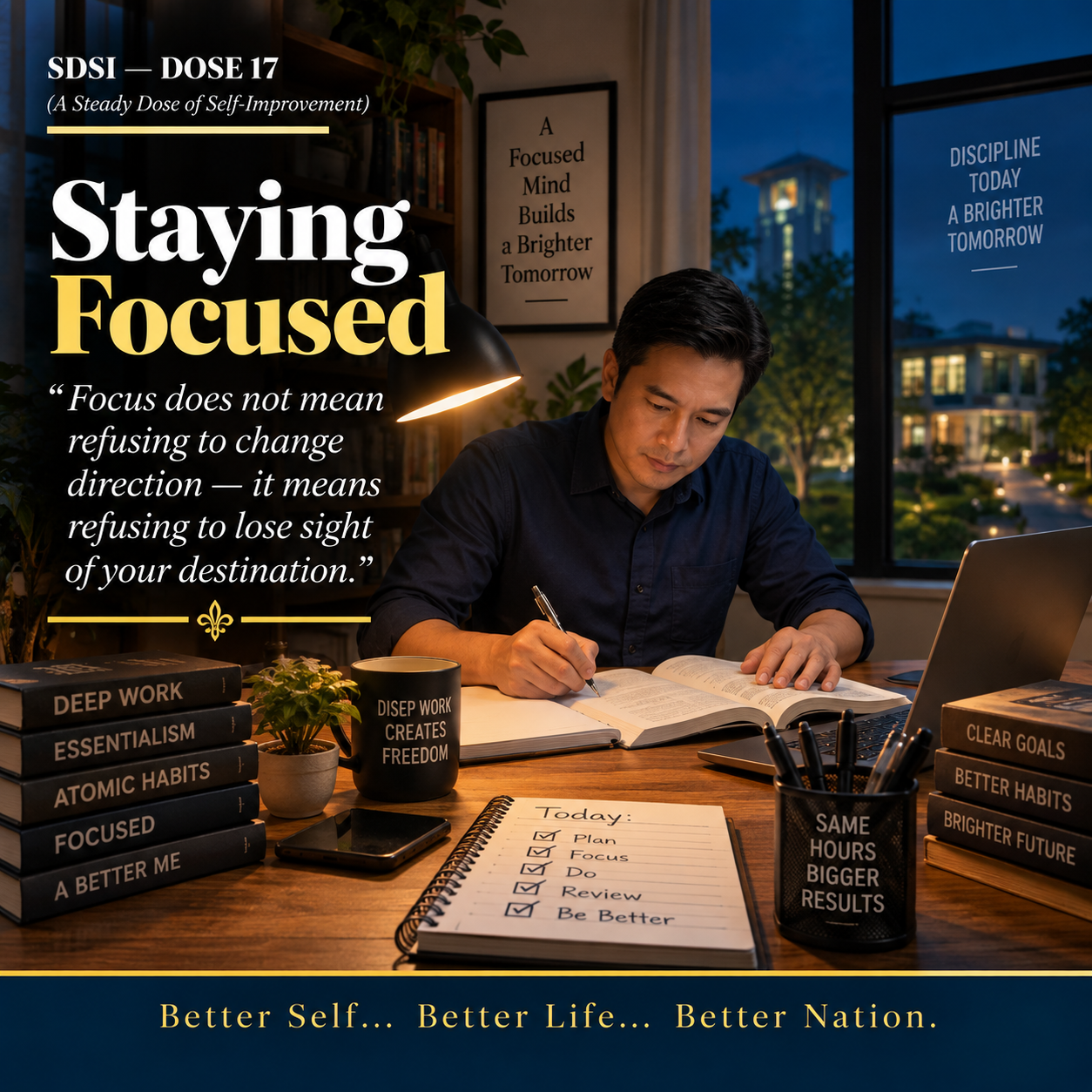
Focus does not mean refusing to change direction—it means refusing to lose sight of your destination.
During my third rejection from a Middle Eastern university, I overheard a panelist say that I could not be considered because I lacked a TESOL certificate.
I was deeply disappointed. I had a bachelor’s degree in English, a master’s degree in Education, and a PhD in Educational Management. I had also completed most of the academic requirements for a master’s degree in English but had been unable to finish the thesis. Added to these qualifications were more than twenty years of teaching experience.
Surely, I thought, all of that should compensate for one missing certificate.
But it did not. The university had a policy: applicants without TESOL certification could not be hired. Whatever the panelists may have thought of my other qualifications, their hands were bound by that requirement.
I could have treated the rejection as proof that overseas teaching was not meant for me. I could have complained that the policy failed to recognize my education and experience. Perhaps I even had legitimate reasons to question it. But neither disappointment nor argument would give me the qualification I lacked.
So I asked myself a more useful question: What can I do next?
I enrolled in a TESOL program and earned the certificate.
That decision taught me something important about staying focused. Focus is sometimes mistaken for stubbornly following one plan. But genuine focus distinguishes between the goal and the route. My goal—to teach overseas—remained unchanged. The route toward it had to be adjusted.
Eventually, I secured a university teaching position in South Korea. The earlier rejections had not ended my journey. One of them had identified a gap I needed to close.
This is why setbacks should be examined before they are accepted as verdicts. Some criticism is unfair and should not control us. But some negative feedback contains useful information. Focus allows us to separate the pain of hearing it from the value of what it may reveal.
Staying focused has become increasingly difficult in a world full of competing goals, constant notifications, and attractive alternatives. Yet distraction does not come only from technology. Even worthwhile activities can pull us away from what matters most. A person can remain extremely busy while making little progress toward the goal that matters.
Focus therefore requires deliberate choices. We must decide what deserves our attention now, protect time for it, and temporarily say no—even to good opportunities that compete with a greater priority.
You do not have to cling to your original method. You may need another qualification, a different strategy, or a longer route than you anticipated.
Change the plan when necessary—but keep your eyes on the destination.
Pause and Reflect
What goal have you nearly abandoned because your original approach did not work?
What useful information might be hidden inside a rejection or criticism you received?
One Step Forward
Choose one important goal. Write down the single obstacle presently blocking it, then identify one concrete action you can take this week to address that obstacle.
Explored more fully in Chapter 9 — “Staying Focused” of A Holistic Approach to Self-Improvement.
Better Self… Better Life… Better Nation.
The Line Between Us
(Were We Ever Meant to Be – Part 4)

Two days later, I opened Kath’s profile again. I looked through her photographs until restraint felt more dishonest than desire.
That was the explanation I gave myself: restraint was dishonesty. I did not call my silence respect for her boundary or loyalty to my wife. I called it denial. By changing the name of the act, I made surrender sound courageous.
“Hello, Kath. Busy?”
“Not really. Just reading to kill time.”
“Can I call?”
“Why? Didn’t we discuss everything two nights ago?”
“Please. Just for a few minutes.”
“Why, Marco?”
I told her the truth. “I miss you. I only want to see you again.”
The message remained marked Seen for several minutes. Then she called me.
“Thank you,” I said as her face appeared.
“Don’t thank me. You are still impossible to refuse.”
She was wearing a sleeveless shirt and shorts. When she noticed where my gaze had settled, she adjusted the camera.
“I’m looking at your face,” I protested.
“Of course you are.”
I asked whether she missed me. She tried to evade the question, then surrendered.
“Yes. I miss you too. Are you happy now?”
“Very.”
Her expression grew serious. “Let me make something clear. We are both married. We both have children. I am talking to you because we are friends and because we shared a past. Nothing more, nothing less.”
“Loud and clear.”
She told me it would be our last video call. I asked for one call a week. She refused, and I knew—or convinced myself—that she would answer the next time anyway.
When she mentioned that Jay might not return until the following year, I asked when she expected me to visit the Philippines.
“You must miss Anna,” she said.
“I miss everyone I love.”
“Including your wife?”
“Why do you always bring her into our conversation?”
“Who should I mention—Mayette?”
Her teasing turned coarse. She asked whether I missed the sex I had had with Mayette. Irritated, I blurted out that I had not slept with anyone in Korea—not once in eight years.
She laughed. “Do you expect me to believe that?”
“It’s the truth.”
“Marco, you have needs. Are you telling me that in eight years, you never once paid a woman there for one night of sex?”
“Never.”
“That’s impossible.”
“I would never pay a woman for sex.”
“And why should I believe that?”
“Because if I ever sleep with a woman, I want it to happen because we both want it—not because I paid her. There should be desire on both sides and something real between us, even if neither of us knows where it will lead.”
Kath gave a short, disbelieving laugh. “That sounds very principled for someone with your history.”
“What is that supposed to mean?”
“Where was all that concern about what a woman wanted when you kissed me in your office and then—”
She stopped, leaving the rest suspended between us.
“And afterward?” she continued. “When you went home to Anna, did you kiss her too?”
“Kath—”
“Did you hold her the way you had just held me? Did you tell her you loved her?”
“It wasn’t like that.”
“Of course not. It never is when you are the one explaining it.”
I could have reminded her that I stopped when she pulled away. I could have insisted that what happened between us had never been entirely one-sided. But neither answer would erase the truth beneath her questions: I had wanted honesty from her while living dishonestly with both women.
“Believe whatever you want.”
“And Anna? What happens when you go home?”
I told her that Anna and I had not had sex since Kenneth was born. Diabetes had diminished her desire, and intercourse had become painful for her. We did not even share a bedroom during my visits.
“I’m sorry,” Kath said quietly.
“We found an arrangement that preserves our marriage and gives both of us peace.”
The arrangement was difficult to explain. Anna and I had forgiven many things without becoming truly compatible. The distance created by my work in Korea had probably saved us from the daily disagreements that once exhausted us.
Kenneth gave us another reason to remain a family, although I rarely admitted how much of the emotional labor of raising him Anna carried while I lived abroad. I called from Korea, sent money, came home when my schedule allowed, and told myself that provision was presence. The unanswered video call earlier that evening should have reminded me of the distance between my son and me. Instead, I had spent the night trying to erase the distance between Kath and me.
“Then why stay?” Kath asked.
“What else should I have done—find another Mayette?”
“I don’t know.”
“In Korea, I finally understood who I should have married. If I ever begin another relationship, I want it with only one person. If I cannot have her, I would rather have no one.”
The declaration sounded noble in my own ears. It converted years of infidelity into evidence of constancy: I had betrayed Anna with other women, yet because none of them mattered as Kath did, I could still imagine myself faithful to one great love. I did not ask whether devotion to an idealized woman could excuse disloyalty to the real woman I had married.
Kath turned partly away. “Who is she?”
“You know.”
“Say it.”