Category Archives: 21st Century Teachers
TEACHER OR LECTURER?
A Reflection on What It Really Means to Teach
“Teaching starts with a relationship. Until then, you are just a dancing monkey standing
in front of your students performing tricks.”
~ Andrew Johnson~
I. The Question Worth Asking
Not everyone who stands in front of a classroom truly teaches.
Some deliver content. Others shape minds. The titles may be identical — Teacher, Instructor, Professor — but the intentions, mindsets, and commitments behind them often are not. And this gap, quiet as it sometimes is, makes all the difference in the world to the students sitting in those chairs.
This raises an uncomfortable yet necessary question — not to accuse, but to reflect:
Are you a teacher? Or are you merely a lecturer?
These are not the same thing. A lecturer delivers content; a teacher transforms it into learning. A lecturer measures success by how much material was covered; a teacher measures it by how much understanding was actually built. Lecturers speak to students; teachers listen to them. A lecturer is satisfied when the lesson ends on time; a teacher is troubled by what remains unclear after the bell rings.
All teachers lecture at times — that is unavoidable. But not all who lecture truly teach. The distinction lies not in the method but in the mindset: Does this person see their role as the transmission of information, or as the cultivation of human potential?
II. How Teachers Differ From One Another
Even among those who genuinely intend to teach, no two practitioners approach the profession in exactly the same way.
Like fingerprints, their mindsets, tendencies, and personal philosophies are unlikely to be identical. Given the same course syllabus, we cannot expect any two teachers to design the same lesson plans or implement the same strategies. Some approach each class with meticulous preparation; others improvise; and some — regrettably — do not plan at all.
Work attitudes vary just as widely. There are teachers acutely conscious of the hours stipulated in their contracts, unwilling to extend themselves beyond what is formally required. There are others who go far beyond — who assist students outside teaching hours, volunteer for tasks no one asked them to do, and give freely of their time and energy without expectation of compensation.
And then there are those who arrive late, leave early, and submit required paperwork only when pressed — or not at all. If you are a teacher reading this, the question is not which group others belong to, but which group you honestly belong to yourself.
No one can force a teacher into the second group. But every teacher owes it to their students — and to themselves — to stay as far as possible from the third.
There are also teachers who are perpetual fault-finders — those who can always identify what is wrong with a policy, a colleague, or an administrator, but rarely what might be improved. When they find fault, they whine about it or gossip about it, or both. This habit does not make them critical thinkers. It makes them corrosive presences in a community that depends on trust and collaboration.
III. How Teachers Treat Their Students
Perhaps no difference among teachers is more consequential than the way they treat the people in their care.
Some set standards so exacting that only the strongest students can meet them, leaving the rest behind without apology. Others calibrate their expectations thoughtfully — maintaining rigor while ensuring that even the slowest learner has a genuine pathway to success. Some believe in a one-size-fits-all approach, as though all students arrive at learning in the same way, at the same pace, with the same needs. Others recognize that students differ profoundly in learning styles, abilities, languages, and personal histories — and they differentiate their methods accordingly.
Numerous studies confirm what students have always known intuitively: among the most valued qualities in an effective teacher are the ability to build genuine relationships, and a patient, caring, and kind personality. These are not soft virtues. They are the foundation on which all learning is built.
What causes some teachers to treat students with indifference or harshness? Sometimes the answer lies in upbringing or in the treatment they themselves received as students — a sad inheritance, passed unconsciously from one generation to the next. Sometimes it is simply burnout. Exhaustion does not excuse poor teaching, but it does help explain why some teachers gradually lose the fire they once had. Compassion, it turns out, is not inexhaustible. It must be renewed.
IV. The Heart of the Matter: Passion and Compassion
At its deepest level, the difference among teachers may be reduced to two qualities — and what each teacher does or does not possess of them.
There are teachers who possess both passion and compassion.
There are teachers who have only one of the two.
There are teachers who have neither.
Passion is what drives a teacher to prepare thoroughly, to stay current in their field, to search for better methods even when existing ones are adequate. It is the restlessness of someone who genuinely believes that this lesson, this class, this student deserves their best effort.
Compassion is what keeps that passion human. It is what reminds a teacher that behind every exam score is a person — with pressures, fears, histories, and hopes that the classroom did not create and cannot simply ignore.
Without passion, teaching becomes mechanical. Without compassion, it becomes cold. Without both, it becomes something that should not be called teaching at all.
If you are a teacher reading this — and if, in honest reflection, you find yourself in the third category — it may be time to ask whether you are in the right profession. That is not an accusation. It is an invitation to reconsider, before another generation of students pays the price for a choice that was never truly theirs to make.
V. The Question of Training — and Its Limits
One of the gravest mistakes an institution can make is hiring someone with no pedagogical training to teach.
Knowledge of a subject is not the same as the ability to teach it. Being a mathematics wizard does not automatically make one a mathematics teacher. Having perfect pronunciation and impeccable grammar does not make one an English teacher. Teaching requires something beyond subject mastery — it requires the ability to make that mastery accessible, to motivate learners who do not yet share it, to design assessments that genuinely measure growth, and to adjust strategies when understanding has not yet arrived.
To be fair, there are rare individuals who compensate for the absence of formal training through humility, mentorship, and a genuine hunger to learn the craft. But these are exceptions, not the rule. And relying on exceptions as a hiring strategy is a gamble made at students’ expense.
Yet perhaps the more troubling question is not about the untrained. It is this:
Why are there teachers who were trained to teach, yet behave as though they were not?
Teachers’ conduct is shaped by the educational philosophy they develop through their training — an evolving framework built from theory, practice, experience, and the personal belief systems they carry into the classroom. That philosophy, whether articulated or not, is visible in every decision a teacher makes: how they speak to students, how they respond to failure, how they handle disagreement, how they use — or misuse — the authority their position grants them.
When teachers act or speak in ways that diminish students, ignore professional codes, or prioritize personal comfort over student welfare, they are not simply having a bad day. They are revealing what they truly believe about teaching — and about the people they were hired to serve.
Common sense, even in the absence of formal training, should be enough to remind any adult in a position of influence: words carry weight. Actions leave marks. Students remember — sometimes for a lifetime — how their teachers made them feel.
VI. A Calling, Not a Paycheck
Teaching is not a neutral act.
Every teacher who enters a classroom makes a choice — consciously or not — about what kind of presence they will be. They can be a source of clarity or confusion, of encouragement or discouragement, of possibility or limitation. They can be the reason a student discovers a love of learning, or the reason that love dies quietly before it ever had a chance to grow.
The difference between a teacher and a lecturer is not merely technical. It is ethical. It is a question of whether one has accepted not just the job title, but the responsibility that comes with it — the responsibility to know your students, to adjust your methods, to take ownership of whether learning is actually happening, and to care about the answer.
A lecturer fills the time. A teacher uses it. A lecturer covers the syllabus. A teacher uncovers the student.
Not every teacher will be extraordinary. Not every lesson will ignite a passion. But every teacher can choose, on any given day, to be present — truly present — for the people who have been entrusted to their care.
That choice is available every single morning. It costs nothing except the willingness to make it.
That is — if they care.
If teaching is still a calling, and not merely a paycheck.
★ ★ ★
— M.A.D. Ligaya, PhD
Can Anyone Teach? (The Extra Mile Teachers Walk)
Search any site on the internet for the highest-paid professions in the world and you will not find “teachers” in the top 30. Expand your search and look for the list of professions in different countries where the practitioners receive the best compensation packages and you will find out that teaching is not among them. You will not find a country where teachers are ranked among the highest money earners.
Teaching not classified among the highest paying jobs, of course, is not surprising. That has been the case since time immemorial and it is most likely not to change anytime soon. One possible reason teaching as a profession is not getting the recognition it should get is because of the pervading notion that “anyone can teach.” You cannot say the same for law and medicine… not just anyone can practice those professions. But how true is it that just anyone can be a teacher?
But even if teachers do not get the recognition and sufficient remuneration they deserve, they wholeheartedly perform the role they have embraced. Indifference and poor salary are included among the thorny steps in the extra mile that teachers need to walk when they have accepted that teaching is not merely a profession but a vocation. It is not merely a job to perform but an obligation to carry out.
Acknowledging that teaching is not merely a job but a duty to fulfill is what makes teachers go the extra mile, to do what is more than required in the performance of their tasks, including sacrificing personal resources and sometimes even happiness. Teachers understand and fully grasp the nature of the responsibility that they agreed to fulfill when they signed up for the job. They know it’s not easy. How in the world would one consider it easy to be responsible for the education of other people, especially the young ones? When did it become easy to facilitate the acquisition of knowledge and values and the development of skills of your fellow human beings?
Teachers would be one of the highest-paid professionals if only pay would be commensurate to how significant is one’s job in the enlightenment of the soul, the preservation and enhancement of the fabric of society, and the socio-economic development of a nation. Teaching would certainly be at top of the list of the highest-paid professions in the world.
But it is what it is. Teaching is not a profitable profession. If it is material wealth one would like to accumulate, teaching is not the profession to have. The realities confronting the teachers in the academe could really make them say a lot of things in the “present unreal conditional” form. There are times that they couldn’t also help but make a “wish statement” like “I wish that I were a health care professional.”
And why?
Healthcare professionals like physicians, surgeons, and dentists, consistently round out the top 10 in the lists of highest-paid professionals.
What they (the medical practitioners and their fellow health workers) do, maintenance and restoration of good health are very important. For that, they deserve the pay they get, most especially during the time that the coronavirus pandemic was raging. But nurturing the human spirit…helping a person achieve holistic development is as equally important, if not more important. What professional endeavor could be more meaningful than helping your fellow men achieve their full potential for them to become responsible human beings and productive members of society?
And not only are the teachers not getting the pay commensurate to the importance of the work they do and the effort they need to exert when doing their job, but they also don’t get the recognition they deserve.
A study concluded that American society does not generally view teachers in the same way, as they view other professionals; the belief that “anyone can teach” is not found in other professions. For example, not just anyone can play professional baseball, be an accountant or engineer, or practice law or medicine.
Such is the indifference teachers, as professionals are getting.
But how true is the contention that “anyone can teach?” Those who know what it takes to become a teacher would say that it is a fallacy. That “anyone can teach” is an erroneous assumption.
Education is not just a matter of whether you can teach or not but also whether or not you can make the students learn. Even if a person is an expert in a particular field, it is not a guarantee that they can teach what they know. Knowing something is different from knowing how to teach it.
Hiring just anyone to become a teacher is doing a disservice to the teaching profession. Hiring somebody to teach a language just because they could speak that language is a mistake. Not because somebody is good at math that they should be allowed to teach math. It takes a lot to become a teacher. Teachers undergo rigid training for them to hone their pedagogical skills. They read a lot knowing that teaching and learning are both grounded in Philosophy, Psychology, Sociology, and other related fields. They understand that they need to be familiar not only with their field of expertise or chosen subject area but with different principles and strategies to effectively deliver learning and teaching. They know that when they are done teaching in the classroom, their work is not done yet. There are other things to be done – checking graded activities and preparing a new lesson plan. The preparation of a lesson plan, in itself, is a tedious process.
The list of the things that teachers need to know and do is long. At the end of that long list are two characteristics that teachers need to develop if they wish to succeed in the profession. Those are PASSION for their work and COMPASSION for their students.
With all the aforementioned, what would anybody assume that just “anyone can teach?”
Be that as it may, teaching will forever be a NOBLE PROFESSION! Nothing can diminish its intrinsic value.
One thing is for sure, all successful professionals in the world – business executives, lawyers, architects, engineers, surgeons, physicians, dentists, nurses, brokers, and what-have-you – know that their teachers, who did not mind walking the extra mile contributed a thing or two or more into whatever they have become.
The Extra Mile Teachers Walk

Search any site on the Internet for the highest paid professions in the world and you will not find “teachers” in the top 30. Expand your search and look for the list of professions in different countries where the practitioners receive the best compensation packages and you will find out that teaching is not among them. You will not find a country where teachers are ranked among the highest money-earners.
Teaching not classified among the highest paying jobs, of course, is not surprising. That has been the case since time immemorial and it is not expected to change anytime soon. However, insufficient remuneration does not deter teachers from performing the role they have embraced. Such is only one of the steps in the extra mile that teachers need to walk when they have accepted that teaching is not merely a profession but a vocation. It is not merely a job to perform but an obligation to carry out.
Acknowledging that teaching is not merely a job but an obligation to carry out is what makes teachers go the extra mile, to do what is more than required in the performance of their tasks, including sacrificing personal resources…sometimes happiness. Teachers know the nature of the responsibility that they agreed to fulfill when they signed up for the job. They know it’s not easy. How in the world would one consider being responsible for the education of other people, especially the young ones, easy? When did it become easy to facilitate the acquisition of knowledge and values and the development of skills of your fellow human beings?
If only pay would be commensurate to how significant is one’s job in the enlightenment of the soul, the preservation and enhancement of the fabric of society, and the socio-economic development of a nation then teachers would get paid handsomely.
But it is what it is. Teaching is not a profitable profession. Realities teachers confront in the academe could really make them say a lot of things in the “present unreal conditional” form. There are times that they couldn’t also help but make a “wish-statement” like “I wish that I were a health care professional.”
Why?
Health care professionals (physicians, surgeons, anesthesiologists, dentists, etc.) consistently round out the top 10 in the lists of highest-paid professionals.
What they (the medical practitioners and their fellow health workers) do, maintenance and restoration of good health is very important. For that, they deserve the pay they get, most especially during this time that the coronavirus pandemic is still raging. But nurturing the human spirit…helping a person achieve holistic development is as equally important, if not more important. What professional endeavor could be more meaningful than helping your fellow men achieve their full potential for them to become responsible human beings and productive members of society?
And not only are the teachers not getting the pay commensurate to the importance of the work they do and the effort they need to exert when doing their job, but they don’t also get the recognition they deserve.
American society, for example, does not generally view teachers in the same way, as they view other professionals; the belief that “anyone can teach” is not found in other professions (i.e., not just anyone can play professional baseball, or be an accountant or engineer, or practice law or medicine.)1
Such is the indifference teachers, as professionals, are getting.
How true is the contention that “anyone can teach?” Those who know what it takes to become a teacher would say it is a fallacy.
Education is not just a matter of whether you can teach or not but also whether or not you can make the students learn. Even if a person is an expert in a field of learning it is not a guarantee that he can teach what he knows. Knowing something is different from knowing how to teach it.
Hiring just anyone to become a teacher would be a huge mistake. Hiring somebody to teach a language just because he or she could speak that language is a huge mistake. It takes a lot to become a teacher. Teachers undergo rigid training for them to hone their pedagogical skills. They read a lot knowing that teaching and learning are both grounded on Philosophy, Psychology, Sociology and other related fields. They know they need to be familiar not only in their field of expertise but with different principles and strategies to effectively deliver learning and teaching. They know that when they are done teaching they still have to evaluate the learning.
The list of the things that teachers need to know and to do is long. At the end of that long list are two characteristics that teachers need to develop if they wish to succeed in the profession – PASSION for their work and COMPASSION for the students.
How then in the world it becomes possible that just “anyone can teach?”
Be that as it may, teaching will forever be a NOBLE PROFESSION! Nothing can diminish its intrinsic value.
One thing is for sure, all successful professionals in the world – business executives, lawyers, architects, engineers, surgeons, physicians, dentists, nurses, brokers, etc. – know that their teachers contributed a thing or two into whatever they have become.
———-
1 Tichenor M.S., Tichenor, J.M. (2005). Understanding teachers’ perspectives on professionalism. ERIC.
Technology and the 21st Century Teacher
The central argument upon which I anchored my previous research work entitled “Factors Affecting The Use of Computers for Classroom Instruction in South Korean Universities”1 is “information technology has significantly altered the landscape of teaching and learning.” Indeed, it drastically changed the ways teachers taught and students learn thus school administrators and teachers need to respond accordingly and effectively.
At the turn of the 21st century education leaders have been reconfiguring educational paradigms that became almost obsolete because of the rapid changes in technology. Nowadays, emerging models of educational frameworks have included technology in both the expected outcomes and support mechanisms of the new paradigms.
The P21, a national non-profit organization that advocates for 21st century readiness for every student, developed the “Framework for 21st Century Learning” (F21CL) to define and illustrate the skills, knowledge students need to succeed in work, life and citizenship.2 The two parts of the framework (see figure below) are student outcomes (as represented by the arches of rainbow) and the support system (as represented by the pools at the bottom. One of the 4 clusters of student outcomes, is “Information, Media, and Technology Skills.” The article explains that to be effective in the 21st century, citizens and worker must be able to create, evaluate and effectively utilize information, media and technology.
And to be effective 21st century teachers, it has become A MUST that the teachers themselves should have those skills just mentioned. We cannot have “the blind leading the blind” scenario.
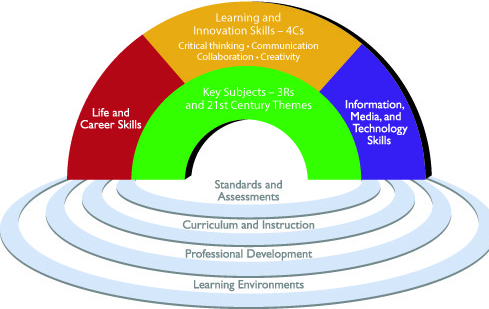
The 21st Century Student Outcomes and Support Systems
Schools need to respond by making the needed investment. They have to upgrade their existing facilities and purchase the necessary equipment in order to cope up with the demands of the new educational paradigms they have drawn up in order to keep abreast with the demands of the 21st century.
Not only in terms of equipment and facilities that the schools should focus on. They need to pay attention also to their manpower – particularly the teachers who plays the key role to ensure that success of the endeavor.
I made an assertion (in the previous work aforementioned) that integration of technology in instruction and assessment is inevitable and the teachers, being at the center of the delivery of learning need to accept it. The F21CL clearly defines the responsibilities of teachers (Standards and Assessment, Curriculum and Instruction, Professional Development and Leaning Environment.) Much of the responsibilities will be shouldered by the teachers. The said framework even specified clearly what is the role of teachers in the attainment of cluster 4 of students outcome – that is to “Enable innovative learning methods that integrate the use of supportive technologies, inquiry-and-problem-based approaches and higher order thinking skills.
But the application of technology in instruction is a contentious area that caused (or is causing) a lot of arguments and controversies in the academe. Despite the immense benefits that technology brings to education, some teachers are still either unwilling or hesitant to embrace the application of technology to the teaching-learning process.
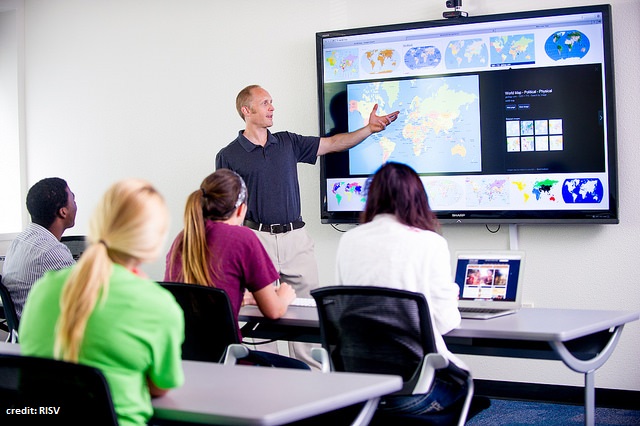
I specifically identified also (in that same work) the pedagogical benefits that computers and internet provide. For example, the internet has become the teachers and students’ virtual library. Projectors and media players make the interaction between the students and their mentors more efficient. For the teachers in particular, the educational and organizational softwares and web browsers give them more resources and enable them to create better presentations.
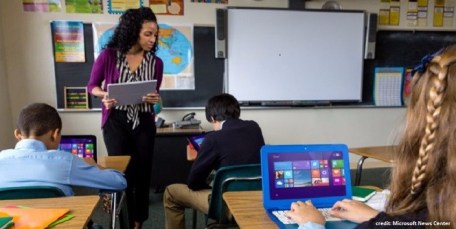
But apparently, not all teachers are convinced. They do not believe that computers benefit teaching and learning. They are the ones who do not use presentation softwares preferring to either just dictate or write on the board everything they wish to convey to their students. They are ones who refuse to use available course softwares opting to just open the prescribed textbook and read from it while teaching.
But why?
There are two possible reasons.
First – these teachers were exposed to educational philosophies different from those of the ones to whom embracing technology is a welcome development . This could be the reason they have different attitudes and views about the value of computers in teaching and learning. Their educational beliefs just don’t jibe with using computers in the classrooms.
Second and last – they simply (heaven forbid) do not know how to use any office software suites (word processing, spreadsheet, database and presentations applications) and specific educational software provided for them. They have difficulty navigating around any computer-generated environment. They are so helplessly not computer-literate that no amount of tutoring would help them learn.
Presumably, the reason they could not use the prescribed course software packages (that make things easier for them and their students) is that they don’t have the ability to do so. Even if assuming a course software, at a particular time, suddenly doesn’t work, its contents can be copied and pasted to any presentation software. But that again could be another problem… they probably don’t know how to create presentations.
Worst, they could simply be just aversive to technology.
Or maybe, they are simply lazy. They are computer literate but are not willing to try new systems being introduced.
The question that begs for answer is, “How can a teacher without the required 21st century skills teach such things to students?”
Professional competence for teachers is continuously evolving as technology keeps creeping into the foundations of education. Alongside pedagogical skills, another skill through which competence of 21st century teachers should be gauged is how extensive and effective do they apply technology (computer) to teaching and learning.
Perhaps it’s about time that computer literacy be strictly considered when hiring teachers.
On the part of school administrators and owners, they have a responsibility of ensuring that when they introduce a new computer application of learning the teachers are given enough time and sufficient training to become familiar with it.
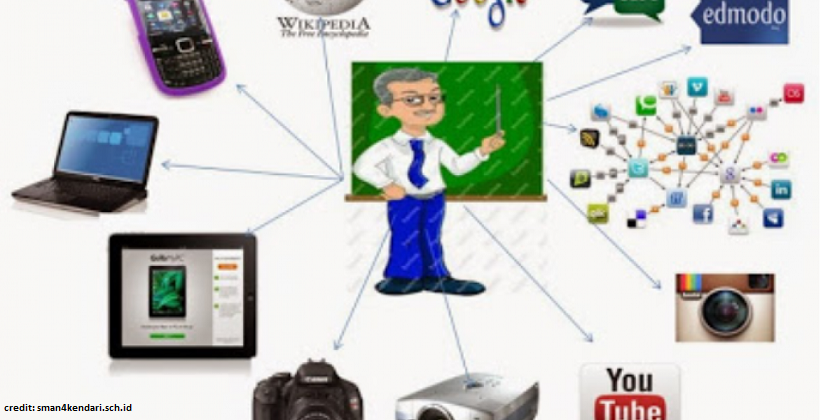
The following is one of the recommendations I made in a previous study I have been referring to.
“It should be noted also that among noted also that among the variables that are significant statistically teachers’ perception on the value of computers has the positive influence on their extent of use of computers for instruction in Korean classrooms. Thus, it is important for school administrators to keep that perception positive. The study also found out that a key factor in this positive perception is the teachers’ level of preparedness in using computers to facilitate learning. Being proficient in using computers is different from being familiar in using a new computer application for learning. Even the most proficient among computer users need time to learn an application introduced to them for the first time. Teachers tend to perceive the value of computers for classroom instruction negatively if they were not given enough time to acclimatize themselves with a new system being introduced.”
According to Edwin Creely3, “I was challenged by the ideas from Don Idle that we are textured for technology and that technology has always been and will ever be part of the deepest learning that we do. Learning to move technology and the digital technology of the 21st century into the heart of the learning process is an ongoing challenge for educators. So, the practice of being a literacy educator in the 21st Century must be, has to be, inclusive of digital literacies, including, most importantly, the use of social media.”
As Janelle Cox puts it, “A modern teacher is willing to try new things, from new educational apps to teaching skills and electronic devices. Being innovative means not only trying new things, but questioning your students, making real-world connections and cultivating a creative mindset. It’s getting your students to take risks and having students learn to collaborate.”4
References:
Factors Affecting the Use of Computer Technology for Instruction in South Korean Universities
http://www.p21.org/our-work/p21-framework
(E.Creely)(https://www.researchgate.net/post/What_are_the_qualities_required_of_ teachers_to_teach_21 st_century_learners.
(J.Cox)http://www.teachhub.com/15-professional-development-skills-modern-teachers



 M.A.D. L I G A Y A