Author Archives: M.A.D. LIGAYA
The Truth About Then
(Were We Ever Meant to Be – Part 3)
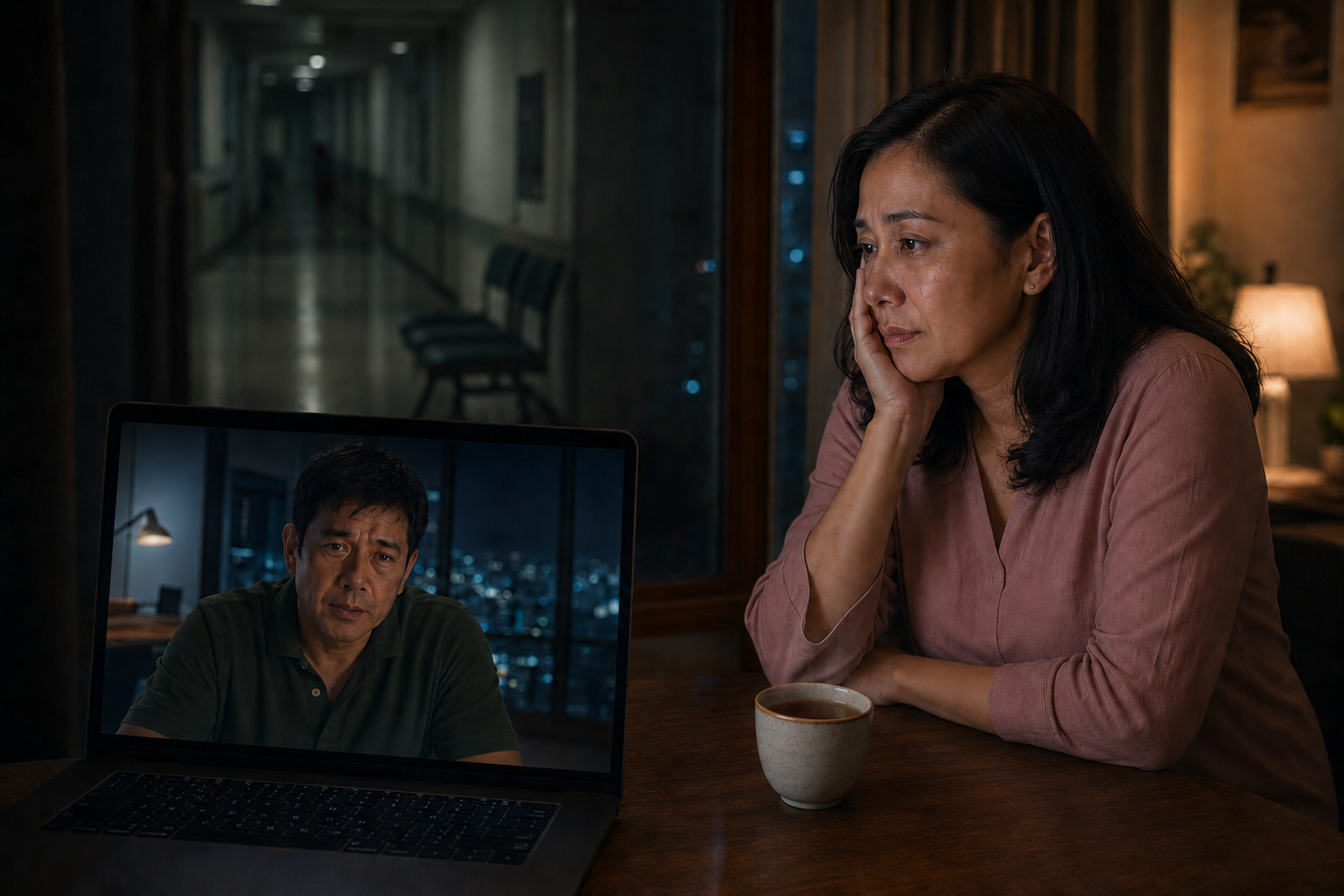
I knew that question would come.
The agency where we had worked was large enough for secrets to travel slowly but small enough for them to arrive eventually. My uncle, a former soldier, owned it with a Korean friend he had known since the war. The business recruited Filipino workers for factories in Korea, which was why my family later had somewhere convenient to send me. Officially, I was transferred to supervise our workers abroad. Unofficially, I was being placed beyond Mayette’s reach—and beyond the daily consequences of what I had done to Anna.
“Why are you frowning?” Kath asked. “Are you angry?”
“No.”
“Then answer me. Do you know Mayette?”
I nodded. There was no point denying it. Kath had made friends at the agency; sooner or later, someone would have told her everything.
“Do I still have to explain?”
“No. I know the details—from the moment Anna found you at Mayette’s apartment to the day your mother and uncle practically exiled you to Korea. I only wanted to hear you admit it.”
I nodded again.
“The last time we met,” I said, “when you were having problems with Jay, I had intended to tell you about Mayette. I was also going to tell you I was leaving for Korea.”
“Your problem, Marco, is that you could never keep that thing under control. Did every intern who worked for you become—”
“Fine. I was a terrible person.”
The irritation in my voice silenced her. For a while neither of us spoke.
“Do you have a girlfriend there?” she finally asked. “How many Korean women have you been with?”
“You wouldn’t believe me if I said none.”
“I hope there’s no one. I hope Mayette ended all that.”
“It was your fault,” I said.
She stared at me. “What was my fault?”
“You left me.”
Even as I said it, I knew how unfair it was. Kath had not abandoned a relationship I had clearly offered her. I had given her secrecy, stolen affection, and complaints about my wife. I had wanted her loyalty while refusing to name what I intended to give in return. Still, the wounded part of me had transformed her transfer and resignation into betrayal. That story allowed me to regard everything I did afterward as pain rather than choice.
Her laughter was sharp with anger. “That’s ridiculous. Did I ask to be transferred? And what exactly was I to you? The person who listened whenever Anna disappointed you? The woman you kissed whenever you needed someone to kiss? Tell me, Marco—what place did I actually have in your life?”
She reminded me of the day I had promised to meet her so we could visit my mother in the hospital. I never arrived. Kath went anyway and felt like a fool.
“I never meant to stand you up,” I said. “When I told Anna I was visiting my mother, she insisted on coming. I delayed our departure, hoping you would finish your visit before we arrived. My mother later told me that you and Anna almost crossed paths.”
“You never explained. One call or message would have been enough.”
“I know.”
“And why was I transferred? Did Anna discover us?”
I drew a breath. “My mother requested the transfer.”
Kath looked stunned. “But your mother liked me.”
“She did. That was why she wanted to protect you. She knew about us—and she knew what I was planning.”
For the first time, I told Kath the truth. I had intended to leave Anna. On the day I failed to meet Kath, I had planned to ask her to fly with me to Cebu and stay there while I arranged the separation. My mother had warned me not to destroy a young woman’s future because of my unhappiness.
My mother had seen what I refused to see. I was newly married, emotionally volatile, and already searching for someone to become everything Anna was not. Kath was intelligent, attentive, affectionate, and easy to talk to. I called those qualities proof that she was my destined partner. My mother feared that I was turning Kath into an answer before I had honestly confronted the questions inside my marriage.
Tears gathered in Kath’s eyes. “Why didn’t you tell me?”
“Because I thought you rejected me.”
The evening after the missed meeting, we had worked late. When Kath brought me coffee, I pulled her into my arms. I kissed and touched her with an urgency I had never shown before. I wanted us to go all the way—not only because I desired her, but because I believed that once we crossed that line, it would be easier to persuade her to leave with me.
“And you thought I would agree?” she asked.
“I felt you pull back. I stopped. But because you had never said you loved me, I decided you were uncertain about us.”
“I was frightened,” she said. “You were married, I had Jay, and I did not know whether you wanted a life with me or only wanted my body that night. You expected me to risk everything on a plan you had never even told me existed.”
There was no defense against that. I had wanted her to prove her love before I proved the seriousness of mine.
“I loved you,” she said after a long silence. “But I could not fight for that love because of Anna. What we were doing was wrong. Every time we kissed, I felt guilty. And you never told me you were serious. I thought you only wanted to make me your…”
She did not finish the sentence.
The call suddenly disconnected. I tried several times to reach her, but she neither answered nor rejected me. Finally, I sent a good-night message.
She called back.
“Are you tired of talking to me?” she asked.
“No. I’m only sad about how things turned out.”
We looked at one another through our screens.
“How long had you and Anna been married when I became your intern?”
“Two months,” I said. “You arrived two months too late.”
“Another perfect line from Marco.”
It was playful, but it was also true. Anna and I had married after knowing each other for barely six months. Both of us had recently emerged from failed relationships. We had mistaken urgency for certainty.
My former girlfriend had wanted me to follow her to the United States, and I had refused. Anna had left a boyfriend she considered lazy and unambitious. We met at the agency, where my uncle—her godfather—had given her work. Two people nursing rejection found comfort in one another and called the speed of their attachment certainty. By the time Kath arrived, the marriage certificate was only two months old, but the differences between Anna and me had already begun to surface.
“Such a waste,” I said.
“It’s simple, Marco. We were not meant to be.”
I told her that when I finally accepted Anna as she was, I began to see her good qualities. We remained incompatible in many ways, but our marriage became more peaceful. I also admitted that after losing Kath, I had used affairs to punish Anna whenever we fought. Mayette had not been the only one.
Anna had forgiven behavior that I would have struggled to forgive in her. That truth complicated every complaint I made about our marriage. She could be temperamental, and our disagreements could be exhausting, but she had remained when she had every reason to leave. Whenever I presented myself as trapped, I omitted the ways she had absorbed the consequences of my choices.
“I’m not proud of what I did.”
“At least you didn’t leave Anna for Mayette.”
“Mayette was not Katherine. It was that simple.”
Kath rolled her eyes, but she smiled.
By the time we ended the call, it was three in the morning.
“Good night, Marco.”
“Good night, Kath.”
Before sleeping, I sent one last message: Love you, my friend.
Her reply came quickly. Friend? Have I been friend-zoned?
When I asked what she meant, she called it a joke and ordered me to delete our conversation.
I began erasing the messages. When I reached the line in which she said we were not meant to be, I stopped.
Were we really not meant to be?
PART 4– THE LINE BETWEEN US
Efficient Time Management
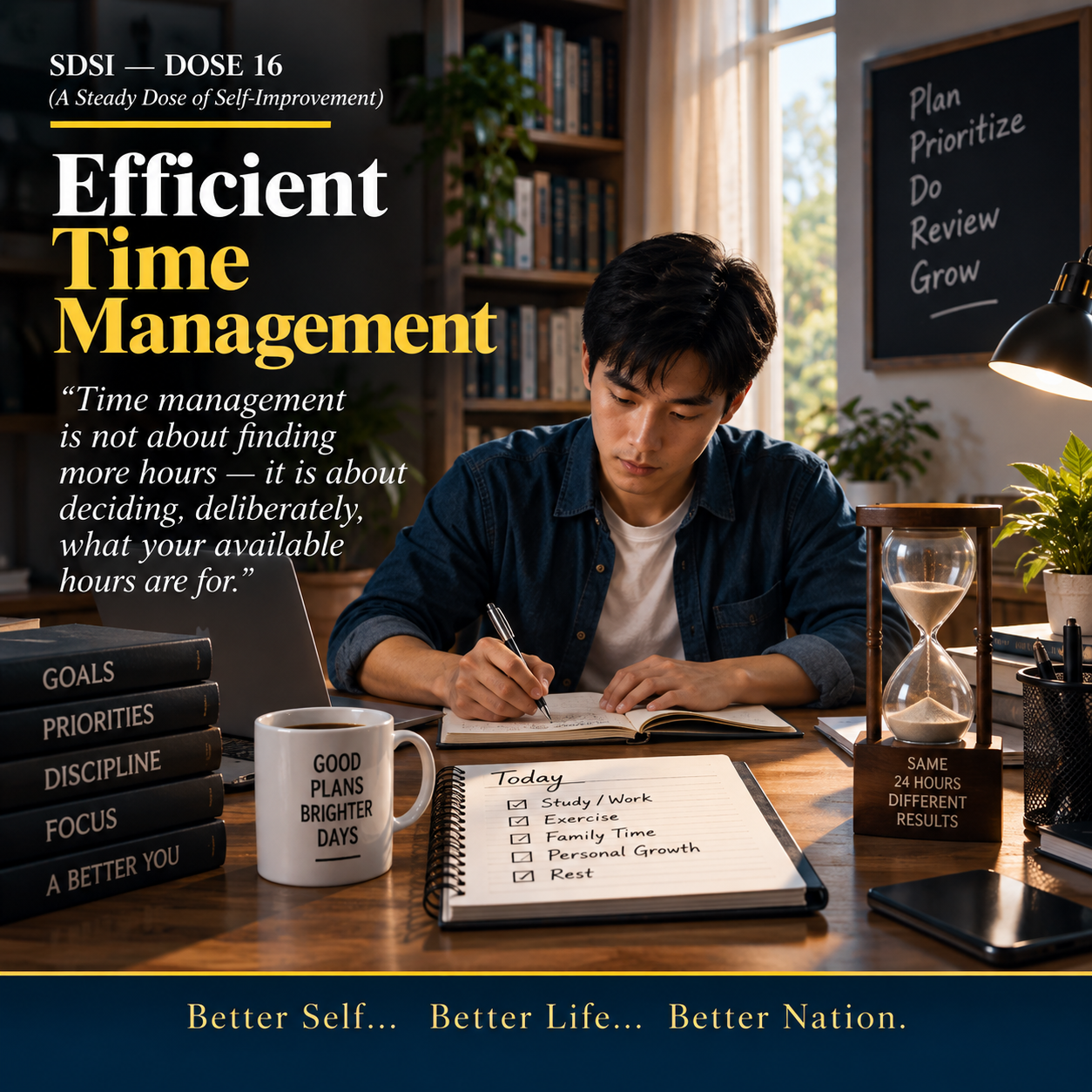
Time management is not about finding more hours—it is about deciding,
deliberately, what your available hours are for.

“If I had some extra time, I could make some extra money.” Jim Rohn’s answer: Forget it. There is no extra time.
Every person receives the same number of chronological hours: 24 each day and 168 each week. However, not everyone has equal freedom over those hours. Work demands, caregiving responsibilities, health conditions, financial circumstances, and long commutes can consume much of a person’s time before any personal choice is made.
Efficient time management does not deny those realities. It asks a more practical question: Within the time I can influence, am I using it for what matters most?
Jim Rohn once recalled a man telling him, “If I had some extra time, I could make some extra money.” Rohn replied that there was no extra time. When midnight arrives, the day is over. Whatever we hope to accomplish must be attempted within the time already available to us.
Laura Vanderkam’s 168-hour framework makes this easier to see. A person who works 40 hours a week and sleeps eight hours each night uses 96 hours, leaving 72. Those remaining hours are not automatically “free”—meals, commuting, household tasks, caregiving, exercise, and rest must come from them. Still, looking at an entire week often reveals possibilities that are hard to notice when we focus on one crowded day at a time.
Benjamin Franklin designed his daily schedule around purposeful blocks of activity. At the beginning of the day, he asked, “What good shall I do this day?” At night, he reflected, “What good have I done today?” His schedule was not merely about filling every hour with work. It connected time use with intention.
Franklin also admitted that maintaining perfect order was difficult. That matters because efficient time management does not mean rigidly controlling every minute. A schedule must guide us without becoming a prison.
Researchers Brad Aeon and colleagues describe time management through three related practices: structuring, protecting, and adapting time. We structure time by creating routines and assigning activities to appropriate periods. We protect it by setting boundaries and declining demands that interfere with important priorities. We adapt it when circumstances change and our original plans are no longer realistic.
Before improving how you use time, however, you must first discover how you are using it now. Memory is unreliable; a written record is much harder to argue with.
A time audit may reveal obvious waste, but it may also reveal something kinder: perhaps you are not lazy or undisciplined at all—perhaps you are carrying more responsibilities than you realized. Either discovery is useful because effective time management begins with truth, not guilt.
You cannot create extra time. But you can become more deliberate with the time that is genuinely yours to direct.
Pause and Reflect
If you recorded every hour for three days, what do you think you would discover about where your time actually goes?
Which activity deserves more of your available time—and which one deserves less?
One Step Forward
For the next three days, record how you use each hour. Mark every entry as essential, useful, restorative, or wasteful. At the end, identify one hour you can use more deliberately.
Explored more fully in Chapter 8 — “Efficient Time Management” of A Holistic Approach to Self-Improvement.
Better Self… Better Life… Better Nation.
What We Left Unsaid
(Were We Ever Meant to Be – Part 2)

“Do you really need to ask me that?”
“You can refuse to answer.”
“Why are you asking?”
Why was I? What difference would the answer make now? What if she admitted that she had loved me—or that she still did?
“Because there are things we never clarified,” I said. “Every time we met after you resigned, we avoided them. Maybe we were afraid. Maybe we knew nothing good could come from talking about them.”
She lowered her eyes.
“Perhaps I was wrong,” I added. “Perhaps I only imagined that something important had happened between us.”
“What was your question again?”
“Did you really love me?”
“Of course I do—I mean, I did. Did.”
I could not suppress a smile.
“What are you grinning at?”
“So it’s did, not do.”
“You heard me.”
“Meaning you don’t love me anymore?”
“You are unbelievable, Marco. Some questions are better left unanswered.”
I let the silence answer for her.
“I’m happy when I see photographs of you and Anna,” she said. “You look happy together.”
“So you check my Facebook page.”
“Don’t you check mine?”
I admitted that I did. Then I asked what she had wanted to ask me.
“You already know,” she said. “But I want an honest answer.”
“Which question—did I love you then, or do I still love you now?”
She smiled. “Both.”
“Do you really need to ask me that?”
She laughed at hearing her own words returned to her.
“I loved you then, Kath.”
“And now?”
“Some questions are better left unanswered.”
“I can read between the lines, Marco.”
“So can I.”
When she left briefly to use the bathroom, memories crowded into the silence. We had once spent nearly every working day together. At first, while she was my intern, we had been strictly professional. Then our conversations became personal. I told her about my difficulties with Anna; she told me about Jay, who was then still courting her.
One night, while we were working overtime, I held her hand and kissed her. The kiss lasted longer than either of us could excuse. After that, affection became part of our secret routine. Sometimes a kiss welcomed one of us into the office. Sometimes I whispered that I missed her or loved her. At night, behind a closed door, we kissed until restraint was the only thing keeping us from going further.
Kath never allowed us to cross that final boundary. She never once said she loved me. And because Anna worked in the next office, we made certain no colleague noticed anything unusual.
Kath returned to the call and settled on a sofa. She wore shorts and a thin shirt, and when she reclined I had to remind myself not to stare.
The years had altered her less than I expected. There were faint lines around her eyes now, but they made her beauty feel lived in rather than diminished. She had become a mother, a wife, and a woman who spoke with greater certainty than the young intern I remembered. Yet when she smiled at something foolish I said, I could still see the twenty-something woman who used to enter my office carrying two cups of coffee and pretend not to notice that I had been waiting for her.
The memory pleased me, but it also carried a fact I preferred not to examine: back then I had been her supervisor. My recommendation had helped determine whether she would be hired. I had told myself that her affection was freely given—and perhaps it was—but I had never asked what my authority might have meant to a young woman beginning her career. It was easier to remember the kisses than the imbalance surrounding them.
“Careful, Marco. Your eyes might fall out.”
“You’ve attracted me for a long time.”
“There goes the charmer again.”
“You’re still very attractive.”
“I know.”
We laughed, but the ease did not last.
“I have another question,” she said. “Do you know someone named Mayette?”
PART 3 – THE TRUTH ABOUT THEM
Competence Framework: Skills and Abilities
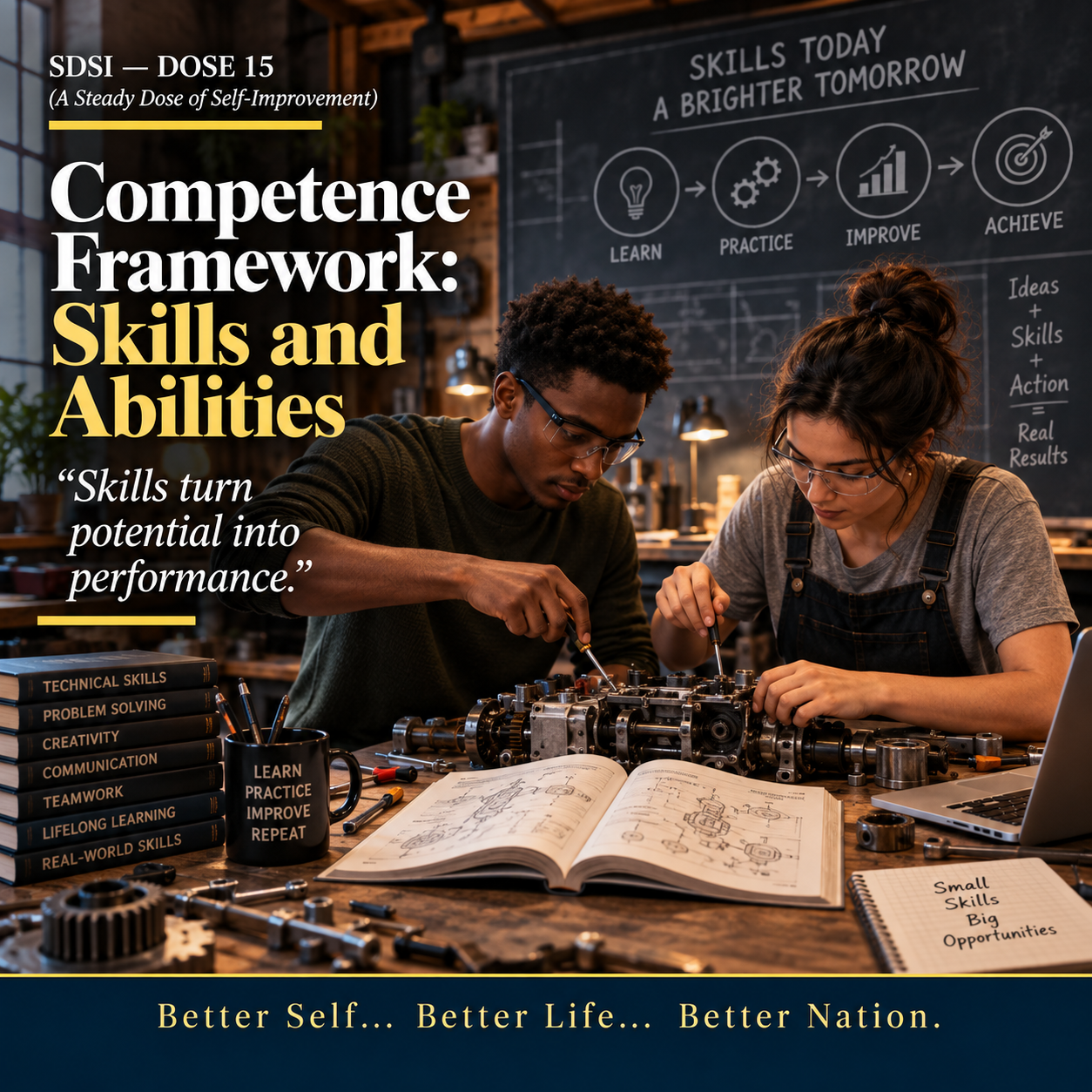
Belief alone is not enough — without the skills to act on it, powerful
convictions produce nothing but inspired inaction.

Your value system is the engine. Your competence framework is the transmission.
In the previous section, we explored the attitudes and beliefs that form the foundation of any meaningful self-improvement journey. Together, they form a value system strong enough to carry you through whatever challenges lie ahead. But a solid foundation alone is not enough. What you build on top of it matters just as much.
Think of it this way: your value system is the engine. Your competence framework is the transmission. Without the engine, there is no power. But without the transmission, that power never reaches the wheels. You need both, working together, to move.
Seven skills consistently appear in the profiles of those who succeed, and their absence consistently explains why others fall short: efficient time management, staying focused, thinking first, purposeful decision-making, effective communication, creating work-life balance, and — the capstone of them all — conquering self-doubt. You can manage your time flawlessly and communicate brilliantly, but if self-doubt runs unchecked, none of those other skills will ever reach their full potential.
I did not arrive in South Korea fully formed as a high performer. The move itself was an act of faith, and what followed required deliberate development of each of these seven skills. I had to manage my time more carefully than ever before, balancing teaching, advising, research, and writing. I had to stay focused on long-term goals even when the novelty of a new country made distraction effortless. I had to think carefully before speaking in a professional culture different from my own.
I had to communicate across language and cultural barriers with students, colleagues, and administrators. I had to protect my personal time and my connection with family back home, so I could sustain performance over years rather than burn out in months. And I had to conquer the recurring self-doubt that whispered: Who do you think you are, writing books, presenting research, building something new? None of these skills came naturally. They were built — through practice, failure, and reflection.
Pause and Reflect
Which of the seven skills — time management, focus, thinking first, decision-making, communication, work-life balance, or conquering self-doubt — do you most need to build right now?
One Step Forward
Pick the one skill you’re weakest in. Write one small, specific way you’ll practice it this week.
Explored in full in Part 2, Competence Framework of A Holistic Approach to Self-Improvement.
Better Self… Better Life… Better Nation.
Were We Ever Meant to Be?
Were We Ever Meant to Be? is a provocative love story told as a novelette—a story of unfinished love, renewed desire, marital commitment, and the difficult choice between what the heart wants and what one believes is right.

Story Preview
Living alone in South Korea during the COVID-19 pandemic, Marco sends a simple birthday greeting to Katherine, a woman he has not seen in eight years. What begins as a friendly exchange soon reopens a past they had carefully buried—and feelings neither of them has completely forgotten. But Marco and Kath are no longer the people they once were: both are married, both have children, and both have lives that could unravel if they allow an unfinished love to begin again. As distance disappears through their screens and old questions demand new answers, they must confront a dangerous possibility: perhaps some loves survive because they are meant to be—or perhaps surviving is precisely what makes them hardest to resist.
Part One – A Message After Eight Years
After finishing my third movie of the day, I finally switched off my desktop computer. I would open my laptop later when I felt like browsing the internet.
That was how my days usually passed whenever I had no work—Netflix, the internet, and, when inspiration visited, writing a story, poem, or essay for my website. When I did not feel like watching, browsing, or writing, I read. Whatever I chose, I remained inside my apartment.
I had no desire to go out. COVID was still spreading, and because it was the weekend, I knew the streets and public places would be crowded. Koreans loved going out whenever they were free. Besides, winter was not quite over, and the evening was cold.
I had promised myself I wouldn’t touch anything work-related all weekend. I needed a break from the stress. The report my boss had requested could wait until I returned to the office.
I stepped onto the terrace of my two-bedroom apartment to stretch and breathe some fresh air. It was already past eight, and darkness had settled over the neighborhood.
The terrace was small, with just enough room for a chair and a little table. I sat there whenever I wanted some air, some morning sunlight, or a quiet place to read. Sometimes I drank coffee there. Sometimes beer.
I did not stay long that evening. Hunger drove me back into the kitchen. I had started watching movies after lunch and had not eaten since. I reheated the leftover chicken and pizza in the microwave and cooked a packet of ramen so I would have something warm to sip in the cold weather.
Carrying my food, I returned to the second bedroom, which I had converted into a study and miniature theater. It had also served as my workplace when the rising number of COVID cases forced our company to send its employees home. We had only recently been required to return to the office.
I opened my laptop while I ate. As always, Facebook was my first stop. I messaged Anna, my wife, to ask if she was feeling better. We hadn’t chatted all day because she had told me that morning that she was unwell.
She appeared to be offline. The green dot beside her name was gone.
I tried video-calling our son, Kenneth, but he did not answer. He was probably asleep—or too absorbed in Mobile Legends to notice my call.
I scrolled through my feed instead, then checked the profiles of several close friends and relatives. From thousands of kilometers away, Facebook was the easiest way to know what was happening in their lives back in the Philippines. If I saw something that made me miss someone, I messaged them.
That evening, one of them was celebrating her birthday.
Katherine.
I opened Kath’s profile, found an attractive birthday image on Google, and sent it to her through Messenger, along with a brief greeting and a question about how she had been.
Then I moved on to ESPN to check the day’s NBA results and watched the game highlights on YouTube. By the time I finished, it was already eleven. My food was gone, and I was tired of browsing.
I decided to watch another movie, but first I made myself a cup of coffee.
Before closing the laptop, I checked Facebook one last time. Kath’s profile was still open. I looked at the message I had sent her.
Not yet seen.
She was probably asleep. She would see it in the morning.
For no particular reason—or perhaps for one I did not want to admit—I opened our conversation history and began scrolling upward.
We had not had a real conversation since I moved to South Korea. Every year, I greeted her on her birthday. She thanked me, we exchanged a few questions about how life was treating us, and then we said goodbye. I often wanted to keep talking, but I could never tell whether she wanted the same.
I scrolled down again.
The year before, when I had been preparing to visit the Philippines, we had talked about meeting. Friends often promised to have coffee with me whenever I came home, but most of those plans remained exactly that—plans. Perhaps Kath and I would have met if COVID hadn’t disrupted everything.
I knew I would not have wasted the opportunity to see her.
I simply did not know whether she felt the same way.
I was about to close Facebook when the status beneath my message suddenly changed.
Seen.
Kath was online.
A moment later, the three moving dots appeared. She was typing.
“Sirrr!!!”
I smiled.
Even after all these years, she still called me Sir. She had once been an intern at the travel and recruitment agency owned by my uncle, where Anna and I had both worked before I was assigned to Korea. I had headed the human resources office, and my uncle had placed Kath directly under my supervision.
She had been a fresh graduate then. The arrangement was that she would complete a one-month paid internship, after which my recommendation would determine whether she would be hired as a regular employee.
“How are you, sir?” she added.
“What is this, Kath? First you call me Sir, and now you’re being formal with me. Just call me Marco.”
“All right. Let me try again. How are you, Marco?”
“Still beautiful.”
“Wow. Same here—and I’m more beautiful than you.”
We exchanged laughing emojis.
“Thank you for remembering my birthday,” she wrote.
“How could I forget? You’re on my annual list of people I’m required to greet.”
“Oh, really? Well, thank you for including me on your precious list.”
She reacted to my message with a heart.
“What have you been doing lately?” I asked.
That simple question began the longest conversation we had shared since I left the Philippines. Before that night, we rarely exchanged more than three or four messages before one of us found a reason to leave.
I asked about her family.
“Jay and I are happy together,” she replied. “We’ve been blessed as a couple.”
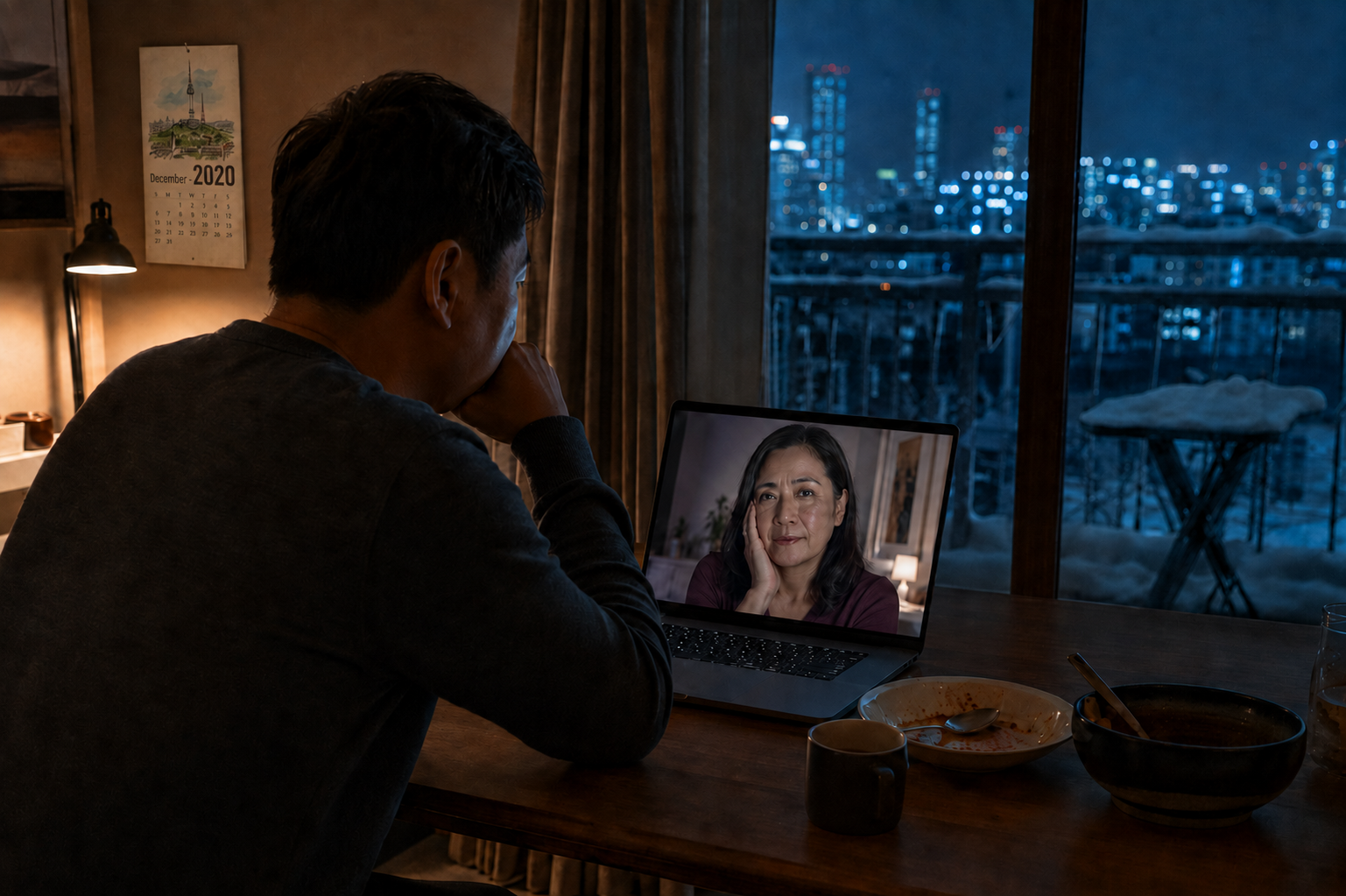
I had meant her whole family. To be honest, her husband had not even entered my mind when I asked. But since she had brought him into the conversation, I asked whether he was home.
I knew Jay was a seafarer. Kath said he was currently aboard a ship operating in South America.
“How about you and Anna?” she asked.
My fingers remained above the keyboard for a long time.
How were Anna and I?
“We’re okay,” I finally typed.
Kath replied almost immediately.
“Wow. It took you that long to answer, and all you can say is that you’re okay?”
I had intended to add more. I had pressed Enter too soon.
“Things became more peaceful between us when I stopped expecting her to meet my standards.”
“Has she changed?”
Again, I hesitated.
“Anna is Anna,” I wrote. “She is who she is. I’ve learned to accept that.”
Kath sent a thumbs-up.
Her question stirred memories I had kept untouched for years. Whenever Anna and I fought back then, Kath had been the person who listened to me. If she entered my office and found me unusually quiet, she immediately knew that something had happened between my wife and me. She would make me coffee, sit nearby, and tell me I did not have to keep everything to myself.
I thought the thumbs-up would end our conversation. Instead, she sent a sad emoji.
“I’m all right, Kath,” I assured her.
She reacted with a heart.
I turned the question toward her.
“How are things between you and Jay? Have you completely repaired your relationship? Are you back to the way you used to be?”
“Yes. We worked through our problems. We both realized that perhaps we needed to experience what happened—just as you and Anna needed to go through your own difficulties. You know we’re both Christians. We chose to remain together and allowed God to guide us through the healing process.”
I sent her a thumbs-up.
“I think we’re more mature now in the way we handle our problems,” she added.
Shortly before I moved to Korea, Kath and I had met because she and Jay were going through a serious marital crisis. She had needed someone to talk to, and I had listened. At the time, she believed their problems might end their marriage. I asked what caused the conflict, but she was reluctant to tell me.
Her problems had seemed so heavy that I never found the opportunity to tell her about mine. I had been going through a crisis severe enough for a doctor to prescribe antidepressants. I had not even told her that I would soon be leaving for South Korea.
“You suddenly went quiet,” she wrote. “Are you busy?”
“No. I was just remembering the last time we saw each other. We watched a movie that day, didn’t we?”
“Which part are you remembering—the movie, or the way you pretended to comfort me so you could steal a kiss on my cheek?”
“That isn’t true,” I protested. “I was genuinely trying to comfort you. If I had wanted anything else, then I would have—”
“Stop it, Marco.”
“All right. But I really didn’t have any hidden intention that day.”
“If you say so.”
I sent her smiling emojis.
She sent back three hearts.
“I miss you, Kath,” I typed. “I really do.”
The words had escaped before I could decide whether they were appropriate. Something familiar had risen inside me—a feeling I knew too well whenever it concerned her.
The message had already been delivered when I realized she might take it the wrong way.
“Oh, Marco,” she replied. “It’s getting late. I should say good night.”
Perhaps I had offended her.
“I’m sorry, Kath.”
“Sorry? What are you sorry for?”
I stared at the screen, unable to type a single word.
“Marco, I asked what you’re apologizing for.”
I do not know how long I sat there. Memories I had spent years avoiding began returning one after another.
Finally, I typed, “It’s nothing. You said it’s time to sleep, so good night. Thank you for talking to me.”
A series of angry emojis appeared.
“Fine, Marco. Leave me hanging again. I should be used to that by now.”
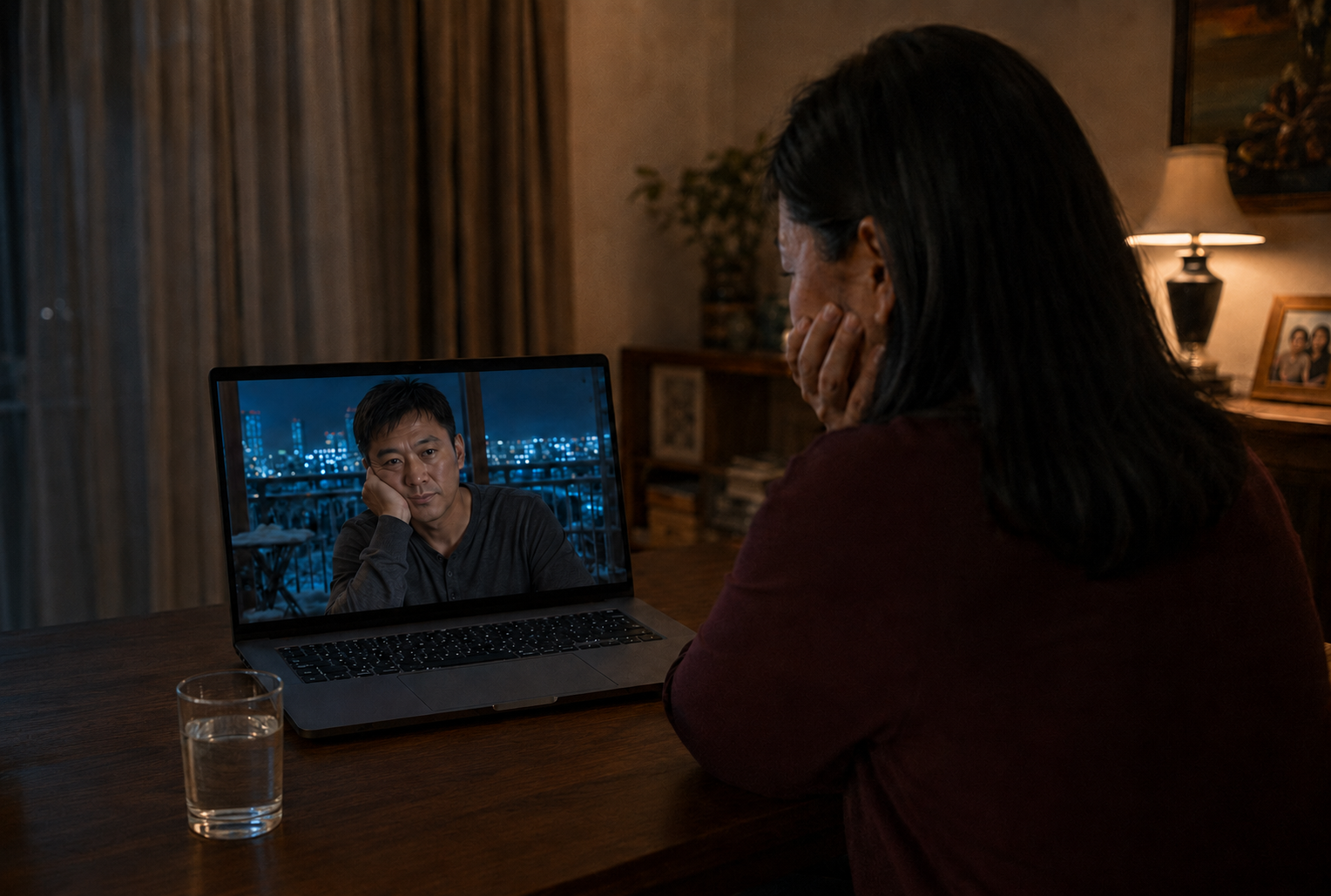
I pressed my palm against my forehead.
This was why I kept my distance even when I wanted to speak to her. Perhaps it was also why she kept hers. Neither of us wanted to uncover what we had spent years burying.
Instead of replying, I tried to video-call her.
She rejected the call.
I tried again.
Rejected.
“Please answer,” I wrote. “My hands are tired from typing.”
I called a third time.
At last, she answered—but her camera was off.
“Please turn on your camera,” I typed.
“Why?”
“I want to see you.”
It took her a while, but eventually the screen flickered and her face appeared.
I looked at Kath. She seemed to be studying me in the same way. Almost eight years had passed since we last saw each other, yet she looked scarcely changed.
“Have you been crying?” I asked.
“You’re infuriating, Marco. Why did we have to make this a video call?”
“My fingers were beginning to hurt from typing. And besides…”
I stopped.
“Besides what?”
I drew a breath. “I miss you, Kath.”
“I can never tell whether you’re telling the truth or merely charming me.”
“Is that really what you think of me?”
“Yes. It has been—for a long time. Since the day you failed to show up.”
I had no answer.
Whenever our conversations came dangerously close to what had once existed between us, she returned to that day—the meeting I had missed and the explanation I had never given.
“Marco, I want to ask you something,” she said. “And for once in your life, please answer me honestly. Just this once.”
Her words hurt. They made me sound like a man who had lied about everything.
“All right. I promise I’ll be honest. What do you want to know?”
She stared at me through the screen.
I tried to guess what she was about to ask.
Was it why I had not shown up that day when we were supposed to visit my mother in the hospital? Was it why my uncle had transferred her to another branch after she had worked in my office for six months? She had resigned two months after the transfer. Perhaps she wanted to know why I had not tried to stop her.
Or why I had seemed unaffected when she told me that she and Jay were getting married.
Perhaps she wanted to know why I had left for Korea without telling her—or why I had made so little effort to remain part of her life afterward.
Which of those questions had she carried all these years?
She took so long to speak that I wondered whether she had changed her mind.
“Never mind,” she finally said. “It’s embarrassing.”
“What are you—a teenager?”
“That’s enough, Marco.”
“All right. Ask me.”
“I said forget it.”
I sighed.
Perhaps I already knew what she had wanted to ask.
“Fine,” I said. “Then I’ll ask the question.”
“Go ahead. Just don’t ask me anything about mathematics. You know that’s my weakness.”
I smiled. Her humor had not changed.
“Kath…”
“Yes?”
“Did you really love me back then?”
She closed her eyes and released a long, unsteady breath.
Part 2 – What We Left Unsaid
Purpose-Driven
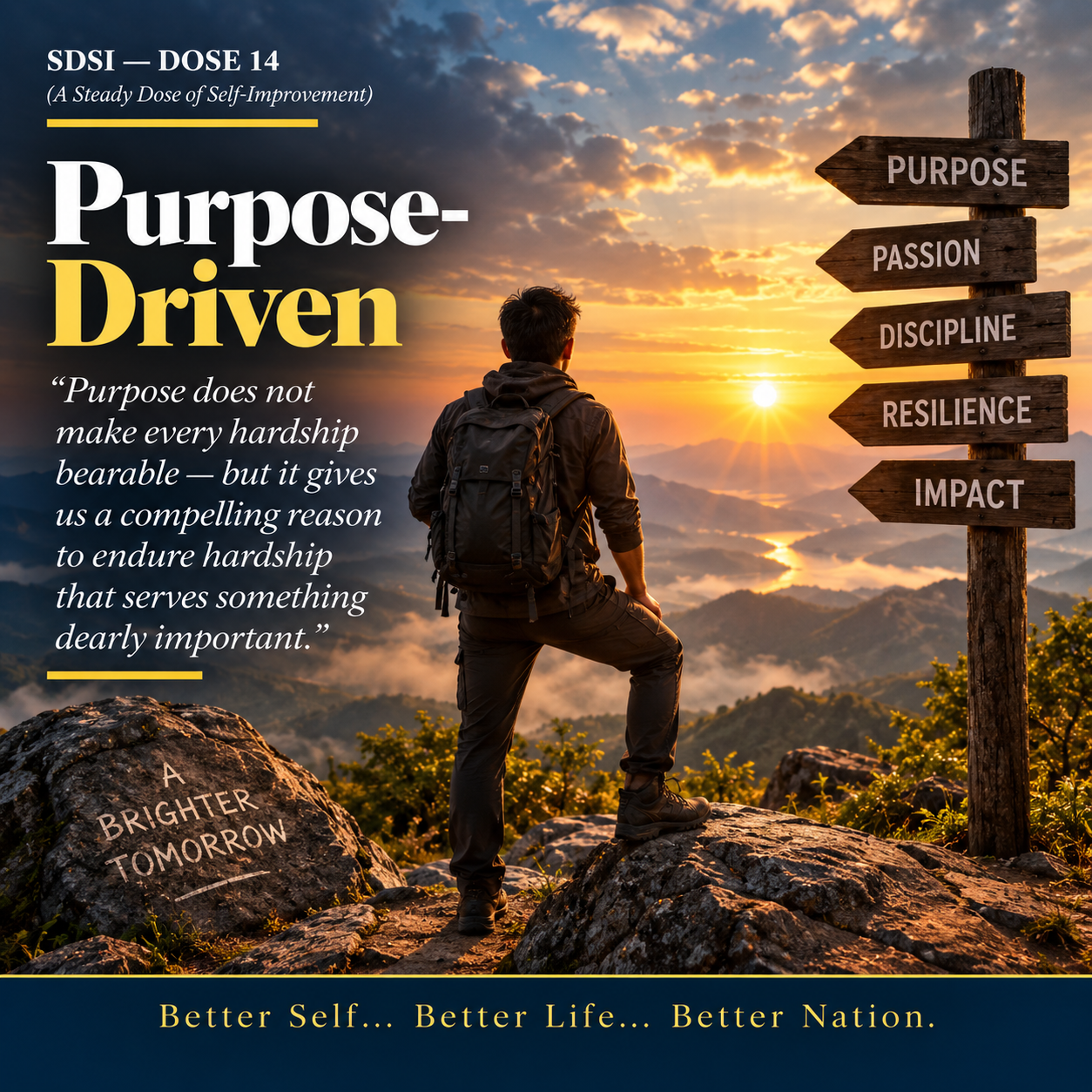
Purpose does not make every hardship bearable—but it gives us a compelling reason to endure
hardship that serves something deeply important.
“He who has a why to live can bear almost any how.”
This statement, commonly attributed from Friedrich Nietzsche, expresses a truth that many people discover while pursuing difficult goals: purpose is not a decoration placed on top of ambition. It is the foundation beneath it.
Ambition tells us what we want to achieve. Purpose tells us why achieving it matters.
Marie Curie became the first person to receive two Nobel Prizes and remains the only individual awarded Nobel Prizes in two different scientific categories. She pursued her scientific work in an era when women faced formidable barriers in education and science. Her devotion to investigating radioactivity did not remove those barriers, but it gave her a reason to continue working despite them.
Nelson Mandela spent 27 years in prison for his struggle against apartheid. Imprisonment deprived him of freedom, separated him from his family, and subjected him to years of hardship. Yet the democratic and nonracial South Africa he envisioned remained larger than his immediate suffering. His purpose did not make prison painless, but it helped prevent imprisonment from becoming the end of his mission.
Purpose does something motivation alone cannot reliably do: it can remain when enthusiasm disappears.
Motivation often rises when progress is visible, recognition is received, or success appears close. It can weaken when work becomes repetitive, rewards are delayed, and setbacks accumulate. Purpose reaches deeper because it reconnects the effort with the reason the effort began.
However, being purpose-driven does not mean stubbornly pursuing every goal forever. Sometimes circumstances change. Sometimes the method is ineffective, or the goal itself no longer reflects who we are becoming. Purpose allows us to change the route without abandoning the destination. It helps us distinguish between an obstacle that must be endured and a warning that requires us to reconsider our direction.
A goal without a meaningful reason behind it is fragile. Once inconvenience outweighs excitement, it becomes easy to surrender. A goal anchored in purpose is more resilient because the work serves something beyond immediate comfort, praise, or reward.
Your purpose does not need to impress the world. It may be caring for your family, educating young people, creating something meaningful, serving God, improving your community, or becoming capable of helping others. What matters is that it is genuinely yours—and important enough to influence how you use your time, abilities, and life.
When the path becomes difficult, purpose does not promise that you will never become tired.
It reminds you why resting is different from quitting.
Pause and Reflect
What meaningful purpose lies beneath one of your most important goals?
Would you still consider that goal worthwhile if recognition and immediate rewards were delayed?
One Step Forward
Complete this sentence: “I am pursuing __________ because __________.” Read your answer, then take one small action today that serves that reason.
Explored more fully in Part 2 — Section I — Chapter 7, “Purpose-Driven,” of A Holistic Approach to Self-Improvement.
Better Self… Better Life… Better Nation.
Adaptive Mindset
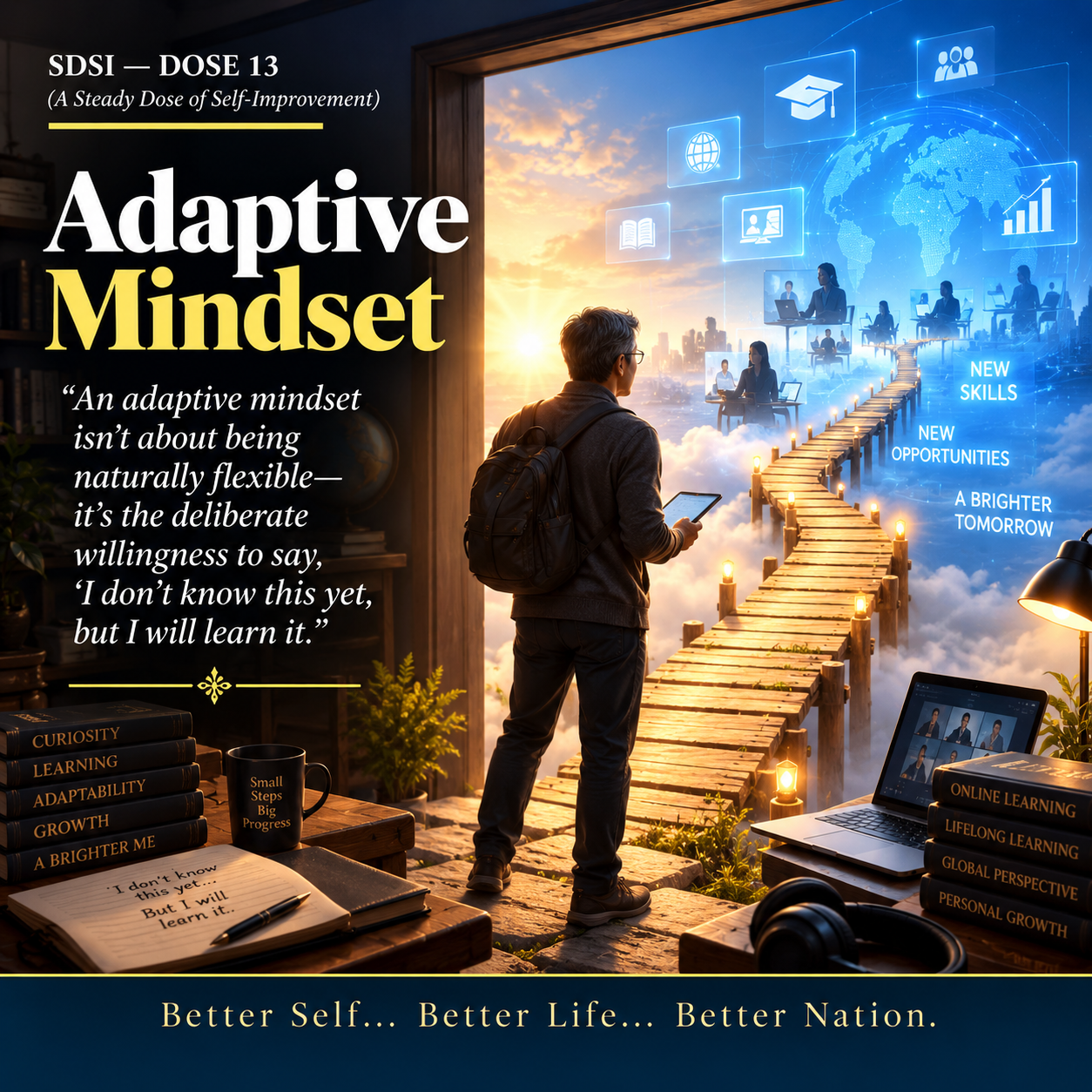
An adaptive mindset isn’t about being naturally flexible — it’s the deliberate willingness to say,
“I don’t know this yet, but I will learn it.”
When my university announced all classes were going online overnight, I had one problem: I’d never taught online in my life.
When my university announced, with almost no warning, that all classes would move online indefinitely, I was immediately aware of my limitation: I had never taught a single minute online in my career. I am not naturally tech-savvy. The shift felt like being asked to play an entirely different game with rules I did not know.
But I knew I had to adapt, or perish professionally. So I attended every training session offered. I learned the university’s E-Class platform. I mastered video conferencing software I’d never touched before. I began producing lecture videos for my students. Within weeks, I had not only adapted — I’d found new ways to engage students that I’d never explored in a traditional classroom.
Some of my colleagues could not make that same adjustment. Rather than continue struggling in an environment that had changed beyond their comfort, several chose to resign. The difference between us was not technical ability. It was mindset. The willingness to say: I do not know this yet — but I will learn it. That is an adaptive mindset in action.
Charles Darwin’s theory of adaptation offers the clearest parallel: species that adapt to changing conditions survive; those that cannot, perish. The same principle governs human beings in a rapidly changing world. Satya Nadella took over a Microsoft many considered to be losing its edge, and rather than defend the old way of doing things, replaced a culture of “know-it-alls” with a culture of “learn-it-alls” — growing the company’s value from $300 billion to over $2 trillion.
Your mindset is not fixed. The default responses you rely on were programmed over years by family, culture, and experience — and they can be reprogrammed with awareness and deliberate practice. Build self-awareness through daily reflection. Name your negative inclinations specifically, so they lose their power to operate invisibly. And seek out discomfort on purpose — an adaptive mindset is built in friction, not in comfort.
Pause and Reflect
What’s one skill you’ve been avoiding learning, telling yourself it’s simply “not who you are”?
One Step Forward
Name one negative reflex you have under pressure. Write down the adaptive response you’ll try the next time it happens.
Explored more fully in Part 2 — Section I — Chapter 6, “Proper Perspective,” of A Holistic Approach to Self-Improvement.