Category Archives: Better Self…Better Life
The Self-Improvement Paradigm at a Glance
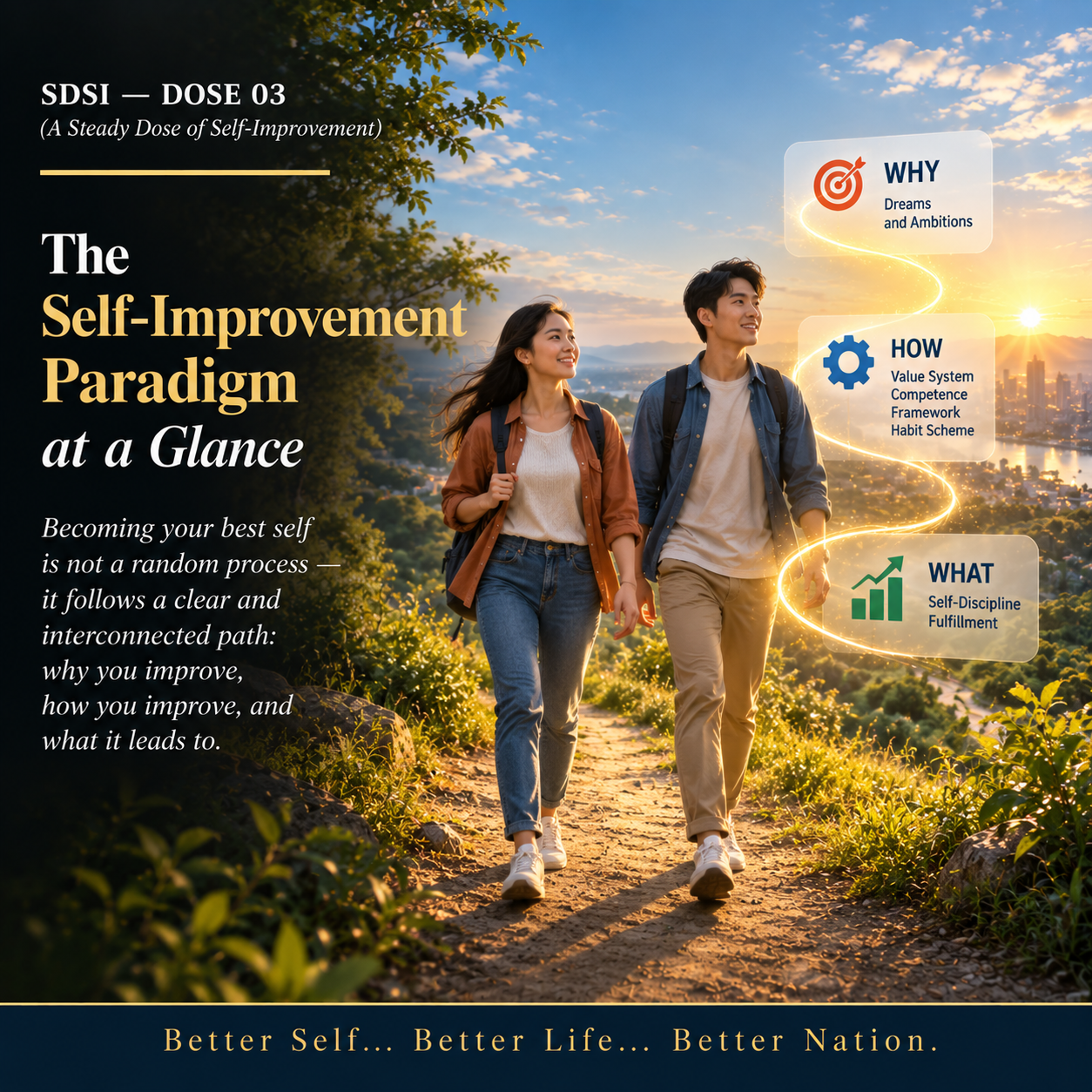
Real transformation rests on three pillars — what you believe, what you can do, and what
you practice — held together by self-discipline.

Becoming your best self was never going to be one thing.
For years, I thought growth meant picking whichever self-help idea resonated that month — a book on mindset here, a productivity system there — without ever asking how they fit together. It took time to see that the people who actually transform their lives aren’t chasing isolated fixes. They’re building on a structure.
That structure rests on three pillars. The first is your Value System — the attitudes and beliefs you carry about yourself and the world. The second is your Competence Framework — the actual skills and abilities you develop. The third is your Habit Scheme — the practices and activities you repeat often enough that they become who you are.

Remove any one of the three, and the other two eventually wobble. Belief without skill produces confidence with nothing to stand on. Skill without habit produces potential that never compounds into results. Habit without belief produces motion without conviction — busywork mistaken for progress.
Holding all three together is self-discipline — the thread that keeps the structure upright once the initial motivation fades, as it always eventually does. Health, success, and happiness arrive as natural results of the structure underneath, not as prizes you win by wanting them hard enough.
This is the paradigm the rest of this book unpacks, chapter by chapter — twenty chapters split across the three pillars, each one a single brick in a foundation meant to hold up an entire life, not just a single good year.
Pause and Reflect
Which of the three — belief, ability, or practice — do you most need to shore up right now?
One Step Forward
Pick the weakest of the three pillars in your life right now. Write one concrete step you’ll take this week to strengthen it.
Explored in full in the Introduction (Figure 1) of A Holistic Approach to Self-Improvement.
Better Self… Better Life… Better Nation.
About the Title – Why “A Holistic Approach”?
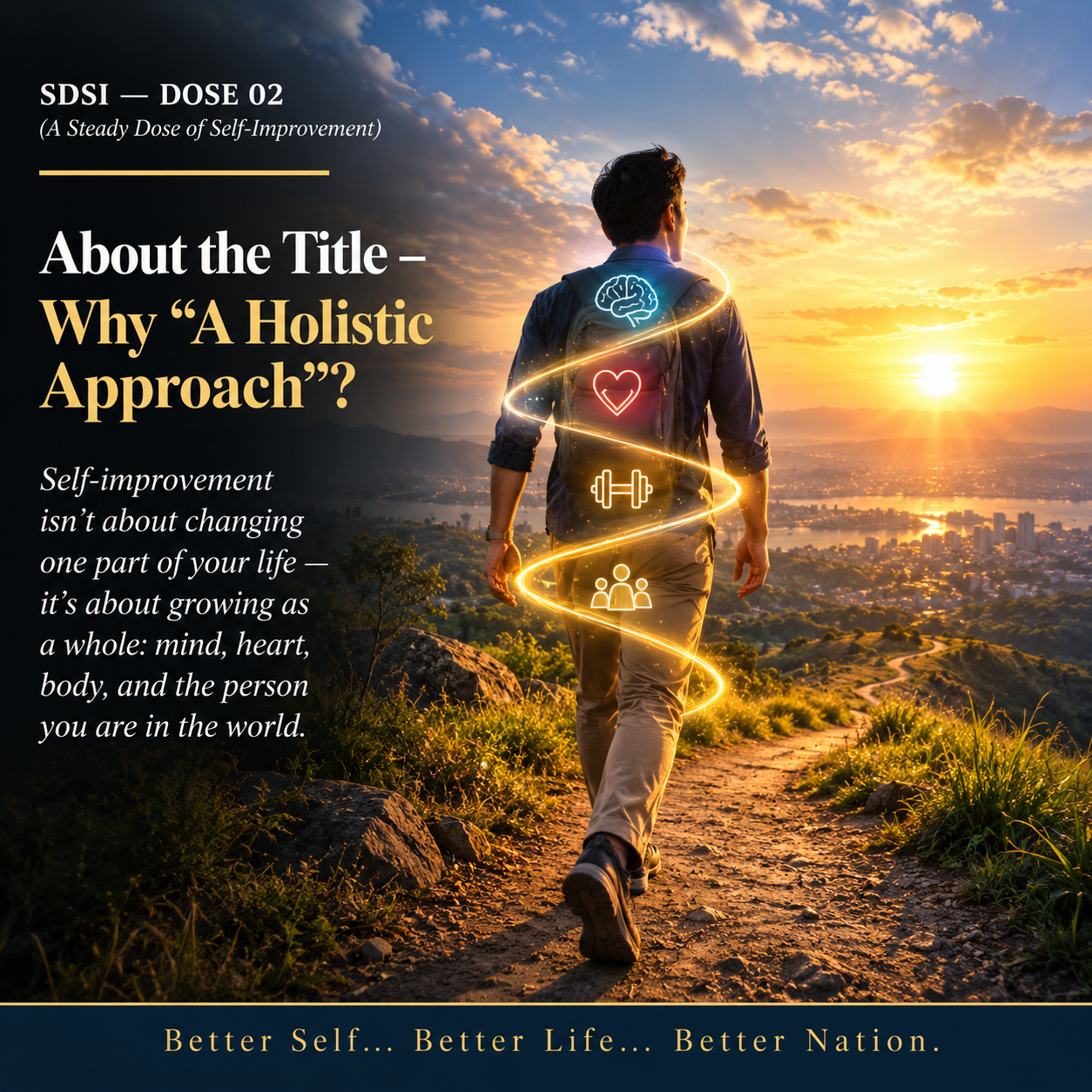
Self-improvement fails when it’s treated as a single fix; this book is holistic because lasting change
requires belief, skill, and habit working together.
Why “holistic”? Why not just “self-improvement”?
Because I tried the narrow version first, and it didn’t work.
I thought reading self-help books was enough. It wasn’t. I thought adding positive thinking on top of my faith and self-belief would complete the picture. I was wrong again. I wanted more — and I couldn’t yet name why.
The turning point came almost by accident. I bought a DVD titled “The Secret” without knowing what it was — the store had mixed it in with other genres, no synopsis, nothing to explain it. I watched it skeptical, then curious, then genuinely changed. That led me to Bob Proctor, and from there to a long list of thinkers — Jim Rohn, Tony Robbins, Wayne Dyer, Napoleon Hill, Dale Carnegie, Earl Nightingale.
What struck me across all of them was this: none of them treated self-improvement as one lever to pull. Every lasting example of growth I found required cultivating the right attitudes and beliefs, developing real skills and abilities, and consistently practicing the right daily habits. Not one of these in isolation. All three, together.
This book is organized around that conviction — a Value System, a Competence Framework, and a Habit Scheme, held together by self-discipline. It’s not a shortcut. It’s a fuller map.
Pause and Reflect
Which single area have you been trying to fix on its own, while the rest quietly stayed the same?
One Step Forward
Name the one dimension — belief, skill, or habit — you’ve most neglected. Write one sentence describing what giving it real attention would look like this week.
Explored in full in the Preface of A Holistic Approach to Self-Improvement.
Better Self… Better Life… Better Nation.
A Steady Dose of Self-Improvement

As Jim Rohn said, “Those who seek a better life must first become a better person.” You don’t need a magic pill to become a better person. That pill does not exist anyway. What you need is “A Steady Dose of Self-Improvement.”
“A Steady Dose of Self-Improvement (SDSI)” is a continuing educational and reflective series. My objective in launching this project is to present, through concise and accessible installments, the central ideas of my book, A Holistic Approach to Self-Improvement: A Practical Guide to Becoming Your Best Self.
Betting on Ourselves

I have a section on my website that I christened “Road to Self-Improvement.” That section was born of my advocacy for self-improvement — and it is where the idea of writing a book on the subject first took shape. But the advocacy itself is older than the website, older than the book. It started years ago, when a friend asked me a simple question: what is the best national development framework for the Philippines?
I told him this — for the Philippines to develop as a nation, Filipinos need to abandon the mindset that a messiah will come to save our country from the socio-political and economic quicksand where we are currently drowning. We think we can pin our hopes for a better future, a better life, on a leader or politician we believe in and support — most of the time, blindly. And yet whoever we elect to the seats of the Executive and Legislative branches has consistently failed to move the needle of progress and peace.
So what, then, is the framework? I believe it begins smaller than any election, smaller than any administration — it begins with the individual. If every Filipino embraces self-improvement and pursues their full potential, they can grow in every aspect of life: mind, character, discipline, livelihood, health. When that happens, they succeed — and with that success comes the capacity to lift not only themselves, but the families they belong to. When every Filipino and every family commit, simply and consistently, to becoming better, imagine what their community becomes. And if every community in our towns, cities, and provinces reflects that same commitment, we will have built — not waited for, not voted for, but built — a stronger Philippine society. A stronger Filipino nation.
It is time for Filipinos to abandon the mindset that we can pin our hopes on a strong politician or leader — a messiah, a savior. Every Filipino should pin their hopes on themselves. We must bet on ourselves, not on someone who promises us the moon and the stars during an election. Betting on a leader to single-handedly bring our nation to paradise is like betting on a lottery with 45 numbers to choose from — your odds of winning are 1 in more than 8,000,000. It’s like fishing for one single fish in a fishing area the size of the entire Pacific Ocean.
One need not look far for proof. As I write this, the nation watches its vice president stand trial for corruption and misuse of public funds, while senators allied with one camp or another are arrested, disappear, or resurface depending on which side of a political feud they happen to stand. Officials once inseparable allies now accuse each other of the very crimes they once campaigned to eradicate together. This is not an aberration — it is the lottery working exactly as it always has: fortunes made and unmade not by the merit of public service, but by the shifting arithmetic of political alliances. Whoever wins this particular round of the game, the game itself remains what it has always been — a gamble the ordinary Filipino never gets to place a real bet in, only to watch.
Betting on ourselves, on the other hand, is not a bet on chance at all — it is a commitment to effort, and effort is not drawn from a bin of eight million balls where luck alone decides the outcome. When a Filipino bets on a leader, he marks a ballot once, then waits — powerless, passive — for a stranger’s decisions to shape his future. When a Filipino bets on himself, there is no waiting and no ballot box; there is only the next skill learned, the next hour of work invested, the next discipline practiced. These are not draws from a lottery machine — they are deposits, and, like any deposit made consistently, they compound. A leader may fail to deliver even after winning every vote in his favor; a Filipino who invests in his own competence, character, and resilience cannot be defrauded of that investment by any politician, any administration, or any election cycle.
This is exactly the mechanism by which one Filipino’s discipline becomes a family’s stability, a family’s stability becomes a community’s strength, and a community’s strength becomes a nation’s foundation. No leader can legislate that chain into existence. No election can manufacture it overnight. It has to be built — person by person, family by family, town by town — and the beauty of it is that, unlike the lottery of politics, every single one of us holds a winning ticket the moment we decide to act on it.
This is the difference between hoping for a miracle and building one. It is why I stopped asking, years ago, who will save our nation — and started asking instead what I myself was willing to build. That question became a website section. It became years of writing. It eventually became a book. But long before it became any of those things, it was simply a decision — the same decision I believe every Filipino is capable of making, the same decision that, multiplied across a hundred million of us, could move the needle that a hundred years of elections never did.
We do not need a messiah. We need each other, choosing, one by one, to bet on ourselves.
A Holistic Approach To Self-Improvement

Self-improvement is often treated as a collection of isolated goals—building confidence, learning new skills, developing better habits, or becoming more disciplined. But lasting transformation requires something more. It requires a holistic approach.
This book presents a practical framework that brings together the essential dimensions of personal growth into one integrated system. Rather than focusing on a single aspect of development, it shows how genuine and lasting change occurs when your beliefs, abilities, habits, and actions work together.
Through this book, you will discover how to:
• Build a strong value system that shapes your character and guides your decisions.
• Develop the competencies needed to navigate life’s personal and professional challenges.
• Establish a habit scheme that transforms good intentions into consistent action.
• Cultivate the self-discipline that binds every element into a sustainable way of life.
• Pursue lasting health, success, happiness, and fulfillment through balanced personal growth.
Grounded in research yet written in a clear and practical style, this book combines timeless principles, scientific insights, reflective exercises, self-assessments, and real-life examples to help you understand not only what to improve, but how meaningful transformation actually happens.
Whether you are a student, educator, professional, leader, entrepreneur, or simply someone seeking a more purposeful life, A Holistic Approach to Self-Improvement offers a complete roadmap for becoming your best self—one intentional step at a time.
Grow with purpose. Live with meaning.
Lessons on Perspective

I have a friend who is regularly mistaken for me. We teach at the same university, share a similar build and height, and have the same rounded face — though I have a more defined nose and he has fairer skin. One day, visibly bemused, he asked me, “Why would they think I am you? Do I look as old as you?” I paused, smiled, and replied, “No. I look as young and handsome as you.” He laughed. And in that small exchange, I noticed something larger than the joke: the same mix-up, the same mistaken identity, had produced two completely different reactions in two different men. He heard an insult about age. I heard a compliment about my looks. Nothing about the situation had changed. Only the lens through which each of us chose to receive it.
That, I think, is the simplest definition of perspective — not what happens to you, but the angle from which you decide to look at what happens to you. Two people can stand at the same window on the same morning. One sees the smudge on the glass. The other sees the sun rising behind it. Neither is wrong, exactly. But one view will serve the viewer far better than the other.
I was reminded of this again in a conversation with a colleague, an expat teacher like me, who was frustrated about his salary. He told me, with some bitterness, that a truck driver back in his home country earned more in a year than he did. I listened, then asked him to slow down and look at the bigger picture. How many hours did that truck driver work to earn that figure? What were the physical demands of long-haul driving, year after year? And what about our own schedule — the fact that, as university teachers, we are paid in full through both winter and summer breaks, which together amount to five months of the year? During those five months, our only real obligations are a handful of meetings at the start and end of each semester. The rest of the time is simply ours.
When he ran the numbers on his actual hourly rate, his frustration lost its footing. He was earning more per hour than the truck driver, under incomparably gentler conditions. His complaint had been built on a true fact — the raw annual figure — but an incomplete picture. He was not wrong about the number. He was wrong about what the number meant because he had left out everything around it.
This is the most common failure of perspective, and the most forgivable one. We are not lying to ourselves on purpose. We simply stop looking before we have gathered the whole view. The fix is almost always the same: pause, and ask what else belongs in the frame.
But there is a second, less innocent failure of perspective, and a different colleague handed me a clear example of it. He told me, flatly, that he considered motivational quotes to be nonsense. To prove his point, he gestured at a small bulletin board bearing a quote that read, “Whatever you are, be good at it.” Then he delivered what he clearly believed was the knockout line: “So if you are a rapist, be a good rapist.”
I told him he had chosen the worst possible illustration he could have picked. More importantly, his example revealed the lens through which he had chosen to interpret the quote. You cannot be good at doing something that is, by its nature, an act of harm. Goodness and harm are not two settings on the same dial; one cancels the very premise of the other. I asked him the obvious question: Why a rapist, of all the things a person could be? Why not a teacher? A father? A leader? Each of those would have proven the quote’s point beautifully — that excellence, applied to a worthy role, elevates both the role and the person in it. Instead, he reached for the most grotesque example available, not because it was the most honest one, but because it was the most useful one for the argument he had already decided to win.
That is the difference between an incomplete perspective and a distorted one. My colleague with the salary complaint was missing pieces of the picture, but he was not hiding from the truth — he simply hadn’t gone looking for it yet, and once he did, he changed his mind. The man at the bulletin board was doing something else entirely. He was not missing information. He was selecting the most damaging frame available and presenting it as the obvious one, so that the quote — and perhaps optimism itself — would look foolish by comparison. One man’s perspective needed completing. The other man’s perspective needed correcting.
I think about these three exchanges together because they map out the territory so well. The mistaken-identity story is perspective in its lightest form — the same fact, received through two different temperaments, producing two different emotional outcomes, both harmless. The truck driver story is perspective in its most repairable form — a real grievance, resting on a partial view, that dissolves the moment the missing pieces are added back in. And the bulletin board story is perspective at its most dangerous — not an honest gap in the picture, but a deliberate choice of the worst possible angle, used to discredit something that did not deserve it.
Obi-Wan Kenobi was right when he said that many of the truths we cling to depend greatly on our own point of view. But that is not an excuse to pick whichever point of view is most convenient, most cynical, or most self-serving. It is an invitation to be honest about which direction you are choosing to look — and deliberate enough to ask whether you have actually seen the whole field before you decide what it means.
Perspective, in the end, is not something that happens to us. It is something we choose, conversation by conversation, frame by frame. The only real question is whether we are choosing it carefully — or just reaching for whichever lens lets us win the argument we already wanted to have.
An Invitation (YouTube Channel Teaser)
Is self-improvement an end in itself or a means to achieve an end?
By introducing a comprehensive paradigm for self-improvement, I do not seek to complicate the process of personal growth, but rather to present a realistic framework that brings together the many constructs essential to it. There are two serious loopholes in self-improvement schemes promoted nowadays. The first one is the promise of becoming the best version of yourself in a few days or weeks. And the second is the attainment of full potential, being floated as a goal to be achieved rather than a process to be undergone.
Self-improvement is not an end in itself but rather a means to achieve an end. It is not a destination. It is the path to reach a desired destination.
I believe that there is no shortcut, no magic pill, and no single technique that can instantly transform one’s life. Genuine growth requires cultivating the right attitudes and beliefs, developing essential skills and abilities, and consistently practicing positive habits and activities. This holistic approach recognizes that lasting change arises from deliberate effort across multiple areas of life.



 M.A.D. L I G A Y A