Author Archives: M.A.D. LIGAYA
Face-to-Face and Online English Lounges: A Comparative Analysis
A research paper published in a Scopus-indexed journal

Face-to-Face and Online English Lounges: A Comparative Analysis
Massuline Antonio D. Ligaya, Hyun Jung Lee, Joung-Hyun Ham, Randy S. Tolentino,
Thomas Edward Farrell II, and Christopher Glenn Gunther
International Journal of Information and Education Technology, Vol. 12, No. 9, September 2022, pp. 888–897
DOI: 10.18178/ijiet.2022.12.9.1698
Research Summary
English conversation lounges provide university students with opportunities to practice a foreign language outside the formal classroom in a more relaxed and socially interactive environment. At the university examined in this study, the English Café Program (ECP) was established to give students additional opportunities to communicate with foreign English teachers, improve their speaking ability, and develop greater confidence and more positive attitudes toward interacting with foreigners. When the COVID-19 pandemic forced university activities online, the program shifted from its traditional face-to-face format to a virtual environment, creating an opportunity to compare the effectiveness of the two modes.
The study employed a descriptive-comparative survey design and examined the ECP during its face-to-face implementation in 2019 and online implementation in 2020. The student participants came from different academic departments and were members of the same general cohort: 800 students were selected for each phase of the study. Nineteen foreign English teachers also participated in both phases. Separate but closely parallel questionnaires for students and teachers assessed the perceived effects of the program on two principal outcomes: students’ speaking ability and their attitude toward foreign teachers. The study also considered teachers’ educational qualifications and length of service. Data were analyzed using frequency and mean analyses, t-tests, correlation analysis, and simple linear regression.
Both students and teachers perceived the face-to-face and online versions of the English Café Program as improving students’ speaking ability and their attitudes toward foreign teachers to a great extent. Although some mean scores differed between the two delivery modes, statistical testing showed no significant difference between the perceived effects of the face-to-face and online programs. This suggests that moving the conversation lounge to a virtual environment did not substantially diminish its perceived effectiveness.
One of the study’s most notable findings concerned the relationship between students and their foreign teachers. Students’ speaking ability was strongly and positively correlated with their attitude toward foreign teachers in both the face-to-face (r = .881, p < .01) and online (r = .889, p < .01) implementations. Regression analysis likewise indicated that attitude toward foreign teachers significantly predicted perceived speaking ability in both settings. These results emphasize that language development involves more than simply providing opportunities for practice; the quality of the student-teacher relationship and students’ comfort in interacting with their teachers also matter.
Teachers’ educational qualifications did not show a significant positive relationship with the major student outcomes. An unexpected finding was that teachers’ length of service was negatively correlated with students’ speaking ability in the face-to-face implementation (r = -.532, p < .05), although this relationship did not appear in the online implementation. The study treated this result cautiously and suggested that it warranted further investigation rather than assuming that greater teaching experience itself adversely affects student learning.
Overall, the findings support English conversation lounges as valuable forms of out-of-class language learning. They also demonstrate that such programs can be successfully adapted to online environments, potentially expanding access to students who cannot regularly participate in on-campus sessions.
Research Contribution
The study contributes to research on out-of-class language learning by providing a direct comparison of face-to-face and online English conversation lounges within the same university program. Its findings suggest that the effectiveness of a conversation lounge depends less on whether interaction occurs physically or virtually than on whether students are given meaningful opportunities to communicate and develop positive relationships with their language teachers. The study therefore provides practical support for universities considering hybrid, online, or flexible conversation-lounge programs as supplements to formal language instruction.
Keywords: English lounges, out-of-class language learning, speaking ability, foreign English teachers, student-teacher relationship, online learning, face-to-face learning
Full Text
The full text of this publication is available upon request. Researchers, educators, students, and other interested readers who wish to obtain a copy may contact the author through this website or by email at madligaya@gmail.com.
Between Us Bi-Multilinguals: Bilingual and Multilingual Views on Codeswitching
A research paper published in a Scopus-indexed journal

Between Us Bi-Multilinguals: Bilingual and Multilingual Views on Codeswitching
Estrella F. Fajardo, Massuline Antonio D. Ligaya, and Joung-Hyun Ham
Indian Journal of Public Health Research & Development, Vol. 9, No. 8, August 2018
DOI: 10.5958/0976-5506.2018.00860.4
Research Summary
Codeswitching—the practice of alternating between two or more languages within a conversation—is a common feature of communication in bilingual and multilingual societies. In the Philippines, where many people routinely use English, Filipino, and regional languages, codeswitching has become a natural part of everyday interaction. This study examined the phenomenon among bilingual and multilingual English teachers, focusing not only on how they switched languages but also on the communicative purposes their switches served.
The study specifically investigated the syntactic patterns of codeswitching used by the teachers and the social or discourse functions underlying their language choices. Eight English faculty members participated in the study: three bilingual speakers of English and Tagalog and five multilingual speakers who also spoke Kapampangan. Naturally occurring face-to-face communication and interviews were used to gather samples of their linguistic behavior. The recorded switches were classified according to their syntactic patterns and communicative functions and analyzed using frequency counts and percentages.
A total of 90 codeswitched utterances were identified. Intrasentential switching—changing languages within a phrase, clause, or sentence—was by far the most common pattern, accounting for 64.44% of all observed switches. This was followed by intra-word switching (17.77%), intersentential switching (12.22%), and tag-switching (5.55%). Most switches occurred at the word or phrase level rather than through more structurally complex changes between complete sentences. The teachers also tended to use Tagalog-based sentences containing English elements despite all participants being English teachers.
The analysis further showed that codeswitching performed several communicative functions. Among the functions identified, ease of expression was the most frequent, followed by insufficient academic vocabulary. Other functions included repetition for clarification, expressing the speaker’s mood, adding emphasis, and habitual experience. These findings suggest that codeswitching is not merely random language mixing or evidence of linguistic deficiency. Rather, speakers draw on the languages available to them to communicate ideas, emotions, and experiences more naturally and effectively.
Overall, the study highlights codeswitching as a functional and socially meaningful feature of bilingual and multilingual communication. The findings demonstrate how language choice is influenced by context, topic, linguistic resources, and the speaker’s communicative needs, particularly in an academic workplace where several languages coexist.
Research Contribution
The study contributes to the understanding of codeswitching by combining structural analysis with communicative-function analysis in the natural interactions of bilingual and multilingual English teachers. It reinforces the view that codeswitching should be understood not simply as alternation between languages but as a linguistic resource speakers strategically—and sometimes unconsciously—use to facilitate communication and express meaning.
Keywords: codeswitching, bilingualism, multilingualism, syntactic patterns, discourse functions, language choice
Full Text
The full text of this publication is available upon request. Researchers, educators, students, and other interested readers who wish to obtain a copy may contact the author through this website or by email at madligaya@gmail.com.
Ang Hamon Ng Salamin
(A Personal Essay in Filipino)

Habang ang bayan natin ay nilulunod ng tubig-bahang tila ayaw nang humupa at ng walang katapusang bangayan sa pulitika, sisinghap-singhap akong humarap sa salamin at napatanong:
“Kailan kaya magbabago ang bansang ito?”
Habang tinititigan ko ang aking sarili sa salamin at pinagninilayan ang katanungang iyon, bigla kong naalala ang isang bahagi ng kanta ni Michael Jackson na Man in the Mirror.
At muli kong binalikan ang katanungang iyon.
May magbabago pa nga ba? May pagbabago bang ihahatid ang halalan sa 2028?
Pumikit ako.
At muli na namang umalingawngaw sa aking isip ang bahaging iyon ng kanta ni Michael Jackson.
At kapagdaka’y napagtanto kong mali ang tanong ko.
Ang pagbabagong kailangan ng ating bansa ay hindi magsisimula sa halalan sa 2028.
Magsisimula ito sa akin—hindi sa balota, hindi sa 2028, kundi ngayon.
Napakadaling tumingin sa mga pulitiko, sa mga institusyon, at sa sistema at sabihin kung ano ang mali sa kanila. Ngunit may isang simpleng katotohanan akong napagtanto. Sabihin ko man kung ano ang mali sa kanila, ipagsigawan ko man ito sa kanilang mukha hanggang malagot ang lahat ng litid ko sa leeg, wala pa ring katiyakang magbabago sila.
Hindi ko kayang baguhin nang mag-isa ang Pilipinas. Hindi ko kayang baguhin nang mag-isa ang sistema. At lalong hindi ko kayang pilitin ang aking kapwa Pilipino na magbago.
Pero kaya kong baguhin ang sarili ko.
Hindi nito inaalis ang pananagutan ng mga politikong nangungulimbat sa kaban ng bayan. Hindi rin ibig sabihin nito na dapat akong tumigil sa paghingi ng katapatan, kakayahan, at pananagutan mula sa mga namumuno.
Managot ang dapat managot.
Pero may pananagutan din ako, eh. Dapat din akong managot. Hindi ako puwedeng magmalinis.
Bakit?
Ibinoto ko sila.
Paulit-ulit.
At aaminin kong pati mga tatay, nanay, ate, kuya—at kung sinu-sino pang kadugo nila—ay naiboto ko rin.
Noong una, nagpaloko ako. Nang kalaunan ay nakikita ko na ang panlilinlang, nagbulag-bulagan naman ako. Mas masahol pa, kung minsan ay ipinagtanggol ko pa sila.
Nakipag-away pa nga ako dahil sa kanila.
Pero ano ang napala ko?
Umunlad ba ang buhay ko? Nadagdagan ba kahit singkong kusing ang kinikita ko? Sumarap ba ang pang-ulam na kinakain ko?
Nangyari na ang nangyari. Hindi ko na mababago ang nakaraan. At lalong hindi ko kayang baguhin nang sapilitan ang mga lider kuno na hinayaan kong paulit-ulit na nakawan ang kaban ng bayan at paikot-ikutin akong parang trumpo.
At marahil, doon dapat magsimula ang aking pananagutan—hindi sa pagsisikap na baguhin ang mga politiko o ang ibang tao, kundi sa pagbabago ng aking sarili.
Mahirap nang baguhin ang sarili ko. Bakit ko pa uubusin ang aking lakas sa pagsisikap na baguhin ang mga taong wala naman akong kapangyarihang kontrolin?
Maaari kong tuligsain nang tuligsain ang sistema ngunit manatili pa rin akong katulad ng dati. Maaari akong magreklamo tungkol sa katiwalian ngunit palampasin ang maliliit na pandaraya at kasinungalingan sa sarili kong buhay. Maaari akong humingi ng disiplina sa mga opisyal ng pamahalaan habang ako mismo ay kulang sa disiplina. Maaari akong humingi ng responsableng pamumuno habang ayaw kong akuin ang pananagutan sa sarili kong mga pasya.
Kaya napagpasyahan kong magsimula kung saan mayroon talaga akong kapangyarihan.
Sa sarili ko.
Kung magsisimula ako sa sarili, unti-unti akong magiging mas mabuting bersyon ng kung sino ako ngayon. At sa pagiging mas mabuting tao, mas malaki ang pagkakataon kong magkaroon—kasama ang aking pamilya—ng mas mabuting buhay.
At paano kung mas marami pang Pilipino ang gumawa ng ganito ring pasya?
Hindi naghihintay ng halalan.
Hindi naghihintay ng bagong pangulo.
Hindi naghihintay ng isang malaking pangyayaring biglang babago sa buong bansa.
Kundi nagsisimula sa sarili.
Isipin natin ang milyun-milyong Pilipinong nagsisikap maging mas responsable, mas disiplinado, mas matapat, mas mahabagin, mas mahusay, at mas handang managot sa kanilang mga ginagawa.
Isipin natin ang mga pamilyang mahuhubog ng ganitong mga tao, ang mga lugar ng trabahong maiimpluwensiyahan nila, ang mga pamayanang mapauunlad nila, at kalaunan, ang mga institusyong pamumunuan nila.
Marahil, ang isang mas mabuting bansa ay hindi nagsisimula sa Malacañang.
Marahil, nagsisimula ito sa ating mga tahanan, sa ating mga pinagtatrabahuhan, sa ating mga silid-aralan, at sa maliliit na pasyang ginagawa natin araw-araw.
Marahil, ang pagbabago ng Pilipinas ay hindi lamang nakasalalay sa paghahanap natin ng mas mabubuting pinuno.
Marahil, nakasalalay rin ito sa pagiging mas mabubuting mamamayan natin.
Hindi ko kayang baguhin nang mag-isa ang Pilipinas.
Pero kaya kong baguhin ang sarili ko.
At biglang naging mas makahulugan sa akin ang mensahe ng Man in the Mirror:
“If you want to make this world a better place, tak a look at yourself then make a change.”
Kung tunay kong nais na maging mas mabuti ang mundong ginagalawan ko, marahil ang unang taong dapat kong hamuning magbago ay ang taong nakatitig sa akin mula sa salamin.
Kaya sa halip na itanong ko,
“Kailan kaya magbabago ang bansang ito?”
marahil ay panahon nang ibaling ko sa aking sarili ang tanong.
“Kailan ako magsisimulang magbago?”
Better Self… Better Life… Better Nation.
Conquering Self-Doubt
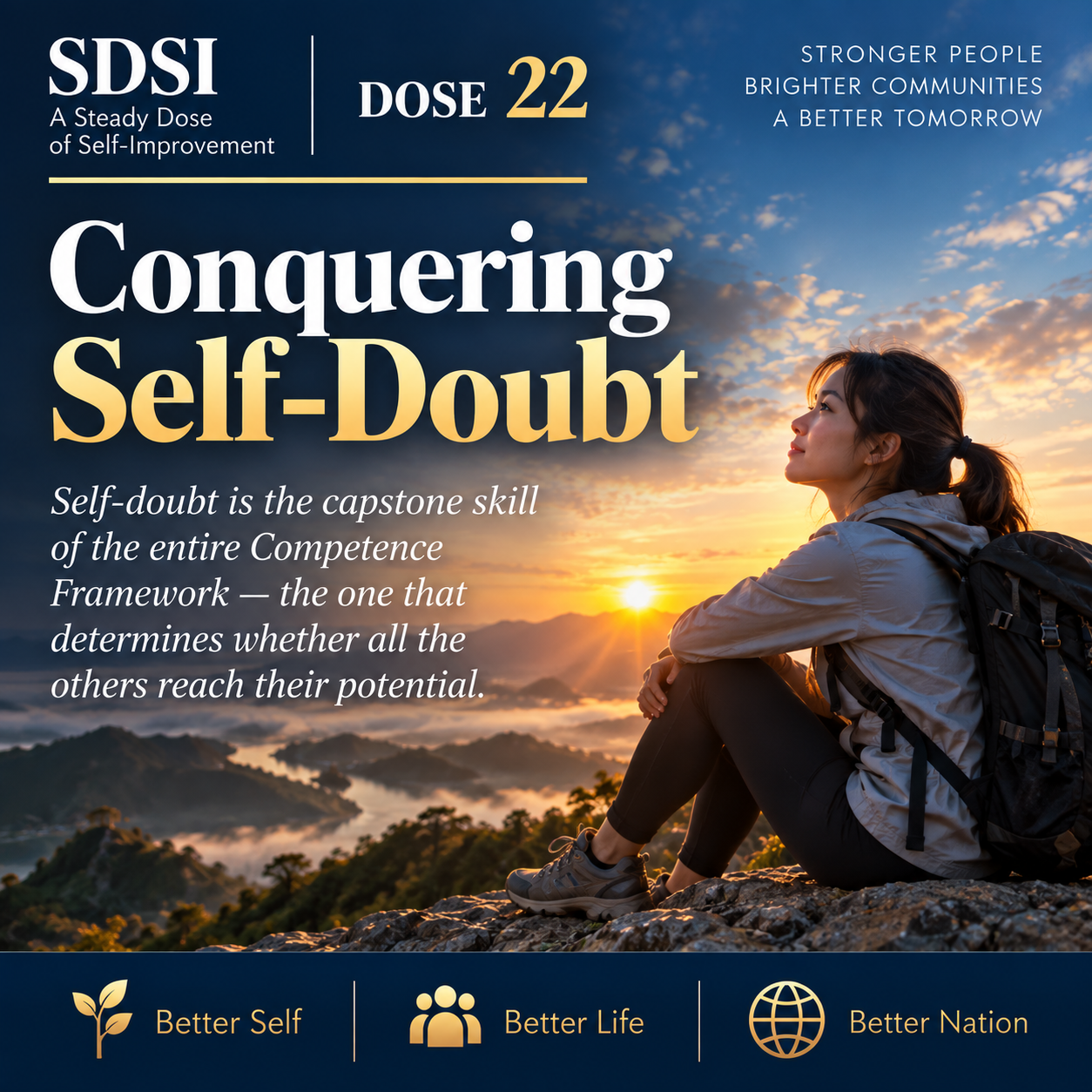
Self-doubt is the capstone challenge of the Competence Framework—the one that determines whether
all our other abilities are ever fully used.

What if self-doubt belongs on the list of deadly sins?
Perhaps that question goes too far. Ordinary self-dOubt is neither evil nor necessarily harmful. Sometimes it protects us from arrogance. It makes us examine our preparation, recognize our limitations, and seek the help or training we genuinely need.
But self-doubt becomes destructive when it continues speaking even after the evidence has answered it.
It whispers that you are not intelligent enough, capable enough, or worthy enough to succeed. It dismisses every accomplishment as luck, every compliment as politeness, and every opportunity as something intended for somebody better. Given enough authority, it does more than make you uncomfortable—it prevents you from using the abilities you already possess.
I know that voice.
It has asked me who I thought I was to teach abroad, present research, write books, and advocate self-improvement. It did not disappear when I earned another degree, accumulated years of teaching experience, published my work, or stood before international students. Whenever I attempted something larger, the same question returned in a different form:
Who do you think you are?
Eventually, I learned to answer it with evidence.
I am someone who has faced unfamiliar situations and learned. I am someone who has been rejected and continued. I am someone who has completed difficult work before. None of this guarantees that everything I attempt will succeed. It simply proves that self-doubt is not qualified to declare what I cannot do.
Conquering self-doubt does not mean silencing it forever. Even accomplished people occasionally question themselves. The goal is not to become so confident that we ignore our weaknesses or assume that we cannot fail. That is not confidence; it is carelessness.
The goal is to place self-doubt in its proper position. Let it ask questions, but do not let it deliver the final judgment. Examine what it says. If it identifies a real deficiency, improve. If it merely repeats an old fear that contradicts the evidence, proceed despite it.
This is why conquering self-doubt completes the Competence Framework. You may manage your time efficiently, remain focused, think before acting, make purposeful decisions, communicate effectively, and maintain balance. But if you continually doubt your right or ability to use those skills, much of your potential will remain untouched.
You do not need absolute certainty before taking the next step. You need sufficient preparation, honest evidence, and the courage to act while a little uncertainty remains.
Self-doubt may accompany you.
It simply must not lead you.
Pause and Reflect
What opportunity have you avoided because you doubted yourself?
What evidence from your own life challenges that doubt?
One Step Forward
Write one sentence naming a capability you genuinely possess. Beneath it, list three experiences or accomplishments that provide concrete evidence for it.
Explored more fully in Chapter 14 — “Conquering Self-Doubt” of A Holistic Approach to Self-Improvement.
Better Self… Better Life… Better Nation.
Striking Work-Life Balance
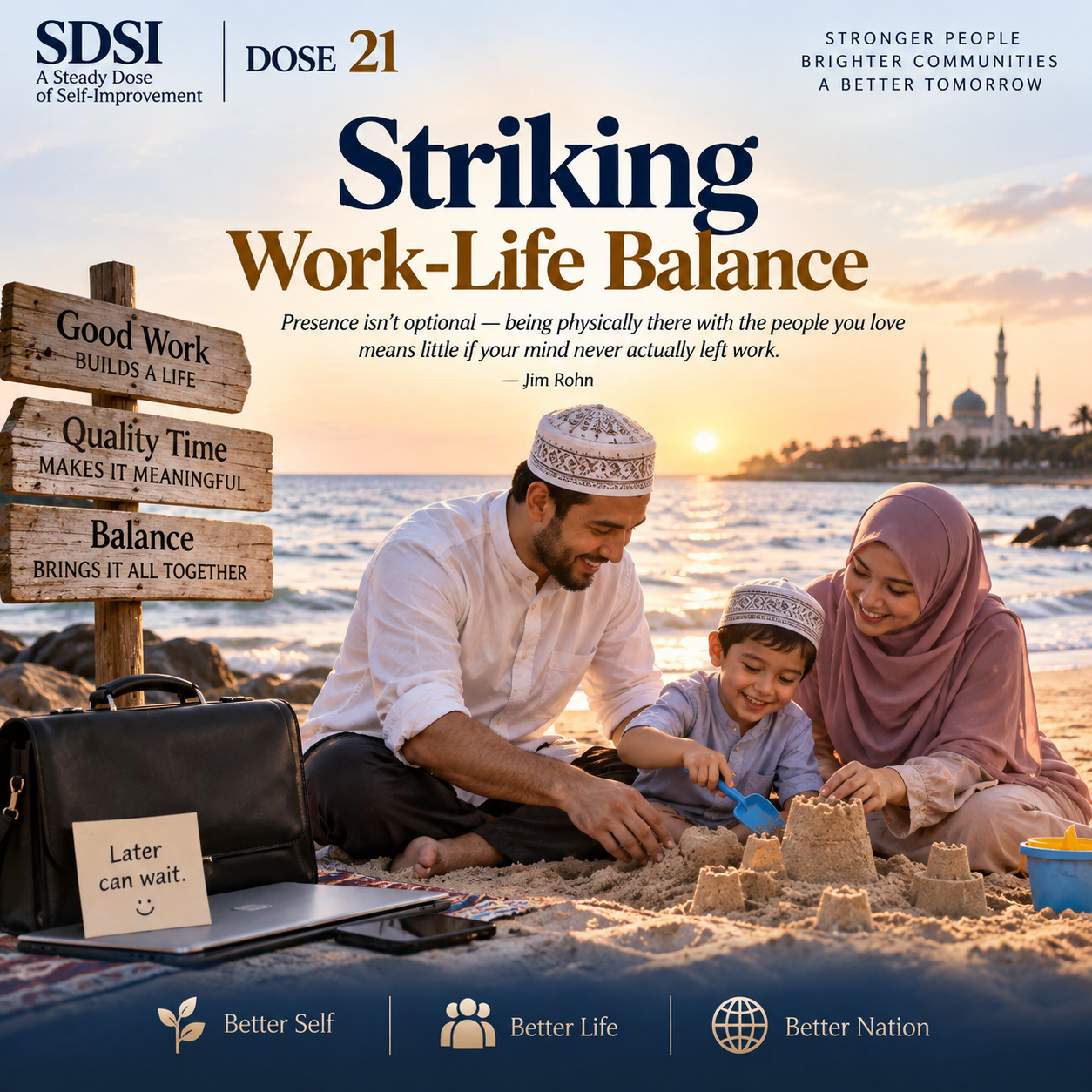
Presence isn’t optional — being physically there with the people you love means little
if your mind never actually left work.
Jim Rohn once took his family to the beach. He brought his briefcase.
Striking a balance between personal undertakings and professional endeavors is easier said than done. Yet few things matter more to the quality of our lives than getting this balance right. A life tilted too far toward work may make us productive while leaving us personally impoverished. But neglecting meaningful work and responsibility can also deprive us of the sense of purpose and accomplishment they provide.
Work-life balance is not simply a matter of dividing our hours equally between work and home. It depends not only on the time we spend physically at work, but also on the energy, focus, and attention that work continues to demand after we leave.
You can leave the office and still be psychologically at work — replaying problems, answering messages, planning tomorrow, or worrying about what remains unfinished. True balance therefore requires something more difficult than simply going home: learning to mentally disengage from work when work is done.
Jim Rohn illustrated this lesson with a simple story. He recalled taking his family to the beach while bringing his briefcase along. His family was not pleased. The lesson was unmistakable: being physically present with the people you love is not enough if your attention remains somewhere else.
Presence isn’t optional.
When you’re with your family, be with your family. When you’re resting, allow yourself to rest. When you’re working, give your work the attention it deserves. Balance comes not from giving everything equal time, but from giving each part of life the attention it deserves when its time comes.
Arianna Huffington learned a similar lesson far more painfully. After collapsing from exhaustion and injuring herself, she began questioning conventional definitions of success built primarily around money and power. Her experience eventually helped shape her advocacy for a broader measure of success—one that includes well-being, wisdom, wonder, and our capacity to live fully.
My own experience teaching at a university in South Korea has given me something I have learned not to take for granted: protected time outside work. My teaching schedule and semester breaks have allowed me time to write, connect with family, pursue personal projects, and simply rest.
That experience has taught me that time away from work is not necessarily time taken from productivity. Properly used, it can replenish the very energy, creativity, and perspective that make productive work possible.
Work is an important part of life.
But work is not life itself.
The goal is not to work less simply for the sake of working less. Nor is it to divide every day neatly into equal portions. The goal is to build a life in which professional accomplishment does not require sacrificing the people, experiences, health, and moments that make accomplishment worth having.
Pause and Reflect
When you’re with the people you love, are you truly present — or is work still occupying your mind?
One Step Forward
Choose a specific time after which you won’t check work messages tonight. Hold that line, even if it feels uncomfortable.
Explored in full in Chapter 13 — Work-Life Balance of A Holistic Approach to Self-Improvement.
Better Self… Better Life… Better Nation.
Effective Communication
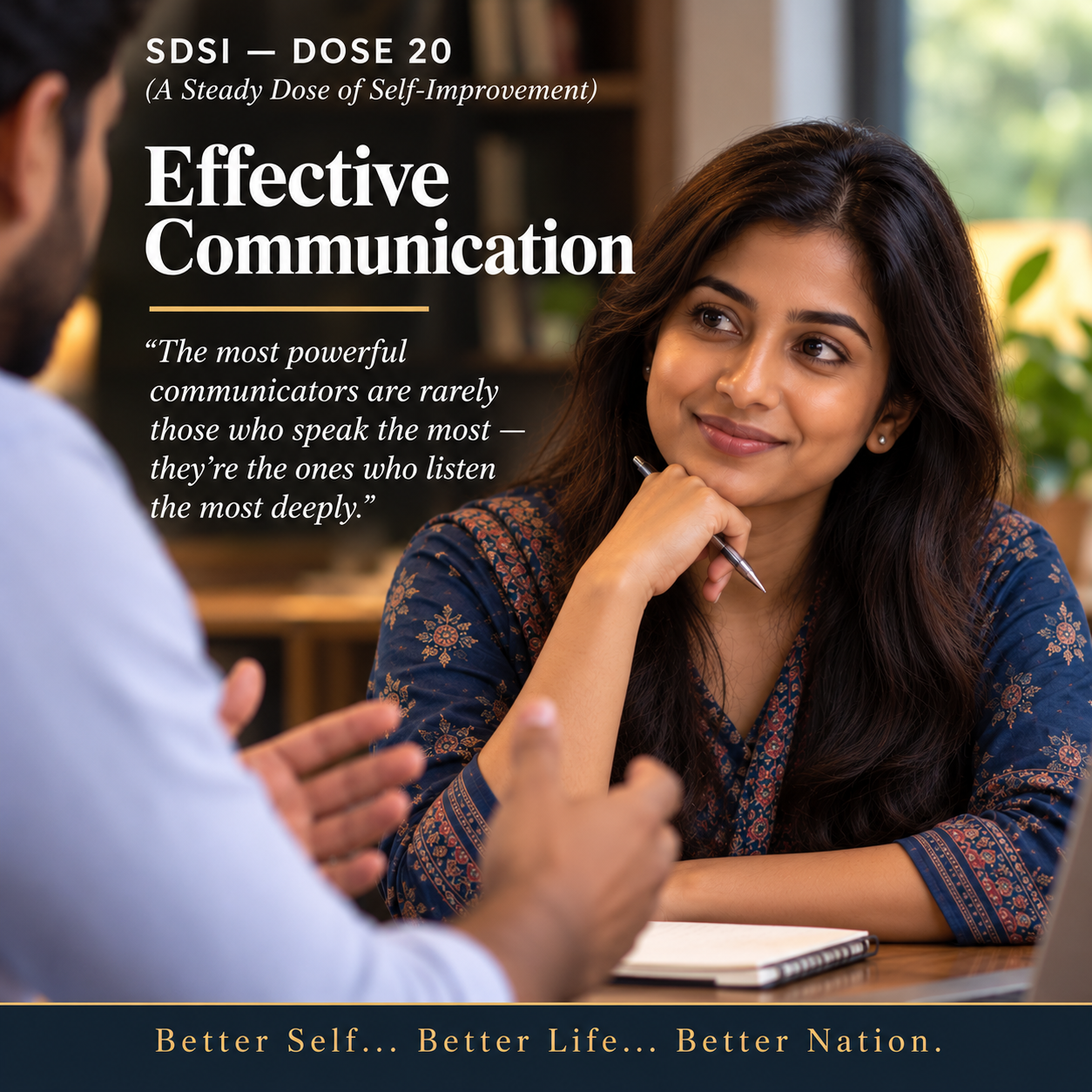
The most powerful communicators are rarely those who speak the most — they’re the ones who listen the most deeply.
Nelson Mandela’s greatest communication skill wasn’t his speeches. It was his listening.
Of all the skills in the Competence Framework, effective communication may be the most universally required. Every relationship you build, every idea you want to share, every conflict you hope to resolve depends on your ability to communicate clearly, honestly, and with genuine attention to the person on the other side of the conversation.
At its simplest, communication is the exchange of information. But effective communication is more specific: it’s communication that achieves its intended purpose — the message sent is the message received, understood, and responded to appropriately. That requires five elements working together: sender, message, channel, receiver, and feedback, all shaped by context and threatened by noise.
Nelson Mandela, who appears in several chapters of this book for good reason, was one of the most powerful communicators of the 20th century. What made him extraordinary wasn’t rhetorical brilliance alone, but the quality of his listening. He studied his opponents carefully, understood their perspectives before engaging them, and found language that could reach across divides rather than deepen them.
Oprah Winfrey built one of the most successful media empires in history largely on her capacity for active listening. In her interviews, she was famous for making her subjects feel genuinely heard, which led them to share more openly and authentically than they had with almost anyone else. She understood that the most powerful communicators are often not those who speak the most, but those who listen the most deeply.
Active listening means giving the speaker your full, undivided attention: no phone, no mental composing of your response while they’re still talking. After someone speaks, reflect back what you heard: ‘So what I’m hearing is…’ This simple practice dramatically reduces misunderstandings and signals that the other person has genuinely been heard — the precondition for any productive exchange.
Pause and Reflect
What is the biggest barrier to effective communication in your own life — and what would change if you removed it?
One Step Forward
In your next conversation, practice reflecting back what you heard before responding. Notice how it changes the exchange.
Explored in full in Chapter x — Effective Communication of A Holistic Approach to Self-Improvement.
Better Self… Better Life… Better Nation.
Purposeful Decision-Making
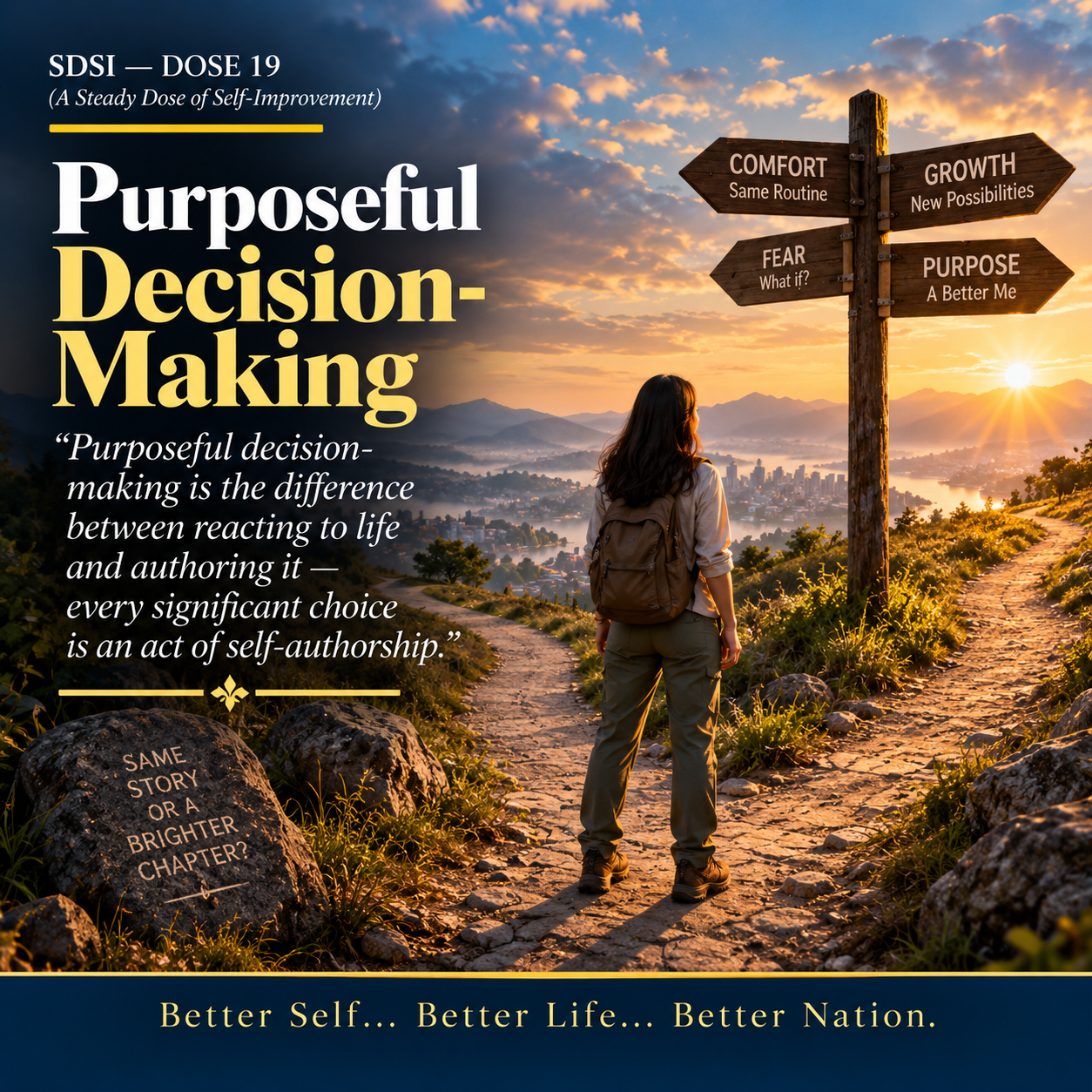
Purposeful decision-making is the difference between reacting to life and authoring it —
every significant choice is an act of self-authorship.
Are you where you are by design, or by default?
Your life is the product of the chain of decisions youUve made since you began taking control of it. Every choice, from the inconsequential to the life-altering, has shaped the person you are today. And every decision from this moment forward will continue shaping who you become.
Purposeful decision-making is the practice of making choices consciously aligned with your values, goals, and long-term vision, rather than choices driven by habit, fear, or the path of least resistance. It is the difference between reacting to life and authoring it. Pause and look honestly at where you are. Are you there by design, or by default?
In the year before I decided to leave the Philippines to teach ESL in South Korea, I found myself in what I can only describe as my own version of Chuck Noland’s deserted island in Cast Away — stranded in positions that, despite their prestige, were draining rather than fulfilling. I had served as a school principal and a dean. I chose not to stay, because I had no peace of mind and knew I would not grow.
My loved ones considered it reckless. I had a good position, a decent salary, other income. Some cited an upcoming government post with job security. But I applied for ESL positions abroad anyway, faced rejection from three Middle East universities, learned what I was missing, obtained a TESOL certificate, and was eventually hired in South Korea. That single decision, made in early spring of 2013, reshaped everything.
It was not an impulsive leap. It was a calculated risk, made with full awareness of what I was putting on the line and faith in my preparation and values. Mel Robbins was right: I was one decision away from a completely different life. And I made that decision on purpose. As the character Socrates says in Peaceful Warrior: ‘Life is a choice. You can choose to be a victim or anything else you would like to be.’ I chose. And I have no regrets.
Pause and Reflect
Is there a decision you’ve been avoiding that you know, deep down, needs to be made? What’s holding you back?
One Step Forward
Write down one decision you’ve been putting off. List what you’re afraid of, and one small first step you could take this week regardless.
Explored in full in Chapter 12 — Purposeful Decision-Making of A Holistic Approach to Self-Improvement.