Blog Archives
Big Heads, Small Hearts
Why Education Must Go Beyond Knowledge and Skills

Today, I introduced a lesson on conditional sentences and the conjunction if with a quotation: “If you don’t believe in yourself, no one will.”
What was supposed to be a discussion of English grammar became something more meaningful. My students began asking questions, and before I knew it, we were discussing self-belief, personal development, and the attitudes that influence how we approach life.
I welcomed their questions. In fact, I found myself enjoying the discussion immensely. After all, I have always believed that my responsibility as a teacher extends beyond teaching grammar, vocabulary, and the various competencies required in an English language examination.
I am not simply preparing my students to pass an examination. I would like to believe that, in my own little way, I am also helping prepare them for life.
And that brings me to a question I believe every educator and educational institution should occasionally confront:
What is the purpose of education if it produces knowledgeable and highly skilled individuals who lack the character to use their knowledge and skills responsibly?
Beyond Knowledge and Skills
Education is commonly associated with the acquisition of knowledge and the development of skills. Students attend school to learn facts, understand concepts, master procedures, solve problems, and develop competencies that will eventually help them pursue careers and contribute to society.
These are undoubtedly important objectives. I would be the last person to suggest otherwise.
But education, as I understand it, involves four equally important dimensions: Knowledge, Skills, Attitudes, and Values (KSAV).
Knowledge concerns what we know.
Skills concern what we are capable of doing.
Attitudes influence how we approach ourselves, other people, our responsibilities, and the challenges we encounter.
Values provide the moral and ethical foundations that guide our decisions, behavior, and relationships.
The first two dimensions largely determine our competence. The latter two profoundly influence how that competence is exercised.
A person may possess an impressive amount of knowledge and extraordinary technical abilities. But what happens when that person lacks integrity, compassion, humility, and a sense of responsibility?
Intelligence can be used to enlighten or deceive. Communication skills can be used to inspire or manipulate. Leadership abilities can be exercised to serve others or exploit them.
The difference often lies not in how much people know or what they can do, but in the attitudes they possess and the values that govern their actions.
Knowledge and skills make us capable. Attitudes and values help determine whether we use those capabilities constructively or destructively.
The Values I Carried Into My Classroom
Looking back, I cannot help reflecting on how much of my educational philosophy was shaped and strengthened by the nine years I spent as a teacher and administrator at St. Mary’s College of Baliuag, one of the educational institutions administered by the Religious of the Virgin Mary (RVM) sisters in the Philippines.
During those years, I was immersed in an educational culture guided by the Ignacian core values of Faith, Excellence, and Service. These were not merely ideals expressed in institutional statements or displayed on school walls. They were principles integrated into educational practices, institutional policies, and the everyday experiences of teachers, administrators, and students.
Faith emphasized the importance of moral and spiritual formation. Excellence encouraged the pursuit of knowledge, competence, discipline, and continuous improvement. Service reminded us that our abilities and achievements should ultimately contribute to the welfare of others.
As I reflect on these values, I see how beautifully they complement one another. Faith provides the moral and spiritual foundation upon which character is formed. Excellence encourages individuals to develop their knowledge, skills, abilities, and potential. Service gives purpose to these achievements by directing them toward the welfare of others.
Perhaps I did not fully appreciate at the time how deeply that institutional culture was influencing my understanding of education. But years after leaving St. Mary’s College of Baliuag, and after more than a decade of teaching in South Korea, I find myself continuing to advocate principles that reflect those formative experiences.
I do not attribute my educational philosophy exclusively to my years with the RVM. My upbringing, personal faith, academic preparation, and subsequent professional experiences have also contributed to its development. Nevertheless, I gratefully acknowledge the significant influence of the Religious of the Virgin Mary and St. Mary’s College of Baliuag in strengthening my belief that education should nurture both intellectual competence and moral character.
The institution where I teach has changed. The students I teach have changed. But the values I carried from those formative years remain part of the educator I am today.
Big Heads, Small Hearts
One of my concerns about contemporary education is the possibility that schools may become so preoccupied with academic performance, examination results, professional qualifications, and employability that character formation receives insufficient attention.
We celebrate academic excellence, intellectual achievement, and technical proficiency. We encourage students to accumulate information, earn degrees, obtain certifications, and develop increasingly sophisticated competencies.
There is nothing inherently wrong with these pursuits. They are essential to individual advancement and social progress.
But what if, in our enthusiasm to fill students’ minds, we neglect to nurture their hearts?
We may eventually produce individuals with big heads bursting with knowledge but small hearts lacking compassion, humility, and concern for others.
Imagine a society filled with highly educated individuals who are intellectually brilliant but morally indifferent. People who can solve complicated mathematical problems but cannot appreciate another person’s suffering. Professionals who possess impressive credentials but regard dishonesty as acceptable when it serves their interests. Leaders who know how to exercise authority but have never learned the importance of exercising it with humility and compassion.
Such individuals may be successful by conventional standards. They may accumulate wealth, occupy prestigious positions, and command considerable influence.
But can we confidently regard them as genuinely educated?
A degree may certify academic achievement. It does not necessarily certify good character.
And a society populated by competent individuals who lack a sense of ethical responsibility may find that its greatest problems are created not by ignorance but by the misuse of intelligence.
The Leaders Sitting in Our Classrooms
When I look at my students, I do not see merely young people preparing for examinations or future employment.
I see potential parents, professionals, entrepreneurs, educators, and leaders.
Some may eventually lead families. Others may become influential members of their communities, organizations, or circles of friends. A few may even occupy positions from which their decisions affect thousands or millions of people.
Whatever paths they choose, their knowledge and skills will certainly matter.
But so will their attitudes and values.
A future parent needs more than the financial ability to support a family. That parent also needs patience, understanding, and compassion.
A future employer needs more than managerial competence. That employer also needs fairness, integrity, and respect for employees.
A future leader needs more than intelligence and persuasive communication skills. That leader also needs humility, accountability, and a genuine concern for the welfare of others.
These qualities do not automatically emerge when students graduate.
They must be cultivated, practiced, questioned, and strengthened throughout the educational journey.
Of course, schools cannot assume sole responsibility for character formation. Families, communities, religious and cultural institutions, and personal experiences all contribute to shaping an individual’s attitudes and values.
Nevertheless, schools occupy a particularly influential position. For many years, students spend a considerable portion of their waking hours in classrooms, interacting with teachers and classmates, encountering different perspectives, and developing habits of thought and behavior.
Surely, such an environment offers opportunities to cultivate not only intellectual competence but also personal character.
Teaching Grammar, Teaching Life
Let me return to today’s classroom discussion.
Our lesson concerned conditional sentences. Grammatically, the word if introduces a condition and allows us to express possibilities, consequences, imagined situations, and relationships between events.
I could have introduced the grammatical structures, presented examples, assigned exercises, and assessed my students’ understanding.
That would have been a perfectly legitimate language lesson.
Instead, I began with a quotation about self-belief.
The quotation became a starting point for questions and discussion. Students were encouraged to consider not only how conditional sentences are constructed but also the meaning of the ideas expressed through them.
And that is precisely the kind of opportunity I believe teachers should recognize.
A lesson on conditional sentences can become a discussion about choices and consequences.
A reading passage about success can invite reflection on perseverance, discipline, and integrity.
A speaking activity about leadership can encourage students to examine the qualities of a responsible leader.
A writing task about social problems can help develop empathy and awareness of the experiences of others.
None of these requires abandoning the academic objectives of the lesson.
On the contrary, meaningful content can make language learning more engaging while encouraging students to think critically and reflect on their own beliefs.
This does not mean teachers should impose their personal convictions on students. Character education should encourage thoughtful reflection, respectful disagreement, and the development of sound judgment—not unquestioning acceptance of a teacher’s opinions.
Indeed, students should be encouraged to question even the quotations we present to them.
Consider the statement I used today: “If you don’t believe in yourself, no one will.”
It is a powerful reminder of the importance of self-belief. Yet it is not universally true. Sometimes, a parent, friend, or teacher believes in someone long before that person discovers confidence in themselves.
Recognizing such nuances can make the discussion more meaningful.
And perhaps, through conversations like these, students learn something valuable about both language and life.
Education That Reaches the Heart
I am not suggesting that every grammar lesson should become a lecture on morality or that teachers should sacrifice academic rigor in favor of inspirational discussions.
Far from it.
Students deserve competent instruction, well-designed learning experiences, meaningful assessments, and opportunities to develop the knowledge and skills necessary for their future endeavors.
But I believe they deserve something more.
They deserve an educational environment that encourages honesty, respect, accountability, compassion, self-discipline, and a sense of purpose.
They deserve teachers who recognize that the way they treat students may be as influential as the lessons they deliver.
After all, students learn not only from what teachers say but also from how teachers behave.
A teacher who speaks about respect but humiliates students sends a contradictory message.
A teacher who emphasizes honesty but practices favoritism undermines the very value being taught.
Conversely, a teacher who demonstrates patience, fairness, humility, and genuine concern for students provides living examples of the attitudes and values that education should nurture.
In this sense, character formation is not confined to a particular subject or classroom activity.
It is woven into the everyday experiences of schooling.
And perhaps this is one of the most enduring lessons I carried from my years at St. Mary’s: the values an institution professes become truly meaningful only when they are reflected in the everyday actions of the people within it.
When Education Truly Educates
I often remind myself that the students sitting before me today will eventually leave the classroom and enter a world where their decisions will affect other people.
Some may forget the grammatical rules I taught them. Others may never again encounter the particular reading passages or vocabulary exercises we discussed.
But I hope that some of the ideas we explored will remain with them.
Perhaps one day, when confronted with a difficult decision, a former student will remember a classroom discussion about integrity.
Perhaps another, struggling with self-doubt, will recall a conversation about self-belief.
Perhaps someone who eventually occupies a position of authority will remember that leadership is not merely about power but also about responsibility and service.
I cannot know whether these things will happen. Nor can I claim that a few classroom conversations will necessarily transform someone’s character.
But I believe the possibility is worth pursuing.
Education should prepare students not merely to earn a living but also to live meaningfully and responsibly.
It should develop minds capable of understanding the world and hearts willing to make that world better.
And if our educational institutions succeed in producing brilliant minds but fail to encourage the development of good character, we must ask ourselves whether we have truly fulfilled the purpose of education.
For what good is a head filled with knowledge if the heart has little room for humanity?
Perhaps the greatest achievement of education is not simply producing individuals who know more and can do more.
It is helping develop individuals who, because of what they know, what they can do, what they believe, and what they value, are capable of becoming better human beings.
Big minds and big hearts.
That, to me, is what education should aspire to cultivate.
TEACHER OR LECTURER?
A Reflection on What It Really Means to Teach

“Teaching starts with a relationship. Until then, you are just a dancing monkey standing
in front of your students performing tricks.”
~ Andrew Johnson~
I. The Question Worth Asking
Not everyone who stands in front of a classroom truly teaches.
Some deliver content. Others shape minds. The titles may be identical — Teacher, Instructor, Professor — but the intentions, mindsets, and commitments behind them often are not. And this gap, quiet as it sometimes is, makes all the difference in the world to the students sitting in those chairs.
This raises an uncomfortable yet necessary question — not to accuse, but to reflect:
Are you a teacher? Or are you merely a lecturer?
These are not the same thing. A lecturer delivers content; a teacher transforms it into learning. A lecturer measures success by how much material was covered; a teacher measures it by how much understanding was actually built. Lecturers speak to students; teachers listen to them. A lecturer is satisfied when the lesson ends on time; a teacher is troubled by what remains unclear after the bell rings.
All teachers lecture at times — that is unavoidable. But not all who lecture truly teach. The distinction lies not in the method but in the mindset: Does this person see their role as the transmission of information, or as the cultivation of human potential?
II. How Teachers Differ From One Another
Even among those who genuinely intend to teach, no two practitioners approach the profession in exactly the same way.
Like fingerprints, their mindsets, tendencies, and personal philosophies are unlikely to be identical. Given the same course syllabus, we cannot expect any two teachers to design the same lesson plans or implement the same strategies. Some approach each class with meticulous preparation; others improvise; and some — regrettably — do not plan at all.
Work attitudes vary just as widely. There are teachers acutely conscious of the hours stipulated in their contracts, unwilling to extend themselves beyond what is formally required. There are others who go far beyond — who assist students outside teaching hours, volunteer for tasks no one asked them to do, and give freely of their time and energy without expectation of compensation.
And then there are those who arrive late, leave early, and submit required paperwork only when pressed — or not at all. If you are a teacher reading this, the question is not which group others belong to, but which group you honestly belong to yourself.
No one can force a teacher into the second group. But every teacher owes it to their students — and to themselves — to stay as far as possible from the third.
There are also teachers who are perpetual fault-finders — those who can always identify what is wrong with a policy, a colleague, or an administrator, but rarely what might be improved. When they find fault, they whine about it or gossip about it, or both. This habit does not make them critical thinkers. It makes them corrosive presences in a community that depends on trust and collaboration.
III. How Teachers Treat Their Students
Perhaps no difference among teachers is more consequential than the way they treat the people in their care.
Some set standards so exacting that only the strongest students can meet them, leaving the rest behind without apology. Others calibrate their expectations thoughtfully — maintaining rigor while ensuring that even the slowest learner has a genuine pathway to success. Some believe in a one-size-fits-all approach, as though all students arrive at learning in the same way, at the same pace, with the same needs. Others recognize that students differ profoundly in learning styles, abilities, languages, and personal histories — and they differentiate their methods accordingly.
Numerous studies confirm what students have always known intuitively: among the most valued qualities in an effective teacher are the ability to build genuine relationships, and a patient, caring, and kind personality. These are not soft virtues. They are the foundation on which all learning is built.
What causes some teachers to treat students with indifference or harshness? Sometimes the answer lies in upbringing or in the treatment they themselves received as students — a sad inheritance, passed unconsciously from one generation to the next. Sometimes it is simply burnout. Exhaustion does not excuse poor teaching, but it does help explain why some teachers gradually lose the fire they once had. Compassion, it turns out, is not inexhaustible. It must be renewed.
IV. The Heart of the Matter: Passion and Compassion
At its deepest level, the difference among teachers may be reduced to two qualities — and what each teacher does or does not possess of them.
There are teachers who possess both passion and compassion.
There are teachers who have only one of the two.
There are teachers who have neither.
Passion is what drives a teacher to prepare thoroughly, to stay current in their field, to search for better methods even when existing ones are adequate. It is the restlessness of someone who genuinely believes that this lesson, this class, this student deserves their best effort.
Compassion is what keeps that passion human. It is what reminds a teacher that behind every exam score is a person — with pressures, fears, histories, and hopes that the classroom did not create and cannot simply ignore.
Without passion, teaching becomes mechanical. Without compassion, it becomes cold. Without both, it becomes something that should not be called teaching at all.
If you are a teacher reading this — and if, in honest reflection, you find yourself in the third category — it may be time to ask whether you are in the right profession. That is not an accusation. It is an invitation to reconsider, before another generation of students pays the price for a choice that was never truly theirs to make.
V. The Question of Training — and Its Limits
One of the gravest mistakes an institution can make is hiring someone with no pedagogical training to teach.
Knowledge of a subject is not the same as the ability to teach it. Being a mathematics wizard does not automatically make one a mathematics teacher. Having perfect pronunciation and impeccable grammar does not make one an English teacher. Teaching requires something beyond subject mastery — it requires the ability to make that mastery accessible, to motivate learners who do not yet share it, to design assessments that genuinely measure growth, and to adjust strategies when understanding has not yet arrived.
To be fair, there are rare individuals who compensate for the absence of formal training through humility, mentorship, and a genuine hunger to learn the craft. But these are exceptions, not the rule. And relying on exceptions as a hiring strategy is a gamble made at students’ expense.
Yet perhaps the more troubling question is not about the untrained. It is this:
Why are there teachers who were trained to teach, yet behave as though they were not?
Teachers’ conduct is shaped by the educational philosophy they develop through their training — an evolving framework built from theory, practice, experience, and the personal belief systems they carry into the classroom. That philosophy, whether articulated or not, is visible in every decision a teacher makes: how they speak to students, how they respond to failure, how they handle disagreement, how they use — or misuse — the authority their position grants them.
When teachers act or speak in ways that diminish students, ignore professional codes, or prioritize personal comfort over student welfare, they are not simply having a bad day. They are revealing what they truly believe about teaching — and about the people they were hired to serve.
Common sense, even in the absence of formal training, should be enough to remind any adult in a position of influence: words carry weight. Actions leave marks. Students remember — sometimes for a lifetime — how their teachers made them feel.
VI. A Calling, Not a Paycheck
Teaching is not a neutral act.
Every teacher who enters a classroom makes a choice — consciously or not — about what kind of presence they will be. They can be a source of clarity or confusion, of encouragement or discouragement, of possibility or limitation. They can be the reason a student discovers a love of learning, or the reason that love dies quietly before it ever had a chance to grow.
The difference between a teacher and a lecturer is not merely technical. It is ethical. It is a question of whether one has accepted not just the job title, but the responsibility that comes with it — the responsibility to know your students, to adjust your methods, to take ownership of whether learning is actually happening, and to care about the answer.
A lecturer fills the time. A teacher uses it. A lecturer covers the syllabus. A teacher uncovers the student.
Not every teacher will be extraordinary. Not every lesson will ignite a passion. But every teacher can choose, on any given day, to be present — truly present — for the people who have been entrusted to their care.
That choice is available every single morning. It costs nothing except the willingness to make it.
That is — if they care.
If teaching is still a calling, and not merely a paycheck.
★ ★ ★
— M.A.D. Ligaya, PhD
Native Speaker…ism

A couple of weeks ago, I was at our university’s English lounge when a colleague from a native-speaking country, who was chatting with one of our Korean students, suddenly called my attention. He said he just wanted to confirm that I was from a country where English is not the native language. I responded in the affirmative, and he went on to mention some of my countrymen who are also part of our university’s foreign faculty. He then reiterated to the student that English is only a second language to us Filipinos.
At that moment, I felt uncomfortable. Was this another case of native speakerism? Was this yet another instance where someone implied that the native variety of English is inherently superior, while the English spoken by non-native speakers is somehow lesser? Was he indirectly suggesting that he was a better English teacher than I am, simply because he happens to be a native speaker?
I was tempted to approach the table where they were conversing, but I held my horses. I inhaled, then exhaled—flooding my brain with the oxygen that, according to positive psychology experts, is often lacking in the gray matter between one’s ears when negative emotions, such as anger informed by patriotism, begin to rise. I did it one more time: I inhaled (counting one, two, three, four) and exhaled (counting one, two, three, four) again.
But it wasn’t working. While my arteries were busy transporting oxygen to my skull, the floodgates of my hippocampus seemed to open, reminding me of an unfortunate experience last summer. The Immigration officers had denied my request to teach at an English camp simply because I was not from any of the seven native English-speaking countries. Despite my explaining that I was already teaching English at a university in South Korea—and that my university had authorized me to teach at that camp—they stood firm on their decision. Their reasoning was that only native speakers could teach there. I wanted to ask why Immigration would allow me to teach English at a university but not at a small English camp. It seemed illogical and unreasonable. However, I decided to move on, considering it a learning experience and choosing not to jeopardize my future interactions with the officers I would eventually encounter again for my contract renewal.
I took another deep breath, this time with my eyes closed. In the darkness, I imagined two figures whispering into my ears—one with horns and a pitchfork, urging me to confront my colleague and demand why he needed to stress that English is merely a second language to Filipinos; and the other with beautiful wings and a gleaming sword, gently reminding me that I didn’t know the full context of their conversation and that perhaps he meant no harm.
I suppose I had taken in just enough oxygen for the “Andres Bonifacio” in me to yield to the “Jose Rizal.” I heeded the whisper of the one with the sword.
I slipped on my earphones, shutting myself off from the rest of their conversation. I would rather not have anything more to do with it.
Since then, every time I see that colleague, the memory of that encounter still crosses my mind, but I shrug it off, knowing that one day I’ll forget it altogether.
Then, two days ago, I received a text message while working out at the gym. A reliable source informed me that our university has released the results of this year’s faculty evaluation for foreign faculty members. Three Filipinos landed the top spots—first, second, and third. I recalled that last year (and almost every year I can remember), Filipinos were consistently among the top-performing foreign English teachers at our university.
Now, I’ll leave it to you to draw the moral of this story.
A Note From My Students

Today, it’s Teachers’ Day here in South Korea. What could be more exhilarating than at the beginning of the class, students would hand you an expression of their appreciation for the things that you do as a teacher. I knew that at that moment, I must stop teaching and read the note. I was teary but bowed my head low so my students wouldn’t notice it. I don’t know if I succeeded in hiding from them that their gesture moved me. Those were not just tears of joy but triumph. I feel triumphant, for I could see from what they have written how my goals of establishing a good rapport with my students and making learning fun have panned out.
They call me 할아버지 [ha-ra-beo-ji], grandpa in English, because during the first day of class, when they saw the PhD at the end of my name, one of them asked how they should address me – Doctor Tony, professor Tony, or what. I told them I don’t like to be addressed as a doctor or professor, and Tony Harabeoji is better. They laughed that time, but I told them I was serious. They can call me either Tony or Tony harabeoji. When I said the same thing, one of my students in another class said, “What about oppa Tony?”. I said, “No.. I prefer Tony harabeoji.”
After the class, I reread the note. I reflected on what my students said. I have been an EFL/ESL teacher long enough to understand that there are realities in language learning that are inevitable. It is impractical to set very high expectations when your students in a class belong to different language proficiency levels and come from diverse language learning backgrounds. As a teacher, I always do my best to help students learn in a way that will not make them averse to learning. But in the end, if students are having a bad day and no matter what I do, I wouldn’t be able to make them understand a language lesson, then at least they have fun while attending my class. Making them smile despite their frustration of not being able to grasp the lessons I am teaching and convincing them to try harder next time is a victory. After all, staying motivated to learn despite failure indicates that they learned something more important than language lessons.
“Please Teach Me English!” (2)
(Second of Three Parts)

I’ve realized that getting into K-pop and K-drama has been beneficial for me. It has provided me with valuable insights into the nature and culture of my Korean students even before I taught my first class in their country. Watching the movie “Please Teach Me English” has also been helpful.
The Young-jus and Jang-hyuks
The students in the movie are not regular enrollees in basic education institutions or universities. They are professionals enrolled in what looks like a hagwon (or it could be an adult education center of a university). In reality, classes in hagwons could be a mixture of students and working people.
Through the characters in the romantic-comedy film, I learned in advance about the different types of Korean students and their reasons for learning the language. The students in the movie had to choose English names, like Candy for Young-ju and Elvis for Jang-hyuk. Other students in Catherine’s class had English names like Betty, Julie, Tyson, and Richard, but their real Korean names were not revealed in the movie. I followed Catherine’s example in my classes. I also had my students adopt English names. Most embraced the idea, but some, like Young-ju, were hesitant. When I asked them to adopt an English name in one of my classes, a student suggested I should also have a Korean name. That student named me Hyeong. When I asked why he chose that name for me, he said the word means “big brother” in English, and that’s how he considered me.
The film emphasizes the reasons why Korean students take English classes. Young-ju was chosen to take the class because the head of the government office where she works made it mandatory. Someone in their office must learn English to effectively deal with foreigners.
Around the time the movie was released, the Korean government began to acknowledge the growing interconnectedness of global economies and cultures. South Koreans are actively engaged in international trade, exporting products as well as pop culture, entertainment, music, TV dramas, and movies. They recognize that success in business and international relations relies on establishing connections with the outside world, which necessitates the ability to communicate in English.
Language experts have identified two types of motivation for learning a language: instrumental and integrative. As contextualized in the movie, instrumental motivation is learning for practical reasons, while integrative motivation is learning to connect with others.
Those who are instrumentally motivated to learn a language, like Young-ju, do so to obtain essential qualifications and to improve career prospects. On the other hand, Jang-hyuk is integratively motivated to learn English. He wants to learn the language because his long-lost English-speaking sister, who cannot speak Korean, is visiting South Korea to meet him and their mother. His intention is to be able to “socialize” with somebody who does not speak his native tongue.
Many of my Korean students, like Young-ju, are instrumentally motivated. They aim to obtain the required scores for their English course or to meet specific academic or job requirements rather than to effectively communicate and engage with people from different cultures who speak a different language.
Like Young-ju, Richard is instrumentally motivated. His new boss is a foreigner who conducts his meetings in English. Thus, he must learn the language, even if it’s difficult given his old age. Julie’s reason is akin to Jang-hyuk’s. She is going to migrate to the US soon. The film does not have enough information to help determine Betty and Tyson’s motivation for taking the language course. But Betty seems to enjoy attending English classes, for where Catherine teaches is already her nineteenth school.
The movie also reveals specific characteristics of Korean learners when it comes to language learning. There was one instance when Julie and Betty disagreed with Catherine’s teaching style. They demanded that their teacher do away with preliminary activities or introductions and focus on the primary language skills they wanted to acquire. It is hard to determine if this indicates their impatience or desire to learn only the primary language skills they signed up for. This incident may be unfortunate, as it goes against a trait Koreans are known for – respect for elders and persons in authority. However, it reminds me of what every teacher must bear in mind – that students have expectations that must be met.
What The Students Expect
Before embarking on my journey as an English teacher in South Korea, I read a lot about the country’s culture and people. As an English teacher who would soon teach Korean students, I felt it incumbent upon me to study their culture because of some cultural nuances that may affect or influence my communication with them.
I have watched several K-dramas such as Jewel in the Palace, Stairway to Heaven, Lovers in Paris, Winter Sonata, and Baker King. These shows have taught me a great deal about the people of South Korea. The movie “Please Teach Me English” also gave me insights into Korean students. Furthermore, our TESOL supervisor shared tips on effectively working with ESL/EFL students.
It’s not enough to be guided by the apparent truth that students want to learn and expect their teachers to guide them in their learning journey. Yes, I had been a teacher in the Philippines for over two decades before I came to South Korea. However, students in those countries are of a different breed of learners.
The information the film provided about the characteristics of Korean learners is obviously not enough. So, as I taught during the first weeks of my classes, I took the opportunity to observe my students and determine their tendencies and habits, strengths, and weaknesses.
Korean students have a strong foundation in grammar. They pay more attention to the discussion of grammar points than other topics. They expect their teachers to give them grammatical rules, structures, and many grammar exercises. They tend to understand what they are being taught when presented to them in structural form. This group of learners pays close attention to details and can quickly determine grammar and spelling mistakes. However, they struggle with spoken fluency. As much as they prioritize grammatical accuracy, their speaking proficiency was paid less attention. This makes them feel less confident (or unconfident) in speaking English. My students are aware of this and want me to help them develop confidence in speaking.
Considering that they are from a technologically advanced country, Korean students are highly skilled in using digital tools and accessing online resources for learning. Being so, they expect their teachers to incorporate technology in the classroom; without it, they tend to lose interest. Therefore, I have had to adapt and stay current with the latest educational technologies. For instance, I have transitioned to using Google Forms for assessments instead of traditional paper-based exams. Additionally, I have set up individual Google folders for each student to submit their assignments and other requirements. My presentations need to be visually stimulating as well.
Many of them are highly motivated to excel in English because, as mentioned earlier, they understand its significance in business and international relations. As a result, they persist in their efforts to learn the language and expect to succeed at any cost. Their desire to learn the language sometimes borders on desperation. This is illustrated in a scene in the movie where Young-ju (and another character on a bus) is seen chewing and swallowing pages of a dictionary. It is hard to determine whether that is just a symbolic illustration of their fervent desire to learn the language or if it happened.
I found out that it is true that Korean students, like the rest of their compatriots, demonstrate politeness and respect. In the movie, it may have seemed that Betty and Julie were not polite when arguing with their English teacher. However, Catherine was at fault for repeatedly committing a faux pas by forgetting to include politeness when she talked to her students in Korean. Yes, Catherine is the teacher, but most of her students are adults, and some are even older than she is. This part of the movie may remind foreign teachers that cultural norms regarding social etiquette and English-speaking cultures’ formality levels are different from theirs. Tyson, the most sensible among Catherine’s students, tried to find a way to point this out to their teacher nicely. He advised Catherine to include honorifics if she insists on using Korean when talking to them.
Catherine followed Tyson’s advice. She started including honorifics whenever she used the Korean language, much to the delight of her students. What she did improved communication between her and the students. Their rapport resulted in Catherine enjoying teaching and the students having fun learning.
Establishing A Good Rapport
The film “Please Teach Me English” underscored the importance of rapport. Establishing a harmonious relationship with students is essential in Korean ESL/EFL classrooms. Creating a good rapport between me and my students is something I learned as a teacher a long time ago. I have also read many studies that found that students tend to perform better academically when their teachers establish a good rapport with them. It is one of the foundations of effective learning in any subject area, including English.
I always prioritize building a positive relationship with my students regardless of where I teach. As a foreigner in South Korea, this can be more challenging, so I make a conscious effort to earn the trust of my Korean students. I take special care in planning the class orientation to establish a strong partnership with my students. It’s not just a simple introduction to the course but a foundation for a constructive relationship.
In addition to introducing myself and going over the course content and requirements, I need to establish a good rapport with my students, clarify any misconceptions about the classroom and the teacher, debunk any myths about ESL/EFL teaching, and deliver an encouraging speech to motivate them for the upcoming semester. Together, these elements constitute the script I use religiously when meeting my classes for the first time in a semester.
During the initial meeting, my goal would be to achieve one of the most challenging educational tasks: to change the students’ perception of the classroom as a prison cell, with them as inmates and the teachers as harsh prison guards. Traditionally, Korean students hold a high level of respect for teachers, often seeing them as authoritative figures in the classroom. While this is good for maintaining order and discipline in the class, it can have adverse effects as it affects the development of critical thinking and creativity. My students are reluctant to ask questions, thinking that doing so is disrespectful. Rarely did they participate in discussions, even if they knew the answer to my questions. They would not volunteer to answer, so I had to call on them.
Students deferring too much to their teachers kills their creativity and makes instruction teacher-centered instead of student-centered, which reduces their engagement and motivation. They become overly dependent on their teachers.
I ensured the students felt comfortable in my presence at our first meeting. I emphasized that I am not a “sage on the stage” but rather a “guide on the side,” always ready to assist them. I encouraged them to ask questions, seek clarification, and actively participate in discussions.
Like Catherine, the teacher in the movie, I consciously try to build a positive connection with my Korean students. The first day of class is the perfect opportunity to establish this connection, especially as an expat teacher working with students for whom English is a second or foreign language. Through my research, I discovered that students’ speaking ability is influenced by their attitude towards foreign English teachers. This reinforced my belief that students are more motivated to learn when they perceive their teachers as approachable, friendly, and caring. It solidified my determination to deliver course content and prioritize building a rapport with my students. Just like a farmer must prepare the soil before planting seeds, I understand that gaining the trust and confidence of my students is crucial. Teaching students without establishing a positive relationship with them is akin to sowing seeds on unprepared soil.
Like Catherine, ESL/EFL teachers need to be adaptable and open-minded. When she followed Tyson’s advice to behave and speak in a way acceptable to Koreans, her students began to enjoy her class and became more engaged and interactive. This illustrates that foreign teachers, like myself, must consider cultural nuances when interacting with Korean students. We must learn quickly and try to understand their specific communication styles and social norms.
The whole semester is a marathon, and I believe that by first winning my students’ hearts, our journey together in language learning will be as enjoyable and productive as possible. Gaining their trust means that half of the battle is already won.
Establishing rapport with my students is more complicated due to our cultural barrier. Before I can start teaching, I need to put in more effort than my local counterparts. The cultural barrier immediately arose when I entered the classroom during our first meeting. This barrier makes the students anxious, as they don’t know what to expect from me as their English teacher from a foreign land. The student’s level of English proficiency could add to their anxiety. The lower their language ability, the more uncomfortable they would feel dealing with me. Therefore, I must set the right tone during my class orientation, ensuring my students feel comfortable and confident when interacting with me. Achieving this depends on how I present myself to them the first time we meet. Thus, I must make a good account of myself.
I always strive to make the first day of class memorable wherever I teach, and that’s no different here in South Korea. But here, I have added a new task to my routine during class orientations – to destroy a fallacy, which I will explain in the next section. The rest of my introduction is the same as usual; I present the course contents and requirements. The only difference is that I incorporate humor into my presentation. Those who know me say I have a strong sense of humor and a knack for making people laugh. I use humor as a tool in my teaching because I know it effectively captures students’ attention and makes the learning experience more enjoyable.
I create a relaxed and enjoyable atmosphere when introducing myself to my students during our first meeting. As I previously mentioned, one of my immediate objectives as a teacher is to help the students not feel that the classroom is a prison cell and I am a jail guard. Thus, I would never miss presenting and explaining my educational philosophy to them – “The classroom is my playground. The students are my playmates, and the subject I teach is our toy.” I know it’s unconventional, but I find it to be practical. My students here in South Korea seem to enjoy this approach to teaching as much as my students in the Philippines do.
My self-introduction would always include telling my students the nickname I adopted to elicit laughter whenever I deliver a talk. It’s Tony-Tony-Bo-Bony- Banana-Fanna-Fo-Fony-Fee-Fi-Mo-Mony-Tony. Yes, that’s taken from the song “Name Game” by Laura Branigan. I say that with the exact tune from the song – twice, sometimes thrice. Some students would smile. A few would laugh. I am not sure if that is because of the way I introduce myself or the way I sing.
It is incredible how when I tell my students my long nickname and jokingly threaten them to memorize it, or they will fail in my subject, they try very hard to repeat it after me. If they can’t say it, they laugh at themselves. I always add, “Whoever can say my nickname correctly will get an A+.” Of course, I don’t mean it. Luckily, no one has succeeded in saying it correctly so far. It’s always me who succeeds – in getting their attention.
When I have their attention, that’s the time I would try to debunk a myth.
“Please Teach Me English!” (1)
(First of Three Parts)

“I don’t speak English well… please teach me.” One or two of my Korean students would tell me this (or a similar statement) in broken English at the end of our first meeting or any class as the semester progressed. Their voice and how they said it straddled between surrender and supplication. I cannot recall a semester where I did not hear something similar to that sentence. It reminds me of the first Korean movie I watched, “Please Teach Me English,” a romantic comedy film. It was recommended by the instructor who supervised the Teaching English to Speakers of Other Languages (TESOL) short course that I took when I decided to include teaching English overseas as one of my career options. Each enrollee in that program was given a VCD copy of the movie. Well, I watched the film not because of TESOL-related intentions but because of the increasing popularity of K-Drama and K-Pop, with which I got hooked. Little did I know that watching that movie would later influence my career path.
There is no shame in admitting that I am one of the millions who became obsessed with Korean cultural content. In short, I got drowned by the Korean Wave (Hallyu) that reached the shores of the Philippines at the turn of the 21st century. Like many of my compatriots (and people from other parts of the world), I became enamored with K-pop and K-drama. Therefore, even if our TESOL supervisor did not mention that the movie provides plenty of tips for foreign English teachers, I would watch the movie. I even revisited the film before completing the program. However, the movie only came back to my mind during my first semester of teaching here in South Korea when my students started approaching me and saying sentences similar to the movie’s title. It prompted me to vividly recall the scenes between the English teacher and her students and made me rewatch the film.
Since then, when students confide in me about their difficulties in learning English, I am reminded of the main characters, Young-ju and Jang-hyuk, in the movie. These characters embody the excitement and struggles many Koreans face while learning English. One scene that particularly stands out is when Young-ju is seen eating pages from a dictionary in hopes of improving her vocabulary. This desperation is a testament to the lengths that some Koreans will go to master the English language.
The English teacher in the story is named Catherine, a native speaker of English from Australia. After watching the movie again, her interactions with students came to mind when I held my classes. Catherine tried to speak Korean to communicate better with her students, which is something I struggle with.
The movie provides insight into the English education system in South Korea. It sheds light on how Koreans perceive English learning and interact with English-speaking foreigners. The film also reveals the differing opinions on the necessity of learning the language. Despite being released in 2003, it still accurately portrays the current realities of English education in South Korea and their belief that English is essential for upward social and economic mobility. It also gave me a deeper understanding of life in Korea and the Korean psyche. The movie succeeded in reconfiguring my “Korean Dream.”
My “Korean Dream”
The constant influx of Korean content in my country’s print and broadcast media sparked a deep interest in the history and culture of South Korea within me. In addition to watching K-dramas on TV, I actively sought out Korean-related materials on the internet and read encyclopedia entries about the country south of the 38th parallel line. Gradually, I found myself becoming more and more immersed in Korean culture. Instead of using traditional greetings like “hello” and “thank you,” I began using “annyeonghaseyo” and “gamsahamnida.” When expressing deep affection, I started saying “saranghaeyo” instead of “I love you.” I even began singing Korean songs and desired to try their food, particularly the legendary Kimchi. Over time, my interest in everything related to Korea grew.
The cultural influences of South Korea on my homeland have ignited a strong desire within me to visit the country and explore the locations featured in TV shows and movies. I have always wanted to come here to fulfill that desire. I had many plans for my trip, such as riding the subway system in Seoul, strolling through Myeongdong at night and trying street food, spending my summer vacation on the beautiful island of Jeju, tasting soju and maekju, and trying the unique combination of the two, known as somaek. I also looked forward to savoring Korean dishes prepared by local chefs, wearing traditional hanbok outfits, and immersing myself in the culture by interacting with native Korean people. This is how my dream of experiencing Korea began and has become deeply rooted in my mind.
After watching the movie “Please Teach Me English,” I dreamt of teaching English in South Korea. Initially, I wanted to teach English at a university in the Middle East, but then I started thinking, why not teach in the country I have been fascinated with for so long? My dream of visiting South Korea as a tourist turned into a desire to live and work here.
When I was training for TESOL, I was then experiencing severe burnout from years of work as a school administrator. It did not help that I was confronted by personal demons at the same time. That personal circumstance required that I make not only a change in my career but also in my environment. That’s when I decided to apply for a position as an English teacher here in South Korea. This country is a popular destination for English teachers due to the attractive salaries and excellent benefits. However, there is intense competition among native English speakers for teaching positions in schools and hagwons (private academies). Non-native English speakers encounter even more tremendous obstacles in securing these positions, and their prospects of landing a teaching role in the language department of a South Korean university are slim. It’s like trying to find a needle in a haystack. If you’re not a citizen of a country that belongs to the inner circle of the concentric circles model of the English language, it’s nearly impossible to get hired.
I couldn’t believe it when, for the first time, I read in an advertisement for ESL/EFL teachers the lines “Only native speakers of English may apply!”. I thought it was a prank. But it wasn’t. Why native speakers of English are accorded that preference or almost an exclusive right to teach Korean students is unfathomable. Fortunate and privileged are the “Catherines” of the world.
Blessed “Catherines”
When I began searching for teaching positions abroad, I noticed numerous job openings for English teachers in South Korea. However, I was disappointed to find very few opportunities for non-native English speakers like myself, while there were many for native speakers like the character named Catherine in the movie. I couldn’t help but grudgingly think that being a “Catherine” in this world is a privilege. I was surprised to learn that many universities in Asian countries such as South Korea, China, Japan, Vietnam, and the Middle East only preferred to hire native English speakers to teach the language. I realized this policy existed when I started looking for teaching positions abroad. I never thought that native-speakerism was a real thing. In a world as diverse as ours, it seems unfair that only native English speakers can teach the language.
Is the “only native speakers of English may apply” policy fair, just, and acceptable? If I get to respond to the question, the answer is already apparent. So, I decided to seek the opinion not of a non-native English speaker or a native speaker of the language but of a neutral entity – ChatGPT.
ChatGPT explains that “being a native speaker does not necessarily equate to being a skilled language teacher. Teaching requires specific training and expertise in pedagogy and language instruction, which native speakers may not possess. Additionally, non-native speakers who have learned English as a second language often have firsthand experience with the challenges that learners face, making them empathetic and effective teachers.” It added that “the effectiveness of language teaching depends on various factors, including the qualifications, experience, and teaching approach of the instructor, rather than solely on their native speaker status. Therefore, a more inclusive approach that values expertise and diversity in language education may be a wiser policy in promoting effective language learning for all students.”
I have worked with English teachers from specific countries over the years and observed their personalities and levels of professionalism. Additionally, as a member of the hiring team at the university where I currently teach, I have gained insight into job applicants’ educational qualifications and training. As shown in their CVs, some who tried to apply for a teaching position in our university are legitimate and qualified ESL/EFL teachers, but some were hired mainly because of their country of origin. They have been teaching in South Korea for a long time but are not English majors and have not graduated from courses aligned with education and language teaching. If only I could take the liberty to spill (all of) the beans.
It’s puzzling why most universities in South Korea and other Asian countries prefer to hire only native English speakers to teach the language. This practice is a form of discrimination, and, ironically, Asians themselves deny their fellow Asians equal job opportunities. However, I didn’t give up my dream of living and working as an English teacher in South Korea. Some universities here understand that accent and country of origin should not be the criteria for hiring ESL/EFL teachers. I hoped that some universities would prioritize qualifications, training, language proficiency, and pedagogical skills over accent and country of origin when hiring English teachers.
I was right! Although few and far between, some universities in South Korea do not discriminate against non-native English speakers. I sent an application to all of them. After a challenging application process, a university offered me a teaching contract, even though I am not a “Catherine.” My dream of living and working in this country became a reality. I have been plying my trade here as an English teacher for over ten years.
If there is something else significant that the movie “Please Teach Me English” taught me, it is understanding more about the Young-jus and Jang-hyuks and how to deal with them.
My Continuing Journey In South Korea
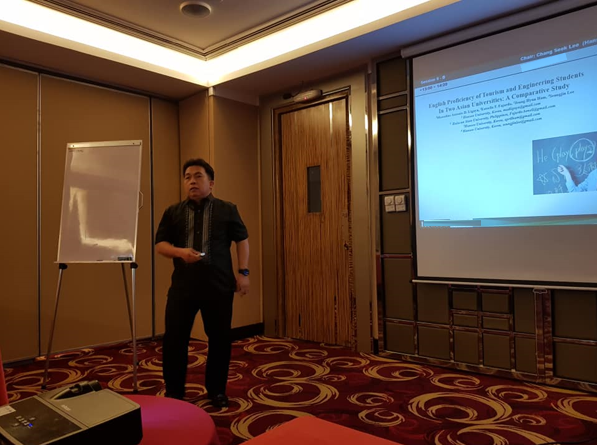
When I quit my job as a school administrator in Bulacan to pursue ESL teaching in South Korea, my loved ones and friends strongly advised me to reconsider. They reminded me that I already had a solid career in the academe in the Philippines, and the pay was decent. But as Jake Sully says in the movie Avatar, “Sometimes your whole life boils down to one insane move.”
So, in 2013, I flew to South Korea. But it wasn’t an insane move, rather a calculated risk. I have no regrets, as coming here was one of the best decisions I’ve made in my life. Working here has been an enormous blessing. This country is a beautiful place to live. When I arrived, I could confirm the impressions created by the Korean dramas and movies I had watched. Indeed, South Korea is progressive and beautiful, and its citizens are competitive, hard-working, and health-conscious.
Beyond providing financial stability for me and my family, my time in South Korea has fostered tremendous personal and professional growth. The working conditions at the university where I am currently employed are excellent. At first, I could hardly believe that I only needed to work less than 20 hours over four days. We must work only seven months but are paid for the entire year. This arrangement has given me ample time to connect virtually with my family and pursue my other passion—writing. Additionally, our university offers performance points and cash incentives for research projects, further enhancing my love for writing.
I mainly teach English subjects. There have been semesters when I was asked to teach at the graduate school and serve as an adviser to graduate students working on their dissertations. When I’m not engaged in academic work, I dedicate time to writing stories, poems, plays, and scholarly studies, many of which are published on my personal website. Several of my research studies have been presented at international conferences and published in internationally indexed journals. I have genuinely found fulfillment as a writer in this country.
I can’t imagine having any other “job cum hobby” besides teaching and writing. You may ask why. As Seth Godin said, “Do what you love and love what you do.” What I do and love is teaching, and what I love and do is writing. I use the expression “job cum hobby” because, when I engage in these activities, I don’t feel like I’m working; it feels more like pursuing hobbies.
My greatest challenge as a teacher is overcoming the cultural barrier between myself and my Korean students. I address this by building a good rapport with them and diligently fulfilling my responsibilities. Being a Filipino in ESL/EFL teaching places me and my fellow countrymen at a disadvantage. There is a common misconception that only native English speakers can teach the language, and even some of our Korean students believe this. It is something that Filipino English teachers like me must work to dispel. If I were to identify my most significant contribution as a Filipino in my profession, it would be demonstrating to the academic community in South Korea that one doesn’t need to be a native English speaker to be an effective ESL/EFL teacher.
I can’t think of anything negative about my current job; I have nothing but gratitude. I enjoy a harmonious relationship with my coworkers, both Korean and foreign. Although I occasionally clash with fellow foreigners over policy matters and work attitudes, we adhere to the principle of disagreeing without being disagreeable, which helps us maintain mutual respect.
My best advice for my fellow Filipinos working in South Korea is to work hard and respect everyone. Hard work leads to success as expat workers, while respect for others, regardless of citizenship, helps them stay out of trouble. It’s also important to abide by the laws of our host country.
Reflecting on my 12 years here, I see that what began as a leap into the unknown has become the most fulfilling chapter of my life. Teaching and writing—my two greatest passions—have flourished in this country. Embracing new challenges reminds me why I took that “calculated risk” in 2013. South Korea has provided me with opportunities to improve my overall well-being and has reaffirmed my belief that staying true to what you love leads to rewarding outcomes.