Blog Archives
TEACHER OR LECTURER?
A Reflection on What It Really Means to Teach

“Teaching starts with a relationship. Until then, you are just a dancing monkey standing
in front of your students performing tricks.”
~ Andrew Johnson~
I. The Question Worth Asking
Not everyone who stands in front of a classroom truly teaches.
Some deliver content. Others shape minds. The titles may be identical — Teacher, Instructor, Professor — but the intentions, mindsets, and commitments behind them often are not. And this gap, quiet as it sometimes is, makes all the difference in the world to the students sitting in those chairs.
This raises an uncomfortable yet necessary question — not to accuse, but to reflect:
Are you a teacher? Or are you merely a lecturer?
These are not the same thing. A lecturer delivers content; a teacher transforms it into learning. A lecturer measures success by how much material was covered; a teacher measures it by how much understanding was actually built. Lecturers speak to students; teachers listen to them. A lecturer is satisfied when the lesson ends on time; a teacher is troubled by what remains unclear after the bell rings.
All teachers lecture at times — that is unavoidable. But not all who lecture truly teach. The distinction lies not in the method but in the mindset: Does this person see their role as the transmission of information, or as the cultivation of human potential?
II. How Teachers Differ From One Another
Even among those who genuinely intend to teach, no two practitioners approach the profession in exactly the same way.
Like fingerprints, their mindsets, tendencies, and personal philosophies are unlikely to be identical. Given the same course syllabus, we cannot expect any two teachers to design the same lesson plans or implement the same strategies. Some approach each class with meticulous preparation; others improvise; and some — regrettably — do not plan at all.
Work attitudes vary just as widely. There are teachers acutely conscious of the hours stipulated in their contracts, unwilling to extend themselves beyond what is formally required. There are others who go far beyond — who assist students outside teaching hours, volunteer for tasks no one asked them to do, and give freely of their time and energy without expectation of compensation.
And then there are those who arrive late, leave early, and submit required paperwork only when pressed — or not at all. If you are a teacher reading this, the question is not which group others belong to, but which group you honestly belong to yourself.
No one can force a teacher into the second group. But every teacher owes it to their students — and to themselves — to stay as far as possible from the third.
There are also teachers who are perpetual fault-finders — those who can always identify what is wrong with a policy, a colleague, or an administrator, but rarely what might be improved. When they find fault, they whine about it or gossip about it, or both. This habit does not make them critical thinkers. It makes them corrosive presences in a community that depends on trust and collaboration.
III. How Teachers Treat Their Students
Perhaps no difference among teachers is more consequential than the way they treat the people in their care.
Some set standards so exacting that only the strongest students can meet them, leaving the rest behind without apology. Others calibrate their expectations thoughtfully — maintaining rigor while ensuring that even the slowest learner has a genuine pathway to success. Some believe in a one-size-fits-all approach, as though all students arrive at learning in the same way, at the same pace, with the same needs. Others recognize that students differ profoundly in learning styles, abilities, languages, and personal histories — and they differentiate their methods accordingly.
Numerous studies confirm what students have always known intuitively: among the most valued qualities in an effective teacher are the ability to build genuine relationships, and a patient, caring, and kind personality. These are not soft virtues. They are the foundation on which all learning is built.
What causes some teachers to treat students with indifference or harshness? Sometimes the answer lies in upbringing or in the treatment they themselves received as students — a sad inheritance, passed unconsciously from one generation to the next. Sometimes it is simply burnout. Exhaustion does not excuse poor teaching, but it does help explain why some teachers gradually lose the fire they once had. Compassion, it turns out, is not inexhaustible. It must be renewed.
IV. The Heart of the Matter: Passion and Compassion
At its deepest level, the difference among teachers may be reduced to two qualities — and what each teacher does or does not possess of them.
There are teachers who possess both passion and compassion.
There are teachers who have only one of the two.
There are teachers who have neither.
Passion is what drives a teacher to prepare thoroughly, to stay current in their field, to search for better methods even when existing ones are adequate. It is the restlessness of someone who genuinely believes that this lesson, this class, this student deserves their best effort.
Compassion is what keeps that passion human. It is what reminds a teacher that behind every exam score is a person — with pressures, fears, histories, and hopes that the classroom did not create and cannot simply ignore.
Without passion, teaching becomes mechanical. Without compassion, it becomes cold. Without both, it becomes something that should not be called teaching at all.
If you are a teacher reading this — and if, in honest reflection, you find yourself in the third category — it may be time to ask whether you are in the right profession. That is not an accusation. It is an invitation to reconsider, before another generation of students pays the price for a choice that was never truly theirs to make.
V. The Question of Training — and Its Limits
One of the gravest mistakes an institution can make is hiring someone with no pedagogical training to teach.
Knowledge of a subject is not the same as the ability to teach it. Being a mathematics wizard does not automatically make one a mathematics teacher. Having perfect pronunciation and impeccable grammar does not make one an English teacher. Teaching requires something beyond subject mastery — it requires the ability to make that mastery accessible, to motivate learners who do not yet share it, to design assessments that genuinely measure growth, and to adjust strategies when understanding has not yet arrived.
To be fair, there are rare individuals who compensate for the absence of formal training through humility, mentorship, and a genuine hunger to learn the craft. But these are exceptions, not the rule. And relying on exceptions as a hiring strategy is a gamble made at students’ expense.
Yet perhaps the more troubling question is not about the untrained. It is this:
Why are there teachers who were trained to teach, yet behave as though they were not?
Teachers’ conduct is shaped by the educational philosophy they develop through their training — an evolving framework built from theory, practice, experience, and the personal belief systems they carry into the classroom. That philosophy, whether articulated or not, is visible in every decision a teacher makes: how they speak to students, how they respond to failure, how they handle disagreement, how they use — or misuse — the authority their position grants them.
When teachers act or speak in ways that diminish students, ignore professional codes, or prioritize personal comfort over student welfare, they are not simply having a bad day. They are revealing what they truly believe about teaching — and about the people they were hired to serve.
Common sense, even in the absence of formal training, should be enough to remind any adult in a position of influence: words carry weight. Actions leave marks. Students remember — sometimes for a lifetime — how their teachers made them feel.
VI. A Calling, Not a Paycheck
Teaching is not a neutral act.
Every teacher who enters a classroom makes a choice — consciously or not — about what kind of presence they will be. They can be a source of clarity or confusion, of encouragement or discouragement, of possibility or limitation. They can be the reason a student discovers a love of learning, or the reason that love dies quietly before it ever had a chance to grow.
The difference between a teacher and a lecturer is not merely technical. It is ethical. It is a question of whether one has accepted not just the job title, but the responsibility that comes with it — the responsibility to know your students, to adjust your methods, to take ownership of whether learning is actually happening, and to care about the answer.
A lecturer fills the time. A teacher uses it. A lecturer covers the syllabus. A teacher uncovers the student.
Not every teacher will be extraordinary. Not every lesson will ignite a passion. But every teacher can choose, on any given day, to be present — truly present — for the people who have been entrusted to their care.
That choice is available every single morning. It costs nothing except the willingness to make it.
That is — if they care.
If teaching is still a calling, and not merely a paycheck.
★ ★ ★
— M.A.D. Ligaya, PhD
When Students Don’t Learn

One morning, I witnessed how an English teacher masterfully discussed the intricacies of the English language. It would take me a paragraph or two to explain in detail the things he talked about. Let me just say that he is every inch a native English speaker. His knowledge of the phonemes, morphemes, lexemes, syntax, and context is impeccable. He dissected the language so skillfully, and the way he did it almost made me envious. I was reduced to being a listener, uncertain whether I just wanted to make sure not to miss anything new (something I don’t know yet) from what he was saying or I had nothing more to share because he had everything covered about what he was discussing. I wasn’t really sure what prevented me from saying anything. Maybe I was intimidated by his mastery of grammar, semantics, and pragmatics, or I did not like to gatecrash into his moment to showcase his brilliance. Stealing someone’s thunder is not my cup of tea.
That teacher held court in his impromptu lecture. He had the attention of everybody present. It was difficult to judge the intentions of my colleagues whenever they (unsolicitedly) shared their expertise like that. Was it to impress upon us (their co-teachers) that they know that much, or they simply would (good-naturedly) like to help us learn more about the subject (English) we’re teaching.
Later that day, I changed upon a student who had attended my English class in a previous semester. That student was one of the best in my class. Like me, he was heading out of the campus. After the exchange of greetings, I asked, “Who’s your English teacher this semester?” The student had already started responding before I recalled that I had previously made a promise to myself never to ask any of my former students that question for the reason that a few of my previous attempts led to the opening of “a can of worms.”
But it already happened – I asked that stupid question again.
The student named the teacher – he was the one I heard deliver an impromptu lecture about the English language earlier that day. After that, the student heaved a sigh and said, “We could hardly understand what he was teaching.”
I looked at him seriously, and all I could say was, “Really!?”.
He nodded and said, “He is also very serious.”
Before he could open that “can of worms,” I told my former student to give that teacher more time to adjust since the semester is still a long way to go. Then, I quickly redirected our conversation to another topic after that.
What’s amazing is the occurrence – of one day hearing a colleague deliver a brilliant impromptu lecture, but later that same day (or within the week), I would meet one of his students (who used to be my student also) claiming that they, in the class, could hardly understand what he is teaching – did not happen only once. If my memory serves me right, that’s the fourth time.
It finally made me reflect. That’s the reason I wrote something about it.
It made me wonder (again) how my former students rate my performance as a teacher. What do they think (and how they feel) about me as their teacher? What would they say to a colleague or fellow students when asked about me?
Students evaluate the performance of their teachers every semester. It’s hard to tell how reliable and valid the results of such evaluation are. Whether or not the results are a reflection of the true professional and personal qualities of the teachers is a matter of debate.
But valid or not, reliable or otherwise, it’s hard to ignore what students say about the performance and behavior of their teachers. Teachers get to read what students write in their evaluations. They could either agree or disagree with the results of their evaluation. But what the teachers would not know is what students say about them in informal discussions. Only the most naïve among teachers don’t know that students talk about their teachers.
In gatherings, teachers talk (or should I say gossip) about their students – their performance and behavior in the class. Conversely, students do the same. They talk (or gossip) about their teachers. There are only two possibilities – they either praise or curse their teachers.
One of the most unacceptable things that students could say about a teacher is that they do not (or they could hardly understand) what he/she is teaching.
Witnessing firsthand an English teacher discuss with ease the complexities of the English language and hearing a student claim that he and his classmates could hardly understand what that teacher was teaching is quite paradoxical.
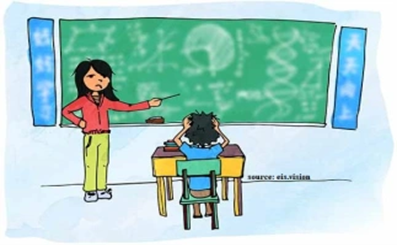
So I asked myself this question that night – Which is true… my impressions about that English teacher or that of his students?
What could have gone wrong?
My former student said that their current English teacher is very serious. Is that the problem – good rapport does not exist between him and the students? It is no secret that a teacher’s personality is correlated to students’ academic performance.
I tried to think of other reasons.
Then I recalled my teaching demonstration when I was applying for a job right after my graduation. When the high school principal called me to her office to discuss the results, she told me I did great. But she said there was a problem – I explained things in a way that only students enrolled in a graduate program could understand.
Could that be the reason?
If that teacher carried out discussions in the class in the same way he explained the grammar topic to us in that gathering earlier that day then that exactly is the problem. You cannot discuss a grammar point with students trying to learn the language the way you would with teachers teaching that language. I think that is not rocket science.
There are two things I learned before I officially began my teaching career – adapt my strategies and materials to students’ levels and simplify my language.
The problem is there are teachers who have a “one-size-fits-all” mentality, thinking that educational processes and approaches to teaching and learning are standard and cannot be tailored to meet individual needs. They wouldn’t buy into the idea of differentiated learning and teaching.
They will never accept responsibility when their students don’t learn.
Their standards are as immovable and high as Mt. Everest. The students have no choice but to climb that “Mt. Everest.”
For them, it’s the fault of the students when they fail.
On Passing and Failing Students

The current semester of the school year 2021 is drawing to a close. Teachers will soon make a decision – pass or fail their students.
To pass, or not to pass… that is the dilemma that confronts teachers when the performance of some students during an entire term is below par and their total grades go south of the passing mark.
What should the teachers do – pass or fail the students?
Is passing students in a subject or course mandatory on the part of the teachers?
It’s a different story if a student fails due to absences. The student failed by default. But what if a student is regularly attending classes?
There are possible repercussions should teachers fail their students. When they fail students they had better be ready to answer possible queries from the students themselves or from their parents. Usually, complaints of students, most especially when they are accompanied by their parents, would also lead to school authorities investigating the teachers concerned. It’s not only a matter of being ready to answer questions but the teachers should also prepare class records and other documents that could prove beyond reasonable doubt that the students did not perform well and deserve to get a failing mark.
There are times that teachers thought that they have exhausted all possible means to help the students perform better but to no avail… that they have tried different strokes for different folks, but none of the strokes they applied worked.
But the painful truth is that there are also teachers who would not walk an extra mile to help students improve on their academic performance.
Now, granting that the teachers have done everything they possibly could to help the students pass but their efforts proved futile, would failing the students be considered justifiable already?
Should teachers be applauded when they take the moral high ground and say that schools are committed to excellence and passing failing students would be tantamount to promoting mediocrity?
Failing students is not a simple decision to make. Whether or not to pass students is a path that teachers have to tread carefully. There are a lot of things to be considered before making the final decision. There are questions that the teachers need to answer very clearly. Questions that would lead to more questions.
Do the grades teachers give truly reflect the abilities of the students? Let’s say that the answer is yes. The next question would be, “Were the tests the teachers made valid? Did the teachers make sure that their tests measured what they intended to measure?
There are more questions – Were the tests the teachers designed congruent with the strategies they used when they presented their lessons? What informed the strategies that they have selected? What foundation of learning and teaching did they stand upon when they delivered their lessons? Did they consider the abilities of their students when they designed the activities in the class? Or is it a matter of whatever decisions they make as teachers are contingent upon their personal comfort?
Yes, the role of the teacher is that complicated. That’s why the decision to pass or not to pass students is actually an examination of the teachers’ conscience. It is answering the ultimate question – “Did I really do my job as a teacher?”
Ask teachers if they are really doing the things expected of them and their response would be an unequivocal yes.
Really?
So here is another question – “Why would students fail if teachers are doing their job well?”
The question above leads us to the next question – “When students fail does it mean they did not learn?”
Students failing means they did not pass the majority (if not all) of the tests (short or long, oral or written) the teachers gave during the entire term. All of those tests are meant to evaluate learning that was supposed to have taken place when the teachers discussed their lessons and did all the activities they designed for the class. So, if the students failed the tests it would mean they did not learn.
Why did the students not learn? What happened? Did the teachers bother to know why? Could there be something wrong with their strategies? Like their strategies probably did not work or something could be wrong with their methods of testing. Yet, they did not bother to adjust and allowed the accumulation of failed tests on the part of the students.
Only the teachers who are pedagogically trained would be able to detect when something is not right with what they are doing. If they are true to their calling as teachers, they would do something about it. They will make the necessary adjustments. If they don’t care then may God bless the students. It’s much worse when those hired to teach are not really trained as teachers. They don’t have the pedagogical skills to understand what is really happening. For them, it’s just a matter of when the students don’t get the scores required they fail. That’s it.
Let’s bring back one of the questions posed earlier – “When students fail does it mean they did not learn?”
If the answer to this is yes it means that the grades of the students reflect not only their performance but that of their teachers as well.
How true is it that “it’s not teaching if there’s no learning.” Can the teachers claim they did their job as teachers even if their students fail?”
When students fail the tests meant to evaluate learning then the activities designed and strategies selected fail to help achieve the objectives. It is the responsibility of the teachers to make sure that their objectives are attainable and the corresponding activities and strategies are effective. It is their responsibility to make sure that their students would succeed. It is as simple as that. A philosophical mind is not needed to grasp that… just common sense would do.
The worst thing that can happen to students is to have teachers whose view of education is myopic – teachers who judge students according to the numbers they crunch during tests and recitations. The students are much more valuable than those numbers.
Education transcends all statistical data that teachers collect during a school term. Yes, there are written rules. There are policies and regulations. But they are not absolute. Education cannot be confined to a box. It is more than black and white. It is as colorful as the rainbow. Teachers should lead their students to the proverbial end of that rainbow where a pot of gold – a good future – awaits them



 M.A.D. L I G A Y A