Category Archives: Personal Growth and Development
Happiness

Happiness is an inside job—but not a solitary one. Circumstances and relationships matter; the part
we must not surrender is our responsibility for how we live within them.

During a seminar, someone reportedly asked John Maxwell’s wife, Margaret, whether her husband made her happy.
Her answer was no.
Ask a hundred people what makes them happy and you may hear a hundred different answers. Many will point outward: a person, a possession, a promotion, financial security, recognition, travel, comfort, or the achievement of a long-held goal. External conditions do matter. Poverty, illness, loneliness, unsafe environments, and painful relationships can affect well-being profoundly. But making our happiness entirely dependent on what we cannot control leaves us dangerously powerless.
A story John Maxwell has shared about his wife, Margaret, captures the point. When asked whether her husband made her happy, she reportedly answered no—not because he was a poor husband, but because she did not regard another person as solely responsible for her happiness. The story is useful precisely because it separates contribution from responsibility. People can enrich our happiness enormously without becoming its sole custodians.
Happiness is therefore neither purely internal nor purely external. Relationships, security, health, purpose, and opportunity all shape it. At the same time, our habits of attention, gratitude, interpretation, choice, and response influence how we experience the life we have. We cannot command happiness on demand, but we can cultivate conditions in which it has more room to grow.
This also means resisting the belief that happiness begins only after the next milestone: after the promotion, the house, the recognition, the retirement, the perfect relationship. Goals matter, but a life spent postponing happiness until everything is finally in place may postpone it forever.
Perhaps the wiser pursuit is to build a life in which happiness has several roots: meaningful relationships, worthwhile work, enough security, continuing growth, moments of enjoyment, service to others, gratitude, and a sense of purpose. Then when one source is shaken—as eventually happens in every life—the entire tree does not have to fall.
Pause and Reflect
What have you been asking another person, achievement, or circumstance to provide before you allow yourself to feel happy?
One Step Forward
Write down one source of happiness you have been treating as completely outside your control. Then identify one small action within your control that could improve that part of your life today.
Explored in full in Part 3, Section II — Fulfillment (Redefining Happiness) of A Holistic Approach to Self-Improvement.
Success

You must define success for yourself. A borrowed definition can make you spend your life
winning a game you never wanted to play.

The farmer who rises at dawn. The fisherman who braves the waves. The janitor who keeps the halls clean. Are they not successful?
Success is often presented to us through visible symbols: income, titles, possessions, influence, awards, fame. Those things can represent genuine achievement, and there is nothing inherently wrong with wanting them. The problem begins when we accept them as the only legitimate measures of a successful life.
Consider the farmer who rises before dawn to nurture crops, the fisherman who faces rough water to provide food, the driver who carries people safely, or the janitor whose work keeps a shared space clean and orderly. Their names may never appear on a wealth list. Yet work performed honestly, competently, and with purpose has value that no public scoreboard can fully measure.
Success, therefore, must be personal before it becomes public. It should reflect your values, circumstances, responsibilities, capabilities, and purpose. For one person, success may mean building a company. For another, it may mean raising a family well, becoming an excellent teacher, creating meaningful art, living debt-free, serving a community, or simply having enough time and freedom to live deliberately.
This does not mean lowering standards or using “my definition” as an excuse to stop growing. A personal definition of success should still challenge us. As our abilities expand, we can raise the bar—not to satisfy someone else’s expectations, but to honor more of our own potential.
The danger of an inherited definition is that we can achieve it and still discover that it was never ours. So define success before the world defines it for you. Then measure your progress against the life you genuinely value, not merely the life that attracts the most applause.
Pause and Reflect
Whose definition of success have you been quietly living by—your own, your family’s, your profession’s, or society’s?
One Step Forward
Write your own one-sentence definition of success. Try doing it without using money, job title, fame, or anyone else’s approval as the primary measure.
Explored in full in Part 3, Section II — Fulfillment (Redefining Success) of A Holistic Approach to Self-Improvement.
Big Heads, Small Hearts
Why Education Must Go Beyond Knowledge and Skills

Today, I introduced a lesson on conditional sentences and the conjunction if with a quotation: “If you don’t believe in yourself, no one will.”
What was supposed to be a discussion of English grammar became something more meaningful. My students began asking questions, and before I knew it, we were discussing self-belief, personal development, and the attitudes that influence how we approach life.
I welcomed their questions. In fact, I found myself enjoying the discussion immensely. After all, I have always believed that my responsibility as a teacher extends beyond teaching grammar, vocabulary, and the various competencies required in an English language examination.
I am not simply preparing my students to pass an examination. I would like to believe that, in my own little way, I am also helping prepare them for life.
And that brings me to a question I believe every educator and educational institution should occasionally confront:
What is the purpose of education if it produces knowledgeable and highly skilled individuals who lack the character to use their knowledge and skills responsibly?
Beyond Knowledge and Skills
Education is commonly associated with the acquisition of knowledge and the development of skills. Students attend school to learn facts, understand concepts, master procedures, solve problems, and develop competencies that will eventually help them pursue careers and contribute to society.
These are undoubtedly important objectives. I would be the last person to suggest otherwise.
But education, as I understand it, involves four equally important dimensions: Knowledge, Skills, Attitudes, and Values (KSAV).
Knowledge concerns what we know.
Skills concern what we are capable of doing.
Attitudes influence how we approach ourselves, other people, our responsibilities, and the challenges we encounter.
Values provide the moral and ethical foundations that guide our decisions, behavior, and relationships.
The first two dimensions largely determine our competence. The latter two profoundly influence how that competence is exercised.
A person may possess an impressive amount of knowledge and extraordinary technical abilities. But what happens when that person lacks integrity, compassion, humility, and a sense of responsibility?
Intelligence can be used to enlighten or deceive. Communication skills can be used to inspire or manipulate. Leadership abilities can be exercised to serve others or exploit them.
The difference often lies not in how much people know or what they can do, but in the attitudes they possess and the values that govern their actions.
Knowledge and skills make us capable. Attitudes and values help determine whether we use those capabilities constructively or destructively.
The Values I Carried Into My Classroom
Looking back, I cannot help reflecting on how much of my educational philosophy was shaped and strengthened by the nine years I spent as a teacher and administrator at St. Mary’s College of Baliuag, one of the educational institutions administered by the Religious of the Virgin Mary (RVM) sisters in the Philippines.
During those years, I was immersed in an educational culture guided by the Ignacian core values of Faith, Excellence, and Service. These were not merely ideals expressed in institutional statements or displayed on school walls. They were principles integrated into educational practices, institutional policies, and the everyday experiences of teachers, administrators, and students.
Faith emphasized the importance of moral and spiritual formation. Excellence encouraged the pursuit of knowledge, competence, discipline, and continuous improvement. Service reminded us that our abilities and achievements should ultimately contribute to the welfare of others.
As I reflect on these values, I see how beautifully they complement one another. Faith provides the moral and spiritual foundation upon which character is formed. Excellence encourages individuals to develop their knowledge, skills, abilities, and potential. Service gives purpose to these achievements by directing them toward the welfare of others.
Perhaps I did not fully appreciate at the time how deeply that institutional culture was influencing my understanding of education. But years after leaving St. Mary’s College of Baliuag, and after more than a decade of teaching in South Korea, I find myself continuing to advocate principles that reflect those formative experiences.
I do not attribute my educational philosophy exclusively to my years with the RVM. My upbringing, personal faith, academic preparation, and subsequent professional experiences have also contributed to its development. Nevertheless, I gratefully acknowledge the significant influence of the Religious of the Virgin Mary and St. Mary’s College of Baliuag in strengthening my belief that education should nurture both intellectual competence and moral character.
The institution where I teach has changed. The students I teach have changed. But the values I carried from those formative years remain part of the educator I am today.
Big Heads, Small Hearts
One of my concerns about contemporary education is the possibility that schools may become so preoccupied with academic performance, examination results, professional qualifications, and employability that character formation receives insufficient attention.
We celebrate academic excellence, intellectual achievement, and technical proficiency. We encourage students to accumulate information, earn degrees, obtain certifications, and develop increasingly sophisticated competencies.
There is nothing inherently wrong with these pursuits. They are essential to individual advancement and social progress.
But what if, in our enthusiasm to fill students’ minds, we neglect to nurture their hearts?
We may eventually produce individuals with big heads bursting with knowledge but small hearts lacking compassion, humility, and concern for others.
Imagine a society filled with highly educated individuals who are intellectually brilliant but morally indifferent. People who can solve complicated mathematical problems but cannot appreciate another person’s suffering. Professionals who possess impressive credentials but regard dishonesty as acceptable when it serves their interests. Leaders who know how to exercise authority but have never learned the importance of exercising it with humility and compassion.
Such individuals may be successful by conventional standards. They may accumulate wealth, occupy prestigious positions, and command considerable influence.
But can we confidently regard them as genuinely educated?
A degree may certify academic achievement. It does not necessarily certify good character.
And a society populated by competent individuals who lack a sense of ethical responsibility may find that its greatest problems are created not by ignorance but by the misuse of intelligence.
The Leaders Sitting in Our Classrooms
When I look at my students, I do not see merely young people preparing for examinations or future employment.
I see potential parents, professionals, entrepreneurs, educators, and leaders.
Some may eventually lead families. Others may become influential members of their communities, organizations, or circles of friends. A few may even occupy positions from which their decisions affect thousands or millions of people.
Whatever paths they choose, their knowledge and skills will certainly matter.
But so will their attitudes and values.
A future parent needs more than the financial ability to support a family. That parent also needs patience, understanding, and compassion.
A future employer needs more than managerial competence. That employer also needs fairness, integrity, and respect for employees.
A future leader needs more than intelligence and persuasive communication skills. That leader also needs humility, accountability, and a genuine concern for the welfare of others.
These qualities do not automatically emerge when students graduate.
They must be cultivated, practiced, questioned, and strengthened throughout the educational journey.
Of course, schools cannot assume sole responsibility for character formation. Families, communities, religious and cultural institutions, and personal experiences all contribute to shaping an individual’s attitudes and values.
Nevertheless, schools occupy a particularly influential position. For many years, students spend a considerable portion of their waking hours in classrooms, interacting with teachers and classmates, encountering different perspectives, and developing habits of thought and behavior.
Surely, such an environment offers opportunities to cultivate not only intellectual competence but also personal character.
Teaching Grammar, Teaching Life
Let me return to today’s classroom discussion.
Our lesson concerned conditional sentences. Grammatically, the word if introduces a condition and allows us to express possibilities, consequences, imagined situations, and relationships between events.
I could have introduced the grammatical structures, presented examples, assigned exercises, and assessed my students’ understanding.
That would have been a perfectly legitimate language lesson.
Instead, I began with a quotation about self-belief.
The quotation became a starting point for questions and discussion. Students were encouraged to consider not only how conditional sentences are constructed but also the meaning of the ideas expressed through them.
And that is precisely the kind of opportunity I believe teachers should recognize.
A lesson on conditional sentences can become a discussion about choices and consequences.
A reading passage about success can invite reflection on perseverance, discipline, and integrity.
A speaking activity about leadership can encourage students to examine the qualities of a responsible leader.
A writing task about social problems can help develop empathy and awareness of the experiences of others.
None of these requires abandoning the academic objectives of the lesson.
On the contrary, meaningful content can make language learning more engaging while encouraging students to think critically and reflect on their own beliefs.
This does not mean teachers should impose their personal convictions on students. Character education should encourage thoughtful reflection, respectful disagreement, and the development of sound judgment—not unquestioning acceptance of a teacher’s opinions.
Indeed, students should be encouraged to question even the quotations we present to them.
Consider the statement I used today: “If you don’t believe in yourself, no one will.”
It is a powerful reminder of the importance of self-belief. Yet it is not universally true. Sometimes, a parent, friend, or teacher believes in someone long before that person discovers confidence in themselves.
Recognizing such nuances can make the discussion more meaningful.
And perhaps, through conversations like these, students learn something valuable about both language and life.
Education That Reaches the Heart
I am not suggesting that every grammar lesson should become a lecture on morality or that teachers should sacrifice academic rigor in favor of inspirational discussions.
Far from it.
Students deserve competent instruction, well-designed learning experiences, meaningful assessments, and opportunities to develop the knowledge and skills necessary for their future endeavors.
But I believe they deserve something more.
They deserve an educational environment that encourages honesty, respect, accountability, compassion, self-discipline, and a sense of purpose.
They deserve teachers who recognize that the way they treat students may be as influential as the lessons they deliver.
After all, students learn not only from what teachers say but also from how teachers behave.
A teacher who speaks about respect but humiliates students sends a contradictory message.
A teacher who emphasizes honesty but practices favoritism undermines the very value being taught.
Conversely, a teacher who demonstrates patience, fairness, humility, and genuine concern for students provides living examples of the attitudes and values that education should nurture.
In this sense, character formation is not confined to a particular subject or classroom activity.
It is woven into the everyday experiences of schooling.
And perhaps this is one of the most enduring lessons I carried from my years at St. Mary’s: the values an institution professes become truly meaningful only when they are reflected in the everyday actions of the people within it.
When Education Truly Educates
I often remind myself that the students sitting before me today will eventually leave the classroom and enter a world where their decisions will affect other people.
Some may forget the grammatical rules I taught them. Others may never again encounter the particular reading passages or vocabulary exercises we discussed.
But I hope that some of the ideas we explored will remain with them.
Perhaps one day, when confronted with a difficult decision, a former student will remember a classroom discussion about integrity.
Perhaps another, struggling with self-doubt, will recall a conversation about self-belief.
Perhaps someone who eventually occupies a position of authority will remember that leadership is not merely about power but also about responsibility and service.
I cannot know whether these things will happen. Nor can I claim that a few classroom conversations will necessarily transform someone’s character.
But I believe the possibility is worth pursuing.
Education should prepare students not merely to earn a living but also to live meaningfully and responsibly.
It should develop minds capable of understanding the world and hearts willing to make that world better.
And if our educational institutions succeed in producing brilliant minds but fail to encourage the development of good character, we must ask ourselves whether we have truly fulfilled the purpose of education.
For what good is a head filled with knowledge if the heart has little room for humanity?
Perhaps the greatest achievement of education is not simply producing individuals who know more and can do more.
It is helping develop individuals who, because of what they know, what they can do, what they believe, and what they value, are capable of becoming better human beings.
Big minds and big hearts.
That, to me, is what education should aspire to cultivate.
Health

Health is not something to spend in pursuit of success and recover later. It is part of the foundation
that makes every worthwhile pursuit sustainable.

The wealthy, the famous, and the powerful—are they sleeping peacefully? Are their relationships intact?
When we speak of health, many of us immediately picture its physical dimension: a reassuring medical report, a fit body, enough energy to get through the day, and the absence of serious illness. Physical health matters enormously. But it is not the whole picture.
A person can appear physically strong while being emotionally depleted, mentally exhausted, socially isolated, or trapped in relationships that are deteriorating. That is why some of the more revealing questions about a successful life cannot be answered by a weighing scale or laboratory result. Do you sleep peacefully? Do you still have people with whom you can be completely yourself? Can you stop working without feeling that your worth has disappeared?
The pursuit of success can sometimes exact costs that do not appear on a medical chart until much later. Chronic pressure, neglected relationships, inadequate rest, and the constant demand for more can quietly erode the well-being that achievement was supposed to improve. A person may gain income, status, or recognition while losing sleep, peace, connection, or a sense of self.
Health, then, is better understood holistically: physical, mental, emotional, and relational well-being influencing one another. We will not keep every dimension in perfect condition at every moment, nor can every health outcome be controlled by lifestyle. But we can refuse to treat health as an expendable resource to be sacrificed indefinitely for another goal.
Protecting health requires intentionality: adequate rest, movement, nourishing food, relationships that receive time rather than leftovers, attention to emotional strain, and the humility to seek appropriate help when needed. Success becomes easier to enjoy when we are healthy enough—in the broadest sense—to be present for it.
Pause and Reflect
Beyond how healthy you look, how healthy does your life actually feel—physically, mentally, emotionally, and relationally?
One Step Forward
Identify one dimension of health you have been neglecting. Write one realistic boundary or practice that can protect it this week.
Explored in full in Part 3, Section II — Fulfillment (Redefining Health) of A Holistic Approach to Self-Improvement.
The Sense of Fulfillment

Fulfillment isn’t a trophy waiting at the end of self-improvement. It grows from
becoming more fully the person you are capable of being.

Achievement asks, “What did I accomplish?” Fulfillment asks a deeper question: “Who did I become while accomplishing it?”
Fittingly, fulfillment stands at the far end of the self-improvement process presented in this book. But it should not be mistaken for a final destination where all striving stops. Fulfillment goes deeper than accomplishment. It is not merely reaching a goal; it is experiencing the meaning that comes from growing into the person capable of reaching it.
This is why external achievement alone can feel strangely incomplete. A promotion, publication, degree, business, award, or financial milestone can be deeply satisfying, but none automatically creates a fulfilling life. What matters is how those achievements relate to our values, health, relationships, purpose, and continuing development.
The Why–How–What structure helps clarify the relationship. The Why is the person you are trying to become and the potential you want to realize. The How is the self-improvement process—the attitudes, skills, habits, choices, and discipline through which growth occurs. The What is the life that emerges from that process: the concrete expressions of success, health, happiness, contribution, and meaning.
In my framework, fulfillment is strengthened when success, health, and happiness support rather than destroy one another. Success without health can become fragile. Health without purpose can feel incomplete. Happiness that depends entirely on circumstances can disappear as quickly as those circumstances change. Fulfillment becomes richer when these dimensions reinforce one another rather than compete for survival.
And because we continue changing, fulfillment must remain dynamic. Today’s best self is not necessarily tomorrow’s. New responsibilities, losses, discoveries, relationships, and possibilities reshape what a meaningful life requires from us. Fulfillment, then, is not the end of growth. It is one of the experiences that tells us our growth is moving in a direction that matters.
Pause and Reflect
If you stopped chasing fulfillment as an outcome and focused instead on becoming your best self, what would you do differently today?
One Step Forward
Write one sentence describing the person you are becoming—not what you hope to possess or achieve, but who you want to be in the process.
Explored in full in Part 3, Section II — Fulfillment of A Holistic Approach to Self-Improvement.
Consistent Daily Routine

A well-designed routine isn’t a cage — it’s daily proof that you’re authoring
your life instead of drifting through it.

Are you more like a homing pigeon, or driftwood?
Are you more like a homing pigeon—or driftwood?
Whether we notice it or not, much of life is built from repetition. What we habitually do—or repeatedly fail to do—shapes our health, competence, relationships, and progress. Significant results rarely come from one dramatic burst of effort. More often, they emerge from small actions performed often enough to become part of who we are.
A daily routine gives those actions a place to live. It is a deliberate pattern of activities that supports the things we say matter to us. Without some structure, we can become like driftwood—moved by whatever demand, distraction, mood, or circumstance happens to arrive. With direction, we become more like a homing pigeon: still affected by wind and distance, but oriented toward home.
Benjamin Franklin famously organized his day around work, reading, meals, reflection, and rest. He began the morning by asking what good he would do that day and ended by examining what good he had done. Maya Angelou also created a remarkably consistent writing practice, regularly leaving home to work in a plain hotel room for hours. Neither routine was glamorous. Both reduced the need to renegotiate important work every day.
I have experienced the same principle in my own life. The routines I have developed in South Korea—morning preparation, teaching, writing and research during available periods, reading and reflection, and attention to physical well-being—have contributed enormously to what I have been able to produce. The individual actions often feel ordinary. Their accumulated effect is not.
A useful routine should serve your life, not imprison it. It must leave room for rest, relationships, emergencies, spontaneity, and change. But when the essentials are given a dependable place in the day, progress no longer depends entirely on whether motivation happens to show up.
Pause and Reflect
How intentional is your daily routine? Do the things you repeatedly do actually support the person you say you want to become?
One Step Forward
Choose one deliberate morning ritual and one evening wind-down activity. Try both tomorrow, then decide whether they deserve a permanent place in your routine.
Explored in full in Chapter 20 — Consistent Daily Routine of A Holistic Approach to Self-Improvement.
Pursuing Longevity
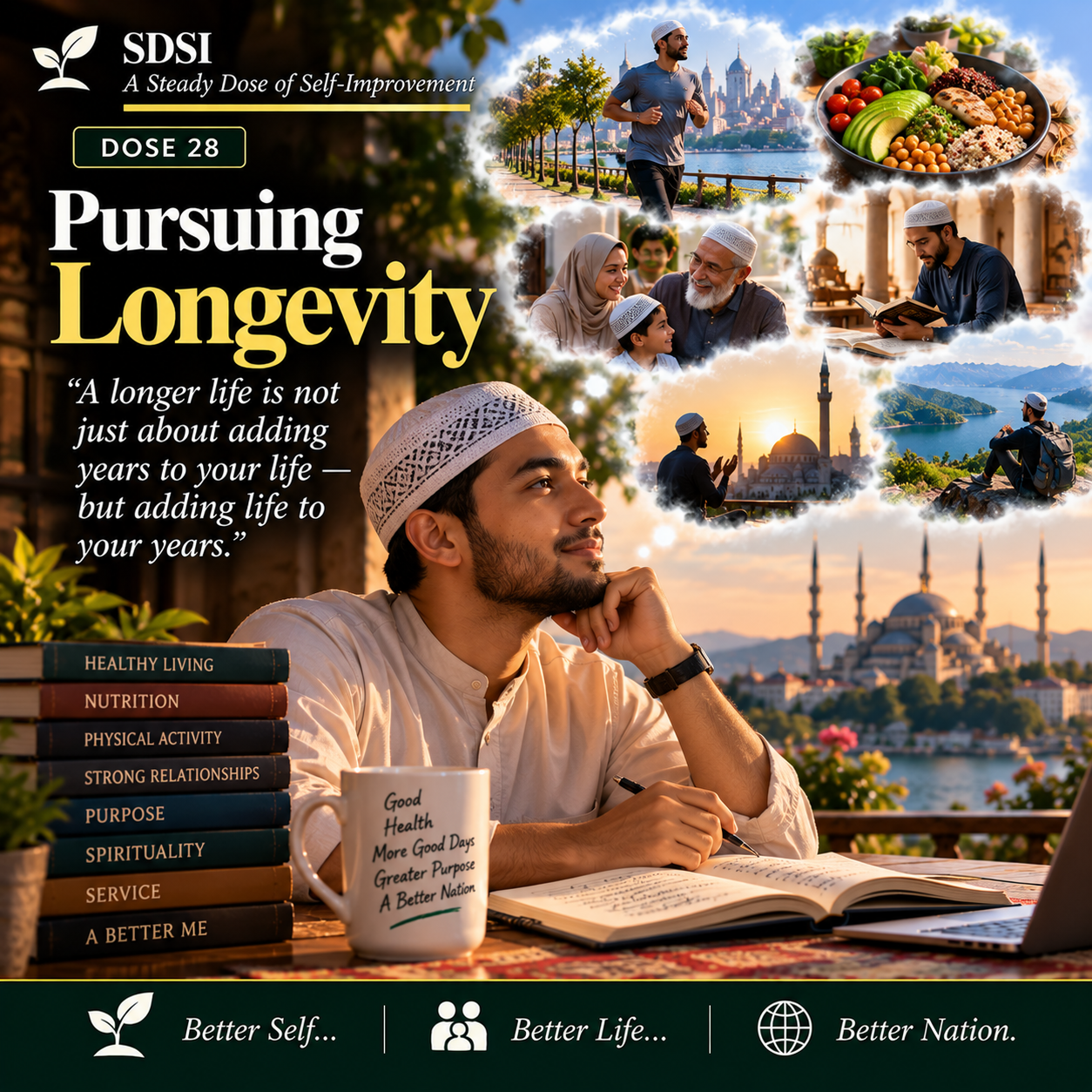
Longevity isn’t just physical survival — true longevity harmonizes the physical, mental, emotional, social,
and spiritual dimensions of who you are.

“I have signed up for what I call the Race to 100.”
I have signed up for what I call the Race to 100. I want to celebrate my 100th birthday on my feet—still able to move, think, laugh, create, and perhaps dance while surrounded by people I love. Reaching a number is not the entire goal. I want the years themselves to remain worth living.
That is why longevity should not be understood as physical survival alone. A long life becomes more meaningful when physical health is accompanied by mental engagement, emotional resilience, social connection, spiritual depth, and a continuing sense of purpose. The aim is not simply to stay alive longer, but to preserve as much capacity for living as circumstances allow.
Studies of long-lived populations repeatedly point toward familiar patterns: regular movement, nourishing food, strong relationships, purpose, and social engagement. None offers a guarantee. Genetics, environment, healthcare, chance, and many other factors also matter. Longevity is not something we can completely control—but we can influence some of the conditions under which we age.
Our beliefs about aging may matter too. In a well-known longitudinal study, older adults with more positive self-perceptions of aging lived, on average, several years longer than those with more negative perceptions, even after researchers accounted for several other factors. That does not mean positive thinking can defeat biology. It does suggest that the way we approach aging may influence the behaviors, motivation, and resilience with which we live it.
So I choose to treat aging not as a countdown but as a continuing project. I can strengthen my body. I can keep learning. I can protect relationships. I can pursue purpose. I can make choices today that my older self may one day be grateful for. The finish line is uncertain for all of us. But the way we run the race is still partly ours to shape.
Pause and Reflect
What does longevity mean to you: simply living longer, or remaining capable of living well for as long as possible? Is your present lifestyle moving you toward that picture?
One Step Forward
Imagine yourself 30 years from now. Write down one specific change that future version of you would thank you for beginning this week.
Explored in full in Chapter 19 — Pursuing Longevity of A Holistic Approach to Self-Improvement.