Blog Archives
The Self-Improvement Paradigm at a Glance
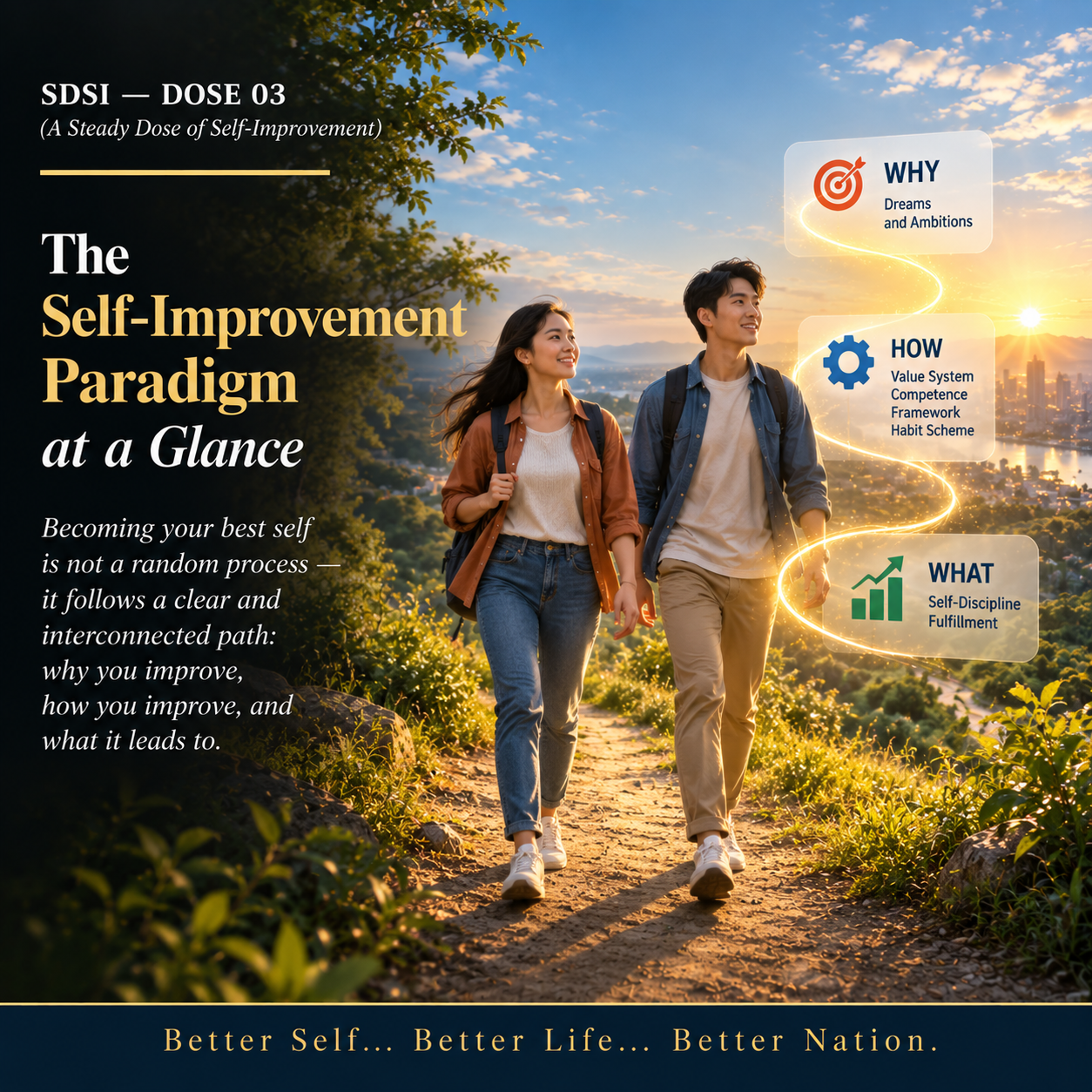
Real transformation rests on three pillars — what you believe, what you can do, and what
you practice — held together by self-discipline.

Becoming your best self was never going to be one thing.
For years, I thought growth meant picking whichever self-help idea resonateD that month — a book on mindset here, a productivity system there — without ever asking how they fit together. It took time to see that the people who actually transform their lives aren’t chasing isolated fixes. They’re building on a structure.
That structure rests on three pillars. The first is your Value System — the attitudes and beliefs you carry about yourself and the world. The second is your Competence Framework — the actual skills and abilities you develop. The third is your Habit Scheme — the practices and activities you repeat often enough that they become who you are.

Remove any one of the three, and the other two eventually wobble. Belief without skill produces confidence with nothing to stand on. Skill without habit produces potential that never compounds into results. Habit without belief produces motion without conviction — busywork mistaken for progress.
Holding all three together is self-discipline — the thread that keeps the structure upright once the initial motivation fades, as it always eventually does. Health, success, and happiness arrive as natural results of the structure underneath, not as prizes you win by wanting them hard enough.
This is the paradigm the rest of this book unpacks, chapter by chapter — twenty chapters split across the three pillars, each one a single brick in a foundation meant to hold up an entire life, not just a single good year.
Pause and Reflect
Which of the three — belief, ability, or practice — do you most need to shore up right now?
One Step Forward
Pick the weakest of the three pillars in your life right now. Write one concrete step you’ll take this week to strengthen it.
Explored in full in the Introduction (Figure 1) of A Holistic Approach to Self-Improvement.
Better Self… Better Life… Better Nation.
Betting on Ourselves

I have a section on my website that I christened “Road to Self-Improvement.” That section was born of my advocacy for self-improvement — and it is where the idea of writing a book on the subject first took shape. But the advocacy itself is older than the website, older than the book. It started years ago, when a friend asked me a simple question: what is the best national development framework for the Philippines?
I told him this — for the Philippines to develop as a nation, Filipinos need to abandon the mindset that a messiah will come to save our country from the socio-political and economic quicksand where we are currently drowning. We think we can pin our hopes for a better future, a better life, on a leader or politician we believe in and support — most of the time, blindly. And yet whoever we elect to the seats of the Executive and Legislative branches has consistently failed to move the needle of progress and peace.
So what, then, is the framework? I believe it begins smaller than any election, smaller than any administration — it begins with the individual. If every Filipino embraces self-improvement and pursues their full potential, they can grow in every aspect of life: mind, character, discipline, livelihood, health. When that happens, they succeed — and with that success comes the capacity to lift not only themselves, but the families they belong to. When every Filipino and every family commit, simply and consistently, to becoming better, imagine what their community becomes. And if every community in our towns, cities, and provinces reflects that same commitment, we will have built — not waited for, not voted for, but built — a stronger Philippine society. A stronger Filipino nation.
It is time for Filipinos to abandon the mindset that we can pin our hopes on a strong politician or leader — a messiah, a savior. Every Filipino should pin their hopes on themselves. We must bet on ourselves, not on someone who promises us the moon and the stars during an election. Betting on a leader to single-handedly bring our nation to paradise is like betting on a lottery with 45 numbers to choose from — your odds of winning are 1 in more than 8,000,000. It’s like fishing for one single fish in a fishing area the size of the entire Pacific Ocean.
One need not look far for proof. As I write this, the nation watches its vice president stand trial for corruption and misuse of public funds, while senators allied with one camp or another are arrested, disappear, or resurface depending on which side of a political feud they happen to stand. Officials once inseparable allies now accuse each other of the very crimes they once campaigned to eradicate together. This is not an aberration — it is the lottery working exactly as it always has: fortunes made and unmade not by the merit of public service, but by the shifting arithmetic of political alliances. Whoever wins this particular round of the game, the game itself remains what it has always been — a gamble the ordinary Filipino never gets to place a real bet in, only to watch.
Betting on ourselves, on the other hand, is not a bet on chance at all — it is a commitment to effort, and effort is not drawn from a bin of eight million balls where luck alone decides the outcome. When a Filipino bets on a leader, he marks a ballot once, then waits — powerless, passive — for a stranger’s decisions to shape his future. When a Filipino bets on himself, there is no waiting and no ballot box; there is only the next skill learned, the next hour of work invested, the next discipline practiced. These are not draws from a lottery machine — they are deposits, and, like any deposit made consistently, they compound. A leader may fail to deliver even after winning every vote in his favor; a Filipino who invests in his own competence, character, and resilience cannot be defrauded of that investment by any politician, any administration, or any election cycle.
This is exactly the mechanism by which one Filipino’s discipline becomes a family’s stability, a family’s stability becomes a community’s strength, and a community’s strength becomes a nation’s foundation. No leader can legislate that chain into existence. No election can manufacture it overnight. It has to be built — person by person, family by family, town by town — and the beauty of it is that, unlike the lottery of politics, every single one of us holds a winning ticket the moment we decide to act on it.
This is the difference between hoping for a miracle and building one. It is why I stopped asking, years ago, who will save our nation — and started asking instead what I myself was willing to build. That question became a website section. It became years of writing. It eventually became a book. But long before it became any of those things, it was simply a decision — the same decision I believe every Filipino is capable of making, the same decision that, multiplied across a hundred million of us, could move the needle that a hundred years of elections never did.
We do not need a messiah. We need each other, choosing, one by one, to bet on ourselves.
An Invitation (YouTube Channel Teaser)
Is self-improvement an end in itself or a means to achieve an end?
By introducing a comprehensive paradigm for self-improvement, I do not seek to complicate the process of personal growth, but rather to present a realistic framework that brings together the many constructs essential to it. There are two serious loopholes in self-improvement schemes promoted nowadays. The first one is the promise of becoming the best version of yourself in a few days or weeks. And the second is the attainment of full potential, being floated as a goal to be achieved rather than a process to be undergone.
Self-improvement is not an end in itself but rather a means to achieve an end. It is not a destination. It is the path to reach a desired destination.
I believe that there is no shortcut, no magic pill, and no single technique that can instantly transform one’s life. Genuine growth requires cultivating the right attitudes and beliefs, developing essential skills and abilities, and consistently practicing positive habits and activities. This holistic approach recognizes that lasting change arises from deliberate effort across multiple areas of life.
Foreword to My Book on Self-Improvement
Aside from the values of faith and self-belief my mother instilled in me, one key element of personal growth and development that was embedded in me long before I joined the self-improvement bandwagon was lifelong learning. My parents taught my siblings and me the value of education, the importance of learning new things and skills, and the need to always strive to be the best and strongest we could be to fulfill our dreams and ambitions.
I believed them to the point that when I had already acquired the degrees I wanted, I looked for a new jar of knowledge where I could dip my fingers. I pushed it further when I realized I had been doing much to improve my health and acquire new skills. I decided to focus on personal growth and development.
At first, my affair with self-improvement was just a fling. I thought it was enough that I read self-help books. However, I was not satisfied. I thought adding positive thinking to my faith, self-belief, and lifelong learning was enough. I was wrong. I wanted more.
Then, the unexpected happened. My romance with self-improvement took a serious turn after I watched a film entitled “The Secret.” I saw the movie’s DVD by accident. The store owner mixed it with other genres of film. When I bought it, I had no idea what it was. There was no synopsis or a brief note explaining anything about it. That was it. Everything was what the title suggests—SECRET.
I wondered whether it was a mystery-thriller or a sci-fi movie. When I played it, I discovered it was a “self-help” film—technically a documentary.
I must admit that I initially considered the ideas presented to be preposterous. Things
from the beginning of the film, what I saw and heard seemed lifted straight from the pages of a science fiction book, but they also tickled my curiosity, perhaps because I love science fiction.
I continued watching, tried to be open-minded, and considered the information in the film as tips for personality development. I have always considered anything that advocates positive change worth my time and effort. I watched it a second time and rewatched some interesting segments a few more. After that, I began applying the valuable tips I had learned from the movie. I even shared the ideas I discovered with my students whenever I saw a connection to the topic’s content.
Then I decided to do an Internet search for one of the speakers, the one who spoke first in the movie – Bob Proctor. That Internet search led me to his motivational videos on YouTube and links to information and videos of other motivational speakers such as Jim Rohn, Wayne Dyer, Les Brown, Joe Dispenza, John Assaraf, Brendon Burchard, Brian Tracy, Zig Ziglar, Tony Robbins, Simon Sinek, Tom Bilyeu, John Maxwell, Jordan Peterson, Jay Shetty, Andrew Huberman and Mel Robbins. I heard them mention Napoleon Hill, Earl Nightingale, and Earl Shoaff, which led me to find them online.
They were all my professors at VU (Virtual University). I religiously watched the videos they posted on their social media platforms, and they taught me well. I consider them my mentors in personal growth and development. Through them, I learned much about constructs related to self-improvement and Positive Psychology—goal-setting, planning, decision-making, time management, well-being, mindset, personal accountability, lifelong learning, good thinking, positive thinking, self-discipline, and more.
I consider them my mentors. They taught me valuable lessons I never learned in school. Thanks to them, I realized that in striving to be the best I can be, as my parents instructed, there are attitudes and beliefs I must pursue and possess, skills and abilities I must learn and acquire, and practices
and activities I must carry out and perform. I realized how essential they are for achieving one’s full potential and becoming the best.
Seeing how personal growth and development have benefited me personally and professionally, and recognizing that, as a teacher, I can help my students and influence my loved ones and dear friends to experience the same, I have embraced self-improvement as an act of advocacy. I am committed to promoting it. There may be those my mentors from VU could not reach, but whom I may be able to. I strive to do so in my humble ways.
To the best of my ability, I aim to plant seeds of motivation and inspiration in others, encouraging them to recognize their potential and embrace the transformative power of self-improvement. I believe that each interaction, no matter how small, has the potential to spark a profound change in someone’s life. Whether through teaching, writing, or engaging in meaningful conversations, I see every opportunity as a chance to leave a positive imprint on those I encounter.
In doing so, I am trying to carry forward the legacy of my mentors, whose wisdom and guidance have shaped my journey. Their influence reminds me that advocacy is not confined to grand gestures but is often reflected in our quiet, consistent efforts to uplift those around us.
My mission is to reach individuals who may feel unseen or undervalued and empower them to believe in their capacity to grow and succeed.
In my classes, I actively seek opportunities to instill the value of striving to improve. I do the same in informal discussions with friends, loved ones, and sometimes strangers. Whenever I have the chance to discuss self-improvement, I seize it without hesitation.
My approach is grounded in the belief that the desire to grow and evolve is universal, and all it often takes is a spark—a meaningful word, a shared experience, or a heartfelt conversation—to ignite that desire in someone.
It reminds me of how those simple compliments from a couple of teachers in high school inspired me to study harder.
I also write essays on personal growth and development, which I post on my websites and social media accounts. When I realized how much I had already written on the subject, the idea of writing a self-improvement book emerged. I decided to compile and interconnect everything I had written about personal growth and development into a book.
My motivation for writing this book is clear: I want to offer a guide that could help readers like you achieve their full potential, be the best and strongest version of themselves, and attain fulfillment by achieving what they desire. I also had my students in mind when I began working on this book. I hope they and other young people like them will read this book like you.
It is not luck or chance that gets you to the fulfillment of dreams and desires—it is learning the right strategies and applying the focus, determination, and passion you need to pursue your personal and professional endeavors. The future is yours to take.
My book is divided into three parts, each focusing on different aspects of self-improvement. In Part I, I discuss beliefs and attitudes; in Part II, I cover skills and abilities; and in Part III, I examine practices and activities.
I collectively refer to beliefs and attitudes as a value system, skills and abilities as a competence framework, and practices and activities as a habit scheme.
The world needs people willing to rise to their full potential, lead purposefully, and contribute to something greater. I believe you are one of those people.
As you read through the following pages, I hope you will find the encouragement, insight, and tools you need to take the next step in your journey. My goal is to inspire you to view your personal and professional goals not as impossible dreams, but as inevitable outcomes that await your dogged determination to succeed.
This book is both a reflection of my journey and an invitation to join me on the path to unlocking the greatness within you. I do not feel like I am already the best version of myself. Thus, my journey towards unlocking my full potential has not ended yet. If you have not started with yours, now is the time to begin.
—–
This foreword is only the beginning. If you wish to go deeper into the ideas shared here, my book on self-improvement is available on Amazon. May it serve as a companion in your own journey.