Blog Archives
TEACHER OR LECTURER?
A Reflection on What It Really Means to Teach
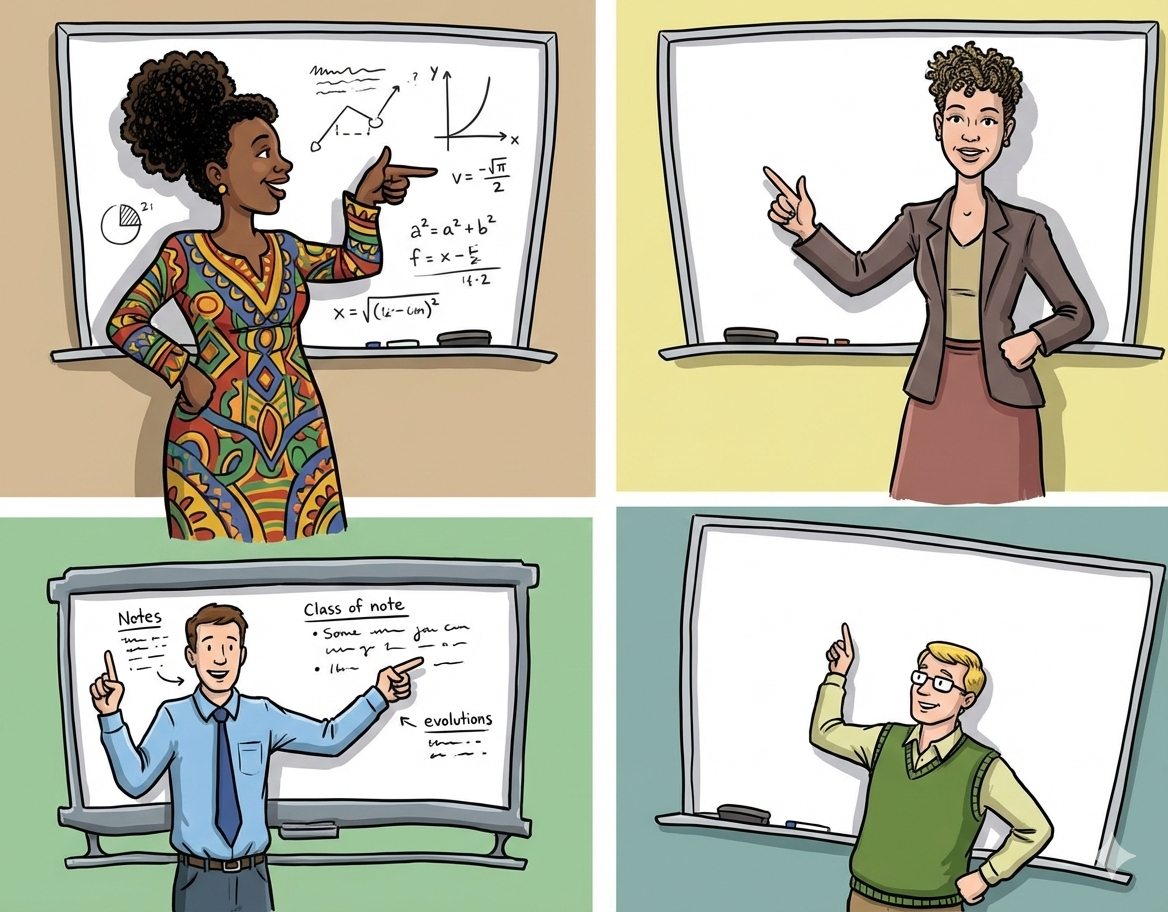
“Teaching starts with a relationship. Until then, you are just a dancing monkey standing
in front of your students performing tricks.”
~ Andrew Johnson~
I. The Question Worth Asking
Not everyone who stands in front of a classroom truly teaches.
Some deliver content. Others shape minds. The titles may be identical — Teacher, Instructor, Professor — but the intentions, mindsets, and commitments behind them often are not. And this gap, quiet as it sometimes is, makes all the difference in the world to the students sitting in those chairs.
This raises an uncomfortable yet necessary question — not to accuse, but to reflect:
Are you a teacher? Or are you merely a lecturer?
These are not the same thing. A lecturer delivers content; a teacher transforms it into learning. A lecturer measures success by how much material was covered; a teacher measures it by how much understanding was actually built. Lecturers speak to students; teachers listen to them. A lecturer is satisfied when the lesson ends on time; a teacher is troubled by what remains unclear after the bell rings.
All teachers lecture at times — that is unavoidable. But not all who lecture truly teach. The distinction lies not in the method but in the mindset: Does this person see their role as the transmission of information, or as the cultivation of human potential?
II. How Teachers Differ From One Another
Even among those who genuinely intend to teach, no two practitioners approach the profession in exactly the same way.
Like fingerprints, their mindsets, tendencies, and personal philosophies are unlikely to be identical. Given the same course syllabus, we cannot expect any two teachers to design the same lesson plans or implement the same strategies. Some approach each class with meticulous preparation; others improvise; and some — regrettably — do not plan at all.
Work attitudes vary just as widely. There are teachers acutely conscious of the hours stipulated in their contracts, unwilling to extend themselves beyond what is formally required. There are others who go far beyond — who assist students outside teaching hours, volunteer for tasks no one asked them to do, and give freely of their time and energy without expectation of compensation.
And then there are those who arrive late, leave early, and submit required paperwork only when pressed — or not at all. If you are a teacher reading this, the question is not which group others belong to, but which group you honestly belong to yourself.
No one can force a teacher into the second group. But every teacher owes it to their students — and to themselves — to stay as far as possible from the third.
There are also teachers who are perpetual fault-finders — those who can always identify what is wrong with a policy, a colleague, or an administrator, but rarely what might be improved. When they find fault, they whine about it or gossip about it, or both. This habit does not make them critical thinkers. It makes them corrosive presences in a community that depends on trust and collaboration.
III. How Teachers Treat Their Students
Perhaps no difference among teachers is more consequential than the way they treat the people in their care.
Some set standards so exacting that only the strongest students can meet them, leaving the rest behind without apology. Others calibrate their expectations thoughtfully — maintaining rigor while ensuring that even the slowest learner has a genuine pathway to success. Some believe in a one-size-fits-all approach, as though all students arrive at learning in the same way, at the same pace, with the same needs. Others recognize that students differ profoundly in learning styles, abilities, languages, and personal histories — and they differentiate their methods accordingly.
Numerous studies confirm what students have always known intuitively: among the most valued qualities in an effective teacher are the ability to build genuine relationships, and a patient, caring, and kind personality. These are not soft virtues. They are the foundation on which all learning is built.
What causes some teachers to treat students with indifference or harshness? Sometimes the answer lies in upbringing or in the treatment they themselves received as students — a sad inheritance, passed unconsciously from one generation to the next. Sometimes it is simply burnout. Exhaustion does not excuse poor teaching, but it does help explain why some teachers gradually lose the fire they once had. Compassion, it turns out, is not inexhaustible. It must be renewed.
IV. The Heart of the Matter: Passion and Compassion
At its deepest level, the difference among teachers may be reduced to two qualities — and what each teacher does or does not possess of them.
There are teachers who possess both passion and compassion.
There are teachers who have only one of the two.
There are teachers who have neither.
Passion is what drives a teacher to prepare thoroughly, to stay current in their field, to search for better methods even when existing ones are adequate. It is the restlessness of someone who genuinely believes that this lesson, this class, this student deserves their best effort.
Compassion is what keeps that passion human. It is what reminds a teacher that behind every exam score is a person — with pressures, fears, histories, and hopes that the classroom did not create and cannot simply ignore.
Without passion, teaching becomes mechanical. Without compassion, it becomes cold. Without both, it becomes something that should not be called teaching at all.
If you are a teacher reading this — and if, in honest reflection, you find yourself in the third category — it may be time to ask whether you are in the right profession. That is not an accusation. It is an invitation to reconsider, before another generation of students pays the price for a choice that was never truly theirs to make.
V. The Question of Training — and Its Limits
One of the gravest mistakes an institution can make is hiring someone with no pedagogical training to teach.
Knowledge of a subject is not the same as the ability to teach it. Being a mathematics wizard does not automatically make one a mathematics teacher. Having perfect pronunciation and impeccable grammar does not make one an English teacher. Teaching requires something beyond subject mastery — it requires the ability to make that mastery accessible, to motivate learners who do not yet share it, to design assessments that genuinely measure growth, and to adjust strategies when understanding has not yet arrived.
To be fair, there are rare individuals who compensate for the absence of formal training through humility, mentorship, and a genuine hunger to learn the craft. But these are exceptions, not the rule. And relying on exceptions as a hiring strategy is a gamble made at students’ expense.
Yet perhaps the more troubling question is not about the untrained. It is this:
Why are there teachers who were trained to teach, yet behave as though they were not?
Teachers’ conduct is shaped by the educational philosophy they develop through their training — an evolving framework built from theory, practice, experience, and the personal belief systems they carry into the classroom. That philosophy, whether articulated or not, is visible in every decision a teacher makes: how they speak to students, how they respond to failure, how they handle disagreement, how they use — or misuse — the authority their position grants them.
When teachers act or speak in ways that diminish students, ignore professional codes, or prioritize personal comfort over student welfare, they are not simply having a bad day. They are revealing what they truly believe about teaching — and about the people they were hired to serve.
Common sense, even in the absence of formal training, should be enough to remind any adult in a position of influence: words carry weight. Actions leave marks. Students remember — sometimes for a lifetime — how their teachers made them feel.
VI. A Calling, Not a Paycheck
Teaching is not a neutral act.
Every teacher who enters a classroom makes a choice — consciously or not — about what kind of presence they will be. They can be a source of clarity or confusion, of encouragement or discouragement, of possibility or limitation. They can be the reason a student discovers a love of learning, or the reason that love dies quietly before it ever had a chance to grow.
The difference between a teacher and a lecturer is not merely technical. It is ethical. It is a question of whether one has accepted not just the job title, but the responsibility that comes with it — the responsibility to know your students, to adjust your methods, to take ownership of whether learning is actually happening, and to care about the answer.
A lecturer fills the time. A teacher uses it. A lecturer covers the syllabus. A teacher uncovers the student.
Not every teacher will be extraordinary. Not every lesson will ignite a passion. But every teacher can choose, on any given day, to be present — truly present — for the people who have been entrusted to their care.
That choice is available every single morning. It costs nothing except the willingness to make it.
That is — if they care.
If teaching is still a calling, and not merely a paycheck.
★ ★ ★
— M.A.D. Ligaya, PhD
Professionalism Among Teachers

The complexities involving the teaching profession and the importance of the role of teachers in the holistic development of learners require strict adherence to the tenets of professionalism. There are expectations that teachers need to meet, and there are qualities that they are expected to possess.
All the qualities teachers ought to have and what is expected of them can be summed up in one concept – “teacher professionalism.”
“Teacher professionalism” is an idea that can be defined differently based on multiple perspectives, and its merits are scrutinized according to various arguments. It is considered a broad concept consisting of several dimensions. However, for delimitation purposes, this article’s discussion on the subject is anchored only on the definitions of “professionalism” given in the next two (2) paragraphs.
Evans pointed out that “professionalism means different things to different people.”1 The Oxford dictionary defines the term as “the competence or skills expected of a professional.”2 It is the level of excellence or competence that professionals should manifest in their chosen fields of specialization.
Tichenor3 explains that professionalism is the expected behavior of individuals in a specific occupation. Professionals need to conduct themselves in accordance with set standards.
Boyt, Lusch, and Naylor4 combined the views about professionalism when they describe it as a multi-dimensional structure consisting of one’s attitudes and behaviors towards his/her job and achieving high standards. Similarly, Hargreaves5 defines professionalism as the conduct, demeanor, and standards that guide the work of professionals.
The terms associated with professionalism, as seen from the definitions and explanations given, are as follows: competence, skills, behaviors, conduct, demeanor, and standards. Competence and skills are synonymous with behaviors, conduct, and demeanor. Standards refer to the quality or accepted norms for competence and behaviors.
Skills are not the only components that make up a teacher’s competence. Knowledge is, of course, an integral part of it.
However, skills and knowledge are very broad attributions to a teacher’s competence. What specifically are the skills and knowledge that would make a teacher competent?
As Baggini puts it, “To be a professional or a professor was to profess in some skill or field of knowledge.”6 It’s a given that teachers should have knowledge of the subject matter or expertise in a particular skill. Teachers are expected to know not a little but much about what they are teaching.
What adds challenge to being a teacher is the ability to dig (whenever applicable) into the scientific, philosophical, legal, sociological, and psychological foundations of what is being taught. It is important that teachers can relate whatever they are discussing to other fields. Such an ability would enable teachers to enrich the discussion.
But teaching and learning are complex processes that involve a lot more… not just knowing what to teach and being able to connect a topic to other disciplines. The corresponding skills that enable teachers to effectively teach what they know and make the students learn would make them truly competent. Such skills are acquired through training in pedagogy.
Pedagogy is commonly defined as “the art, science, or profession of teaching.” Pedagogy informs teaching strategies, teacher actions, and teacher judgments and decisions by considering theories of learning, understandings of students and their needs, and the backgrounds and interests of individual students.7
Pedagogy, in a nutshell, tells how best to teach and how best the students learn.
Knowledge and expertise in a field would not make one a teacher. Pedagogical skills are needed. Competent teachers SHOULD know the subject matter and how to set learning objectives, motivate students, design learning activities, facilitate learning, construct assessment, and assess learning.’
In addition, another skill through which the competence of 21st-century teachers is gauged is how extensively and effectively they apply technology (computer) to teaching and learning.
Aside from competence, the other dimension of a teacher’s professionalism this article explores is behavior.
Teachers are aware that they should behave according to the ethical standards set for the teaching profession. They are expected to speak, act, and dress accordingly. Barber8 pointed this out when he identifies as one of the main characteristics of professional behavior a “high degree of self-control of behavior through codes of ethics.”
However, the behavior dimension of professionalism among teachers goes beyond proper manners and decorum.
Another characteristic of professional behavior identified by Barber is “orientation primarily to community interest rather than to individual self-interest.” It is no secret that teachers sacrifice a lot to help their students. Teachers work long hours and practice a lot of patience. As Orlin puts it, “ I see it (teaching) as an act of self-sacrifice, as a hard path undertaken for the greater good.”9
Teachers also know that they need to keep learning. They need a continuing professional development plan to better deal with the profession’s challenges. They need to keep abreast with the current trends and innovations in the field of education.
There are also general teaching behaviors that, according to a study, are the most important for effective teaching (as perceived by students). Hativa identified five (5) of them: making the lessons clear, organized, engaging /interesting, and maintaining interactions and rapport with students.10
Two (2) of the said general teaching behaviors (making the lessons clear and organized) are related to the first dimension of teacher professionalism (competence and skills). The rest are more indicative of the second dimension (behavior).
Teacher professionalism strongly implies the demands and complexities of teaching, making it harder to understand why the profession doesn’t get due recognition. Teaching is not just any profession. Not just anybody can be a teacher. Helping young people achieve holistic development and preparing them to become responsible individuals and productive members of society is a ginormous responsibility. If those young people are your children, you will not entrust that responsibility to any Tom, Dick, or Harry but to a “professional” teacher.
References:
- Evans, Linda (2008) Professionalism, professionality and the development of education professionals. British Journal of Educational Studies, 56 (1). pp. 20-38.
- Definition of “professionalism” – Oxford English Dictionary
- Tichenor, M. S., Tichenor, J. M. (2005). Understanding teachers’ perspectives on professionalism. ERIC.
- Boyt, T., Lusch, R. F. ve Naylor, G. (2001). The role of professionalism in determining job satisfaction in professional services: a study of marketing researchers, Journal of Service Research, 3(4), 321-330
- Hargreaves, A. (2000). Four ages of professionalism and professional learning. Teachers and Teaching: History and Practice, 6 (2),151-182.
- Baggini, J. (2005). What does professionalism mean for teachers today? Education Review, 18 (2), 5-11.
- Shulman, Lee (1987). “Knowledge and Teaching: Foundations of the New Reform”(PDF). Harvard Educational Review. 15(2): 4–14. Retrieved 12 June 2017.
- Barber, B. (1965). Some Problems in the Sociology of the Professions. In K. S. Lynn (Edt.), The Professions in America (pp. 669-688). Boston: Houghton Mifflin.
- Orlin, Ben “Teaching As Self Sacrifice.” Match With Bad Drawing. WordPress, March 10, 2014. Web. 19 July, 2017.
- Hativa, N. (2014). A practical approach to designing, operating, and reporting, 2nd, Tel Aviv: Oron Publications.



 M.A.D. L I G A Y A