Author Archives: M.A.D. LIGAYA
When Good News Didn’t Feel Good
Reflections on the Weakening Peso and the Plight of Ordinary Filipinos
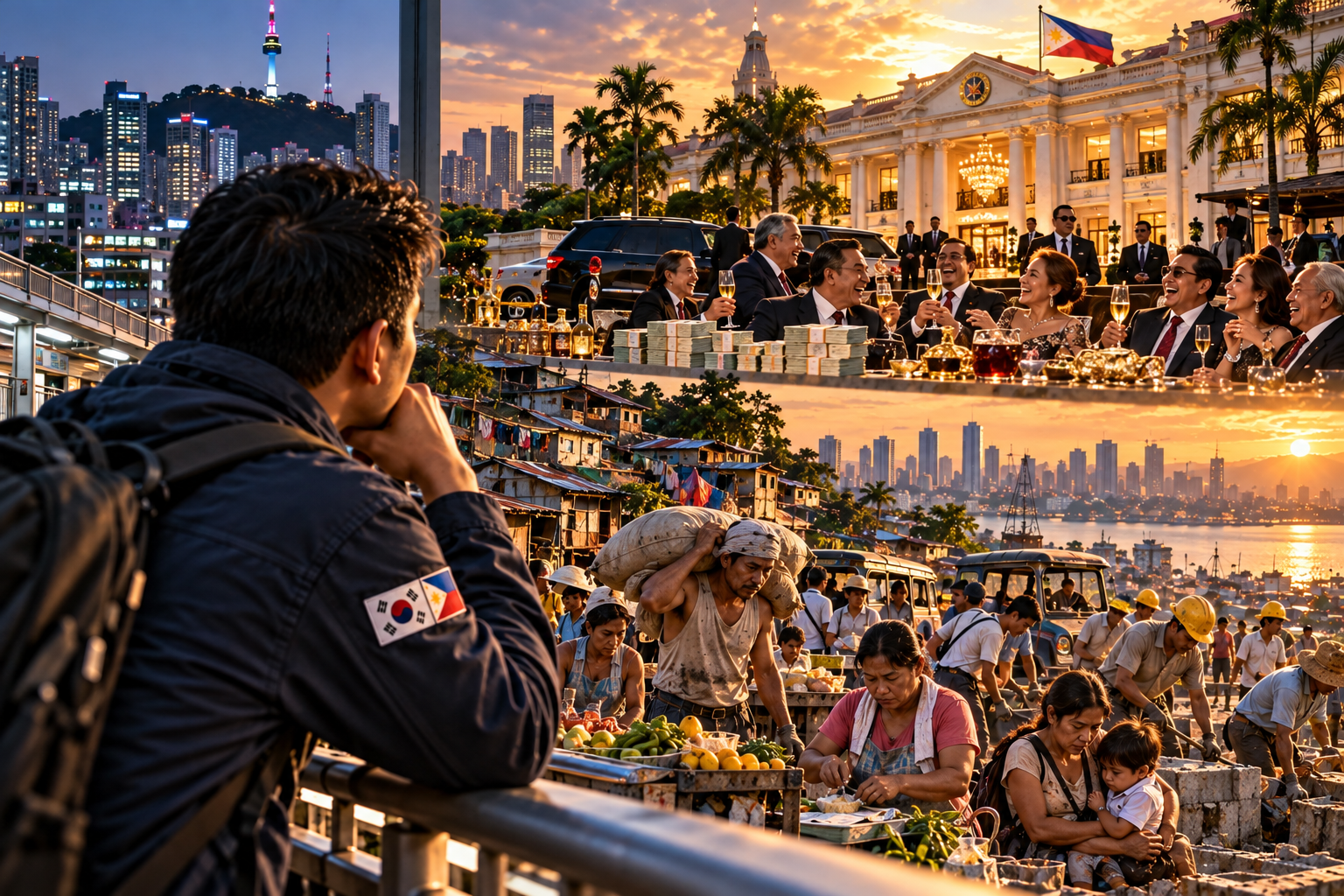
When I recently checked the exchange rate between the Korean won and the Philippine peso, I discovered that one million won was worth approximately 46,000 pesos. In June 2026, the same amount would have given me less than 40,000 pesos.
For someone like me who earns a living in South Korea but still has family and financial responsibilities in the Philippines, that was supposed to be good news. Without working additional hours but earning an extra won, I could now send home several thousand pesos more.
Under ordinary circumstances, that would have been something to celebrate.
And for a moment, I did. I was pleasantly surprised, and a smile crossed my face. But as the implications of what I had just discovered began to sink in, my smile slowly faded.
The difference alone amounted to several thousand pesos—money that many ordinary Filipino wage earners would have to work for days, perhaps even weeks, to earn. And here I was, gaining that much simply because the exchange rate had changed.
That realization left me increasingly uneasy. What initially seemed like a welcome financial advantage gradually became a source of concern. The additional pesos that my family could receive reminded me of something far more troubling: the continuing decline in the value of our currency and what it might mean for millions of Filipinos who earn their living in pesos.
I realized that what appeared to be a financial advantage for my family could also be a reflection of economic pressures affecting countless other families back home.
And I found myself thinking: Filipinos are not just me and my family.
There are millions of ordinary Filipinos who wake up every morning, go to work, and struggle to make ends meet. Unlike overseas Filipino workers and their families, they do not have the advantage of earning in a foreign currency whose value has increased against the peso.
When prices rise, their salaries do not necessarily rise with them. When the cost of food, transportation, electricity, and other necessities increases, they must find ways to stretch an income that may already be barely sufficient.
Some reduce their spending. Others sacrifice the little comforts they once enjoyed. Still others borrow money, postpone medical treatment, or compromise their children’s educational needs.
And for families already living on the margins, there may be very little left to sacrifice.
Of course, I understand that the exchange rate alone does not tell the complete story of our economy. A weakening peso does not necessarily mean that the entire economy is collapsing. Economic growth can continue even when the currency depreciates. There are industries that remain productive, businesses that prosper, and economic indicators that suggest progress.
But I cannot help asking: Progress for whom?
What does economic growth mean to a father whose salary can no longer adequately feed his family? What does an increase in national production mean to a mother who must decide which household necessities she can afford to buy? What comfort can favorable economic statistics offer a young worker whose earnings leave almost nothing for savings?
I do not dismiss the importance of economic indicators. They are essential for understanding where our country stands and where it may be heading.
But behind those numbers are people. Behind every percentage point are households trying to survive, parents trying to provide, and young Filipinos hoping for a better future.
An economy may be growing, but if its ordinary citizens are finding it increasingly difficult to live decently, then surely something deserves closer examination.
I am also aware that not everyone suffers equally during difficult economic times. Those who possess substantial resources, diversified investments, or foreign-currency earnings may be better equipped to protect themselves from rising prices. Some may even benefit from changing economic conditions.
Those who have little, however, have fewer choices. And as the cost of living continues to rise, what little they have becomes worth even less.
And that is what troubles me most. Economic hardship does not distribute its burdens equally. Often, those who have the least are asked, by circumstances rather than choice, to endure the most.
Living abroad has given me a particular perspective on this reality. I have spent many years working in South Korea, and I am grateful for the opportunities this country has provided me. I have been able to support my family, pursue my profession, and build a life that would have been different had I remained in the Philippines.
Yet I cannot separate my personal circumstances from my identity as a Filipino.
My financial security does not make me indifferent to the insecurity of my countrymen. My family’s ability to adjust to rising prices does not diminish my concern for families who cannot.
And perhaps that is why those additional pesos did not bring me the satisfaction I might otherwise have felt.
They reminded me of the distance between my circumstances and those of many people back home.
As I reflected further, my thoughts inevitably turned toward the larger question of what it would take to improve our country’s condition.
I wish there were simple answers. I wish our economic problems could be solved through a single policy, a change in leadership, or a temporary intervention that would immediately ease the burdens of ordinary Filipinos.
But the problems confronting our nation have accumulated over many years. They involve not only economic policies and institutions but also deeply rooted attitudes, practices, and behaviors that influence how we work, govern, cooperate, and hold ourselves accountable.
This is why I continue to believe in the importance of self-improvement—not as an instant remedy for poverty or economic inequality, and certainly not as a way of blaming those who are struggling for circumstances beyond their control.
Rather, I see it as one of the foundations of lasting national transformation.
A nation needs citizens who are capable, responsible, disciplined, discerning, and guided by sound values. It needs people who can think critically, make purposeful decisions, demand accountability, and contribute meaningfully to their communities.
At the same time, those citizens deserve institutions that protect their rights, reward honest work, provide fair opportunities, and enable them to improve their lives.
Personal transformation and institutional reform must work together. Neither can fully accomplish what our country needs without the other.
I recognize that this is a long-term undertaking. Its results may not be immediately visible, and I may never witness the kind of national transformation I hope to see.
Sometimes, that realization leaves me feeling helpless.
What can one Filipino, living thousands of kilometers away, realistically do about the economic hardships confronting millions of his countrymen?
I cannot determine the exchange rate. I cannot control inflation. I cannot single-handedly reform institutions or create employment opportunities for those who need them.
But I can continue doing what I know how to do: teach, write, share ideas, and encourage others to recognize their capacity for personal growth and meaningful contribution.
Perhaps these efforts are modest when measured against the magnitude of our national problems. But I would rather contribute something, however small, than surrender to the belief that nothing can be done.
After all, national transformation does not happen independently of the people who constitute a nation.
I have come to believe that our country’s socioeconomic problems cannot be resolved through changes in political leadership alone. Holding public officials accountable, strengthening institutions, and pursuing meaningful reforms are necessary. But even these efforts may fall short of producing lasting progress unless they are accompanied by changes within ourselves.
For what good would changing our leaders do if we continued to tolerate, practice, or perpetuate the very attitudes and behaviors that contribute to our nation’s problems?
Perhaps the transformation we long to see in our country must also begin with the transformation of its people—not as a substitute for political and institutional reforms, but as an essential part of them.
And so I return to the conviction that has guided my advocacy:
Better Self… Better Life… Better Nation!
These words are not a promise of an easy solution. They express a direction, a commitment, and a hope that the improvement of individuals, accompanied by the strengthening of our institutions, can eventually contribute to the improvement of our country.
I still appreciate the additional pesos that my Korean won can now provide my family. I am grateful that we have some protection against the increasing cost of living.
But I cannot bring myself to celebrate a favorable exchange rate without thinking about the economic circumstances that may be contributing to it and the people who must endure those circumstances without the same protection.
Perhaps someday I will look at the exchange rate and find less reason to worry about the condition of my country.
Not necessarily because the peso has become stronger, but because ordinary Filipinos have become economically secure enough that fluctuations in currency values no longer threaten their ability to live decently.
That is the kind of progress I hope to see.
Until then, I will remain grateful for what my family has, concerned for those who have less, and committed to doing whatever I can to contribute to a better Philippines.
Because while one million Korean won may now be worth more pesos, the well-being of my countrymen will always be worth far more to me than the additional money my family receives.
Happiness

Happiness is an inside job—but not a solitary one. Circumstances and relationships matter; the part
we must not surrender is our responsibility for how we live within them.

During a seminar, someone reportedly asked John Maxwell’s wife, Margaret, whether her husband made her happy.
Her answer was no.
Ask a hundred people what makes them happy and you may hear a hundred different answers. Many will point outward: a person, a possession, a promotion, financial security, recognition, travel, comfort, or the achievement of a long-held goal. External conditions do matter. Poverty, illness, loneliness, unsafe environments, and painful relationships can affect well-being profoundly. But making our happiness entirely dependent on what we cannot control leaves us dangerously powerless.
A story John Maxwell has shared about his wife, Margaret, captures the point. When asked whether her husband made her happy, she reportedly answered no—not because he was a poor husband, but because she did not regard another person as solely responsible for her happiness. The story is useful precisely because it separates contribution from responsibility. People can enrich our happiness enormously without becoming its sole custodians.
Happiness is therefore neither purely internal nor purely external. Relationships, security, health, purpose, and opportunity all shape it. At the same time, our habits of attention, gratitude, interpretation, choice, and response influence how we experience the life we have. We cannot command happiness on demand, but we can cultivate conditions in which it has more room to grow.
This also means resisting the belief that happiness begins only after the next milestone: after the promotion, the house, the recognition, the retirement, the perfect relationship. Goals matter, but a life spent postponing happiness until everything is finally in place may postpone it forever.
Perhaps the wiser pursuit is to build a life in which happiness has several roots: meaningful relationships, worthwhile work, enough security, continuing growth, moments of enjoyment, service to others, gratitude, and a sense of purpose. Then when one source is shaken—as eventually happens in every life—the entire tree does not have to fall.
Pause and Reflect
What have you been asking another person, achievement, or circumstance to provide before you allow yourself to feel happy?
One Step Forward
Write down one source of happiness you have been treating as completely outside your control. Then identify one small action within your control that could improve that part of your life today.
Explored in full in Part 3, Section II — Fulfillment (Redefining Happiness) of A Holistic Approach to Self-Improvement.
Success
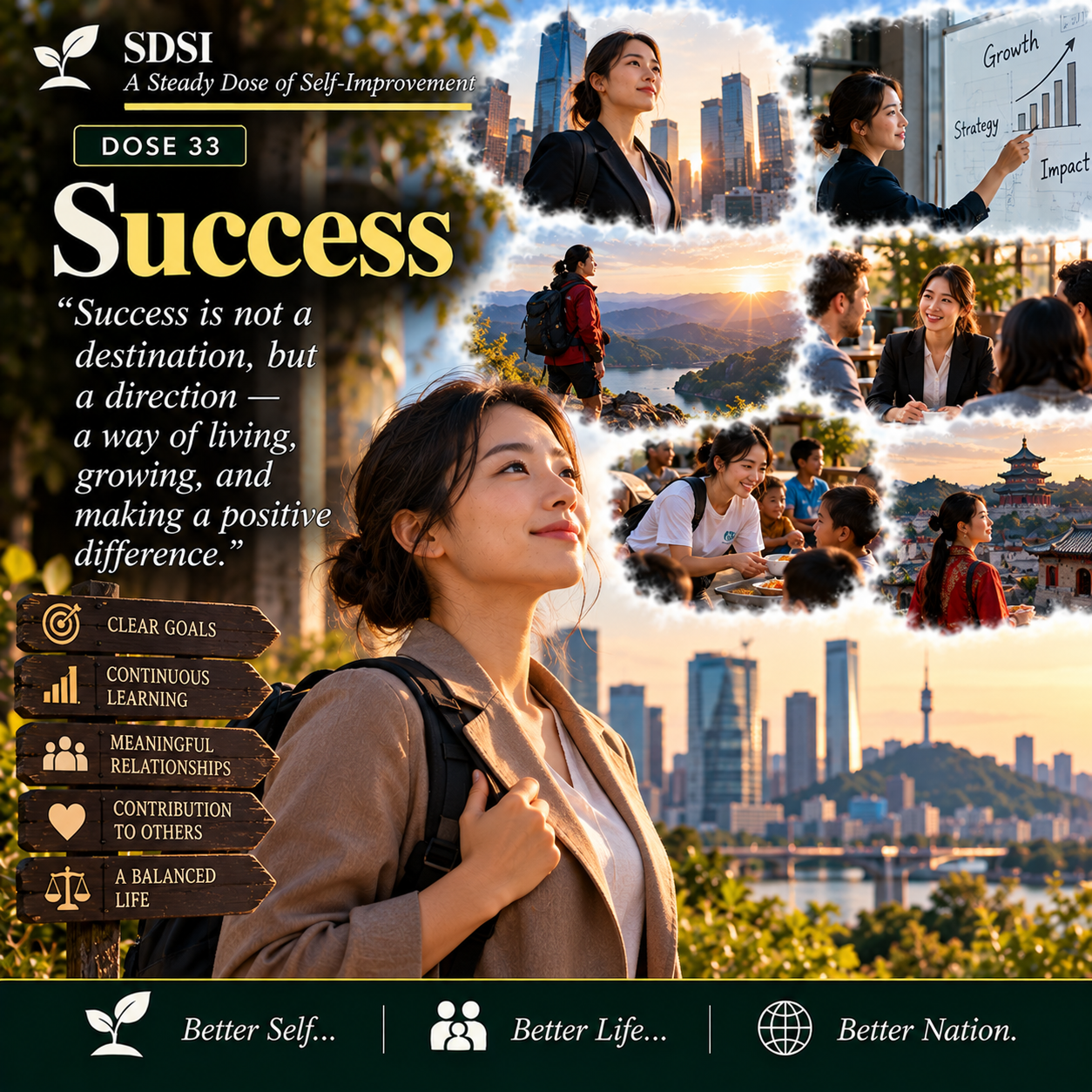
You must define success for yourself. A borrowed definition can make you spend your life
winning a game you never wanted to play.

The farmer who rises at dawn. The fisherman who braves the waves. The janitor who keeps the halls clean. Are they not successful?
Success is often presented to us through visible symbols: income, titles, possessions, influence, awards, fame. Those things can represent genuine achievement, and there is nothing inherently wrong with wanting them. The problem begins when we accept them as the only legitimate measures of a successful life.
Consider the farmer who rises before dawn to nurture crops, the fisherman who faces rough water to provide food, the driver who carries people safely, or the janitor whose work keeps a shared space clean and orderly. Their names may never appear on a wealth list. Yet work performed honestly, competently, and with purpose has value that no public scoreboard can fully measure.
Success, therefore, must be personal before it becomes public. It should reflect your values, circumstances, responsibilities, capabilities, and purpose. For one person, success may mean building a company. For another, it may mean raising a family well, becoming an excellent teacher, creating meaningful art, living debt-free, serving a community, or simply having enough time and freedom to live deliberately.
This does not mean lowering standards or using “my definition” as an excuse to stop growing. A personal definition of success should still challenge us. As our abilities expand, we can raise the bar—not to satisfy someone else’s expectations, but to honor more of our own potential.
The danger of an inherited definition is that we can achieve it and still discover that it was never ours. So define success before the world defines it for you. Then measure your progress against the life you genuinely value, not merely the life that attracts the most applause.
Pause and Reflect
Whose definition of success have you been quietly living by—your own, your family’s, your profession’s, or society’s?
One Step Forward
Write your own one-sentence definition of success. Try doing it without using money, job title, fame, or anyone else’s approval as the primary measure.
Explored in full in Part 3, Section II — Fulfillment (Redefining Success) of A Holistic Approach to Self-Improvement.
Big Heads, Small Hearts
Why Education Must Go Beyond Knowledge and Skills

Today, I introduced a lesson on conditional sentences and the conjunction if with a quotation: “If you don’t believe in yourself, no one will.”
What was supposed to be a discussion of English grammar became something more meaningful. My students began asking questions, and before I knew it, we were discussing self-belief, personal development, and the attitudes that influence how we approach life.
I welcomed their questions. In fact, I found myself enjoying the discussion immensely. After all, I have always believed that my responsibility as a teacher extends beyond teaching grammar, vocabulary, and the various competencies required in an English language examination.
I am not simply preparing my students to pass an examination. I would like to believe that, in my own little way, I am also helping prepare them for life.
And that brings me to a question I believe every educator and educational institution should occasionally confront:
What is the purpose of education if it produces knowledgeable and highly skilled individuals who lack the character to use their knowledge and skills responsibly?
Beyond Knowledge and Skills
Education is commonly associated with the acquisition of knowledge and the development of skills. Students attend school to learn facts, understand concepts, master procedures, solve problems, and develop competencies that will eventually help them pursue careers and contribute to society.
These are undoubtedly important objectives. I would be the last person to suggest otherwise.
But education, as I understand it, involves four equally important dimensions: Knowledge, Skills, Attitudes, and Values (KSAV).
Knowledge concerns what we know.
Skills concern what we are capable of doing.
Attitudes influence how we approach ourselves, other people, our responsibilities, and the challenges we encounter.
Values provide the moral and ethical foundations that guide our decisions, behavior, and relationships.
The first two dimensions largely determine our competence. The latter two profoundly influence how that competence is exercised.
A person may possess an impressive amount of knowledge and extraordinary technical abilities. But what happens when that person lacks integrity, compassion, humility, and a sense of responsibility?
Intelligence can be used to enlighten or deceive. Communication skills can be used to inspire or manipulate. Leadership abilities can be exercised to serve others or exploit them.
The difference often lies not in how much people know or what they can do, but in the attitudes they possess and the values that govern their actions.
Knowledge and skills make us capable. Attitudes and values help determine whether we use those capabilities constructively or destructively.
The Values I Carried Into My Classroom
Looking back, I cannot help reflecting on how much of my educational philosophy was shaped and strengthened by the nine years I spent as a teacher and administrator at St. Mary’s College of Baliuag, one of the educational institutions administered by the Religious of the Virgin Mary (RVM) sisters in the Philippines.
During those years, I was immersed in an educational culture guided by the Ignacian core values of Faith, Excellence, and Service. These were not merely ideals expressed in institutional statements or displayed on school walls. They were principles integrated into educational practices, institutional policies, and the everyday experiences of teachers, administrators, and students.
Faith emphasized the importance of moral and spiritual formation. Excellence encouraged the pursuit of knowledge, competence, discipline, and continuous improvement. Service reminded us that our abilities and achievements should ultimately contribute to the welfare of others.
As I reflect on these values, I see how beautifully they complement one another. Faith provides the moral and spiritual foundation upon which character is formed. Excellence encourages individuals to develop their knowledge, skills, abilities, and potential. Service gives purpose to these achievements by directing them toward the welfare of others.
Perhaps I did not fully appreciate at the time how deeply that institutional culture was influencing my understanding of education. But years after leaving St. Mary’s College of Baliuag, and after more than a decade of teaching in South Korea, I find myself continuing to advocate principles that reflect those formative experiences.
I do not attribute my educational philosophy exclusively to my years with the RVM. My upbringing, personal faith, academic preparation, and subsequent professional experiences have also contributed to its development. Nevertheless, I gratefully acknowledge the significant influence of the Religious of the Virgin Mary and St. Mary’s College of Baliuag in strengthening my belief that education should nurture both intellectual competence and moral character.
The institution where I teach has changed. The students I teach have changed. But the values I carried from those formative years remain part of the educator I am today.
Big Heads, Small Hearts
One of my concerns about contemporary education is the possibility that schools may become so preoccupied with academic performance, examination results, professional qualifications, and employability that character formation receives insufficient attention.
We celebrate academic excellence, intellectual achievement, and technical proficiency. We encourage students to accumulate information, earn degrees, obtain certifications, and develop increasingly sophisticated competencies.
There is nothing inherently wrong with these pursuits. They are essential to individual advancement and social progress.
But what if, in our enthusiasm to fill students’ minds, we neglect to nurture their hearts?
We may eventually produce individuals with big heads bursting with knowledge but small hearts lacking compassion, humility, and concern for others.
Imagine a society filled with highly educated individuals who are intellectually brilliant but morally indifferent. People who can solve complicated mathematical problems but cannot appreciate another person’s suffering. Professionals who possess impressive credentials but regard dishonesty as acceptable when it serves their interests. Leaders who know how to exercise authority but have never learned the importance of exercising it with humility and compassion.
Such individuals may be successful by conventional standards. They may accumulate wealth, occupy prestigious positions, and command considerable influence.
But can we confidently regard them as genuinely educated?
A degree may certify academic achievement. It does not necessarily certify good character.
And a society populated by competent individuals who lack a sense of ethical responsibility may find that its greatest problems are created not by ignorance but by the misuse of intelligence.
The Leaders Sitting in Our Classrooms
When I look at my students, I do not see merely young people preparing for examinations or future employment.
I see potential parents, professionals, entrepreneurs, educators, and leaders.
Some may eventually lead families. Others may become influential members of their communities, organizations, or circles of friends. A few may even occupy positions from which their decisions affect thousands or millions of people.
Whatever paths they choose, their knowledge and skills will certainly matter.
But so will their attitudes and values.
A future parent needs more than the financial ability to support a family. That parent also needs patience, understanding, and compassion.
A future employer needs more than managerial competence. That employer also needs fairness, integrity, and respect for employees.
A future leader needs more than intelligence and persuasive communication skills. That leader also needs humility, accountability, and a genuine concern for the welfare of others.
These qualities do not automatically emerge when students graduate.
They must be cultivated, practiced, questioned, and strengthened throughout the educational journey.
Of course, schools cannot assume sole responsibility for character formation. Families, communities, religious and cultural institutions, and personal experiences all contribute to shaping an individual’s attitudes and values.
Nevertheless, schools occupy a particularly influential position. For many years, students spend a considerable portion of their waking hours in classrooms, interacting with teachers and classmates, encountering different perspectives, and developing habits of thought and behavior.
Surely, such an environment offers opportunities to cultivate not only intellectual competence but also personal character.
Teaching Grammar, Teaching Life
Let me return to today’s classroom discussion.
Our lesson concerned conditional sentences. Grammatically, the word if introduces a condition and allows us to express possibilities, consequences, imagined situations, and relationships between events.
I could have introduced the grammatical structures, presented examples, assigned exercises, and assessed my students’ understanding.
That would have been a perfectly legitimate language lesson.
Instead, I began with a quotation about self-belief.
The quotation became a starting point for questions and discussion. Students were encouraged to consider not only how conditional sentences are constructed but also the meaning of the ideas expressed through them.
And that is precisely the kind of opportunity I believe teachers should recognize.
A lesson on conditional sentences can become a discussion about choices and consequences.
A reading passage about success can invite reflection on perseverance, discipline, and integrity.
A speaking activity about leadership can encourage students to examine the qualities of a responsible leader.
A writing task about social problems can help develop empathy and awareness of the experiences of others.
None of these requires abandoning the academic objectives of the lesson.
On the contrary, meaningful content can make language learning more engaging while encouraging students to think critically and reflect on their own beliefs.
This does not mean teachers should impose their personal convictions on students. Character education should encourage thoughtful reflection, respectful disagreement, and the development of sound judgment—not unquestioning acceptance of a teacher’s opinions.
Indeed, students should be encouraged to question even the quotations we present to them.
Consider the statement I used today: “If you don’t believe in yourself, no one will.”
It is a powerful reminder of the importance of self-belief. Yet it is not universally true. Sometimes, a parent, friend, or teacher believes in someone long before that person discovers confidence in themselves.
Recognizing such nuances can make the discussion more meaningful.
And perhaps, through conversations like these, students learn something valuable about both language and life.
Education That Reaches the Heart
I am not suggesting that every grammar lesson should become a lecture on morality or that teachers should sacrifice academic rigor in favor of inspirational discussions.
Far from it.
Students deserve competent instruction, well-designed learning experiences, meaningful assessments, and opportunities to develop the knowledge and skills necessary for their future endeavors.
But I believe they deserve something more.
They deserve an educational environment that encourages honesty, respect, accountability, compassion, self-discipline, and a sense of purpose.
They deserve teachers who recognize that the way they treat students may be as influential as the lessons they deliver.
After all, students learn not only from what teachers say but also from how teachers behave.
A teacher who speaks about respect but humiliates students sends a contradictory message.
A teacher who emphasizes honesty but practices favoritism undermines the very value being taught.
Conversely, a teacher who demonstrates patience, fairness, humility, and genuine concern for students provides living examples of the attitudes and values that education should nurture.
In this sense, character formation is not confined to a particular subject or classroom activity.
It is woven into the everyday experiences of schooling.
And perhaps this is one of the most enduring lessons I carried from my years at St. Mary’s: the values an institution professes become truly meaningful only when they are reflected in the everyday actions of the people within it.
When Education Truly Educates
I often remind myself that the students sitting before me today will eventually leave the classroom and enter a world where their decisions will affect other people.
Some may forget the grammatical rules I taught them. Others may never again encounter the particular reading passages or vocabulary exercises we discussed.
But I hope that some of the ideas we explored will remain with them.
Perhaps one day, when confronted with a difficult decision, a former student will remember a classroom discussion about integrity.
Perhaps another, struggling with self-doubt, will recall a conversation about self-belief.
Perhaps someone who eventually occupies a position of authority will remember that leadership is not merely about power but also about responsibility and service.
I cannot know whether these things will happen. Nor can I claim that a few classroom conversations will necessarily transform someone’s character.
But I believe the possibility is worth pursuing.
Education should prepare students not merely to earn a living but also to live meaningfully and responsibly.
It should develop minds capable of understanding the world and hearts willing to make that world better.
And if our educational institutions succeed in producing brilliant minds but fail to encourage the development of good character, we must ask ourselves whether we have truly fulfilled the purpose of education.
For what good is a head filled with knowledge if the heart has little room for humanity?
Perhaps the greatest achievement of education is not simply producing individuals who know more and can do more.
It is helping develop individuals who, because of what they know, what they can do, what they believe, and what they value, are capable of becoming better human beings.
Big minds and big hearts.
That, to me, is what education should aspire to cultivate.
Health

Health is not something to spend in pursuit of success and recover later. It is part of the foundation
that makes every worthwhile pursuit sustainable.

The wealthy, the famous, and the powerful—are they sleeping peacefully? Are their relationships intact?
When we speak of health, many of us immediately picture its physical dimension: a reassuring medical report, a fit body, enough energy to get through the day, and the absence of serious illness. Physical health matters enormously. But it is not the whole picture.
A person can appear physically strong while being emotionally depleted, mentally exhausted, socially isolated, or trapped in relationships that are deteriorating. That is why some of the more revealing questions about a successful life cannot be answered by a weighing scale or laboratory result. Do you sleep peacefully? Do you still have people with whom you can be completely yourself? Can you stop working without feeling that your worth has disappeared?
The pursuit of success can sometimes exact costs that do not appear on a medical chart until much later. Chronic pressure, neglected relationships, inadequate rest, and the constant demand for more can quietly erode the well-being that achievement was supposed to improve. A person may gain income, status, or recognition while losing sleep, peace, connection, or a sense of self.
Health, then, is better understood holistically: physical, mental, emotional, and relational well-being influencing one another. We will not keep every dimension in perfect condition at every moment, nor can every health outcome be controlled by lifestyle. But we can refuse to treat health as an expendable resource to be sacrificed indefinitely for another goal.
Protecting health requires intentionality: adequate rest, movement, nourishing food, relationships that receive time rather than leftovers, attention to emotional strain, and the humility to seek appropriate help when needed. Success becomes easier to enjoy when we are healthy enough—in the broadest sense—to be present for it.
Pause and Reflect
Beyond how healthy you look, how healthy does your life actually feel—physically, mentally, emotionally, and relationally?
One Step Forward
Identify one dimension of health you have been neglecting. Write one realistic boundary or practice that can protect it this week.
Explored in full in Part 3, Section II — Fulfillment (Redefining Health) of A Holistic Approach to Self-Improvement.
That Space Between Stimulus and Response

Had I known earlier that there is a space between stimulus and response, I might have saved my younger self a great deal of pain and trouble.
Think of that space as a stopover—a brief opportunity to collect ourselves before deciding how to respond to something that happens to us. It offers us the luxury of stopping, even for a split second, before allowing our emotions to take the driver’s seat.
But then again, can we really call a split second a luxury? How much thinking can we possibly do in such a fleeting moment? Unless, of course, we happen to be Flash, the comic-book superhero who can accomplish extraordinary things in the blink of an eye. Unfortunately, most of us do not possess his superhuman speed. ^^
That space has a name: the pause.
It has always been there, quietly waiting to be recognized and used. Yet many of us go through life without realizing its significance.
When something makes us angry, frightened, embarrassed, or offended, our emotions can rise faster than our thoughts. Before we fully understand what has happened, harsh words may have already escaped our lips, and regrettable actions may have already been committed. Words we would never utter and actions we would never consider when we are at our best suddenly become part of a moment we wish we could undo.
And yes, how we wish we could be Flash, if only to give ourselves enough time to think before our tongues get us into trouble or our actions leave us with consequences we must live with.
But perhaps we do not need superhuman powers after all.
As I articulated in a related article, Thinking First, we are not helpless victims of our emotions. Emotional reactions may arise almost instantly, but they do not necessarily have to dictate what happens next. We can learn to recognize our feelings without immediately acting on them. We can develop the habit of pausing, however briefly, to allow reason to catch up with emotion.
A statement often associated with Viktor Frankl describes the space between stimulus and response as the place where our freedom to choose resides. Although the exact wording cannot be reliably attributed to Frankl, the underlying principle reflects one of his central teachings: circumstances may influence us, but we retain some freedom in choosing how we respond to them.
And therein lies the power of the pause.
It may not always be long enough for deep reflection, but it can be enough to stop an angry word, reconsider an impulsive decision, or prevent an action we might later regret. With practice, that seemingly insignificant moment can become a powerful instrument of self-control.
We cannot always control what happens to us. We cannot always prevent emotions from arising. But we can learn to exercise greater control over what we do with those emotions.
Perhaps growing wiser is not simply about learning what to say or do. Sometimes, it is about learning when not to say or do anything at all.
Remember this:
Every word you have regretted saying and every action you have wished you could take back probably began the same way: you reacted before you thought.
And perhaps, between the next stimulus and your response, you will find that little space where a better choice is waiting to be made.
Beyond the Billions: Who Really Deserves the Box-Office Crown (Part 1)
An evidence-based comparison of Avatar 1 and Avengers: Endgame

The Avengers: Endgame rerelease is still underway. Having watched the original film three times already, I decided to see it once more. With the release of Avengers: Doomsday on the horizon, I wanted to revisit the story and see whether I could connect a few more dots in the ever-expanding Marvel multiverse. Besides, there was the promise of something in the post-credits scene that I was particularly eager to see.
The rerelease certainly seems well-timed to rekindle excitement for Doomsday. But let’s be honest—could a rather petty subplot also be unfolding behind the scenes? Perhaps another battle is being fought, one that has nothing to do with superheroes saving the universe: the race to reclaim the No. 1 spot at the all-time worldwide box office. And should Endgame close the gap on James Cameron’s original Avatar, the Marvel–Disney machine might just pull off another spectacular comeback.
Would James Cameron eventually retaliate by rereleasing the original Avatar, perhaps under the convenient pretext of promoting the franchise’s fourth installment, while quietly plotting to wrest the crown back from the Avengers? Well, that remains to be seen. As they say, the plot thickens! And with Spider-Man web-swinging toward the top of the leaderboard, the plot might thicken even more.
Now, if I were to decide the winner purely on sentimental grounds, the verdict would be easy. As a big fan of Iron Man—and being a “Tony” myself, just like Tony Stark—I would gladly hand the crown to Avengers: Endgame without a second thought. But the researcher in me refuses to let personal attachment dictate the outcome. He insists that I set aside my superhero loyalties, put sentiment on the sidelines, and examine the evidence through a set of reasonably objective and measurable criteria. After all, if I am going to crown a champion, I had better make sure that my judgment is guided by more than my admiration for the man inside that red-and-gold suit.
Sorry, Tony Stark. This time, even your genius, billionaire, playboy, philanthropist credentials won’t earn you extra points.
But jokes aside, who truly deserves the cinematic crown if we look beyond the staggering mountains of cash these movies have accumulated? To answer that question, I developed a multidimensional framework to evaluate these box-office titans on a more level playing field. After all, the final box-office gross is not the be-all and end-all of cinematic success. There is much more to the story than the billions printed on the scoreboard.
So, let the cinematic showdown begin.