Category Archives: Educational Philosophy
Big Heads, Small Hearts
Why Education Must Go Beyond Knowledge and Skills

Today, I introduced a lesson on conditional sentences and the conjunction if with a quotation: “If you don’t believe in yourself, no one will.”
What was supposed to be a discussion of English grammar became something more meaningful. My students began asking questions, and before I knew it, we were discussing self-belief, personal development, and the attitudes that influence how we approach life.
I welcomed their questions. In fact, I found myself enjoying the discussion immensely. After all, I have always believed that my responsibility as a teacher extends beyond teaching grammar, vocabulary, and the various competencies required in an English language examination.
I am not simply preparing my students to pass an examination. I would like to believe that, in my own little way, I am also helping prepare them for life.
And that brings me to a question I believe every educator and educational institution should occasionally confront:
What is the purpose of education if it produces knowledgeable and highly skilled individuals who lack the character to use their knowledge and skills responsibly?
Beyond Knowledge and Skills
Education is commonly associated with the acquisition of knowledge and the development of skills. Students attend school to learn facts, understand concepts, master procedures, solve problems, and develop competencies that will eventually help them pursue careers and contribute to society.
These are undoubtedly important objectives. I would be the last person to suggest otherwise.
But education, as I understand it, involves four equally important dimensions: Knowledge, Skills, Attitudes, and Values (KSAV).
Knowledge concerns what we know.
Skills concern what we are capable of doing.
Attitudes influence how we approach ourselves, other people, our responsibilities, and the challenges we encounter.
Values provide the moral and ethical foundations that guide our decisions, behavior, and relationships.
The first two dimensions largely determine our competence. The latter two profoundly influence how that competence is exercised.
A person may possess an impressive amount of knowledge and extraordinary technical abilities. But what happens when that person lacks integrity, compassion, humility, and a sense of responsibility?
Intelligence can be used to enlighten or deceive. Communication skills can be used to inspire or manipulate. Leadership abilities can be exercised to serve others or exploit them.
The difference often lies not in how much people know or what they can do, but in the attitudes they possess and the values that govern their actions.
Knowledge and skills make us capable. Attitudes and values help determine whether we use those capabilities constructively or destructively.
The Values I Carried Into My Classroom
Looking back, I cannot help reflecting on how much of my educational philosophy was shaped and strengthened by the nine years I spent as a teacher and administrator at St. Mary’s College of Baliuag, one of the educational institutions administered by the Religious of the Virgin Mary (RVM) sisters in the Philippines.
During those years, I was immersed in an educational culture guided by the Ignacian core values of Faith, Excellence, and Service. These were not merely ideals expressed in institutional statements or displayed on school walls. They were principles integrated into educational practices, institutional policies, and the everyday experiences of teachers, administrators, and students.
Faith emphasized the importance of moral and spiritual formation. Excellence encouraged the pursuit of knowledge, competence, discipline, and continuous improvement. Service reminded us that our abilities and achievements should ultimately contribute to the welfare of others.
As I reflect on these values, I see how beautifully they complement one another. Faith provides the moral and spiritual foundation upon which character is formed. Excellence encourages individuals to develop their knowledge, skills, abilities, and potential. Service gives purpose to these achievements by directing them toward the welfare of others.
Perhaps I did not fully appreciate at the time how deeply that institutional culture was influencing my understanding of education. But years after leaving St. Mary’s College of Baliuag, and after more than a decade of teaching in South Korea, I find myself continuing to advocate principles that reflect those formative experiences.
I do not attribute my educational philosophy exclusively to my years with the RVM. My upbringing, personal faith, academic preparation, and subsequent professional experiences have also contributed to its development. Nevertheless, I gratefully acknowledge the significant influence of the Religious of the Virgin Mary and St. Mary’s College of Baliuag in strengthening my belief that education should nurture both intellectual competence and moral character.
The institution where I teach has changed. The students I teach have changed. But the values I carried from those formative years remain part of the educator I am today.
Big Heads, Small Hearts
One of my concerns about contemporary education is the possibility that schools may become so preoccupied with academic performance, examination results, professional qualifications, and employability that character formation receives insufficient attention.
We celebrate academic excellence, intellectual achievement, and technical proficiency. We encourage students to accumulate information, earn degrees, obtain certifications, and develop increasingly sophisticated competencies.
There is nothing inherently wrong with these pursuits. They are essential to individual advancement and social progress.
But what if, in our enthusiasm to fill students’ minds, we neglect to nurture their hearts?
We may eventually produce individuals with big heads bursting with knowledge but small hearts lacking compassion, humility, and concern for others.
Imagine a society filled with highly educated individuals who are intellectually brilliant but morally indifferent. People who can solve complicated mathematical problems but cannot appreciate another person’s suffering. Professionals who possess impressive credentials but regard dishonesty as acceptable when it serves their interests. Leaders who know how to exercise authority but have never learned the importance of exercising it with humility and compassion.
Such individuals may be successful by conventional standards. They may accumulate wealth, occupy prestigious positions, and command considerable influence.
But can we confidently regard them as genuinely educated?
A degree may certify academic achievement. It does not necessarily certify good character.
And a society populated by competent individuals who lack a sense of ethical responsibility may find that its greatest problems are created not by ignorance but by the misuse of intelligence.
The Leaders Sitting in Our Classrooms
When I look at my students, I do not see merely young people preparing for examinations or future employment.
I see potential parents, professionals, entrepreneurs, educators, and leaders.
Some may eventually lead families. Others may become influential members of their communities, organizations, or circles of friends. A few may even occupy positions from which their decisions affect thousands or millions of people.
Whatever paths they choose, their knowledge and skills will certainly matter.
But so will their attitudes and values.
A future parent needs more than the financial ability to support a family. That parent also needs patience, understanding, and compassion.
A future employer needs more than managerial competence. That employer also needs fairness, integrity, and respect for employees.
A future leader needs more than intelligence and persuasive communication skills. That leader also needs humility, accountability, and a genuine concern for the welfare of others.
These qualities do not automatically emerge when students graduate.
They must be cultivated, practiced, questioned, and strengthened throughout the educational journey.
Of course, schools cannot assume sole responsibility for character formation. Families, communities, religious and cultural institutions, and personal experiences all contribute to shaping an individual’s attitudes and values.
Nevertheless, schools occupy a particularly influential position. For many years, students spend a considerable portion of their waking hours in classrooms, interacting with teachers and classmates, encountering different perspectives, and developing habits of thought and behavior.
Surely, such an environment offers opportunities to cultivate not only intellectual competence but also personal character.
Teaching Grammar, Teaching Life
Let me return to today’s classroom discussion.
Our lesson concerned conditional sentences. Grammatically, the word if introduces a condition and allows us to express possibilities, consequences, imagined situations, and relationships between events.
I could have introduced the grammatical structures, presented examples, assigned exercises, and assessed my students’ understanding.
That would have been a perfectly legitimate language lesson.
Instead, I began with a quotation about self-belief.
The quotation became a starting point for questions and discussion. Students were encouraged to consider not only how conditional sentences are constructed but also the meaning of the ideas expressed through them.
And that is precisely the kind of opportunity I believe teachers should recognize.
A lesson on conditional sentences can become a discussion about choices and consequences.
A reading passage about success can invite reflection on perseverance, discipline, and integrity.
A speaking activity about leadership can encourage students to examine the qualities of a responsible leader.
A writing task about social problems can help develop empathy and awareness of the experiences of others.
None of these requires abandoning the academic objectives of the lesson.
On the contrary, meaningful content can make language learning more engaging while encouraging students to think critically and reflect on their own beliefs.
This does not mean teachers should impose their personal convictions on students. Character education should encourage thoughtful reflection, respectful disagreement, and the development of sound judgment—not unquestioning acceptance of a teacher’s opinions.
Indeed, students should be encouraged to question even the quotations we present to them.
Consider the statement I used today: “If you don’t believe in yourself, no one will.”
It is a powerful reminder of the importance of self-belief. Yet it is not universally true. Sometimes, a parent, friend, or teacher believes in someone long before that person discovers confidence in themselves.
Recognizing such nuances can make the discussion more meaningful.
And perhaps, through conversations like these, students learn something valuable about both language and life.
Education That Reaches the Heart
I am not suggesting that every grammar lesson should become a lecture on morality or that teachers should sacrifice academic rigor in favor of inspirational discussions.
Far from it.
Students deserve competent instruction, well-designed learning experiences, meaningful assessments, and opportunities to develop the knowledge and skills necessary for their future endeavors.
But I believe they deserve something more.
They deserve an educational environment that encourages honesty, respect, accountability, compassion, self-discipline, and a sense of purpose.
They deserve teachers who recognize that the way they treat students may be as influential as the lessons they deliver.
After all, students learn not only from what teachers say but also from how teachers behave.
A teacher who speaks about respect but humiliates students sends a contradictory message.
A teacher who emphasizes honesty but practices favoritism undermines the very value being taught.
Conversely, a teacher who demonstrates patience, fairness, humility, and genuine concern for students provides living examples of the attitudes and values that education should nurture.
In this sense, character formation is not confined to a particular subject or classroom activity.
It is woven into the everyday experiences of schooling.
And perhaps this is one of the most enduring lessons I carried from my years at St. Mary’s: the values an institution professes become truly meaningful only when they are reflected in the everyday actions of the people within it.
When Education Truly Educates
I often remind myself that the students sitting before me today will eventually leave the classroom and enter a world where their decisions will affect other people.
Some may forget the grammatical rules I taught them. Others may never again encounter the particular reading passages or vocabulary exercises we discussed.
But I hope that some of the ideas we explored will remain with them.
Perhaps one day, when confronted with a difficult decision, a former student will remember a classroom discussion about integrity.
Perhaps another, struggling with self-doubt, will recall a conversation about self-belief.
Perhaps someone who eventually occupies a position of authority will remember that leadership is not merely about power but also about responsibility and service.
I cannot know whether these things will happen. Nor can I claim that a few classroom conversations will necessarily transform someone’s character.
But I believe the possibility is worth pursuing.
Education should prepare students not merely to earn a living but also to live meaningfully and responsibly.
It should develop minds capable of understanding the world and hearts willing to make that world better.
And if our educational institutions succeed in producing brilliant minds but fail to encourage the development of good character, we must ask ourselves whether we have truly fulfilled the purpose of education.
For what good is a head filled with knowledge if the heart has little room for humanity?
Perhaps the greatest achievement of education is not simply producing individuals who know more and can do more.
It is helping develop individuals who, because of what they know, what they can do, what they believe, and what they value, are capable of becoming better human beings.
Big minds and big hearts.
That, to me, is what education should aspire to cultivate.
THE DAY “FART” BECAME A TEACHING AID
When Grammar, Chemistry, and Childhood Mischief Met in My Classroom
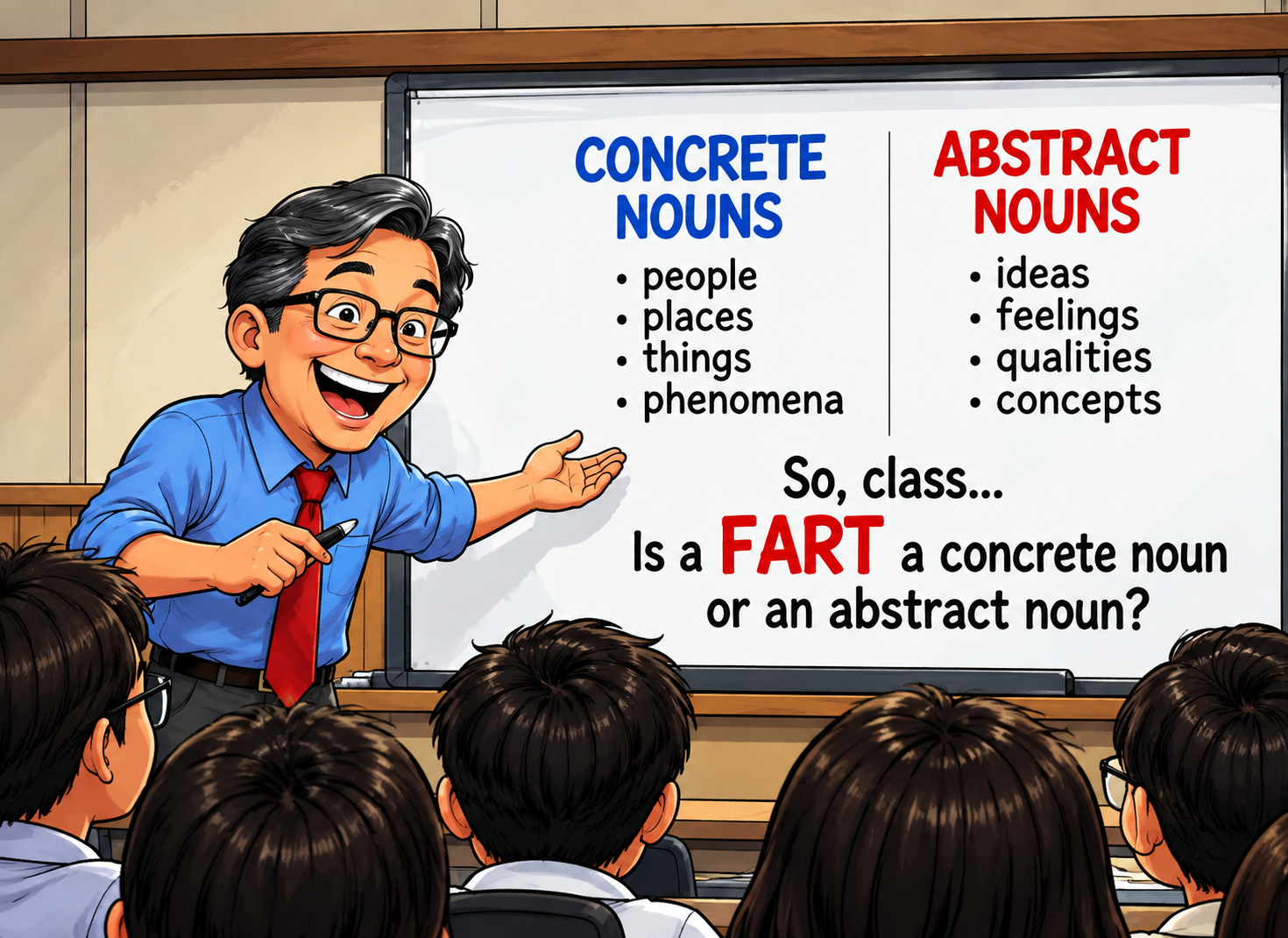
Nouns can be a very boring topic in grammar. After all, how much excitement can students possibly find in learning about the names of people, places, things, and ideas?
But the challenge for teachers like me is how to make even the simplest and seemingly most boring topics interesting, engaging, and, whenever possible, fun.
I once came across a saying suggesting that good teaching is one-fourth preparation and three-fourths pure theatre. I cannot remember its exact wording or who originally said it, but I have always appreciated the sentiment behind it.
Preparation provides the substance of a lesson. Theatre gives it life.
Of course, I do not enter my classroom intending to perform a comedy show. I prepare my lessons, identify my objectives, and think about how best to explain the concepts. Whatever theatrical elements emerge usually happen spontaneously.
Sometimes, even I am surprised by what comes out of my mouth.
And speaking of things coming out…
One day, while discussing nouns, I introduced the distinction between concrete and abstract nouns.
I explained that concrete nouns refer to physical things or occurrences you can perceive through the senses, whereas abstract nouns refer to concepts, qualities, feelings, and ideas.
After giving several conventional examples, I decided to test my students with a less conventional one.
“Class,” I asked, “is a FART a concrete noun or an abstract noun?”
There was a moment of hesitation.
“Yes class you heard it right… FART.”
The students looked at each other, some smiled, some laughed.
They I warned those who laughed, “Oops not too much… you might fart.”
More laughter came after that.
Then came the answers.
“Abstract, sir!”
Practically everyone agreed.
I could understand their reasoning. A fart is generally invisible. You cannot put it on a table, examine its shape, or display it like a book or a chair.
But I had other ideas.
“No!” I declared. “A fart is a concrete noun!”
The students looked puzzled.
And so, our grammar lesson unexpectedly became a chemistry lesson.
I explained that a fart involves releasing intestinal gases. These gases have physical existence. They occupy space, consist of matter, and can be detected through our senses.
“Just because you cannot see something,” I explained, “does not mean it does not exist!”
I thought that would settle the matter.
But then I decided to go further.
“Besides,” I told them, “who says you cannot hold a fart?”
That was when I remembered something from my childhood.
When I was a little boy, I was playing with my younger sister. At some point, I passed gas. Being the mischievous little creature that I was, I quickly cupped my hand near my behind, pretending to catch what had just escaped.
Before the gas could completely disperse, I brought my cupped hand close to my sister’s nose.
Then I opened it.
My poor sister!
She cried and immediately ran to our mother to report the terrible injustice she had suffered.
Mama, apparently finding the whole incident amusing despite my sister’s distress, gave me a light smack with her slipper, partly to reprimand me and partly to appease the offended little girl.
I had received my punishment.
My sister had received her justice.
And neither of us could have imagined that decades later, the incident would become part of a university grammar lesson in South Korea.
By the time I finished telling the story, my students were in stitches.
What began as an ordinary discussion of concrete and abstract nouns wandered through chemistry, human biology, childhood mischief, and a mother’s slipper.
And somehow, we were still discussing grammar!
But the laughter wasn’t over
Having established that a fart was a concrete noun, I decided to challenge my students further.
“Now, class,” I asked, “is fart a count noun or a non-count noun?”
Immediately, two students began debating.
“It’s non-count, sir!” one insisted.
“No, it’s count!” the other argued.
One student tried to defend his position by referring to our earlier discussion.
“Sir just said it’s concrete! Like a smartphone is concrete. You can say, ‘I have one smartphone!'”
His classmate was unconvinced.
“Come on!” he protested. “You can’t say, ‘I have one fart!'”
The classroom erupted in laughter again.
I could hardly have asked for a more entertaining grammatical disagreement.
When the laughter subsided, I explained that fart is indeed a countable noun. We can say a fart, two farts, or several farts. The issue wasn’t its countability but the choice of expression. In ordinary conversation, we generally say someone lets out a fart rather than has one fart.
I also clarified that concrete and countable describe two different noun characteristics. A noun can be concrete and countable, like chair, or concrete and uncountable, like water.
By then, we had explored two grammatical classifications using one rather unconventional example.
But something else had happened.
My students were no longer merely listening to an explanation. They were arguing, reasoning, challenging one another, and defending their answers.
One student had attempted to apply an earlier grammatical concept to a new question. Although the reasoning wasn’t entirely correct, it gave us another chance to clarify the distinction between the two classifications.
And all of this happened because of a fart!
When Preparation Meets Theatre…
Looking back, I find the experience amusing not merely because of the laughter it produced, but because the lesson unfolded so naturally.
I had not planned to tell that childhood story. It wasn’t in my lesson plan. There was certainly no instruction in my teaching materials that said, “At this point, introduce a childhood fart incident.”
The story simply emerged from our discussion.
But beneath the humor was a genuine learning opportunity.
My students had initially associated concrete with things they could see or hold. The unusual example challenged that assumption and encouraged them to reconsider what physical existence means.
The chemistry explanation supplied the conceptual clarification. The childhood anecdote made the discussion memorable.
The subsequent debate about countability created another learning opportunity. It required students to examine their assumptions, explain their reasoning, and distinguish between two different grammatical concepts.
Did the laughter guarantee that every student understood the lesson? Of course not. Understanding still needs to be checked through questions, examples, and opportunities to apply what has been learned.
But the laughter helped turn an otherwise ordinary lesson into an experience we could share.
I have always believed that teaching should be a serious undertaking without necessarily becoming a solemn activity.
A teacher can be academically rigorous without being intimidating. A lesson can be intellectually demanding without being joyless. And sometimes, a little spontaneity can encourage students to participate in ways a carefully prepared explanation alone might not.
Perhaps that is what the expression about preparation and theatre really means to me.
Preparation ensures that I know what I am teaching, why I am teaching it, and what I want my students to learn.
Theatre, whether intentional or spontaneous, helps me bring the lesson to life.
And when the two come together, the classroom becomes more than a place where information is delivered. It becomes a place where ideas are explored, mistakes are examined, questions are encouraged, and learning can be accompanied by laughter.
I have often described my philosophy of teaching this way:
“The classroom is my playground, the students are my playmates, and the subject is our toy.”
That particular day, our toy happened to be a fart.
And somewhere in the Philippines, my younger sister probably has no idea that her childhood suffering has contributed to the grammatical education of university students in South Korea.
Sorry, little sister.
But thank you for your contribution to science—and English grammar!
TEACHER OR LECTURER?
A Reflection on What It Really Means to Teach

“Teaching starts with a relationship. Until then, you are just a dancing monkey standing
in front of your students performing tricks.”
~ Andrew Johnson~
I. The Question Worth Asking
Not everyone who stands in front of a classroom truly teaches.
Some deliver content. Others shape minds. The titles may be identical — Teacher, Instructor, Professor — but the intentions, mindsets, and commitments behind them often are not. And this gap, quiet as it sometimes is, makes all the difference in the world to the students sitting in those chairs.
This raises an uncomfortable yet necessary question — not to accuse, but to reflect:
Are you a teacher? Or are you merely a lecturer?
These are not the same thing. A lecturer delivers content; a teacher transforms it into learning. A lecturer measures success by how much material was covered; a teacher measures it by how much understanding was actually built. Lecturers speak to students; teachers listen to them. A lecturer is satisfied when the lesson ends on time; a teacher is troubled by what remains unclear after the bell rings.
All teachers lecture at times — that is unavoidable. But not all who lecture truly teach. The distinction lies not in the method but in the mindset: Does this person see their role as the transmission of information, or as the cultivation of human potential?
II. How Teachers Differ From One Another
Even among those who genuinely intend to teach, no two practitioners approach the profession in exactly the same way.
Like fingerprints, their mindsets, tendencies, and personal philosophies are unlikely to be identical. Given the same course syllabus, we cannot expect any two teachers to design the same lesson plans or implement the same strategies. Some approach each class with meticulous preparation; others improvise; and some — regrettably — do not plan at all.
Work attitudes vary just as widely. There are teachers acutely conscious of the hours stipulated in their contracts, unwilling to extend themselves beyond what is formally required. There are others who go far beyond — who assist students outside teaching hours, volunteer for tasks no one asked them to do, and give freely of their time and energy without expectation of compensation.
And then there are those who arrive late, leave early, and submit required paperwork only when pressed — or not at all. If you are a teacher reading this, the question is not which group others belong to, but which group you honestly belong to yourself.
No one can force a teacher into the second group. But every teacher owes it to their students — and to themselves — to stay as far as possible from the third.
There are also teachers who are perpetual fault-finders — those who can always identify what is wrong with a policy, a colleague, or an administrator, but rarely what might be improved. When they find fault, they whine about it or gossip about it, or both. This habit does not make them critical thinkers. It makes them corrosive presences in a community that depends on trust and collaboration.
III. How Teachers Treat Their Students
Perhaps no difference among teachers is more consequential than the way they treat the people in their care.
Some set standards so exacting that only the strongest students can meet them, leaving the rest behind without apology. Others calibrate their expectations thoughtfully — maintaining rigor while ensuring that even the slowest learner has a genuine pathway to success. Some believe in a one-size-fits-all approach, as though all students arrive at learning in the same way, at the same pace, with the same needs. Others recognize that students differ profoundly in learning styles, abilities, languages, and personal histories — and they differentiate their methods accordingly.
Numerous studies confirm what students have always known intuitively: among the most valued qualities in an effective teacher are the ability to build genuine relationships, and a patient, caring, and kind personality. These are not soft virtues. They are the foundation on which all learning is built.
What causes some teachers to treat students with indifference or harshness? Sometimes the answer lies in upbringing or in the treatment they themselves received as students — a sad inheritance, passed unconsciously from one generation to the next. Sometimes it is simply burnout. Exhaustion does not excuse poor teaching, but it does help explain why some teachers gradually lose the fire they once had. Compassion, it turns out, is not inexhaustible. It must be renewed.
IV. The Heart of the Matter: Passion and Compassion
At its deepest level, the difference among teachers may be reduced to two qualities — and what each teacher does or does not possess of them.
There are teachers who possess both passion and compassion.
There are teachers who have only one of the two.
There are teachers who have neither.
Passion is what drives a teacher to prepare thoroughly, to stay current in their field, to search for better methods even when existing ones are adequate. It is the restlessness of someone who genuinely believes that this lesson, this class, this student deserves their best effort.
Compassion is what keeps that passion human. It is what reminds a teacher that behind every exam score is a person — with pressures, fears, histories, and hopes that the classroom did not create and cannot simply ignore.
Without passion, teaching becomes mechanical. Without compassion, it becomes cold. Without both, it becomes something that should not be called teaching at all.
If you are a teacher reading this — and if, in honest reflection, you find yourself in the third category — it may be time to ask whether you are in the right profession. That is not an accusation. It is an invitation to reconsider, before another generation of students pays the price for a choice that was never truly theirs to make.
V. The Question of Training — and Its Limits
One of the gravest mistakes an institution can make is hiring someone with no pedagogical training to teach.
Knowledge of a subject is not the same as the ability to teach it. Being a mathematics wizard does not automatically make one a mathematics teacher. Having perfect pronunciation and impeccable grammar does not make one an English teacher. Teaching requires something beyond subject mastery — it requires the ability to make that mastery accessible, to motivate learners who do not yet share it, to design assessments that genuinely measure growth, and to adjust strategies when understanding has not yet arrived.
To be fair, there are rare individuals who compensate for the absence of formal training through humility, mentorship, and a genuine hunger to learn the craft. But these are exceptions, not the rule. And relying on exceptions as a hiring strategy is a gamble made at students’ expense.
Yet perhaps the more troubling question is not about the untrained. It is this:
Why are there teachers who were trained to teach, yet behave as though they were not?
Teachers’ conduct is shaped by the educational philosophy they develop through their training — an evolving framework built from theory, practice, experience, and the personal belief systems they carry into the classroom. That philosophy, whether articulated or not, is visible in every decision a teacher makes: how they speak to students, how they respond to failure, how they handle disagreement, how they use — or misuse — the authority their position grants them.
When teachers act or speak in ways that diminish students, ignore professional codes, or prioritize personal comfort over student welfare, they are not simply having a bad day. They are revealing what they truly believe about teaching — and about the people they were hired to serve.
Common sense, even in the absence of formal training, should be enough to remind any adult in a position of influence: words carry weight. Actions leave marks. Students remember — sometimes for a lifetime — how their teachers made them feel.
VI. A Calling, Not a Paycheck
Teaching is not a neutral act.
Every teacher who enters a classroom makes a choice — consciously or not — about what kind of presence they will be. They can be a source of clarity or confusion, of encouragement or discouragement, of possibility or limitation. They can be the reason a student discovers a love of learning, or the reason that love dies quietly before it ever had a chance to grow.
The difference between a teacher and a lecturer is not merely technical. It is ethical. It is a question of whether one has accepted not just the job title, but the responsibility that comes with it — the responsibility to know your students, to adjust your methods, to take ownership of whether learning is actually happening, and to care about the answer.
A lecturer fills the time. A teacher uses it. A lecturer covers the syllabus. A teacher uncovers the student.
Not every teacher will be extraordinary. Not every lesson will ignite a passion. But every teacher can choose, on any given day, to be present — truly present — for the people who have been entrusted to their care.
That choice is available every single morning. It costs nothing except the willingness to make it.
That is — if they care.
If teaching is still a calling, and not merely a paycheck.
★ ★ ★
— M.A.D. Ligaya, PhD
On The First Day of Class

Each meeting with my students is important but it’s the first day that I consider very special – the most strategically important. It’s the day that I would attempt to accomplish one of the hardest things to do in education – to shatter the students’ image of the classroom as a prison cell, with them as prisoners and the teachers as nasty prison guards. It’s the day when I begin to lay the foundations of what every teacher should endeavor to forge between them and their students – a good rapport.
The entire semester is a long haul and I know that winning their hearts would make our journey together as enjoyable and productive as it could be. If I succeed in making them trust me, half-of-the battle is already won. Earning the trust of my Korean students is very important to me as an expat teacher teaching English. What makes that task of earning their trust not only necessary but also (doubly) challenging is the fact that I maybe an ESL teacher with the proper qualifications and training but I am not from any of their preferred native English-speaking countries.
There’s nothing very special about the way I conduct my first meeting with my new students here in South Korea. It’s just a bit unconventional.
My introduction would always include telling my students the nickname which I adopted with the intention of eliciting laughter whenever I deliver a talk – Tonitonipoponibananananapoponinomimayfofoni. (That’s inspired by the song “Name Game.”) Amazingly, when I tell my students that and jokingly threaten them to memorize it if not they would fail in my subject, they would try very hard to repeat it after me and laugh at themselves if they wouldn’t be able to say it.
Then I would add, “Whoever could say my nickname correctly will get an A+.” I don’t mean it of course. Luckily, up until this time, no one among those who tried succeeded. It was I who would always succeed – in getting their attention.
From there, I would give them the necessary information about me as their teacher. The most significant of which (as far as I am concerned) is the number of years I have been teaching. It’s 34 years. The point I wish to drive home for highlighting to my students how long I have been teaching is – I wouldn’t stay this long in the academe if I don’t love my job.
The next part of my first-day-of-class script would touch on the boundaries of philosophy.
I would be delivering something like an“eve-of-battle” speech. The way they do it in movies.
I would ask my first question: “Why am I a teacher?”
Puzzled, the students would grope for an answer.
I would give follow-up questions after that – Would you call a woman a mother without a son or a daughter? Are your mothers and fathers mothers and fathers without you as their children?
Amid their “aahs” and nods I would then say, “I am a teacher because of the students. My reason for being a teacher is each of you. Without you, I am just a person – not a teacher.”
That’s my way of telling my students that the most important stakeholder in a school are them. Schools exist because of them. School administrators and teachers have work because of them.
That’s my way of telling them that I exist (as a teacher) to serve their interests.
I would end that part with the following statement: “Thank you for having me as your teacher.”
After that, I would show them a video clip from the movie “Collateral Beauty” – that part where Howard Inlet, the character played by Will Smith, delivered a speech in a gathering of his employees at the beginning of the movie.
- “What is your why? Why did you even get out of bed this morning? Why did you eat what you ate? Why did you wear what you wore? Why did you come here?”
I would pause the video clip after each question and would ask them to give an answer.
Then I would ask them follow-up questions. (These were the only questions I asked when I was not yet using that movie clip.)
Why are you here in school?
Why do you want to finish your studies?
The last question I would ask is– Why did you enroll in this class?
I never failed to ask the said questions because I want my students to understand that for them to succeed not only in their studies but in all their present and future endeavors, they need to set goals. They ought to know their whys. They must know the reasons why they do what they do, say what they say, and think what they think.
I would tell them also that the worst “why” to have for studying is to get A+ – that grades are not the be-all and end-all of schooling.
All of the foregoing would be finished in twenty to thirty minutes.
I would then ask the student to introduce themselves.
After all of the foregoing, I would proceed to the presentation of the course syllabus – explain the course objectives, give the topics to be discussed weekly, and tell them what activities will be done in the class and how are they going to be graded.
In explaining discipline in the class, I would simply ask this question – “Are you small children?” They would of course say “NO.” Then I would tell them this – “I, therefore, expect you not to speak and behave like small children.”
Then we proceed to the finale – the presentation of course requirements.
It’s not surprising to see the students frown when they see the course requirements on the last page of the syllabus. That’s the time that I would deliver the last part of my “eve-of-battle” speech.
I would ask – “Is learning fun?”
As expected, majority would say “no.”
My next question would be – “Is work fun?”
Of course the students would say “no” again. And every time I would ask that, one or two would say “There were many times I heard my father complained about his job.”
Then I would go on and tell them the following:
“Nothing is to be given to you in a silver platter. You need to work hard to achieve your dreams. Studying and working would require effort – you have to exert mentally, emotionally and physically. But something could make studying and working fun – your attitude. Your attitude towards studying will be dictated by your whys. Your whys put together is your philosophy.”
I told my students that I would be lying should I tell them that studying is easy. Then I added the following…
“Going to the gym to exercise is not also easy. Doing all forms of exercises… lifting barbells and dumbbells is stressful. You stress your muscles. But what would be the result? Your body will look better and you will be healthier. That kind of stress is good. But you have not only a body but a mind as well. You need to develop both. Now, imagine the books as barbells and dumbbells. You read them to exercise, not your body, but your brain. Reading… studying… that’s the way you develop your mind.”
I would spend another minute or two to explain something about “personal philosophy.” At the end I would tell them that each teacher has a personal teaching philosophy and mine is as follows:
“The classroom is my playground. The students are my playmates. The subject is our toy.”
How surprised they would be whenever I say that when I come to class I don’t work, I play. Work is hard. Play is fun.
As we end the first meeting I would tell them, “Come back next week and let’s play.”
How I Conduct My First Class

Each meeting with my students, either online or face-to-face, is important. But it’s the first day that I consider very special – the most strategically important. It’s the day that I would attempt to accomplish one of the hardest things to do in education – to shatter the students’ image of the classroom as a prison cell, with them as prisoners and the teachers as nasty prison guards. It’s the day when I begin to lay the foundations of what every teacher should endeavor to forge between them and their students – a good rapport. The entire semester is a long haul and I know that winning their hearts – making them comfortable – would make our journey together as enjoyable and productive as it could be. If I succeed in making them trust me, especially since I am not the native speaker of English they were expecting as an ESL teacher, half of the battle is already won.
There’s nothing very special about the way I conduct my first meeting with my new students. It’s just a bit unconventional.
My introduction would always include telling my students the nickname which I adopted with the intention of eliciting laughter whenever I deliver a talk – Tonitonipoponibananananapoponinomimayfofoni. (That’s inspired by the song “Name Game.”) Amazingly, when I tell my students that and jokingly threaten them to memorize it if not they would fail in my subject, they would try very hard to repeat it after me and laugh at themselves if they wouldn’t be able to say it.
Then I would add, “Whoever could say my nickname correctly will get an A+.” I was just kidding of course. Luckily, up until this time, no one among those who tried succeeded. It was me who would always succeed – in getting their attention.
From there, I would give them the necessary information about me as their teacher. The most significant of those information (as far as I am concerned) is the number of years I have been teaching. I won’t say it directly. Just do the math and… a little bit of research. I sarted teaching the year the summer olympics was held here in South Korea. The point I wish to drive home for highlighting to my students how long I have been teaching is – I wouldn’t stay this long in the academe if I don’t love my job.
The next part of my first-day-of-class script would touch the boundaries of philosophy.
I would be delivering something like an “eve-of-battle” speech. The way they do it in movies.
I would ask my first question: “Why am I teacher?”
Puzzled, the students would grope for an answer.
I would give follow-up questions after that – Would you call a woman a mother without a son or a daughter? Are your mothers and fathers mothers and fathers without you as their children?
Amid their “aahs” and nods I would then say, “I am a teacher because of the students. My reason for being a teacher is each of you. Without you I am not a teacher.” In the same manner that a woman wouldn’t be called a mother if she has no son or daughter, biological or adopted.
That’s my way of telling my students that the most important stakeholder in a school are them. Schools exist because of them. School administrators and teachers have work because of them.
That’s my way of telling them that I exist (as a teacher) to serve their interest.
I would end that part with the following statement: “Thank you for having me as your teacher.”
After that I would show them a videoclip from the movie “Collateral Beauty” – that part where Howard Inlet, a character played by Will Smith, delivered a speech in a gathering of his employees at the beginning of the movie.
He said “What is your why? Why did you even get out of the bed this morning? Why did you eat what you ate? Why did you wear what you wore? Why did you come here?”
I would pause the video clip after each question and would ask them to give an answer.
Then I would ask them follow-up questions. (These were the only questions I asked when I was not yet using that movie clip.)
Why are you here in school?
Why do you want to finish your studies?
The last question I would ask – Why did you enroll in this class?
I never failed to ask the said questions because I want my students to understand that for them to succeed not only in their studies but in all their present and future endeavors, they need to set goals. They ought to know their whys. They must know the reasons why they do what they do, say what they say, and think what they think.
I would tell them also that the worst “why” to have for studying is to get A+ – that grades are not the be-all and end-all of schooling.
All of the foregoing would be finished in twenty to thirty minutes.
I would then ask the student to introduce themselves.
After all of the foregoing , that’s the only time that I would present the course syllabus – explain the course objectives, give the topics to be discussed weekly, and tell them what activities will be done in the class and how they are going to be graded.
It’s not surprising to see the students frown when they see the course requirements on the last page of the syllabus. That’s the time that I would deliver the last part of my “eve-of-battle” speech.
I would ask – “Is learning fun?”
As expected, majority would say “no.”
My next question would be – “Is work fun?”
Of course the students would say “no” again. And every time I would ask that, one or two would say “My father always complains about his job.”
Then I would go on and tell them the following:
“Nothing is to be given to you in a silver platter. You need to work hard to achieve your dreams. Studying and working would require effort – you have to exert mentally, emotionally and physically. But something could make studying and working fun – your attitude. Your attitude towards studying will be dictated by your whys. Your whys put together is your philosophy.”
I would spend another minute or two to explain something about “personal philosophy.” At the end I would tell them that each teacher has a personal teaching philosophy and mine is as follows:
“The classroom is my playground. The students are my playmates. The subject is our toy.”
How surprised they would be whenever I say that when I come to class I don’t work, I play. Work is hard. Play is fun.
And that’s how I found joy in teaching – to not consider it as just another job. It works for me.
After all the aforementioned, when I know that I communicated already what I wanted to, that’s the only time that I would present the course syllabus.
As we end the first meeting I would tell them, “Come back next week and let’s play.”
Just imagine – I play and get paid handsomely for doing so. The remuneration is just the icing on the cake. Which one is the cake? It’s the happiness; the happiness that I derive from doing what I love doing – teaching.
The Keys to Effective Teaching
This is the talk I delivered when I was invited as a resource person in a webinar for Education students in the Philippines on February 16, 2022.
Part 1
Part 2:
On Teaching Philosophies

No two teachers are alike. Even if they are from the same race and culture and graduated from the same university, don’t expect them to embrace the same educational philosophies and to develop the same set of beliefs and values. You won’t see them apply the same methods and strategies in the classroom, approach teaching and learning with the same degree of passion, and treat the learners in the same manner.
Teachers are different in many ways.
Teachers decide which perspectives they would use when looking at their role as mentors and when looking at their students. Such perspective depends on either the philosophical foundations upon which they are grounded or their personal set of beliefs… or maybe both.
Teachers may have read too much of Hegel, Kant, and Plato that they may have developed idealistic tendencies indoctrinating their students into believing that they do not exist for themselves but for others and for a higher purpose. Or like Aristotle, Locke, or Rousseau (who all tried to debunk the ideas established by Plato and company) the teachers maybe slowly training their students to subscribe to rational thinking, that the latter need to think critically and scientifically. They could be pragmatists like Dewey and Kilpatrick, guiding students to keep themselves in touch with reality for they believe that there is no other world aside from what can be perceived by the senses.
Whatever values and beliefs teachers have doesn’t really matter for as long as nothing they say and do in the class is inimical to the interests of the students. What is important is that everything that they say and do in the classroom is intended to lead the students to the attainment of their full potentials, help them acquire and develop the necessary knowledge, skills, attitudes, and values, and prepare them to live a meaningful and productive life. Teachers should not forget Descartes’ view of formal education – “It is the process of acquiring and developing quality or skill.”
So, for as long as the end is to make the students the best they can be, the philosophy upon which the teachers grounded their teaching doesn’t matter.
So be it if the teachers are like Satre, leaning towards Existentialism in guiding the students to take responsibility in deciding who they are in order to make themselves authentic individuals.
Nobody can claim that this or that philosophical perspective in education is superior to the other. It’s fine if the teachers wish to embrace all the philosophies and combine their best features to serve and guide them in shaping their set of values and in choosing their methods and strategies.
Combining the philosophies is not, by the way, a novel idea. In Scholasticism, St. Thomas Aquinas, harmonized Idealism and Realism. What about coming out with a philosophical perspective combining the four major philosophies in Education?
The philosophies aforementioned have shaped the teachers into the kind of educators that they are today. Whatever they knowingly and unknowingly say and do in the classrooms are offshoots of their set of values and beliefs. And this set of values and beliefs constitute their philosophy of education.
Teachers may have also accumulated through the years a personal system of values that govern every decision they make in the classrooms. Thus we see them approach their teaching (and deal with their students) in different ways. We see them display different degrees of enthusiasm in teaching. Some display no enthusiasm at all.
There are teachers who are “sages on the stage” who believe, the way the realists and idealists do, that knowledge emanates from them being the authorities. So, the students should be spoonfed. Conversely, there are teachers, who, like the existentialists and pragmatists, act like “guides on the side” painstakingly guiding the students to self-discovery.
There are teachers who would choose specific methods and strategies without considering the specific needs of their students. But there are also those who would be conscientious enough to take into consideration the heterogeneity in the class before deciding what learning system they would put into effect.
There are teachers whose mere mention of their names would either disgust the students or send shivers down their spine. Conversely, there are teachers who try to make learning fun making the students enjoy, and not fear, the classroom.
There are teachers who consider the classroom a workplace, while others consider it a playground. They work playfully or playfully work happy doing what they are doing in the classroom thereby rubbing off to the students their joyful spirit and make learning fun.
There are teachers who have seemingly forgotten that the students are not just empty sheets waiting to be filled out as in Locke’s Tabula Rasa. The kids in the classrooms are not wax figures with empty minds which the teachers need to stuff with all the knowledge that the curriculum requires. These students are not just intellectual beings, they have emotions. They have needs beyond knowledge and skills. They also need respect, love, and understanding. They should be treated the way parents would treat their children. What for that we call the school the second home? What for that we call the teachers the second parents?
Whatever the teachers decide to be… whatever system they implement… whatever method and strategies they apply… however they view learning… however they treat their students… would depend on their perspectives as dictated by their educational philosophy and their set of values and beliefs.
The way teachers conduct themselves as professionals and the way they treat their students depend on whether they treat teaching as means of livelihood or a way of life.