Blog Archives
Adaptive Mindset
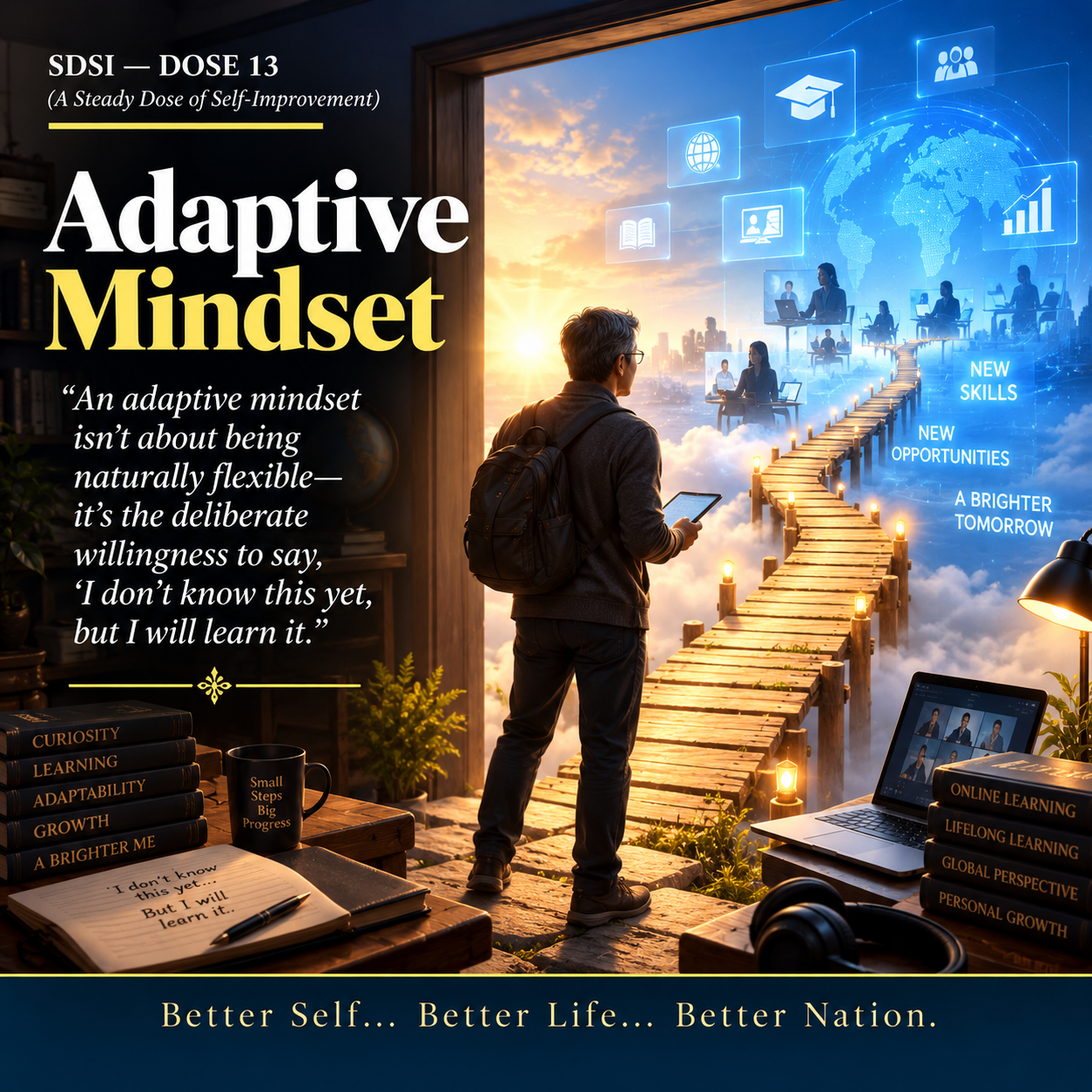
An adaptive mindset isn’t about being naturally flexible — it’s the deliberate willingness to say,
“I don’t know this yet, but I will learn it.”

When my university announced all classes were going online overnight, I had one problem: I’d never taught online in my life.
When my university announced, with almost no warning, that all classes would move online indefinitely, I was immediately aware of my limitation: I had never taught a single minute online in my career. I am not naturally tech-savvy. The shift felt like being asked to play an entirely different game with rules I did not know.
But I knew I had to adapt, or perish professionally. So I attended every training session offered. I learned the university’s E-Class platform. I mastered video conferencing software I’d never touched before. I began producing lecture videos for my students. Within weeks, I had not only adapted — I’d found new ways to engage students that I’d never explored in a traditional classroom.
Some of my colleagues could not make that same adjustment. Rather than continue struggling in an environment that had changed beyond their comfort, several chose to resign. The difference between us was not technical ability. It was mindset. The willingness to say: I do not know this yet — but I will learn it. That is an adaptive mindset in action.
Charles Darwin’s theory of adaptation offers the clearest parallel: species that adapt to changing conditions survive; those that cannot, perish. The same principle governs human beings in a rapidly changing world. Satya Nadella took over a Microsoft many considered to be losing its edge, and rather than defend the old way of doing things, replaced a culture of “know-it-alls” with a culture of “learn-it-alls” — growing the company’s value from $300 billion to over $2 trillion.
Your mindset is not fixed. The default responses you rely on were programmed over years by family, culture, and experience — and they can be reprogrammed with awareness and deliberate practice. Build self-awareness through daily reflection. Name your negative inclinations specifically, so they lose their power to operate invisibly. And seek out discomfort on purpose — an adaptive mindset is built in friction, not in comfort.
Pause and Reflect
What’s one skill you’ve been avoiding learning, telling yourself it’s simply “not who you are”?
One Step Forward
Name one negative reflex you have under pressure. Write down the adaptive response you’ll try the next time it happens.
Explored more fully in Part 2 — Section I — Chapter 6, “Proper Perspective,” of A Holistic Approach to Self-Improvement.
Better Self… Better Life… Better Nation.
HOLISTIC APPROACH TO SELF-IMPROVEMENT
My book, A PARADIM FOR SELF-IMPROVEMENT, will be retitled HOLISTIC APPROACH TO SELF-IMPROVEMENT for its second edition. The decision to change was informed by the fact that, after reviewing the contents, I found that the original title does not fully reflect the book’s scope and spirit. The original title focused on a conceptual framework, but the new title, Holistic Approach to Self-Improvement, better describes the book’s integrated view of personal growth and development. This view goes far beyond positive thinking to include ATTITUDES, BELIEFS, SKILLS, ABILITIES, PRACTICES, ACTIVITIES, and SELF-DISCIPLINE.
The change was made to ensure the title better fits the book’s content and its practical approach.
As I continue to fine-tune the contents, I have come to understand that the book is not merely about suggesting a framework; it is about embodying one. The word HOLISTIC describes that change. The word PARADIGM is too technical and creates the impression that this is just another research work, something to study. Replacing it with APPROACH tells readers that this is not a book meant only for academic purposes, but one that outlines the steps for those who intend to embrace personal growth and development.
Adding holistic indicates that growth doesn’t happen in separate parts; it happens when attitudes, beliefs, skills, abilities, practices, activities, and self-discipline come together. That’s the purpose of including PARADIGM in the original title: to show that SELF-IMPROVEMENT is a PROCESS that, when successfully carried out, would help an individual become their BEST SELF and attain FULFILLMENT.
In my book, I proposed the concepts of VALUE SYSTEM to comprise attitudes and values, COMPETENCE FRAMEWORK skills and abilities, and HABIT SCHEME practices and activities. The proposed concepts are viewed as DIMENSIONS of self-improvement.
The book, whether bearing the old or new title, encapsulates the interrelationships among these categories and self-discipline into a framework, illustrating how their synergy yields an effective process of self-improvement that leads to the attainment of one’s full potential.
The paradigm is divided into three sections: left, middle, and right. The middle section comprises three parts: the dimensions of self-improvement, the self-improvement process, and the concept of full potential, also known as the best self. The dimensions of self-improvement in this book are generally categorized as the attitudes & beliefs (value system), skills & abilities (competence framework), and practices & activities (habit scheme) that a person pursuing personal growth and development should acquire, possess, or develop. These elements come together through the self-improvement process, forming the second part of this section. This process aims
to help one become one’s best self, not as attaining perfection but as unlocking one’s full potential.
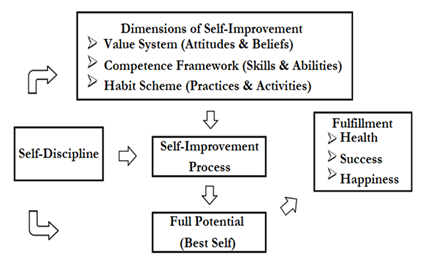
The left section of the paradigm highlights a crucial requirement for self-improvement: self-discipline. The paradigm illustrates how self-discipline continuously influences the process; even after one has achieved one’s full potential and become one’s best self, self-discipline remains essential. Self-discipline bolsters personal growth and development, forming the foundation for consistent progress and sustained fulfillment.
The right section of the paradigm illustrates the outcome of the self-improvement journey—fulfillment, characterized by becoming healthy, successful, and happy. This fulfillment represents not only the achievement of personal goals but also a deep sense of completeness and satisfaction that comes from living in alignment with one’s true potential. It is the reward for the dedication and discipline invested in becoming the best version of oneself.
Through self-improvement, individuals develop attitudes and beliefs, acquire skills and abilities, and engage in practices and activities to navigate life’s complexities confidently and purposefully. This transformation empowers them to achieve personal success, sustain a healthy state of being, and experience genuine happiness.
Those who achieve their full potential and become their best selves succeed in personal and professional endeavors. They become HEALTHY, SUCCESSFUL, and HAPPY.
If one intends to achieve their full potential and attain fulfillment, they must approach self-improvement holistically.
Foreword to My Book on Self-Improvement
Aside from the values of faith and self-belief my mother instilled in me, one key element of personal growth and development that was embedded in me long before I joined the self-improvement bandwagon was lifelong learning. My parents taught my siblings and me the value of education, the importance of learning new things and skills, and the need to always strive to be the best and strongest we could be to fulfill our dreams and ambitions.
I believed them to the point that when I had already acquired the degrees I wanted, I looked for a new jar of knowledge where I could dip my fingers. I pushed it further when I realized I had been doing much to improve my health and acquire new skills. I decided to focus on personal growth and development.
At first, my affair with self-improvement was just a fling. I thought it was enough that I read self-help books. However, I was not satisfied. I thought adding positive thinking to my faith, self-belief, and lifelong learning was enough. I was wrong. I wanted more.
Then, the unexpected happened. My romance with self-improvement took a serious turn after I watched a film entitled “The Secret.” I saw the movie’s DVD by accident. The store owner mixed it with other genres of film. When I bought it, I had no idea what it was. There was no synopsis or a brief note explaining anything about it. That was it. Everything was what the title suggests—SECRET.
I wondered whether it was a mystery-thriller or a sci-fi movie. When I played it, I discovered it was a “self-help” film—technically a documentary.
I must admit that I initially considered the ideas presented to be preposterous. Things
from the beginning of the film, what I saw and heard seemed lifted straight from the pages of a science fiction book, but they also tickled my curiosity, perhaps because I love science fiction.
I continued watching, tried to be open-minded, and considered the information in the film as tips for personality development. I have always considered anything that advocates positive change worth my time and effort. I watched it a second time and rewatched some interesting segments a few more. After that, I began applying the valuable tips I had learned from the movie. I even shared the ideas I discovered with my students whenever I saw a connection to the topic’s content.
Then I decided to do an Internet search for one of the speakers, the one who spoke first in the movie – Bob Proctor. That Internet search led me to his motivational videos on YouTube and links to information and videos of other motivational speakers such as Jim Rohn, Wayne Dyer, Les Brown, Joe Dispenza, John Assaraf, Brendon Burchard, Brian Tracy, Zig Ziglar, Tony Robbins, Simon Sinek, Tom Bilyeu, John Maxwell, Jordan Peterson, Jay Shetty, Andrew Huberman and Mel Robbins. I heard them mention Napoleon Hill, Earl Nightingale, and Earl Shoaff, which led me to find them online.
They were all my professors at VU (Virtual University). I religiously watched the videos they posted on their social media platforms, and they taught me well. I consider them my mentors in personal growth and development. Through them, I learned much about constructs related to self-improvement and Positive Psychology—goal-setting, planning, decision-making, time management, well-being, mindset, personal accountability, lifelong learning, good thinking, positive thinking, self-discipline, and more.
I consider them my mentors. They taught me valuable lessons I never learned in school. Thanks to them, I realized that in striving to be the best I can be, as my parents instructed, there are attitudes and beliefs I must pursue and possess, skills and abilities I must learn and acquire, and practices
and activities I must carry out and perform. I realized how essential they are for achieving one’s full potential and becoming the best.
Seeing how personal growth and development have benefited me personally and professionally, and recognizing that, as a teacher, I can help my students and influence my loved ones and dear friends to experience the same, I have embraced self-improvement as an act of advocacy. I am committed to promoting it. There may be those my mentors from VU could not reach, but whom I may be able to. I strive to do so in my humble ways.
To the best of my ability, I aim to plant seeds of motivation and inspiration in others, encouraging them to recognize their potential and embrace the transformative power of self-improvement. I believe that each interaction, no matter how small, has the potential to spark a profound change in someone’s life. Whether through teaching, writing, or engaging in meaningful conversations, I see every opportunity as a chance to leave a positive imprint on those I encounter.
In doing so, I am trying to carry forward the legacy of my mentors, whose wisdom and guidance have shaped my journey. Their influence reminds me that advocacy is not confined to grand gestures but is often reflected in our quiet, consistent efforts to uplift those around us.
My mission is to reach individuals who may feel unseen or undervalued and empower them to believe in their capacity to grow and succeed.
In my classes, I actively seek opportunities to instill the value of striving to improve. I do the same in informal discussions with friends, loved ones, and sometimes strangers. Whenever I have the chance to discuss self-improvement, I seize it without hesitation.
My approach is grounded in the belief that the desire to grow and evolve is universal, and all it often takes is a spark—a meaningful word, a shared experience, or a heartfelt conversation—to ignite that desire in someone.
It reminds me of how those simple compliments from a couple of teachers in high school inspired me to study harder.
I also write essays on personal growth and development, which I post on my websites and social media accounts. When I realized how much I had already written on the subject, the idea of writing a self-improvement book emerged. I decided to compile and interconnect everything I had written about personal growth and development into a book.
My motivation for writing this book is clear: I want to offer a guide that could help readers like you achieve their full potential, be the best and strongest version of themselves, and attain fulfillment by achieving what they desire. I also had my students in mind when I began working on this book. I hope they and other young people like them will read this book like you.
It is not luck or chance that gets you to the fulfillment of dreams and desires—it is learning the right strategies and applying the focus, determination, and passion you need to pursue your personal and professional endeavors. The future is yours to take.
My book is divided into three parts, each focusing on different aspects of self-improvement. In Part I, I discuss beliefs and attitudes; in Part II, I cover skills and abilities; and in Part III, I examine practices and activities.
I collectively refer to beliefs and attitudes as a value system, skills and abilities as a competence framework, and practices and activities as a habit scheme.
The world needs people willing to rise to their full potential, lead purposefully, and contribute to something greater. I believe you are one of those people.
As you read through the following pages, I hope you will find the encouragement, insight, and tools you need to take the next step in your journey. My goal is to inspire you to view your personal and professional goals not as impossible dreams, but as inevitable outcomes that await your dogged determination to succeed.
This book is both a reflection of my journey and an invitation to join me on the path to unlocking the greatness within you. I do not feel like I am already the best version of myself. Thus, my journey towards unlocking my full potential has not ended yet. If you have not started with yours, now is the time to begin.
—–
This foreword is only the beginning. If you wish to go deeper into the ideas shared here, my book on self-improvement is available on Amazon. May it serve as a companion in your own journey.
Your Blame List

The last time we came to work late, was it the traffic or the weather that we blamed? Or was it the alarm clock’s fault for it didn’t go off? Ahh, the battery of the cellphone went dead.
When we had a break-up with a lover (or a major falling out with a friend), who did we blame? Ourselves or the other party?
Whenever something goes wrong, seldom or rarely (or is it never?) do we hold ourselves responsible for it. We always point our finger at something or hold others accountable. When things don’t turn the way we expect them to, we are always ready to check our blame list to find somebody or something to put the liability on.
This reminds me of one of the narratives of Jim Rohn.* He said that one day he was asked by his mentor Earl Shoaff, “Jim just out of curiosity tell me how come you haven’t done well up until now?” What Mr. Rohn did, according to him, for him not to look too bad, was read on his list of why he wasn’t looking good and not doing well. He blamed, among other things, the government, weather, traffic, company policies, negative relatives, cynical neighbors, economy, and community.
What about our personal blame lists? Is it as long Mr. Rohn’s. Perhaps it’s longer.
Who do people who could not find jobs blame? Of course the favorite whipping boy – the government. They contend that it is the duty of the government to create job opportunities for them. That is true. But work is something that is not going to be awarded to anybody on a silver platter. We have to search for it and we ought to be prepared. It is our responsibility to get ourselves ready for employment. Get the required education or training. We need to have the necessary knowledge and skills.
What if you could not get the education and training you need? Well, whose fault? Okay, I will give you time to check your blame list.
Done?
Now let’s continue.
Common sense will tell us that the government cannot possibly provide each citizen with a job. It is also impossible for the private sector to employ everybody. That’s just the reality. Harsh it may be. So, what should we do? Simple – be competitive. Be the best in your field or profession. The best ones are always on top of the priority lists of prospective employers. And if in our respective countries there are no job opportunities, or we won’t get the salary we want, let’s consider applying for work overseas. If you’re not satisfied where you are, go somewhere else.
“You can always move out from where you are now to find yourselves better opportunities. You’re not a tree.” That’s also from Mr. Rohn.
The ones who won’t get employed, or do not want to work for others because they have better plans for themselves, could perhaps succeed as entrepreneurs. Not everybody is trained to be in a workplace and be someone else’s employee. Some of us will be farmers, or fishermen, or plumbers, or drivers, or gardeners. There is always a way to earn an honest living. Whatever it is that we find as a source of livelihood, let’s us be thankful.
Accept the reality that some are rich and some are poor. And hey, don’t blame the rich if they don’t want to help the poor. Don’t blame your rich siblings, friends, and neighbors if they don’t share with you their blessings. It’s either you work as hard as they did for you to have what they have or be content with what you are capable of having.
Just bear in mind that each of us has a choice to A – Be rich; B – Have the means to meet both ends and at least get extra cash to afford some luxuries in life; or C – Have 3 square meals a day. Yes, I consider A, B and C as choices. It’s up to us to decide what to aim at… which of the three would make us happy.
Some people live simple lives happy to be able to eat three times a day. Some set their ceilings high and sometimes even go through it. Each of us has a chance at A. Nobody would prevent us from wanting to become rich. But becoming that won’t be easy… unless you win millions in the lottery.
There are two ways to go (and robbing a bank is not one of them) for those who would aim at A – hope that you hit that lotto jackpot or work as hard and wisely as those who became millionaires and billionaires did.
And when you fail to be so… when you fail to achieve your dreams and realize your goals… blame no one.
People who suffer from setbacks and face adversities would more often than not blame their friends or family members – parents, siblings, children, spouses – citing lack of support. Let’s not forget that support is something that is given voluntarily. It is not an entitlement. We could say that it is the obligation of our loved ones to help us. But what if they are not capable of helping for just like us they also need help or they also have problems of their own?
Or what if they have the capacity to support but they won’t? That would bring us to another “don’t” aside from don’t blame. That is don’t expect. If we get support in the pursuit of our dreams and goals we should be thankful. If not, our fight goes on. It’s not the end of the world. We should always be ready to fight our battles alone.
And please, let’s not blame our parents also if we are not doing well in life. Let’s not accuse them of not paving the way for us and ensure that rolled in our paths to better lives is a red carpet. Whatever kind of parents we have (or had) – good or bad – they ceased to be in control of us and our future the moment we became capable of deciding for ourselves. The question is, “What did we do when we sat in the driver’s seat of our lives?” Did we do everything we could to ensure that we succeed in our endeavors? Or did we expect that success is like the manna that fell from heaven which the Israelites in the Exodus just freely picked up?
Remember the narrative of Mr. Rohn? It did not end after he made a litany of the reasons why he was not succeeding and who and what should be blamed for that. Mr. Shoaff patiently listened to him and at the end said the following, “Mr. Rohn, the problem with your list is you ain’t on it!”
Before Mr. Rohn decided to work for Mr. Shoaff, he tore off his old blame list and replaced it with a new one where he wrote the only reason for not doing good in life – “ME.”
Now, let’s review our personal blame lists? Are we included on it? Or we automatically assign fault to something or someone for the misfortunes and failures that befall us?
Something that we should understand and accept is whatever we have become, wherever we are in the socio-economic pyramid, and whatever we have and don’t have, are the results of all the decisions we made. Others may disagree but I believe that our destiny is the sum total of all our decisions and indecisions.
We disagree in our interpretation of destiny. Theists believe that whatever happens to us is the will of a supreme being. I also believe that God exists but I think that we chart our own destiny. He gave us the gift of volition so we could have the dignity to decide for ourselves.
So, if we are not succeeding in our endeavors, if we are not healthy, and if we are not happy, we only have ourselves to blame.
__________
* Jim Rohn was a successful American entrepreneur and motivational speaker and his net worth before his death, according to estimates, was $500 million.
Road to Self-Improvement: The Road Not Taken

“When we strive to become better than we are,
everything around us becomes better too.”
– Paulo Coelho
“Two roads diverged in a yellow wood…”
That’s the first line in Robert Frost’s poem entitled “The Road Not Taken.”
Each time you wake up in the morning, you stand at a fork in a road – one path leads to self-complacency and the other to self-improvement.
“And sorry [you] could not travel both
And be one traveler, long [you] stood
And looked down one as far as [you] could
To where it bent in the undergrowth;”
You wouldn’t be able to see what lies ahead because the forest of life is dense and the road is not straight. All I can tell you is you will either bear the consequences or enjoy the results of choosing which way to go. And you were not born yesterday not to know the repercussions of self-complacency and the wonderful effects of self-improvement. You know which direction leads to ruin and which one winds through the valley of success and happiness.
But the road to self-improvement is either not taken or the one less traveled because it is easier, if not intuitive for people, to be complacent. Well, according to neuroscientists, we should blame our brain for this. And this is where we’re good at – putting the blame on someone or something else. Would you now add your brain to the list of what or who is to blame for your failures?
Neuroscientists say that we are naturally wired to prefer either lying on the couch or sleeping. We are naturally lazy. We hate getting out of our comfort zones. We want things to be given to us on a silver platter. Thus…
“Then took the other, as just as fair
And having perhaps the better claim,
Because it was grassy and wanted wear;”
We don’t want to read or to do any personal growth and development program dropping as our excuse the lack of time to do it. We don’t like to undertake fitness programs saying they’re too difficult to commit to. We don’t believe in the value of proper nutrition reiterating that we have the right to eat whatever and whenever we want.
What we want is a magic pill that we can take to magically unlock our full potential and transform us into the best version of ourselves. The bad news is – there’s no such pill and there will never be. Self-improvement is not a magic pill to take but a Mt. Everest to climb.
Sometimes, when you feel like finally wanting to walk the path to self-improvement. You say…
“Oh I kept the first to another day!”
But having enjoyed your journey in the lane of self-complacency, you would exclaim…
“Yet knowing how way leads on to way,
I doubted if I should ever come back.”
Well, God has given us free will. We live life the way we want. Nobody could ever coerce us into doing what we don’t like. Just don’t forget that whatever becomes of you when you get to the end of the path you decided to take when you came to that fork in the road is your personal choice. “Life is a sum of all your choices.” That’s from Albert Camus.
As I said in another article I wrote about self-improvement, “We indeed have the freedom to choose. It is just unfortunate that some people would choose not to make themselves better.” Free will is both a boon and a bane.
But should you decide to take the road not (or less) traveled – the road to self-improvement – this is what you would say when every strand of your hair turns gray…
“I shall be telling this with a sigh
Somewhere ages and ages hence:
Two roads diverged in a wood, and I –
I took the one less traveled by,
And that has made all the difference.”
Enlightened Perspective

“It is a narrow mind which cannot look at a subject
from various points of view.”
– George Eliot
I do have a friend who would usually be mistakenly identified as me. There were many instances that people in the university where both of us are teaching called me by his name and him by mine. Why? I am not a dead ringer for him but very likely that our similar built, height, and rounded face would make people commit that mistake.
Seemingly bemused, he asked me one time, “Why would they think I am you? Do I look as old as you are?” I paused for a while, smiled then told him jokingly, “No, I think I just look as young and handsome as you are.”
As my friend laughed at my response, I thought that the contrasting way we looked at the issue has opened an opportunity for me to revisit the topic “perspective.”
Perspective – our tendency to look at the same things, events, issues, and concepts differently – is one of the most amazing things about us humans. According to Duffy (2019), “perspective is arguably the single greatest aspect of our uniqueness and that each of us has a uniquely valuable perspective of life – a lens through which we interpret our lives.” She (Duffy) explained that we can expand our perspective through a tool called perspective taking – learning from the way others see life.
In this book we will refer to perspective taking without consideration of the way others see things, events, issues, and concepts. Yes, there is a need to respect and learn from the way others view life but are those views correct? Are those views not inimical to our interest and wellbeing.
The kind of perspective taking that I think we should be doing is choosing the best vantage point of looking at things, events, issues, and concepts according to their own merits and not according to the socio-cultural frames set by anybody. Are they positive or negative the way that they are and not the way anybody wants to see them/or the way you want to see them?
Anything in this world can be viewed from different perspectives. We get to decide at what vantage point we would look at circumstances, problems, events and even objects using lenses that are uniquely ours. We tend to measure and interpret those things using our own value system. We label and define them according to our beliefs. We react to them according to our attitudes. Those beliefs and attitudes, as I explained (in my other self-improvement articles which I hope you have read), are shaped by the way we were raised by our parents, trained by our teachers, influenced by the people around us, and conditioned by our culture. Two persons could look at the same window one morning and one would see the speck in the window instead of the sun rising. It is in this context that I wish to discuss enlightened perspective.
The sum total of the experiences we accumulated since birth and the amount and quality of information we gathered through the years from different sources are the factors that contribute to the kind of perspectives we develop as persons. Our way of viewing things depends on the value system that those experiences and information impressed upon us.
Each person is entitled to embrace a particular attitude towards something. There are no specific measurement to determine the rightness and wrongness of perspectives. Only the consequences of a person’s action (or the lack of it) as a result of embracing certain perspectives could perhaps be labeled as right or wrong.
When we are about to take a perspective it’s like we’re positioning ourselves in the number scale and decide whether to go north or south. We can either be positive or negative with our perspective. Those are the only directions we could take when we look at issues and circumstances confronting us. It’s a matter of choice. If you want more choices, imagine perspective as the Cartesian plane.
When viewing an issue, an event, or a circumstance and you’re about to make a decision about it, place yourself at the origin or the center of the Cartesian plane. Decide in which quadrant you would focus your lens on when making a decision – positive/positive, positive/negative, negative/positive, or negative/negative. What I mean is you can decide to view what is happening or what is about to happen purely as good, or purely bad, or you are objectively weighing both the good and the bad. There are always the pros and cons – the advantages and disadvantages. You have to carefully weigh both before making any decision or before passing your judgement.
An enlightened perspective is a perspective taking devoid of biases, prejudices, and preferences.
Your perspectives affect the decisions you make. They inform the things you think, say and do. Thus, while you are entitled to have any kind of perspective, in the same manner that we are entitled to our own opinions, you should bear in mind that we will bear whatever consequences there may be for embracing the perspectives we take.
You also need to understand that you could not assume that what you believe or see is definitive. Different people have different ways of looking at things. The perspective of the world that dictates the lens through which you see it is not the same for everybody. You need to develop the ability to see things also from another’s viewpoint. This is what I referred to earlier as perspective-taking. But while you try to understand and respect how others view things and issues, you don’t need to embrace them when you deem that that perspective is negative and contrary to the positive outlook that you are trying to develop.
Perspectives can either be broad or narrow.
Having a broad perspective means being able to see the bigger picture. `
I once had a conversation with another friend about working conditions. He bewailed the fact that a truck driver in his country earns more than what he is earning in a year as an expat teacher. After listening to his litany, I told him to pause for a while and dig deeper into his comparison and consider other factors like number of required work hours and the physical demands for the job. When computing the number of hours, I reminded him that we as teachers are not actually working during winter and summer breaks but we get paid in full by the university as stipulated in our contracts.
He realized at the end that his pay per hour is actually higher than the truck driver and his working conditions are much better.
It is not really hard to train the mind to look at the bigger picture. It is easy to look beyond the obvious if only we’re open-minded. It does not require a special kind of training. All we need is common sense.
There are a lot more that could be explored in the discussion of perspective. At the end, the thing that matters is the answer to the question, “How do our perspectives affect the way we live?”
If the lenses you are using to view the world have brought you success and happiness, why change them. We’ve been told many times, “If it ain’t broke, don’t fix it.” But what about if those lenses are seemingly broken and have caused you nothing but failure and misery? Is it time to visit an OPTIMIST?
Reference/s:
Duffy, J. (2019). The Power of Perspective Taking. Retrieved from https://www.psychologytoday.
com/blog/the-power-personal-narrative/201906/the-power-perspective-taking
Evolving Your Mindset

“Mind is a flexible mirror, adjust it,
to see a better world.”
– Amit Ray
Positive thinking, perspective, and mindset are often construed as similar concepts. But in previous articles I have written on these topics, I presented them as separate constructs. I have already articulated my takes on positive thinking and perspective in the said articles. I appended “enlightened” to perspective for the purpose of presenting the idea in the manner I intended to explain it. To mindset, I am using “evolved” as a descriptor to distinguish my ideas about this concept from Carol S. Dweck’s “growth mindset.” I would say though, to somehow connect my ideas to hers (Dweck’s), that it is difficult to convince people with a “fixed mindset” that their mindset is capable of evolving. Let me expound later.
(https://madligaya.com/works-in-english/essays/on_personal_development/)
Successful people whom we call winners are positive thinkers – they are full of optimism and hope. But let me reiterate that they are not just optimistic and hopeful. While they expect good things to happen, they don’t just sit idle and do nothing. They embark on a course of action, not just daydream when pursuing whatever it is that they wish to accomplish. They do everything that ought to be done in order to get the results they want.
They (the winners) also know that realizing their desired outcome entails good decision-making. And they are aware that all decisions they make, all assumptions drawn and conclusions arrived at in the process, should be based on facts and details gathered using not only the methods they have already proven effective (that’s why they are successful) but by applying their enlightened perspective.
What about evolved mindset? What is it?
Dweck (2006) defines mindset as a self-perception or self-theory that people hold about themselves. But my discussion of this idea will not be anchored on mindset as the way a person perceives themselves or what belief they hold about themselves. These are notions similar to what I have previously discussed in an article on “self-belief.” The way I presented mindset here is also different from the way I discussed mindset in an article entitled “Cultivating Mindset.”
In addition to Dweck’s, if you check online dictionaries, you will see the different definitions of mindset. Cambridge defines it as “a person’s way of thinking and their opinion.” Oxford’s goes “the established set of attitudes held by someone.” And here is Merriam-Webster’s – “a mental attitude or inclination.” It is from the perspective of the third definition (Merriam-Webster’s) that I will explain mindset and why it is a vital component of the value system of successful people. I will dwell more on the “inclination” part of the definition.
Inclination is defined as a person’s natural tendency or urge to act or feel in a particular way (Lexico, n.d.). Whenever you receive any kind of stimuli from the environment, you respond in the way you do. That’s your inclination.
There are only two ways to categorize your inclinations – positive or negative. Your inclinations are either good or bad. They are either helping you establish a good future or they are ruining it. Your inclinations will determine whether you will end up a winner or a loser in the game we call life. Consider your inclinations a web of your modes and patterns. In that web, are you the spider or a trapped insect?
You react by thinking, saying, or doing something. Doing nothing is in itself a reaction. Inclinations are established sets of behavior that dictate the way we respond to an event, idea, circumstance, or what have you. The question is – are you consciously making those responses? Very likely that you’re not. Very likely that you are responding reflexively. You are not mindful of your inclinations. Usually, after you do or say something, it is only when you would realize that it’s not the proper thing to say or do. That realization, more often than not, comes right after you are already staring at the consequences of whatever you have said or done.
Sigmund Freud theorized that there are three levels of awareness – the conscious, preconscious, and unconscious. The unconscious mind is a reservoir of feelings, thoughts, urges, and memories that are outside of our conscious awareness. The unconscious contains contents that are unacceptable or unpleasant, such as feelings of pain, anxiety, or conflict (Cherry, 2020). It is in the unconscious mind where our inclinations reside.
People do respond differently to the same stimuli.
How do you respond when somebody curses you or calls you names? You might get angry and retaliate or you will choose to keep your cool and just walk away. How do you respond when your personal and professional pursuits fail? You might never try again or keep trying until you succeed. The foregoing are just a few examples of stimuli that confront as every day and how we react.
Your mindset (or your inclinations) could be affected by the culture you have grown into. Factors related to family, school, and environment are considered determinants of the kind of inclinations that you would end up having.
The inclinations or tendencies of a person depends on the kind of “wiring” their immediate family or society at large set on their minds. How such elements affect them as they grow older could be gleaned from the way they naturally react on just about anything later on in life. It will manifest in the way they think, talk, and behave. They are, in effect, programmed to think, talk, and behave in a certain way. In the deep recesses of their unconscious minds are their default responses to stimuli that they receive from the environment.
A person’s mindset could evolve. We can overcome our default mindset and get rid of our destructive default modes and patterns. We can, if we want, reprogram our minds. This begins by identifying which of our inclinations need to change. We need to be aware of our inclinations so we can educate ourselves how to properly respond to the stimuli we receive every day in our lives. Identifying whatever negative inclinations we have then correcting them is how the mindset transforms. When we succeed in doing so, when we succeed in either controlling or eradicating our bad inclinations, we achieve the state of an evolved mindset.
Uncontrolled negative inclinations could lead to failures in both personal and professional undertakings. It could ruin relationships and reputation. Negative inclinations are the biggest roadblock to sound decision making.
At this point, let me present Dweck’s notion of mindset. She (Dweck) categorized mindset into two – “fixed mindset” and “growth mindset.” She explained that “In a fixed mindset students [people] believe that their abilities, their intelligence, their talents, are just fixed traits. In a growth mindset, students [people] understand that their talents and abilities can be developed through effort, good teaching, and persistence.”
The danger is that if a person has what Dweck refers to as a “fixed mindset” they, as you might expect from people with that kind of mindset, have already embraced that they are who they are and whatever behavior and characteristics they possess are permanent and can no longer be changed. Winners are different. They do possess a “growth mindset.” They believe that inclinations can be changed in the same way that they think that talents can be developed. Inclinations are not fixed characteristics. If you decide to, you can identify which of them are bad and either control or completely eradicate them. Obviously, you should nurture the good ones.
Winners are mindful of what they think, say, and do. Being aware of their negative inclinations enables them to have restraints and make the right decisions. That’s the reason they are in the podium with their hands raised.
Be the spider, not the trapped insect, in the web of your default modes and patters.
References:
Cherry, K. (2020). The Preconscious, Conscious, and Unconscious Minds. verywell mind https://www.verywellmind.com/the-conscious-and-unconscious-mind
Dweck, C.S. (2006). Mindset: The New Psychology of Success. New York: Ballantine Books.
Inclination. (n.d.). In lexico.com. Retrieved from https://www.lexico.com/definition/inclination
Mindset. (n.d.). In merriam-webter.com. Retrieved from https://www.merriam-webster.com/dicti
onary/mindset
Mindset. (n.d.). In dictionary.cambridge.com. Retrieved from https://dictionary.cambridge.org/ dictionary/english/mindset
Mindset. (n.d.). In lexico.com. Retrieved from https://www.lexico.com/definition/mindset



 M.A.D. L I G A Y A