Blog Archives
Beyond the Billions: Who Really Deserves the Box-Office Crown (Part 1)
An evidence-based comparison of Avatar 1 and Avengers: Endgame

The Avengers: Endgame rerelease is still underway. Having watched the original film three times already, I decided to see it once more. With the release of Avengers: Doomsday on the horizon, I wanted to revisit the story and see whether I could connect a few more dots in the ever-expanding Marvel multiverse. Besides, there was the promise of something in the post-credits scene that I was particularly eager to see.
The rerelease certainly seems well-timed to rekindle excitement for Doomsday. But let’s be honest—could a rather petty subplot also be unfolding behind the scenes? Perhaps another battle is being fought, one that has nothing to do with superheroes saving the universe: the race to reclaim the No. 1 spot at the all-time worldwide box office. And should Endgame close the gap on James Cameron’s original Avatar, the Marvel–Disney machine might just pull off another spectacular comeback.
Would James Cameron eventually retaliate by rereleasing the original Avatar, perhaps under the convenient pretext of promoting the franchise’s fourth installment, while quietly plotting to wrest the crown back from the Avengers? Well, that remains to be seen. As they say, the plot thickens! And with Spider-Man web-swinging toward the top of the leaderboard, the plot might thicken even more.
Now, if I were to decide the winner purely on sentimental grounds, the verdict would be easy. As a big fan of Iron Man—and being a “Tony” myself, just like Tony Stark—I would gladly hand the crown to Avengers: Endgame without a second thought. But the researcher in me refuses to let personal attachment dictate the outcome. He insists that I set aside my superhero loyalties, put sentiment on the sidelines, and examine the evidence through a set of reasonably objective and measurable criteria. After all, if I am going to crown a champion, I had better make sure that my judgment is guided by more than my admiration for the man inside that red-and-gold suit.
Sorry, Tony Stark. This time, even your genius, billionaire, playboy, philanthropist credentials won’t earn you extra points.
But jokes aside, who truly deserves the cinematic crown if we look beyond the staggering mountains of cash these movies have accumulated? To answer that question, I developed a multidimensional framework to evaluate these box-office titans on a more level playing field. After all, the final box-office gross is not the be-all and end-all of cinematic success. There is much more to the story than the billions printed on the scoreboard.
So, let the cinematic showdown begin.
PART TWO
The Hardest Choice
(Were We Ever Meant to Be – Part 7)
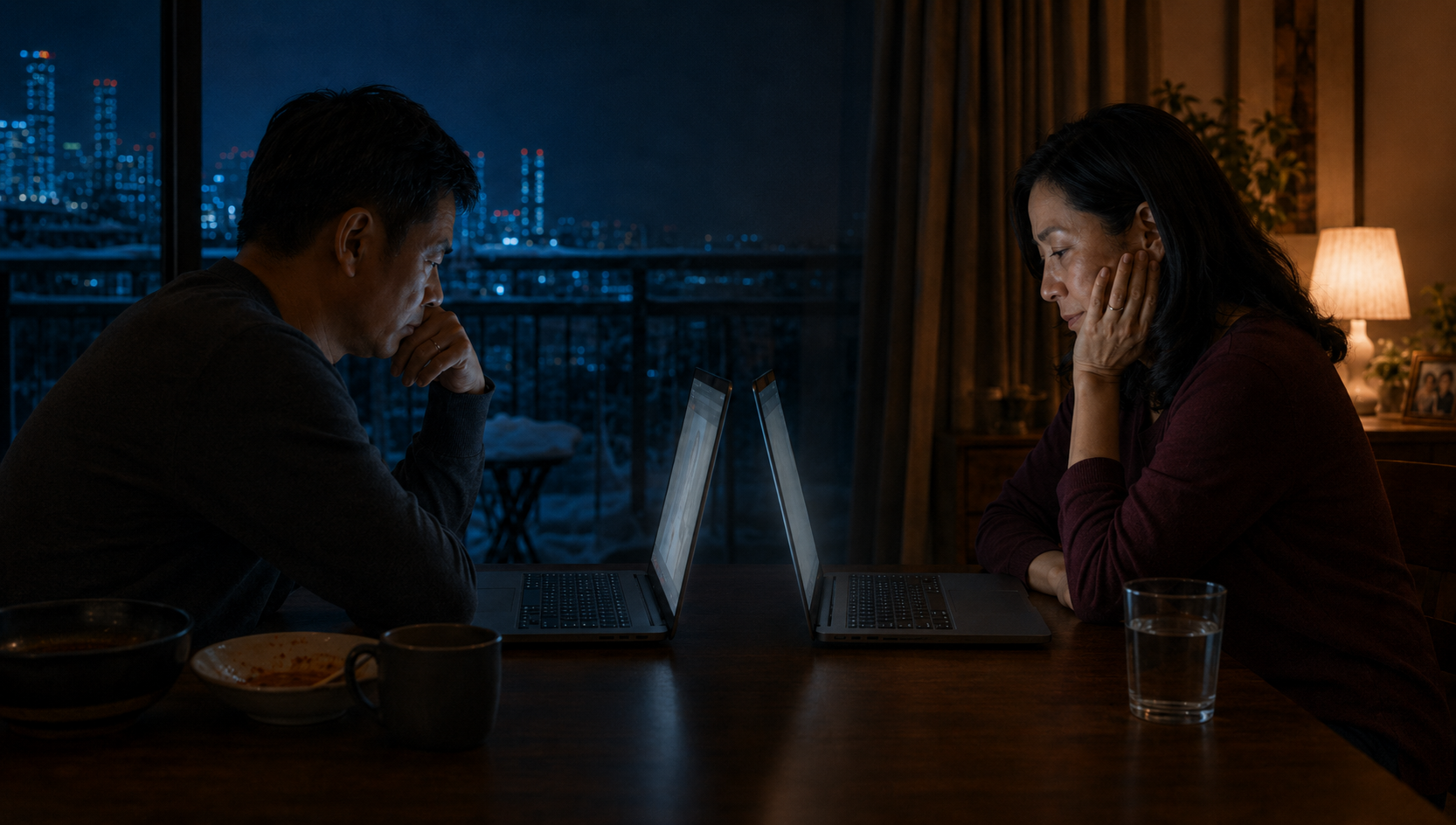
Two days later, Kath asked that we not speak over the weekend. Her church had an important Sunday activity, and she needed time alone to think.
I gave her the silence she asked for, but filled it with visions of the life I believed we would finally claim. By then, I understood that Jay was not the greatest obstacle between us. Something far more powerful had already begun calling her back.
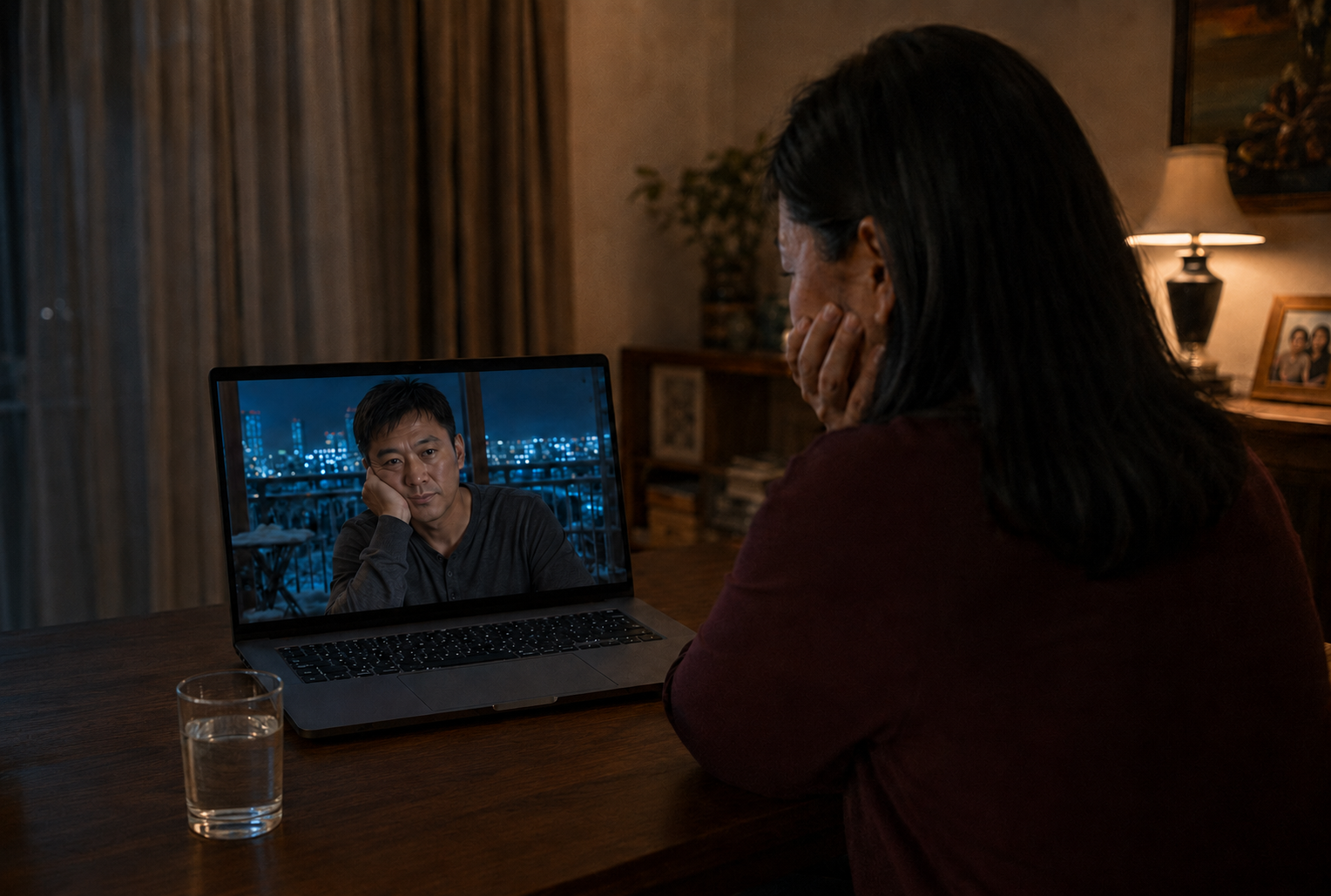
Kath called on Sunday night. Her eyes were swollen.
Her laptop was on the study table again, not on the bed. The change was small but deliberate. She had moved our conversation away from the place where we had surrendered to desire, as though furniture and distance could help her recover the boundary we had erased.
“I’m not all right,” she said. “The sermon struck me again.”
She told me that every service since our affair became serious had felt directed at her. Every time we undressed for each other, every time she chose my call over Jay’s, she felt the distance between her desire and her faith widening.
Her Christianity was not a convenient device she discovered at the end of our affair. It had shaped the marriage she chose to repair, the community in which she served, and the understanding of herself she wanted to preserve. Loving me had not erased those commitments. It had divided her against them.
“Doesn’t what we’re doing trouble you?” she asked.
I believed in God, though I was not devout in the way she was. I had asked for forgiveness and understanding, but desire had thrown my conscience aside. All I wanted was Kath.
“We love each other,” I said. “That is what matters.”
“Stop using love to make this right. It isn’t right. Are we supposed to live permanently in sin?”
“Would it be less sinful to remain with people we do not love?”
Kath wiped her eyes. “You keep speaking as if Anna and Jay are merely mistakes standing between two rightful lovers. They are people, Marco. We made promises to them. Our children did not choose this. Love does not make them disappear.”
I had no answer that did not return to what I wanted.
Even as I said it, I heard the convenience in my reasoning.
“It has to end,” she said. “Before Jay, Anna, or anyone else discovers us.”
“Kath—”
“I am not choosing between you and Jay. I am choosing between what is right and what is wrong.”
The sentence was not a denial of her feelings. That was why it hurt. If she had stopped loving me, I could have blamed time or distance. Instead, she was refusing precisely because the love remained powerful enough to destroy what she believed she was called to protect.
There it was: the rival I could not charm, outwait, or defeat.
“We can still be friends,” she continued. “We can exchange messages occasionally, but no more calls.”
“Let me call sometimes.”
“We both know what will happen. If you call, I will block you. If you use your phone, I will block your number. Please help me do this. I have grown used to your presence, and you know how weak I am when it comes to you.”
I had pushed against every boundary she had drawn because I believed persistence was proof of love. Now the only loving act left to me was the one I least wanted to perform: allow the boundary to remain.
“Jay will call soon,” she said. “I asked him to. Instead of talking to you, I should be talking to my husband.”
The words hurt more than I expected.
“Is there anything else you want to say?”
I shook my head.
“Then let me say this one last time. I love you, Marco. But I have to learn to forget you. I hope you understand why.”
“I love you too, Kath.”
“Goodbye. Please try to love Anna. I wish both of you well.”
The screen went dark.
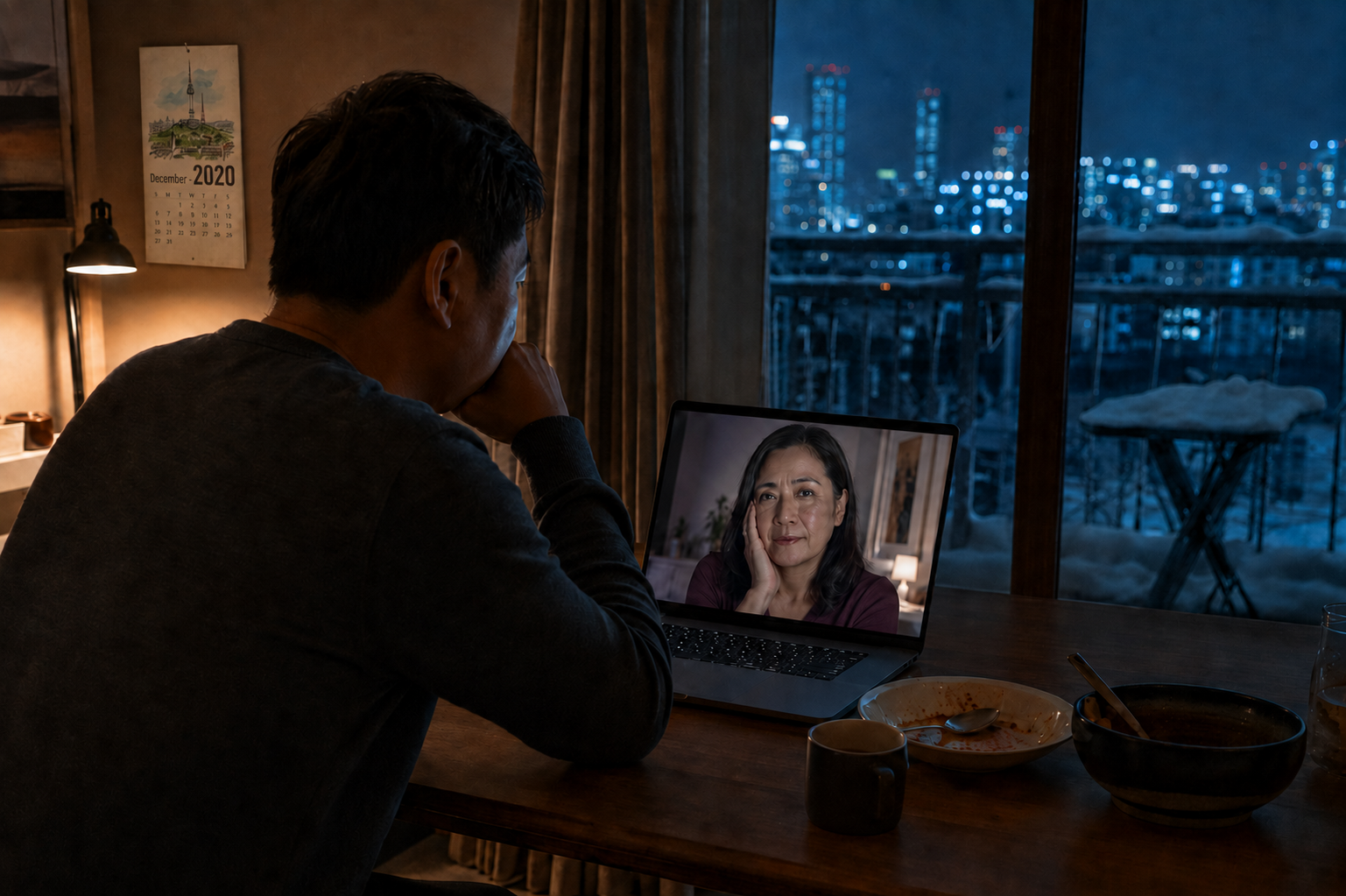
For several minutes, my own reflection remained on the screen. The apartment was unchanged: the cup beside me, the winter lights outside, the empty room waiting for another film or another sleepless night. Yet the space felt altered because I had allowed Kath’s presence to occupy it so completely.
I thought of Anna, who had forgiven betrayals I would have struggled to forgive and still remembered to ask whether I had eaten. I thought of Kenneth, whose failure to answer my call I had dismissed so easily, without considering how much of his life I had already missed. I thought of Jay at sea, trusting that his wife would be there when he called. For the first time since Kath’s birthday, I understood that what we had called our private story had never belonged only to us. We had made it private by pushing everyone else beyond its borders, even though they would have borne the consequences of every choice we made.
I had spent all that time thinking of Jay as my rival. But I had not lost Kath to him. In the end, she had not chosen one man over another.
She had chosen her faith—and the person she still wanted to be.
It was difficult to compete with God.
Against Him, I never had a chance.
Perhaps Kath had been right all along.
Perhaps we were never meant to be.
— END —
Beyond the Screen
(Were We Ever Meant to Be – Part 6)
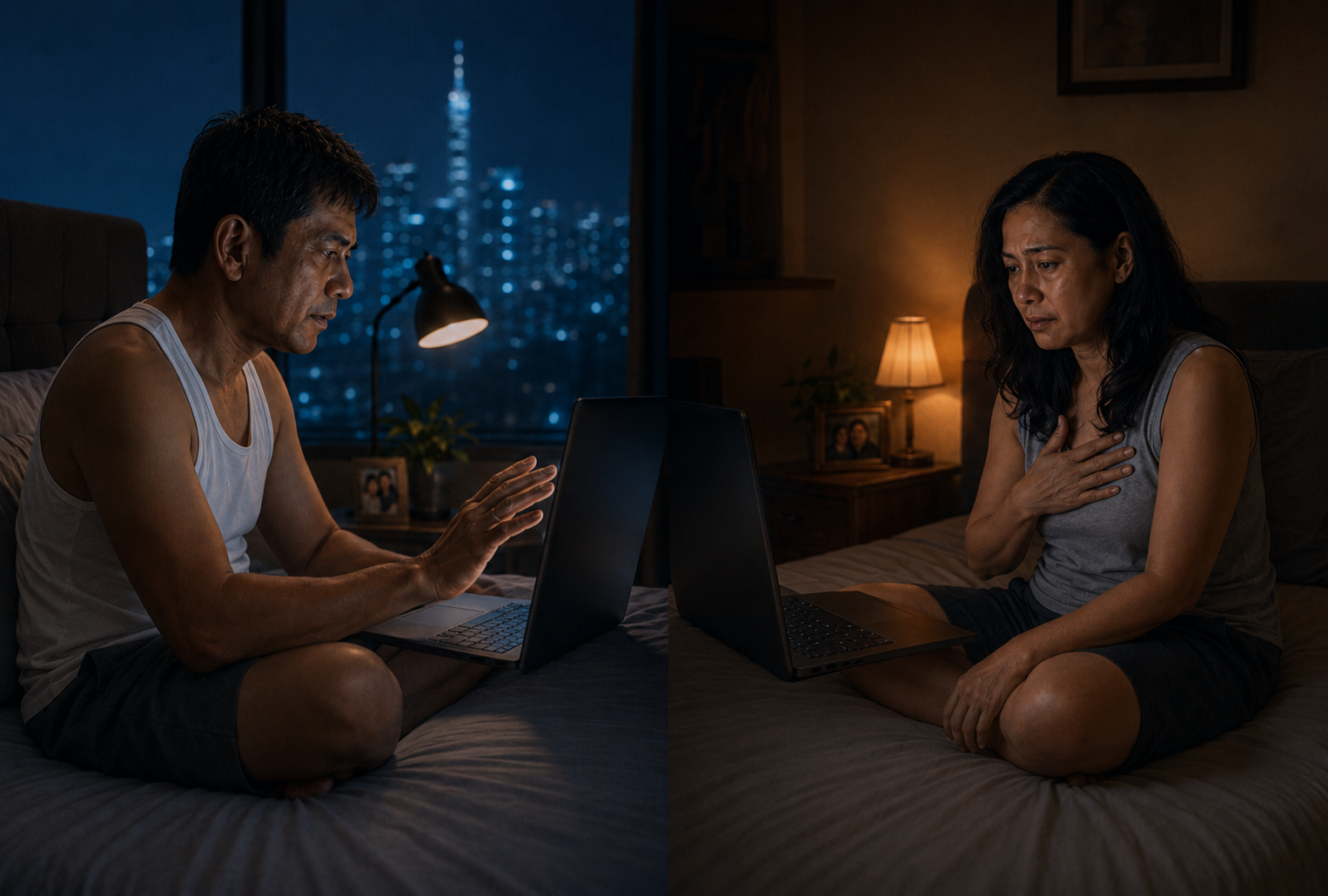
After that, we spoke almost every night. If our affair were a voyage, we had sailed so far from shore that neither of us could see where we had begun—or decide whether we still wanted to return.
Our conversations developed rituals. I messaged first to ask whether the children were asleep. She checked whether Anna might call. We used earphones, lowered our voices, and deleted exchanges that could expose us. Secrecy itself became intimacy: every precaution reminded us that there was an us important enough to hide.
One evening, Kath returned to the claim she had never completely believed.
“You still expect me to believe that you lived without sex for eight years?”
“I already told you. I never paid anyone, and I never found a girlfriend.”
“Not even once?”
“Not even once.”
“Then how did you manage?”
“A selfie,” I said, making her laugh. “Twice a week. I tell myself regular release is good for a man’s health.”
“Do you need stimulation?”
I admitted to visiting adult websites.
“Disgusting,” she said, although she was still laughing.
“They would become unnecessary if I had something better to look at.”
Her laughter disappeared. “Don’t start, Marco.”
“I haven’t started anything.”
“Your voice changes whenever you want something.”
“And you recognize it.”
“Unfortunately.”
Then I asked whether she ever touched herself.
“No. Jay and I once tried doing something online when he first returned to sea, but it didn’t work for me. We never tried again.”
“Perhaps it wasn’t the distance.”
“What do you mean?”
“Perhaps it was the person on the other side of the screen.”
She stared at me without answering.
The conversation changed the air between us. Her teasing smile faded, but she did not look away. I heard her breathing through my earphones, each quiet breath making the thousands of kilometers between us seem less real.
“What’s wrong?” she asked.
“Nothing.”
“Tell me.”
“I feel like taking a selfie.”
She understood. “Then take one.”
“I need inspiration.”
“Visit one of your disgusting websites.”
“I would rather look at you.”
Silence.
I removed my shirt first. Beneath it, I was wearing a white undershirt. Kath shook her head, but the faint smile at the corner of her mouth betrayed her.
“You are shameless.”
“Your turn.”
“No.”
“Then why haven’t you ended the call?”
She could have. Her finger hovered near the touchpad, and for several seconds I believed she would make the choice neither of us had been strong enough to make. Instead, she leaned back.
Her hand moved slowly over her chest, almost unconsciously at first, then stopped when she realized I was watching.
“Marco, what is happening to me?”
“Nothing you don’t want.”
“Don’t pretend you know what I want.”
“Then tell me to stop.”
“I have been telling you that from the beginning.”
The answer should have ended everything. Instead, neither of us moved.
“Please,” I whispered.
Kath closed her eyes. When she opened them again, fear and desire occupied the same expression.
“Why are you so difficult to resist?”
She carried the laptop to her bed. I did the same. Before setting it down, she changed into a thin undershirt and returned beneath the sheet.
“This is all you are going to see,” she warned.
“For now.”
“Don’t push me.”
But she remained.
The two rooms, thousands of kilometers apart, became one private space of restrained movements, uneven breathing, exposed shoulders, and whispered names. We watched each other without touching, yet every movement seemed answered by another on the opposite side of the screen.
Kath hesitated several times. Each pause gave us an opportunity to stop; each time, I asked her whether she wanted to continue. Sometimes she said no while remaining in front of the camera. Once she covered herself completely, and I thought the moment had ended. Then her face reappeared.
When she finally chose to continue, the surrender was mutual, but it was not free of pressure, guilt, or fear. The screen protected us from physical touch while permitting us to pretend that what happened through it was somehow less real.
That night, we crossed the boundary Kath had refused to cross eight years earlier.
It was not the last time. Soon, many of our late-night calls ended the same way. We began our conversations sitting at desks and finished them in bed. What we called friendship had become impossible to defend, even to ourselves.
Afterward, Kath sometimes covered herself quickly and avoided my eyes. At other times she laughed with the shy happiness of the younger woman I remembered. I preferred those moments. Her guilt threatened the future I was constructing, so I answered it with assurances: no one had forced us, our marriages were already incomplete, and love could not be evil simply because it arrived at the wrong time. The arguments comforted me because they began with the conclusion I wanted.
Yet the more we possessed of one another through our screens, the less sufficient the screen became. I wanted to return to the Philippines. I wanted to hold her without glass, pixels, or distance between us.
One night, Kath asked, “What exactly do you intend to do about us?”
I had waited for that question.
“First, answer something. Whom do you love more—Jay or me?”
“That is a ridiculous question.”
“Why?”
“Do you remember the crisis Jay and I went through before you left for Korea?”
I nodded.
“You were the reason. I told him everything about us. He asked whom I loved more, and I answered honestly: you. He threatened to leave me. That was why I came to you that day. I expected warmth, some sign that you still wanted me. Instead, you advised me to reconcile with him. You pushed me back into his arms.”
Her revelation rearranged eight years of memory. I had believed Kath chose Jay because she loved him more or because what existed between us had been insignificant to her. Now I learned that she had once approached me on the edge of choosing—and I, absorbed by my own crisis, had failed to recognize it. The lost possibility became more intoxicating than any future we could realistically build.
Had I known, I thought, I might never have boarded the plane to Korea.
“When Jay apologized and promised to help me forget you, I accepted. But did he erase you? Look at me, Marco. I talk to you instead of him. I want to see you all the time. You ask whom I love more?”
“I understand.”
“No. Say it.”
“You love me more.”
“You fool. You are the only man I love. I needed Jay because you were not there. I was learning to love him. Then you returned.”
She began to cry.
“Perhaps we decide whether we are meant to be,” I said. “Leave Jay. I will leave Anna. Come with me.”
Kath lifted her tear-streaked face.
“And my children?”
“I will accept them as my own.”
We discussed separation, secrecy, scandal, custody, and sacrifice. She had far more to lose than I did, but I was confident she would choose me.
I proposed that we keep our relationship hidden even after separating from our spouses. If Jay discovered that I was the reason Kath left, he might fight for custody or prevent the children from seeing her. Anna would have to face another betrayal, Kenneth would have to understand why his parents’ marriage ended, and both families would endure gossip and anger. I spoke of these consequences as obstacles we could manage, not wounds other people would suffer.
Kath listened, but the practical future made her quieter than the romantic one. It was easy to say she would leave everything for love while we were safely separated by thousands of kilometers. It was harder to imagine telling her children that the man on her laptop would replace the father they knew.
“Give me time,” she said. “I love you, but I don’t know what to do.”
I heard only the words I wanted to hear: I love you. I treated everything that followed as uncertainty time would eventually overcome.
PART 7 – The Hardest Choice
The Line Between Us
(Were We Ever Meant to Be – Part 4)
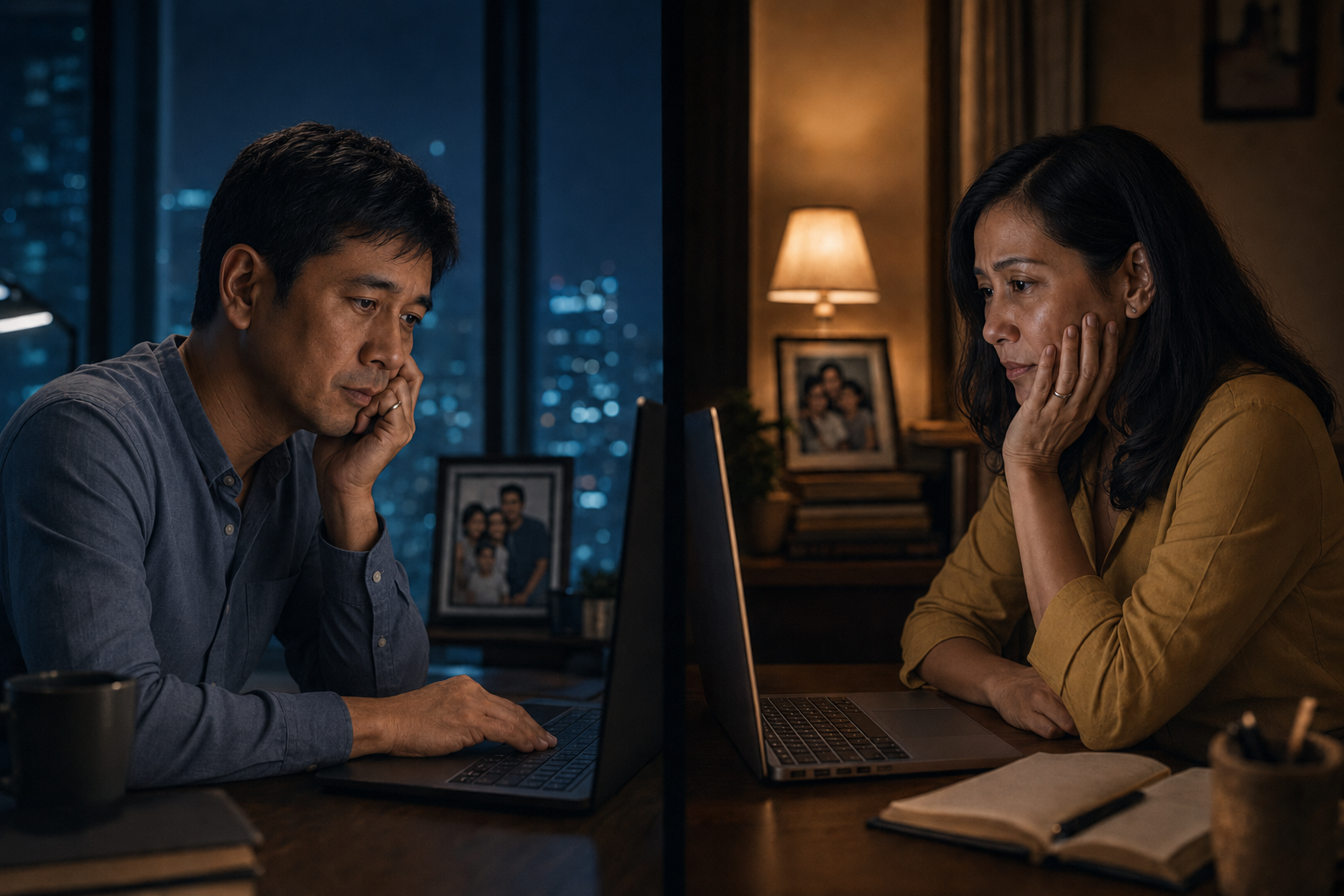
Two days later, I opened Kath’s profile again. I looked through her photographs until restraint felt more dishonest than desire.
That was the explanation I gave myself: restraint was dishonesty. I did not call my silence respect for her boundary or loyalty to my wife. I called it denial. By changing the name of the act, I made surrender sound courageous.
“Hello, Kath. Busy?”
“Not really. Just reading to kill time.”
“Can I call?”
“Why? Didn’t we discuss everything two nights ago?”
“Please. Just for a few minutes.”
“Why, Marco?”
I told her the truth. “I miss you. I only want to see you again.”
The message remained marked Seen for several minutes. Then she called me.
“Thank you,” I said as her face appeared.
“Don’t thank me. You are still impossible to refuse.”
She was wearing a sleeveless shirt and shorts. When she noticed where my gaze had settled, she adjusted the camera.
“I’m looking at your face,” I protested.
“Of course you are.”
I asked whether she missed me. She tried to evade the question, then surrendered.
“Yes. I miss you too. Are you happy now?”
“Very.”
Her expression grew serious. “Let me make something clear. We are both married. We both have children. I am talking to you because we are friends and because we shared a past. Nothing more, nothing less.”
“Loud and clear.”
She told me it would be our last video call. I asked for one call a week. She refused, and I knew—or convinced myself—that she would answer the next time anyway.
When she mentioned that Jay might not return until the following year, I asked when she expected me to visit the Philippines.
“You must miss Anna,” she said.
“I miss everyone I love.”
“Including your wife?”
“Why do you always bring her into our conversation?”
“Who should I mention—Mayette?”
Her teasing turned coarse. She asked whether I missed the sex I had had with Mayette. Irritated, I blurted out that I had not slept with anyone in Korea—not once in eight years.
She laughed. “Do you expect me to believe that?”
“It’s the truth.”
“Marco, you have needs. Are you telling me that in eight years, you never once paid a woman there for one night of sex?”
“Never.”
“That’s impossible.”
“I would never pay a woman for sex.”
“And why should I believe that?”
“Because if I ever sleep with a woman, I want it to happen because we both want it—not because I paid her. There should be desire on both sides and something real between us, even if neither of us knows where it will lead.”
Kath gave a short, disbelieving laugh. “That sounds very principled for someone with your history.”
“What is that supposed to mean?”
“Where was all that concern about what a woman wanted when you kissed me in your office and then—”
She stopped, leaving the rest suspended between us.
“And afterward?” she continued. “When you went home to Anna, did you kiss her too?”
“Kath—”
“Did you hold her the way you had just held me? Did you tell her you loved her?”
“It wasn’t like that.”
“Of course not. It never is when you are the one explaining it.”
I could have reminded her that I stopped when she pulled away. I could have insisted that what happened between us had never been entirely one-sided. But neither answer would erase the truth beneath her questions: I had wanted honesty from her while living dishonestly with both women.
“Believe whatever you want.”
“And Anna? What happens when you go home?”
I told her that Anna and I had not had sex since Kenneth was born. Diabetes had diminished her desire, and intercourse had become painful for her. We did not even share a bedroom during my visits.
“I’m sorry,” Kath said quietly.
“We found an arrangement that preserves our marriage and gives both of us peace.”
The arrangement was difficult to explain. Anna and I had forgiven many things without becoming truly compatible. The distance created by my work in Korea had probably saved us from the daily disagreements that once exhausted us.
Kenneth gave us another reason to remain a family, although I rarely admitted how much of the emotional labor of raising him Anna carried while I lived abroad. I called from Korea, sent money, came home when my schedule allowed, and told myself that provision was presence. The unanswered video call earlier that evening should have reminded me of the distance between my son and me. Instead, I had spent the night trying to erase the distance between Kath and me.
“Then why stay?” Kath asked.
“What else should I have done—find another Mayette?”
“I don’t know.”
“In Korea, I finally understood who I should have married. If I ever begin another relationship, I want it with only one person. If I cannot have her, I would rather have no one.”
The declaration sounded noble in my own ears. It converted years of infidelity into evidence of constancy: I had betrayed Anna with other women, yet because none of them mattered as Kath did, I could still imagine myself faithful to one great love. I did not ask whether devotion to an idealized woman could excuse disloyalty to the real woman I had married.
Kath turned partly away. “Who is she?”
“You know.”
“Say it.”
PART 5 – It Has Always Been You
The Truth About Then
(Were We Ever Meant to Be – Part 3)
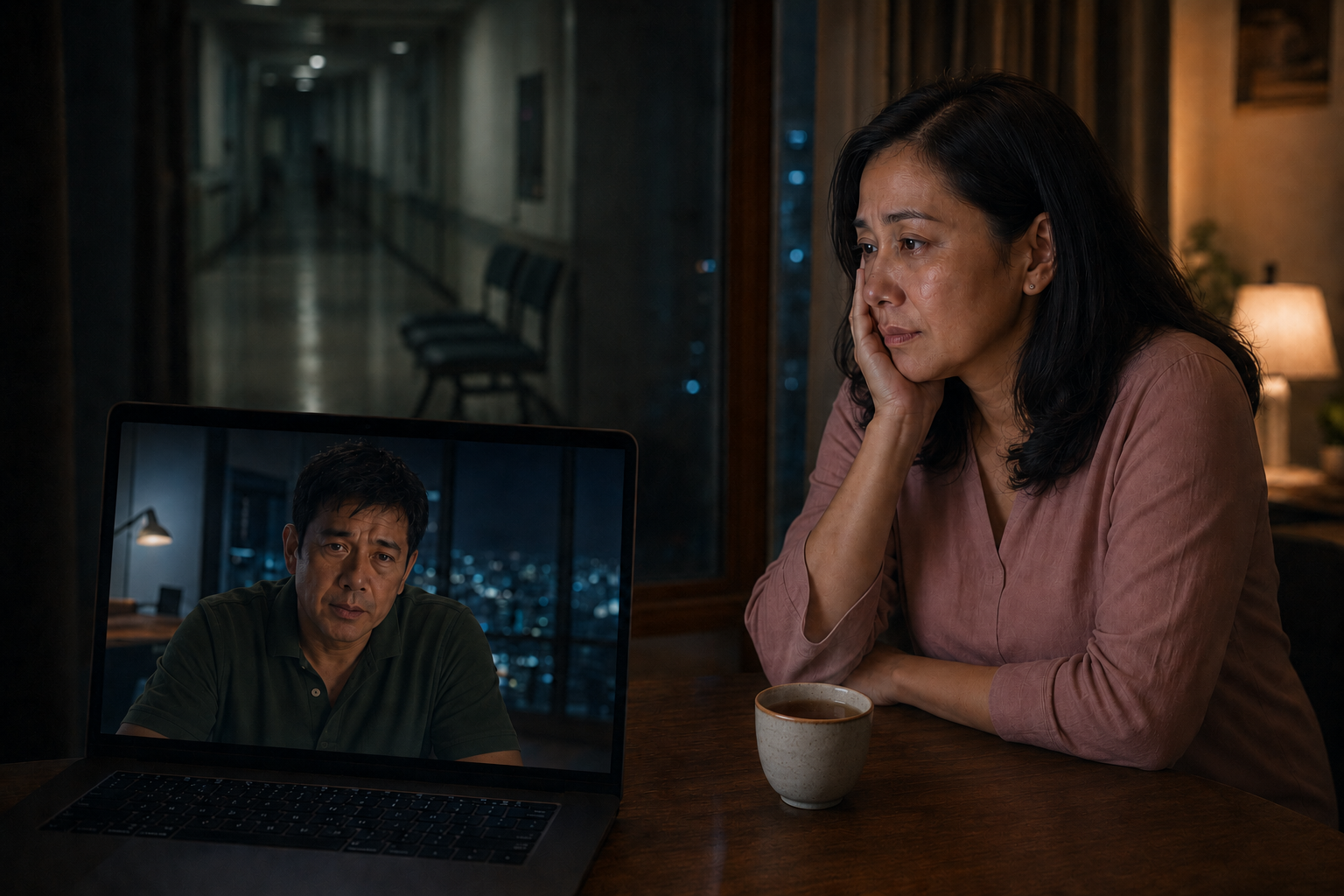
I knew that question would come.
The agency where we had worked was large enough for secrets to travel slowly but small enough for them to arrive eventually. My uncle, a former soldier, owned it with a Korean friend he had known since the war. The business recruited Filipino workers for factories in Korea, which was why my family later had somewhere convenient to send me. Officially, I was transferred to supervise our workers abroad. Unofficially, I was being placed beyond Mayette’s reach—and beyond the daily consequences of what I had done to Anna.
“Why are you frowning?” Kath asked. “Are you angry?”
“No.”
“Then answer me. Do you know Mayette?”
I nodded. There was no point denying it. Kath had made friends at the agency; sooner or later, someone would have told her everything.
“Do I still have to explain?”
“No. I know the details—from the moment Anna found you at Mayette’s apartment to the day your mother and uncle practically exiled you to Korea. I only wanted to hear you admit it.”
I nodded again.
“The last time we met,” I said, “when you were having problems with Jay, I had intended to tell you about Mayette. I was also going to tell you I was leaving for Korea.”
“Your problem, Marco, is that you could never keep that thing under control. Did every intern who worked for you become—”
“Fine. I was a terrible person.”
The irritation in my voice silenced her. For a while neither of us spoke.
“Do you have a girlfriend there?” she finally asked. “How many Korean women have you been with?”
“You wouldn’t believe me if I said none.”
“I hope there’s no one. I hope Mayette ended all that.”
“It was your fault,” I said.
She stared at me. “What was my fault?”
“You left me.”
Even as I said it, I knew how unfair it was. Kath had not abandoned a relationship I had clearly offered her. I had given her secrecy, stolen affection, and complaints about my wife. I had wanted her loyalty while refusing to name what I intended to give in return. Still, the wounded part of me had transformed her transfer and resignation into betrayal. That story allowed me to regard everything I did afterward as pain rather than choice.
Her laughter was sharp with anger. “That’s ridiculous. Did I ask to be transferred? And what exactly was I to you? The person who listened whenever Anna disappointed you? The woman you kissed whenever you needed someone to kiss? Tell me, Marco—what place did I actually have in your life?”
She reminded me of the day I had promised to meet her so we could visit my mother in the hospital. I never arrived. Kath went anyway and felt like a fool.
“I never meant to stand you up,” I said. “When I told Anna I was visiting my mother, she insisted on coming. I delayed our departure, hoping you would finish your visit before we arrived. My mother later told me that you and Anna almost crossed paths.”
“You never explained. One call or message would have been enough.”
“I know.”
“And why was I transferred? Did Anna discover us?”
I drew a breath. “My mother requested the transfer.”
Kath looked stunned. “But your mother liked me.”
“She did. That was why she wanted to protect you. She knew about us—and she knew what I was planning.”
For the first time, I told Kath the truth. I had intended to leave Anna. On the day I failed to meet Kath, I had planned to ask her to fly with me to Cebu and stay there while I arranged the separation. My mother had warned me not to destroy a young woman’s future because of my unhappiness.
My mother had seen what I refused to see. I was newly married, emotionally volatile, and already searching for someone to become everything Anna was not. Kath was intelligent, attentive, affectionate, and easy to talk to. I called those qualities proof that she was my destined partner. My mother feared that I was turning Kath into an answer before I had honestly confronted the questions inside my marriage.
Tears gathered in Kath’s eyes. “Why didn’t you tell me?”
“Because I thought you rejected me.”
The evening after the missed meeting, we had worked late. When Kath brought me coffee, I pulled her into my arms. I kissed and touched her with an urgency I had never shown before. I wanted us to go all the way—not only because I desired her, but because I believed that once we crossed that line, it would be easier to persuade her to leave with me.
“And you thought I would agree?” she asked.
“I felt you pull back. I stopped. But because you had never said you loved me, I decided you were uncertain about us.”
“I was frightened,” she said. “You were married, I had Jay, and I did not know whether you wanted a life with me or only wanted my body that night. You expected me to risk everything on a plan you had never even told me existed.”
There was no defense against that. I had wanted her to prove her love before I proved the seriousness of mine.
“I loved you,” she said after a long silence. “But I could not fight for that love because of Anna. What we were doing was wrong. Every time we kissed, I felt guilty. And you never told me you were serious. I thought you only wanted to make me your…”
She did not finish the sentence.
The call suddenly disconnected. I tried several times to reach her, but she neither answered nor rejected me. Finally, I sent a good-night message.
She called back.
“Are you tired of talking to me?” she asked.
“No. I’m only sad about how things turned out.”
We looked at one another through our screens.
“How long had you and Anna been married when I became your intern?”
“Two months,” I said. “You arrived two months too late.”
“Another perfect line from Marco.”
It was playful, but it was also true. Anna and I had married after knowing each other for barely six months. Both of us had recently emerged from failed relationships. We had mistaken urgency for certainty.
My former girlfriend had wanted me to follow her to the United States, and I had refused. Anna had left a boyfriend she considered lazy and unambitious. We met at the agency, where my uncle—her godfather—had given her work. Two people nursing rejection found comfort in one another and called the speed of their attachment certainty. By the time Kath arrived, the marriage certificate was only two months old, but the differences between Anna and me had already begun to surface.
“Such a waste,” I said.
“It’s simple, Marco. We were not meant to be.”
I told her that when I finally accepted Anna as she was, I began to see her good qualities. We remained incompatible in many ways, but our marriage became more peaceful. I also admitted that after losing Kath, I had used affairs to punish Anna whenever we fought. Mayette had not been the only one.
Anna had forgiven behavior that I would have struggled to forgive in her. That truth complicated every complaint I made about our marriage. She could be temperamental, and our disagreements could be exhausting, but she had remained when she had every reason to leave. Whenever I presented myself as trapped, I omitted the ways she had absorbed the consequences of my choices.
“I’m not proud of what I did.”
“At least you didn’t leave Anna for Mayette.”
“Mayette was not Katherine. It was that simple.”
Kath rolled her eyes, but she smiled.
By the time we ended the call, it was three in the morning.
“Good night, Marco.”
“Good night, Kath.”
Before sleeping, I sent one last message: Love you, my friend.
Her reply came quickly. Friend? Have I been friend-zoned?
When I asked what she meant, she called it a joke and ordered me to delete our conversation.
I began erasing the messages. When I reached the line in which she said we were not meant to be, I stopped.
Were we really not meant to be?
PART 4– THE LINE BETWEEN US
What We Left Unsaid
(Were We Ever Meant to Be – Part 2)
“Do you really need to ask me that?”
“You can refuse to answer.”
“Why are you asking?”
Why was I? What difference would the answer make now? What if she admitted that she had loved me—or that she still did?
“Because there are things we never clarified,” I said. “Every time we met after you resigned, we avoided them. Maybe we were afraid. Maybe we knew nothing good could come from talking about them.”
She lowered her eyes.
“Perhaps I was wrong,” I added. “Perhaps I only imagined that something important had happened between us.”
“What was your question again?”
“Did you really love me?”
“Of course I do—I mean, I did. Did.”
I could not suppress a smile.
“What are you grinning at?”
“So it’s did, not do.”
“You heard me.”
“Meaning you don’t love me anymore?”
“You are unbelievable, Marco. Some questions are better left unanswered.”
I let the silence answer for her.
“I’m happy when I see photographs of you and Anna,” she said. “You look happy together.”
“So you check my Facebook page.”
“Don’t you check mine?”
I admitted that I did. Then I asked what she had wanted to ask me.
“You already know,” she said. “But I want an honest answer.”
“Which question—did I love you then, or do I still love you now?”
She smiled. “Both.”
“Do you really need to ask me that?”
She laughed at hearing her own words returned to her.
“I loved you then, Kath.”
“And now?”
“Some questions are better left unanswered.”
“I can read between the lines, Marco.”
“So can I.”
When she left briefly to use the bathroom, memories crowded into the silence. We had once spent nearly every working day together. At first, while she was my intern, we had been strictly professional. Then our conversations became personal. I told her about my difficulties with Anna; she told me about Jay, who was then still courting her.
One night, while we were working overtime, I held her hand and kissed her. The kiss lasted longer than either of us could excuse. After that, affection became part of our secret routine. Sometimes a kiss welcomed one of us into the office. Sometimes I whispered that I missed her or loved her. At night, behind a closed door, we kissed until restraint was the only thing keeping us from going further.
Kath never allowed us to cross that final boundary. She never once said she loved me. And because Anna worked in the next office, we made certain no colleague noticed anything unusual.
Kath returned to the call and settled on a sofa. She wore shorts and a thin shirt, and when she reclined I had to remind myself not to stare.
The years had altered her less than I expected. There were faint lines around her eyes now, but they made her beauty feel lived in rather than diminished. She had become a mother, a wife, and a woman who spoke with greater certainty than the young intern I remembered. Yet when she smiled at something foolish I said, I could still see the twenty-something woman who used to enter my office carrying two cups of coffee and pretend not to notice that I had been waiting for her.
The memory pleased me, but it also carried a fact I preferred not to examine: back then I had been her supervisor. My recommendation had helped determine whether she would be hired. I had told myself that her affection was freely given—and perhaps it was—but I had never asked what my authority might have meant to a young woman beginning her career. It was easier to remember the kisses than the imbalance surrounding them.
“Careful, Marco. Your eyes might fall out.”
“You’ve attracted me for a long time.”
“There goes the charmer again.”
“You’re still very attractive.”
“I know.”
We laughed, but the ease did not last.
“I have another question,” she said. “Do you know someone named Mayette?”
PART 3 – THE TRUTH ABOUT THEM
Were We Ever Meant to Be?
Were We Ever Meant to Be? is a provocative love story told as a novelette—a story of unfinished love, renewed desire, marital commitment, and the difficult choice between what the heart wants and what one believes is right.

Story Preview
Living alone in South Korea during the COVID-19 pandemic, Marco sends a simple birthday greeting to Katherine, a woman he has not seen in eight years. What begins as a friendly exchange soon reopens a past they had carefully buried—and feelings neither of them has completely forgotten. But Marco and Kath are no longer the people they once were: both are married, both have children, and both have lives that could unravel if they allow an unfinished love to begin again. As distance disappears through their screens and old questions demand new answers, they must confront a dangerous possibility: perhaps some loves survive because they are meant to be—or perhaps surviving is precisely what makes them hardest to resist.

Part One – A Message After Eight Years
After finishing my third movie of the day, I finally switched off my desktop computer. I would open my laptop later when I felt like browsing the internet.
That was how my days usually passed whenever I had no work—Netflix, the internet, and, when inspiration visited, writing a story, poem, or essay for my website. When I did not feel like watching, browsing, or writing, I read. Whatever I chose, I remained inside my apartment.
I had no desire to go out. COVID was still spreading, and because it was the weekend, I knew the streets and public places would be crowded. Koreans loved going out whenever they were free. Besides, winter was not quite over, and the evening was cold.
I had promised myself I wouldn’t touch anything work-related all weekend. I needed a break from the stress. The report my boss had requested could wait until I returned to the office.
I stepped onto the terrace of my two-bedroom apartment to stretch and breathe some fresh air. It was already past eight, and darkness had settled over the neighborhood.
The terrace was small, with just enough room for a chair and a little table. I sat there whenever I wanted some air, some morning sunlight, or a quiet place to read. Sometimes I drank coffee there. Sometimes beer.
I did not stay long that evening. Hunger drove me back into the kitchen. I had started watching movies after lunch and had not eaten since. I reheated the leftover chicken and pizza in the microwave and cooked a packet of ramen so I would have something warm to sip in the cold weather.
Carrying my food, I returned to the second bedroom, which I had converted into a study and miniature theater. It had also served as my workplace when the rising number of COVID cases forced our company to send its employees home. We had only recently been required to return to the office.
I opened my laptop while I ate. As always, Facebook was my first stop. I messaged Anna, my wife, to ask if she was feeling better. We hadn’t chatted all day because she had told me that morning that she was unwell.
She appeared to be offline. The green dot beside her name was gone.
I tried video-calling our son, Kenneth, but he did not answer. He was probably asleep—or too absorbed in Mobile Legends to notice my call.
I scrolled through my feed instead, then checked the profiles of several close friends and relatives. From thousands of kilometers away, Facebook was the easiest way to know what was happening in their lives back in the Philippines. If I saw something that made me miss someone, I messaged them.
That evening, one of them was celebrating her birthday.
Katherine.
I opened Kath’s profile, found an attractive birthday image on Google, and sent it to her through Messenger, along with a brief greeting and a question about how she had been.
Then I moved on to ESPN to check the day’s NBA results and watched the game highlights on YouTube. By the time I finished, it was already eleven. My food was gone, and I was tired of browsing.
I decided to watch another movie, but first I made myself a cup of coffee.
Before closing the laptop, I checked Facebook one last time. Kath’s profile was still open. I looked at the message I had sent her.
Not yet seen.
She was probably asleep. She would see it in the morning.
For no particular reason—or perhaps for one I did not want to admit—I opened our conversation history and began scrolling upward.
We had not had a real conversation since I moved to South Korea. Every year, I greeted her on her birthday. She thanked me, we exchanged a few questions about how life was treating us, and then we said goodbye. I often wanted to keep talking, but I could never tell whether she wanted the same.
I scrolled down again.
The year before, when I had been preparing to visit the Philippines, we had talked about meeting. Friends often promised to have coffee with me whenever I came home, but most of those plans remained exactly that—plans. Perhaps Kath and I would have met if COVID hadn’t disrupted everything.
I knew I would not have wasted the opportunity to see her.
I simply did not know whether she felt the same way.
I was about to close Facebook when the status beneath my message suddenly changed.
Seen.
Kath was online.
A moment later, the three moving dots appeared. She was typing.
“Sirrr!!!”
I smiled.
Even after all these years, she still called me Sir. She had once been an intern at the travel and recruitment agency owned by my uncle, where Anna and I had both worked before I was assigned to Korea. I had headed the human resources office, and my uncle had placed Kath directly under my supervision.
She had been a fresh graduate then. The arrangement was that she would complete a one-month paid internship, after which my recommendation would determine whether she would be hired as a regular employee.
“How are you, sir?” she added.
“What is this, Kath? First you call me Sir, and now you’re being formal with me. Just call me Marco.”
“All right. Let me try again. How are you, Marco?”
“Still beautiful.”
“Wow. Same here—and I’m more beautiful than you.”
We exchanged laughing emojis.
“Thank you for remembering my birthday,” she wrote.
“How could I forget? You’re on my annual list of people I’m required to greet.”
“Oh, really? Well, thank you for including me on your precious list.”
She reacted to my message with a heart.
“What have you been doing lately?” I asked.
That simple question began the longest conversation we had shared since I left the Philippines. Before that night, we rarely exchanged more than three or four messages before one of us found a reason to leave.
I asked about her family.
“Jay and I are happy together,” she replied. “We’ve been blessed as a couple.”
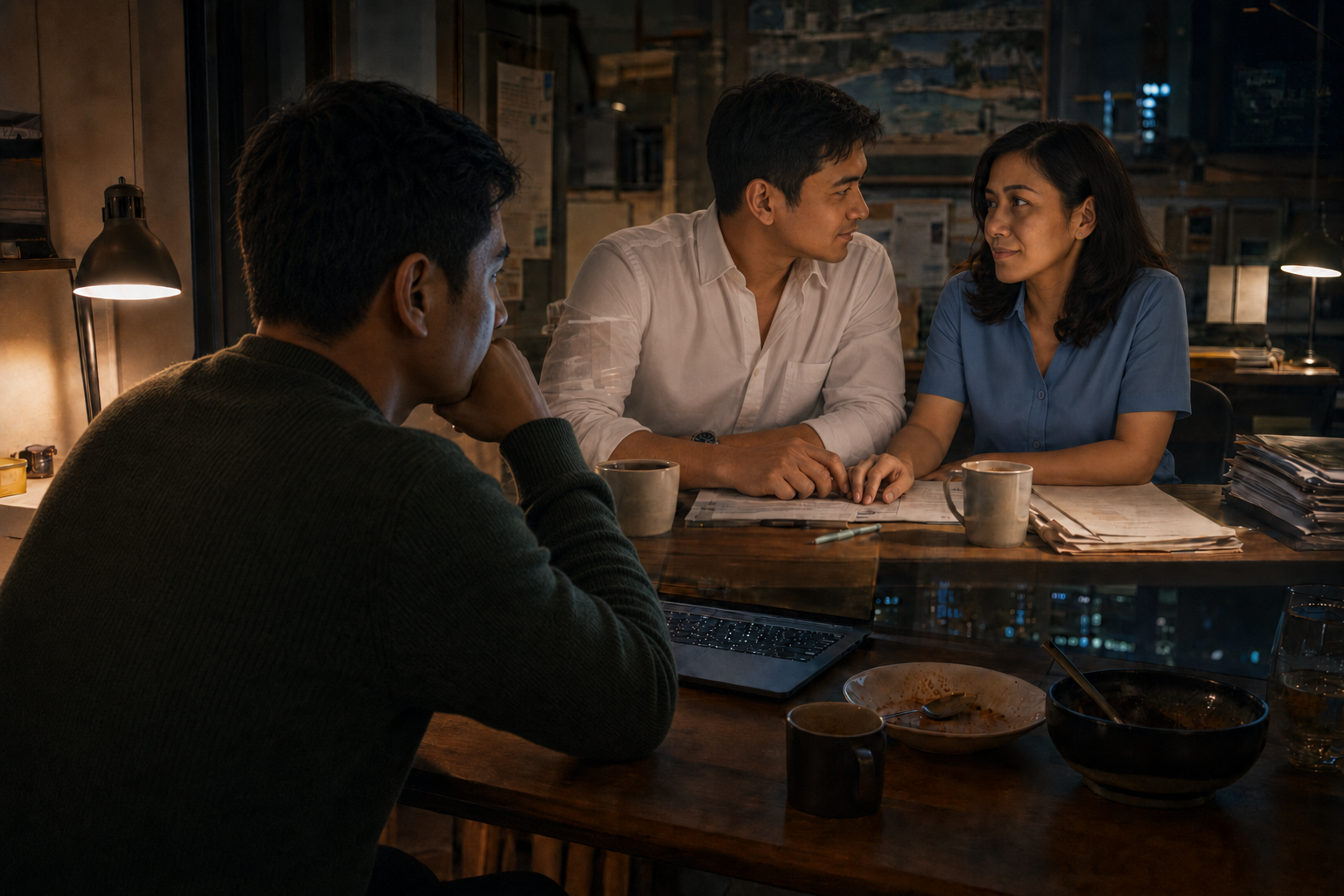
I had meant her whole family. To be honest, her husband had not even entered my mind when I asked. But since she had brought him into the conversation, I asked whether he was home.
I knew Jay was a seafarer. Kath said he was currently aboard a ship operating in South America.
“How about you and Anna?” she asked.
My fingers remained above the keyboard for a long time.
How were Anna and I?
“We’re okay,” I finally typed.
Kath replied almost immediately.
“Wow. It took you that long to answer, and all you can say is that you’re okay?”
I had intended to add more. I had pressed Enter too soon.
“Things became more peaceful between us when I stopped expecting her to meet my standards.”
“Has she changed?”
Again, I hesitated.
“Anna is Anna,” I wrote. “She is who she is. I’ve learned to accept that.”
Kath sent a thumbs-up.
Her question stirred memories I had kept untouched for years. Whenever Anna and I fought back then, Kath had been the person who listened to me. If she entered my office and found me unusually quiet, she immediately knew that something had happened between my wife and me. She would make me coffee, sit nearby, and tell me I did not have to keep everything to myself.
I thought the thumbs-up would end our conversation. Instead, she sent a sad emoji.
“I’m all right, Kath,” I assured her.
She reacted with a heart.
I turned the question toward her.
“How are things between you and Jay? Have you completely repaired your relationship? Are you back to the way you used to be?”
“Yes. We worked through our problems. We both realized that perhaps we needed to experience what happened—just as you and Anna needed to go through your own difficulties. You know we’re both Christians. We chose to remain together and allowed God to guide us through the healing process.”
I sent her a thumbs-up.
“I think we’re more mature now in the way we handle our problems,” she added.
Shortly before I moved to Korea, Kath and I had met because she and Jay were going through a serious marital crisis. She had needed someone to talk to, and I had listened. At the time, she believed their problems might end their marriage. I asked what caused the conflict, but she was reluctant to tell me.
Her problems had seemed so heavy that I never found the opportunity to tell her about mine. I had been going through a crisis severe enough for a doctor to prescribe antidepressants. I had not even told her that I would soon be leaving for South Korea.
“You suddenly went quiet,” she wrote. “Are you busy?”
“No. I was just remembering the last time we saw each other. We watched a movie that day, didn’t we?”
“Which part are you remembering—the movie, or the way you pretended to comfort me so you could steal a kiss on my cheek?”
“That isn’t true,” I protested. “I was genuinely trying to comfort you. If I had wanted anything else, then I would have—”
“Stop it, Marco.”
“All right. But I really didn’t have any hidden intention that day.”
“If you say so.”
I sent her smiling emojis.
She sent back three hearts.
“I miss you, Kath,” I typed. “I really do.”
The words had escaped before I could decide whether they were appropriate. Something familiar had risen inside me—a feeling I knew too well whenever it concerned her.
The message had already been delivered when I realized she might take it the wrong way.
“Oh, Marco,” she replied. “It’s getting late. I should say good night.”
Perhaps I had offended her.
“I’m sorry, Kath.”
“Sorry? What are you sorry for?”
I stared at the screen, unable to type a single word.
“Marco, I asked what you’re apologizing for.”
I do not know how long I sat there. Memories I had spent years avoiding began returning one after another.
Finally, I typed, “It’s nothing. You said it’s time to sleep, so good night. Thank you for talking to me.”
A series of angry emojis appeared.
“Fine, Marco. Leave me hanging again. I should be used to that by now.”
I pressed my palm against my forehead.
This was why I kept my distance even when I wanted to speak to her. Perhaps it was also why she kept hers. Neither of us wanted to uncover what we had spent years burying.
Instead of replying, I tried to video-call her.
She rejected the call.
I tried again.
Rejected.
“Please answer,” I wrote. “My hands are tired from typing.”
I called a third time.
At last, she answered—but her camera was off.
“Please turn on your camera,” I typed.
“Why?”
“I want to see you.”
It took her a while, but eventually the screen flickered and her face appeared.
I looked at Kath. She seemed to be studying me in the same way. Almost eight years had passed since we last saw each other, yet she looked scarcely changed.
“Have you been crying?” I asked.
“You’re infuriating, Marco. Why did we have to make this a video call?”
“My fingers were beginning to hurt from typing. And besides…”
I stopped.
“Besides what?”
I drew a breath. “I miss you, Kath.”
“I can never tell whether you’re telling the truth or merely charming me.”
“Is that really what you think of me?”
“Yes. It has been—for a long time. Since the day you failed to show up.”
I had no answer.
Whenever our conversations came dangerously close to what had once existed between us, she returned to that day—the meeting I had missed and the explanation I had never given.
“Marco, I want to ask you something,” she said. “And for once in your life, please answer me honestly. Just this once.”
Her words hurt. They made me sound like a man who had lied about everything.
“All right. I promise I’ll be honest. What do you want to know?”
She stared at me through the screen.
I tried to guess what she was about to ask.
Was it why I had not shown up that day when we were supposed to visit my mother in the hospital? Was it why my uncle had transferred her to another branch after she had worked in my office for six months? She had resigned two months after the transfer. Perhaps she wanted to know why I had not tried to stop her.
Or why I had seemed unaffected when she told me that she and Jay were getting married.
Perhaps she wanted to know why I had left for Korea without telling her—or why I had made so little effort to remain part of her life afterward.
Which of those questions had she carried all these years?
She took so long to speak that I wondered whether she had changed her mind.
“Never mind,” she finally said. “It’s embarrassing.”
“What are you—a teenager?”
“That’s enough, Marco.”
“All right. Ask me.”
“I said forget it.”
I sighed.
Perhaps I already knew what she had wanted to ask.
“Fine,” I said. “Then I’ll ask the question.”
“Go ahead. Just don’t ask me anything about mathematics. You know that’s my weakness.”
I smiled. Her humor had not changed.
“Kath…”
“Yes?”
“Did you really love me back then?”
She closed her eyes and released a long, unsteady breath.