Is The Workplace A Jungle?
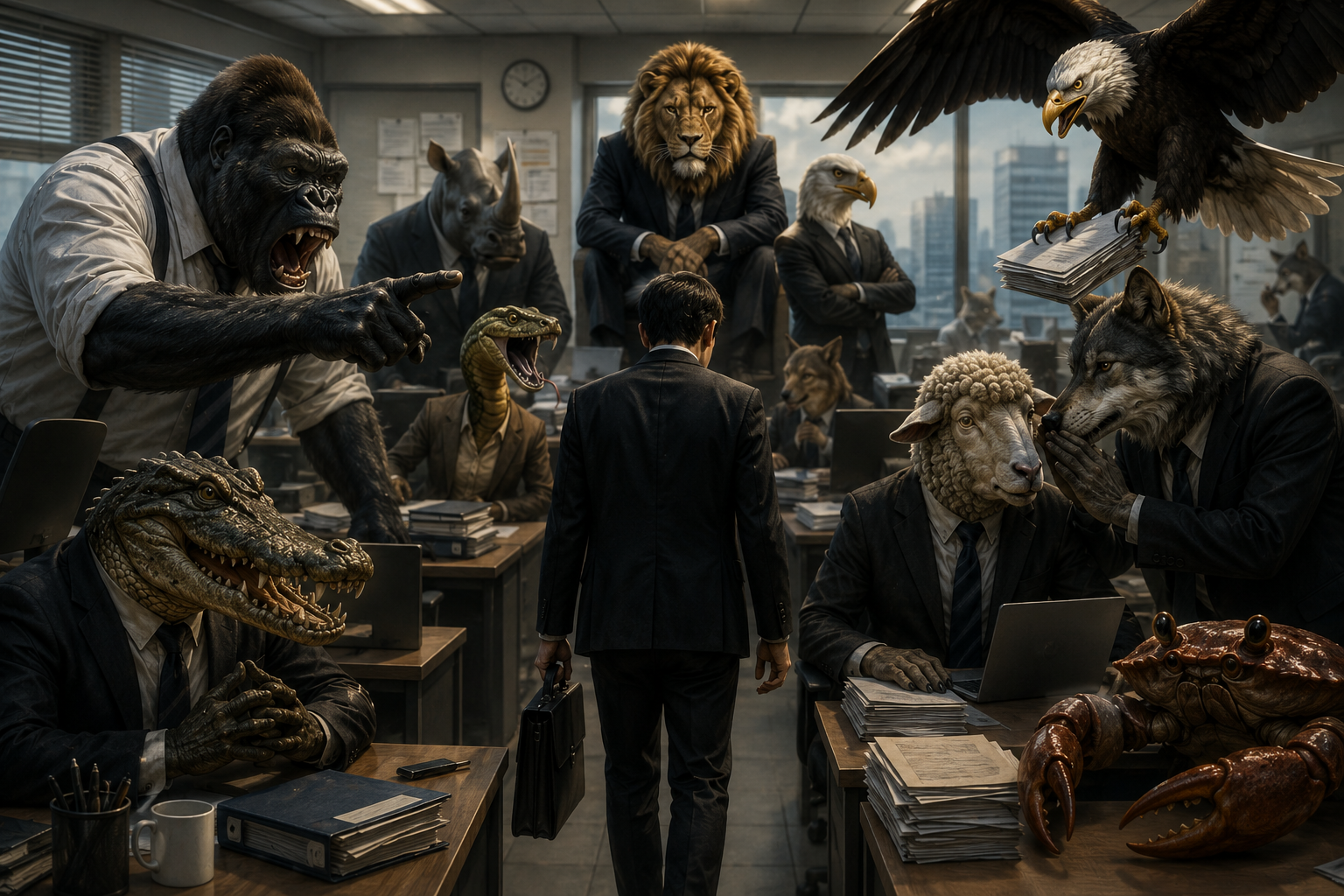
I couldn’t agree more when people describe the workplace as “a jungle.” I have worked for over thirty years at eight different institutions in two countries, so I have ample reason to concur with that description. The similarities between workplace behavior and that of forest animals are uncanny. Even the relationships among people in the workplace resemble how wild animals treat one another. Thus, they say, in the workplace, “only the fittest survive.”
I have been in this jungle called a workplace for more than three decades now. Here I am, still standing and breathing. I managed to hold my own against the beasts I crossed paths with as I searched for greener pastures and overflowing water holes. I experienced being stared down by a lion, bullied by a gorilla, stalked by an eagle, ambushed by a crocodile, bitten by a snake, screamed at by hyenas, and clipped by a crab. Those attacks left me scarred. Nevertheless, I survived – and they did not go unscathed either.
I simply took a cue from Charles Darwin’s theory of natural selection — the idea that organisms whose traits are better suited to their environment are the ones that survive and pass those traits on. Adaptation is the name of the game. But adaptation does not always mean bending. Sometimes it means standing your ground — and the real skill is knowing which one the moment is asking of you. That is what I have been doing, and what you should do if you intend to stay alive and kicking in that jungle where you are now — ADAPT.
If you do not wish to be dinner for the predators, study the workplace where you belong. Know what kind of animals you are dealing with. Study them carefully. You also need to put your survival instincts into full gear.
If you decide to fight the bullies in the organization, be ready to face the consequences. I did not do this often, and I never did it lightly — only when staying quiet would have cost me more than the fight did. I poked bears and twisted the tails of lions to remind them they were not the kings of the forest and lords of the jungle they thought themselves to be. I took the bulls by the horns. I did not chicken out. Thankfully, I survived.
Predators lurk in the shadows. It could be a big cat hiding in the bushes or a mighty bird hovering above. These predators could be the “people upstairs” or somebody from among you “downstairs.”
Don’t get me wrong. I don’t mean that all bosses who succeeded in their business endeavors did it at the expense of the people in the rank and file — like predators slaying their prey and eating them. It could be just a few, or half, or most of them. Nobody knows for sure. But definitely not all. Perhaps most of them (I hope) consider themselves rhinos, and the people they hire are oxpeckers whom they allow to freely land on their backs to feast on the insects pestering them.
The point I wish to drive at when I posited that they (the bosses) are predators is that they are at the top of the food chain and, like it or not, when you agreed to work for them, you entered their territory. They dictate the terms and conditions of your employment. That doesn’t sound good, but it’s the reality in the workplace.
The ones who own or manage the workplace are the alpha males. You need to understand how they think and operate. Better if you could dig deeper and learn what they like and dislike. Stay in the pack if it is not too much for your dignity (or EGO) to adapt to their whims and fancies. These whims and fancies could be the policies that you consider disagreeable. You’ve got to choose whether to follow these policies. For not following, of course, you are not naïve about the consequences. Following the terms and conditions of your employment is not equivalent to flopping onto your back to show that you submit to the alpha males. It is simply like the chimpanzees presenting their back, crouching, bowing, and bobbing to show deference to the alpha in their group.
If not, if you are tired of being an omega, if your ego clashes with that of the alpha, the wisest thing to do is find another pack. You can be a lone wolf. Don’t be employed. Establish your own business and be your own boss. If you succeed and your business grows big, hire people — that is your chance to be the alpha and see if you are better than your former bosses (and hopefully) not worse than them.
Believe me, you cannot afford to take too much bravado and think you are that brave “angry bird” who would post your disagreement online and not expect dire consequences. Whether it’s a tweet, a Facebook rant, or a viral TikTok, your chirps and screams will not go unnoticed. Little birds that might tell them about your misplaced braggadocio are hovering around you. Before you know it, the eagle will swoop down on your nest and tear you apart with its powerful beak. So, learn to hold your horses. Clam up. Just work.
The angry bird isn’t the only one who talks too much and pays for it. There’s also the barnyard crowd — the roosters and the hens — and they have their own way of finding trouble.
Speaking of noise, there’s also the rooster in the office. This one loves the sound of his own crowing — not about deadlines, not about deliverables, but about everything else under the sun: politics, gossip from last night’s game, his side hustle, his opinions on things nobody asked him to opine on. He crows at the top of his lungs while everyone else is trying to work. Sooner or later, somebody upstairs starts wondering if the rooster actually does any work at all, or if he just announces the sunrise every morning and calls it a contribution.
Then there are the hens, clucking away in their corner of the coop. One small workplace hiccup — a missed deadline, a minor disagreement, a memo that rubbed someone the wrong way — and the clucking starts, spreading from cubicle to cubicle until the whole flock is in an uproar over something that could have stayed a whisper. The volume isn’t the problem. It’s that the noise is rarely about the work either.
And here’s the thing about roosters that won’t stop crowing and hens that won’t stop clucking: the farmer (the boss) is always listening. Too much noise, too little work, and eventually somebody decides the coop needs thinning out. That’s how roosters and hens end up as fried chicken — plucked, seasoned, and served, while the quiet ones who kept their heads down and did the work are still out in the yard, unbothered.
More often than not, or almost always, locking horns with the “powers that be” in the workplace is like a deer thinking it could take on a full-grown lion. It’s a losing proposition.
Of course, not all bosses are saints. Some would take advantage of the people they hire in different ways. That you’d discover (hopefully) in time. So, why stay in a watering hole when you discover crocodiles waiting in an ambush under the mud?
What about the predators among you “downstairs.”
Wherever you work, you’ll encounter malevolent individuals. So, be careful. Beware of the wolf in sheep’s clothing. These are co-workers who camouflage themselves as your friends but would stab you in the back when they have the chance.
Okay. Let’s talk more about the different animals in the workplace. You must be able to identify them if you want to survive the wild called the workplace.
We have already mentioned the monkey at the top of the tree, the big cats, and the mighty birds. Yeah… including the wolves pretending to be sheep.
Are there other animals you ought to be wary of?
Of course, there are!
Be careful of the buzzing bees called “rumormongers.”
Thinking that they are your friends and therefore could be trusted, you share with them your darkest secrets. Later you’ll discover that the entire workplace is talking about the skeletons you keep in your closet. These people would let the cat out of the bag so easily.
Gossiping is a deadly disease in the workplace. So contagious is it that even people who consider themselves professionals and decent individuals spread personal and work-related gossip. Identify who among your co-workers is fond of tittle-tattling. Don’t say anything negative to them about the work or co-workers, let alone personal matters. Just listen when they talk. Don’t fall into their trap. They will quote you without batting an eyelid. But here is the best way to deal with them — avoid them like the plague.
Among your co-workers, you should also be able to spot the crabs.
Why?
Do you know what happens when you put crabs in a bucket? They’ll try to escape by pulling others back down, effectively preventing any of them from climbing out of the bucket.
That’s the origin of the proverbial “crab mentality.” The philosophy of the malevolent among your co-workers is “if they can’t have a promotion or an incentive, neither can you.” Some people in workplaces just don’t want to see their co-workers succeed. They hate it when somebody climbs the ladder, especially if they’ve been there longer. These snakes would bite you with intrigue and gossip when they see you work harder than they do. They would accuse you of being a leech trying to suck the attention and favor of the people upstairs. Avoid them like mosquitoes and cockroaches, for they could carry a deadly disease.
Watch out too for the hyena – the one who laughs loudest at everyone else’s mistakes. Miss a deadline, fumble a presentation, get called out in a meeting, and the hyena is there, cackling, making sure the room notices your stumble. But corner a hyena the way it corners others, and the laugh disappears fast. The moment the mistake traces back to them, or somebody else outshines them in front of the people upstairs, that same mouth that laughed now screams – scrambling to explain, deflect, or drag someone else down before the blame lands. The hyena was never as confident as it sounded. It only knew how to laugh at others. It never learned how to carry its own weight.
Don’t let the snakes’ venom get to your nerves and kill your enthusiasm and motivation. Continue to work as hard as your personal values allow. That’s just the reality in the workplace – generally, there are two types of workers – the ants and the termites.
And with whom would you rather be associated – with the ants in the workplace who keep themselves busy working and helping one another to achieve the goals of the organization or with the termites, whose actions and pronouncements, deliberate or otherwise, are damaging – not only to the organization but more so to themselves?
They are basically a negative bunch that should be avoided at all costs. The termites hold a grudge against the people upstairs for one reason or another, and they think that by not doing their jobs the way they ought to and behaving oddly, they could get even. They spin tales about the organization’s current state to demotivate people. Be aware that the termites could also sow dissension among their co-workers.
Nonetheless, the people upstairs are not naïve. They could easily detect termites and have them exterminated.
Also watch out for parasites in the workplace.
The parasites seem to have special training in detecting generosity. Once they spot a kind-hearted co-worker who won’t say no when asked for favors, they will have a field day. They would ask you to solve their work-related problems and sometimes even seek personal favors.
So, be careful. Learn to say no when you must, or they will waste your time and resources. They would not hesitate to abuse you.
It’s okay if they return the favor. The problem is the word “reciprocate” is not in their vocabulary.
They also tend to exhibit that selfish attribute in their work. You could neither expect them to go the extra mile for the organization nor to perform their duties and responsibilities as stipulated in their contracts. They care for nothing but their salaries.
Beware, because where we work, roaming are also the “old dogs” – the dinosaurs who refuse to retool and retrain to cope with the demands of what has become a technology-driven workplace.
The infusion of technology in the different aspects of organizational functions is inevitable. They make work more efficient. Organizations that refuse to embrace this new reality are destined to either be eaten up by the competition or buried in the grave of their own insignificance, dug by refusing to change. However, some people in the workplace refuse to be attuned to this emerging reality by subscribing to the notion that “old dogs can’t learn new tricks.”
Now here’s an animal in the jungle you should aspire to be, not fear – the chameleon.
The chameleon has no claws to speak of, no venom, no roar. Its survival skill is subtler and, frankly, smarter: it reads the branch it’s sitting on and changes color to match it, without becoming a different creature underneath. That’s the part people miss when they hear the word ADAPT and think it means surrender. It doesn’t. It means knowing when to display your true colors boldly and when to keep them muted until the moment is right. The chameleon isn’t the fiercest animal in the jungle, and it doesn’t need to be – it survives because it’s smart enough never to walk into a fight it wasn’t built to win. Blending in is not surrender. It is the same choice that sometimes tells you to fight – only pointed in the other direction. Learn to be that watchful. Read the room before you speak. Read the branch before you land on it. That is how you outlast the lions.
The relationship between the people and the organization should be symbiotic for the workplace to prosper.
Let’s consider the relationship between the clownfish and the sea anemone. It’s a perfect example of a symbiotic mutualistic relationship. While the clownfish’s fecal matter serves as a nutrient source for the sea anemone, the sea anemone protects the clownfish from predators.
You can choose between becoming a parasite or a clownfish.
The workplace gives you a venue for professional growth and a source of livelihood. You need to keep it afloat. Your organization needs your help to succeed and continue to exist. You may have disagreements with the people upstairs, but you must remember that commitment to your job and organization differs from commitment to your employers.
Lastly, to survive in the forest, you must clearly determine where you rank in the food chain. Identify the different kinds of animals there. And most importantly – don’t stand in the path of your predators.
It’s as simple as knowing your designated place in the organization, being mindful of your words and actions, and being careful with how you deal with everyone. And remember that the most foolish thing to do is to offend your employers and think that there’ll be no consequences. Pray that they are rhinos and not king cobras who bite when provoked.
In the end, this jungle does not ask you to be purely meek or purely fierce. It asks you to know, moment to moment, which one keeps you standing – and to have the nerve to be either one when it’s called for.
You have to study the workplace culture. Again… ADAPT. There’s a line about survival that gets attributed to Charles Darwin, though historians who’ve gone looking for it in his actual writing have never found it there – it seems to have been coined decades later by a business professor paraphrasing Darwinian ideas: “It is not the strongest of the species that survive, nor the most intelligent, but the one most responsive to change.” Misattributed or not, the wisdom in it still holds – for the chameleon, and for you.
If you can’t adapt, feel disrespected and gravely offended, or think you are no longer growing professionally – what are you waiting for? It’s time to migrate to another forest. And if you think there are better animals in other forests, good luck!
 M.A.D. LIGAYA



 M.A.D. L I G A Y A