Category Archives: Self-Discipline
About the Title – Why “A Holistic Approach”?
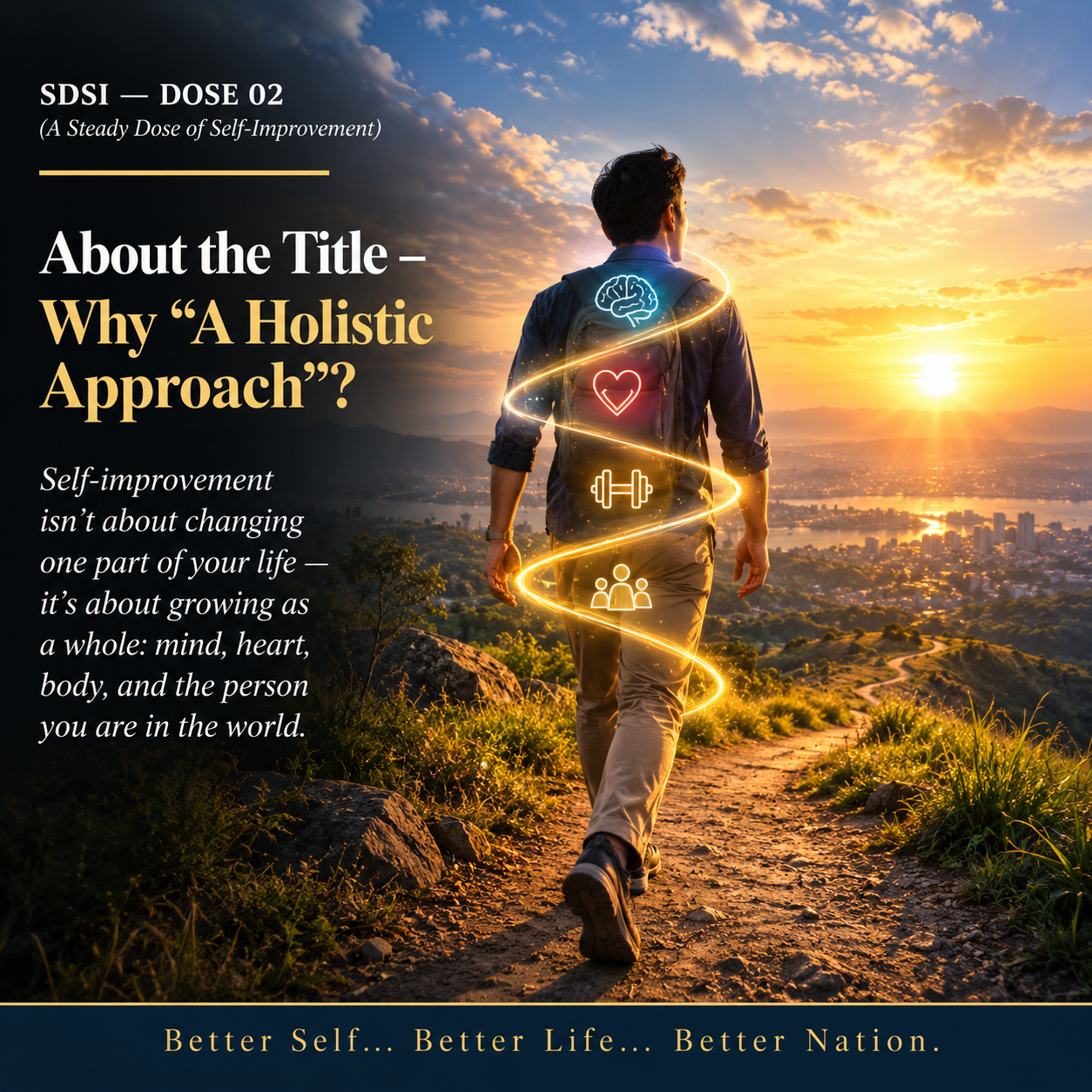
Self-improvement fails when it’s treated as a single fix; this book is holistic because lasting change
requires belief, skill, and habit working together.

Why “holistic”? Why not just “self-improvement”?
Because I tried the narrow version first, and it didn’t work.
I thought reading self-help books was enough. It wasn’t. I thought adding positive thinking on top of my faith and self-belief would complete the picture. I was wrong again. I wanted more — and I couldn’t yet name why.
The turning point came almost by accident. I bought a DVD titled “The Secret” without knowing what it was — the store had mixed it in with other genres, no synopsis, nothing to explain it. I watched it skeptical, then curious, then genuinely changed. That led me to Bob Proctor, and from there to a long list of thinkers — Jim Rohn, Tony Robbins, Wayne Dyer, Napoleon Hill, Dale Carnegie, Earl Nightingale.
What struck me across all of them was this: none of them treated self-improvement as one lever to pull. Every lasting example of growth I found required cultivating the right attitudes and beliefs, developing real skills and abilities, and consistently practicing the right daily habits. Not one of these in isolation. All three, together.
This book is organized around that conviction — a Value System, a Competence Framework, and a Habit Scheme, held together by self-discipline. It’s not a shortcut. It’s a fuller map.
Pause and Reflect
Which single area have you been trying to fix on its own, while the rest quietly stayed the same?
One Step Forward
Name the one dimension — belief, skill, or habit — you’ve most neglected. Write one sentence describing what giving it real attention would look like this week.
Explored in full in the Preface of A Holistic Approach to Self-Improvement.
Better Self… Better Life… Better Nation.
Before the Journey Begins
Becoming your best self rarely begins with a dramatic transformation; more often,
it begins with one meaningful idea put into practice.
Why did I write a book on self-improvement and create this program – “A Steady Dose of Self-Improvement”?
Not to sell you on overnight transformation — there isn’t one, and I’ve never believed in the ones sold in the self-help aisle. I wrote this book because if even a single person reads it and becomes who they were truly meant to be, that’s a life genuinely changed. That, to me, has always been reason enough.
My own path into this started long before I called it self-improvement. My mother instilled in me the values of faith and self-belief. My parents taught me the importance of education and the discipline of always striving to be the best version of myself. I believed them — enough that I explored them in full in the Introduction of A Holistic Approach to Self-Improvement. After I’d earned the degrees I wanted, I kept looking for a new jar of knowledge to dip my fingers into.
Along the way, I found myself drawing from teachers I never met in person — Jim Rohn, Tony Robbins, Zig Ziglar, Napoleon Hill, Earl Nightingale, and many others whose ideas reached me through books, recordings, and screens exactly when I needed them. I came to think of them as professors in what I call my “Virtual University” — a classroom without walls.
Jim Rohn said it plainly: “Those who seek a better life must first become a better person.” Everything in the chapters ahead stands on that one sentence. Self-improvement, done right, isn’t a single skill or habit fixed in isolation. It touches your beliefs, your abilities, and your daily practices — all at once, all connected.
If you’ve ever doubted yourself, felt overwhelmed by your circumstances, or questioned whether you have what it takes to reach your goals, I want you to know something plainly: you have the capacity to grow, to improve, and to become the best version of yourself. Your journey doesn’t need to begin when everything is perfect. It begins the moment you decide to take the first step.
Pause and Reflect
What part of yourself or your life do you most sincerely want to improve, and why does it matter to you now?
One Step Forward
Identify one area of your life that you want to improve. Write down one small but meaningful action that can mark the beginning of that change.
Explored in full in the Introduction of A Holistic Approach to Self-Improvement.
Better Self… Better Life… Better Nation.
A Holistic Approach To Self-Improvement

Self-improvement is often treated as a collection of isolated goals—building confidence, learning new skills, developing better habits, or becoming more disciplined. But lasting transformation requires something more. It requires a holistic approach.
This book presents a practical framework that brings together the essential dimensions of personal growth into one integrated system. Rather than focusing on a single aspect of development, it shows how genuine and lasting change occurs when your beliefs, abilities, habits, and actions work together.
Through this book, you will discover how to:
• Build a strong value system that shapes your character and guides your decisions.
• Develop the competencies needed to navigate life’s personal and professional challenges.
• Establish a habit scheme that transforms good intentions into consistent action.
• Cultivate the self-discipline that binds every element into a sustainable way of life.
• Pursue lasting health, success, happiness, and fulfillment through balanced personal growth.
Grounded in research yet written in a clear and practical style, this book combines timeless principles, scientific insights, reflective exercises, self-assessments, and real-life examples to help you understand not only what to improve, but how meaningful transformation actually happens.
Whether you are a student, educator, professional, leader, entrepreneur, or simply someone seeking a more purposeful life, A Holistic Approach to Self-Improvement offers a complete roadmap for becoming your best self—one intentional step at a time.
Grow with purpose. Live with meaning.
Holistic Approach To Self-Improvement
A PARADIGM FOR PERSONAL GROWTH & DEVELOPMENT
There is no shortcut to self-improvement. It’s a long journey. Personal growth and development cannot be achieved by simply embracing positive thinking. It’s much more complicated than that. It involves establishing a value system, developing a competence framework, and maintaining a habit scheme. And as if doing these is not difficult, self-improvement also requires acquiring self-discipline. This makes the process of improving oneself not for the faint-hearted. Yes, it is extremely tedious and difficult, but the reward is enormous – the achievement of one’s full potential leading to self-fulfillment measured in terms of health, success, and happiness.
#HolisticSelfImprovement
#PersonalGrowth
#SelfDevelopment
#LifelongLearning
#GrowthMindset
HOLISTIC APPROACH TO SELF-IMPROVEMENT
My book, A PARADIM FOR SELF-IMPROVEMENT, will be retitled HOLISTIC APPROACH TO SELF-IMPROVEMENT for its second edition. The decision to change was informed by the fact that, after reviewing the contents, I found that the original title does not fully reflect the book’s scope and spirit. The original title focused on a conceptual framework, but the new title, Holistic Approach to Self-Improvement, better describes the book’s integrated view of personal growth and development. This view goes far beyond positive thinking to include ATTITUDES, BELIEFS, SKILLS, ABILITIES, PRACTICES, ACTIVITIES, and SELF-DISCIPLINE.
The change was made to ensure the title better fits the book’s content and its practical approach.
As I continue to fine-tune the contents, I have come to understand that the book is not merely about suggesting a framework; it is about embodying one. The word HOLISTIC describes that change. The word PARADIGM is too technical and creates the impression that this is just another research work, something to study. Replacing it with APPROACH tells readers that this is not a book meant only for academic purposes, but one that outlines the steps for those who intend to embrace personal growth and development.
Adding holistic indicates that growth doesn’t happen in separate parts; it happens when attitudes, beliefs, skills, abilities, practices, activities, and self-discipline come together. That’s the purpose of including PARADIGM in the original title: to show that SELF-IMPROVEMENT is a PROCESS that, when successfully carried out, would help an individual become their BEST SELF and attain FULFILLMENT.
In my book, I proposed the concepts of VALUE SYSTEM to comprise attitudes and values, COMPETENCE FRAMEWORK skills and abilities, and HABIT SCHEME practices and activities. The proposed concepts are viewed as DIMENSIONS of self-improvement.
The book, whether bearing the old or new title, encapsulates the interrelationships among these categories and self-discipline into a framework, illustrating how their synergy yields an effective process of self-improvement that leads to the attainment of one’s full potential.
The paradigm is divided into three sections: left, middle, and right. The middle section comprises three parts: the dimensions of self-improvement, the self-improvement process, and the concept of full potential, also known as the best self. The dimensions of self-improvement in this book are generally categorized as the attitudes & beliefs (value system), skills & abilities (competence framework), and practices & activities (habit scheme) that a person pursuing personal growth and development should acquire, possess, or develop. These elements come together through the self-improvement process, forming the second part of this section. This process aims
to help one become one’s best self, not as attaining perfection but as unlocking one’s full potential.
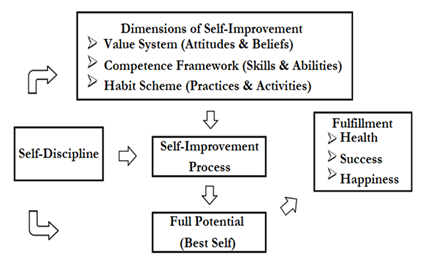
The left section of the paradigm highlights a crucial requirement for self-improvement: self-discipline. The paradigm illustrates how self-discipline continuously influences the process; even after one has achieved one’s full potential and become one’s best self, self-discipline remains essential. Self-discipline bolsters personal growth and development, forming the foundation for consistent progress and sustained fulfillment.
The right section of the paradigm illustrates the outcome of the self-improvement journey—fulfillment, characterized by becoming healthy, successful, and happy. This fulfillment represents not only the achievement of personal goals but also a deep sense of completeness and satisfaction that comes from living in alignment with one’s true potential. It is the reward for the dedication and discipline invested in becoming the best version of oneself.
Through self-improvement, individuals develop attitudes and beliefs, acquire skills and abilities, and engage in practices and activities to navigate life’s complexities confidently and purposefully. This transformation empowers them to achieve personal success, sustain a healthy state of being, and experience genuine happiness.
Those who achieve their full potential and become their best selves succeed in personal and professional endeavors. They become HEALTHY, SUCCESSFUL, and HAPPY.
If one intends to achieve their full potential and attain fulfillment, they must approach self-improvement holistically.
Having More Time Than We Think

A dilemma confronting expatriates like me as we work and live in another country is what to do with our free time. We must decide how to spend the extra hours at our disposal, whether to use them effectively or squander them. Free time can either be an opportunity or a temptation. It presents a chance to be productive, doing something worthwhile that contributes to achieving our personal and professional goals, or it can lead us astray, luring us into mindless distractions or unfulfilling pursuits.
Understandably, the hours we spend not working are moments when homesickness or boredom could set in. Those not equipped with a coping mechanism against boredom and that intense yearning for home and beloved ones, resort to anything that can help them relax and overcome loneliness and emptiness. They find solace in entertainment, socializing, or, sometimes (and unfortunately), vices. More often than not, resorting to vices to overcome homesickness leads to more problems.
Finding a way to be productive with our extra hours is a protection against temptation and homesickness. Admittedly, that isn’t easy to do. Neuroscience and evolutionary psychology reveal that our brains are wired to seek pleasure and avoid pain. Thus, it is much more convenient for some to go out with friends and have a good time during non-working hours. The mind’s circuitry gravitates towards rewarding tasks instead of exerting more effort to do something else.
Being productive means looking for ways to use the time when we’re not working for worthwhile endeavors. Some of us use them to find a second job to earn extra income, while others use them to pursue a rewarding hobby. There are also those of us who utilize our free time for self-improvement. Of course, some expatriates also seek gratification when they are off duty. Let me clarify that using our free time constructively doesn’t mean depriving ourselves of enjoyment. We are entitled to a day off from time to time to breathe fresh air. For our overall well-being as expatriates, we need to strike a balance between work and life. But we need to draw the line between having fun and going wild.
Expatriates have different ways of using their free time effectively and efficiently, either for productivity’s sake, to protect themselves against temptations, or to overcome homesickness. Based on what I have gathered, most of my colleagues would flock to the capital city for socialization. During long weekends, a few of them would travel. Those with their families with them, of course, would spend their free time with their loved ones. But I would lie if I said that none of us unnecessarily indulged in some forms of vices, particularly gambling and drinking.
What about me? How do I spend my free time? Imagine this: I have 168 hours a week. As I sleep an average of 6 hours a night (42 hours a week), I am awake for 126 hours. My contract requires me to work 19 hours a week, spread over 4 weekdays. Let me add 3 hours to evaluate and assess my student’s performance. That still leaves me a little more than 100 hours a week. If I spend 3 hours daily on meals and snacks, that’s only 14 hours a week. Which means I still have a lot of free time. What Laura Vanderkam said in her book “168 Hours” is true: “You have more time than you think.”
I have more time than I thought. So, what do I do with it? If I am not communicating with my loved ones in my country of origin, I am either in the gym working out or outside walking. I spend an average of one hour a day connecting with my family, with longer sessions during weekends and holidays. On the other hand, I engage in all the physical activities I mentioned five times a week, each lasting at least an hour.
After doing all the other things I must, I figured I have an average of 50-60 hours a week of free time, sometimes more. Additionally, I have more free time during winter and summer breaks when the university does not require me to work, except for attending two-hour meetings at the end of a semester or when one begins. We are also required to attend graduation ceremonies two weeks before the start of each semester.
There came a time when I faced the dilemma of determining how to spend those excess hours. It wasn’t a question of whether to use them effectively or squander them. I know that I must walk the path of productivity during my free time and ensure that I don’t succumb to the enticement of a good life. That’s my mindset. I consider my extra hours an opportunity for growth, not an invitation to waste my resources and self-destruct. Expatriates, particularly those who don’t have their families with them like me, are prone to different kinds of temptations and vices.
And how specifically do I spend my free time?
Spending nights in the bar, particularly during weekends, is not my thing. I don’t enjoy wine and beer. I consider it illogical to drink a lot and then suffer from a hangover the following day. Besides, I know how much damage alcohol inflicts on human cells. I need to stay healthy, for it is difficult for expatriates like me to get sick and be hospitalized. So, I would rather stay home, read books, listen to audiobooks, or watch movies. That lifestyle appears boring, but with the many things that I could do, I have no time to be bored. No, I am not allergic to interaction. Quite the contrary, I love mingling with people, discussing anything under the sun with them. I am what psychologists refer to as an ambivert. I can switch any of my personality’s introvert and extrovert buttons as needed. I do socialize occasionally, but only with a few friends. We go out for dinner and coffee. I go to a noraebang with the same group on special occasions. But there are times when I need to switch to lonewolf mode.
I spend the majority of my free time pursuing my passion for writing. There is no better way to be productive with my extra hours than writing.
Writing has become a sanctuary for me, not just a way to pass the time, but a space where I can thrive emotionally, intellectually, and creatively. It is a refuge that protects me from the challenges of working and living abroad, allowing me to grow and reflect. In the pages of my writing, I have found peace, a workshop for my mind, and a shelter from the storms of life. Those pages shelter me from external and internal noise and help me find clarity.
There were times when writing protected me from my internal struggles. Through it, I could confront my demons and fears and transform them into meaningful and constructive expressions. I release my pain, anger, disagreement, and disappointments by writing about them. Whatever emotions boil within me, I express them creatively, through prose and poetry.
Making writing my sanctuary has not only fueled my productivity and creativity but also become a source of additional income.
Ultimately, how we choose to spend our free time plays a significant role in shaping who we are and how we grow, especially as expatriates navigating the complexities of life away from home. The hours we have at our disposal are a precious resource, allowing us to either build our lives or let them slip unnoticed.
For me, writing has become a powerful tool for personal development, a sanctuary that provides both protection and growth. But regardless of the path we choose—whether through physical activity, self-improvement, or connecting with others—the key is to make the most of every moment. We have more time than we think; with that time, we can either invest in our future or squander it. The choice is ours, and it is up to us to ensure that we walk the path of productivity, growth, and purpose, rather than succumb to temptations that may lead us astray and broke.
Race To 100 (Longevity)
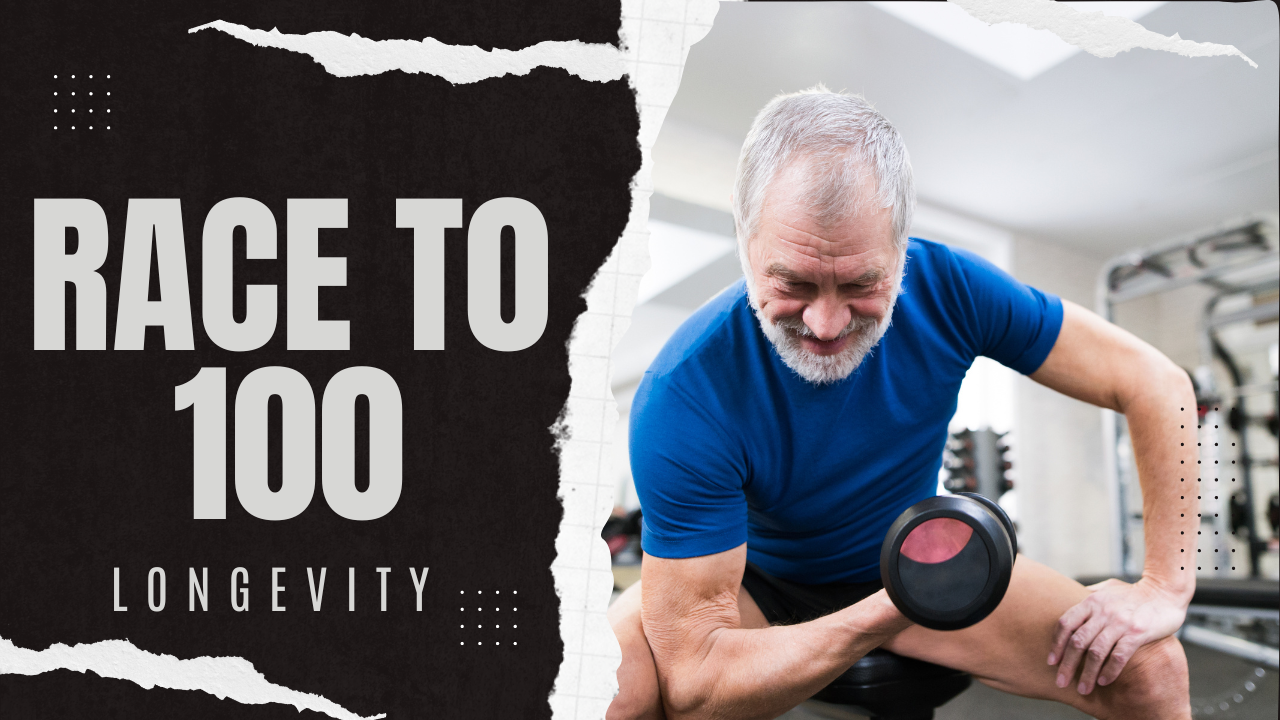
As I explore deeper into self-improvement, I came across a lot of literature written on longevity. I got so fascinated by the idea of people not just reaching their full potential as persons but living as long as they could.
Creating a paradigm to capture the relationship between the constructs “reaching one’s full potential” and “longevity” is a little bit tricky. Will the conceptual model show that the latter is an integral part (or the result) of the former? Which of the following questions should be answered – “Is living as long as a person could a part of reaching the maximum physical capability of their body?” or “Is longevity the result of being able to develop fully as a person?”
I think longevity should be viewed as a product of the efforts of people to reach their full potential. To say that living as long as people could is the result of them giving their physical bodies the maximum care only is tantamount to considering a person as a mere physical specimen. A person has, not just a body, but a mind and a spirit. In psychology, an individual is looked at as a physical, mental, emotional, social, and spiritual being. I believe that only when people are able to strike a perfect harmony among these different aspects of being that they could hope to have a shot at longevity.
The interest that longevity has been drawing from both the scientific community and the general public has seemingly created a new sport which I call “race to 100.” I signed up for the race. I want to celebrate my 100th birthday. It is my desire to be on my feet dancing and probably carrying one of my great-grandchildren (or would it be great great-grandchildren) when that happens. I don’t like to be in a wheelchair struggling to blow out those 100 candles.
Celebrating the 100th birthday is a milestone only a few were able to reach. Those who are lucky to live that long are called centenarians. The United Nation estimated that worldwide there are only more or less 600,000 centenarians. That’s less than 1% of the world’s total population of 8 billion people. Studies have shown that they live in certain locations in some countries which were designated as “blue zones.” Japan has the highest number of centenarians with more than 90,000.
When I told some of my friends about me wanting to be at least 100 years old, they said I am crazy to want to live that long. For them, they would be happy to live a few more years after their retirement. One of the reasons they would not want to go 80 and beyond is the possibility of them becoming weak and sickly and unable to fend for themselves. They are worried that their loved ones might just send them to nursing homes. One of them who happened to have visited an institution for elderly people lately told me that the pitiful physical, mental, and emotional condition of the old people she mingled with seemingly made her dread reaching advanced age.
That’s the most challenging part of the “race to 100” – getting there on your two feet and not aided by a wheelchair. Thus, it should be treated as a serious goal entailing careful planning and execution. It is definitely not a walk in the park. For those intending to join the race, it will help to know the life expectancy in the country where you live. In the whole world, it is currently pegged at 72.98 years. That’s the number of years an earthling can expect to live. Adding 20 or so more years is a tall order.
Genetics and environment play an important role in healthy aging and longevity. Thus, people aspiring to live way beyond their retirement age need to be aware of their family’s health histories for them to know if they have any genetic predisposition that should be addressed as early as possible. They need to ensure as well that they live in a conducive environment that would help them live healthier and longer.
The to-do list for people wanting to live as long as they could is as formidable as it could be. The list includes among other things slowing down aging, avoiding and curing diseases, staying healthy, striking a work-life balance, and keeping a robust wellbeing. All of the said undertakings are not easy to do.
There are procedures and treatments available to slow down aging. Most of them are skin-related. But it’s not only the skin cells that age. The tissues in our muscles, brain, heart, and other bodily organs succumb to the unforgiving hands of time as well. And available are natural and practical ways to slow down (if not reverse) it. What’s on top of the list is not surprising – proper nutrition and regular exercise. Eating the right kinds of foods and staying physically active help us stay healthy. Health experts claim that they contribute also to making us feel and look younger. Activities like getting enough sleep, meditation, and fasting intermittently or fully have been proven to contribute to longevity.
Additionally, it is also important to take a look at one’s lifestyle. Aside from genetics and the environment, how long people live is influenced also by their manner of living. Destructive habits like smoking should be avoided. How many times we have been told that smoking is known to cause illnesses that include heart disease and lung disorders. Scientists also found out that alcohol doesn’t only inflame the liver, it also infuses every cell causing damage to the genes. So, if drinking could not be completely avoided, at least it should be done moderately.
That’s how difficult the race to 100 is. As if those undertakings listed on the to-do list of people wanting to celebrate their 100th birthday are not already difficult, they must also observe self-discipline and sacrifice self-gratifying activities (of course only those that are classified as destructive). What makes joining this race a bit more challenging is the fact that it’s not just a matter of making sure that the physical, mental, emotional, social, and spiritual aspects of your being are in tip-top shape as you march toward the century mark. It also entails financial stability to ensure that at least your basic needs – food, shelter, clothes, medicine, and what-have-you – are met. Part of the planning in racing to 100 is calculating how much money you’ll need.
If you save more than enough to secure all that you need as you run the race to 100 and you have plenty to spare, consider traveling to places you have never been and enjoy life. Enjoy aging, don’t gripe about it. Age gracefully and gratefully. A study concluded that “those who view growing older positively lived seven years longer than those who griped about it.” So, instead of griping and worrying, just prepare for its coming.


 M.A.D. L I G A Y A