Category Archives: Effective Communication
Effective Communication
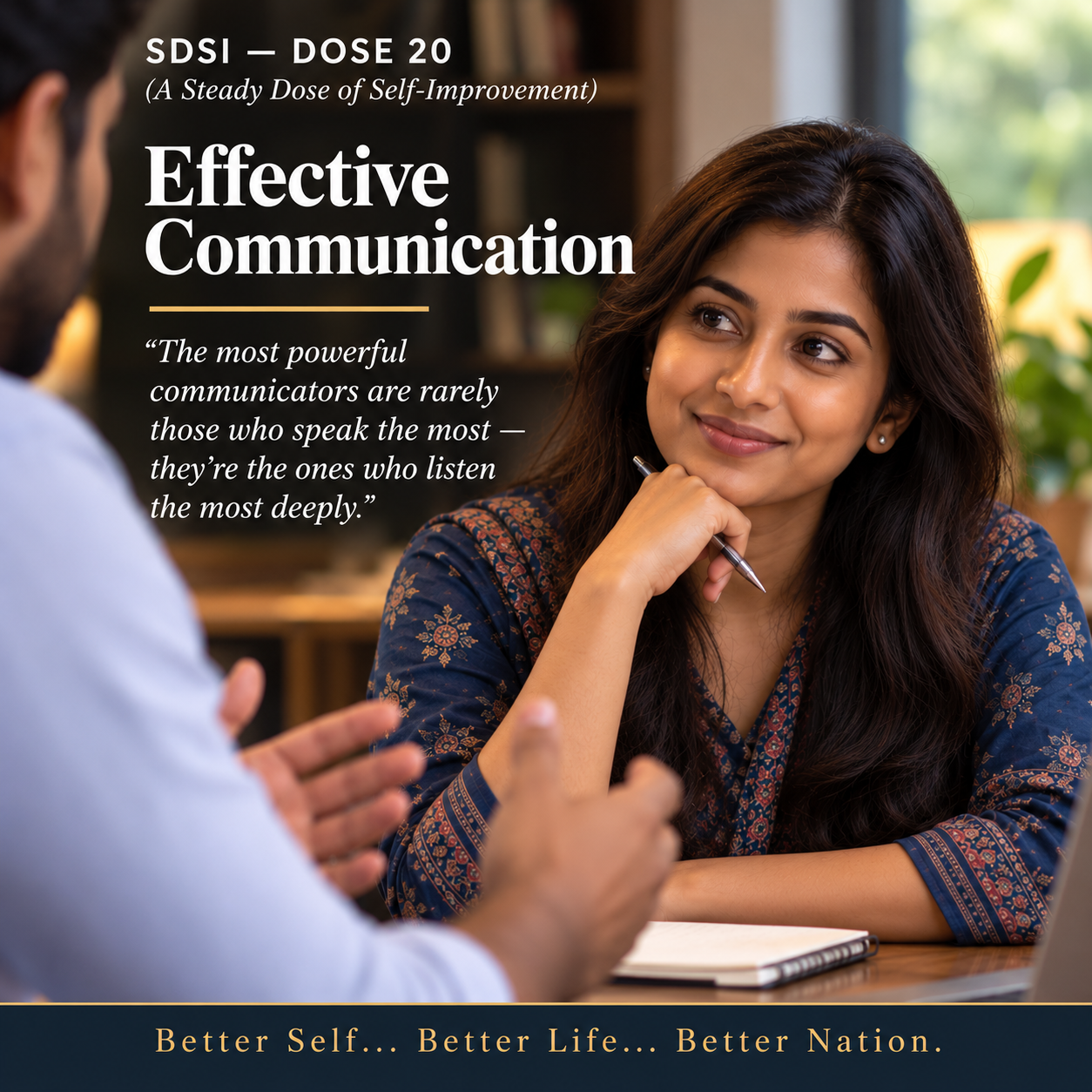
The most powerful communicators are rarely those who speak the most — they’re the ones who listen the most deeply.

Nelson Mandela’s greatest communication skill wasn’t his speeches. It was his listening.
Of all the skills in the Competence Framework, effective communication may be the most universally required. Every relationship you build, every idea you want to share, every conflict you hope to resolve depends on your ability to communicate clearly, honestly, and with genuine attention to the person on the other side of the conversation.
At its simplest, communication is the exchange of information. But effective communication is more specific: it’s communication that achieves its intended purpose — the message sent is the message received, understood, and responded to appropriately. That requires five elements working together: sender, message, channel, receiver, and feedback, all shaped by context and threatened by noise.
Nelson Mandela, who appears in several chapters of this book for good reason, was one of the most powerful communicators of the 20th century. What made him extraordinary wasn’t rhetorical brilliance alone, but the quality of his listening. He studied his opponents carefully, understood their perspectives before engaging them, and found language that could reach across divides rather than deepen them.
Oprah Winfrey built one of the most successful media empires in history largely on her capacity for active listening. In her interviews, she was famous for making her subjects feel genuinely heard, which led them to share more openly and authentically than they had with almost anyone else. She understood that the most powerful communicators are often not those who speak the most, but those who listen the most deeply.
Active listening means giving the speaker your full, undivided attention: no phone, no mental composing of your response while they’re still talking. After someone speaks, reflect back what you heard: ‘So what I’m hearing is…’ This simple practice dramatically reduces misunderstandings and signals that the other person has genuinely been heard — the precondition for any productive exchange.
Pause and Reflect
What is the biggest barrier to effective communication in your own life — and what would change if you removed it?
One Step Forward
In your next conversation, practice reflecting back what you heard before responding. Notice how it changes the exchange.
Explored in full in Chapter x — Effective Communication of A Holistic Approach to Self-Improvement.
Better Self… Better Life… Better Nation.
A Holistic Approach To Self-Improvement

Self-improvement is often treated as a collection of isolated goals—building confidence, learning new skills, developing better habits, or becoming more disciplined. But lasting transformation requires something more. It requires a holistic approach.
This book presents a practical framework that brings together the essential dimensions of personal growth into one integrated system. Rather than focusing on a single aspect of development, it shows how genuine and lasting change occurs when your beliefs, abilities, habits, and actions work together.
Through this book, you will discover how to:
• Build a strong value system that shapes your character and guides your decisions.
• Develop the competencies needed to navigate life’s personal and professional challenges.
• Establish a habit scheme that transforms good intentions into consistent action.
• Cultivate the self-discipline that binds every element into a sustainable way of life.
• Pursue lasting health, success, happiness, and fulfillment through balanced personal growth.
Grounded in research yet written in a clear and practical style, this book combines timeless principles, scientific insights, reflective exercises, self-assessments, and real-life examples to help you understand not only what to improve, but how meaningful transformation actually happens.
Whether you are a student, educator, professional, leader, entrepreneur, or simply someone seeking a more purposeful life, A Holistic Approach to Self-Improvement offers a complete roadmap for becoming your best self—one intentional step at a time.
Grow with purpose. Live with meaning.
On How Important Effective Communication Is
“Good communication is the bridge between confusion and clarity.”
~ Nat Turner ~

We all agree that communication is very important, especially in this era when most of our decisions are data-driven. And I think only a few (or no one) would disagree that communication skills are difficult to develop. But no matter how arduous that task is, we must work hard to acquire them.
The ability to communicate effectively is a “must-possess” skill. If somebody says that it is a “superpower,” I wouldn’t disagree, for if you can communicate effectively, you have one of the most important tools needed to succeed in whatever endeavors and undertakings you undertake.
You and I should learn how to effectively convey our ideas and feelings and divulge our intentions properly. Lest we forget, though, that communication is a two-way process. It is not just a matter of us sending or encoding a message but being able to process the response or feedback being sent back to us. Or we could be at the receiving end of the process. This means we could be the receiver instead of being the sender.
In whatever role – processing feedback or receiving a message – we need to decipher or decode efficiently.
Communication is one of the few constructs that can be found in the vocabulary of different fields of study. The said concept is a fundamental aspect of major areas related to language and literature. It is an integral part of any field that requires information to be disseminated, such as in media, business, politics, health care, and education. Even in science and math. The said subjects may be technical in nature, but they require effective communication. Without it, scientists and mathematicians cannot disseminate the necessary information and knowledge to the general public.
I cannot recall any concept that serves most (if not all) fields of endeavors other than communication. Thus, the ability to communicate is included in the list of skills a person must develop. It is a vital component of any “self-improvement” model. It is hard to imagine a personal growth and development program that does not include improving communication skills.
Communication is simply the process of exchanging information or expressing one’s ideas, thoughts, or feelings to someone else using spoken or written words or any other medium. The process involves the interplay of the main elements of communication – sender, receiver, message, channel or medium, and feedback. The interaction of the above-mentioned components is affected also by other factors – context and interference or noise.
The communication process starts with the intention to send a message (the information to be conveyed). Others refer to the messages as the subject matter of communication. The sender initiates the process. They are the source of information or the one sending the message to a receiver using a particular channel or medium.
Channel is described as the path through which an encoded message is transmitted from a sender to a receiver. The message can be relayed through written or verbal (electronic or personal) means. Messages sent electronically may come either in audio or video formats. The receiver is tasked to understand or decipher the message they receive, after which they are expected to send feedback to complete the communication process.
Feedback is the receiver’s response to the message. Giving feedback reverses the communication process, where the receiver becomes the sender and vice-versa. When you communicate, you, as the sender, naturally expect a favorable response. For that to happen, you must ensure your message is clear and easy to understand. And your message will be easier to understand if you make it concise. You must deliver your message in the shortest (but complete) way possible. Clarity and conciseness are the hallmarks of an effective message. They help avoid ambiguity and confusion.
To ensure the success of the communication process, you also need to consider the factors that affect it. When the sender conveys the message and the receiver gives feedback, the environment or situation should be set to help the communication achieve its intended purpose. Dham (2023) explained how context and noise could disrupt the process of communication. He explained that the “context provides the backdrop against the communication. This includes the physical, social, psychological, and cultural environment in which the interaction occurs. Context influences how the message is interpreted and helps establish shared meanings between the sender and receiver. Noise, on the other hand, refers to any interference or distortion that affects the clarity of the message during the communication process. It can be external, such as background noise or technical glitches, or internal, such as language barriers, cultural differences, or emotional distractions. Minimizing noise is crucial to ensuring the message is accurately transmitted and received.”
Understanding how the process works is a prerequisite to effective communication. If you succeed in creating a synergy among the main elements of communication and are able to control the effects of the other factors, you will reap great dividends. It will enable you to deliver a message or convey information accurately and efficiently, ensuring mutual comprehension and avoiding misunderstanding.
Communicating effectively is as important as the other self-improvement skills you need to pursue success, happiness, and wealth. It is required when interacting with others in both professional and personal environments. Communicating effectively is an essential skill whose development you cannot take for granted. Through a good communication approach, effective and meaningful interactions can be effected.
Communication plays a fundamental role in both our professional endeavors and personal undertakings. Whatever those endeavors or undertakings may be, they all involve interpersonal relationships that can only be nurtured when we establish connections with other people.
On a personal level, we need to establish communication with our loved ones and friends. It helps build a stronger connection with them and resolve conflicts or disagreements. Effective communication is the foundation of successful friendships, including romantic relationships. It promotes intimacy, trust, and mutual understanding.
Any professional pursuits also require the development of the ability to communicate. You cannot find a job or succeed in business if you are incapable of self-expression. We have been told countless times that in order to succeed, we should be able to communicate.
In the workplace, effective communication plays a significant role. If you are a leader or manager of any enterprise, you must be ready to articulate the goals and objectives of the organization and make the members cooperate in their pursuit. The members should be provided with clear direction and motivation so they can all work together for the organization’s success. Teamwork and collaboration can be achieved through effective communication.
Even if you don’t like to work for any organization in the workplace and you’re planning to establish a business of your own or be a freelancer, you still need to develop the ability to communicate. Working alone, sometimes, means having to work harder. The business of selling products and services by yourself would require stronger efforts in persuading potential customers.
Effective communication is a prerequisite to any successful business endeavor, whether doing it with an organization or by yourself. Remember that it is also essential in the pursuit of happiness, for it helps build meaningful relationships.
_____
Dham, M. (2023). Elements of Communication Process. PrepBytes Blog. https://www.prepbytes. com/ blog /basics-of-communication/elements-of-communication-process/



 M.A.D. L I G A Y A