Blog Archives
Lessons on Perspective

I have a friend who is regularly mistaken for me. We teach at the same university, share a similar build and height, and have the same rounded face — though I have a more defined nose and he has fairer skin. One day, visibly bemused, he asked me, “Why would they think I am you? Do I look as old as you?” I paused, smiled, and replied, “No. I look as young and handsome as you.” He laughed. And in that small exchange, I noticed something larger than the joke: the same mix-up, the same mistaken identity, had produced two completely different reactions in two different men. He heard an insult about age. I heard a compliment about my looks. Nothing about the situation had changed. Only the lens through which each of us chose to receive it.
That, I think, is the simplest definition of perspective — not what happens to you, but the angle from which you decide to look at what happens to you. Two people can stand at the same window on the same morning. One sees the smudge on the glass. The other sees the sun rising behind it. Neither is wrong, exactly. But one view will serve the viewer far better than the other.
I was reminded of this again in a conversation with a colleague, an expat teacher like me, who was frustrated about his salary. He told me, with some bitterness, that a truck driver back in his home country earned more in a year than he did. I listened, then asked him to slow down and look at the bigger picture. How many hours did that truck driver work to earn that figure? What were the physical demands of long-haul driving, year after year? And what about our own schedule — the fact that, as university teachers, we are paid in full through both winter and summer breaks, which together amount to five months of the year? During those five months, our only real obligations are a handful of meetings at the start and end of each semester. The rest of the time is simply ours.
When he ran the numbers on his actual hourly rate, his frustration lost its footing. He was earning more per hour than the truck driver, under incomparably gentler conditions. His complaint had been built on a true fact — the raw annual figure — but an incomplete picture. He was not wrong about the number. He was wrong about what the number meant because he had left out everything around it.
This is the most common failure of perspective, and the most forgivable one. We are not lying to ourselves on purpose. We simply stop looking before we have gathered the whole view. The fix is almost always the same: pause, and ask what else belongs in the frame.
But there is a second, less innocent failure of perspective, and a different colleague handed me a clear example of it. He told me, flatly, that he considered motivational quotes to be nonsense. To prove his point, he gestured at a small bulletin board bearing a quote that read, “Whatever you are, be good at it.” Then he delivered what he clearly believed was the knockout line: “So if you are a rapist, be a good rapist.”
I told him he had chosen the worst possible illustration he could have picked. More importantly, his example revealed the lens through which he had chosen to interpret the quote. You cannot be good at doing something that is, by its nature, an act of harm. Goodness and harm are not two settings on the same dial; one cancels the very premise of the other. I asked him the obvious question: Why a rapist, of all the things a person could be? Why not a teacher? A father? A leader? Each of those would have proven the quote’s point beautifully — that excellence, applied to a worthy role, elevates both the role and the person in it. Instead, he reached for the most grotesque example available, not because it was the most honest one, but because it was the most useful one for the argument he had already decided to win.
That is the difference between an incomplete perspective and a distorted one. My colleague with the salary complaint was missing pieces of the picture, but he was not hiding from the truth — he simply hadn’t gone looking for it yet, and once he did, he changed his mind. The man at the bulletin board was doing something else entirely. He was not missing information. He was selecting the most damaging frame available and presenting it as the obvious one, so that the quote — and perhaps optimism itself — would look foolish by comparison. One man’s perspective needed completing. The other man’s perspective needed correcting.
I think about these three exchanges together because they map out the territory so well. The mistaken-identity story is perspective in its lightest form — the same fact, received through two different temperaments, producing two different emotional outcomes, both harmless. The truck driver story is perspective in its most repairable form — a real grievance, resting on a partial view, that dissolves the moment the missing pieces are added back in. And the bulletin board story is perspective at its most dangerous — not an honest gap in the picture, but a deliberate choice of the worst possible angle, used to discredit something that did not deserve it.
Obi-Wan Kenobi was right when he said that many of the truths we cling to depend greatly on our own point of view. But that is not an excuse to pick whichever point of view is most convenient, most cynical, or most self-serving. It is an invitation to be honest about which direction you are choosing to look — and deliberate enough to ask whether you have actually seen the whole field before you decide what it means.
Perspective, in the end, is not something that happens to us. It is something we choose, conversation by conversation, frame by frame. The only real question is whether we are choosing it carefully — or just reaching for whichever lens lets us win the argument we already wanted to have.
An Invitation (YouTube Channel Teaser)
Is self-improvement an end in itself or a means to achieve an end?
By introducing a comprehensive paradigm for self-improvement, I do not seek to complicate the process of personal growth, but rather to present a realistic framework that brings together the many constructs essential to it. There are two serious loopholes in self-improvement schemes promoted nowadays. The first one is the promise of becoming the best version of yourself in a few days or weeks. And the second is the attainment of full potential, being floated as a goal to be achieved rather than a process to be undergone.
Self-improvement is not an end in itself but rather a means to achieve an end. It is not a destination. It is the path to reach a desired destination.
I believe that there is no shortcut, no magic pill, and no single technique that can instantly transform one’s life. Genuine growth requires cultivating the right attitudes and beliefs, developing essential skills and abilities, and consistently practicing positive habits and activities. This holistic approach recognizes that lasting change arises from deliberate effort across multiple areas of life.
Holistic Approach To Self-Improvement
A PARADIGM FOR PERSONAL GROWTH & DEVELOPMENT
There is no shortcut to self-improvement. It’s a long journey. Personal growth and development cannot be achieved by simply embracing positive thinking. It’s much more complicated than that. It involves establishing a value system, developing a competence framework, and maintaining a habit scheme. And as if doing these is not difficult, self-improvement also requires acquiring self-discipline. This makes the process of improving oneself not for the faint-hearted. Yes, it is extremely tedious and difficult, but the reward is enormous – the achievement of one’s full potential leading to self-fulfillment measured in terms of health, success, and happiness.
#HolisticSelfImprovement
#PersonalGrowth
#SelfDevelopment
#LifelongLearning
#GrowthMindset
HOLISTIC APPROACH TO SELF-IMPROVEMENT
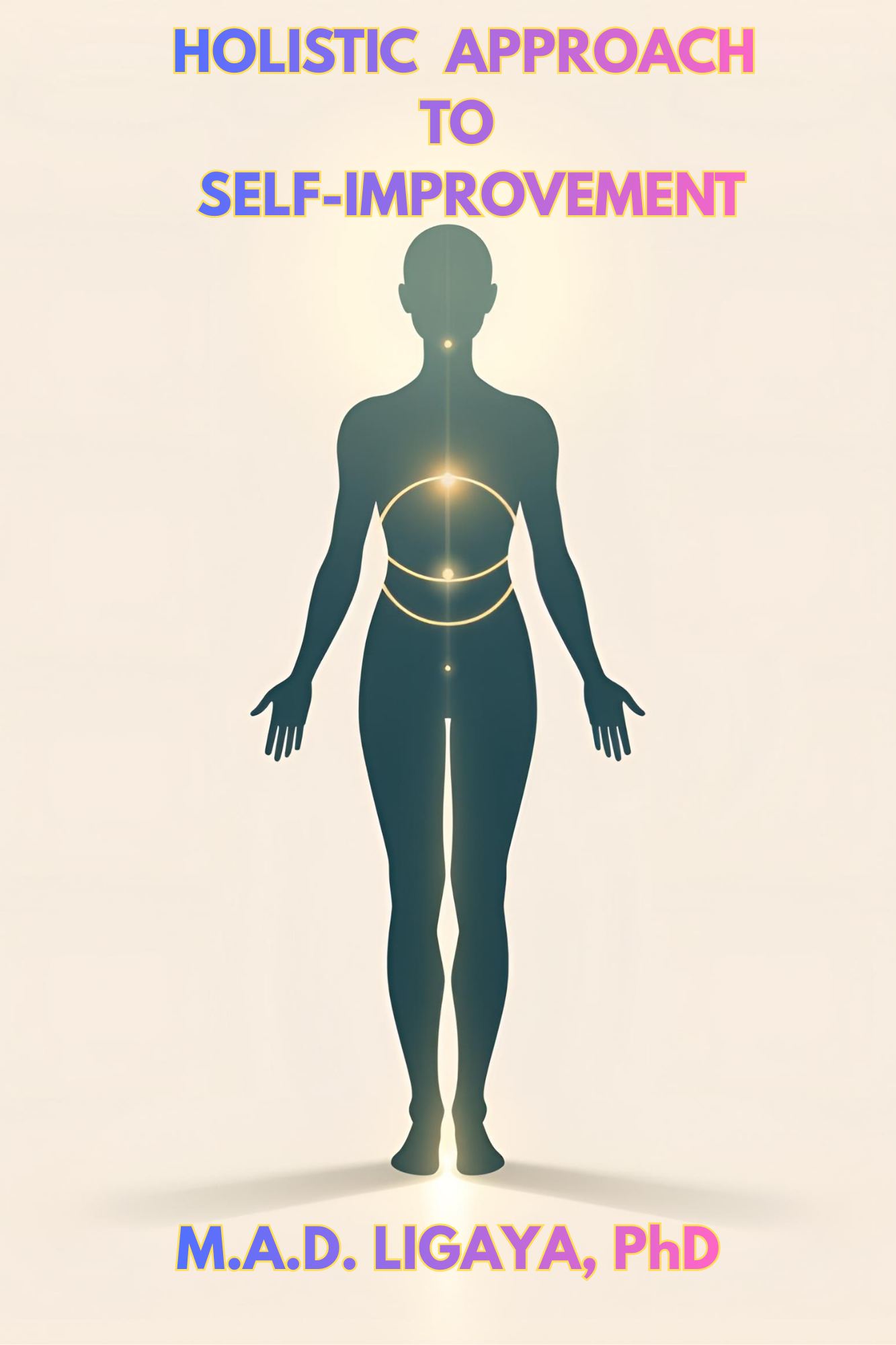
My book, A PARADIM FOR SELF-IMPROVEMENT, will be retitled HOLISTIC APPROACH TO SELF-IMPROVEMENT for its second edition. The decision to change was informed by the fact that, after reviewing the contents, I found that the original title does not fully reflect the book’s scope and spirit. The original title focused on a conceptual framework, but the new title, Holistic Approach to Self-Improvement, better describes the book’s integrated view of personal growth and development. This view goes far beyond positive thinking to include ATTITUDES, BELIEFS, SKILLS, ABILITIES, PRACTICES, ACTIVITIES, and SELF-DISCIPLINE.
The change was made to ensure the title better fits the book’s content and its practical approach.
As I continue to fine-tune the contents, I have come to understand that the book is not merely about suggesting a framework; it is about embodying one. The word HOLISTIC describes that change. The word PARADIGM is too technical and creates the impression that this is just another research work, something to study. Replacing it with APPROACH tells readers that this is not a book meant only for academic purposes, but one that outlines the steps for those who intend to embrace personal growth and development.
Adding holistic indicates that growth doesn’t happen in separate parts; it happens when attitudes, beliefs, skills, abilities, practices, activities, and self-discipline come together. That’s the purpose of including PARADIGM in the original title: to show that SELF-IMPROVEMENT is a PROCESS that, when successfully carried out, would help an individual become their BEST SELF and attain FULFILLMENT.
In my book, I proposed the concepts of VALUE SYSTEM to comprise attitudes and values, COMPETENCE FRAMEWORK skills and abilities, and HABIT SCHEME practices and activities. The proposed concepts are viewed as DIMENSIONS of self-improvement.
The book, whether bearing the old or new title, encapsulates the interrelationships among these categories and self-discipline into a framework, illustrating how their synergy yields an effective process of self-improvement that leads to the attainment of one’s full potential.
The paradigm is divided into three sections: left, middle, and right. The middle section comprises three parts: the dimensions of self-improvement, the self-improvement process, and the concept of full potential, also known as the best self. The dimensions of self-improvement in this book are generally categorized as the attitudes & beliefs (value system), skills & abilities (competence framework), and practices & activities (habit scheme) that a person pursuing personal growth and development should acquire, possess, or develop. These elements come together through the self-improvement process, forming the second part of this section. This process aims
to help one become one’s best self, not as attaining perfection but as unlocking one’s full potential.
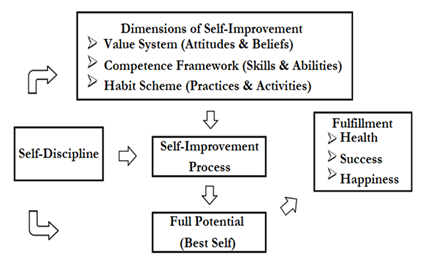
The left section of the paradigm highlights a crucial requirement for self-improvement: self-discipline. The paradigm illustrates how self-discipline continuously influences the process; even after one has achieved one’s full potential and become one’s best self, self-discipline remains essential. Self-discipline bolsters personal growth and development, forming the foundation for consistent progress and sustained fulfillment.
The right section of the paradigm illustrates the outcome of the self-improvement journey—fulfillment, characterized by becoming healthy, successful, and happy. This fulfillment represents not only the achievement of personal goals but also a deep sense of completeness and satisfaction that comes from living in alignment with one’s true potential. It is the reward for the dedication and discipline invested in becoming the best version of oneself.
Through self-improvement, individuals develop attitudes and beliefs, acquire skills and abilities, and engage in practices and activities to navigate life’s complexities confidently and purposefully. This transformation empowers them to achieve personal success, sustain a healthy state of being, and experience genuine happiness.
Those who achieve their full potential and become their best selves succeed in personal and professional endeavors. They become HEALTHY, SUCCESSFUL, and HAPPY.
If one intends to achieve their full potential and attain fulfillment, they must approach self-improvement holistically.
The Self-improvement Paradigm

According to Jim Rohn, “Success is not to be pursued, it is to be attracted by the person you become.” Imagine success as the fruit of a tree. A tree has to grow and mature. It will reach a certain stage of maturity that allows it to bear fruits. Imagine yourself as that tree. You have to grow and mature. The person you see at the end of the process of growing and maturing is what Jim Rohn refers to as the person you become. The fruits you bear or the success you achieve depends on the kind of tree you would turn into. And you have to become the best version of yourself. That’s the kind of tree you should be. You need to reach your full potential so you would bear the best fruits.
Self-improvement is the key to becoming the best version of yourself. If you succeed in getting to the end of the road to self-improvement, you reach your full potential.
But self-improvement is a complicated process. It is easier said than done. It requires the possession of certain beliefs, attitudes, and characteristics that will make up your value system. It requires also the acquisition of certain skills and abilities and the development of certain practices and habits.
The right beliefs, attitudes, characteristics, skills, abilities, practices, and habits, together, are the catalysts of self-improvement. However, having them is not enough. Something else is needed in order to make them work. Without it any attempt to reach one’s full potential is bound to fail. What is it? It’s self-discipline.
Self-improvement is not as simple as just being able to think positively. Positive thinking is but a tip of a huge iceberg called personal growth and development.
Self-improvement is a tedious process. Its ultimate goal is becoming the “best self” or achieving one’s full potential. As previously mentioned, certain beliefs, attitudes, characteristics, skills, abilities, practices, and habits are required. But possessing the said requirements is not enough. Consistency is needed in their pursuit. Thus, self-discipline is also needed.
The foregoing are the elements that comprise the self-improvement paradigm that I developed to guide my advocacy for personal growth and development.
The contents of my YouTube channel (https://www.youtube.com/channel/UC2zzJ6T94fNnvPPwrA0OxAA) and the personal growth and development book I am currently writing are based on this paradigm.



 M.A.D. L I G A Y A