Category Archives: Time Management
Efficient Time Management
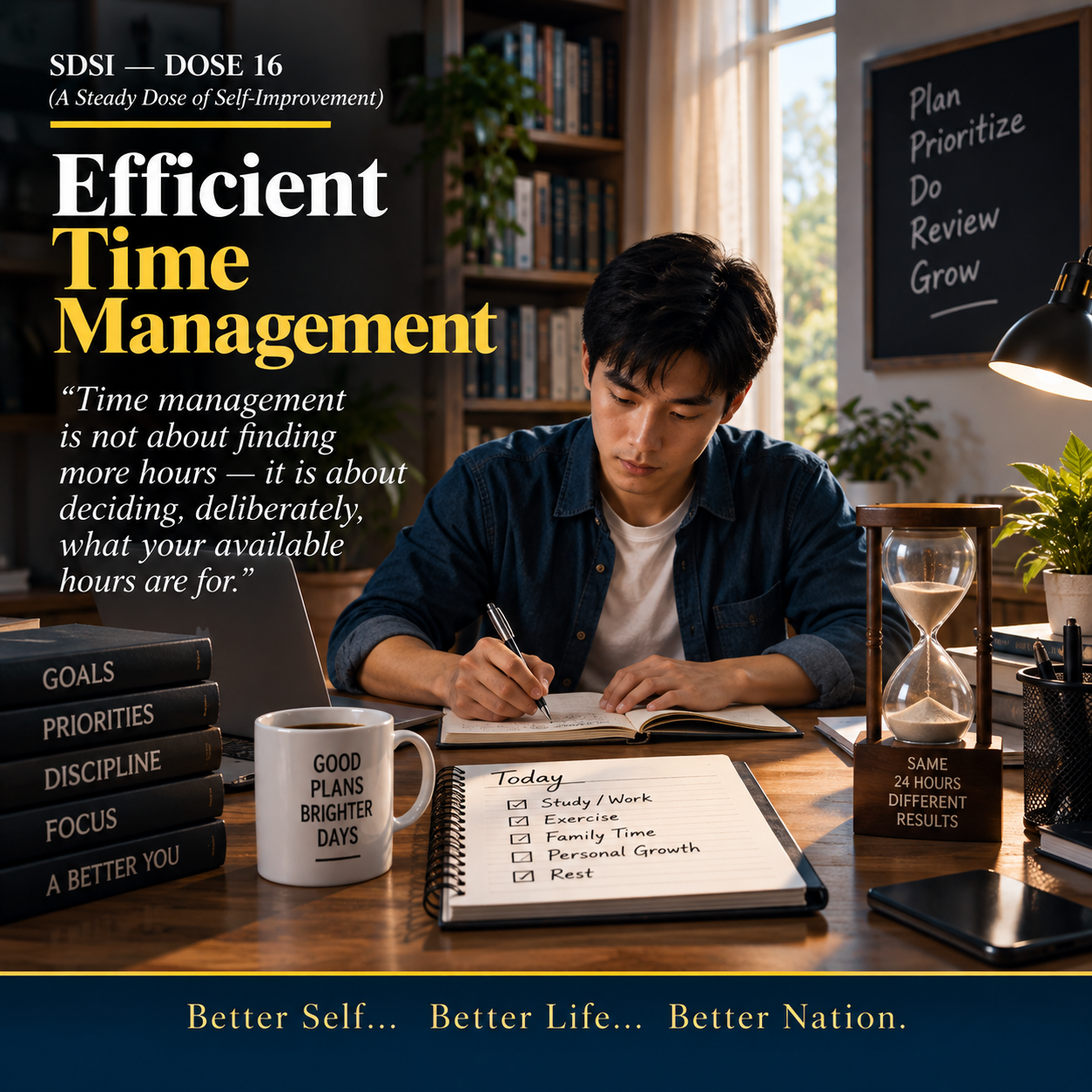
Time management is not about finding more hours—it is about deciding,
deliberately, what your available hours are for.

“If I had some extra time, I could make some extra money.” Jim Rohn’s answer: Forget it. There is no extra time.
Every person receives the same number of chronological hours: 24 each day and 168 each week. However, not everyone has equal freedom over those hours. Work demands, caregiving responsibilities, health conditions, financial circumstances, and long commutes can consume much of a person’s time before any personal choice is made.
Efficient time management does not deny those realities. It asks a more practical question: Within the time I can influence, am I using it for what matters most?
Jim Rohn once recalled a man telling him, “If I had some extra time, I could make some extra money.” Rohn replied that there was no extra time. When midnight arrives, the day is over. Whatever we hope to accomplish must be attempted within the time already available to us.
Laura Vanderkam’s 168-hour framework makes this easier to see. A person who works 40 hours a week and sleeps eight hours each night uses 96 hours, leaving 72. Those remaining hours are not automatically “free”—meals, commuting, household tasks, caregiving, exercise, and rest must come from them. Still, looking at an entire week often reveals possibilities that are hard to notice when we focus on one crowded day at a time.
Benjamin Franklin designed his daily schedule around purposeful blocks of activity. At the beginning of the day, he asked, “What good shall I do this day?” At night, he reflected, “What good have I done today?” His schedule was not merely about filling every hour with work. It connected time use with intention.
Franklin also admitted that maintaining perfect order was difficult. That matters because efficient time management does not mean rigidly controlling every minute. A schedule must guide us without becoming a prison.
Researchers Brad Aeon and colleagues describe time management through three related practices: structuring, protecting, and adapting time. We structure time by creating routines and assigning activities to appropriate periods. We protect it by setting boundaries and declining demands that interfere with important priorities. We adapt it when circumstances change and our original plans are no longer realistic.
Before improving how you use time, however, you must first discover how you are using it now. Memory is unreliable; a written record is much harder to argue with.
A time audit may reveal obvious waste, but it may also reveal something kinder: perhaps you are not lazy or undisciplined at all—perhaps you are carrying more responsibilities than you realized. Either discovery is useful because effective time management begins with truth, not guilt.
You cannot create extra time. But you can become more deliberate with the time that is genuinely yours to direct.
Pause and Reflect
If you recorded every hour for three days, what do you think you would discover about where your time actually goes?
Which activity deserves more of your available time—and which one deserves less?
One Step Forward
For the next three days, record how you use each hour. Mark every entry as essential, useful, restorative, or wasteful. At the end, identify one hour you can use more deliberately.
Explored more fully in Chapter 8 — “Efficient Time Management” of A Holistic Approach to Self-Improvement.
Better Self… Better Life… Better Nation.
A Holistic Approach To Self-Improvement

Self-improvement is often treated as a collection of isolated goals—building confidence, learning new skills, developing better habits, or becoming more disciplined. But lasting transformation requires something more. It requires a holistic approach.
This book presents a practical framework that brings together the essential dimensions of personal growth into one integrated system. Rather than focusing on a single aspect of development, it shows how genuine and lasting change occurs when your beliefs, abilities, habits, and actions work together.
Through this book, you will discover how to:
• Build a strong value system that shapes your character and guides your decisions.
• Develop the competencies needed to navigate life’s personal and professional challenges.
• Establish a habit scheme that transforms good intentions into consistent action.
• Cultivate the self-discipline that binds every element into a sustainable way of life.
• Pursue lasting health, success, happiness, and fulfillment through balanced personal growth.
Grounded in research yet written in a clear and practical style, this book combines timeless principles, scientific insights, reflective exercises, self-assessments, and real-life examples to help you understand not only what to improve, but how meaningful transformation actually happens.
Whether you are a student, educator, professional, leader, entrepreneur, or simply someone seeking a more purposeful life, A Holistic Approach to Self-Improvement offers a complete roadmap for becoming your best self—one intentional step at a time.
Grow with purpose. Live with meaning.
Having More Time Than We Think

A dilemma confronting expatriates like me as we work and live in another country is what to do with our free time. We must decide how to spend the extra hours at our disposal, whether to use them effectively or squander them. Free time can either be an opportunity or a temptation. It presents a chance to be productive, doing something worthwhile that contributes to achieving our personal and professional goals, or it can lead us astray, luring us into mindless distractions or unfulfilling pursuits.
Understandably, the hours we spend not working are moments when homesickness or boredom could set in. Those not equipped with a coping mechanism against boredom and that intense yearning for home and beloved ones, resort to anything that can help them relax and overcome loneliness and emptiness. They find solace in entertainment, socializing, or, sometimes (and unfortunately), vices. More often than not, resorting to vices to overcome homesickness leads to more problems.
Finding a way to be productive with our extra hours is a protection against temptation and homesickness. Admittedly, that isn’t easy to do. Neuroscience and evolutionary psychology reveal that our brains are wired to seek pleasure and avoid pain. Thus, it is much more convenient for some to go out with friends and have a good time during non-working hours. The mind’s circuitry gravitates towards rewarding tasks instead of exerting more effort to do something else.
Being productive means looking for ways to use the time when we’re not working for worthwhile endeavors. Some of us use them to find a second job to earn extra income, while others use them to pursue a rewarding hobby. There are also those of us who utilize our free time for self-improvement. Of course, some expatriates also seek gratification when they are off duty. Let me clarify that using our free time constructively doesn’t mean depriving ourselves of enjoyment. We are entitled to a day off from time to time to breathe fresh air. For our overall well-being as expatriates, we need to strike a balance between work and life. But we need to draw the line between having fun and going wild.
Expatriates have different ways of using their free time effectively and efficiently, either for productivity’s sake, to protect themselves against temptations, or to overcome homesickness. Based on what I have gathered, most of my colleagues would flock to the capital city for socialization. During long weekends, a few of them would travel. Those with their families with them, of course, would spend their free time with their loved ones. But I would lie if I said that none of us unnecessarily indulged in some forms of vices, particularly gambling and drinking.
What about me? How do I spend my free time? Imagine this: I have 168 hours a week. As I sleep an average of 6 hours a night (42 hours a week), I am awake for 126 hours. My contract requires me to work 19 hours a week, spread over 4 weekdays. Let me add 3 hours to evaluate and assess my student’s performance. That still leaves me a little more than 100 hours a week. If I spend 3 hours daily on meals and snacks, that’s only 14 hours a week. Which means I still have a lot of free time. What Laura Vanderkam said in her book “168 Hours” is true: “You have more time than you think.”
I have more time than I thought. So, what do I do with it? If I am not communicating with my loved ones in my country of origin, I am either in the gym working out or outside walking. I spend an average of one hour a day connecting with my family, with longer sessions during weekends and holidays. On the other hand, I engage in all the physical activities I mentioned five times a week, each lasting at least an hour.
After doing all the other things I must, I figured I have an average of 50-60 hours a week of free time, sometimes more. Additionally, I have more free time during winter and summer breaks when the university does not require me to work, except for attending two-hour meetings at the end of a semester or when one begins. We are also required to attend graduation ceremonies two weeks before the start of each semester.
There came a time when I faced the dilemma of determining how to spend those excess hours. It wasn’t a question of whether to use them effectively or squander them. I know that I must walk the path of productivity during my free time and ensure that I don’t succumb to the enticement of a good life. That’s my mindset. I consider my extra hours an opportunity for growth, not an invitation to waste my resources and self-destruct. Expatriates, particularly those who don’t have their families with them like me, are prone to different kinds of temptations and vices.
And how specifically do I spend my free time?
Spending nights in the bar, particularly during weekends, is not my thing. I don’t enjoy wine and beer. I consider it illogical to drink a lot and then suffer from a hangover the following day. Besides, I know how much damage alcohol inflicts on human cells. I need to stay healthy, for it is difficult for expatriates like me to get sick and be hospitalized. So, I would rather stay home, read books, listen to audiobooks, or watch movies. That lifestyle appears boring, but with the many things that I could do, I have no time to be bored. No, I am not allergic to interaction. Quite the contrary, I love mingling with people, discussing anything under the sun with them. I am what psychologists refer to as an ambivert. I can switch any of my personality’s introvert and extrovert buttons as needed. I do socialize occasionally, but only with a few friends. We go out for dinner and coffee. I go to a noraebang with the same group on special occasions. But there are times when I need to switch to lonewolf mode.
I spend the majority of my free time pursuing my passion for writing. There is no better way to be productive with my extra hours than writing.
Writing has become a sanctuary for me, not just a way to pass the time, but a space where I can thrive emotionally, intellectually, and creatively. It is a refuge that protects me from the challenges of working and living abroad, allowing me to grow and reflect. In the pages of my writing, I have found peace, a workshop for my mind, and a shelter from the storms of life. Those pages shelter me from external and internal noise and help me find clarity.
There were times when writing protected me from my internal struggles. Through it, I could confront my demons and fears and transform them into meaningful and constructive expressions. I release my pain, anger, disagreement, and disappointments by writing about them. Whatever emotions boil within me, I express them creatively, through prose and poetry.
Making writing my sanctuary has not only fueled my productivity and creativity but also become a source of additional income.
Ultimately, how we choose to spend our free time plays a significant role in shaping who we are and how we grow, especially as expatriates navigating the complexities of life away from home. The hours we have at our disposal are a precious resource, allowing us to either build our lives or let them slip unnoticed.
For me, writing has become a powerful tool for personal development, a sanctuary that provides both protection and growth. But regardless of the path we choose—whether through physical activity, self-improvement, or connecting with others—the key is to make the most of every moment. We have more time than we think; with that time, we can either invest in our future or squander it. The choice is ours, and it is up to us to ensure that we walk the path of productivity, growth, and purpose, rather than succumb to temptations that may lead us astray and broke.
On Time Management
“Time is really the only capital that any human has,
and the only thing he can’t afford to lose.”
– Thomas Edison
In one of his speeches, Jim Rohn told his audience the story of a man who one day told him the following – “You know if I have some extra time, I can make some extra money.” He told the man to forget about it because there is no such thing as extra time.
Indeed, there is no extra time. Whatever are the things we intend to do in a day, we have a 24-hour window to accomplish them. Definitely, that man did not mean extra as in time over 24 hours but how he could squeeze in in his daily schedule activities that will allow him to have an additional income.
What the man told Jim Rohn is the usual excuse of people for being unable to do what they should do to improve themselves in areas of their lives where they need improvement. How many times have you heard people say that they have no time to – exercise – read – learn a new skill – or do any self-improvement activities? How many times have you heard somebody drop the following lines – “I am too busy earning a living and I could no longer find time to do other things? What about you? Have you ever dropped those excuses also?
Are 24 hours really not enough to finish everything we need to do in a day? That’s the question we’ve been trying hard to answer since time immemorial. People keep saying that they don’t have enough time to do this and to do that. But I think the real problem is not the lack of time. The failure to manage it is.
The real issue is time management – how are we using our hours and minutes in a day. Oxford defines time management as the ability to use one’s time effectively or productively, especially at work. Take note of the italicized words. That’s how we are supposed to use our hours and minutes – effectively and productively.
Jonathan Estrin opined, “The way we spend our time defines who we are.” I agree 100% and let me add that the way we use our time will also determine whether or not we will be listed in the directory of winners and achievers.
Time management is a very important skill in the pursuit of success. According to Brian Tracy, many people think that time management is only a business tool, like a calculator or a cell phone, something that you use to increase productivity. He argued that it is not just a peripheral skill but the core skill on which everything else in life depends. He added that time is your most precious resource, the most valuable thing you have. It is both perishable and irreplaceable. It cannot be saved.
The non-renewability of our time is also one of the things Seneca, a Roman philosopher, reminded us in his essay entitled “On Shortness of Life.” Being non-renewable, the philosopher suggested the need to treat it as a commodity, something valuable that we cannot afford to waste or throw away. Thus, we need to manage (the use of) it well.
Aside from giving us the best chance to achieve our goals and succeed, there are other benefits we can get from effective time management. According to Misra & McKean (2000), “good time management skills have been identified as having a buffering effect on stress.” When you fail to allocate time properly to your responsibilities and activities expect to feel overwhelmed. You know what to expect when for example you realize that you only have an hour to finish the equivalent of a 2-hour workload – an increased level of stress
Time management also offers individuals the means to structure and control their activities (Claessens, et al., 2004). This leads to avoidance of cramming and a better quality of output. When people are hard pressed to finish an assigned task or a commitment to beat a deadline the result may not be as desired.
Let’s go back to the question I asked earlier – Are 24 hours really not enough to finish everything we need to do in a day?
In her book “168 Hours: You Have More Time Than You Think,” Laura Vanderkam deplored the time-poverty narratives that have been persisting for a long time. She said that we all have 24 hours in our day, and 7 days in our week giving us a total of 168 hours (7 x 24) each week to create the lives we want, and if I may add – to do the things we ought to do.
Let’s do some math and instead of using the 24-hour model let’s use Vanderkam’s 168-hour paradigm.
On the average, how many hours in a day do you spend for some specific daily activities? If you work for 8 hours and sleep for 7, how many more do you have left for other things? You still have 9 hours. Right? Let’s say that you spend 2 of those for meals and snacks, what remains is 7 hours.
In one week you have an extra 49 hours (7 x 7). But if you work only for 5 days then add 16 to the 49. That’s 66 hours. What do you want to do with those remaining hours in one week?
Yes, you are entitled to have leisure time or do Netflix binge-viewing. But are you going to spend all 66 hours for fun and recreation? If you do, then say goodbye to success and say hello to failure and poverty.
Okay, spend 2 hours a day for play or “me time.” I think that is still normal. That’s 14 hours. You still have 52. Should you decide to add 1 more hour to your daily leisurely activities (or to your sleeping time), you would end up still having 43 extra hours in a week.
Now, are you going to use all those 43 hours to aimlessly browse the Internet? Don’t! Unless you are not really serious in the pursuit of your goals.
What if you spend only 2 hours a day to check your emails and visit your social media accounts? That will eat 14 hours out of the 43 extra that you still have leaving you with 29 more.
What if you exercise or workout for 1 hour 5 times a week? You still have 24 hours extra. What if you read a book for 1 hour 5 times a week only (if doing it daily is too much)? Look. You still have 19 hours left. Go back to the math we did for leisure time. If 2 hours a day is sufficient then you can put 7 back to the 19 hours. That’s a total of 26 hours. How do you want to use it? Decide. Would you like to spend some of those hours nurture your existing relationships? What about using a few hours to pursue some personal growth and development goals?
You can do the math for your particular situation and determine whether or not you really don’t have enough time to do what you need to do. Find out how many out of the 168 hours a week (or 24 hours a day) are you using productively and how many are you wasting doing things that don’t matter.
When you decide what to do with those remaining hours, you might want to consider what Brian Tracy said, “Perhaps the greatest single problem that people have today is time poverty. Working people have too much to do and too little for their personal lives.”
As you try to manage the hours and minutes in your day, you need to make a conscious effort to maintain a work-life balance. Allocate time for yourself. I don’t mean just taking a time-off from work and have fun. What I mean with allocating time for yourself is dedicating your free time to activities that promote self-improvement and wellbeing. Consider this – “The capacity to manage free time is found to significantly increase an individual’s quality of life (Wang et al., 2011).” So think of how you spend your free time.
What I may consider as the best advise for time management came also from Laura Vanderkam – “Be intentional with the use of your time.”
Now, go back to the 168 hours paradigm. Consider it as a blank slate, how would you fill it? Again, the problem is not the lack of time. How you manage it is.
As Harvey MacKay said, “Time is free, but it’s priceless. You can’t own it, but you can use it. You can’t keep it, but you can spend it. Once you’ve lost it, you’ll never get it back.”
References:
Claessens, C., et al. (2005). A review of the time management literature. Personnel Review, 36(2), 255-276. DOI 10.1108/00483480710726136
Misra, R., McKean, M. (2000). College students’ academic stress and its relation to their anxiety, time management, and leisure satisfaction. American Journal of Health Studies, 16(1), 41-51.
Time Management. (n.d.). In lecixo.com. Retrieved from https://www.lexico.com/definition/ time_management
Wang et al. (2011). Free time management contributes to better quality of life: A study of undergraduate students in Taiwan. Journal of Happiness Studies, 12, 561-573. doi:10.1007/s1142-013-9256-4
Vanderkam, L. (2010). 168 Hours: You Have More Time Than You Think. London: Penguin Books Ltd.



 M.A.D. L I G A Y A