Blog Archives
Purposeful Decision-Making
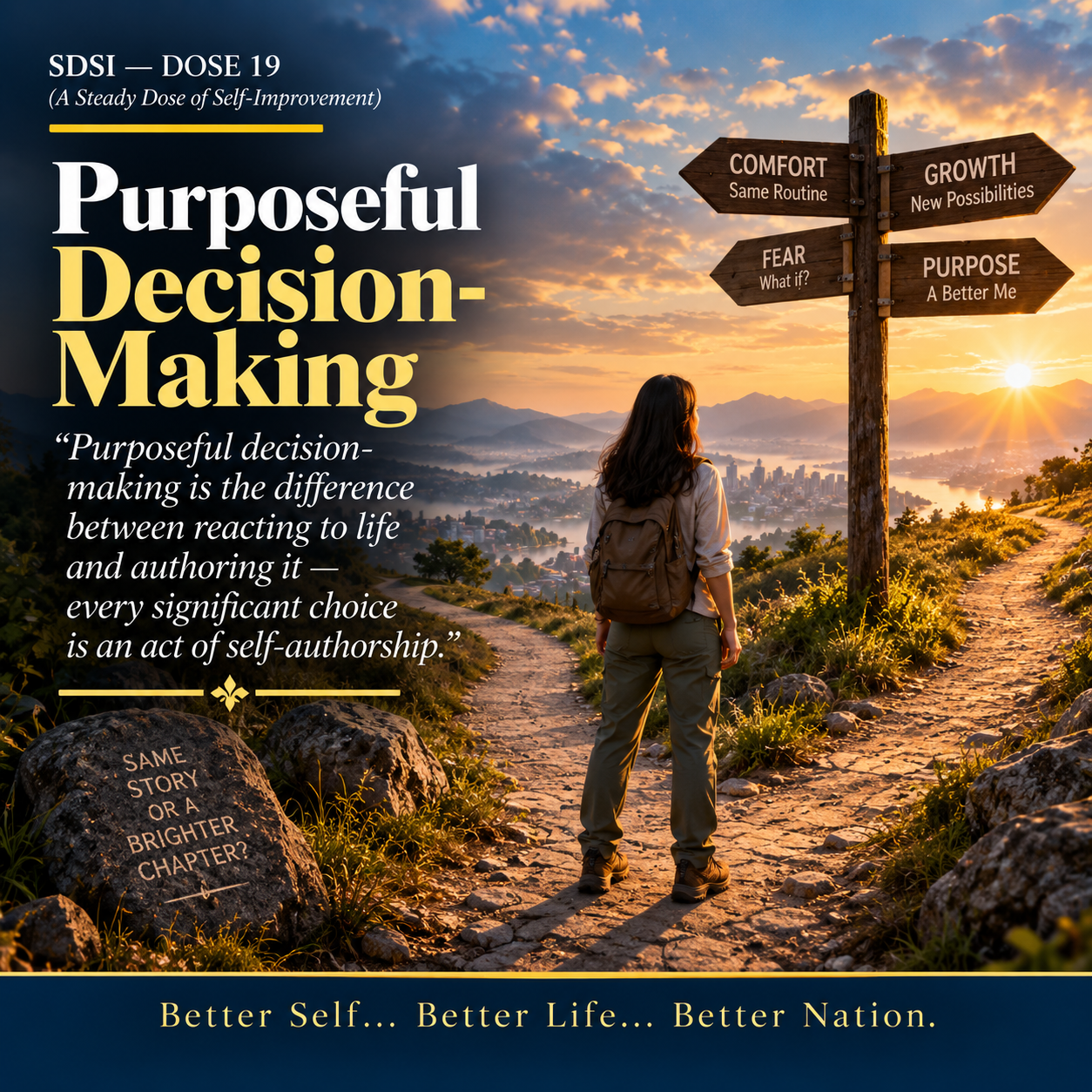
Purposeful decision-making is the difference between reacting to life and authoring it —
every significant choice is an act of self-authorship.

Are you where you are by design, or by default?
Your life is the product of the chain of decisions youUve made since you began taking control of it. Every choice, from the inconsequential to the life-altering, has shaped the person you are today. And every decision from this moment forward will continue shaping who you become.
Purposeful decision-making is the practice of making choices consciously aligned with your values, goals, and long-term vision, rather than choices driven by habit, fear, or the path of least resistance. It is the difference between reacting to life and authoring it. Pause and look honestly at where you are. Are you there by design, or by default?
In the year before I decided to leave the Philippines to teach ESL in South Korea, I found myself in what I can only describe as my own version of Chuck Noland’s deserted island in Cast Away — stranded in positions that, despite their prestige, were draining rather than fulfilling. I had served as a school principal and a dean. I chose not to stay, because I had no peace of mind and knew I would not grow.
My loved ones considered it reckless. I had a good position, a decent salary, other income. Some cited an upcoming government post with job security. But I applied for ESL positions abroad anyway, faced rejection from three Middle East universities, learned what I was missing, obtained a TESOL certificate, and was eventually hired in South Korea. That single decision, made in early spring of 2013, reshaped everything.
It was not an impulsive leap. It was a calculated risk, made with full awareness of what I was putting on the line and faith in my preparation and values. Mel Robbins was right: I was one decision away from a completely different life. And I made that decision on purpose. As the character Socrates says in Peaceful Warrior: ‘Life is a choice. You can choose to be a victim or anything else you would like to be.’ I chose. And I have no regrets.
Pause and Reflect
Is there a decision you’ve been avoiding that you know, deep down, needs to be made? What’s holding you back?
One Step Forward
Write down one decision you’ve been putting off. List what you’re afraid of, and one small first step you could take this week regardless.
Explored in full in Chapter 12 — Purposeful Decision-Making of A Holistic Approach to Self-Improvement.
Better Self… Better Life… Better Nation.
Staying Focused
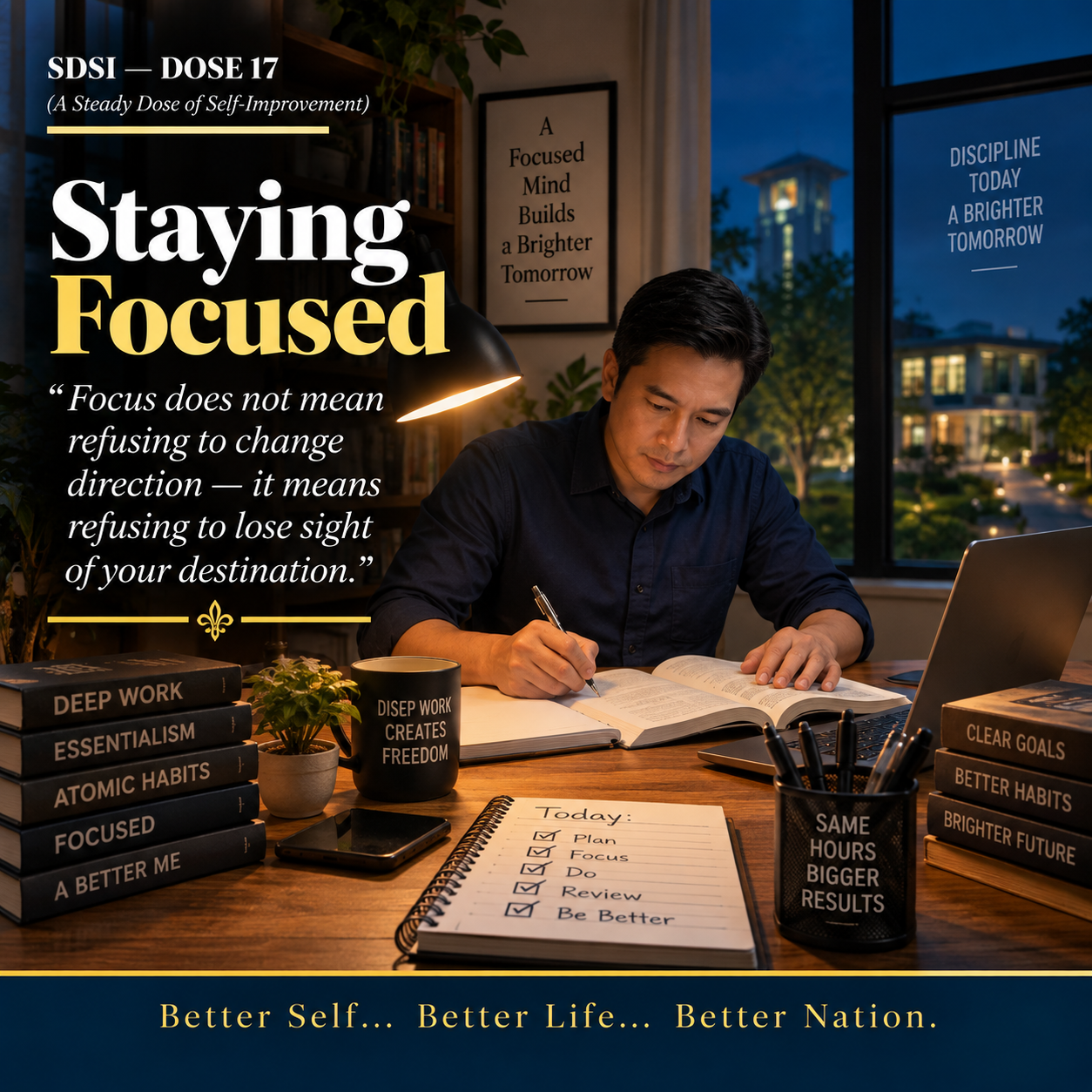
Focus does not mean refusing to change direction—it means refusing to lose sight of your destination.
During my third rejection from a Middle Eastern university, I overheard a panelist say that I could not be considered because I lacked a TESOL certificate.
I was deeply disappointed. I had a bachelor’s degree in English, a master’s degree in Education, and a PhD in Educational Management. I had also completed most of the academic requirements for a master’s degree in English but had been unable to finish the thesis. Added to these qualifications were more than twenty years of teaching experience.
Surely, I thought, all of that should compensate for one missing certificate.
But it did not. The university had a policy: applicants without TESOL certification could not be hired. Whatever the panelists may have thought of my other qualifications, their hands were bound by that requirement.
I could have treated the rejection as proof that overseas teaching was not meant for me. I could have complained that the policy failed to recognize my education and experience. Perhaps I even had legitimate reasons to question it. But neither disappointment nor argument would give me the qualification I lacked.
So I asked myself a more useful question: What can I do next?
I enrolled in a TESOL program and earned the certificate.
That decision taught me something important about staying focused. Focus is sometimes mistaken for stubbornly following one plan. But genuine focus distinguishes between the goal and the route. My goal—to teach overseas—remained unchanged. The route toward it had to be adjusted.
Eventually, I secured a university teaching position in South Korea. The earlier rejections had not ended my journey. One of them had identified a gap I needed to close.
This is why setbacks should be examined before they are accepted as verdicts. Some criticism is unfair and should not control us. But some negative feedback contains useful information. Focus allows us to separate the pain of hearing it from the value of what it may reveal.
Staying focused has become increasingly difficult in a world full of competing goals, constant notifications, and attractive alternatives. Yet distraction does not come only from technology. Even worthwhile activities can pull us away from what matters most. A person can remain extremely busy while making little progress toward the goal that matters.
Focus therefore requires deliberate choices. We must decide what deserves our attention now, protect time for it, and temporarily say no—even to good opportunities that compete with a greater priority.
You do not have to cling to your original method. You may need another qualification, a different strategy, or a longer route than you anticipated.
Change the plan when necessary—but keep your eyes on the destination.
Pause and Reflect
What goal have you nearly abandoned because your original approach did not work?
What useful information might be hidden inside a rejection or criticism you received?
One Step Forward
Choose one important goal. Write down the single obstacle presently blocking it, then identify one concrete action you can take this week to address that obstacle.
Explored more fully in Chapter 9 — “Staying Focused” of A Holistic Approach to Self-Improvement.
Better Self… Better Life… Better Nation.
Competence Framework: Skills and Abilities
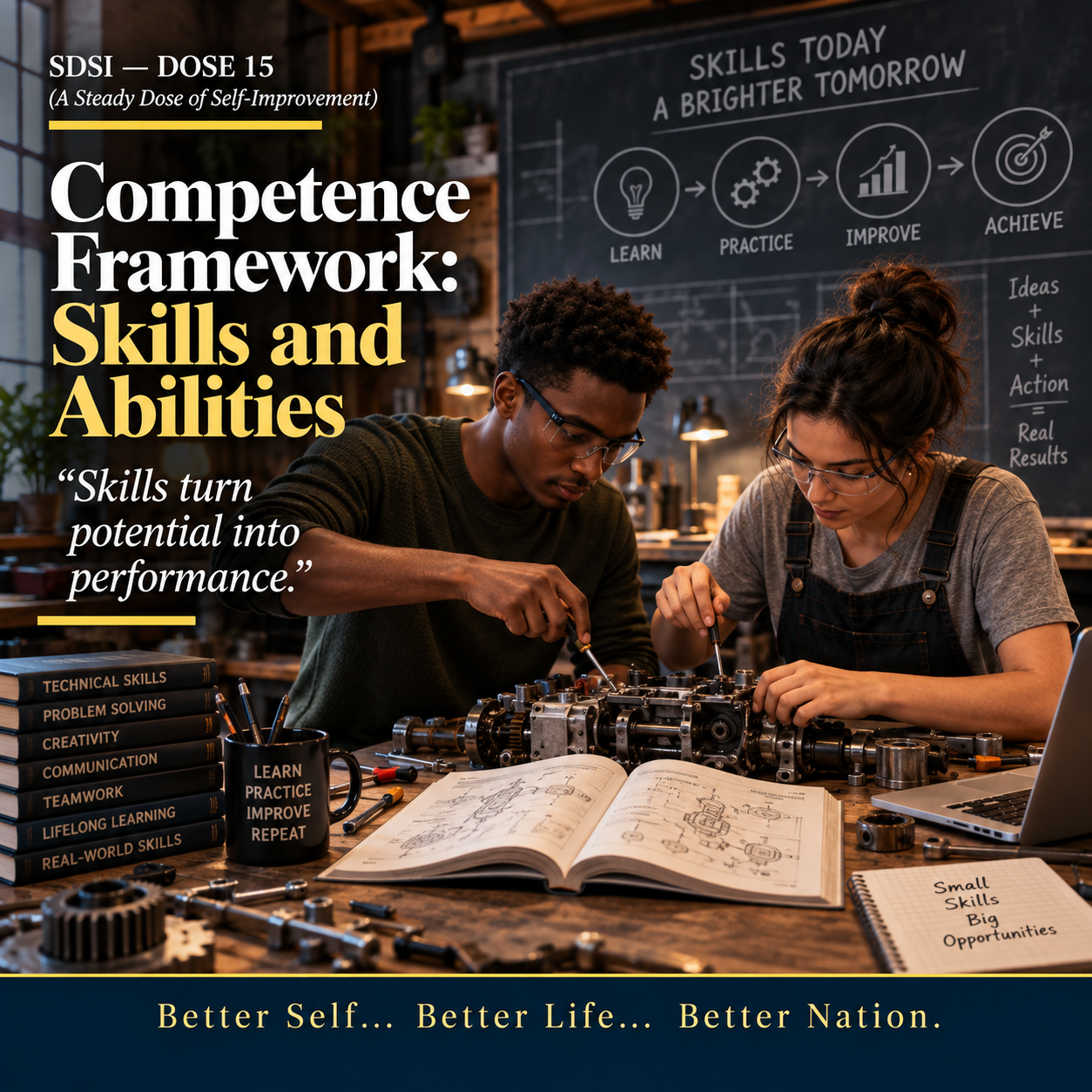
Belief alone is not enough — without the skills to act on it, powerful
convictions produce nothing but inspired inaction.

Your value system is the engine. Your competence framework is the transmission.
In the previous section, we explored the attitudes and beliefs that form the foundation of any meaningful self-improvement journey. Together, they form a value system strong enough to carry you through whatever challenges lie ahead. But a solid foundation alone is not enough. What you build on top of it matters just as much.
Think of it this way: your value system is the engine. Your competence framework is the transmission. Without the engine, there is no power. But without the transmission, that power never reaches the wheels. You need both, working together, to move.
Seven skills consistently appear in the profiles of those who succeed, and their absence consistently explains why others fall short: efficient time management, staying focused, thinking first, purposeful decision-making, effective communication, creating work-life balance, and — the capstone of them all — conquering self-doubt. You can manage your time flawlessly and communicate brilliantly, but if self-doubt runs unchecked, none of those other skills will ever reach their full potential.
I did not arrive in South Korea fully formed as a high performer. The move itself was an act of faith, and what followed required deliberate development of each of these seven skills. I had to manage my time more carefully than ever before, balancing teaching, advising, research, and writing. I had to stay focused on long-term goals even when the novelty of a new country made distraction effortless. I had to think carefully before speaking in a professional culture different from my own.
I had to communicate across language and cultural barriers with students, colleagues, and administrators. I had to protect my personal time and my connection with family back home, so I could sustain performance over years rather than burn out in months. And I had to conquer the recurring self-doubt that whispered: Who do you think you are, writing books, presenting research, building something new? None of these skills came naturally. They were built — through practice, failure, and reflection.
Pause and Reflect
Which of the seven skills — time management, focus, thinking first, decision-making, communication, work-life balance, or conquering self-doubt — do you most need to build right now?
One Step Forward
Pick the one skill you’re weakest in. Write one small, specific way you’ll practice it this week.
Explored in full in Part 2, Competence Framework of A Holistic Approach to Self-Improvement.
Better Self… Better Life… Better Nation.
Adaptive Mindset
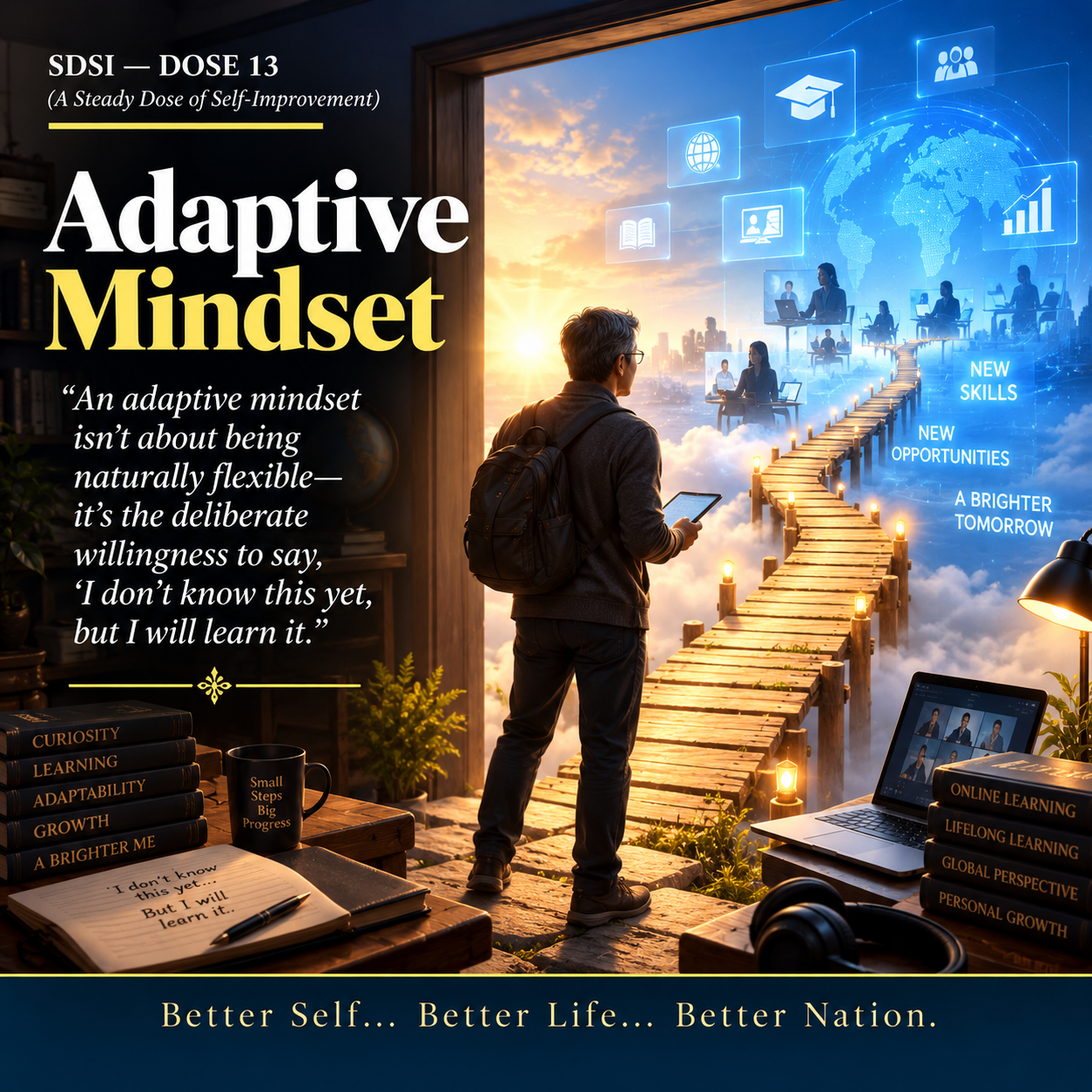
An adaptive mindset isn’t about being naturally flexible — it’s the deliberate willingness to say,
“I don’t know this yet, but I will learn it.”
When my university announced all classes were going online overnight, I had one problem: I’d never taught online in my life.
When my university announced, with almost no warning, that all classes would move online indefinitely, I was immediately aware of my limitation: I had never taught a single minute online in my career. I am not naturally tech-savvy. The shift felt like being asked to play an entirely different game with rules I did not know.
But I knew I had to adapt, or perish professionally. So I attended every training session offered. I learned the university’s E-Class platform. I mastered video conferencing software I’d never touched before. I began producing lecture videos for my students. Within weeks, I had not only adapted — I’d found new ways to engage students that I’d never explored in a traditional classroom.
Some of my colleagues could not make that same adjustment. Rather than continue struggling in an environment that had changed beyond their comfort, several chose to resign. The difference between us was not technical ability. It was mindset. The willingness to say: I do not know this yet — but I will learn it. That is an adaptive mindset in action.
Charles Darwin’s theory of adaptation offers the clearest parallel: species that adapt to changing conditions survive; those that cannot, perish. The same principle governs human beings in a rapidly changing world. Satya Nadella took over a Microsoft many considered to be losing its edge, and rather than defend the old way of doing things, replaced a culture of “know-it-alls” with a culture of “learn-it-alls” — growing the company’s value from $300 billion to over $2 trillion.
Your mindset is not fixed. The default responses you rely on were programmed over years by family, culture, and experience — and they can be reprogrammed with awareness and deliberate practice. Build self-awareness through daily reflection. Name your negative inclinations specifically, so they lose their power to operate invisibly. And seek out discomfort on purpose — an adaptive mindset is built in friction, not in comfort.
Pause and Reflect
What’s one skill you’ve been avoiding learning, telling yourself it’s simply “not who you are”?
One Step Forward
Name one negative reflex you have under pressure. Write down the adaptive response you’ll try the next time it happens.
Explored more fully in Part 2 — Section I — Chapter 6, “Proper Perspective,” of A Holistic Approach to Self-Improvement.
Better Self… Better Life… Better Nation.
Personal Accountability

Personal accountability begins when you stop asking only who caused the problem
and start asking what part of the response belongs to you.
Put Yourself on the List
Jim Rohn had a blame list. His mentor pointed out the one name missing from it.
Jim Rohn often told a story about his mentor, Earl Shoaff, who once asked him, “Jim, just out of curiosity, tell me, how come you haven’t done well up until now?”
Rohn had an impressive list of explanations ready: the government, taxes, rising prices, the weather, traffic, company policies, inadequate training, negative relatives, cynical neighbors, the economy, and the community.
Shoaff listened patiently. When Rohn finished, his mentor identified the problem: Jim’s own name was missing from the list.
That realization changed him. Rohn discarded his collection of excuses, took a fresh sheet of paper, and wrote one word on it:
Me.
But personal accountability does not mean blaming yourself for everything that happens. Some hardships are imposed upon us. We do not cause every injustice, illness, rejection, betrayal, accident, or disadvantage we experience. Holding yourself responsible for what was never within your control is not accountability—it is misplaced guilt.
Accountability means looking honestly at what was yours: your decision, your effort, your preparation, your conduct, your promise, your mistake, or your response.
It allows you to say, This situation may not be entirely my fault, but what I do next is still my responsibility.
One of my favorite poems is William Ernest Henley’s Invictus. Its closing declaration has remained with me: “I am the master of my fate: I am the captain of my soul.” To be the captain does not mean controlling the sea. A captain cannot command the wind, silence the storm, or remove every obstacle beneath the water. But the captain remains responsible for reading the conditions, adjusting the course, protecting the vessel, and deciding what to do next.
This is where personal accountability follows seizing control. Seizing control means recognizing that you still possess agency. Personal accountability means answering honestly for how you use it.
When something goes wrong, blame asks, Whose fault is this? Accountability asks more useful questions: What part of this belongs to me? What could I have done better? What must I repair? What will I do differently next time?
Accountability is not humiliation. It does not require endless punishment for past mistakes. Its purpose is growth. Once you acknowledge your part, you recover the power to learn, apologize, make amends, improve, and choose differently.
Other people may belong on the list. Circumstances may belong there too. But before you finish writing, make sure your own name has not been conveniently left out.
Pause and Reflect
In one unresolved problem in your life, what part genuinely belongs to you?
Have you been protecting yourself with an explanation that prevents you from changing?
One Step Forward
Divide a page into two parts: Not Mine to Control and Mine to Own. Write one present difficulty under both headings, identify your responsibility, and take one corresponding action today.
Explored more fully in Part 2 — Section I — Chapter 3, “Personal Accountability,” of A Holistic Approach to Self-Improvement.
Better Self… Better Life… Better Nation.
Seizing Control

You may not control every circumstance written into your life,
but you still hold the pen that writes what comes next.
Who Is Writing Your Story?
Your life is not a blank page—but neither is it a finished book.
You did not choose where you were born, the family into which you arrived, or many of the circumstances that shaped your early life. Even now, illness, injustice, economic hardship, other people’s decisions, and unexpected events can alter your plans without your permission.
Seizing control does not mean pretending that these forces do not exist. It means refusing to give them authorship over the rest of your story.
Fate and destiny are often used interchangeably to suggest that the future has already been decided. What makes this belief dangerous is not the vocabulary but the helplessness it can produce. When people become convinced that nothing they do matters, they stop making deliberate decisions. They wait for fortune to improve, for someone to rescue them, or for the right moment to arrive.
Waiting then becomes a decision in itself.
Nelson Mandela spent 27 years in prison under South Africa’s apartheid regime. He could not simply choose to unlock his cell or erase the injustice that placed him there. His control was severely restricted, but not completely destroyed. He could still decide what kind of person he would become within those restrictions and what he would do if freedom came.
Mandela emerged from prison without allowing bitterness to dictate his entire future. He helped negotiate an end to white minority rule and, in 1994, became South Africa’s first democratically elected president. He did not control every event that shaped his life or his country. But within the choices available to him, he exercised courage, discipline, patience, and purpose.
That is what seizing control truly means.
You cannot command every outcome. You cannot guarantee that effort will always be rewarded, that people will treat you fairly, or that every plan will succeed. But you can examine your options, choose your response, develop your abilities, seek help, change direction, and take the next meaningful step.
Your circumstances may influence the story. They may limit some choices and make others painfully difficult. But influence is not always authorship. As long as you retain the capacity to choose your next response, part of the pen remains in your hand.
Do not waste your strength trying to control what is beyond you. Use it to take responsibility for what is still yours.
You may not be able to rewrite the opening chapters. But today, you can write the next sentence.
Pause and Reflect
Who or what has been making too many of your recent decisions?
What part of your present situation remains genuinely within your control?
One Step Forward
Identify one area in which you have been waiting for circumstances to decide for you. Take one concrete action today that places the pen back in your hand.
Explored more fully in Part 2 — Section I — Chapter 2, “Seizing Control,” of A Holistic Approach to Self-Improvement.
Better Self… Better Life… Better Nation.
Strong Self-Belief
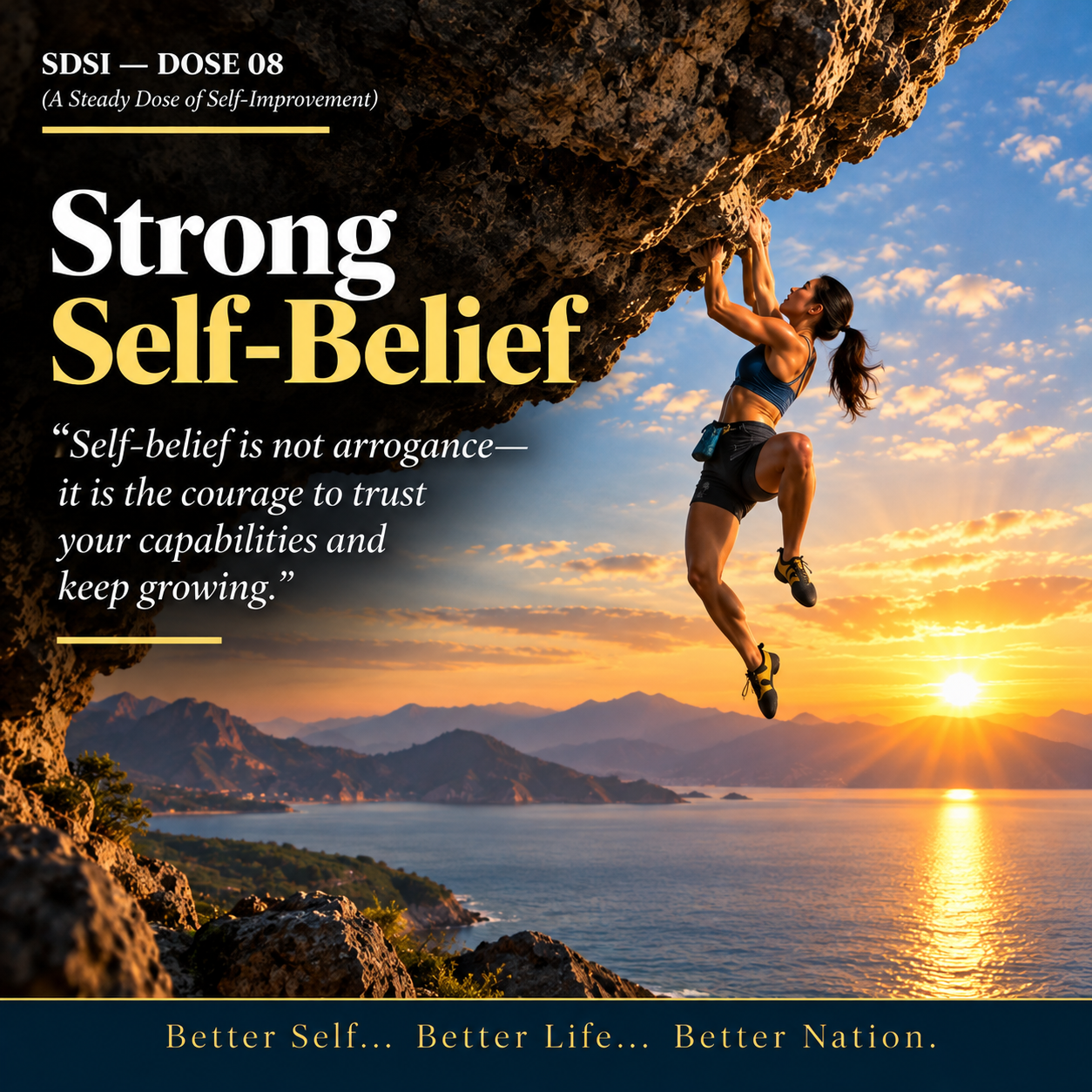
Self-belief is not arrogance—it is an honest recognition of your capabilities and the courage
to move forward while continuing to improve.

Other people’s disbelief does not kill a dream. It is the self-doubt that follows it home.
One image from the Gospel of Mark has stayed with me: “No one pours new wine into old wineskins, or the wine will burst the skins.” In its biblical context, the passage speaks of the incompatibility between the new and the old. But it also offers a powerful metaphor for personal growth.
The knowledge, skills, and habits we acquire through self-improvement are like new wine. Yet when we try to contain them within an old identity built on fear, inadequacy, and self-doubt, our growth becomes difficult to sustain. We may receive opportunities but feel unworthy of them. We may develop new abilities but remain afraid to use them. We may know what must be done but still believe we are incapable of doing it.
Strong self-belief provides room for growth.
This does not mean pretending that we can do everything. Self-belief is not self-conceit, nor is it blind confidence. It is the grounded conviction that says: I know what I can do. I recognize what I still need to learn. I trust that through effort, preparation, and persistence, I can become more capable than I am today.
Sometimes, self-belief comes before action and gives us the courage to begin. At other times, it develops after we act, struggle, learn, and discover evidence of our own capability. We do not need absolute confidence before taking the first step. We need only enough belief to take it—and then allow each honest effort to strengthen that belief.
Michael Jordan offers a familiar example. As a sophomore, he did not make his high school’s varsity basketball team. He could have accepted that disappointment as a final judgment of his ability. Instead, he trained harder, improved, and eventually became one of basketball’s greatest players. His confidence was not merely something he declared. It was strengthened through disciplined work, repeated failure, and measurable improvement.
This is what separates self-belief from wishful thinking. Wishful thinking says, I will succeed because I want to. Self-belief says, I can learn, prepare, persevere, and become capable of succeeding.
People will sometimes question your plans, underestimate your abilities, or judge your future according to your present limitations. Their disbelief may hurt, but it does not have the power to end your dream—unless you carry it home, make it your own, and allow it to become self-doubt.
Listen to criticism when it contains truth. Learn what you still need to learn. But do not surrender your future to someone else’s limited view of what you can become.
Believe enough to begin. Work enough to produce evidence. Then let that evidence teach you to believe even more.
Pause and Reflect
When has someone’s reaction caused you to question something you genuinely wanted to pursue?
What evidence from your own life shows that you are more capable than you sometimes believe?
One Step Forward
Write one sentence affirming a capability for which you have real evidence—and identify one action you will take today to strengthen it further.
Explored in full in Part 2 – Section I – Chapter 1 ( Strong Self-Belief) of A Holistic Approach to Self-Improvement.