The Self-Improvement Paradigm at a Glance
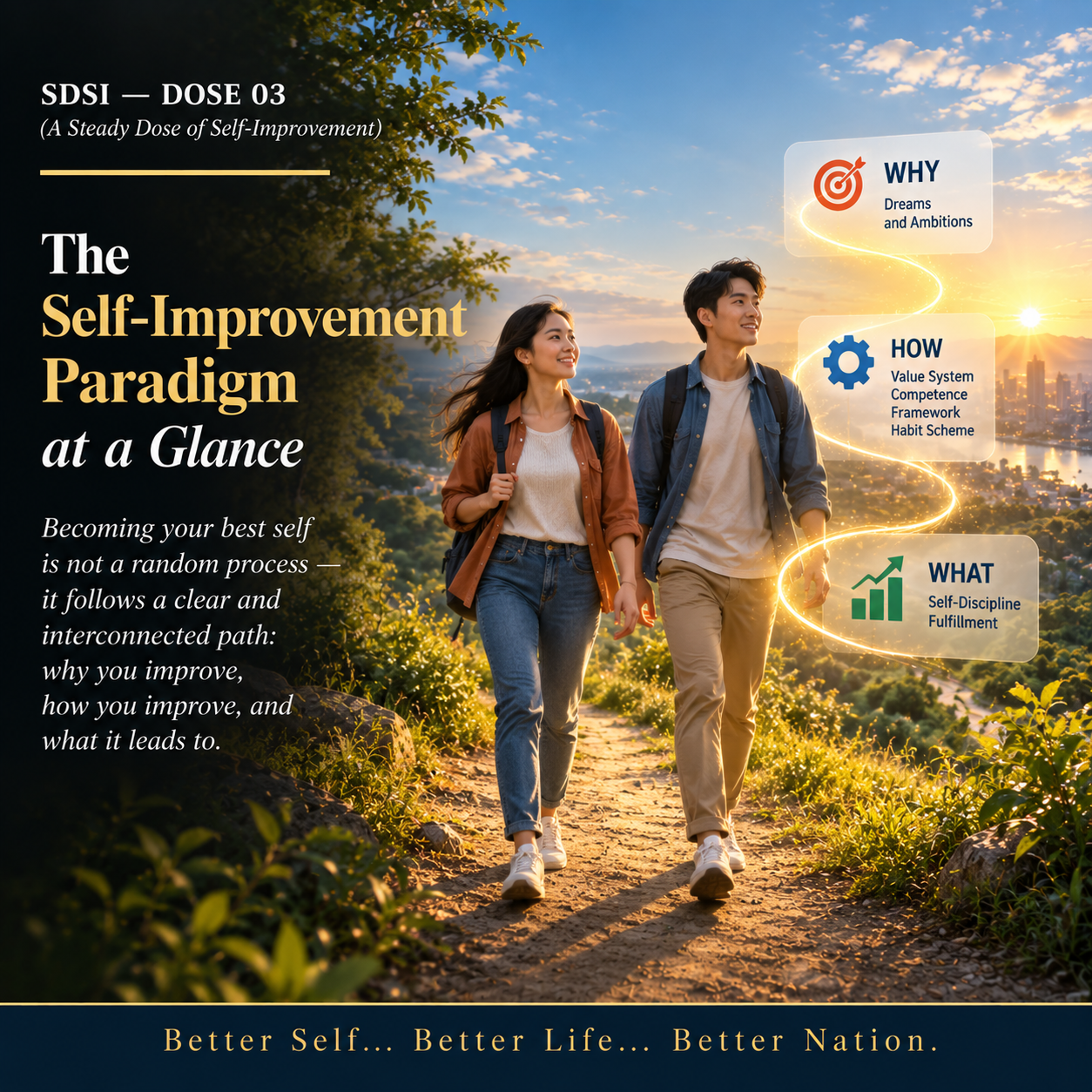
Real transformation rests on three pillars — what you believe, what you can do, and what
you practice — held together by self-discipline.

Becoming your best self was never going to be one thing.
For years, I thought growth meant picking whichever self-help idea resonated that month — a book on mindset here, a productivity system there — without ever asking how they fit together. It took time to see that the people who actually transform their lives aren’t chasing isolated fixes. They’re building on a structure.
That structure rests on three pillars. The first is your Value System — the attitudes and beliefs you carry about yourself and the world. The second is your Competence Framework — the actual skills and abilities you develop. The third is your Habit Scheme — the practices and activities you repeat often enough that they become who you are.

Remove any one of the three, and the other two eventually wobble. Belief without skill produces confidence with nothing to stand on. Skill without habit produces potential that never compounds into results. Habit without belief produces motion without conviction — busywork mistaken for progress.
Holding all three together is self-discipline — the thread that keeps the structure upright once the initial motivation fades, as it always eventually does. Health, success, and happiness arrive as natural results of the structure underneath, not as prizes you win by wanting them hard enough.
This is the paradigm the rest of this book unpacks, chapter by chapter — twenty chapters split across the three pillars, each one a single brick in a foundation meant to hold up an entire life, not just a single good year.
Pause and Reflect
Which of the three — belief, ability, or practice — do you most need to shore up right now?
One Step Forward
Pick the weakest of the three pillars in your life right now. Write one concrete step you’ll take this week to strengthen it.
Explored in full in the Introduction (Figure 1) of A Holistic Approach to Self-Improvement.
Better Self… Better Life… Better Nation.

Posted on August 1, 2026, in Better Self...Better Life, Competence Framework, Holistic Self-improvement, Self-Improvement, Value System and tagged Better, Better Self... Better Life, Competence Framework, Hoslistic Self-Improvement. Bookmark the permalink. Leave a comment.
 M.A.D. LIGAYA



 M.A.D. L I G A Y A
Leave a comment
Comments 0