Blog Archives
Seizing Control

You may not control every circumstance written into your life,
but you still hold the pen that writes what comes next.

Who Is Writing Your Story?
Your life is not a blank page—but neither is it a finished book.
You did not choose where you were born, the family into which you arrived, or many of the circumstances that shaped your early life. Even now, illness, injustice, economic hardship, other people’s decisions, and unexpected events can alter your plans without your permission.
Seizing control does not mean pretending that these forces do not exist. It means refusing to give them authorship over the rest of your story.
Fate and destiny are often used interchangeably to suggest that the future has already been decided. What makes this belief dangerous is not the vocabulary but the helplessness it can produce. When people become convinced that nothing they do matters, they stop making deliberate decisions. They wait for fortune to improve, for someone to rescue them, or for the right moment to arrive.
Waiting then becomes a decision in itself.
Nelson Mandela spent 27 years in prison under South Africa’s apartheid regime. He could not simply choose to unlock his cell or erase the injustice that placed him there. His control was severely restricted, but not completely destroyed. He could still decide what kind of person he would become within those restrictions and what he would do if freedom came.
Mandela emerged from prison without allowing bitterness to dictate his entire future. He helped negotiate an end to white minority rule and, in 1994, became South Africa’s first democratically elected president. He did not control every event that shaped his life or his country. But within the choices available to him, he exercised courage, discipline, patience, and purpose.
That is what seizing control truly means.
You cannot command every outcome. You cannot guarantee that effort will always be rewarded, that people will treat you fairly, or that every plan will succeed. But you can examine your options, choose your response, develop your abilities, seek help, change direction, and take the next meaningful step.
Your circumstances may influence the story. They may limit some choices and make others painfully difficult. But influence is not always authorship. As long as you retain the capacity to choose your next response, part of the pen remains in your hand.
Do not waste your strength trying to control what is beyond you. Use it to take responsibility for what is still yours.
You may not be able to rewrite the opening chapters. But today, you can write the next sentence.
Pause and Reflect
Who or what has been making too many of your recent decisions?
What part of your present situation remains genuinely within your control?
One Step Forward
Identify one area in which you have been waiting for circumstances to decide for you. Take one concrete action today that places the pen back in your hand.
Explored more fully in Part 2 — Section I — Chapter 2, “Seizing Control,” of A Holistic Approach to Self-Improvement.
Better Self… Better Life… Better Nation.
Strong Self-Belief
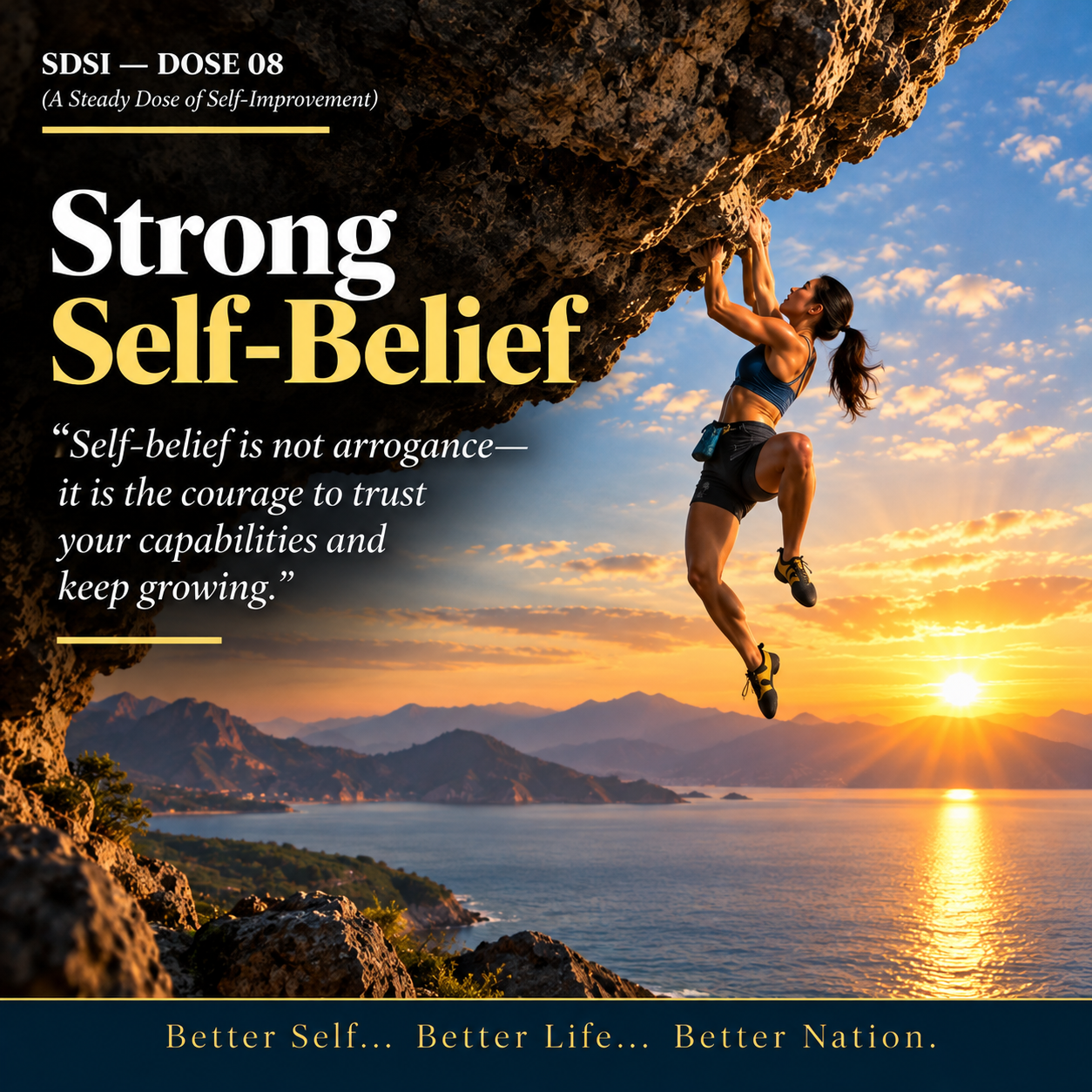
Self-belief is not arrogance—it is an honest recognition of your capabilities and the courage
to move forward while continuing to improve.

Other people’s disbelief does not kill a dream. It is the self-doubt that follows it home.
One image from the Gospel of Mark has stayed with me: “No one pours new wine into old wineskins, or the wine will burst the skins.” In its biblical context, the passage speaks of the incompatibility between the new and the old. But it also offers a powerful metaphor for personal growth.
The knowledge, skills, and habits we acquire through self-improvement are like new wine. Yet when we try to contain them within an old identity built on fear, inadequacy, and self-doubt, our growth becomes difficult to sustain. We may receive opportunities but feel unworthy of them. We may develop new abilities but remain afraid to use them. We may know what must be done but still believe we are incapable of doing it.
Strong self-belief provides room for growth.
This does not mean pretending that we can do everything. Self-belief is not self-conceit, nor is it blind confidence. It is the grounded conviction that says: I know what I can do. I recognize what I still need to learn. I trust that through effort, preparation, and persistence, I can become more capable than I am today.
Sometimes, self-belief comes before action and gives us the courage to begin. At other times, it develops after we act, struggle, learn, and discover evidence of our own capability. We do not need absolute confidence before taking the first step. We need only enough belief to take it—and then allow each honest effort to strengthen that belief.
Michael Jordan offers a familiar example. As a sophomore, he did not make his high school’s varsity basketball team. He could have accepted that disappointment as a final judgment of his ability. Instead, he trained harder, improved, and eventually became one of basketball’s greatest players. His confidence was not merely something he declared. It was strengthened through disciplined work, repeated failure, and measurable improvement.
This is what separates self-belief from wishful thinking. Wishful thinking says, I will succeed because I want to. Self-belief says, I can learn, prepare, persevere, and become capable of succeeding.
People will sometimes question your plans, underestimate your abilities, or judge your future according to your present limitations. Their disbelief may hurt, but it does not have the power to end your dream—unless you carry it home, make it your own, and allow it to become self-doubt.
Listen to criticism when it contains truth. Learn what you still need to learn. But do not surrender your future to someone else’s limited view of what you can become.
Believe enough to begin. Work enough to produce evidence. Then let that evidence teach you to believe even more.
Pause and Reflect
When has someone’s reaction caused you to question something you genuinely wanted to pursue?
What evidence from your own life shows that you are more capable than you sometimes believe?
One Step Forward
Write one sentence affirming a capability for which you have real evidence—and identify one action you will take today to strengthen it further.
Explored in full in Part 2 – Section I – Chapter 1 ( Strong Self-Belief) of A Holistic Approach to Self-Improvement.
BETTER SELF… BETTER LIFE… BETTER NATION.
Value System: Attitudes and Beliefs
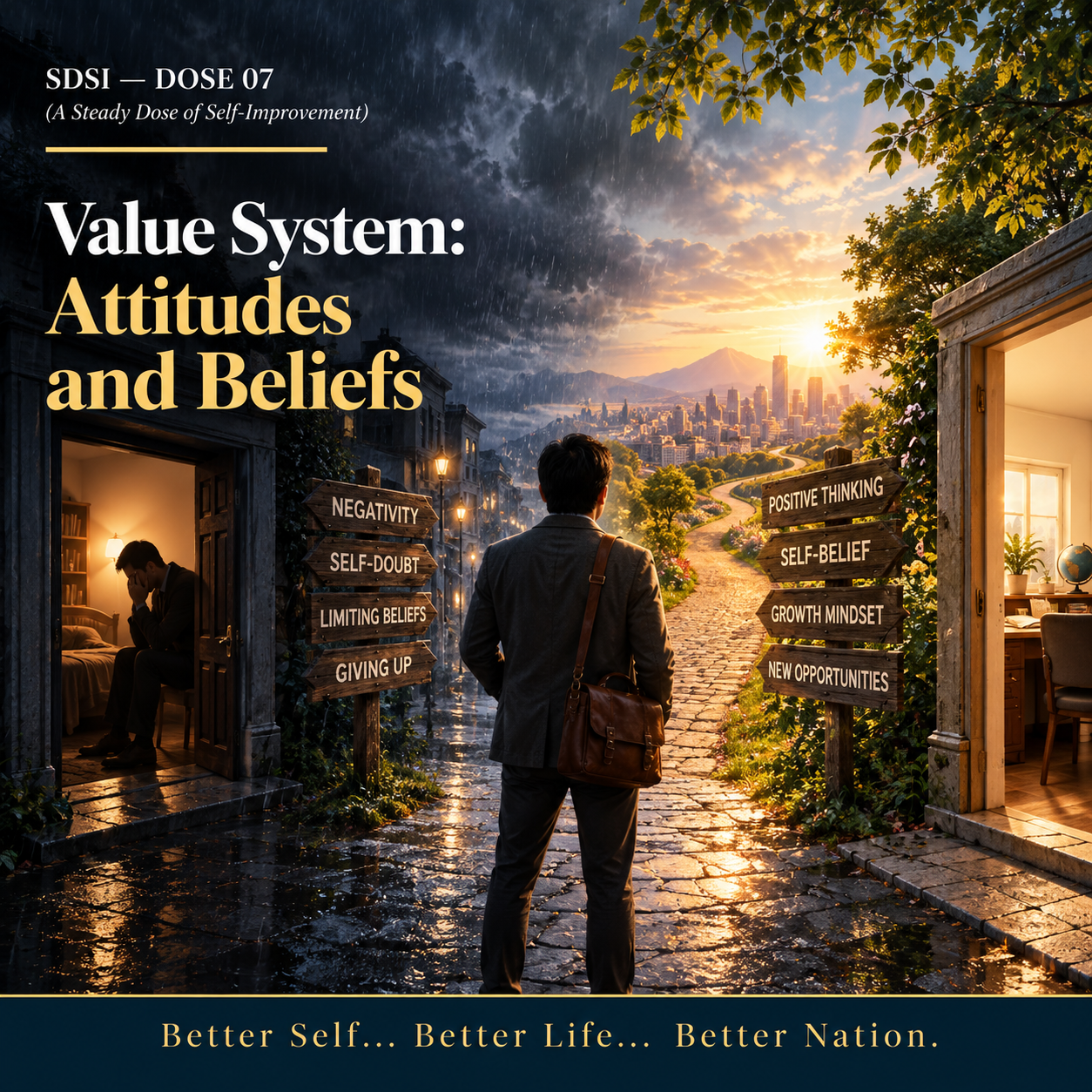
Your value system—the attitudes and beliefs you carry—shapes how you see yourself,
interpret your circumstances, and decide what to do next.
Two salesmen. The same storm. Two completely different mornings.
Two traveling salesmen awaken to heavy rain. The first looks out the window and thinks, No one will buy anything in this weather. He returns to bed.
The second looks at the same storm and thinks, Everyone will be indoors today. This may be the easiest day to find customers. He gets dressed and walks out the door.
The rain is the same. The morning is the same. What differs is the meaning each man gives to the situation—and the action that follows.
We do not respond to circumstances exactly as they are. We respond to them according to what we believe they mean. One person sees rejection as proof that the journey is over; another sees it as a reason to improve and try again. One sees difficulty as an excuse to retreat; another sees it as an opportunity to grow.
This is why our exploration of holistic self-improvement begins with the Value System. Our attitudes and beliefs serve as the lenses through which we view ourselves and the world. They influence our decisions, and our decisions gradually determine the direction of our lives. Skills may tell us how to act, and habits may help us act consistently—but our value system often determines whether we act at all.
I experienced this when I left a comfortable position in the Philippines to pursue ESL teaching in South Korea. The decision required more than qualifications. I had to believe that I was capable of building a new professional life in an unfamiliar country. After three rejections, I could have treated them as evidence that I did not belong there. Instead, I chose to regard them as temporary setbacks. I persisted until I finally received the opportunity that changed the course of my professional life.
As Zig Ziglar famously said, “Your attitude, more than your aptitude, will determine your altitude.” Ability matters, but ability alone cannot take us very far when our beliefs prevent us from using it.
A strong value system does not guarantee that every storm will pass quickly or that every effort will succeed. It equips us to meet adversity with self-belief, take control of what we can, accept personal accountability, think positively without denying reality, maintain proper perspective, adapt when conditions change, and remain guided by purpose.
These attitudes and beliefs are the foundation of everything that follows. Before improving what we can do, we must examine how we think and what we believe—because every lasting change begins within.
When you encounter a setback, what beliefs usually shape your response?
Pause and Reflect
Are those beliefs helping you move forward—or giving you permission to remain where you are?
One Step Forward
Identify one limiting belief influencing a current difficulty. Rewrite it as a more constructive belief that encourages action without denying reality.
Explored in full in Part 2 – Foundations of Holistic Self-Improvement, Section I — Value System ( Attitude & Belief) of A Holistic Approach to Self-Improvement.
Better Self… Better Life… Better Nation.
Full Potential
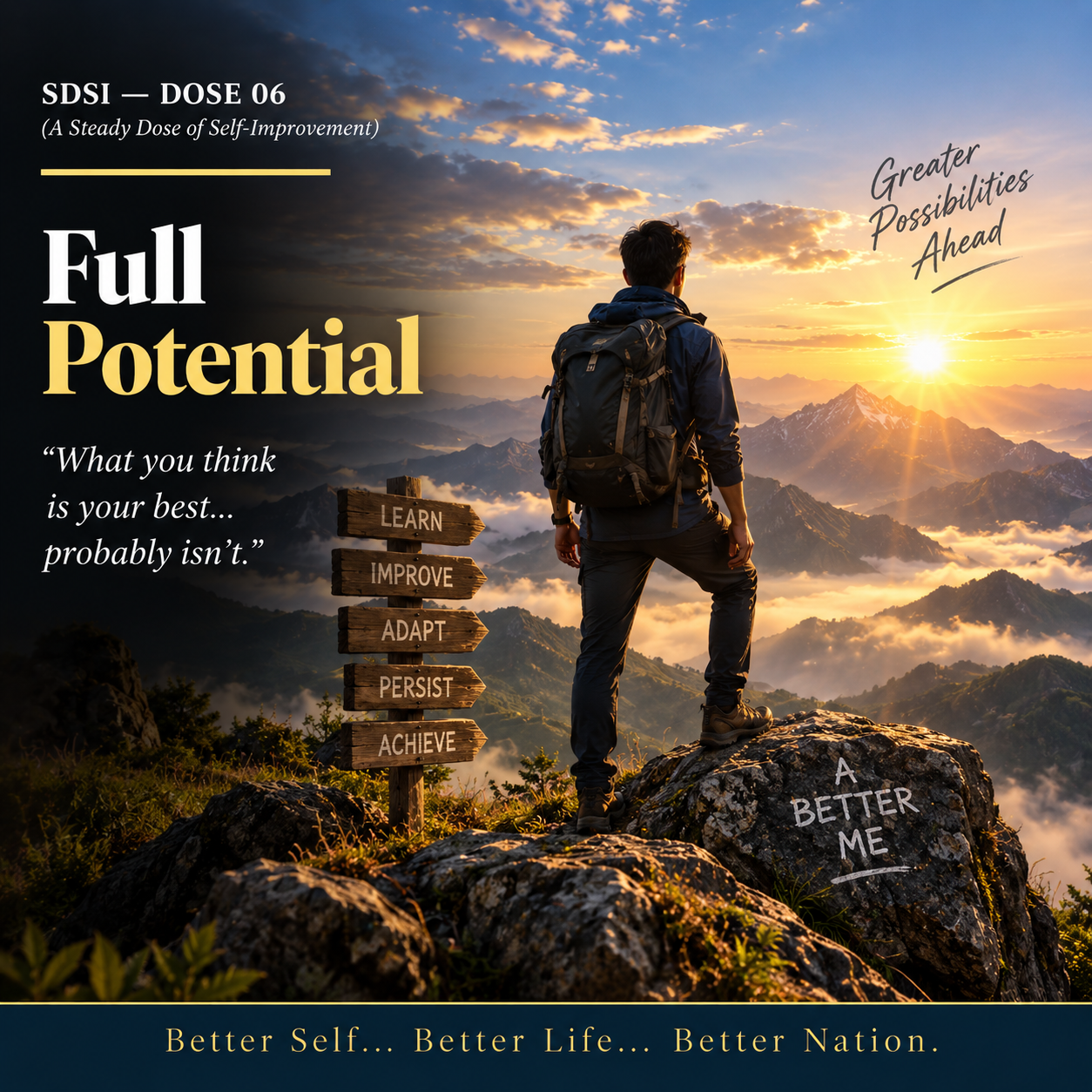
What feels like your ceiling may simply be the point where you stopped testing how far you could grow.
What you think is your best… probably isn’t.
Many highly accomplished people keep reading long after formal schooling has ended. Warren Buffett, Bill Gates, Barack Obama, Oprah Winfrey, and others are known for surrounding themselves with books. Their reading is not merely entertainment; it reflects a deeper commitment to lifelong learning and the refusal to stop growing. Reading is only one path, but it reveals the attitude at the heart of self-improvement: there is always more to learn and more of ourselves to develop.
That pursuit should not be confused with perfectionism. Perfectionism keeps us trapped in constant self-evaluation, often producing frustration and anxiety. Unlocking our full potential means something healthier: deliberately developing our physical, intellectual, emotional, moral, and social capacities so that we become the most capable versions of ourselves. We will never be perfect in every dimension, but we can become better developed than we are today.
One of the greatest barriers is the ceiling we set for ourselves. When an attempt fails, it is tempting to say, “That was the best I could do.” Perhaps it was the best we did on that occasion—but it may not represent the best we can ever become. What feels like our limit may simply be the point at which we stopped learning, practicing, or trying.
The book uses the image of someone stopping only three feet from gold. We rarely know how close another effort, lesson, or adjustment might bring us to the result we seek. Failure does not prove that our potential has been exhausted; it shows us what has not yet worked. Growth requires the humility to learn from that information and the courage to try again.
You will know your ceiling only after you have pushed yourself to find it. Take every opportunity for self-improvement—and when no opportunity appears, create one. Read, practice, seek guidance, and keep developing your abilities. Your full potential is not a label waiting to be discovered. It is a capacity gradually revealed through continuous, deliberate growth.
Pause and Reflect
What “ceiling” have you assumed was fixed even though you have never truly tested it?
One Step Forward
Choose one skill or ability you believe has reached its limit. Spend 20 focused minutes today learning, practicing, or attempting something slightly beyond your usual level.
Explored in full in Part 1, Section III — Self-Improvement and Unlocking One’s Full Potential of A Holistic Approach to Self-Improvement.
Better Self… Better Life… Better Nation.
An Invitation (YouTube Channel Teaser)
Is self-improvement an end in itself or a means to achieve an end?
By introducing a comprehensive paradigm for self-improvement, I do not seek to complicate the process of personal growth, but rather to present a realistic framework that brings together the many constructs essential to it. There are two serious loopholes in self-improvement schemes promoted nowadays. The first one is the promise of becoming the best version of yourself in a few days or weeks. And the second is the attainment of full potential, being floated as a goal to be achieved rather than a process to be undergone.
Self-improvement is not an end in itself but rather a means to achieve an end. It is not a destination. It is the path to reach a desired destination.
I believe that there is no shortcut, no magic pill, and no single technique that can instantly transform one’s life. Genuine growth requires cultivating the right attitudes and beliefs, developing essential skills and abilities, and consistently practicing positive habits and activities. This holistic approach recognizes that lasting change arises from deliberate effort across multiple areas of life.
Longevity: The Race To 100
Longevity should be viewed as a product of the efforts of people to reach their full potential. To say that living as long as people can is the result of them giving their physical bodies the maximum care is tantamount to considering a person as a mere physical specimen. A person has not just a body but a mind and a spirit. In psychology, an individual is considered a physical, mental, emotional, social, and spiritual being. I believe that only when people can strike a perfect harmony among these different aspects of being can they hope to have a shot at longevity. How long do you want (or expect) to live?
What Makes You Happy?
A lot has already been written about happiness. Much has been said about how to achieve it and where to find it. It is my hope that the things I shared in this video would give you additional insights on the topic.



 M.A.D. L I G A Y A