Category Archives: Happiness
A Holistic Approach To Self-Improvement

Self-improvement is often treated as a collection of isolated goals—building confidence, learning new skills, developing better habits, or becoming more disciplined. But lasting transformation requires something more. It requires a holistic approach.
This book presents a practical framework that brings together the essential dimensions of personal growth into one integrated system. Rather than focusing on a single aspect of development, it shows how genuine and lasting change occurs when your beliefs, abilities, habits, and actions work together.
Through this book, you will discover how to:
• Build a strong value system that shapes your character and guides your decisions.
• Develop the competencies needed to navigate life’s personal and professional challenges.
• Establish a habit scheme that transforms good intentions into consistent action.
• Cultivate the self-discipline that binds every element into a sustainable way of life.
• Pursue lasting health, success, happiness, and fulfillment through balanced personal growth.
Grounded in research yet written in a clear and practical style, this book combines timeless principles, scientific insights, reflective exercises, self-assessments, and real-life examples to help you understand not only what to improve, but how meaningful transformation actually happens.
Whether you are a student, educator, professional, leader, entrepreneur, or simply someone seeking a more purposeful life, A Holistic Approach to Self-Improvement offers a complete roadmap for becoming your best self—one intentional step at a time.
Grow with purpose. Live with meaning.
Sense of Fulfillment
“Those who live a life of purpose will find true fulfillment .”
~ Hardpen ~

In my book “Paradigm for Self-Improvement”, I proposed a framework for personal growth and development. One of the main constructs I explored in the said framework is fulfillment.
In the self-improvement framework, fulfillment is presented as the outcome of the process. This concept has multiple definitions, but in my book, it is described as akin to “the achievement of something desired, promised, or predicted.” I use the phrase “akin to” because fulfillment goes deeper than accomplishment.
Fulfillment (characterized by achieving health, success, and happiness) is presented as the outcome of the self-improvement process. When you embrace personal growth and development, your ultimate goal becomes realizing your full potential.
Through self-improvement, you will acquire attitudes, beliefs, skills, and abilities, and engage in practices and activities to become your best and strongest version. The transformation you will undergo will enable you to achieve success, maintain good health, and experience genuine happiness, giving you a sense of fulfillment.
Establishing the connection between achieving one’s full potential and experiencing fulfillment—where the latter results from the former—aligns with Jim Rohn’s statement: “Success is not to be pursued; it is to be attracted by the person you become.”
The quote implies that self-improvement is a prerequisite to fulfillment. It emphasizes the importance of personal growth and development in pursuing success, health, and happiness. Rohn suggests that you do not need to chase these things. Fulfillment naturally comes when you focus on improving yourself from within. It is the byproduct of becoming the best you.
When you cultivate the right attitudes and beliefs, hone the necessary skills and abilities, and consistently perform the vital practices and activities, you grow personally and professionally, and opportunities and achievements will follow naturally. When you work hard to improve yourself, you create conditions where success is drawn to you.
Some people argue that fulfillment—the realization of dreams and ambitions—is the ultimate goal of self-improvement. They view it as the end, and self-improvement is the means to achieve it.
The relationship between the constructs of self-improvement and fulfillment, as articulated by Jim Rohn, can be framed in Simon Sinek’s WHY-HOW-WHAT structure.
The Why (Goal) is to attain full potential, the How (Plan) is the self-improvement process, and the What (Outcome) is fulfillment (Health, Success, Happiness)
Molding the relationship between self-improvement and fulfillment within Sinek’s Why-How-What framework is necessary to present this connection more clearly in the context of my proposed self-improvement paradigm. The WHY (or the reason) for undergoing personal growth and development is attaining full potential, while the pursuit of fulfillment—becoming successful, healthy, and happy—is the WHAT. The HOW is the self-improvement process.
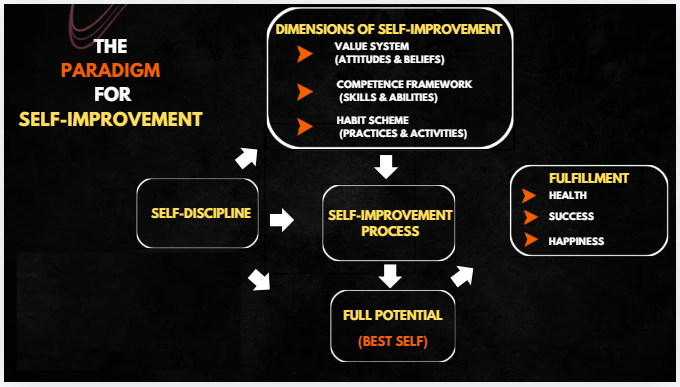
The pursuit of personal growth and development becomes deeply rooted when achieving one’s full potential serves as the core purpose (WHY). Perhaps this is because I subscribe to the dictum that becoming the best version of yourself leads to success. Success, health, and happiness are the natural consequences of growing and enhancing one’s abilities.
That does not mean that making fulfillment your WHY is wrong. If your motivation comes from the joy and satisfaction of achieving something or accomplishing specific and meaningful goals, fulfillment could be a better WHY.
“Becoming the best you” or “achieving fulfillment” are good reasons to embrace self-improvement. Both of them are powerful and meaningful WHYs. Which one you choose depends on what resonates more deeply with you.
Fulfillment, as presented here, is highlighted as the “WHAT.” Specifically, the tangible outcomes of the self-improvement journey are success, health, and happiness. As to why I have grouped these three concepts to characterize fulfillment, I will explain toward the end of this discourse.
Volumes have been written about success, health, and happiness.
Success, as defined in various dictionaries, broadly refers to achieving desired results, whether fame, wealth, or accomplishment. Prosperity, wealth, and triumph are some of the words synonymous with success. These definitions and related terms reveal how success is quantified through wealth, status, influence, and achievement, contributing to our understanding of fulfillment.
So, when asked who the most successful people in the world are, we never fail to mention the names of the world’s wealthiest men listed in Forbes’ top billionaires. The next ones on our lists are showbiz, sports, media, and political personalities.
When we discuss successful people, we also remember the names of quite a few—some of them our friends—who may not be rich, famous, or influential but excel in their respective fields of endeavor.
Some questions are begging for answers.
Are those people we consider successful happy, too? Do their money, fame, power, and accomplishments bring them happiness? Nobody knows but themselves and perhaps their loved ones and close friends.
At least they have the money. However, can their money buy them happiness? Can money buy happiness? These questions have been asked so often that they could already be considered meaningless. However, in the light of the present discussion, they should be asked, not to have them answered, but as a point to ponder.
We presume that with all the luxuries the money of the wealthy, famous, and powerful could afford, it is almost impossible that they are not happy. Unless it is true that, according to Maslow’s hierarchy of needs, only the basic needs (physiological and safety) can be met by money. Psychological needs (esteem, belonging, and love) and self-fulfillment are not available on the shelves of even the most expensive stores.
Here is the next question: “Are they healthy?”
They are already wealthy, famous, and powerful. They are truly blessed if they are also in good shape. Of course, they are—financially. But what about the physical, emotional, mental, and other dimensions of their well-being? Again, nobody knows but themselves and the people close to them.
Whether or not they are suffering from any debilitating disease, mental anguish, or emotional stress is difficult to determine.
I brought out the questions on happiness and health in the discussion of success because there is a need to strike a balance between the ephemeral and the ethereal when defining the concept. The prevailing view of success is materialistic. We attach tangible proofs to it—money, a big house, a new car, a degree, a job title, a specific body type, etc. I am not saying such an act (attaching tangible proof of success) is wrong. Nevertheless, I consider it not encompassing.
Why?
What about simple people who did not attend school, did not have cars, and lived in simple houses in far-flung farming and fishing villages, happily living a simple life with their loved ones and diligently performing their role in society? Would they not be considered as having achieved fulfillment?
When you do not have a mansion, a car, fancy clothes, expensive jewelry, a university degree, or a considerable amount of money in the bank—when you are not famous and not influential—when you are just an ordinary, decent individual, honestly earning a living and contented with what you have and what you are capable of achieving, but you are happy and healthy, would you not be considered successful?
Success need not be confined to material possessions or societal acclaim. For the farmer rising at dawn to nurture crops, the fisherman braving the waves to provide food, the driver ensuring safe journeys, or the janitor maintaining clean spaces, success can be measured by the dignity with which they live and work. Their fulfillment lies in their purpose, dedication, and the quiet joy they derive from their societal roles, which they fulfill diligently and without complaints.
Viewing success in this light means measuring it as personal and individual, like happiness and health. There is no standard measuring stick that can be imposed for its measurement. You must set your parameters when determining your happiness.
When we consider success as part of the holistic idea of fulfillment—blending health, happiness, and purpose—it becomes a universal concept accessible to all, regardless of status or possessions.
The most valuable lesson I heard about success is this: You, yourself, must define it. Do not allow other people to define success for you. Do not subscribe to the standards they set. You know your capabilities and limitations. Factor them in when setting your success parameters. However, do not be satisfied with your current skill set. You must improve and raise your bar as you see yourself improving. Do not forget that as you reach your goals, you should not sacrifice your happiness and health.
This brings me to why I have bundled success, health, and happiness as the key descriptors or manifestations of fulfillment. These three elements are interconnected and essential for a truly fulfilling life. Fulfillment is a harmonious state where success, health, and happiness converge.
Success is a source of personal and professional fulfillment, but not worth sacrificing good health. Similarly, happiness can add meaning and joy to life, but cannot stand alone without the stability of success or the vitality of good health. To achieve true fulfillment, you must experience all three simultaneously, as they complement and reinforce one another, creating a balanced and complete sense of well-being.
In bundling success, health, and happiness as the key descriptors of fulfillment, we recognize their interdependence and collective power to shape a truly enriched life. Success without health is fragile; health without happiness is incomplete; and happiness without the satisfaction of achievement may lack depth. Fulfillment arises from the synergy of these three elements, which create a balance that nourishes both body and spirit.
When you travel the road to self-improvement, remember that fulfillment is not a static final destination but a continuous state to aspire to, shaped by your choices and priorities. You will live a productive and deeply satisfying life by nourishing success, health, and happiness, and equally giving importance to each other.
What Makes You Happy?
A lot has already been written about happiness. Much has been said about how to achieve it and where to find it. It is my hope that the things I shared in this video would give you additional insights on the topic.
The Road To Self-Improvement: A Collection of Essays

I gathered in this part of my website the essays I have written about personal growth and development. I want to share the lessons and insights I learned from motivational speakers whose books (and videos on YouTube) have given me the blueprint on how best I could restructure my way of thinking so I could make better decisions in the different areas of my life.
I have been experiencing amazing changes in my life that I started regretting why didn’t I dig into these personal development stuffs when I was younger. I have heard a lot about “positive thinking” and related ideas before but I did not pay attention. But as the saying goes, “better late than never.”
I came to realize that “positive thinking” is but the first step in a person’s journey to a better self and a better life. It’s not the be-all-end-all of personal growth and development. But it all begins in setting a positive mindset. Positive actions should follow. People are in a better position to succeed when they break free from limiting beliefs and debilitating attitudes.
My goal in writing these essays and have them put together in this corner of my website is to help promote awareness on personal growth and development. I am not (yet) an expert in this field. I just want to share the little things I have learned so far and to say that I am so happy with the results I am getting.
**********
Cultivating a Positive Mindset
The Pursuit of Happiness
A lot of essays have already been written about happiness. There’s even a scientific journal called “Journal of Happiness Studies.” I think I don’t need to explain what kind of studies are published in the said journal.
I also have several essays about this topic. One of them is entitled “Defining Happiness” which if you wish to read later then you may click on this link.
So, what else should I be discussing here about happiness when it is possible that I may have already articulated everything I wish to say about it in my past essays. I decided to revisit this topic because I just want to share one very significant insight I heard when I listened to one of Dr. John C. Maxwell’s audiobooks. Dr. Maxwell is an American author, speaker, and pastor. He has written many books and I have actually purchased two of those – “How Successful People Think” and “Jumpstart Your Thinking.” I sometimes watch his videos on YouTube and that’s how I came across that audio book.
In that said audio book Dr. Maxwell shared an experience when he and his wife (Margaret) were invited as co-speakers in a seminar about happiness. According to him, when it was Mrs. Maxwell’s turn to speak, one of the participants asked, “Does your husband make you happy?”
Dr. Maxwell said that he was surprised with the question, but even more so with the answer given by his wife – “No!” He added that upon hearing that, people started to look at him. And as if the negative response was not enough to indict him (if it were true), somebody from the audience asked “Why?”
Then his wife explained.
“No! John Maxwell cannot make me happy. John Maxwell is a very good husband. He is never drunk. He never cheats on me. He always tries to fulfill my needs, physically and spiritually. But still, he cannot make me happy. Why? Because no one in this world is responsible for my happiness than me.”
The message is simple – we are responsible for our own happiness. It’s nobody else’s job to make us happy. Mrs. Maxwell is telling us that whether we become happy or not is up to us. It is a decision we make and not based on what others do or don’t do. As you probably have read (or heard) many times – “Happiness is an inside job.” You should have control over it. You shouldn’t allow your JOYstick to be handled by anyone.
Each of us is responsible for setting the parameters of our own happiness and we should be careful when we do so. We should set our own answers to the question “What would make me happy?” The question that should follow is – Which level (or levels) in the Maslow’s hierarchy of needs should be met for you to be happy – the basic, the psychological, or the self-actualization needs?
Those who consider money as their source of happiness have their physiological and safety needs as underlying reasons for doing so. Their need for food, clothes, and shelter are foremost among their concerns. There’s nothing wrong with that – for as long as they acknowledge that living a happy life requires more than eating, wearing clothes, and living under a roof.
We all have a dream house and car. We all want to eat the best foods. We all want something more – jewelry, bag, and what have you. We all want to have a vacation in the places listed in our bucket lists. For all those, we need money.
Money is not bad, it’s a blessing. The more of it we have, the better. Whoever says “I don’t need it” is a hypocrite. Whoever says also that “money is the root of all evils” is mistaken. Very likely that those people who have this kind of mindset about money don’t have it. What makes money bad is the way we want it, how we acquire it, how we spend it, and what we sacrifice to have it. What makes it bad is the answer to the question – “Are you the master of money… or its slave?” And what are you sacrificing in your quest for fortune? Is it your health… relationships… or your dignity as a human being? Is it worth it?
If you tie up your happiness with your need for love and belongingness, that’s when other people – your family and loved ones, friends, and to some extent, co-workers – get involved. From “What makes you happy?” it now becomes a matter of “Who makes you happy?” This is when we should be reminded of Mrs. Maxwell’s words – “No one is responsible for my happiness than me.”
It’s difficult but we should not allow other people to dictate our happiness. No matter how close they may be to us. We should manage our relationships in such a way that it would not destroy the tranquility of our lives and distract us from our personal pursuits and endeavors.
How to do it?
We become unhappy in our relationships when we get disappointed by something that a loved one, a friend, or a co-worker did or had failed to do. That is because we have set expectations and standards that they must measure up to. When they don’t, we become disappointed leading us to feel unhappy.
What should you do then? Consider dumping your expectations and standards.
Our happiness should not be contingent upon the way we expect other people to think, speak, and act. Do not set standards that whether your relatives, boyfriend, girlfriend, husband, wife, children, parents, friends, co-workers, boss, leaders, neighbor or a stranger, like it or not, should comply with. You will be gravely disappointed if you expect other people to behave and think exactly the way you want.
You have no control of the way your fellowmen would conduct themselves as persons and as professionals. You just need to embrace them for the way that they are. Just like you and me, they are not perfect. If your relationship is at a level that they could accept rebuke and advice then try. But how sure are you that with whatever issues or disagreements that you have with whoever, you are right and they are wrong – that the mistake is theirs, not yours. Should they not accept your rebuke or advice, in the event that you are certain that you stand on the side of truth and reason, then let them be and you do what is best for you. Move on. Let whoever erred suffer the consequences… and pray that it’s not you.
Happiness, being an inside job that it is, should not be hinged upon any external factors that we don’t have direct control of. We should, therefore, in our pursuit of happiness, focus internally. Our happiness is our own business. We should strive higher than satisfying our basic needs and our need for love and belongingness. We should set higher ideals for ourselves.
Nestled on top of Maslow’s hierarchy of needs are self-esteem and self-actualization. Include them in the list of your answers to the question “What would make me happy?”. It will be in your best interest should you place them on top of your list as well.
Happy you will certainly become if you acquire the knowledge and skills that would enable you to achieve success in your chosen field of endeavor. Through it, you will earn the recognition and respect of your fellowmen bringing you an immeasurable amount of self-esteem.
If you attain self-actualization, it means that you succeeded in unleashing your full potential as a person and you will be surprised how money, love and admiration, and respect of other people will come knocking at your door even if you don’t seek them.
True happiness comes from within thus there are people asserting that it (happiness) is actually a decision we make and not a goal that we try to achieve. But if we consider it as an “end,” the “means” of getting it should not be anybody or anything but what we become as a person.
Happiness is our reward when we succeed in our efforts to become, not perfect for perfection can never be achieved, but the best version of ourselves. When we become the best of what we could be, we can live our lives to the fullest and become productive members of both our family and society.
Paano Nga Ba Dapat Sukatin Ang Tagumpay?
 Paano nga ba?
Tignan muna natin ang kahulugan ng salitang tagumpay.
Ang tagumpay daw ay katuparan o kaganapan ng anumang plano o balak. Simple! Hindi ba? Kapag may binalak kang gawin at nangyari eh nakamit mo ang tagumpay. Pero ang tatanungin ng karamihan eh sa ginusto mong gawin na natupad mo naman eh ano ang napala mo? Yumaman ka ba? Sumikat ka ba?
Heto pa ang isang kahulugan ng tagumpay – “Ang pagkakamit ng yaman, katanyagan, at kapangyarihan.” Ang kahulugang ito ang ginagamit nating sukatan ng tagumpay. Tama ba?
Kung may pangarap kang natupad o bagay na nagawa sasabihing nagtagumpay ka kung dahil sa mga iyon ay nagkaroon ka ng maraming pera, nakilala ka, o kaya’y naging makapangyarihan ka.
Kaya tuwing ang pinaguusapan ay kung sino ang mga taong maituturing nating nagtagumpay ay kagyat nating naiisip ang mga bilyonaryong nasa listahan ng Forbes’ top billionaires katulad nina Jeff Bezos, Warren Buffet, Bill Gates, Mark Zuckeberg at ang mga mayayamang Pilipino katulad ng mga Zobel, Ayala, Gokongwei at Sy. At ang susunod sa listahan ay ang mga sikat na artista, atleta, at mga makakapangyarihang pulitiko.
At sa ating mga kaybigan at mga kaklase ang mga itinuturing nating nagtagumpay eh iyong may mataas na pinagaralan at mga yumaman. Kaya nga kapag may class reunion eh hangang-hanga tayo sa kanila.
Pero iyong mga taong itunuturing nating matagumpay – iyong mga bilyonaryo’t milyonaryo, mga artista, mga pulitiko, at mga kaybigan natin at mga kaklase na mga titulado, maganda ang puwesto o trabaho at maraming pera – masaya ba sila?
Ang limpak-limpak ba nilang yaman, ang kanilang kasikatan, ang kanilang kapangyarihan, at ang mga diploma, rango, at kanilang puwesto eh nakapagbigay ba sa kanila ng saya? Sila lamang, o ang mga taong malalapit sa kanila, ang pwedeng makasagot niyan.
Hindi natin alam kung totoo nga na ang mga mayayaman – dahil sa kagustuhan nilang mas dumami pa ang kanilang pera; ang mga kilalang artista – dahil sa kagustuhan nilang huwag mawala ang ningning ng kanilang kasikatan; at ang mga pulitiko – dahil ayaw nilang maagaw ang kanilang pwesto, eh sila’y hindi namumuhay ng normal. Hirap silang matulog sa gabi. Hindi daw sila masaya – marami daw silang mga agam-agam. Sana naman eh hindi totoo.
Ganoon pa man eh marami silang pera.
Pero, kaya bang bilhin ng pera ang kaligayahan ng tao? Maraming beses nang naitanong iyan. Muli kong itinanong hindi upang hanapin ang kasagutan kundi gusto kong pagbulay-bulayan lamang natin.
Kumustahin naman natin ang kanilang kalusugan. Kapag sinabi nating kalusugan eh hindi lamang katawan ang tinitignan. Meron tayong tinatawag sa English na physical, mental, at emotional health. Iyan ang pangkalahatang kalusugan.
Ang tanong – Ano kaya ang kalagayan ng kalusugan ng mga kilala nating mayayaman, sikat, at mga makapangyarihan? Wala ba silang malubhang sakit? Tahimik ba ang kanilang kalooban at pagiisip? Sila din lang, at ang mga taong malalapit sa kanila, ang nakakaalam kung ano ang totoo hinggil sa kanilang pangkalusugan.
Bakit sa pagtalakay ko ng tagumpay ay isiningit ko ang kaligayahan at kalusugan?
Simple lang. Ano ang halaga ng kayamanan, kasikatan, at kapangyarihan ng isang tao kung hindi naman siya masaya, meron siyang malubhang karamdaman, at hindi panatag ang kanyang isip at kalooban? Paano nating masasabing nagtagumpay ang tao kung dumami nga ang pera niya at naging kilala kung nakaratay naman siya sa banig ng karamadaman at miserable ang kanyang buhay?
Materyalistik kasi ang pananaw ng tao sa tagumpay. Sinusukat natin ang tagumpay sa dami ng pera, sa laki ng bahay, sa pagmamay-aring sasakyan, sa alahas, sa pinag-aralan, sa rango o puwesto, sa kasikatan… sa mga bagay na materyal at panandalian.
Paano na kung wala ka lahat niyon?
Eh paano naman ang mga simpleng tao na hindi nakapag-aral, walang naipong pera sa bangko, walang kotse at naninirahan sa isang simpleng bahay o kaya’y nangungupahan lang. Pero masaya sila, walang sakit, at ginagampanan ang ano mang simpleng tungkuling dapat nilang gampanan sa lipunan. Paano ang mga magsasaka at mga mangingisda na nagsisikap itaguyod ang kanilang pamilya at nagawa naman nila? Paano ang mga magulang na nagbanat ng buto at nakamit ang simpleng pangarap na mapagtapos sa pag-aaral ang kanilang mga anak? Hindi ba natin pwedeng sabihin na nakamit nila ang tagumpay?
Paano kung simpleng buhay lang ang hangad ng isang tao at ang tanging gusto niya eh mamuhay ng tahimik at matiwasay kasama ang kanyang mga mahal sa buhay, ang maging masaya at magkaraoon ng magandang kalusugan? Sabihin na nating natupad naman niya ang mga simple pangarap na iyon. Hindi ba ito maituturing na pagtatagumpay?
Walang masama kung maghangad ang taong yumaman at sumikat. Walang masama kung magsisikap ang tao, mag-aral at mag-ambisyon… magkaroon ng pangalan. Basta’t sa bandang dulo, sa dapit-hapon ng isang araw o ng buhay, eh walang kang pagsisihan.
Sa bandang huli eh kanya-kanya ng panuntunan sa buhay ang tao. Bawat isa sa atin eh may sariling sukatan ng tagumpay. Ang sa akin lang eh mas masarap namnamin ang tagumpay na nakangiti ka’t walang pinagsisihan, malusog ang pangangatawan, at tahimik ang kalooban at isipan.
At maniwala ka man sa akin o hindi, matatangap mo ang tunay na tagumpay kung matibay ang paniniwala mo sa iyong sarili at nananalig ka sa Dakilang Maykapal.
Defining Success
 How do you view success? How do you measure it? These two are the usual questions whenever the topic is discussed. But I think the more important question that should be asked is – Do you consider yourself successful?
Before you answer those questions, let’s revisit the definition of the word. Let’s check how online dictionaries define success.
Cambridge’s definition of the word is something broad – “The achieving of the results wanted or hoped for.” Colin’s goes – “The achievement of something that you have been trying to do.” Oxford is more specific with its definition – “The attainment of fame, wealth or social status.” Merriam-Webster’s is almost the same as Oxford’s – “The attainment of wealth, favor or eminence.”.
Our favorite research assistant – “Dr. Google” – says that success is “the accomplishment of an aim or purpose” and “the attainment of popularity and profit.”
Let’s also check the synonyms: prosperity, affluence , wealth, riches, opulence, and triumph.
I hope that the foregoing definitions and synonyms are sufficient to help you come out with meaningful and definitive answers to the questions I asked at the beginning of this article. And by the way, do the ideas conveyed by those definitions and synonyms jibe with what you think success is?
The definitions and synonyms above actually show the way people in our society quantify success. They tell us about the measuring sticks being used by most people, including you probably, to determine whether or not a person is successful. Everything boil down to one or a combination of the following: wealth, fame and power.
So, when asked who are the most successful people in the world, people never fail to mention the names of the world’s richest men – Jess Bezos, Warren Buffet, Bill Gates, Mark Zuckerberg, and the others who are listed in Forbes’ top 10 world’s billionaires . The next ones in our lists are the showbiz, sports, media, and political personalities. We also remember the names of quite a few people – some of them could be our own friends – who excel in their respective fields of endeavors when we discuss about successful people.
Now, let me ask some questions.
Are those people we consider successful happy also? Have the money, fame, power, and accomplishment they possess brought them happiness? They are the only ones, or their relatives (or their close friends and confidants), who could answer those questions. People outside of their inner circle could only make speculations and assumptions.
Many believe that rich people live under the constant pressure of wanting to amass more wealth – famous people to ensure that their stars keep shining – politicians to perpetuate themselves to power – so much so that they forget to live a life. Thus, they are perceived to be unhappy.
At least, they have the money.
“But can their money buy them happiness?” This question has been asked so many times that it could be considered meaningless already. But in the light of the present discussion it should be asked, not for the purpose of having it answered, but as a point to ponder on.
We presume that with all the luxuries the money of the wealthy, famous and powerful could afford, it’s almost impossible that they are not happy. Unless it is true that of the needs which Maslow’s identified in the hierarchy of needs, only the basic ones (physiological and safety) could be covered by money. The psychological needs (esteem needs, belongingness and love needs) and self-fulfillment needs are definitely not available in the shelves of even the most expensive stores.
Here is the next question I would like to ask – “Are they healthy?”
They are already rich, famous, and powerful. They are truly blessed if they are also in good shape. Of course they are – financially. What about physically, emotionally, and mentally? In their quest for riches, fame and power, did they not sacrifice their health, values, and relationships? While they sit on their thrones clutching their coffer, do they feel peace flowing within them? Again, they are the only ones, and the people around them, who could give a definite answer. They are the only ones who know whether or not they are suffering from any debilitating disease, mental anguish, and emotional stress?
I brought out the questions on happiness and health in the discussion of success because I believe that there is a need to strike balance between the ephemeral and the ethereal when defining the concept. The prevailing view of success is materialistic. We attach tangible proofs to it – money, big house, new car, degree, job title, a certain body type, etc. I am not saying that such act (of attaching those tangible proofs to success) is wrong. I just consider it as not encompassing.
Why?
What about simple people who did not attend school, don’t have cars, and live in simple houses in far-flung farming and fishing villages happily living a simple life and diligently performing their role in society? Can’t they not be considered successful in their own right?
When you don’t have a mansion – a car – fancy clothes – expensive jewelry – a university degree – huge amount in the bank, when you’re not famous and not powerful, when you’re just an ordinary decent individual honestly earning a living and contended with what you have and what you’re capable of achieving and you’re happy and healthy, would people not consider you successful?
If a person’s goal is to be happy and healthy and he/she achieves it, isn’t that success?
Correlating happiness and health to success is a kind of paradigm shift that will make capitalists unhappy. It is the materialistic view of success that keeps most of their present business ventures alive.
Well, we define success in different ways. Success is subjective and I think that nobody could claim that their way of looking at it is the right one.
The most valuable lesson I learned about success is this – define it for yourself. Don’t allow other people to define success for you. Don’t subscribe to the standards they set. You know your capabilities and limitations more than anyone else, factor them when setting your success parameters. But be not satisfied with your current skill set. You have to improve and as you see yourself becoming better set the bars of your success higher. And most importantly, don’t forget that as you march towards the achievement of your simplest goals and the realization of your grandest ambitions, you should not sacrifice your happiness and health.



 M.A.D. L I G A Y A