Category Archives: Work-life Balance
Striking Work-Life Balance
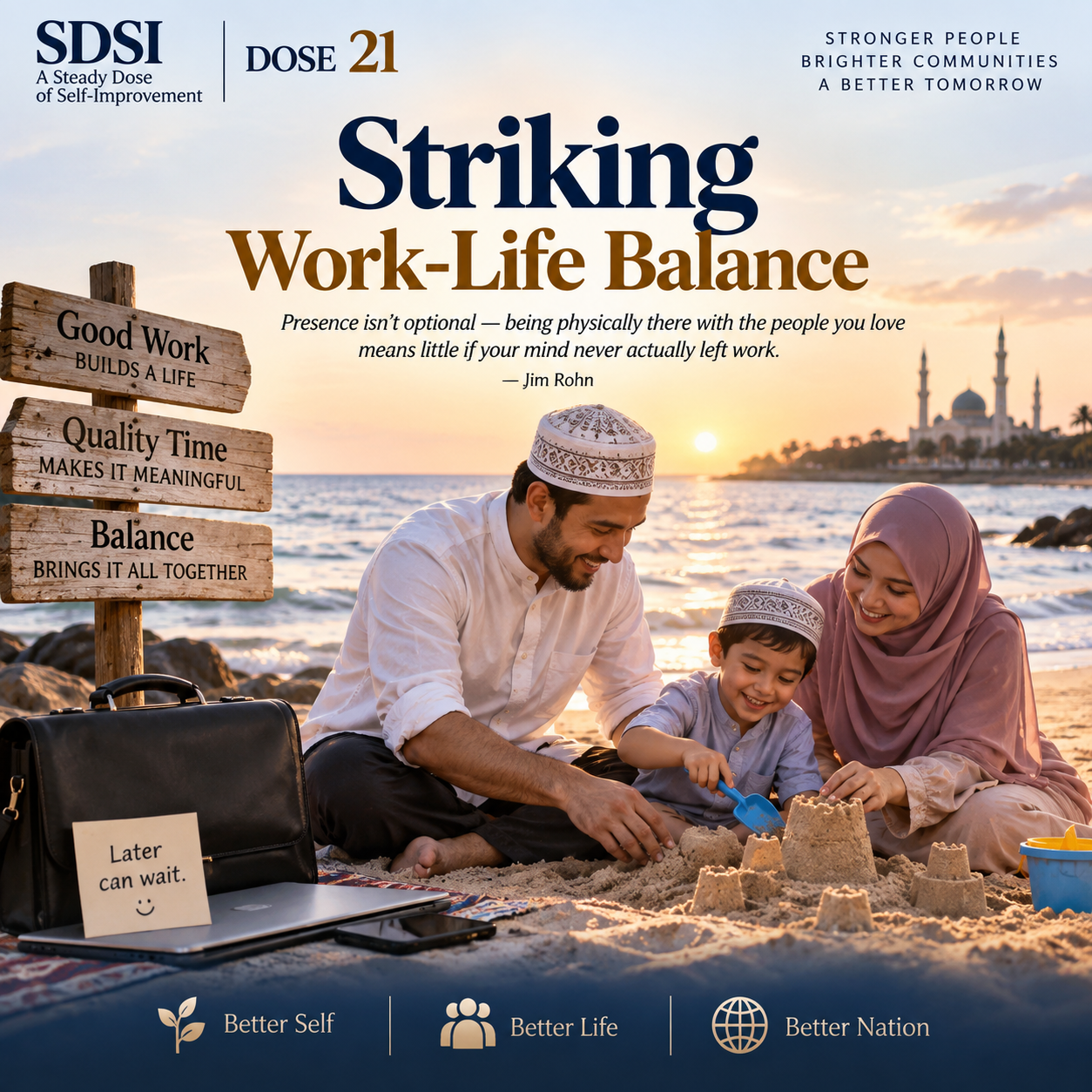
Presence isn’t optional — being physically there with the people you love means little
if your mind never actually left work.

Jim Rohn once took his family to the beach. He brought his briefcase.
Striking a balance between personal undertakings and professional endeavors is easier said than done. Yet few things matter more to the quality of our lives than getting this balance right. A life tilted too far toward work may make us productive while leaving us personally impoverished. But neglecting meaningful work and responsibility can also deprive us of the sense of purpose and accomplishment they provide.
Work-life balance is not simply a matter of dividing our hours equally between work and home. It depends not only on the time we spend physically at work, but also on the energy, focus, and attention that work continues to demand after we leave.
You can leave the office and still be psychologically at work — replaying problems, answering messages, planning tomorrow, or worrying about what remains unfinished. True balance therefore requires something more difficult than simply going home: learning to mentally disengage from work when work is done.
Jim Rohn illustrated this lesson with a simple story. He recalled taking his family to the beach while bringing his briefcase along. His family was not pleased. The lesson was unmistakable: being physically present with the people you love is not enough if your attention remains somewhere else.
Presence isn’t optional.
When you’re with your family, be with your family. When you’re resting, allow yourself to rest. When you’re working, give your work the attention it deserves. Balance comes not from giving everything equal time, but from giving each part of life the attention it deserves when its time comes.
Arianna Huffington learned a similar lesson far more painfully. After collapsing from exhaustion and injuring herself, she began questioning conventional definitions of success built primarily around money and power. Her experience eventually helped shape her advocacy for a broader measure of success—one that includes well-being, wisdom, wonder, and our capacity to live fully.
My own experience teaching at a university in South Korea has given me something I have learned not to take for granted: protected time outside work. My teaching schedule and semester breaks have allowed me time to write, connect with family, pursue personal projects, and simply rest.
That experience has taught me that time away from work is not necessarily time taken from productivity. Properly used, it can replenish the very energy, creativity, and perspective that make productive work possible.
Work is an important part of life.
But work is not life itself.
The goal is not to work less simply for the sake of working less. Nor is it to divide every day neatly into equal portions. The goal is to build a life in which professional accomplishment does not require sacrificing the people, experiences, health, and moments that make accomplishment worth having.
Pause and Reflect
When you’re with the people you love, are you truly present — or is work still occupying your mind?
One Step Forward
Choose a specific time after which you won’t check work messages tonight. Hold that line, even if it feels uncomfortable.
Explored in full in Chapter 13 — Work-Life Balance of A Holistic Approach to Self-Improvement.
Better Self… Better Life… Better Nation.
A Holistic Approach To Self-Improvement

Self-improvement is often treated as a collection of isolated goals—building confidence, learning new skills, developing better habits, or becoming more disciplined. But lasting transformation requires something more. It requires a holistic approach.
This book presents a practical framework that brings together the essential dimensions of personal growth into one integrated system. Rather than focusing on a single aspect of development, it shows how genuine and lasting change occurs when your beliefs, abilities, habits, and actions work together.
Through this book, you will discover how to:
• Build a strong value system that shapes your character and guides your decisions.
• Develop the competencies needed to navigate life’s personal and professional challenges.
• Establish a habit scheme that transforms good intentions into consistent action.
• Cultivate the self-discipline that binds every element into a sustainable way of life.
• Pursue lasting health, success, happiness, and fulfillment through balanced personal growth.
Grounded in research yet written in a clear and practical style, this book combines timeless principles, scientific insights, reflective exercises, self-assessments, and real-life examples to help you understand not only what to improve, but how meaningful transformation actually happens.
Whether you are a student, educator, professional, leader, entrepreneur, or simply someone seeking a more purposeful life, A Holistic Approach to Self-Improvement offers a complete roadmap for becoming your best self—one intentional step at a time.
Grow with purpose. Live with meaning.
Achieving Work-Life Balance: Strategies For Success

“You will never feel truly satisfied by work
until you are satisfied by life.”
– Heather Schuck
In this discourse, “work” refers to the professional responsibilities we either choose to embrace or are assigned, while “life” encompasses our personal existence, including inherent responsibilities and commitments we make. Achieving work-life balance is about finding equilibrium between our professional and personal endeavors, ensuring that neither is neglected at the expense of the other.
For many of us, our work or profession is a significant source of happiness and fulfillment. We derive satisfaction from applying the knowledge we’ve acquired and the skills we’ve honed through education and self-study. This sense of accomplishment, however, should not overshadow the importance of maintaining a balanced life.
Malik (2023) defines work-life balance as “the stability between the time, energy, and attention individuals allocate to their professional commitments and personal lives, including their family, social activities, hobbies, and personal well-being. It emphasizes the need to achieve a harmonious and satisfying integration of both work and personal aspects of life.”
Striking a balance between professional obligations and social responsibilities is easier said than done. It is far from a simple task, as giving equal attention to both areas of life can be challenging. Work demands can sometimes be overwhelming, leaving little time for self-care and nurturing relationships. Conversely, some individuals may prioritize personal and family matters at the expense of their workplace productivity, leading to a lack of fulfillment in their professional lives.
Achieving work-life balance is an essential skill for personal development. While it may be difficult, maintaining equilibrium between work and personal life is crucial for creating an environment conducive to growth and well-being.
When individuals learn to balance their professional and personal lives, they experience significant benefits. They can engage in self-improvement activities, such as furthering their education, learning new skills, and pursuing fulfilling hobbies. This balance also leads to better health, as reduced stress allows for engagement in activities that promote physical and mental well-being.
Moreover, a well-balanced work-life enhances productivity, creativity, and problem-solving abilities. A clear focus and improved concentration naturally follow when one’s life is in harmony.
Perhaps the most valuable outcome of achieving work-life balance is improving personal relationships. Spending more time with loved ones and friends strengthens these bonds, fulfilling our intrinsic need for social interaction. As social beings, meaningful connections are vital to our happiness and well-being.
The significance of balancing work obligations and personal life makes some consider achieving it not a matter of choice but a mandatory requirement in the pursuit of success.
The importance of balancing work obligations with personal life has led many to view achieving this equilibrium not as a choice but as a mandatory requirement for success.
Work-life balance is pursued at both the organizational and individual levels. However, maintaining this balance between the demands of a job or profession and personal obligations is largely a personal responsibility. In the workplace, managers aim to eliminate factors that could reduce organizational productivity. Whiting (2024) defines work-life balance as “the amount of time you spend working compared to the time you spend pursuing activities outside of work, measured in hours, enjoyment, or mental energy.” She adds, “Your work-life balance depends not only on the time you spend physically at work but also on the energy, focus, and attention that work demands even when you’re not in the office.”
Organizations clearly benefit when they implement programs that promote work-life balance. Whiting (2024), citing studies she reviewed, notes that employees who experience a balanced approach to work and personal concerns are more engaged. This heightened engagement improves the working conditions and profitability of the organization. She also emphasizes that work-life balance within organizations results in more engaged employees and helps prevent potential burnout, which can lead to poor health, decreased performance, and a toxic work culture.
The absence of work-life balance in the workplace can result in burnout and neglect of physical health, which may lead to severe health conditions. When employees lack time to recharge, they return to work less focused and less motivated, which reduces their productivity and creativity. Their decision-making skills are also compromised, leading to suboptimal choices and outcomes.
It is evident that work-life balance significantly influences employee performance. Naithani (2010) found that employees with poor work-life balance suffer from reduced productivity and lower job performance. In contrast, Roberts (2008) emphasized that employees with a healthy work-life balance show improved job performance. The findings of a study conducted by Susanto et al. (2022) confirmed the positive relationship between work-life balance and job performance, concluding that as an employee’s work-life balance improves, so does their job performance.
Employees are fortunate if they work in organizations where leaders recognize the importance of promoting work-life balance. However, in some cases, managers may not prioritize formulating policies that create a work environment where employees can fulfill their personal commitments without sacrificing their organizational duties. In such situations, it becomes the employees’ responsibility to find a way to strike a balance between their work and personal lives. Ultimately, work-life balance can and should be achieved at the individual level.
There are telltale signs of poor work-life balance or its complete absence. The most common indicators include burnout and difficulty sleeping. Those who fail to balance their professional and personal lives often feel like they are always working, unable to relax. This constant stress can lead to strained relationships with family and friends. If you experience these symptoms, it’s crucial to reassess your work-life balance.
The steps to achieve work-life balance are practical and straightforward, but the challenge lies in the willingness and determination to implement them. Experts suggest that the pursuit of work-life balance begins with setting clear priorities. It is essential to identify your top priorities in both your personal and professional life, which will allow you to allocate your time and energy appropriately. Drawing clear boundaries between work and personal life is vital.
Work hours should not encroach upon the time allocated for family, hobbies, and relaxation. For those committed to maintaining this boundary, disconnecting from the internet and keeping gadgets out of reach after work is vital. Emails and calls should be restricted to work hours, ensuring that personal time remains sacred.
Another critical component is spending quality time with family. It’s not about the quantity of time but the quality of the interactions. Disconnecting from technology and being fully present is the first step toward giving your loved ones the attention they deserve. Taking a break from social media when spending time with the family is also essential.
Equally important is allocating time for yourself. Your overall well-being should be a priority because success in your professional endeavors is meaningless if it comes at the cost of your health. It is possible to be both wealthy and healthy. Taking care of yourself involves regular exercise, maintaining a balanced diet, and ensuring sufficient sleep. Additionally, pursuing hobbies and engaging in activities you enjoy and contribute to your personal growth will further enhance your well-being.
Achieving a work-life balance is a desirable and essential component of a fulfilling life. The equilibrium between professional and personal commitments is crucial for maintaining physical and mental well-being. When this balance is neglected, the consequences can be severe, affecting not only individual health and relationships but also organizational productivity and culture.
Both organizations and individuals have roles to play in fostering work-life balance. While companies can implement supportive policies and create environments promoting well-being, it ultimately falls on each person to take responsibility for their balance. By setting clear priorities, drawing firm boundaries, and dedicating time to loved ones and personal care, individuals can navigate the challenges of modern life without sacrificing their health or happiness.
In essence, work-life balance is the foundation of a successful and meaningful life. It allows us to thrive in our careers while nurturing our personal relationships and well-being, leading to a more satisfying and well-rounded existence. Striving for this balance may be challenging, but the rewards are profound and far-reaching.
Overcoming Homesickness
 (A Personal Essay)
Longing for home – that’s the simplest way to explain what homesickness is. It is the feeling of sorrow that results from leaving behind loved ones and friends to go somewhere far, usually overseas, for a long period of time
Well, a lot have been written about the subject. The loneliness one feels when away from home is the theme of many essays, stories, and poems. There are also movies about homesickness and plenty of books and speeches sharing tips on how to overcome it are available.
As an expat working here in South Korea (since 2013), I can say that I am no stranger to homesickness. I am so familiar with this emotional experience. I know how it feels to be hundreds of miles away from the comfort of home and the warm embrace and assuring presence of friends and loved ones. I know how discomforting it is to be in an unfamiliar territory where almost everything is different from what one was accustomed to.
There are people claiming to have never experienced homesickness. Well, good for them. What about me?
I waged a battle against this emotional discomfort during my first weeks here in South Korea. I thought that mentally preparing for a departure from my comfort zone would be enough to help me overcome whatever challenges that await me in this country, including homesickness.
While waiting for the day I would fly to this country, I tried to prepare for it mentally by accepting that I would not be with my family for a long time and that my wife who takes good care of me and prepares everything I need wouldn’t be there to help. I thought that somehow I could also prepare emotionally for a life away from my country and my family by simply accepting that it would soon be my reality. I was wrong.
Excitement overwhelmed me when I came out of the plane at the Gimhae International Airport. I was so happy seeing South Korea for the first time and thinking of my good fortune for being given the opportunity to teach here. But the euphoria was short-lived. Upon entering the apartment the university provided, the reality that I was by my lonesome in a faraway place, something that I thought I have already fully embraced when I departed home, seemed like tiny needles starting to prick my emotions.
When I began unpacking, I recalled the conversation I had with my wife and my son while they were helping me stuff all those things in my luggage. I remember how the lady of my house tried unsuccessfully to control her tears. I remembered also the phone calls I made to my parents. It was less than a day of being separated from my family and I was already missing them. Just that and all of a sudden my first episode of homesickness kicked in. Sadness crept in slowly. The early spring weather giving me a chilly welcome exacerbated it.
I tried to dismiss the thought of me feeling homesick by thinking that I was just tired, hungry, and cold at that time. But the feeling lingered in the next days notwithstanding the heater in my room, the multiple layers of clothes in my body, and the hot and spicy foods on my table.
I dreaded the coming of night and the weekend for it meant being alone in my room. At least when in the workplace I have the company of my colleagues and my students and the work made me preoccupied.
During my first two weeks here in South Korea, I was in a funk and I knew I couldn’t afford to stay that way or else my job performance would be adversely affected. So, I resolved to eradicate the problem. I know I have in my repertoire of skills something that I could summon to help me figure out how to get out of the said funk – my ability to bounce back from adversity.
The first thing I did was stop denying that I was longing for home. I stared homesickness in the eyes. I treated it as a problem so I would be able to have the mindset that it could be resolved.
And much that I was missing home and my family, I tried to see if Skyping my loved ones in the Philippines longer than usual would help. Thank God It did. I pushed it further by requesting my wife as well that when we’re done talking she should not cut the Skype connection. I even told her to bring the laptop in any place in the house where I could see her and our son. That worked more wonders for me. Seeing my wife and my son moving around our house in the Philippines doing what they usually do and hearing the songs they listen to and other familiar sounds – the roosters crowing, the dogs barking, the horns of vehicles honking – was emotionally comforting.
It’s hard to believe but I had homesickness figured out within my first month here in South Korea. Thanks to Skype and Facebook Messenger. Thanks also to South Korea’s fast internet connection that allows me to make a video call with my family practically anytime and wherever I am – home, office, or even in the mountain when I was hiking.
I and my family could Skype as long as we want. But it couldn’t be for 24/7. There are times as well that my wife or my son have pressing concerns and other things to attend that makes connecting with them impossible.
Those are the times when I pursue my other passion – writing. I write stories, essays, poems, and research papers. I write in both English and Filipino. It’s only a hobby. Yes, sometimes I get paid for the things I write but I am doing it primarily for the immense joy and sense of satisfaction it gives me.
I have a lot of free time here in South Korea that I was able to create and maintain my own website (M.A.D. LIGAYA). The said website serves as repository for my writings.
Maintaining my website and creating its contents have been making me super busy so much so that I could no longer find time to be homesick.
There were times that I could not even Skype my family because I was busy attending to my website.
Nowadays, whenever people ask me how I got through homesickness I already have a definite response – through “Skyping” my family and writing.
Anyway, there are other activities that I do after work not only to keep homesickness away but to achieve work-life balance – watch movies and the sports I love, go to the gym, read books, and watch videos on personal growth and development. You may say I have a boring routine. But it works for me. Of course, I go out with a very few selected friends during special occasions. But basically, I am a lone wolf. That is by choice for I wanted to avoid vices, troubles, and negative conversations.



 M.A.D. L I G A Y A