Blog Archives
Personal Accountability

Personal accountability begins when you stop asking only who caused the problem
and start asking what part of the response belongs to you.

Put Yourself on the List
Jim Rohn had a blame list. His mentor pointed out the one name missing from it.
Jim Rohn often told a story about his mentor, Earl Shoaff, who once asked him, “Jim, just out of curiosity, tell me, how come you haven’t done well up until now?”
Rohn had an impressive list of explanations ready: the government, taxes, rising prices, the weather, traffic, company policies, inadequate training, negative relatives, cynical neighbors, the economy, and the community.
Shoaff listened patiently. When Rohn finished, his mentor identified the problem: Jim’s own name was missing from the list.
That realization changed him. Rohn discarded his collection of excuses, took a fresh sheet of paper, and wrote one word on it:
Me.
But personal accountability does not mean blaming yourself for everything that happens. Some hardships are imposed upon us. We do not cause every injustice, illness, rejection, betrayal, accident, or disadvantage we experience. Holding yourself responsible for what was never within your control is not accountability—it is misplaced guilt.
Accountability means looking honestly at what was yours: your decision, your effort, your preparation, your conduct, your promise, your mistake, or your response.
It allows you to say, This situation may not be entirely my fault, but what I do next is still my responsibility.
One of my favorite poems is William Ernest Henley’s Invictus. Its closing declaration has remained with me: “I am the master of my fate: I am the captain of my soul.” To be the captain does not mean controlling the sea. A captain cannot command the wind, silence the storm, or remove every obstacle beneath the water. But the captain remains responsible for reading the conditions, adjusting the course, protecting the vessel, and deciding what to do next.
This is where personal accountability follows seizing control. Seizing control means recognizing that you still possess agency. Personal accountability means answering honestly for how you use it.
When something goes wrong, blame asks, Whose fault is this? Accountability asks more useful questions: What part of this belongs to me? What could I have done better? What must I repair? What will I do differently next time?
Accountability is not humiliation. It does not require endless punishment for past mistakes. Its purpose is growth. Once you acknowledge your part, you recover the power to learn, apologize, make amends, improve, and choose differently.
Other people may belong on the list. Circumstances may belong there too. But before you finish writing, make sure your own name has not been conveniently left out.
Pause and Reflect
In one unresolved problem in your life, what part genuinely belongs to you?
Have you been protecting yourself with an explanation that prevents you from changing?
One Step Forward
Divide a page into two parts: Not Mine to Control and Mine to Own. Write one present difficulty under both headings, identify your responsibility, and take one corresponding action today.
Explored more fully in Part 2 — Section I — Chapter 3, “Personal Accountability,” of A Holistic Approach to Self-Improvement.
Better Self… Better Life… Better Nation.
A Holistic Approach To Self-Improvement

Self-improvement is often treated as a collection of isolated goals—building confidence, learning new skills, developing better habits, or becoming more disciplined. But lasting transformation requires something more. It requires a holistic approach.
This book presents a practical framework that brings together the essential dimensions of personal growth into one integrated system. Rather than focusing on a single aspect of development, it shows how genuine and lasting change occurs when your beliefs, abilities, habits, and actions work together.
Through this book, you will discover how to:
• Build a strong value system that shapes your character and guides your decisions.
• Develop the competencies needed to navigate life’s personal and professional challenges.
• Establish a habit scheme that transforms good intentions into consistent action.
• Cultivate the self-discipline that binds every element into a sustainable way of life.
• Pursue lasting health, success, happiness, and fulfillment through balanced personal growth.
Grounded in research yet written in a clear and practical style, this book combines timeless principles, scientific insights, reflective exercises, self-assessments, and real-life examples to help you understand not only what to improve, but how meaningful transformation actually happens.
Whether you are a student, educator, professional, leader, entrepreneur, or simply someone seeking a more purposeful life, A Holistic Approach to Self-Improvement offers a complete roadmap for becoming your best self—one intentional step at a time.
Grow with purpose. Live with meaning.
NOT BROKEN… BUT UNFINISHED (2)
(A Personal Essay)

“Sometimes good things fall apart so better things can fall together.”
– Anonymous –
National Limbo: The History We Inherited Without Choosing
Growing up, I never understood why so many Filipinos carried a quiet heaviness when they spoke about the country. It wasn’t anger. It wasn’t despair. It was something older — a tired acceptance that things were the way they were, and maybe always would be.
I used to hear it from my father.
“Ganito talaga sa Pilipinas,” he would say when we watched the news on TV when I visited him in our hometown.
Not with bitterness. Not with outrage. But with resignation.
It wasn’t until I lived abroad that I understood the weight behind those words.
We were a nation interrupted. A people whose revolution was cut short. A country whose identity was never fully forged.
Our fragmentation did not begin in the present. It was shaped by centuries of divide‑and‑rule, a strategy that kept us scattered — not just in geography, but in identity. We were on the verge of becoming a unified people, only for that moment to be taken from us; our revolution was halted before it could fully forge a national self.
What might have been a defining victory against one colonizer became an unfinished chapter when another, more powerful, intervened — leaving behind not just a political scar but a psychological one, a lingering uncertainty about our capacity to shape our own destiny.
We inherited fragmentation — tribal, regional, political.
We inherited resignation — “pwede na,” “bahala na,” “ganito talaga.” We inherited a sense of “almost.”
Almost free. Almost united. Almost empowered.
But never fully.
We were not broken. We were unfinished.
Even the political theatrics I watched from afar were not anomalies; they were traces of an unfinished identity, performances formed by generations who had learned to survive uncertainty by turning it into spectacle.
We are an archipelago not just in geography, but in identity—a collection of over seven thousand islands intentionally scattered by a history of divide-and-conquer. Living in a country as hyper-connected as Korea, I see how our fragmentation has become a mental habit, a quiet belief that unity is a fantasy and that we are destined to remain an incomplete manuscript.
But an unfinished page is not a tragedy; it is simply a call for the writer to pick up the pen again.
And unfinished things can still be completed — but only if someone chooses to finish them.
The Turning Point: My Personal Purgatory
One afternoon in a small café in Seoul, while working on my book, I wrote a phrase about responsibility—a line I had written many times before.
I looked at the screen, at the Garamond typeface I had carefully chosen. It is a font that carries the organic stroke of the human hand, yet adheres to strict, classical rules of proportion. It occurred to me then how much I craved that balance for my own country; it stood in such sharp contrast to the handwritten chaos of our streets back home, where everything from jeepney signs to public discourse feels improvised and loud. I realized that if paradise is a discipline, it must look a lot like a well-set page: ordered, intentional, and respectful of the space it occupies.
I looked away from the monitor, the clean lines of the font blurring as I stared at my own reflection in the glass.
But that day, my writings talked back at me.
How could I write about responsibility when I had shunned my own? How could I speak of accountability when I had mistaken silence for neutrality? How could I talk about transformation when I had left my country rather than help it change?
I could not bear my own writing confronting me. The truth on the screen served as a reflection I wasn’t yet ready to face, but could no longer deny.
I closed my laptop—the gentle click sounding like an ending—and stared out the window.
Outside, the first hints of spring were beginning to touch the air — not warmth, not yet, but the suggestion of it.
People walked with purpose. Cars moved in clean lines. The city breathed with discipline.
And I realized:
I had grown up in a country that taught me to endure, but I was now living in a country that taught me to improve.
That contrast broke something open inside me.
For the first time, I understood that my frustration with the Philippines wasn’t rooted in hatred — it was rooted in love.
At that moment, I made a quiet promise:
I will stop being a spectator. I will stop being a critic from afar. I will stop being part of the silence.
That was the beginning of my ascent.
The Ascent: What Paradise Means to Me Now
The hell I saw in our country wasn’t just political — it was spiritual. It was the result of millions of small choices, including mine.
I visualize a classroom where students speak without fear—not because they are confident, but because they are encouraged to try.
I imagine offices where people no longer feel the need to know someone just to be heard. I imagine elections where conversations are determined by ideas, not incentives.
I imagine a bus stop—not unlike the one in Haemi—where people line up not because they are forced to, but because they understand that order is not oppression. It is respect.
These are not impossible visions. They are habits waiting to be formed.
But habits do not emerge on their own. They are formed in moments so small they are often dismissed—moments when no one is watching, when no reward is guaranteed, when the easier choice is to look away.
They are formed when a student chooses honesty instead of convenience, even when cheating would go unnoticed. When a worker completes a task with care, even when no one will praise them for it.
When a citizen follows a rule, not out of fear of punishment, but out of respect for others.
These instances do not make headlines. They do not go viral. But they accumulate.
Quietly.
Consistently.
And over time, they shape something larger than themselves.
A culture is not built in bold proclamations. It is built in repetitions—of discipline, of restraint, of responsibility. It is built when the right choice becomes the natural choice.
And perhaps that is where we must begin—not with sweeping reforms or distant promises, but with the silent decision to do what is right, even when it feels insignificant.
Because in the end, nations do not rise via moments of brilliance alone. They rise through habits that refuse to break.
And if hell is built through choices, then so is paradise.
Paradise is not a place to be found. It is a culture. A discipline. A collective decision.
It is built when a citizen refuses a bribe. When a voter chooses integrity over popularity.
When a family teaches discipline instead of entitlement. When a community chooses unity over division. When a nation chooses accountability over excuses.
Paradise is not perfection. It is an effort.
And for the first time, I began to imagine what a Filipino paradise might look like:
A nation where we disagree without destroying each other. Where we demand better without waiting for saviors. Where we build systems that outlast personalities. Where we take pride not in slogans, but in discipline. Where progress is not a miracle — but a habit.
That is the paradise I now hold in my heart.
Not a fantasy. Not a dream. But a direction.
Returning to the Bus Stop
Months after that autumn morning in Haemi, I found myself at the same bus stop again. Students lined up as they always did, quiet and orderly.
Winter had passed. Most of my reflections had taken shape during those long, dark winter nights when silence made certain truths harder to avoid. It was already spring, but the air was still cold, sharp enough to sting my cheeks.
The bus arrived — on time, as always — and the driver gave me the same small nod.
But this time, something felt different.
I no longer felt grief. I felt responsibility.
As the bus rolled through the clean, orderly streets, the signs of Korea’s progress came into view again — quiet reminders of how far my own country had been left behind.
I no longer felt envy. I felt clarity.
I no longer felt like a Filipino escaping hell. I felt like a Filipino preparing to climb out of it. The thought of leaving had once tempted me, but now I understood that escape was not the same as ascent.
I am currently retitling a book I have written, a task that requires me to be a ruthless editor of my own thoughts. Just as a book suffers when an author protects a line that no longer serves the story, I’ve realized our nation fails when we protect partisan loyalties that don’t serve the truth. Revision is a form of purgatory—it is the painful, meticulous act of deleting the excuses and the ‘pwede na’ mentality to make room for something that actually works.
As the bus moved through the clean streets, I pressed my forehead against the window and watched the city pass by.
And I realized:
Paradise is not a destination waiting for us. It is a path we must choose to walk. And the first step is always taken within.
That morning, I made a quiet vow:
I will not abandon my country.
I will not abandon my people.
I will not abandon the possibility of our ascent.
Because hell is not permanent.
Purgatory is not hopeless.
And paradise is not impossible.
We only need the courage to begin.
And I have begun.
NOT BROKEN… BUT UNFINISHED (1)
(A Personal Essay)
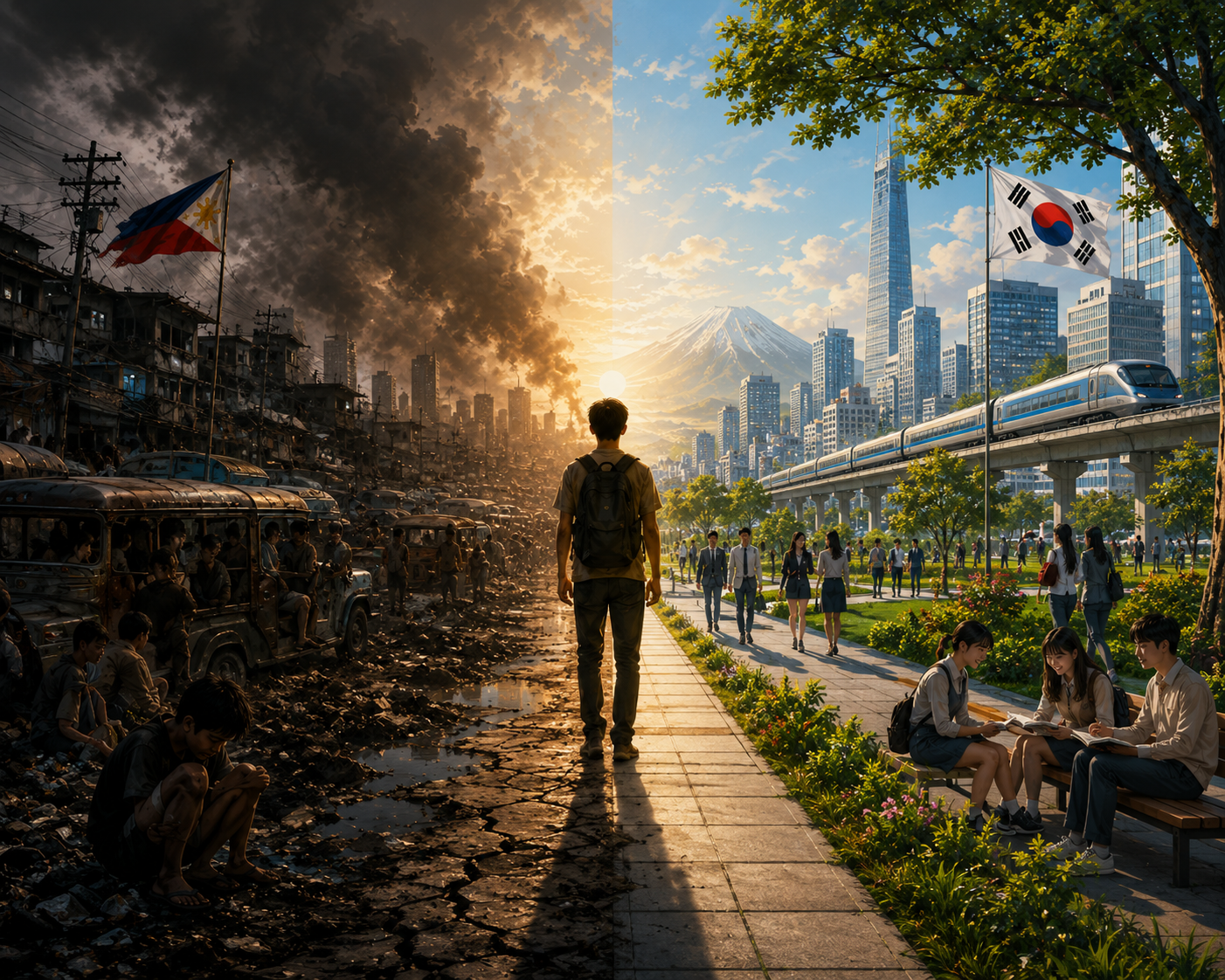
“The darkest places in hell are reserved for those who maintain
their neutrality in times of moral crisis.”
~ Dante Alighieri ~
The Morning I Began to See
I still remember the exact moment something within me changed.
On a cold autumn morning in Haemi — the quiet South Korean suburb where I had been teaching for years — the sharp air and pale sky conspired to make everything feel unusually clear. At the bus stop, middle school students lined up in silence. No pushing. No shouting. Just an unspoken agreement about how shared spaces ought to be used.
The bus arrived on time. Students filed in calmly. I tapped my card; the driver gave me a small nod — not indifferent, not effusive, just a quiet acknowledgment that I was part of the system and the system had noted my presence.
The doors closed with certainty. No scrambling. No negotiation for space. Just an invisible agreement, honored without ceremony.
During the silent commute, my thoughts drifted home. I pictured the relentless noise: engines gunning, barkers shouting, horns bleating without pause. A system always on the brink — not of collapse exactly, but of something we had long mistaken for life.
And that was what unsettled me the most.
I remembered a different bus stop from years ago, back home. People pushed. The driver cursed. The day felt like something to survive, not something to trust. I remembered the heat, the dust, the impatience. Everything slightly off-balance — like a system not functioning but merely persisting.
What I felt then was grief. A quiet, hollow ache for a country I loved but now saw with terrible clarity: trapped — not by a single catastrophe, but by the slow accumulation of small disorders and smaller resignations. Not the scandals themselves, but the quiet expectation beneath them that nothing would change, and no one would be held to account.
The realization went deeper: we were not cursed. We were only accustomed to living with the fire.
As the bus passed streets where even the smallest details hinted at a nation steadily shaping its future, a question I had avoided for years finally surfaced:
How had we fallen so far behind?
More painfully:
What part had I played?
That quiet bus ride in Haemi was the beginning of a difficult journey — one that required me to confront not just my country’s failures but my own. And it set the stage for a deep-seated reflection.
The Stark Contrast
When I arrived in South Korea, I did not come with theories about governance or national identity. I was simply another Filipino abroad — carrying hope, fear, and the particular stubbornness of a person determined to make things work.
Korea became a mirror. It reflected truths I had spent years avoiding.
It started with small things — moments that accumulated quietly, each one altering my understanding a little more.
The first time I walked into a Korean government office, I braced myself for the familiar dread: the long lines, the missing forms, the irritated clerks. I felt the old instinct rising — the feeling that I was about to beg for something that should simply have been mine by right.
Instead, a woman smiled, bowed slightly, and asked how she could help. Her manner was calm, her movements efficient, her respect genuine. Fifteen minutes later, I stood outside with my documents already processed.
I paused on the sidewalk, papers in hand. Out of habit, I glanced around — looking for the fixers. Back home, they hovered outside government buildings, offering shortcuts for a fee, quiet reminders of how thoroughly we had normalized inefficiency. Here, there was nothing of the sort.
For a moment, I simply stood there waiting for something to go wrong.
Nothing did.
In that stillness, I understood something I had never articulated before: all my life, I had been conditioned to expect difficulty — even when none was required. Ease itself had become unfamiliar.
That night, I sat in my apartment staring at the papers on my table. It was not the efficiency that stayed with me. It was the dignity. For the first time in a long time, I had felt like a citizen — not a supplicant, not a burden, not a problem to be processed, not somebody to be taken advantage of.
That feeling followed me everywhere.
Into streets cleaned before dawn. Into lost wallets returned with every bill still inside. Into the way elders were treated as honored members of a community, not inconveniences to be managed. Into rules followed out of shared responsibility, not fear.
I remembered the first time I entered a Korean bank. No armed guards. No shotguns propped by the door. Just a middle-aged woman ushering customers with quiet warmth. Back home, two guards with shotguns stood outside every branch, a third positioned just inside. It was a small detail — but it revealed how differently each society imagined danger, trust, and the public space we all shared.
Once, I watched a man drop a piece of paper on the sidewalk. A teenager picked it up and returned it with a bow. Responsibility was not taught in that moment. It was lived.
Korea was not simply better because it was richer. It was because its people believed they deserved better — and acted accordingly.
Back home, resignation had become the norm. And if systems truly reflect the people who build them, then what did our systems say about us?
That question stayed with me long after the bus reached its stop.
A Tale of Two Citizenships
Living in Korea forced me to examine something I had never fully confronted back home: the quiet power of citizenship. Not the legal kind printed on a passport, but the lived kind — expressed in daily habits, in unspoken agreements, in the hidden threads that hold a society together.
In Korea, I saw how people behaved as if the public space belonged to them — and therefore, they were responsible for it. Streets were clean not because someone was watching, but because everyone believed they should be. Lines were orderly, not because of fear, but because of mutual respect. Even the smallest rules — recycling, queueing, returning trays in restaurants — were followed with a feeling of shared duty.
Back home, I had grown up with a different rhythm.
I grew up where rules were treated as suggestions, public spaces were battlegrounds, and people bent systems that rarely bent for them. I learned to expect delays, disorder, and disappointment. I navigated life with improvisation, instinct, and resilience—a Filipino’s armor.
But Korea showed me something I had never seen so clearly:
resilience is admirable, but it is not the same as progress.
In Korea, I came to trust systems: I believed things would work as designed, so I depended on established rules and processes. In the Philippines, I learned to trust people: I relied on relationships, favors, and personal networks to fill the gaps left by institutions.
“Kaylangang may backer.”
Neither culture was inherently superior; they were simply influenced by different responses to their circumstances. The contrast clarified what worked—and what didn’t—for each society.
Both were formed by history, by struggle, by circumstance.
But the contrast forced me to face a truth I had consistently ignored:
Systems are not built solely by governments.
They are built by citizens — by the habits we practice and the behaviors we tolerate.
And upon that realization, I saw my personal reflection more clearly than ever.
The more I came to understand Korea, the more I began to see the Philippines with new eyes. I did not see with judgment, but with a painful clarity I could no longer escape.
Watching the Philippines from afar, I experienced a familiar ache—not for specific events, but the patterns I recognized in myself. I heard exhaustion in voices, frustration in posts, resignation in jokes. Systems struggled, and citizens struggled to trust. Beneath it all was collective fatigue—a nation moving forward, weighed down by habits we never confronted. It was painful, not because it was new, but because I could no longer ignore it.
Reading the news about the Philippines often felt like watching a tragicomedy. It made me laugh at first, until I saw the humor was only masking something intensely painful. The public arguments, mudslinging, and the way people chose sides, with the intensity of sports rivalries, all seemed absurd and heartbreaking. What unsettled me most wasn’t the disagreements, but how quickly we turned them into spectacles. We forgot that under every insult and accusation were real people trying to make sense of a system they no longer trusted. It seemed as if the nation had become a stage. Frustration and entertainment blurred, and we’d grown so used to the noise that we hardly noticed its cost.
Meanwhile, Korea exported stories that fascinated the world—dramas made with discipline and imagination. At home, our screens showed stories that were loud, chaotic, and painful political theater. One nation entertained with fiction; the other was locked in a cycle of real-life drama that no longer entertained but quietly drained the spirit of its people.
And once I saw myself more clearly, the memories I had deeply buried started to emerge — not as distant recollections, but as images reflecting the habits we had normalized back home.
And as I saw my country more clearly, the memories I had buried began to surface.
The Descent: Memories That Haunt Me
And as if in answer, my past started to speak. The more comfortable I became with life in Korea, the more memories from home resurfaced — memories I had suppressed amid the noise of daily survival.
It was deep winter then, the kind that forces you inward. In those long, silent nights, memories I had suppressed amid the noise of daily survival began to thaw.
I remembered election day when I was younger. I stood nearby. The envelope passed quickly, almost as if it didn’t matter. My neighbor slipped it into his pocket, grinning as others laughed.
“Pang-ulam,” he said.
At the time, I laughed too — not because it was funny, but because everyone else did. It felt easier to belong than to question. I did not yet understand that moments like that were the architecture of the system we would spend the rest of our lives complaining about.
No one objected. No one spoke.
And neither did I. That silence would follow me.
I remembered a barangay captain distributing sacks of rice every Christmas — but only to those who attended his rallies. I remembered people lining up for hours, not out of belief, but because hunger does not negotiate with principles.
I remembered political arguments that tore families apart, destroyed friendships, and worse, had people getting killed. I remembered truth becoming optional. I remembered corruption becoming a punchline. I remembered how we defended politicians as though they were blood relatives, even as they failed us again and again.
And I remembered my own silence.
The times I shrugged. The times I said,
“Ganun talaga.”
The times I accepted dysfunction as the natural order. The times I laughed at what I should have condemned. The times I chose comfort over courage, and called it wisdom.
Those memories followed me like shadows through every clean street, every orderly queue, every moment of dignified efficiency I experienced in Korea. Every time I felt respected, I remembered what it felt like not to be.
We were not simply victims of a broken system. We were its authors. We wrote ourselves into the descent.
The Mirror: How I Realized I Was Part of the Problem
The mirror did not leave me. One night, alone in my apartment, scrolling through news from the Philippines, I experienced the familiar anger rising in me — the kind that blames, condemns, curses the government, curses the system, curses the country.
I had devoted months shaking my head at the tragicomedy unfolding back home, forgetting that I once had played my part in it — through silence, through resignation, through the small compromises I had convinced myself were harmless.
There was even a moment when I considered pursuing Korean citizenship — not out of disloyalty, but out of exhaustion. I felt I was tired of being Filipino, but what I was truly tired of was the helplessness that came with loving a country caught in its own cycles. It wasn’t my identity I wanted to escape; it was the pain of watching a nation I cared for stumble again and again.
But then something inside me burst.
I asked myself a question I had been avoiding for years:
“What have I done differently?”
The question lingered longer than any answer I could produce.
I had left the country. I had escaped the chaos. I had built a life elsewhere. But had I changed anything? Had I spoken when speaking was needed? Had I acted when action was required? Had I taken responsibility for any of it?
Or had I simply abandoned ship and watched it sink from a safe, comfortable distance?
That night, the truth arrived without mercy: I was angry at a nation I had quietly abandoned. I was disappointed in people whose flaws I shared. I was grieving a country I had not loved loudly enough or fought hard enough to save.
And that was the moment — the real beginning of my purgatory.
Honestly, I realized, it’s the first step out of hell.
An Invitation (YouTube Channel Teaser)
Is self-improvement an end in itself or a means to achieve an end?
By introducing a comprehensive paradigm for self-improvement, I do not seek to complicate the process of personal growth, but rather to present a realistic framework that brings together the many constructs essential to it. There are two serious loopholes in self-improvement schemes promoted nowadays. The first one is the promise of becoming the best version of yourself in a few days or weeks. And the second is the attainment of full potential, being floated as a goal to be achieved rather than a process to be undergone.
Self-improvement is not an end in itself but rather a means to achieve an end. It is not a destination. It is the path to reach a desired destination.
I believe that there is no shortcut, no magic pill, and no single technique that can instantly transform one’s life. Genuine growth requires cultivating the right attitudes and beliefs, developing essential skills and abilities, and consistently practicing positive habits and activities. This holistic approach recognizes that lasting change arises from deliberate effort across multiple areas of life.
Your Blame List

The last time we came to work late, was it the traffic or the weather that we blamed? Or was it the alarm clock’s fault for it didn’t go off? Ahh, the battery of the cellphone went dead.
When we had a break-up with a lover (or a major falling out with a friend), who did we blame? Ourselves or the other party?
Whenever something goes wrong, seldom or rarely (or is it never?) do we hold ourselves responsible for it. We always point our finger at something or hold others accountable. When things don’t turn the way we expect them to, we are always ready to check our blame list to find somebody or something to put the liability on.
This reminds me of one of the narratives of Jim Rohn.* He said that one day he was asked by his mentor Earl Shoaff, “Jim just out of curiosity tell me how come you haven’t done well up until now?” What Mr. Rohn did, according to him, for him not to look too bad, was read on his list of why he wasn’t looking good and not doing well. He blamed, among other things, the government, weather, traffic, company policies, negative relatives, cynical neighbors, economy, and community.
What about our personal blame lists? Is it as long Mr. Rohn’s. Perhaps it’s longer.
Who do people who could not find jobs blame? Of course the favorite whipping boy – the government. They contend that it is the duty of the government to create job opportunities for them. That is true. But work is something that is not going to be awarded to anybody on a silver platter. We have to search for it and we ought to be prepared. It is our responsibility to get ourselves ready for employment. Get the required education or training. We need to have the necessary knowledge and skills.
What if you could not get the education and training you need? Well, whose fault? Okay, I will give you time to check your blame list.
Done?
Now let’s continue.
Common sense will tell us that the government cannot possibly provide each citizen with a job. It is also impossible for the private sector to employ everybody. That’s just the reality. Harsh it may be. So, what should we do? Simple – be competitive. Be the best in your field or profession. The best ones are always on top of the priority lists of prospective employers. And if in our respective countries there are no job opportunities, or we won’t get the salary we want, let’s consider applying for work overseas. If you’re not satisfied where you are, go somewhere else.
“You can always move out from where you are now to find yourselves better opportunities. You’re not a tree.” That’s also from Mr. Rohn.
The ones who won’t get employed, or do not want to work for others because they have better plans for themselves, could perhaps succeed as entrepreneurs. Not everybody is trained to be in a workplace and be someone else’s employee. Some of us will be farmers, or fishermen, or plumbers, or drivers, or gardeners. There is always a way to earn an honest living. Whatever it is that we find as a source of livelihood, let’s us be thankful.
Accept the reality that some are rich and some are poor. And hey, don’t blame the rich if they don’t want to help the poor. Don’t blame your rich siblings, friends, and neighbors if they don’t share with you their blessings. It’s either you work as hard as they did for you to have what they have or be content with what you are capable of having.
Just bear in mind that each of us has a choice to A – Be rich; B – Have the means to meet both ends and at least get extra cash to afford some luxuries in life; or C – Have 3 square meals a day. Yes, I consider A, B and C as choices. It’s up to us to decide what to aim at… which of the three would make us happy.
Some people live simple lives happy to be able to eat three times a day. Some set their ceilings high and sometimes even go through it. Each of us has a chance at A. Nobody would prevent us from wanting to become rich. But becoming that won’t be easy… unless you win millions in the lottery.
There are two ways to go (and robbing a bank is not one of them) for those who would aim at A – hope that you hit that lotto jackpot or work as hard and wisely as those who became millionaires and billionaires did.
And when you fail to be so… when you fail to achieve your dreams and realize your goals… blame no one.
People who suffer from setbacks and face adversities would more often than not blame their friends or family members – parents, siblings, children, spouses – citing lack of support. Let’s not forget that support is something that is given voluntarily. It is not an entitlement. We could say that it is the obligation of our loved ones to help us. But what if they are not capable of helping for just like us they also need help or they also have problems of their own?
Or what if they have the capacity to support but they won’t? That would bring us to another “don’t” aside from don’t blame. That is don’t expect. If we get support in the pursuit of our dreams and goals we should be thankful. If not, our fight goes on. It’s not the end of the world. We should always be ready to fight our battles alone.
And please, let’s not blame our parents also if we are not doing well in life. Let’s not accuse them of not paving the way for us and ensure that rolled in our paths to better lives is a red carpet. Whatever kind of parents we have (or had) – good or bad – they ceased to be in control of us and our future the moment we became capable of deciding for ourselves. The question is, “What did we do when we sat in the driver’s seat of our lives?” Did we do everything we could to ensure that we succeed in our endeavors? Or did we expect that success is like the manna that fell from heaven which the Israelites in the Exodus just freely picked up?
Remember the narrative of Mr. Rohn? It did not end after he made a litany of the reasons why he was not succeeding and who and what should be blamed for that. Mr. Shoaff patiently listened to him and at the end said the following, “Mr. Rohn, the problem with your list is you ain’t on it!”
Before Mr. Rohn decided to work for Mr. Shoaff, he tore off his old blame list and replaced it with a new one where he wrote the only reason for not doing good in life – “ME.”
Now, let’s review our personal blame lists? Are we included on it? Or we automatically assign fault to something or someone for the misfortunes and failures that befall us?
Something that we should understand and accept is whatever we have become, wherever we are in the socio-economic pyramid, and whatever we have and don’t have, are the results of all the decisions we made. Others may disagree but I believe that our destiny is the sum total of all our decisions and indecisions.
We disagree in our interpretation of destiny. Theists believe that whatever happens to us is the will of a supreme being. I also believe that God exists but I think that we chart our own destiny. He gave us the gift of volition so we could have the dignity to decide for ourselves.
So, if we are not succeeding in our endeavors, if we are not healthy, and if we are not happy, we only have ourselves to blame.
__________
* Jim Rohn was a successful American entrepreneur and motivational speaker and his net worth before his death, according to estimates, was $500 million.
The Road To Self-Improvement: A Collection of Essays

I gathered in this part of my website the essays I have written about personal growth and development. I want to share the lessons and insights I learned from motivational speakers whose books (and videos on YouTube) have given me the blueprint on how best I could restructure my way of thinking so I could make better decisions in the different areas of my life.
I have been experiencing amazing changes in my life that I started regretting why didn’t I dig into these personal development stuffs when I was younger. I have heard a lot about “positive thinking” and related ideas before but I did not pay attention. But as the saying goes, “better late than never.”
I came to realize that “positive thinking” is but the first step in a person’s journey to a better self and a better life. It’s not the be-all-end-all of personal growth and development. But it all begins in setting a positive mindset. Positive actions should follow. People are in a better position to succeed when they break free from limiting beliefs and debilitating attitudes.
My goal in writing these essays and have them put together in this corner of my website is to help promote awareness on personal growth and development. I am not (yet) an expert in this field. I just want to share the little things I have learned so far and to say that I am so happy with the results I am getting.
**********
Cultivating a Positive Mindset



 M.A.D. L I G A Y A