Category Archives: Self-Discipline
The Self-improvement Paradigm
According to Jim Rohn, “Success is not to be pursued, it is to be attracted by the person you become.” Imagine success as the fruit of a tree. A tree has to grow and mature. It will reach a certain stage of maturity that allows it to bear fruits. Imagine yourself as that tree. You have to grow and mature. The person you see at the end of the process of growing and maturing is what Jim Rohn refers to as the person you become. The fruits you bear or the success you achieve depends on the kind of tree you would turn into. And you have to become the best version of yourself. That’s the kind of tree you should be. You need to reach your full potential so you would bear the best fruits.
Self-improvement is the key to becoming the best version of yourself. If you succeed in getting to the end of the road to self-improvement, you reach your full potential.
But self-improvement is a complicated process. It is easier said than done. It requires the possession of certain beliefs, attitudes, and characteristics that will make up your value system. It requires also the acquisition of certain skills and abilities and the development of certain practices and habits.
The right beliefs, attitudes, characteristics, skills, abilities, practices, and habits, together, are the catalysts of self-improvement. However, having them is not enough. Something else is needed in order to make them work. Without it any attempt to reach one’s full potential is bound to fail. What is it? It’s self-discipline.
Self-improvement is not as simple as just being able to think positively. Positive thinking is but a tip of a huge iceberg called personal growth and development.
Self-improvement is a tedious process. Its ultimate goal is becoming the “best self” or achieving one’s full potential. As previously mentioned, certain beliefs, attitudes, characteristics, skills, abilities, practices, and habits are required. But possessing the said requirements is not enough. Consistency is needed in their pursuit. Thus, self-discipline is also needed.
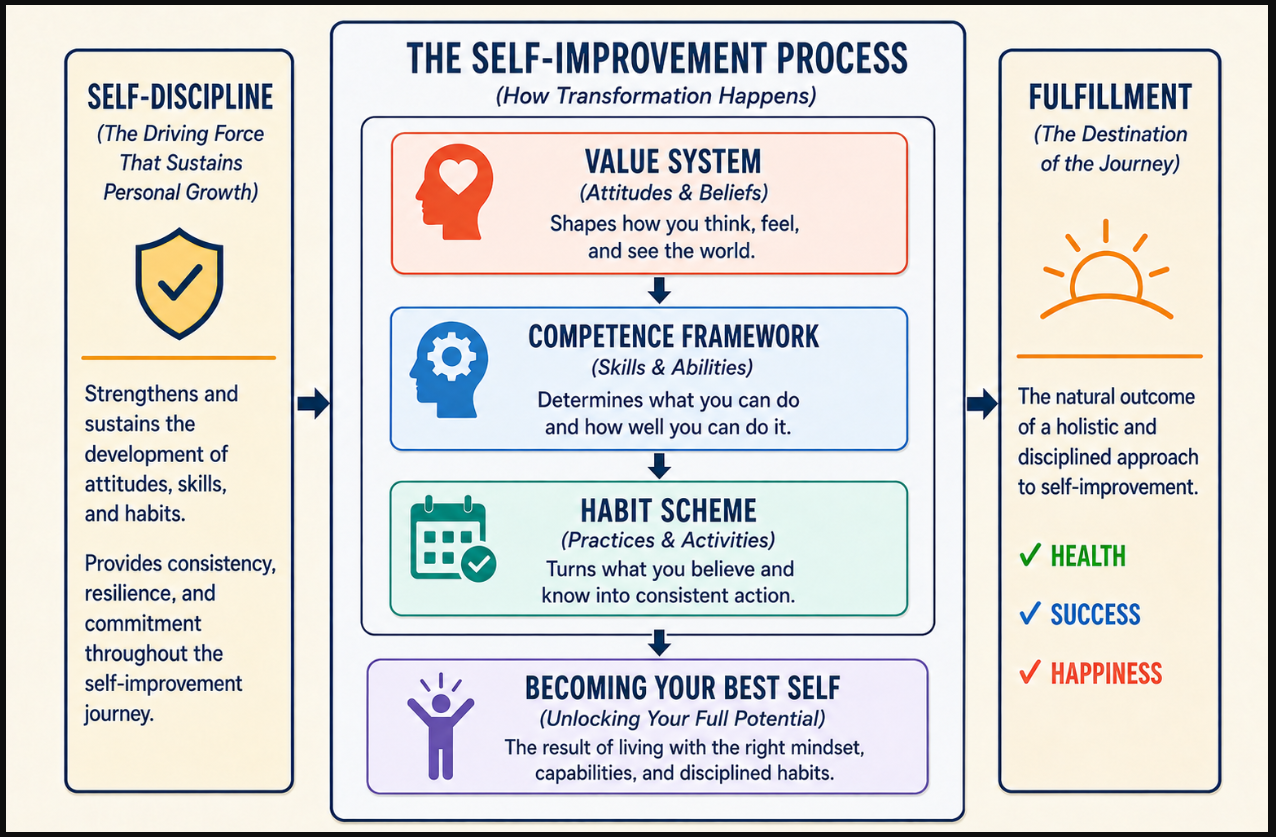
In thes book that I am currently working on (A Paradigm for Self-Imrovement), I will encapsulate the interrelationships among these categories and self-discipline into a paradigm, illustrating how their synergy yields an effective process of self-improvement that leads to the attainment of one’s full potential.
The paradigm is divided into three sections: left, middle, and right. The middle section comprises three parts: the dimensions of self-improvement, the self-improvement process, and the concept of full potential, also known as the best self. The dimensions of self-improvement in this book are generally categorized as the attitudes & beliefs (value system), skills & abilities (competence framework), and practices & activities (habit scheme) that a person pursuing personal growth and development should acquire, possess, or develop. These elements come together through the self-improvement process, forming the second part of this section. This process aims to help one become one’s best self—not as attaining perfection but as unlocking one’s full potential.
The left section of the paradigm highlights a crucial requirement for self-improvement: self-discipline. The paradigm illustrates how self-discipline continuously influences the process; even after one has achieved one’s full potential and become one’s best self, self-discipline remains essential. Self-discipline bolsters personal growth and development, forming the foundation for consistent progress and sustained fulfillment.
The right section of the paradigm illustrates the outcome of the self-improvement journey—fulfillment, marked by health, success, and happiness. This fulfillment represents not only the achievement of personal goals but also a deep sense of completeness and satisfaction that comes from living in alignment with one’s true potential. It is the reward for the dedication and discipline invested in becoming the best version of oneself.
Through self-improvement, individuals develop attitudes and beliefs, acquire skills and abilities, and engage in practices and activities to navigate life’s complexities with confidence and purpose. This transformation empowers them to achieve personal success, sustain a healthy state of being, and experience genuine happiness.
Those who achieve their full potential and become their best selves succeed in personal and professional endeavors. They become healthy, successful, and happy. Throughout this book, I refer to them interchangeably as winners, achievers, champions, high performers, and successful people.
I will divide the book into three major parts. In Part 1, I will explore the nature of dreams, ambitions, and potential; in Part 2, I will examine the foundations of holistic self-improvement; and in Part 3, I will delve into the connection between self-discipline and self-improvement and how their synergy leads to fulfillment.
Part 1 lays the groundwork by helping readers understand the importance of having dreams and ambitions, the deeper reasons that drive them, and the role of self-improvement in unlocking one’s full potential. This section encourages reflection on personal goals and provides the motivational foundation needed to begin the journey toward growth and fulfillment.
Among the three major parts of the book, Part 2 is the core of the holistic framework, presenting the key components that support lasting personal growth and development. Part 2 is subdivided into three sections—Value System, Competence Framework, and Habit Scheme.
The Value System section presents the attitudes and beliefs essential for personal growth. Topics such as the power of strong self-belief, the importance of seizing control over one’s life, and the role of personal accountability in staying grounded are discussed. You will also discover how maintaining the proper perspective, cultivating an adaptive mindset, thinking positively, and living with purpose can propel you forward.
The Competence Framework section focuses on the skills and abilities needed to succeed in one’s pursuits. From mastering time management and sharpening focus to practicing sound thinking, making purposeful decisions, and communicating effectively, this section equips readers with the tools to translate dreams into reality. It also addresses achieving work-life balance and overcoming self-doubt.
The Habit Scheme section emphasizes the practices and activities that transform self-improvement from a concept into a daily way of living. This part explores goal setting and planning, visualization, continuous learning, the pursuit of well-being and longevity, and the development of a consistent daily routine—elements that form the foundation of a fulfilling and productive life.
Part 3 brings the framework together by highlighting the vital role of self-discipline in sustaining self-improvement efforts and achieving fulfillment. It emphasizes that while knowledge and skills are essential, consistent action and commitment are what ultimately turn growth into lasting success.
For clarity, let me emphasize that being healthy, as articulated throughout this book, is a holistic state of well-being, encompassing not only physical, mental, and emotional well-being but also all dimensions of well-being.
If your current personal growth and development model is not helping you attain your desired self-improvement goals, you might need to make a paradigm shift. Try this one.
In this book, I will collectively refer to attitudes and beliefs, skills and abilities, practices and activities, and self-discipline as dimensions of self-improvement.
At the beginning of each chapter, I will include essential questions about the construct being discussed. These questions are designed to prompt reflection and prepare you for the discussion. Your answers will help you gauge your familiarity with the aspect of self-improvement being presented. May I suggest you keep a journal to record your answers and any other insights you gain from reading this book.
I will create and adopt action exercises (from related literature and studies) and put them at the end of each chapter. They are designed to encourage active participation in incorporating the discussed concepts into one’s daily routine.
The exercises are valuable for helping you turn ideas into behaviors that support your personal development. Spend time with each task, consider your answers, and incorporate the steps into your daily schedule. Remember, these activities are meant to help you feel comfortable going through them at your own speed and let them lead you on your path. There is no rush. Take as much time as you need.
There are empty areas at the end of the chapters that you can use for your notes.
I will also create and adapt questionnaires for each self-improvement construct comprising 10 items. Suppose the readers want to assess their understanding of the concepts discussed in personal growth and development. In that case, I will encourage readers to take a few moments to complete the relevant assessment before reading each chapter. It is also okay if they decide to answer them when you are finished reading the whole book. Either way works.
These questionnaires are intended as informal self-assessment tools rather than formal research instruments. Their purpose is to provide personal insight, encourage reflection, and guide you in identifying areas for improvement as you progress through the book.
This book will be more than just a guide—it is an invitation for the readers to take control of theirfuture, be their best and strongest selves by unlocking their full potential, pursue their dreams and ambitions, and live the life you they always envisioned.
This book will cover many concepts, not to mention the related essential questions, the action exercises, and the questionnaires. I hope none of these will overwhelm the readers. I needed to include all the constructs presented as the self-improvement paradigm, which I propose is inherently inclusive, seeking to provide a comprehensive framework that addresses the many dimensions of personal growth and development.
SELF-DOUBT: The 8th Deadly Sin
Here’s my latest YouTube video…
This video is an exposition of the nature of self-doubt and its negative effects.
Road to Self-Improvement: The Road Not Taken


“When we strive to become better than we are,
everything around us becomes better too.”
– Paulo Coelho
“Two roads diverged in a yellow wood…”
That’s the first line in Robert Frost’s poem entitled “The Road Not Taken.”
Each time you wake up in the morning, you stand at a fork in a road – one path leads to self-complacency and the other to self-improvement.
“And sorry [you] could not travel both
And be one traveler, long [you] stood
And looked down one as far as [you] could
To where it bent in the undergrowth;”
You wouldn’t be able to see what lies ahead because the forest of life is dense and the road is not straight. All I can tell you is you will either bear the consequences or enjoy the results of choosing which way to go. And you were not born yesterday not to know the repercussions…
View original post 507 more words
Developing Self-Discipline

“The first and the best victory is to conquer self.”
– Plato
Self-discipline is a simple concept, very easy to define and explain but difficult to practice.
It is reasonable to surmise that you know what self-discipline means, but I am hesitant to presume you possess this ability. Do I have it? I am still determining. However, if, at this point in your (and my) life, we have achieved some measure of success in both our personal and professional undertakings, then perhaps it is not too much to assume that we have practiced or have been practicing self-discipline to a certain extent. But if our needle of success has not moved a bit, if we have not accomplished anything significant that we can be proud of, then something needs to be fixed with how we live and manage our affairs. Could the culprit be the lack of self-discipline?
One of the most probable reasons people realize their dreams and ambitions, get what they want, and become what they wish to be is by practicing self-discipline. How successful or unsuccessful you are corresponds to the degree of self-discipline that you as a person have. I don’t need to cite studies to prove my assertion because even the simplest of minds would tell you that there is a direct correlation between success and self-discipline. As Lou Holtz said, “Without self-discipline, success is impossible, period.”
What comes to mind when self-discipline is mentioned? For me, there are three things – sacrifice, hard work, and focus. To some, those words make self-discipline synonymous with punishment and boredom. They conjure images of long work and study hours, self-deprivation, delayed self-gratification, and strict adherence to specific standards.
In short, self-discipline is not fun. It’s not fun to sacrifice or deny yourself of life’s pleasures. It’s not fun to work hard. Instead, You would go out with friends and party during your free time rather than pursue lifelong learning and self-improvement activities. It’s not fun to focus. It’s difficult with all the forms of distractions this modern world has to offer.
But self-discipline is the key to those who want their names written in the list of people who achieved great things and attained fulfillment. The potent mix of sacrifice, hard work, and focus is the elixir you need to drink to bolster your chances of succeeding.
Specific knowledge and skills are required to pursue whatever it is you want to achieve. You must wait to acquire and develop them overnight. There are no shortcuts, no magic pills. The process will be long and hard, and the question is – Are you willing to sacrifice time and effort to possess them?
You want to be like the athletes, artists, leaders, and personalities you idolize. You want to be like somebody you know who has accomplished great things. You want to become as successful and accomplished as they are. But are you willing and able to walk the paths they walked to get there? Do you have the perseverance to spend months, if not years, dedicated study and training to learn what you need? Those people you admire made it to the top by their sacrifices.
Sometimes, you would feel like giving up because you are seemingly not progressing. But you have to learn to hold on. The process of holding on is an essential component of self-discipline. An online dictionary defines self-discipline this way – “The ability you have to control and motivate yourself, stay on track, and do what is right.”
It would be best if you were willing to put in the hard yards when you want to achieve something. Don’t expect somebody to deliver your dreams and ambitions on a silver platter. We are naturally wired to prefer either lying on the couch or sleeping. That’s according to neuroscientists. But to become a winner, you must overcome that natural laziness. It will be a mighty struggle; only a self-disciplined person can overcome this hurdle. “Self-discipline (as defined by another online dictionary) is “the ability to control one’s feelings and overcome one’s weaknesses; the ability to pursue what one thinks is right despite temptations to abandon it.”
In pursuing your dreams and ambitions, you need to be able to focus too. Keep sight of your goals, of the things you want to accomplish.
Focusing entails avoiding distractions that could derail you from achieving what you want. Distractions are the people, vices, and activities that (or which), instead of helping, might hinder you from accomplishing your goals. You have to choose between them and your dreams.
To stay focused, you must also lay down a definite plan of action for everything you set to accomplish. Focusing is avoiding all kinds of distractions and ensuring that you have a map that will guide you as you navigate your way toward success.
The main objective of focusing is to become single-minded, driven by the pursuit of your personal and professional endeavors. It is putting together all your resources towards fulfilling your purpose and setting aside whatever may hinder you from achieving them.
To sacrifice, work hard, and focus are things that are easier said than done. It’s like doing what we don’t like and going where we don’t want to go. It’s asking us to get out of our comfort zones. And the problem is we are not comfortable being uncomfortable.
Sometimes, we are confronted with the dilemma of choosing between reading a book and binge-watching movies or our favorite TV shows…. going to a karaoke bar or a gym… between eating healthy or keeping the diet that made us gain weight. We would likely end up picking the choices after the “or.” That’s how we are wired – to take the easier route.
The choices we make determine the quality of our self-discipline. It’s hard to control our desires and habits. We usually need help to make the best choices. And we realize that we made the wrong decisions only when we already suffer from the consequences of what we chose to do.
We should bear in mind that self-discipline is correlated not only to success but to our overall well-being. Merriam-Webster defines well-being as “The state of being happy, healthy, or prosperous.” Now ask yourself – “How happy, healthy, and prosperous am I?” Only you know the answer.
If, in the aspects of happiness, health, and wealth, your needle is not also moving, how much of that can be attributed to a lack of self-discipline? How much of that can be attributed to your unwillingness to sacrifice, to work hard, and to focus?