Category Archives: General
The Sense of Fulfillment

Fulfillment isn’t a trophy waiting at the end of self-improvement. It grows from
becoming more fully the person you are capable of being.

Achievement asks, “What did I accomplish?” Fulfillment asks a deeper question: “Who did I become while accomplishing it?”
Fittingly, fulfillment stands at the far end of the self-improvement process presented in this book. But it should not be mistaken for a final destination where all striving stops. Fulfillment goes deeper than accomplishment. It is not merely reaching a goal; it is experiencing the meaning that comes from growing into the person capable of reaching it.
This is why external achievement alone can feel strangely incomplete. A promotion, publication, degree, business, award, or financial milestone can be deeply satisfying, but none automatically creates a fulfilling life. What matters is how those achievements relate to our values, health, relationships, purpose, and continuing development.
The Why–How–What structure helps clarify the relationship. The Why is the person you are trying to become and the potential you want to realize. The How is the self-improvement process—the attitudes, skills, habits, choices, and discipline through which growth occurs. The What is the life that emerges from that process: the concrete expressions of success, health, happiness, contribution, and meaning.
In my framework, fulfillment is strengthened when success, health, and happiness support rather than destroy one another. Success without health can become fragile. Health without purpose can feel incomplete. Happiness that depends entirely on circumstances can disappear as quickly as those circumstances change. Fulfillment becomes richer when these dimensions reinforce one another rather than compete for survival.
And because we continue changing, fulfillment must remain dynamic. Today’s best self is not necessarily tomorrow’s. New responsibilities, losses, discoveries, relationships, and possibilities reshape what a meaningful life requires from us. Fulfillment, then, is not the end of growth. It is one of the experiences that tells us our growth is moving in a direction that matters.
Pause and Reflect
If you stopped chasing fulfillment as an outcome and focused instead on becoming your best self, what would you do differently today?
One Step Forward
Write one sentence describing the person you are becoming—not what you hope to possess or achieve, but who you want to be in the process.
Explored in full in Part 3, Section II — Fulfillment of A Holistic Approach to Self-Improvement.
Self-Discipline
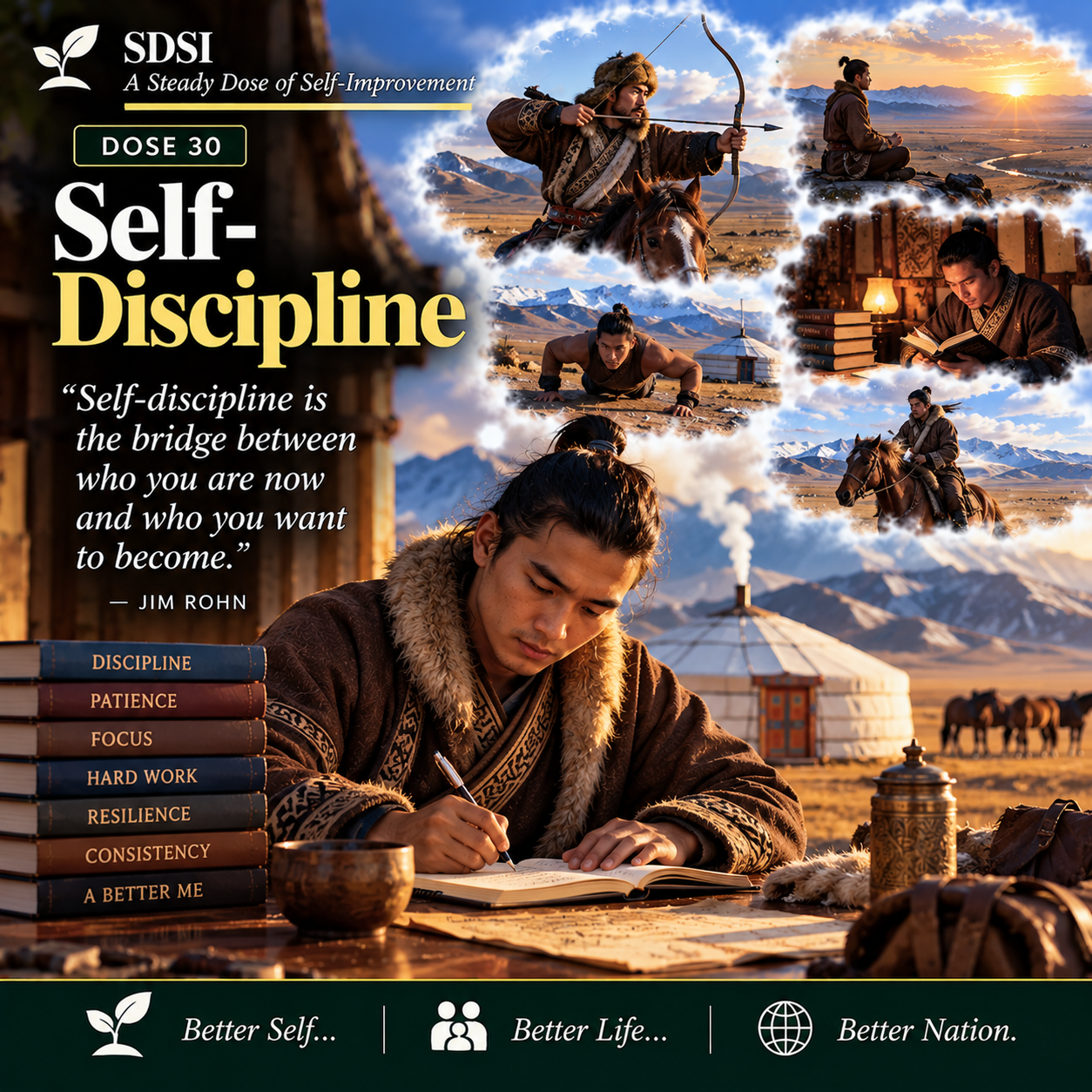
Self-discipline isn’t one more skill on the list—it’s the force that helps hold your beliefs, skills, goals,
and habits together when motivation fades.

Goals may tell you where to go. Self-discipline keeps you moving when the road stops being comfortable.
Self-discipline occupies a special place in self-improvement because it reaches across almost everything else. Strong beliefs are of little use if we do not act on them. Skills remain underdeveloped if we do not practice them. Goals remain plans on paper if we repeatedly abandon the work required to reach them. Self-discipline is what helps convert intention into sustained action.
Three words often accompany it: sacrifice, hard work, and focus. None is particularly comfortable. Sacrifice means saying no to something attractive now for something more important later. Hard work asks us to continue when ease is available. Focus requires us to protect our attention in a world designed to compete for it. Self-discipline does not eliminate discomfort; it teaches us that discomfort does not always deserve the final vote.
This is also why discipline should not be confused with punishment. Healthy self-discipline is not about treating yourself harshly. It is about governing yourself deliberately. Rest can be disciplined. Saying no can be disciplined. Stopping work when continued effort would damage your health can also be disciplined. The question is whether your choices serve your deeper values rather than your immediate impulses.
I learned this most tangibly after pursuing university teaching in South Korea. Opportunities for research, writing, conferences, and professional growth were available—but opportunity by itself produces nothing. Papers still had to be written. Revisions had to be completed. Books required page after page of work. The conditions helped, but conditions do not write books. Discipline does.
Over time, self-discipline strengthens the entire self-improvement process. It turns attitudes into behavior, competence into performance, and repeated practices into habits. Motivation may open the door. Discipline is what helps us keep walking through it.
Pause and Reflect
How disciplined are you when no one is watching, the excitement is gone, and the work has become ordinary?
One Step Forward
Identify one comfort or distraction you are willing to limit this week in service of a goal that genuinely matters to you. Write down what you are protecting—and why it is worth the sacrifice.
Explored in full in Part 3, Section I — Self-Discipline of A Holistic Approach to Self-Improvement.
If you could relive one year of your life, which one would it be?



If I could relive one year of my life, I would choose not a calendar year but a twelve-month period: March 2012 to March 2013. Those months were among the most difficult, uncertain, and ultimately transformative of my life.
In March 2012, I resigned from my position at a public tertiary institution because of irreconcilable differences with my fellow school administrators. My resignation took effect in May. Until then, I had planned to spend the remainder of my career in my country’s public school system. The position was good, and the long-term security it offered was difficult to surrender, but the working environment had become too toxic for me to remain.
Even so, I did not leave the public institution without making a meaningful contribution. While concurrently serving as dean of the college and chair of its Education program, I spearheaded the effort to secure from the Commission on Higher Education (CHED) the permit required to offer Mathematics as a major in the program.
My wife was deeply unhappy with my decision, and her reaction was rooted in our previous experience. Before joining the public institution, I had spent nine years as an administrator at a private college. The school deducted a monthly contribution from our salaries for its retirement fund. Employees who left before completing ten years of service could recover only the amounts deducted from their own salaries; completing ten years would have entitled me to receive the institution’s share as well. My wife therefore urged me to remain for one more year. Financially, she was right. However, I had already become deeply unhappy because of my disagreement with the college president over how she managed the school and treated the people within the organization. Another year felt like a price I was no longer willing to pay, so I resigned and forfeited the institution’s contribution.
Understandably, when I decided to leave the public institution after serving there for only about a year, my wife feared that I was repeating the same pattern—walking away from another stable position without knowing what would come next. Her fears were eased on June 1, the first day I was officially unemployed, when I received a call from a representative of a Pakistan-based international school system that had acquired an existing basic education school in the Philippines. They offered me the position of school principal, with a salary considerably higher than what I had previously earned. The workload was also lighter because my duties were primarily supervisory and carried no required teaching load. However, after spending so many years in education, I could not divorce myself entirely from the classroom. I therefore accepted a part-time teaching position at a tertiary institution in a nearby locality.
Despite that apparent good fortune, I was unhappy.
Some longtime employees had hoped that the school’s new owners would appoint one of them as principal. They had served the institution for years, while I was a newcomer. Their unspoken question was understandable: Why him? As a result, I encountered doubt, indifference, and resistance. At the same time, years of professional turbulence finally caught up with me, and burnout set in. It did not help that I was also struggling with personal demons of my own making.
One day, I realized that I had fallen into depression.
Still, I resolved not to be defeated. I stood my ground, confronted what was draining me professionally, and began dealing with the personal problems I had helped create. More importantly, I searched for a way to begin again. That search led me to apply for a teaching position in South Korea.
There was one complication: accepting the position in South Korea meant leaving the school approximately one month before its graduation ceremonies. The foreign representatives of the Pakistan-based international school system tried to persuade me to stay. However, I had never signed an employment contract—not because the organization intended to withhold one, but because the person responsible for preparing and sending it repeatedly forgot to do so despite my constant reminders. The absence of a binding agreement allowed me to leave without fear of legal repercussions for breaching a contract.
Still, the decision was painful. I had grown attached to my students, and it saddened me to leave without seeing the Grade 6 and fourth-year students graduate. In the end, however, I had to choose between sentiment and my well-being. I could feel my depression worsening, and I knew that remaining merely to participate in the graduation ceremonies could cost me the opportunity to begin again.
On March 2, 2013, I flew to South Korea and began working as an ESL teacher.
Fourteen years later, I am still here in the Land of the Morning Calm. Coming to South Korea was one of the best—if not the best—decisions I have ever made. The country has had a genuinely calming effect on me. In many ways, it tamed my spirit—not by extinguishing the fire within me, but by teaching me where and how to direct it.
I arrived strong-willed, restless, and accustomed to resisting environments that I believed were unhealthy or unjust. South Korea gave me something I had long needed: stability, order, and enough quiet space to breathe, reflect, and rebuild myself. Here, I learned that strength does not always have to announce itself through confrontation. I could disagree without being disagreeable, remain ambitious without being consumed by ambition, and enjoy solitude without feeling isolated. The same intensity that once left me exhausted gradually found more constructive outlets—in teaching, research, writing, physical well-being, and continuous self-improvement.
This country has given me opportunities for tremendous personal and professional growth. It allowed me to rediscover myself not merely as an administrator, but as a teacher, researcher, writer, and lifelong learner. South Korea did not change the essential person I was; it helped me become a calmer, more disciplined, and more purposeful version of him.
I am reminded of something that happened when the school where I served as principal underwent FAPE recertification. Securing that recertification was important because the school needed it to remain eligible for the government assistance administered through the program. During the evaluation, one of the accreditors asked why, after spending nine years at one college, I had transferred to a public institution only to leave after about a year. She also noticed that I had previously worked at three other schools.
One of her fellow accreditors remarked, “Perhaps he has not yet found his niche under the sun.”
Perhaps she was right.
If I could relive those twelve months, I would not return because they were happy, nor would I return to change what happened. I would relive them so that, amid the uncertainty, pain, and apparent failures, I could recognize that they were leading me toward the place where I truly belonged.
Now I have found my niche under the sun.
It is South Korea.
Humanity’s first landing on the Moon

… and I would like to be on the Moon with the astronauts.
I would choose it not to determine whether the Moon landing was real, but to experience what it represented. For nearly all of human history, we could only look upward at the Moon. We worshipped it, wrote poems about it, used it to measure time, and wondered whether anyone could ever reach it. Then, for the first time, a human being stood upon it and looked back at Earth.
I think seeing Earth from there would affect me even more profoundly than seeing the first step. From that distance, there would be no visible national borders, political parties, religions, races, or territorial disputes—only one small, luminous world carrying everyone who had ever lived.
Hopefully, NASA and SpaceX will be able to bring humans back to the Moon soon… and to Mars as well.
12th Fail


Although it is a biographical drama—not really what one would call a tearjerker—it made me cry.
You should see 12th Fail because it is a deeply inspiring reminder that failure is not the end of a person’s story. Based on real events, the film follows an ordinary young man confronting poverty, academic setbacks, and seemingly impossible odds without surrendering his principles or his dream. It is moving without being overly sentimental and inspiring without pretending that success comes easily. More than a story about passing an examination, it is about resilience, discipline, integrity, and the people who help us believe in ourselves when our own confidence begins to fail.
Better Self… Better Life… Better Nation
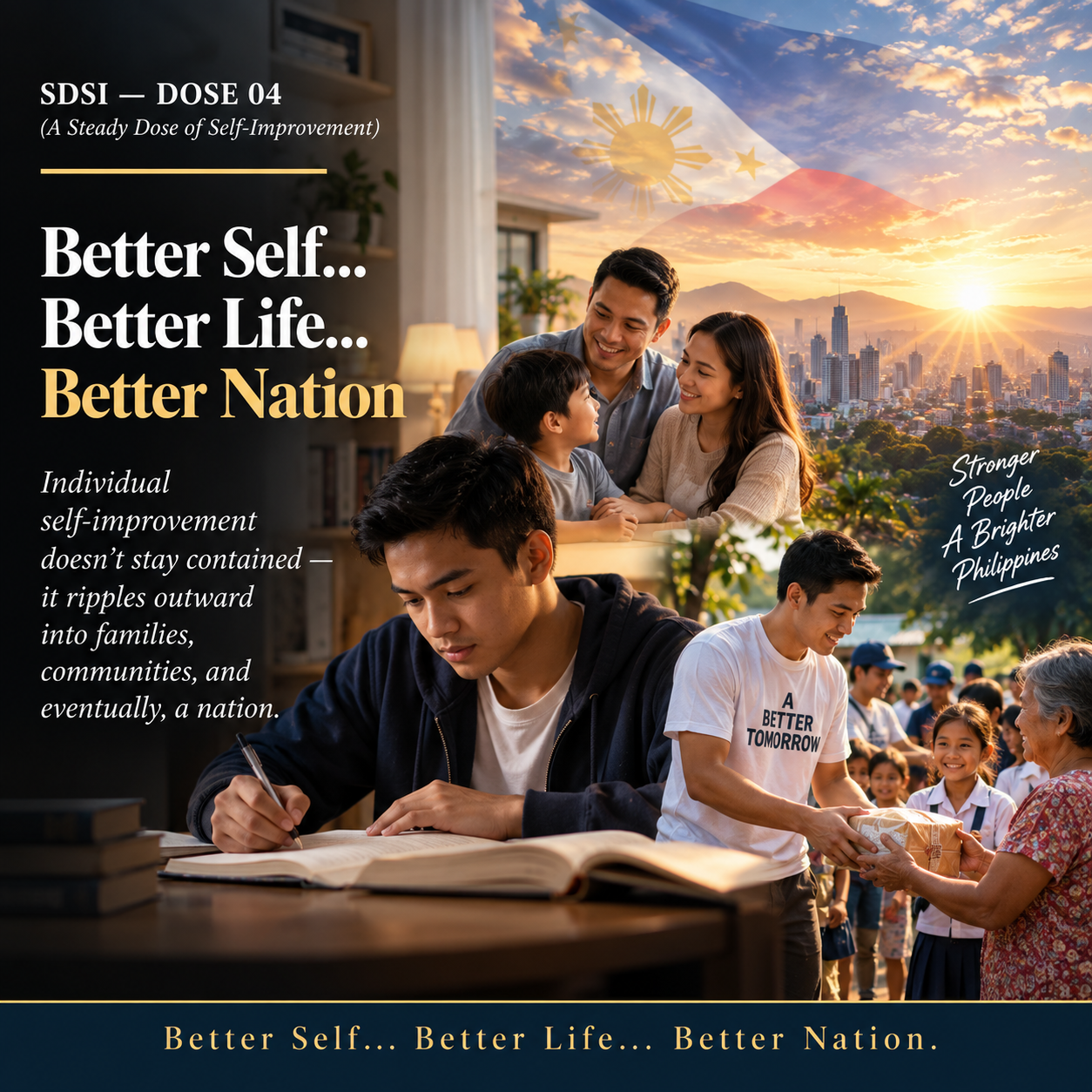
Individual self-improvement doesn’t stay contained — it ripples outward
into families, communities, and eventually, a nation.

What does one person’s self-improvement have to do with a nation?
At the heart of my self-improvement advocacy is a simple but powerful conviction: personal transformation can become a foundation for national progress.
Better Self… Better Life… Better Nation.
Self-improvement begins with the individual, but its influence need not end there. As people become more principled, capable, disciplined, and responsible, they become better equipped not only to improve their own lives but also to contribute meaningfully to their families, communities, and nation.
- Better Self — developing one’s values, competence, habits, and self-discipline.
- Better Life — using that growth to pursue health, happiness, success, and fulfillment.
- Better Nation — better individuals becoming responsible citizens who contribute rather than merely wait for political leaders to solve everything.
Building better citizens does not remove the government’s responsibility to provide honest, competent, and accountable leadership. It simply recognizes that national progress cannot be entrusted to political leaders alone.
A better nation cannot be built by citizens who continually search for political saviors while neglecting their own character, competence, discipline, and responsibilities. We must demand better leaders—but we must also strive to become better people.
The journey toward a better nation does not begin only in palaces, government offices, or polling places. It also begins quietly within every person who chooses to become more principled, capable, disciplined, and responsible.
I didn’t write this book believing it would reach millions. I wrote it believing that if even one person reads it and becomes who they were meant to be, that ripple is worth every year it took to finish.
Pause and Reflect
Where do you see your own growth already spilling over into someone else’s life?
One Step Forward
Think of one person your growth could affect today. Do or say one thing for them that reflects who you’re becoming.
Better Self… Better Life… Better Nation.
About the Title – Why “A Holistic Approach”?
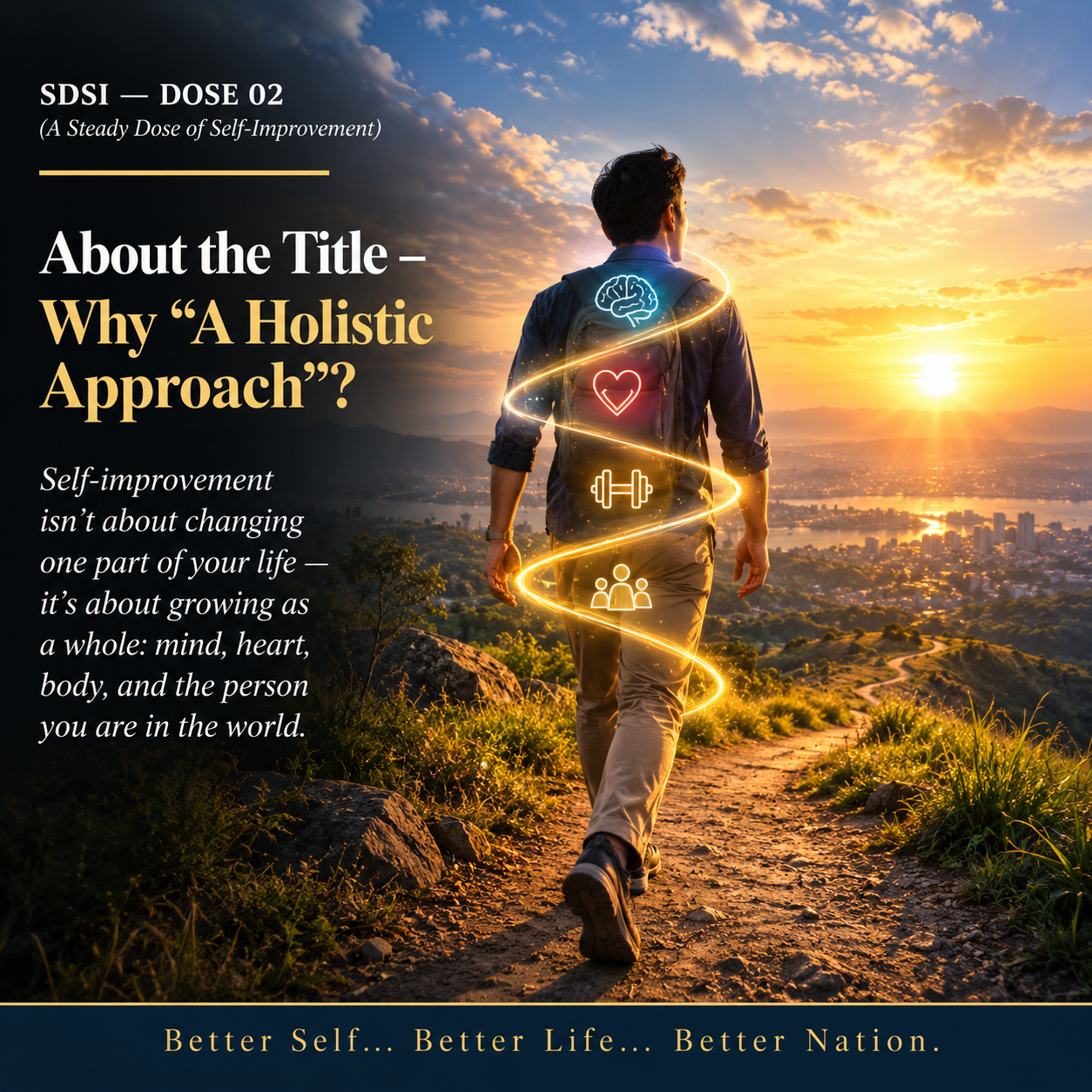
Self-improvement fails when it’s treated as a single fix; this book is holistic because lasting change
requires belief, skill, and habit working together.
Why “holistic”? Why not just “self-improvement”?
Because I tried the narrow version first, and it didn’t work.
I thought reading self-help books was enough. It wasn’t. I thought adding positive thinking on top of my faith and self-belief would complete the picture. I was wrong again. I wanted more — and I couldn’t yet name why.
The turning point came almost by accident. I bought a DVD titled “The Secret” without knowing what it was — the store had mixed it in with other genres, no synopsis, nothing to explain it. I watched it skeptical, then curious, then genuinely changed. That led me to Bob Proctor, and from there to a long list of thinkers — Jim Rohn, Tony Robbins, Wayne Dyer, Napoleon Hill, Dale Carnegie, Earl Nightingale.
What struck me across all of them was this: none of them treated self-improvement as one lever to pull. Every lasting example of growth I found required cultivating the right attitudes and beliefs, developing real skills and abilities, and consistently practicing the right daily habits. Not one of these in isolation. All three, together.
This book is organized around that conviction — a Value System, a Competence Framework, and a Habit Scheme, held together by self-discipline. It’s not a shortcut. It’s a fuller map.
Pause and Reflect
Which single area have you been trying to fix on its own, while the rest quietly stayed the same?
One Step Forward
Name the one dimension — belief, skill, or habit — you’ve most neglected. Write one sentence describing what giving it real attention would look like this week.
Explored in full in the Preface of A Holistic Approach to Self-Improvement.
Better Self… Better Life… Better Nation.