Having and Losing Mark Andrei
(THIS IS A TRUE STORY)

“Life is like a roller coaster ride.” I couldn’t agree more to whoever said that.
Yesterday, you saw people beaming with so much happiness laughing so contagiously and shaking hands or exchanging high fives with everybody around them. Today, the same people maybe crying a river in a desolate room smarting from the pains inflicted by something or someone. Tomorrow, what will it be? Nobody knows! They would have licked their emotional wounds and will emerge from that desolate room, learn to smile again and gradually laugh their way out of whatever bad experiences they had. If not, then we could surmise that they may have decided to stay in the shell of their grief and to plummet deeper in the unfathomable depths of despair.
Perhaps everything may depend on whatever twists and turns that were laid down by the grand designer of the tracks where our personal roller coasters run. We may desire all that we want to alter the course of our roller coasters and wriggle out of the undesirable whirls in the switchbacking tracks. But that’s impossible.
Eventually at a certain age, whether we like it or not, we begin to take control of our lives. That’s when the ride starts. Choose a car in the coaster train. There’s no turning back. All that we can do is to make sure that we’re buckled up. Expect the turns, ups and downs. Be ready to be twizzled and twined. Accept that you could not avoid the spirals and the slammers.
Generally, the way my roller coaster zipped through the tracks have both enthralled and frightened me. There were times, when I was younger, that I wished the joy I was experiencing wouldn’t end. There were moments also when I thought I would not be able to wiggle out of the depths of despair and sadness but my faith in God (that I believe exists) and my unwillingness to succumb to challenges kept me afloat.
One of the most difficult parts of my journey in the tracks happened a few days ago. (I wrote this in 2009, just two weeks after IT happened.) Those days in my life were both exciting and frightening. Perhaps that stage of my ongoing roller coaster ride – that chapter in my life – could have been the most emotionally draining and exhilaratingly suspenseful.
It happened when an angel dropped from the clouds and gave me the privilege of becoming his father (and my wife his mother) for seven days. That’s right – seven days only. I wanted it longer. But from up there in the roller coaster tracks where my car was (and up there I felt enormous joy). I was pulled down. That was a very steep slope. Then I felt passing through a twist and a turn and when my roller coaster made a sudden stop – the angel was gone.
What happened in those seven days?
Let me share what happened in each day.
Day 1: https://madligaya.com/2013/03/19/father-son-for-just-seven-days-1st-of-7-parts/
Day 2: https://madligaya.com/2013/03/22/father-son-for-just-seven-days-2nd-of-7-parts/
Day 3: https://madligaya.com/2013/03/23/father-son-for-seven-days-3rd-of-7-parts/
Day 4: https://madligaya.com/2013/03/28/father-son-for-seven-days-4th-of-7-parts/
Day 5: https://madligaya.com/2013/03/31/father-son-for-seven-days-5th-of-7-parts/
Day 6: https://madligaya.com/2013/04/03/father-son-for-seven-days-6th-of-7-parts/
Day 7: https://madligaya.com/2013/04/04/father-son-for-seven-days-last-of-7-parts/
Pagbigyan Ang Hiling
 Mula bilibid, isang preso’y tumakas
Hating-gabi noon nang siya’y naglakad
Mapapasok na bahay pilit naghanap
Nang ng pera’t damit siya’y makadekwat.
Nakatagpo siya isang gate na bukas
Itinulak niya ito’t pumasok siyang kagyat
Bukas ding pintua’y kanyang itinulak
At sinimulan n’ya ang pangungulimbat.
At nang ang kuwarto ay kanyang binuksan
Mag-asawang nag-aano’y nagulantang.
“Walang sisigaw!” Ang banta ng kawatan.
At ang mag-asawa’y kanyang tinalian.
Ang lalaki’y masyadong kinakabahan
Dorobo kasi’y siya’y tinititigan
At matapos na babae’y saglit lapitan
Iniwan sila’t banyo’y pinuntahan
“Honey halatang ikaw ay kanyang tipo
Nilapitan ka’t humalik pa sa iyo.
Kaya nga’t nang manatiling buhay tayo
Pakiusap ko’y pagbigyan mo ang loko.”
“Hindi niya ako hinalikan darling.
Bagkus sa akin ay meron siyang inamin
Tinanong din kung meron tayong Vaseline
Kako’y doon sa banyo’y kanyang kuhanin.”
“Vaseline? Saan niya ‘yon gagamitin?”
“Darling… Siya daw kasi ay isang bading
At para tayo’y hindi niya patayin
Pagbigyan mo siya sa balak niyang gawin.”
Why I Came To South Korea
(A Personal Essay)
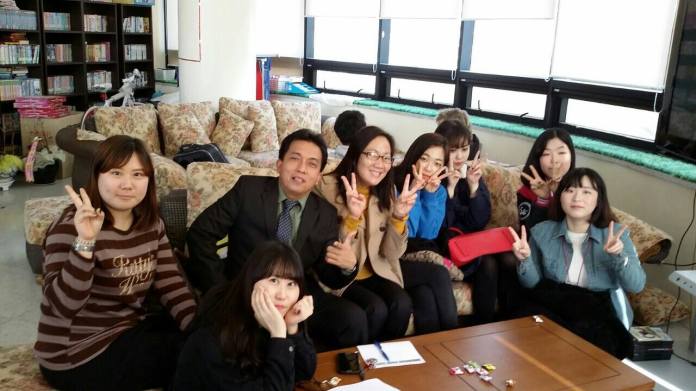
I decided to try ESL teaching here in South Korea not because there were no good jobs available in the Philippines. As a matter of fact, I had to cut short my employment back home in 2013 to come here. That time I was employed as Principal of a basic education (K to 12) institution. To earn extra, I also worked as a part-time instructor in a college and academic consultant in another school .
I had no trouble finding jobs in the Philippines. I carefully crafted a career path and built a strong supporting structure that would ensure I won’t run out of options and ascertain a stable future for me and my family.
So, what made me decide to teach here?
Firstly, I suffered from a severe “job burnout”. I got so tired being a school administrator and a teacher at the same time. There was no sense of fulfillment anymore. I wanted to go back to full-time teaching and try to discover what I was missing. Yes, there was something missing.
I started doing supervisory works in 1994 in a technical-vocational institution. I resigned in 2002 then moved to another school, a Catholic tertiary institution, where I was offered a supervisory position – head of the Education program. Thinking that I could pursue a career in the public school system, I applied (and was accepted) as College Dean in a local college. It did not turn out the way I wanted. The working environment and the organizational climate was not what I envisioned it was. It was then that I began to feel the “burnout.” From there I transferred to that basic education institution where I became a principal. It did not help that at that time the said school had to renew its FAPE (Fund for Assistance to Private Education) accreditation. Those were the days when I almost had to sleep in my office to finish all the required paper work for the re-accreditation.
I really got tired supervising people and performing administrative works. I felt sick about it. I wanted to go back to just being a teacher and find out what I was missing – something else that I should be doing. That’s the reason I applied for a teaching job in South Korea.
After passing through the proverbial eye of the needle, I was hired.
It was that “job burnout” that got me seeking for a job opportunity overseas. It’s not just because the pasture is greener. I would be branded a hypocrite if I say I don’t need a higher pay. But I was really satisfied with the salary I was receiving at that time. It was good enough that it enabled me to buy a small parcel of land and had a house built.
Of course I am happier and more satisfied with my monthly pay in this country. Who wouldn’t be. It’s roughly 75% higher than what my Pakistani employers paid me in the Philippines and with me having to work almost 60% less in terms of hours. That basic education school where I was a Principal then is owned by Pakistanis operating a vast network of schools (The City School) in Pakistan and some parts of Asia.
At that time I felt that I was at the crossroads of my career. I have to admit that there was some kind of dissatisfaction within me. That job burnout (and the search for that something I was missing) torched my soul and it was making me unhappy.
Then came the opportunity to teach here.
When I got settled, I finally figured out what was missing. I found out that with my being so busy with my administrative functions and my concurrent consulting and teaching duties, I was not able to attend to my other passion – WRITING.
In the Philippines, being a school administrator and a teacher at the same time require that you stay in the workplace, officially, for 8 hours a day. But most of the time, I would stay way beyond that, even if I wasn’t required to. It was just something that felt I ought to do. Sometimes I would even go to my office on Saturdays. With that hectic schedule, I could hardly find time to do what really makes me alive – writing poems, essays and stories.
That’s what makes teaching in South Korea different for me. It afforded me a lot of spare time which I could use to write. It gave me an opportunity to create (and maintain my own websites.) I was even able to write papers for presentations in international conferences and for publication in international journals. Something that, unfortunately, I wasn’t able to do in the Philippines. Back then, I would be lucky if in a month I could write even just a single poem.
ESL teaching is part of the career-path I paved for myself. I really trained and prepared for this. I am a licensed English teacher in my country. As early as 2009, I was already thinking of coming to this country to teach. I also applied in universities in the Middle East but I was really hoping that it’s here (South Korea) where I would be given the opportunity to do ESL teaching.
My second (and last) reason for deciding to try teaching here (South Korea) has nothing to do with my career. At that time I was journeying to midlife. There were some personal demons that I ought to slay. It’s too personal to share. Suffice it to say that I needed space. I needed that entire space between the Philippines and South Korea to really get my bearings back.
Then my efforts paid off and my prayers answered. I was hired by a South Korean university in 2013.
God is really good. (Yes, I believe in the existence of God!) I got what I wanted – just teach and no more supervisory works. That gave me a lot of time to write. I was also able to squeeze myself out of a personal crisis. I wouldn’t have not done so had I opted to just stay in that air-conditioned principal’s office.
I am forever grateful to universities (like Hanseo University and Gyeoungju University) who believe that not only native speakers of English could (and should) teach the language – that qualified non-native English speakers could also excel in ESL teaching.
South Korea has become my second home and I would love to stay here to teach (and write) for as long as possible… if given the opportunity.
Ang Talong Ni Father
 Heto pong si Father ay mayroong hardin
At talong ang noo’y doon nakatanim
Isang araw nang mga bunga’y aanihin
Biglaang mga bisita’y nagsidating.
Naroo’y si lola Basyang, isang biyuda
Kasama’y si Luring, matandang dalaga
At nang mga talong kanilang nakita
Biglaang nanlaki kanilang mga mata.
“Ang talong po ba ninyo’y puwedeng hawakan?”
Ang tanong kay Father nitong lola Basyang.
“Basta ba paghawak mo’y hinay-hinay lang.”
Ang wika ng pari bilang katugunan.
“Ah father …” Wika naman ni aling Luring.
“Ang talong po ninyo’y kay sarap himasin.
Mahaba’t kay kinis ang sarap kagatin.”
Ani father, “Inyo po munang lutuin.”
“Naku… naku kayo po eh sobrang pilya.
Kung talong ko’y gusto n’yo, sige dampot na.”
“Ay thank you po! Ang bait mo father talaga.”
Ang sabay na sabi ng soltera’t biyuda
“Oh bakit po tatlo ang inyong kinuha
Gayong kayo naman po eh dadalawa?”
At ang kasagutan ng biyuda’t soltera –
“Eh uulamin po namin itong isa.”
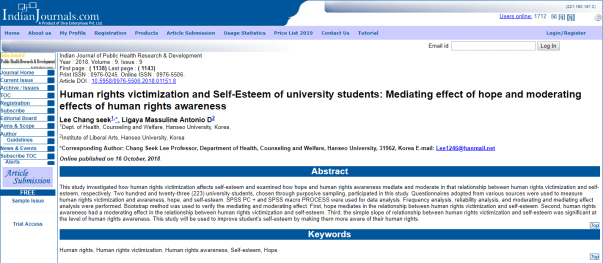
Human rights victimization and self-esteem of university students: Mediating effects of hope and moderating effects of human rights awareness

Beyond Positive Thinking

Some people would say that “life sucks.”
Really!?
I adhere to the dictum that “Life is what we make it.” I believe then that when people say that “life sucks” it’s because that’s the way they made it to be. The kind of life we live is defined by the mind-set we have. It is one’s way of thinking that would make life suck. It is the negative attitude towards life that make people fail in their undertakings – it is what makes them unhappy and dissatisfied. It’s in the midst of all their failures, sadness and dissatisfaction that they say “life sucks.”
People are seemingly not sold on the idea that their way of thinking affects the way they live life and would determine whether or not they succeed. It is hard for them to accept that it is their innate responsibility to examine their way of thinking and ensure that it doesn’t stand in their way to happiness and success. This is something I learned so late in life. How I wish I had learned so when I was younger.
I have heard a lot of things about positive thinking before but it was only around 2009 that I started digging deeper into the idea and it took a few more years before I really became serious about it.
I realized that there is more to positive thinking than veering away from negative thoughts and shedding off negative attitudes.
It all began when I watched a film entitled “The Secret.” I saw the DVD of the movie by accident. The store owner mixed it with regular movies. When I bought it, I had no idea what it was. There was no synopsis, not even a brief note explaining anything about it. That was it… everything was what the title suggests – SECRET.
I thought it was either a mystery-thriller or a sci-fi movie. When I played, it I found out that it was some kind of a “self-help” film. It was technically a documentary. I have to admit that at first I considered the ideas presented as preposterous. Things I was seeing and hearing from the beginning of the film were like lifted straight from the pages of a science fiction book… but at the same they also tickled my curiosity.
So, I continued watching and tried to be open-minded and thought of the information in the film as tips for personality development. I have always considered anything that advocates positive change as worth my time and worth trying. I watched it a few more times after that and even shared the ideas I learned to my students whenever I would see a connection to the contents of the topic we’re discussing.
Then I decided to do an internet search for one of the speakers in the documentary who impressed me the most – Bob Proctor. That internet search led me to his (Bob Proctor’s) motivational videos on YouTube and to links to information and videos of other motivational speakers such as Wayne Dyer, Les Brown, Jim Rohn, Joe Dispenza, Brendon Burchard, Brian Tracy, Zig Ziglar, Tony Robbins, Simon Sinek, Tom Bilyeu, John Maxwell and Mel Robbins.
I watched the videos of the said speakers and searched for electronic copies of the books they have written. At first, it was like once a week that I would play their videos on YoutTube until such time that I started doing it everyday – in the morning and at night. It became part of my daily routine.
I found out later that Napoleon Hill, Earl Nightingale, and Earl Shoaff came ahead of the motivational speakers previously mentioned. My constant browsing of the internet intended to quench what has seemingly become an insatiable thirst for ideas for personality development led me to the works of one of the “pioneering figures of modern inspirational thoughts” – James Allen. His most famous book – “As A Man Thinketh” – set straight everything I learned about positive thinking.
Dr. Joe Dispenza’s book “Evolve Your Brain: The Science of Changing Your Mind” provided enough science into the positive thinking paradigm that wiped out whatever doubts I had about it. I love the way Dr. Wayne Dyer incorporated Asian philosophies into that paradigm and the infusion of practical wisdom and humor to it by Jim Rohn and Les Brown.
Then John C. Maxwell made me think the way I think. His book “Thinking For A Change” reminded me of the value of effective and creative thinking. His suggestions on how to be more focused and creative in the way people should think are very practical but tremendously effective.
I didn’t take everything I read and heard from motivational speakers hook, line, and sinker. I always had my filters and my critical lens ready when I listened to talks and read books. I analyzed their ideas carefully and (without judging and doubting) tried to see which ones work for me and which writers and speakers make sense.
The one thing those motivational speakers succeeded in doing was to change my mind-set. They taught me how to look at things using a positive perspective. They had confirmed what I believed all along that whatever we become is the sum total of all the decisions we make… that a person is in-charge of his own destiny. It is a personal belief I started forming after reading W.E. Henley’s “Invictus” way back in college.
The process of my personal transformation was rather slow and I got to observe things in my life changing for the better only in 2013.
When positive thinking succeeded in changing my perspectives on life, things in my life improved, particularly in the areas of relationships, health, work, and finances.
One day I just woke up and realized that things are the way that they are. People are who they are. They talk, behave and think the way they want, whether I like it or not. I can not change them. I can not change the system of the government, the policies in my workplace, the attitude of my co-workers, the character of my friends and loved ones. The only things I could change are those that I could control directly – my words, actions, and my thoughts. It is my perspective that must change. I need to have paradigm shift as Bob Proctor would put it.
I did exactly that. I changed my perspective and it is continuously evolving. I’m not saying that everything in my life now is perfect. One thing I could say though is I am happy with who I am, what I have, and where I am. Perhaps the life I live now is what Brendon Burchard would describe at the end of his videos as – “a charged life.”
I fully embraced self-sufficiency and personal accountability.
People wrongly think that positive thinking is just that – thinking. It’s merely the springboard. Great things happen to people when they start changing their mindset – from negative to positive. What would make positive thinking weave its magic is the corresponding positive actions you undertake.
Positive thinking without positive action doesn’t work. Brian Tracy added one more to the equation – “One must have an organized plan of action.” He added that action without planning is the cause of every failure, underachievement, frustration, time wastage, anxiety, and stress.
So, it’s not just a person needing to think positively and that’s it. Action and planning are needed.
All motivation gurus advocate the setting of goals. They strongly suggest that people should have their daily, weekly, monthly, and yearly goals… on top of their long-term goals. They also identified two qualities that a person must have in order for positive thinking to work – self-discipline and self-sufficiency.
For me, self-discipline is the most difficult obstacle to hurdle. Old habits die hard. It’s true, but somehow I am succeeding in slaying the bad ones – albeit slowly.
I know it’s not easy to change one’s perspectives on anything especially if such perspectives are already deeply anchored in the person. “You can’t teach an old dog new tricks.” Right? Allow me to be literal on that idiomatic expression and let me add this – “… but people are not dogs.”
Ang Pagsulat Ng Tula
 Hindi madaling sulatin ang tula. Totoong mahirap ang maging makata.
Sa lahat ng dyanra ng panitikan, ang tula ang pinakamahirap sulatin. Hindi gawang biro ang pagsama-samahin sa iisang kabuuan ang mga elemento nitong tugma, sukat, saknong, talinghaga, at kariktan. Kaylangan ding malalim ang balon ng talasalitaan ng sinumang susulat ng tula. Doo’y iigib siya ng mga salitang katumbas ng damdami’t kaisipang nais ipahayag.
Hindi sa mas madaling magsulat ng maikling kuwento o nobela. Hindi rin gawang biro ang pagapangin sa banghay ng kuwento ang mga elemento nitong tagpuan, tauhan at tunggalian. Subalit ang mga sumusulat ng kuwento ay maginhawang nakakagamit ng maraming pahina hanggang matumbok nila ang kasukdulang ng kuwento at marating ang wakas. Si Leo Tolstoy ay nangailangan ng mahigit kalahating milyong salita upang tapusin ang nobela niyang pinamagatang “War and Peace.”
Sa kabilang banda, ang makata’y mayroon lamang isang pahina ng papel, minsan nga kalahati lamang nito, upang ipahayag ng malinaw at buo ang kanyang saloobi’t iniisip. Ang mga Hapon, sa anyo ng tula nilang tinatawag na Haiku, ay kapiranggot na bahagi lang ng papel ang kaylangang gamitin sa dahilang ang naturang tula’y binubuo ng isang saknong lamang na may tatlong taludtod na ang gitna’y may pitong pantig at ang una’t huli’y tig-limang pantig.
May mga dagdag pang hamon sa mga makata kapag kanilang nilakbay ang mundo ng taludturan.
Mahirap bumagtas sa daan ng kalungkutan habang ikaw ay nakangiti. Hindi rin puwedeng sumagwan sa ilog ng kasiyahan habang nakasakay ka sa bangkang yari sa luha. Ang luhang ididilig sa mga taludtod ng tula upang ito’y mamunga ng kalungkutan ay iniigib ng makata sa balon ng mapapait niyang karanasan.
Tanging ang puno ng kalungkutan ang puwedeng pitasan ng luha at tanging ang hardin ng kasiyahan ang puwedeng tubuan ng nakangiting bulaklak. Kung aakyat ang makata sa puno o dadalaw sa hardin ay nakadepende sa uri ng damdaming nais niyang ipahayag.
Kung meron man ay iilan lamang ang mga makatang kayang humahalhak habang gumagapang sa balag ng malungkot na taluduturan.
Mas magandang pakinggan ang kudyapi ng lumbay kung ito’y hihipan ng isang makatang minsa’y halos malunod sa sariling luha dahil sa isang karanasang nagdulot sa kanya ng matinding kapanglawan. Ang tambuli naman ng kagalakan ay puwede lamang hipan ng makatang narating na ang kasukdulan ng saya na tuwing ito’y naaalala ay nangingiti ito o natatawa kahit siya ay nag-iisa.
Ngunit ang buhay ay isang musikerong tinuturuan ang makata na kayang hipan ang kudyapi ng lumbay o tambuli ng kagalakan sa ano mang pagkakataon na kanyang naiisin.
Kung ang intensyon ng makata’y hasikan ng butil ng luha ang kanyang mga taludtod upang doo’y yumabong ang hapis ay kanyang susundutin ng karayom ang pilat na iniwan ng isang sugat ng kahapon hanggang umagos mula rito ang dugo ng kalungkutan. Hindi ito pagiging masokista bagkus ay isang sakripisyo na dapat gawin ng makata. Dapat kasing nararamdaman niya ang ano mang damdaming nais ilatag sa mga saknong ng kanyang tula.
Kaya nga tunay na alagad ng sining ang makata. Kaya niyang paikutin sa kanyang kamay ang mga emosyon. Katulad ng isang artista sa entablado, umiiyak… matapos ang ilang saglit ay biglang tatawa.
Minsan ay mali ang pakahulugan ng mga tao sa makata. Kapag ang sinulat niya’y puno ng pagsisisi at kalungkutan dahil hiwalayan ang temang binalangkas sa tula ay inaakala ng mga bumabasa na ang makata’y minamahal pa rin ang isang taong nakahiwalayan at nais na ito’y muling bumalik. At ang taong nag-aakalang siya ang pinatutungkulan sa tula’y minsa’y parang nagmamalaki pa’t nagbubunyi.
Huwag kalimutang ang makata’y alagad ng kanyang sining. Ang makata’y hindi alipin ng nakaraan, masaya man o malungkot. Ang tunay na makata’y inaalipin ang nakaraan. Pinaglilingkuran siya nito. Pinagkukunan niya ng ano mang nais sulatin ang panahong lumipas.
Binabalikan ng makata ang nakaraan para maghanap lamang ng inspirasyon. Binabalikan ng makata ang nakaraan upang may paghugutan ng emosyon…upang siya ay magalit, mainis, mangiti o matawa…upang muling maramdaman kung paano umibig at mabigo…kung paano magtaksil at pagtaksilan…upang muling mangarap…upang muling maramdaman kung paaano mabigo, bumangon at magtagumpay.
 M.A.D. LIGAYA



 M.A.D. L I G A Y A