Striking Work-Life Balance
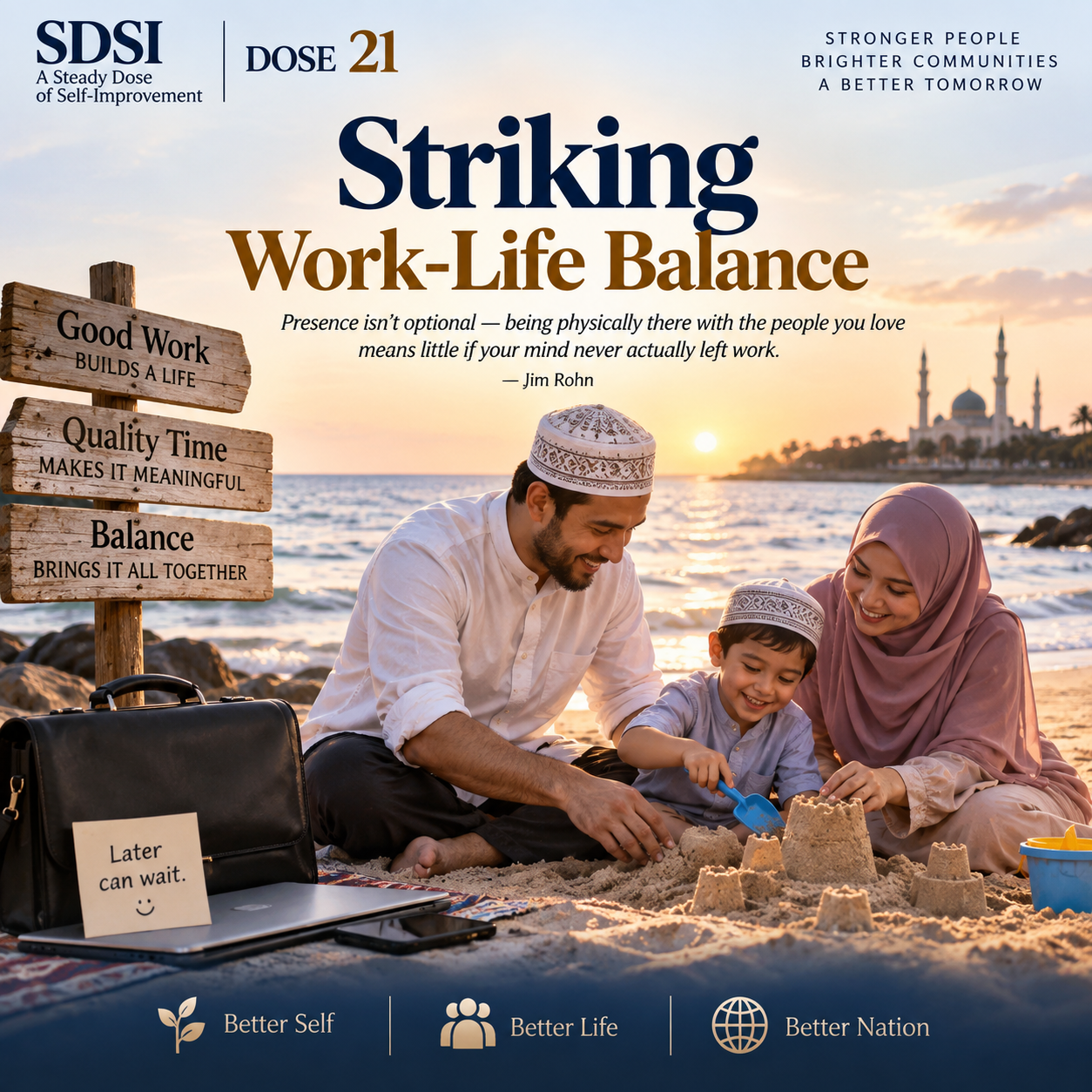
Presence isn’t optional — being physically there with the people you love means little
if your mind never actually left work.

Jim Rohn once took his family to the beach. He brought his briefcase.
Striking a balance between personal undertakings and professional endeavors is easier said than done. Yet few things matter more to the quality of our lives than getting this balance right. A life tilted too far toward work may make us productive while leaving us personally impoverished. But neglecting meaningful work and responsibility can also deprive us of the sense of purpose and accomplishment they provide.
Work-life balance is not simply a matter of dividing our hours equally between work and home. It depends not only on the time we spend physically at work, but also on the energy, focus, and attention that work continues to demand after we leave.
You can leave the office and still be psychologically at work — replaying problems, answering messages, planning tomorrow, or worrying about what remains unfinished. True balance therefore requires something more difficult than simply going home: learning to mentally disengage from work when work is done.
Jim Rohn illustrated this lesson with a simple story. He recalled taking his family to the beach while bringing his briefcase along. His family was not pleased. The lesson was unmistakable: being physically present with the people you love is not enough if your attention remains somewhere else.
Presence isn’t optional.
When you’re with your family, be with your family. When you’re resting, allow yourself to rest. When you’re working, give your work the attention it deserves. Balance comes not from giving everything equal time, but from giving each part of life the attention it deserves when its time comes.
Arianna Huffington learned a similar lesson far more painfully. After collapsing from exhaustion and injuring herself, she began questioning conventional definitions of success built primarily around money and power. Her experience eventually helped shape her advocacy for a broader measure of success—one that includes well-being, wisdom, wonder, and our capacity to live fully.
My own experience teaching at a university in South Korea has given me something I have learned not to take for granted: protected time outside work. My teaching schedule and semester breaks have allowed me time to write, connect with family, pursue personal projects, and simply rest.
That experience has taught me that time away from work is not necessarily time taken from productivity. Properly used, it can replenish the very energy, creativity, and perspective that make productive work possible.
Work is an important part of life.
But work is not life itself.
The goal is not to work less simply for the sake of working less. Nor is it to divide every day neatly into equal portions. The goal is to build a life in which professional accomplishment does not require sacrificing the people, experiences, health, and moments that make accomplishment worth having.
Pause and Reflect
When you’re with the people you love, are you truly present — or is work still occupying your mind?
One Step Forward
Choose a specific time after which you won’t check work messages tonight. Hold that line, even if it feels uncomfortable.
Explored in full in Chapter 13 — Work-Life Balance of A Holistic Approach to Self-Improvement.
Better Self… Better Life… Better Nation.

Posted on September 10, 2026, in Better Self... Better Life...Better Nation, Competence Framework, Habit Scheme, Holistic Self-improvement, Personal Growth and Development, Self-Improvement, Value System, Work-life Balance and tagged Better Self... Better Life... Better Nation., Competence Framework, Habit Scheme, Holistic Approach To Self-Improvement, Personal Growth and Development, Self-Improvement, Value System. Bookmark the permalink. 2 Comments.



Bringing a briefcase to the beach is the ultimate confession. We sit there with our kids building sandcastles while our brains are still drafting emails and running risk assessments, acting like physical proximity counts as showing up. True burnout isn’t about the hours we log at a desk but how the mental load follows us home and steals the moments we are supposed to be resting. You cannot be half-in everywhere and fully alive anywhere. Pick a hard line, close the tab, and let your nervous system finally believe the workday is over.
LikeLiked by 1 person
You are right: being physically present with our families is not enough if our minds remain trapped at work. The difficulty for teachers is that work often follows us home—exams, quizzes, and other requirements must sometimes be checked overnight, especially when grades are due the next day. In such situations, drawing a hard boundary is not always possible. Perhaps the real challenge is to establish and protect those boundaries whenever circumstances permit, so that even teachers can occasionally go to the beach without bringing the classroom with them.
LikeLike