When Good News Didn’t Feel Good
Reflections on the Weakening Peso and the Plight of Ordinary Filipinos
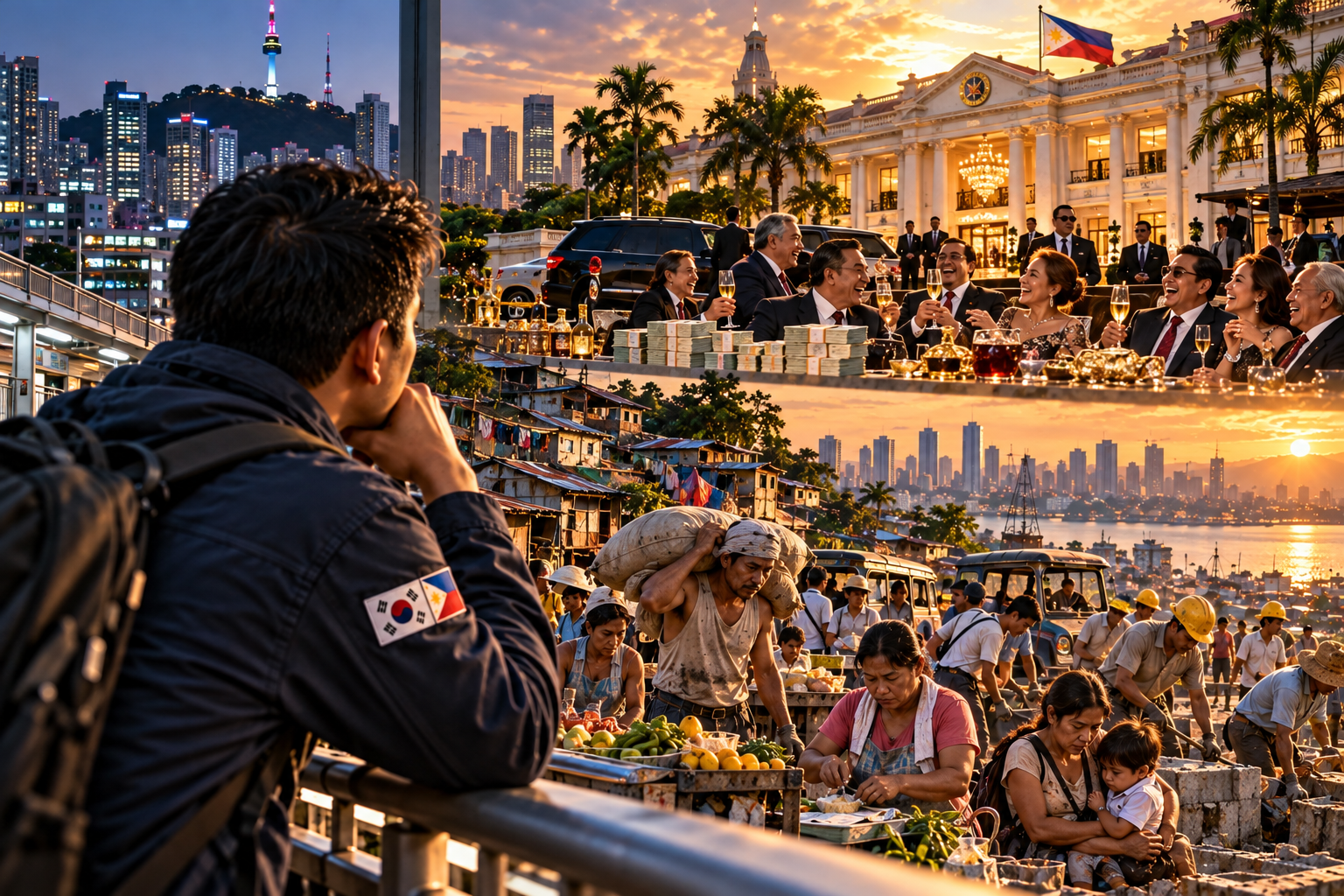
When I recently checked the exchange rate between the Korean won and the Philippine peso, I discovered that one million won was worth approximately 46,000 pesos. In June 2026, the same amount would have given me less than 40,000 pesos.
For someone like me who earns a living in South Korea but still has family and financial responsibilities in the Philippines, that was supposed to be good news. Without working additional hours but earning an extra won, I could now send home several thousand pesos more.
Under ordinary circumstances, that would have been something to celebrate.
And for a moment, I did. I was pleasantly surprised, and a smile crossed my face. But as the implications of what I had just discovered began to sink in, my smile slowly faded.
The difference alone amounted to several thousand pesos—money that many ordinary Filipino wage earners would have to work for days, perhaps even weeks, to earn. And here I was, gaining that much simply because the exchange rate had changed.
That realization left me increasingly uneasy. What initially seemed like a welcome financial advantage gradually became a source of concern. The additional pesos that my family could receive reminded me of something far more troubling: the continuing decline in the value of our currency and what it might mean for millions of Filipinos who earn their living in pesos.
I realized that what appeared to be a financial advantage for my family could also be a reflection of economic pressures affecting countless other families back home.
And I found myself thinking: Filipinos are not just me and my family.
There are millions of ordinary Filipinos who wake up every morning, go to work, and struggle to make ends meet. Unlike overseas Filipino workers and their families, they do not have the advantage of earning in a foreign currency whose value has increased against the peso.
When prices rise, their salaries do not necessarily rise with them. When the cost of food, transportation, electricity, and other necessities increases, they must find ways to stretch an income that may already be barely sufficient.
Some reduce their spending. Others sacrifice the little comforts they once enjoyed. Still others borrow money, postpone medical treatment, or compromise their children’s educational needs.
And for families already living on the margins, there may be very little left to sacrifice.
Of course, I understand that the exchange rate alone does not tell the complete story of our economy. A weakening peso does not necessarily mean that the entire economy is collapsing. Economic growth can continue even when the currency depreciates. There are industries that remain productive, businesses that prosper, and economic indicators that suggest progress.
But I cannot help asking: Progress for whom?
What does economic growth mean to a father whose salary can no longer adequately feed his family? What does an increase in national production mean to a mother who must decide which household necessities she can afford to buy? What comfort can favorable economic statistics offer a young worker whose earnings leave almost nothing for savings?
I do not dismiss the importance of economic indicators. They are essential for understanding where our country stands and where it may be heading.
But behind those numbers are people. Behind every percentage point are households trying to survive, parents trying to provide, and young Filipinos hoping for a better future.
An economy may be growing, but if its ordinary citizens are finding it increasingly difficult to live decently, then surely something deserves closer examination.
I am also aware that not everyone suffers equally during difficult economic times. Those who possess substantial resources, diversified investments, or foreign-currency earnings may be better equipped to protect themselves from rising prices. Some may even benefit from changing economic conditions.
Those who have little, however, have fewer choices. And as the cost of living continues to rise, what little they have becomes worth even less.
And that is what troubles me most. Economic hardship does not distribute its burdens equally. Often, those who have the least are asked, by circumstances rather than choice, to endure the most.
Living abroad has given me a particular perspective on this reality. I have spent many years working in South Korea, and I am grateful for the opportunities this country has provided me. I have been able to support my family, pursue my profession, and build a life that would have been different had I remained in the Philippines.
Yet I cannot separate my personal circumstances from my identity as a Filipino.
My financial security does not make me indifferent to the insecurity of my countrymen. My family’s ability to adjust to rising prices does not diminish my concern for families who cannot.
And perhaps that is why those additional pesos did not bring me the satisfaction I might otherwise have felt.
They reminded me of the distance between my circumstances and those of many people back home.
As I reflected further, my thoughts inevitably turned toward the larger question of what it would take to improve our country’s condition.
I wish there were simple answers. I wish our economic problems could be solved through a single policy, a change in leadership, or a temporary intervention that would immediately ease the burdens of ordinary Filipinos.
But the problems confronting our nation have accumulated over many years. They involve not only economic policies and institutions but also deeply rooted attitudes, practices, and behaviors that influence how we work, govern, cooperate, and hold ourselves accountable.
This is why I continue to believe in the importance of self-improvement—not as an instant remedy for poverty or economic inequality, and certainly not as a way of blaming those who are struggling for circumstances beyond their control.
Rather, I see it as one of the foundations of lasting national transformation.
A nation needs citizens who are capable, responsible, disciplined, discerning, and guided by sound values. It needs people who can think critically, make purposeful decisions, demand accountability, and contribute meaningfully to their communities.
At the same time, those citizens deserve institutions that protect their rights, reward honest work, provide fair opportunities, and enable them to improve their lives.
Personal transformation and institutional reform must work together. Neither can fully accomplish what our country needs without the other.
I recognize that this is a long-term undertaking. Its results may not be immediately visible, and I may never witness the kind of national transformation I hope to see.
Sometimes, that realization leaves me feeling helpless.
What can one Filipino, living thousands of kilometers away, realistically do about the economic hardships confronting millions of his countrymen?
I cannot determine the exchange rate. I cannot control inflation. I cannot single-handedly reform institutions or create employment opportunities for those who need them.
But I can continue doing what I know how to do: teach, write, share ideas, and encourage others to recognize their capacity for personal growth and meaningful contribution.
Perhaps these efforts are modest when measured against the magnitude of our national problems. But I would rather contribute something, however small, than surrender to the belief that nothing can be done.
After all, national transformation does not happen independently of the people who constitute a nation.
I have come to believe that our country’s socioeconomic problems cannot be resolved through changes in political leadership alone. Holding public officials accountable, strengthening institutions, and pursuing meaningful reforms are necessary. But even these efforts may fall short of producing lasting progress unless they are accompanied by changes within ourselves.
For what good would changing our leaders do if we continued to tolerate, practice, or perpetuate the very attitudes and behaviors that contribute to our nation’s problems?
Perhaps the transformation we long to see in our country must also begin with the transformation of its people—not as a substitute for political and institutional reforms, but as an essential part of them.
And so I return to the conviction that has guided my advocacy:
Better Self… Better Life… Better Nation!
These words are not a promise of an easy solution. They express a direction, a commitment, and a hope that the improvement of individuals, accompanied by the strengthening of our institutions, can eventually contribute to the improvement of our country.
I still appreciate the additional pesos that my Korean won can now provide my family. I am grateful that we have some protection against the increasing cost of living.
But I cannot bring myself to celebrate a favorable exchange rate without thinking about the economic circumstances that may be contributing to it and the people who must endure those circumstances without the same protection.
Perhaps someday I will look at the exchange rate and find less reason to worry about the condition of my country.
Not necessarily because the peso has become stronger, but because ordinary Filipinos have become economically secure enough that fluctuations in currency values no longer threaten their ability to live decently.
That is the kind of progress I hope to see.
Until then, I will remain grateful for what my family has, concerned for those who have less, and committed to doing whatever I can to contribute to a better Philippines.
Because while one million Korean won may now be worth more pesos, the well-being of my countrymen will always be worth far more to me than the additional money my family receives.

Posted on October 18, 2026, in Better Philippines, Corrupt Politicians, Corruption in the Government, Phiilppines, Philippine Economy and tagged Corrupt Politicians, Corruption in the Government, Corruption in the Philippines, Philippine Economy, Philippine Politics, Philippines, Socio-Politcal Situation of the Philippines. Bookmark the permalink. Leave a comment.



Leave a comment
Comments 0