Ragnarok: When Gods Become Human – 1
A REVIEW – PART 1
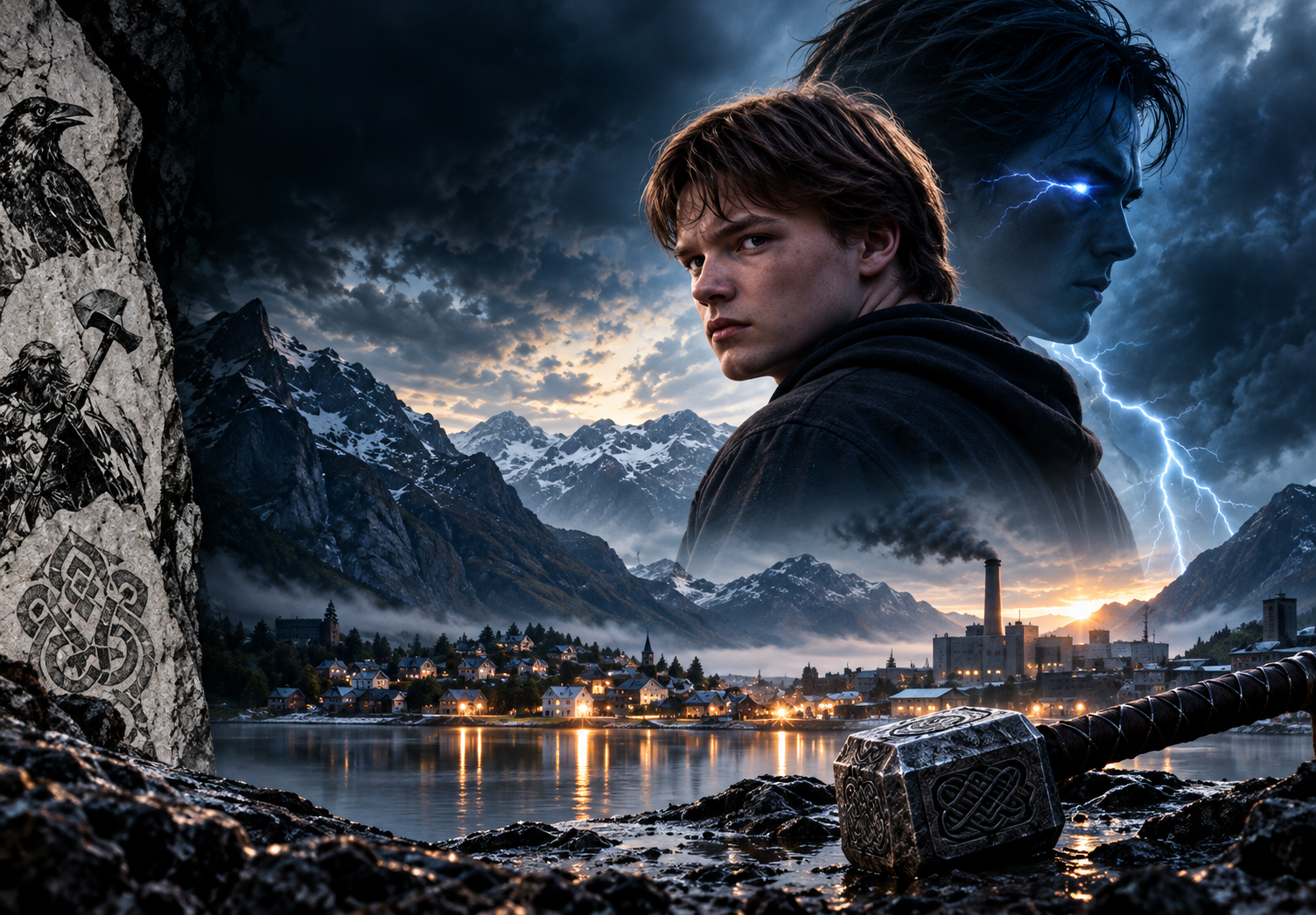
This Is Not Marvel’s Thor
I have always been fascinated by mythology and by the way modern writers and filmmakers reinterpret it. Years ago, I even wrote an essay called “Redefining Mythology,” wondering what happens when ancient gods and legends are transplanted into modern popular culture.
Ragnarok gave me another answer.
Forget Chris Hemsworth.
Here, Thor is Magne, an awkward teenager living with his mother and younger brother in the small Norwegian town of Edda. Odin is Wotan, an old man moving around on a mobility scooter. Loki is Laurits, Magne’s strange, vulnerable and dangerously unpredictable brother. And the giants are not enormous CGI creatures stomping through cities. They are the Jutuls, a fabulously wealthy industrial family whose power comes not merely from supernatural strength but from money, influence and their control over the town’s economy.
Even Jörmungandr, the terrifying Midgard Serpent of Norse mythology, begins life looking like something Laurits might have needed deworming medicine for.
I called it “the worm.”
And somehow, that ridiculous little creature eventually became one of the things I kept worrying about.
Where the hell is the worm?
That is what I enjoyed most about Ragnarok. Instead of making ordinary humans more godlike, the series makes gods and giants disturbingly human.
The mythology supplies the framework, but the conflicts are very much ours.
When the Bullied Becomes the Bully
Magne begins as someone almost completely powerless.
The Jutuls have money, status, influence and the ability to bend Edda around themselves. Magne has anger, an unusually strong sense of justice, and eventually a hammer.
Unfortunately, the hammer changes things.
There is something immensely satisfying about watching bullies get bullied—until you realize that the hero has become the bully.
Once Magne possesses Mjölnir, the balance of power shifts dramatically. The Jutuls, who once appeared untouchable, suddenly become frightened of a teenager. And I confess that watching them squirm was entertaining.
Imagine being an immortal giant only to discover that Thor is now eating your food, sleeping under your roof and using your toilet.
Ragnarök, indeed.
But Magne gradually begins enjoying his power too much. The boy who once fought because he cared about injustice starts behaving as though possessing the hammer gives him the moral authority to decide what justice is.
As Magne’s power grew, his head got bigger and his heart got smaller.
That, for me, became one of the most interesting transformations in the series.
Without the hammer, Magne needed his friends. With the hammer, he increasingly behaved as though his friends needed him.
The real enemy was no longer simply the Jutuls.
It was becoming Magne himself.
And Magne is hardly alone.
Almost every major character carries some weakness that repeatedly gets him or her into trouble. Magne has his pride and growing attachment to power. Laurits wants so desperately to belong that rejection can push him toward resentment and questionable choices. Fjor tries to escape his family but repeatedly finds himself drawn back to the power and identity he inherited from it. Saxa is intelligent and ambitious but sometimes treats people and relationships like pieces on a chessboard. Ran clings to control, while Vidar seems to believe that strength gives him the right to dominate.
Strip away the gods, giants and mythology, and these weaknesses are painfully ordinary.
We may not possess Mjölnir or run multinational industries, but pride can make us stop listening. The need to belong can make us compromise ourselves just to be accepted. Ambition can turn people into instruments for getting what we want. Loyalty can keep us attached to families, groups or traditions even when we know something is wrong. And the desire for control can slowly turn love into possession.
Perhaps our greatest weaknesses are dangerous precisely because they rarely begin as weaknesses.
Confidence can become arrogance. The desire to be loved can become dependence. Ambition can become ruthlessness. Loyalty can become blindness. Strength can become domination.
The line separating virtue from weakness is sometimes surprisingly thin.
Maybe that is why the gods and giants of Ragnarok never seemed completely foreign to me.
Take away their mythology, and they behave disturbingly like us.



 M.A.D. L I G A Y A