Blog Archives
The Only Thing That Interested Me in BBM’s SONA

There is only one sentence in President Ferdinand Marcos Jr.’s latest State of the Nation Address that truly interests me:
“Kaya dapat nakakintal sa puso’t isipan ng mga Pilipino ang lifelong learning at continuous self-improvement.”
Rendered in English, the statement reads:
“Lifelong learning and continuous self-improvement must be deeply ingrained in the hearts and minds of Filipinos.”
Of everything spoken from the podium, this single statement transcended politics. It did not ask Filipinos to applaud a reported accomplishment, believe another political promise, defend an administration, or condemn its opponents. Its truth does not depend on whether one supports or opposes the President. It speaks to every citizen regardless of political affiliation because it places neither a politician nor the government at the center of national progress. It places the individual Filipino there.
Ironically, this sentence—if translated into meaningful legislation, coherent public policy, and sustained community programs—could yield consequences far more profound than any of the applause lines that echoed through the plenary hall. Yet it received no ovation. Perhaps it drew little enthusiasm because true education rarely offers the immediate spectacle that politics demands. Investing in human capacity is like planting a forest: the seeds sown today may take years—or even generations—to reach maturity. Political applause is immediate but fleeting; educational investment is gradual but enduring.
Strip this statement of the President’s name, voice, and political identity, and it loses none of its validity. A DDS, a Kakampink, a Marcos loyalist, or someone entirely indifferent to politics can recognize its worth. Its truth does not derive from the authority of the speaker, but from the reality it expresses:
- Lifelong Learning develops what people know and can do—strengthening competence in a rapidly changing world of technology, evolving industries, and shifting responsibilities.
- Continuous Self-Improvement develops who they are and how they live—cultivating character, discipline, health, ethics, and civic responsibility.
Together, these twin pillars prepare citizens to adapt, solve complex problems, resist manipulation, and create meaningful opportunities.
To be clear, self-improvement alone cannot fix every broken institution or eradicate corruption. Nor does this perspective grant government officials an escape from accountability—Filipinos must remain relentless in demanding honest, competent, and responsive leadership. However, systemic policy and individual growth must go hand in hand; even the best policies fail when executed by individuals who neglect their own ethical and intellectual growth.
We must abandon the myth that electing a political savior will, on its own, transform the nation. We cannot demand discipline from leaders while tolerating indiscipline in ourselves, condemn dishonesty in public office while practicing it in daily life, or expect national excellence while settling for personal mediocrity.
The most vital message in the SONA was not a grand promise of what the government will do for us, but a timely reminder of what Filipinos must continually do for themselves—and, ultimately, for one another. Lifelong learning and continuous self-improvement do not render government obsolete; rather, they cultivate citizens capable of demanding better governance, electing wiser leaders, building resilient institutions, and sustaining lasting national progress.
The future of the country cannot be left solely in the hands of politicians. It must be built within the hearts, minds, character, competence, and daily conduct of the Filipino people.
Better Self • Better Life • Better Nation
The Self-Improvement Paradigm at a Glance
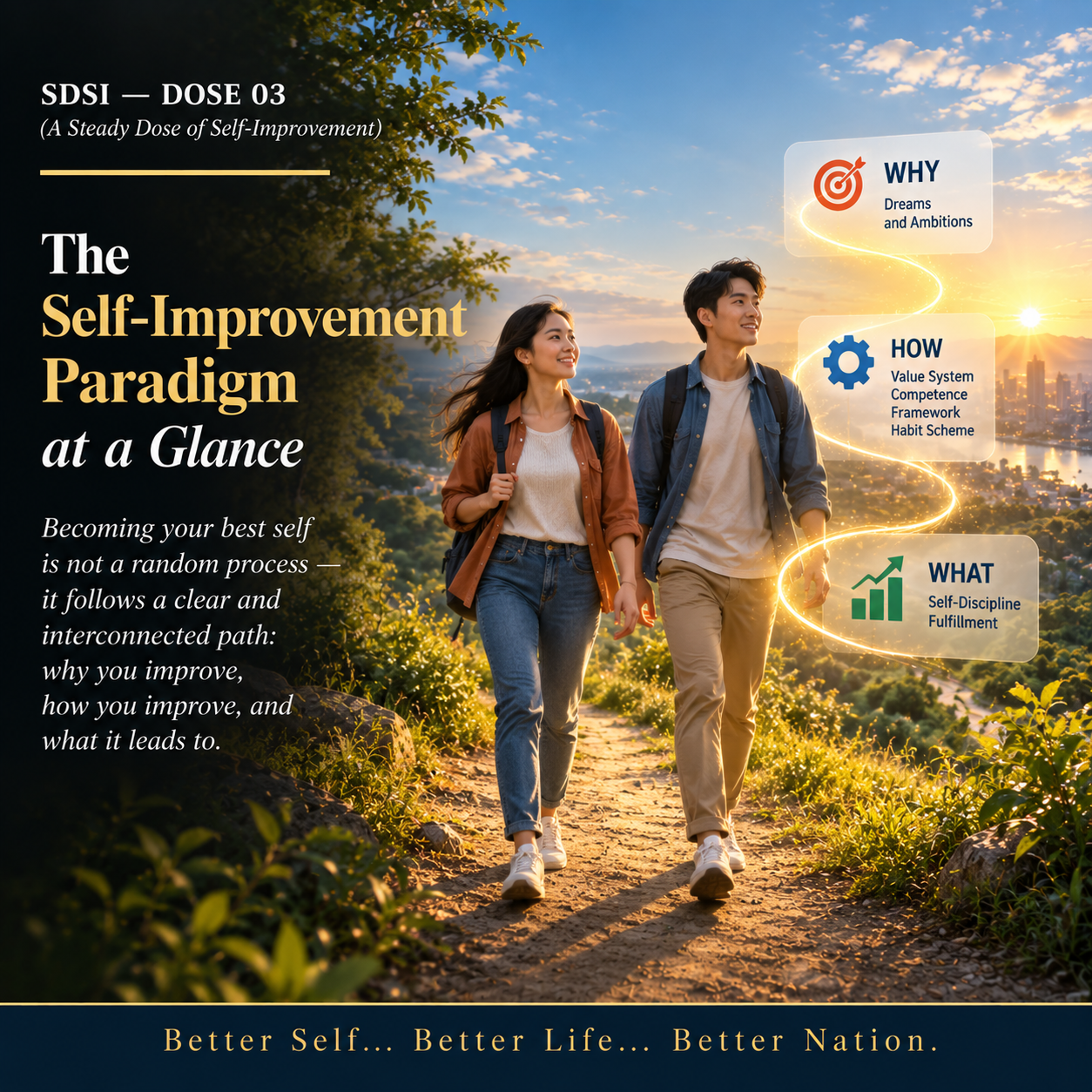
Real transformation rests on three pillars — what you believe, what you can do, and what
you practice — held together by self-discipline.

Becoming your best self was never going to be one thing.
For years, I thought growth meant picking whichever self-help idea resonated that month — a book on mindset here, a productivity system there — without ever asking how they fit together. It took time to see that the people who actually transform their lives aren’t chasing isolated fixes. They’re building on a structure.
That structure rests on three pillars. The first is your Value System — the attitudes and beliefs you carry about yourself and the world. The second is your Competence Framework — the actual skills and abilities you develop. The third is your Habit Scheme — the practices and activities you repeat often enough that they become who you are.

Remove any one of the three, and the other two eventually wobble. Belief without skill produces confidence with nothing to stand on. Skill without habit produces potential that never compounds into results. Habit without belief produces motion without conviction — busywork mistaken for progress.
Holding all three together is self-discipline — the thread that keeps the structure upright once the initial motivation fades, as it always eventually does. Health, success, and happiness arrive as natural results of the structure underneath, not as prizes you win by wanting them hard enough.
This is the paradigm the rest of this book unpacks, chapter by chapter — twenty chapters split across the three pillars, each one a single brick in a foundation meant to hold up an entire life, not just a single good year.
Pause and Reflect
Which of the three — belief, ability, or practice — do you most need to shore up right now?
One Step Forward
Pick the weakest of the three pillars in your life right now. Write one concrete step you’ll take this week to strengthen it.
Explored in full in the Introduction (Figure 1) of A Holistic Approach to Self-Improvement.
Better Self… Better Life… Better Nation.
Lessons on Perspective

I have a friend who is regularly mistaken for me. We teach at the same university, share a similar build and height, and have the same rounded face — though I have a more defined nose and he has fairer skin. One day, visibly bemused, he asked me, “Why would they think I am you? Do I look as old as you?” I paused, smiled, and replied, “No. I look as young and handsome as you.” He laughed. And in that small exchange, I noticed something larger than the joke: the same mix-up, the same mistaken identity, had produced two completely different reactions in two different men. He heard an insult about age. I heard a compliment about my looks. Nothing about the situation had changed. Only the lens through which each of us chose to receive it.
That, I think, is the simplest definition of perspective — not what happens to you, but the angle from which you decide to look at what happens to you. Two people can stand at the same window on the same morning. One sees the smudge on the glass. The other sees the sun rising behind it. Neither is wrong, exactly. But one view will serve the viewer far better than the other.
I was reminded of this again in a conversation with a colleague, an expat teacher like me, who was frustrated about his salary. He told me, with some bitterness, that a truck driver back in his home country earned more in a year than he did. I listened, then asked him to slow down and look at the bigger picture. How many hours did that truck driver work to earn that figure? What were the physical demands of long-haul driving, year after year? And what about our own schedule — the fact that, as university teachers, we are paid in full through both winter and summer breaks, which together amount to five months of the year? During those five months, our only real obligations are a handful of meetings at the start and end of each semester. The rest of the time is simply ours.
When he ran the numbers on his actual hourly rate, his frustration lost its footing. He was earning more per hour than the truck driver, under incomparably gentler conditions. His complaint had been built on a true fact — the raw annual figure — but an incomplete picture. He was not wrong about the number. He was wrong about what the number meant because he had left out everything around it.
This is the most common failure of perspective, and the most forgivable one. We are not lying to ourselves on purpose. We simply stop looking before we have gathered the whole view. The fix is almost always the same: pause, and ask what else belongs in the frame.
But there is a second, less innocent failure of perspective, and a different colleague handed me a clear example of it. He told me, flatly, that he considered motivational quotes to be nonsense. To prove his point, he gestured at a small bulletin board bearing a quote that read, “Whatever you are, be good at it.” Then he delivered what he clearly believed was the knockout line: “So if you are a rapist, be a good rapist.”
I told him he had chosen the worst possible illustration he could have picked. More importantly, his example revealed the lens through which he had chosen to interpret the quote. You cannot be good at doing something that is, by its nature, an act of harm. Goodness and harm are not two settings on the same dial; one cancels the very premise of the other. I asked him the obvious question: Why a rapist, of all the things a person could be? Why not a teacher? A father? A leader? Each of those would have proven the quote’s point beautifully — that excellence, applied to a worthy role, elevates both the role and the person in it. Instead, he reached for the most grotesque example available, not because it was the most honest one, but because it was the most useful one for the argument he had already decided to win.
That is the difference between an incomplete perspective and a distorted one. My colleague with the salary complaint was missing pieces of the picture, but he was not hiding from the truth — he simply hadn’t gone looking for it yet, and once he did, he changed his mind. The man at the bulletin board was doing something else entirely. He was not missing information. He was selecting the most damaging frame available and presenting it as the obvious one, so that the quote — and perhaps optimism itself — would look foolish by comparison. One man’s perspective needed completing. The other man’s perspective needed correcting.
I think about these three exchanges together because they map out the territory so well. The mistaken-identity story is perspective in its lightest form — the same fact, received through two different temperaments, producing two different emotional outcomes, both harmless. The truck driver story is perspective in its most repairable form — a real grievance, resting on a partial view, that dissolves the moment the missing pieces are added back in. And the bulletin board story is perspective at its most dangerous — not an honest gap in the picture, but a deliberate choice of the worst possible angle, used to discredit something that did not deserve it.
Obi-Wan Kenobi was right when he said that many of the truths we cling to depend greatly on our own point of view. But that is not an excuse to pick whichever point of view is most convenient, most cynical, or most self-serving. It is an invitation to be honest about which direction you are choosing to look — and deliberate enough to ask whether you have actually seen the whole field before you decide what it means.
Perspective, in the end, is not something that happens to us. It is something we choose, conversation by conversation, frame by frame. The only real question is whether we are choosing it carefully — or just reaching for whichever lens lets us win the argument we already wanted to have.