Category Archives: From Self to Nation
Betting on Ourselves

I have a section on my website that I christened “Road to Self-Improvement.” That section was born of my advocacy for self-improvement — and it is where the idea of writing a book on the subject first took shape. But the advocacy itself is older than the website, older than the book. It started years ago, when a friend asked me a simple question: what is the best national development framework for the Philippines?
I told him this — for the Philippines to develop as a nation, Filipinos need to abandon the mindset that a messiah will come to save our country from the socio-political and economic quicksand where we are currently drowning. We think we can pin our hopes for a better future, a better life, on a leader or politician we believe in and support — most of the time, blindly. And yet whoever we elect to the seats of the Executive and Legislative branches has consistently failed to move the needle of progress and peace.
So what, then, is the framework? I believe it begins smaller than any election, smaller than any administration — it begins with the individual. If every Filipino embraces self-improvement and pursues their full potential, they can grow in every aspect of life: mind, character, discipline, livelihood, health. When that happens, they succeed — and with that success comes the capacity to lift not only themselves, but the families they belong to. When every Filipino and every family commit, simply and consistently, to becoming better, imagine what their community becomes. And if every community in our towns, cities, and provinces reflects that same commitment, we will have built — not waited for, not voted for, but built — a stronger Philippine society. A stronger Filipino nation.
It is time for Filipinos to abandon the mindset that we can pin our hopes on a strong politician or leader — a messiah, a savior. Every Filipino should pin their hopes on themselves. We must bet on ourselves, not on someone who promises us the moon and the stars during an election. Betting on a leader to single-handedly bring our nation to paradise is like betting on a lottery with 45 numbers to choose from — your odds of winning are 1 in more than 8,000,000. It’s like fishing for one single fish in a fishing area the size of the entire Pacific Ocean.
One need not look far for proof. As I write this, the nation watches its vice president stand trial for corruption and misuse of public funds, while senators allied with one camp or another are arrested, disappear, or resurface depending on which side of a political feud they happen to stand. Officials once inseparable allies now accuse each other of the very crimes they once campaigned to eradicate together. This is not an aberration — it is the lottery working exactly as it always has: fortunes made and unmade not by the merit of public service, but by the shifting arithmetic of political alliances. Whoever wins this particular round of the game, the game itself remains what it has always been — a gamble the ordinary Filipino never gets to place a real bet in, only to watch.
Betting on ourselves, on the other hand, is not a bet on chance at all — it is a commitment to effort, and effort is not drawn from a bin of eight million balls where luck alone decides the outcome. When a Filipino bets on a leader, he marks a ballot once, then waits — powerless, passive — for a stranger’s decisions to shape his future. When a Filipino bets on himself, there is no waiting and no ballot box; there is only the next skill learned, the next hour of work invested, the next discipline practiced. These are not draws from a lottery machine — they are deposits, and, like any deposit made consistently, they compound. A leader may fail to deliver even after winning every vote in his favor; a Filipino who invests in his own competence, character, and resilience cannot be defrauded of that investment by any politician, any administration, or any election cycle.
This is exactly the mechanism by which one Filipino’s discipline becomes a family’s stability, a family’s stability becomes a community’s strength, and a community’s strength becomes a nation’s foundation. No leader can legislate that chain into existence. No election can manufacture it overnight. It has to be built — person by person, family by family, town by town — and the beauty of it is that, unlike the lottery of politics, every single one of us holds a winning ticket the moment we decide to act on it.
This is the difference between hoping for a miracle and building one. It is why I stopped asking, years ago, who will save our nation — and started asking instead what I myself was willing to build. That question became a website section. It became years of writing. It eventually became a book. But long before it became any of those things, it was simply a decision — the same decision I believe every Filipino is capable of making, the same decision that, multiplied across a hundred million of us, could move the needle that a hundred years of elections never did.
We do not need a messiah. We need each other, choosing, one by one, to bet on ourselves.
WHERE WE STAND
Where Do We Truly Stand — In Hell, Purgatory, or Paradise?
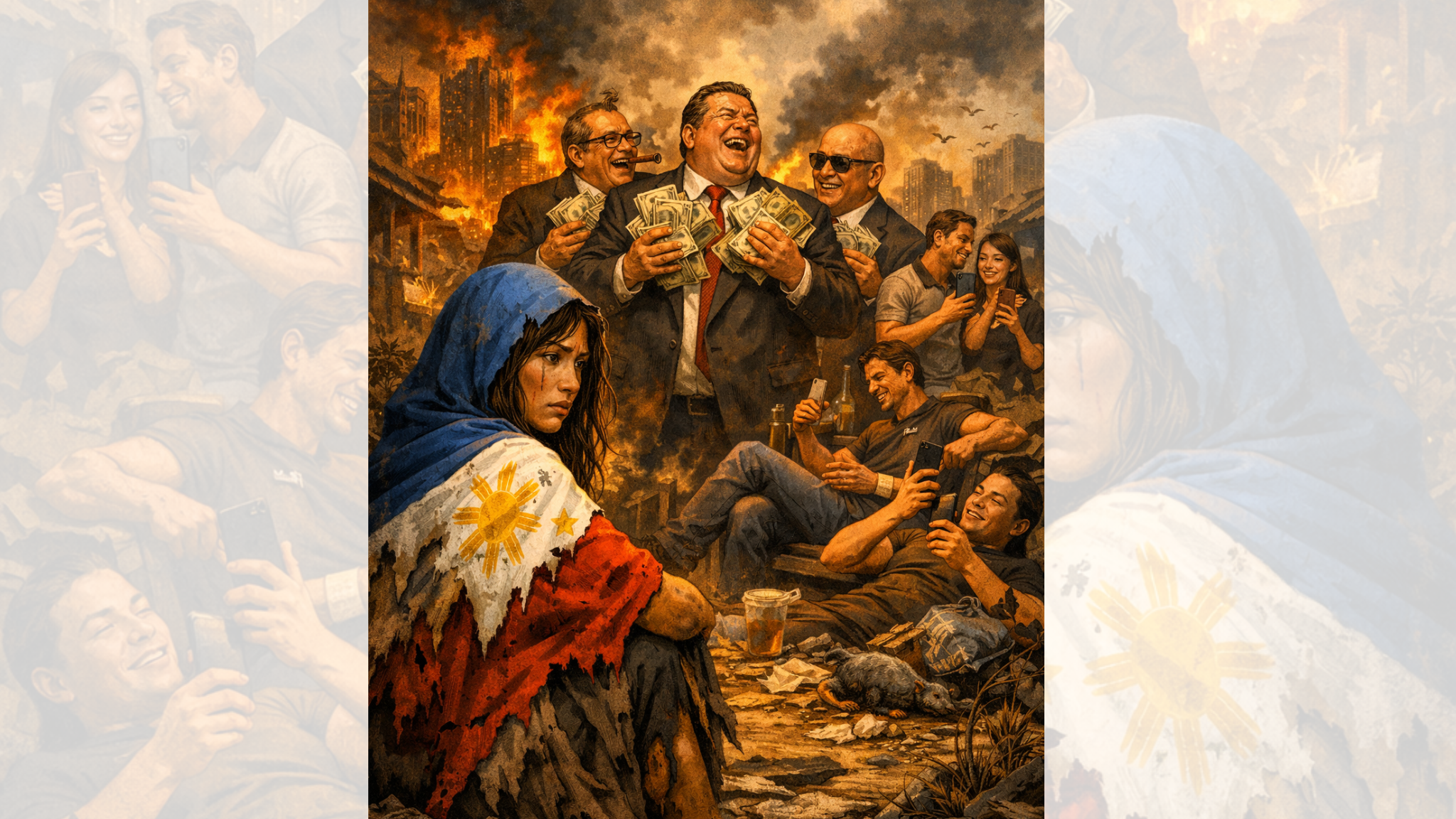
A nation’s destiny rests on two foundations: the integrity of its government and the responsibility of its people—in simpler terms, good government and responsible citizenry. When both are strong, the nation becomes a paradise. When one falters, it drifts into purgatory. When both fail, it descends into hell.
The condition of a nation can be understood as a journey, one that passes through darkness before finding light. As in the Divine Comedy, where Dante descends into Hell before ascending toward Paradise, we may examine our national reality through a similar lens: not as a fixed state, but as a movement shaped by collective choices.
From this perspective, three essential questions arise that Filipinos must address:
Do we have a good government?
Are we a responsible citizenry?
Where do we stand as a nation—paradise, purgatory, or hell?
The answer to the first question is unequivocal.
We have a dysfunctional government.
Corruption plagues our institutions, depleting resources meant for public services. Funds for infrastructure, education, and social programs are often misused or lost to dishonesty. Tools for progress become paths for personal gain. Public coffers become the personal piggy banks of corrupt politicians.
These practices reveal more than institutional failure; they expose deep ethical flaws—greed prioritizes personal gain over public good, pride resists accountability. Such conduct echoes vices long recognized in moral and literary traditions. These ethical failures do not remain confined to values—they manifest in the way institutions function.
This dysfunction erodes our institutions and lowers expectations. As corruption becomes common, integrity is no longer the standard but an exception. Citizens tolerate dishonesty, normalizing inefficiency and sustaining a cycle: weak systems create passive citizens, who in turn allow continued weakness.
More concerning, this dysfunction breeds resignation. Many believe change is impossible, which normalizes corruption. This discourages participation, silences critical voices, and weakens the collective will to demand better governance. When hope is lost, withdrawal from civic engagement prevents reform.
In Dante’s vision, the morally indifferent—those who refused to take a stand—are denied even entry into Hell, condemned not for what they did, but for what they failed to do. In much the same way, silence and inaction among citizens allow dysfunction to persist, unchallenged and uninterrupted.
This condition resembles what Dante portrays as sloth—not simply idleness, but a failure to act when action is required. It is a form of moral passivity that allows injustice to endure, not through direct participation, but through quiet tolerance.
Like the inscription at the gates of Hell—“Abandon all hope, ye who enter here”—many among us have come to accept dysfunction as permanent, surrendering the very hope that could lead to change. In such an environment, political actors are not pressured to rise above dysfunction; rather, they are enabled by it.
Simultaneously, the political theatre is often reduced to mudslinging between rival groups. This pattern frequently reflects not reasoned disagreement but a descent into hostility, in which discourse is driven less by the pursuit of truth than by division. Instead of meaningful dialogue and collaboration, we witness endless accusations, personal attacks, and partisan conflicts that distract from substantive governance—at times resembling a tragicomedy in which the spectacle is at once absurd and deeply troubling, both disquietingly humorous and undeniably tragic. Energy that should address national problems is instead diverted to political theatrics.
More troubling is the persistent failure to hold erring officials fully accountable. While scandals emerge and controversies capture public attention, justice is often delayed, diluted, or denied. This failure is compounded by partisan loyalties, where political actors quickly condemn and pursue wrongdoing by opponents, yet ignore misconduct by their own allies. Accountability becomes selective: applied rigorously to adversaries, but with hesitation or silence toward members of one’s own political bloc. Consequently, those found guilty rarely face consequences proportionate to their actions, thereby strengthening a culture of impunity. When accountability is weak, misconduct is not discouraged; it is, in effect, tolerated.
Taken together, these realities depict a government that struggles to fulfill its most fundamental responsibilities, not because solutions are impossible, but because the system itself is compromised.
If ours is not a good government, does that place us in purgatory?
Not quite, because the failure of government does not exist in isolation; it is mirrored and reinforced by the shortcomings of its people.
We now turn to the second question:
Are we a responsible citizenry?
We cannot attribute our failure to reach full socio-political and economic potential solely to the government. In reality, we contribute to this condition in more ways than we often acknowledge. In many ways, the consequences we face as a nation reflect the very choices we have made. As suggested in Dante’s vision, consequences often correspond to the actions that produce them—a principle sometimes described as contrapasso.
We fail in a fundamental civic duty—we do not choose our leaders wisely. We sell our votes, apply questionable standards in evaluating candidates, and reduce elections to popularity contests. As a result, we elevate into power individuals who are either unqualified, inexperienced, or driven by self-interest.
This failure is perhaps most evident in the persistence of vote-buying and vote-selling practices that continue to weaken the integrity of our democratic systems. Elections, which should serve as a mechanism for selecting the most qualified leaders, are too often reduced to transactions in which public office is effectively purchased rather than rightfully earned. In such a system, consequences tend to mirror the choices that produce them. This is the contrapasso of the ballot. When we treat the sacred right of suffrage as a commodity to be sold for a day’s meal, we are, in turn, governed by those who treat public office as a commodity to be exploited for three to six years—or more—of profit.
We are not simply victims of a corrupt system; we are the architects of our own deprivation, bound within a cycle in which the short-term relief of a bribe becomes the long-term chains of our national poverty. In such a system, leadership is no longer measured by competence, integrity, or vision, but by the capacity to use financial means to secure electoral advantage.
What makes this particularly damaging is how it distorts the very foundation of representation. Those who assume office through monetary influence may come to view their positions not as a public trust, but as an investment to be recovered. Governance, in turn, becomes less about service and more about return—where decisions are formed not by the needs of the people, but by the desire to recoup and profit from the cost of acquiring power. In this way, corruption is not simply incidental; it becomes embedded in the system from the very beginning of leadership.
In light of this reality, beyond refusing to sell our votes, we must exercise discernment in selecting those we entrust with public office. The right to vote is not merely procedural; it is a moral responsibility that demands careful judgment. We must set standards that exceed the minimum qualifications prescribed by law and evaluate candidates based on competence, integrity, and capacity to serve. Without such standards, voting becomes an empty ritual rather than a meaningful contribution to nation-building.
Responsible exercise of the right to vote is especially important in a context where popularity is often mistaken for competence. Public office is not an extension of fame and should not be treated as a platform sustained by recognition alone. Leadership requires the ability to understand complex issues, make sound decisions, and act in the public’s best interest. When popularity becomes the primary criterion for electoral success, the standards of governance are inevitably diminished.
Worse, we continue to recycle the same traditional politicians or replace them with members of their political dynasties, expecting different results from the same choices. In doing so, we reinforce a system in which power remains concentrated within a limited circle, restricting opportunities for genuine reform and perpetuating the same conditions we claim to oppose.
What is often overlooked, however, is that these political dynasties do not sustain themselves independently of the people—they are maintained through repeated electoral support. Leadership within the same families persists not simply because it is motivated by ambition, but because it is continually permitted by the electorate. In this sense, political dynasties are not imposed upon the nation; they are reproduced through the collective decisions of its citizens.
As positions of power are passed from one family member to another, governance becomes less a matter of public trust and more a perpetuation of established control. This tendency limits the emergence of new leadership, narrows the variety of perspectives in governance, and reinforces conditions that make significant change increasingly difficult to achieve. When the same names continue to dominate the political landscape, expectations of different outcomes grow increasingly detached from reality.
Recognizing this reality also highlights our responsibility. The means to make informed choices are within our reach. We can examine candidates’ track records, assess their qualifications, and critically evaluate their platforms. The ability to choose wisely does not require extraordinary expertise, only the willingness to be attentive, thoughtful, and responsible in exercising one’s vote. This pattern of behavior reflects a deeper issue that extends beyond actions at the ballot box.
Beyond the ballot, we also exhibit a mindset of misplaced expectations. We tend to believe that the government is solely responsible for solving all of society’s problems, viewing our relationship with the state through the lens of entitlement. We demand benefits and services without fully recognizing our own responsibilities in nation-building.
This belief is often accompanied by the expectation that those in power can single-handedly deliver national transformation, as if progress were the work of political saviors rather than a shared responsibility. Such expectations reinforce patterns of dependence that extend beyond perception and shape behavior.
This mindset is further reinforced by the so-called “ayuda mentality,” which reflects a growing dependence on government assistance as a primary means of survival. While aid is necessary during crises, it becomes problematic when it fosters long-term reliance rather than empowerment.
Instead of supplying temporary relief, assistance is often regarded as an entitlement, weakening the drive for self-reliance and personal initiative. Over time, this erodes the very values necessary for an effective and responsible citizenry—hard work, discipline, and accountability. More concerning is how, in certain contexts, such assistance becomes entangled with political interests. Rather than serving solely as a mechanism for public welfare, it is sometimes dangled as a reward for political favors, including votes and loyalty. This practice transforms aid from a tool of empowerment into an instrument of influence, reinforcing dependency while simultaneously distorting the democratic process.
This cycle of dependency mirrors Dante’s Third Circle, where the gluttons lie in a foul-smelling slush, eternally drenched by cold, ceaseless rain. Our gluttony is not for food, but for the ease of reliance. The contrapasso is evident: by choosing the temporary comfort of a handout over the challenging path of self-reliance, we are condemned to remain in the mud of national stagnation, perpetually waiting for a rain of ayuda that neither cleanses nor empowers, but keeps us mired in our own making.
The more we rely on external provision without cultivating self-reliance, the more we reinforce the very conditions that make such reliance necessary. It becomes a quiet echo of the same moral logic found in Dante’s vision, where consequences reflect the choices that give rise to them.
When citizens begin to associate public assistance with political allegiance, the relationship between the people and their leaders shifts from one grounded in accountability to one driven by patronage. Instead of evaluating leaders based on competence, integrity, and vision, some are compelled to support those who provide immediate material benefits, regardless of long-term consequences. In this way, assistance no longer uplifts—it conditions. It discourages initiative, weakens independence, and fosters a cycle in which both leaders and citizens become trapped: leaders in the pursuit of political survival through distribution, and citizens in the expectation of continued provision.
To be clear, assistance has a legitimate and necessary role—especially during crises, disasters, and periods of financial hardship. A compassionate government must provide safety nets for its most vulnerable citizens. However, when assistance evolves from temporary support into a permanent expectation, it ceases to empower and begins to weaken.
The issue, therefore, is not the aid itself but the mindset surrounding it. A society that depends primarily on external support, rather than cultivating internal strength, risks losing the qualities that sustain long-term progress: initiative, resilience, and self-reliance.
A nation cannot progress when its people are conditioned to wait rather than act, to receive rather than build.
This is further compounded by a culture of blame. When we fail to achieve success in personal or professional life, we are quick to point fingers at the government, leaders, or circumstances, rather than examining our own decisions and actions. In doing so, we absolve ourselves of responsibility and surrender the agency required for growth. Instead of accountability, we resort to excuses.
This mirrors a recurring moral pattern—inaction, though seemingly harmless, allows dysfunction to persist. In much the same way, silence and inaction among citizens allow dysfunction to persist, unchallenged and uninterrupted.
This is where our Faith must move from ritual to resolve. To claim faith in God while remaining indifferent to the hell of corruption is a spiritual and civic contradiction. True faith does not offer an escape from responsibility; it provides the very mandate for it. If we are to be led by this Virgil, we must realize that God does not build nations—He empowers people to build them.
At its core, the problem is a lack of personal responsibility and civic discipline. We often neglect the role we must play—not only as voters, but as individuals who must prepare ourselves, work diligently, and contribute substantially to society. Nation-building is not the task of government alone; it is a shared responsibility that demands effort from every citizen.
We now come to the third question:
Where do we stand as a nation—paradise, purgatory, or hell?
During his journey through the abyss, Dante was guided by Virgil. For Filipinos, if we are to find our way out of the dark woods of national dysfunction, our Virgil must be Faith in God. This should not be a passive faith that views the Divine as a mere spectator, but a vigorous, demanding faith that serves as our moral compass. It is the light that reveals the ‘ordered circles’ of our descent and provides the strength to begin the ascent.
As previously established, when both government and citizenry are strong, the nation becomes a paradise. When one falters, it drifts into purgatory. When both fail, it descends into hell.
Given the condition of our institutions and the character of our civic behavior, the conclusion becomes difficult to avoid.
We are not in paradise.
We are not even in purgatory.
We are in hell.
And yet, to understand purgatory is to understand that it represents something fundamentally different from both paradise and hell. It is neither a place of fulfillment nor of final condemnation—it is a state of transition. In the Divine Comedy, purgatory is where souls begin the difficult work of purification, and recognition of fault is the first step toward transformation.
In Dante’s vision, these same vices are not simply punished—they are purified. Every spirit confronts the very weakness that led it astray. In much the same way, any path toward national renewal calls not only for recognizing our failures but also for deliberately correcting them.
If hell represents the condition of both a failing government and an irresponsible citizenry, then purgatory may be seen as the point at which one begins to change while the other still lags behind. A nation in purgatory is not yet healed, but it is no longer in denial. It is a nation that has begun to recognize its shortcomings and is actively striving to correct them.
In our context, purgatory would require a shift in consciousness—a willingness among citizens to move beyond blame and toward accountability, and a readiness among institutions to rebuild trust through genuine reform. It is the stage where difficult truths are no longer avoided, but confronted; where excuses give way to effort; and where passive observation transforms into active participation.
Though we have concluded that we are not yet in this state, the concept of purgatory is fundamental—not as a description of where we are, but as a vision of what lies between our current condition and the possibility of renewal. It reminds us that transformation is neither immediate nor effortless, but attainable through deliberate, sustained change.
To understand how we arrived here, we must recognize that this condition is not merely the result of present failures—it is also rooted in a past that still shapes our present. As a nation, we have long been fragmented—geographically, culturally, and politically—an archipelago not only in land, but in identity. Our colonial history reinforced this fragmentation. Through the divide-and-rule strategy, our colonizers kept us subdued, preventing unity and making sure that resistance remained scattered and ineffective.
Though political independence has long been achieved, the imprint of this division remains. We continue to see ourselves not as a united whole, but as competing factions. This fragmentation deepens further when political actors exploit these divisions, prompting citizens to defend them against one another rather than hold them accountable. In doing so, we become participants in our own disunity.
Over time, our prolonged inability to free ourselves swiftly from colonial rule cultivated a quiet resignation. A decisive moment came when the struggle against our conquistadores from the Iberian Peninsula was nearing victory, and a sense of national identity was beginning to take shape. Yet at that critical juncture, the Filipino people were denied the opportunity to complete their own struggle for liberation, as another power, emerging at the close of Spanish rule, intervened—marking a transition from one colonial master to the next.
What followed was not merely a political transition, but a period in which the natural development of nationalism was constrained, delaying the full emergence of a unified national consciousness and leaving a lasting imprint on how we perceive our collective identity and capacity for self-determination.
What could have been a defining victory—one that might have strengthened national pride and unity—was interrupted by forces beyond their control. This left behind not only a political consequence, but a psychological one. In place of a fully realized sense of self-determination, there emerged a lingering uncertainty about our capacity to shape our own destiny.
This uncertainty is our national Limbo. Like those in Dante’s First Circle who lived without the ‘baptism’ of a completed purpose, the Filipino spirit stays suspended in a state of ‘what could have been’. Because our revolution was interrupted and our liberation was granted rather than fully seized, we have inhabited a political twilight for over a century—not fully damned, but not yet free. We are haunted by the sighing of those who are ‘hopeless in desire,’ longing for a national identity that we were never permitted to finish building ourselves.
A people long subjected to domination may begin to internalize limitation—a belief that significant change is difficult or unattainable. This inherited mindset weakens the collective will to act. This condition, however, is not shaped solely by history.
Yet this condition is not a chaotic fall but a structured descent, much like the ordered circles of Hell in the Divine Comedy. Each layer reveals a deeper moral failure: from negligence to apathy to corruption, and ultimately to the betrayal of public trust. What we experience is not random misfortune, but the cumulative result of choices repeatedly made and responsibilities repeatedly ignored.
The natural environment has also shaped our collective mindset. In a country frequently visited by destructive typhoons, repeated exposure to disruption has fostered both resilience and resignation. While these conditions have strengthened our capacity to endure, they have also normalized crisis and reinforced a tendency to respond rather than anticipate, to recover rather than prevent.
Whatever factors and circumstances may have shaped our condition do not absolve us of responsibility for it. Our current condition is not a sudden collapse, but the result of choices made over time, each contributing to a gradual descent. As in the journey through Hell, recognition is only the beginning.
What, then, should we do?
As in the Divine Comedy, the journey does not end in hell. There is a path upward to paradise, though it is difficult. In Dante’s journey, Hell is governed by a moral logic in which each consequence reflects a prior choice. Similarly, the dysfunction we endure as a nation is not without cause; it mirrors the decisions we have made, the leaders we have chosen, and the responsibilities we have neglected.
Although we are not yet in purgatory, we must understand its significance. Purgatory is not a place of perfection, but of transformation. It is where acknowledgment leads to change and responsibility replaces denial. It is the space between failure and renewal, a necessary passage toward improvement. This slow ascent requires effort, discipline, and readiness to confront one’s own shortcomings.
Reaching such a state requires a shift in consciousness, a willingness to move beyond blame toward accountability. It is where effort begins, discipline is cultivated, and participation replaces passivity.
However, that path requires a fundamental change in how we think about national development.
For too long, we have relied on a flawed model that assumes progress begins externally. It is time, therefore, to look inward.
Just as Virgil guided Dante through darkness—not by force, but through the light of Reason and the mandates of the Divine—we too must rely on a Faith sharpened by clarity of thought and self-awareness to navigate our way out of this abyss.
The alternative path begins with the individual and extends outward—to the family, the community, and the nation.
If paradise is to be realized, it must be understood not merely as prosperity, but as the restoration of unity and the overcoming of fragmentation that has long defined us. A nation cannot reach its highest potential while divided. True progress demands cohesion and a shared sense of purpose that transcends regional, political, and ideological boundaries.
To arrive at such a state, we must consciously unlearn the divisions that history has imposed upon us. The legacy of divide et impera must no longer define how we relate to one another. Instead of allowing ourselves to be separated by difference, we must recognize that our strength as a nation lies precisely in our diversity—when it is bound together by a common commitment to the greater good.
A nation in paradise is not free from disagreement, but disagreement does not lead to division. It is a nation where citizens hold leaders accountable without becoming instruments of partisan conflict, and where public discourse is guided by a shared desire for national progress rather than hostility.
Ultimately, paradise is not granted; it is built. It emerges when individuals rise above narrow loyalties, families instill values of discipline and responsibility, and citizens view themselves as integral parts of a greater whole. Only through unity, grounded in shared values and mutual accountability, can a nation truly ascend to its highest form.
The ascent from Hell in Dante’s journey is neither sudden nor effortless; it demands movement, struggle, and persistence. One does not simply escape darkness, but must climb out of it. At the end of this difficult ascent, Dante presents a powerful image: the return of light, the moment when he emerges “to see the stars again.” This reminds us that no descent is final, and even from the deepest darkness, a path toward renewal remains.
Only then can we begin our ascent: from hell, through purgatory, and ultimately toward paradise. The path to national transformation does not begin in the halls of power, but within the quiet decisions of individuals who choose, day by day, to change themselves.
In the end, a nation is nothing more and nothing less than a reflection of its people. If we desire a better nation, we must first become better individuals.
The journey out of the abyss is long, but Dante’s final word in every canticle remained the same: stelle, the stars. For us, the stars are not distant celestial bodies, but the three stars of our national emblem, long obscured by the smoke of partisan conflict. Like Dante emerging from darkness to behold the stars once more, we too may rise if we choose not merely to hope for change, but to become its source. Only when we fix our gaze upward, guided by Faith and shared history, do we leave the darkness behind. In that rising, we do not merely find paradise; we build it.