My Continuing Journey In South Korea
When I quit my job as a school administrator in Bulacan to pursue ESL teaching in South Korea, my loved ones and friends strongly advised me to reconsider. They reminded me that I already had a solid career in the academe in the Philippines, and the pay was decent. But as Jake Sully says in the movie Avatar, “Sometimes your whole life boils down to one insane move.”
So, in 2013, I flew to South Korea. But it wasn’t an insane move, rather a calculated risk. I have no regrets, as coming here was one of the best decisions I’ve made in my life. Working here has been an enormous blessing. This country is a beautiful place to live. When I arrived, I could confirm the impressions created by the Korean dramas and movies I had watched. Indeed, South Korea is progressive and beautiful, and its citizens are competitive, hard-working, and health-conscious.
Beyond providing financial stability for me and my family, my time in South Korea has fostered tremendous personal and professional growth. The working conditions at the university where I am currently employed are excellent. At first, I could hardly believe that I only needed to work less than 20 hours over four days. We must work only seven months but are paid for the entire year. This arrangement has given me ample time to connect virtually with my family and pursue my other passion—writing. Additionally, our university offers performance points and cash incentives for research projects, further enhancing my love for writing.
I mainly teach English subjects. There have been semesters when I was asked to teach at the graduate school and serve as an adviser to graduate students working on their dissertations. When I’m not engaged in academic work, I dedicate time to writing stories, poems, plays, and scholarly studies, many of which are published on my personal website. Several of my research studies have been presented at international conferences and published in internationally indexed journals. I have genuinely found fulfillment as a writer in this country.
I can’t imagine having any other “job cum hobby” besides teaching and writing. You may ask why. As Seth Godin said, “Do what you love and love what you do.” What I do and love is teaching, and what I love and do is writing. I use the expression “job cum hobby” because, when I engage in these activities, I don’t feel like I’m working; it feels more like pursuing hobbies.
My greatest challenge as a teacher is overcoming the cultural barrier between myself and my Korean students. I address this by building a good rapport with them and diligently fulfilling my responsibilities. Being a Filipino in ESL/EFL teaching places me and my fellow countrymen at a disadvantage. There is a common misconception that only native English speakers can teach the language, and even some of our Korean students believe this. It is something that Filipino English teachers like me must work to dispel. If I were to identify my most significant contribution as a Filipino in my profession, it would be demonstrating to the academic community in South Korea that one doesn’t need to be a native English speaker to be an effective ESL/EFL teacher.
I can’t think of anything negative about my current job; I have nothing but gratitude. I enjoy a harmonious relationship with my coworkers, both Korean and foreign. Although I occasionally clash with fellow foreigners over policy matters and work attitudes, we adhere to the principle of disagreeing without being disagreeable, which helps us maintain mutual respect.
My best advice for my fellow Filipinos working in South Korea is to work hard and respect everyone. Hard work leads to success as expat workers, while respect for others, regardless of citizenship, helps them stay out of trouble. It’s also important to abide by the laws of our host country.
Reflecting on my 12 years here, I see that what began as a leap into the unknown has become the most fulfilling chapter of my life. Teaching and writing—my two greatest passions—have flourished in this country. Embracing new challenges reminds me why I took that “calculated risk” in 2013. South Korea has provided me with opportunities to improve my overall well-being and has reaffirmed my belief that staying true to what you love leads to rewarding outcomes.

The Pursuit of Well-Being (Part 2)

A holistic approach to well-being also requires embracing lifelong learning. The primary component of intellectual well-being is the desire to continuously learn and perpetually crave new ideas. Those strong in this dimension possess a sense of curiosity and the desire to develop their critical thinking and creative abilities.
On its website, dedicated to promoting well-being, the University of Virginia refers to intellectual well-being as the ability to open one’s mind to new ideas and experiences that can be applied to personal decisions, group interaction, and community betterment. It added that it also involves using one’s mental abilities meaningfully and feeling satisfied and proud of one’s educational and intellectual journey.
Awareness about how you learn and study best is vital to enhancing your intellectual well-being. You can foster this by challenging yourself and not allowing self-limiting beliefs. You will encounter setbacks and failures along the way, but treat them as opportunities for growth and development.
People with enhanced intellectual well-being are lifelong learners. Talerico (n.d.) states that they are interested in pursuing personal and professional development, such as picking up a hobby, studying a subject, learning a language, taking a vocational course, playing a sport, and joining a club. She also enumerated the benefits of lifelong learning: job security, career options, renewed motivation, stronger soft skills, better cognitive health, confidence, and networking opportunities.
__________
In addition to physical and mental well-being, the World Health Organization (WHO) considers social well-being an important dimension of overall health (Salehi et al., 2017). They identified five key domains of this dimension: social integration, social acceptance, social contribution, social actualization, and social coherence. Social wellness, or the lack of it, can significantly impact overall well-being.
Enhancing your social well-being requires building strong relationships and participating in community activities. You must cultivate positive and healthy relationships with family, friends, and colleagues. Volunteering in activities organized by your community is also an excellent way to establish new connections. Staying connected with the people in your life will help you enhance your health’s social and emotional aspects. Keep in mind that effective communication is essential in the process of establishing connections.
STRIDE (n.d.) explained that social wellness is achieved when one can create and maintain healthy, reciprocal relationships with the people around one. Positive social relationships can provide comfort and support in difficult times, increasing one’s resilience and ability to cope with life’s challenges.
It is not difficult to set a goal for social well-being. You can begin by regularly contacting friends, joining a group of people with whom you share common interests, or volunteering at community organizations that promote your advocacy.
__________
The quest for holistic well-being also involves engaging in activities that provide a feeling of purpose or productivity. At a certain point in your life, you will want a job or work where you can apply the knowledge and skills you acquired or developed. You may either apply for a job or be self-employed (or run an enterprise of your own) in your chosen field. When you finally settle into any kind of work, another dimension of your well-being is activated: your occupational well-being.
Occupational well-being is about pursuing a career that gives you a sense of purpose and fulfillment. It involves recognizing your talents and skills while seeking opportunities for personal satisfaction and growth through your work and pursuing a hobby or interest.
Sometimes, instead of contributing to overall health, having work becomes a source of stress. Instead of finding joy through it, work becomes a source of depression. Oakland University (n.d.) stressed that occupational well-being also involves achieving a healthy work-life balance, managing workplace stress, and building relationships with bosses and coworkers while integrating the commitment to your occupation into a satisfying and rewarding lifestyle. It may not be easy, but the only way to achieve occupational well-being is to learn the art of juggling your personal life and career.
__________
The occupational facet is directly tied to another dimension of well-being–financial well-being. Finding a job or pursuing a hobby or interest is done for self-fulfillment and financial stability. It can serve both purposes. The occupation that awaits you there will provide you the economic resources you must have for your basic needs and those beyond basic (healthcare, self-care, education, recreation, and what-have-you).
The CFPB (2015) defined financial well-being as a state of being wherein a person can fully meet current and ongoing financial problems, feel secure in their financial features, and make choices that allow enjoyment of life. The report added that the concept of financial well-being has four central elements: Having control over day-to-day and month-to-month finances, having the capacity to absorb a financial shock, being on track to meet your financial goals, and having the financial freedom to make the choices that allow you to enjoy life. For Kempson & Poppe (2017), this dimension of well-being refers to how individuals can comfortably meet their current commitments and needs and have financial resilience to maintain this ability.
Individual differences also affect how people determine the financial resources needed to cover necessities, settle obligations, handle emergency expenses, and fund recreational activities. A person’s level of materialism and practicality will influence the amount of money they require to achieve financial well-being.
__________
In the pursuit of overall well-being, we establish and nurture relationships with our fellow human beings, the social institutions we belong to, and our surroundings. You must preserve not only your personal relationships but also the environment. Your awareness of environmental issues, attitudes toward climate change, and willingness to adopt sustainable practices indicate your level of environmental well-being.
BU (n.d.) explains that environmental well-being involves valuing the relationship between ourselves, the spaces we live and work in, and the planet. It requires noticing and understanding how our surroundings impact our thoughts and feelings and how our actions affect the environment. This awareness enables us to make decisions promoting sustainability and respecting our community. According to STRIDE (n.d.), your sense of safety, comfort, and connection with your physical surroundings is called environmental well-being. It entails considering how your surroundings, community, and self interact.
While we may be at the top of the food chain due to our superior intelligence and the technology we have created, we must respect all of nature and the animals that inhabit it. This respect is the foundation of environmental well-being and fosters our environmental consciousness and conscientiousness. Such conscientiousness leads us to take on the role of a good steward of God’s creation rather than its destroyer.
__________
As previously articulated, Swarbrick maintains that all the dimensions of well-being are equally relevant and interdependent. However, if there’s one aspect that strongly affects all the others, it’s the spiritual dimension. While the journey toward overall wellness often begins with physical health, spiritual well-being provides a deeper sense of purpose and meaning, helping to sustain and balance the other dimensions.
The spiritual dimension is the foundation in your quest to achieve overall well-being. It will guide you through challenges and contribute to your emotional, mental, and social stability. Your spiritual inclinations will serve as the guiding force shaping your thoughts, behaviors, and attitudes in every dimension of well-being.
Najarkolaei et al. (2019) explained that spiritual well-being is a unique source that coordinates physical, mental, and social dimensions, and it is characterized by stability in life, peace, adjustment, and harmony, a sense of close relationship with oneself, God, society, and the environment.
Spirituality has a strong positive influence on the way people live. Those whose spiritual well-being is robust are better equipped to deal with difficulties and challenges in life. Faith in the existence of God gives hope when the chips are down, and assurance that helps is on the way. Puchalski (2001) mentioned that some studies indicate that spiritual people tend to have a more positive outlook and a better quality of life. This assertion was supported by the findings of the analysis performed by Casanova et al. (2023). They found a significant correlation between spiritual beliefs and hope/optimism, indicating the positive influence of spirituality on emotional well-being. Additionally, spirituality is positively associated with autonomy, highlighting its role in fostering independence in later life. They also explained that spirituality is both a coping mechanism and a source of purpose and meaning in life.
__________
With all the dimensions of well-being—physical, emotional, social, intellectual, occupational, financial, environmental, and spiritual—collectively contributing to holistic well-being, neglecting any one of them will adversely affect your journey toward living a balanced

The Pursuit of Well-Being (Part 1)

“Wellness is the complete integration of body, mind, and spirit – the realization
that everything we do, think, feel, and believe has an effect
on our state of well-being.”
~ Greg Anderson ~
To most people, being healthy is seemingly inconsequential–not a big deal. It’s not considered an achievement worthy of praise and deserving of a spot on social media. As someone once quipped, “Being healthy is a success that many people forget to celebrate.” They don’t consider not being stricken by any kind of disease or burdened by stress and anxiety a victory–a huge blessing that they should thank God for (if they believe He exists).
Virgil’s assertion that the greatest wealth is health is often disregarded. Only when we get sick and bedridden do we start to pay attention to our health or well-being. In some instances, we only do so when it’s too late, and the condition is already either difficult to reverse or not reversible at all.
Let’s not forget that pursuing your personal and professional endeavors is difficult if you’re not healthy—mind, body, and soul. Nurture your well-being before you can embark on a journey towards achieving your dreams and ambitions.
The Oxford Dictionary defines well-being as the “state of being comfortable, healthy, or happy (Oxford, n.d.). Merriam-Webster defines the construct in almost the same way except that instead of “comfortable,” it uses “prosperous” as an adjective used to explain the construct further. As Purcell (2018) explained, this concept embraces more than just physical health. It considers the entire person, both body and mind [and more]. It indicates not just the absence of illness but also the presence of positive mental states, emotions, and moods.”
Ruggeri et al. (2020) gave a more comprehensive definition of well-being. They explained that well-being is the combination of feeling good and functioning well, experiencing positive emotions such as happiness and contentment, developing one’s potential, having some control of everyone’s life, having a sense of purpose, and experiencing positive relationships. This shows that well-being goes beyond the pursuit of a healthy body. It encompasses various aspects of a person’s life, including physical, mental, emotional, spiritual, and social. A person is a physical, emotional, mental, and a spiritual being.
Engaging in activities that promote wellness can nurture well-being. Good wellness habits can contribute to a sense of well-being. This article will delve into the various wellness activities that can lead to well-being.
Wellness is the active pursuit of activities, choices, and lifestyles that lead to holistic health (Wellness Defined, n.d.). The enhancement of one’s overall well-being is the ultimate goal of engaging in activities that promote wellness.
Swarbrick (2012) explained that wellness is a conscious, deliberate process that requires a person to become aware of and make choices for a more satisfying lifestyle. She proposed a model that has been used to craft a practical framework for the pursuit of overall health. Her ‘wellness model’ (see Figure 1) is considered the gold standard for a comprehensive well-being program. Well-being programs found on the Internet have adopted this program in one way or another, wholly or in part.
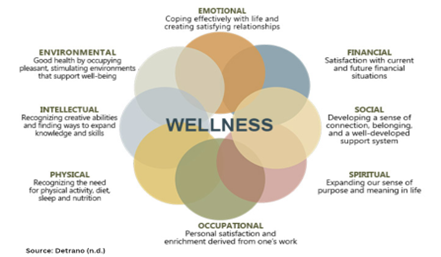
Figure 1 – Eight Dimensions of Well-Being
The model illustrates the different dimensions interlocked in circles to demonstrate their connection and interdependence. Swarbrick proposed that wellness should be approached holistically. You should not focus solely on specific dimensions while neglecting others. A meaningful wellness program aimed at maximizing your overall well-being requires that each dimension be given due consideration. You need to become familiar with each dimension and give them proper attention.
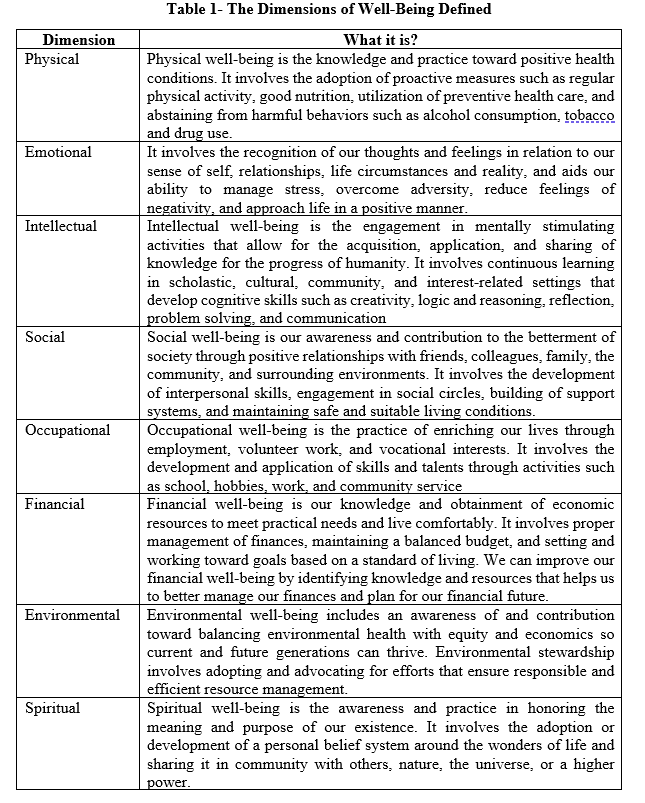
The definitions/explanations of each dimension shown in Table 1 were compiled by the University of Pittsburg on its website, which caters to well-being.
While all eight dimensions are equally important and should receive proper attention, overall well-being should begin with the physical aspect—by taking good care of your body. You must be strong and healthy before pursuing your dreams and ambitions. Regular exercise, a balanced diet, and adequate sleep are the usual advice to achieve physical well-being. It would behoove you to also take regular check-ups and preventive care.
Mahindru et al. (2023) asserted that physical activity also positively affects mental health in addition to the apparent physical health benefits. They mentioned specifically that consistent physical activity may also significantly improve sleep quality. The researchers cautioned that physically inactive individuals have been reported to have higher rates of morbidity and healthcare expenditures. Taking good care of your physical well-being also requires avoiding alcohol, cigarettes, or cigars and using prohibited drugs. Government and health authorities issue warnings against these substances, but surprisingly, there are no high-profile precautions against sugar, another substance that, when abused, will cause illnesses. Just like smoking, excessive sugar consumption leads to debilitating diseases like diabetes, obesity, and heart disease. So, if you genuinely care about the physical aspect of your well-being, be sure to include sugar in the list of substances to avoid.
__________
Emotional wellness has been proven to be directly tied to physical health. When you experience tremendous stress and negative emotions and fail to overcome them, you are bound to develop health problems. You need to develop techniques to manage stress. You probably have often heard how mindfulness practices and meditation help reduce stress and enhance focus.
Mental health professionals suggest staying connected with people in our lives to safeguard our emotional and mental well-being. They also recommend striking a balance between life and work. Thus, you must leave your work in the office so you will have fun and enjoy yourself when you’re with your family and friends. Additionally, cultivating a positive mindset and practicing gratitude are essential. Most importantly, do not hesitate to seek professional help when necessary.
The activities or things you can do to nurture your emotional well-being include exercising, eating well, and getting good sleep. In addition, the CDC (n.d.) offered tips to improve the emotional aspects of your well-being. You get outside to take a nature walk or a city hike. Be active, too. Take a dance break. You can also go to the gym to lift weights or do push-ups or sit-ups. You can also channel your energy into quick cleaning or spending an hour at home. You may also practice relaxation techniques. You can close your eyes, take deep breaths, stretch, do yoga, or meditate. In addition, they suggested that you embrace self-care, check it with yourself, practice gratitude, laugh, consider a new hobby, find an inspiring song or quote, maintain or build your social network, and connect with your faith through prayer or reach out to a member of your faith community.
The Pursuit Of Lifelong/Lifewide Learning

““The key to success is dedication to lifelong learning.”
~ S.R. Covey ~
Jim Rohn had a very unique perspective on success. He said it is not to be pursued but instead attracted by the person you become. He probably meant that success is like a fruit and you are a fruit-bearing tree. How long does it take before a tree bears fruit from the day its seed is planted? Not overnight, not a week or two, not even months, but years. A tree has to grow and mature before it can bear fruit. You must grow, mature, and attain your full potential like a tree. Focus on becoming a sturdy, full-grown tree; the fruits naturally come out of your branches when the proper time comes.
When you become the best you, success comes knocking at your door. However, reaching your full potential or becoming the best you is a long and arduous process. It requires continuous striving, an unending quest for learning. Succeeding requires becoming better every day. As S.R. Covey asserts, “The key to success is dedication to lifelong learning.”
Lifelong learning kicks off when a person starts breathing until their last breath. This means that learning is a continuous process that begins as a newborn infant and progresses throughout your life. Learning doesn’t stop when you’re done schooling. A graduation ceremony is called a commencement exercise because it marks the beginning of a new chapter in a person’s life. The graduate can decide to work or pursue further education. They may do both – work and study again. The world is changing rapidly, with industries improving fast due to technology continuously evolving. That evolution even became faster with the rise of Artificial Intelligence. To keep pace and stay relevant, it is necessary that you constantly learn and embrace changes. You need to adapt and go with the flow of innovation lest you risk becoming obsolete with outdated knowledge, skills, and values.
Lifelong learning is often misconstrued as “lifelong schooling.” It draws a negative subjective feeling to some. Perhaps it conjures up in their minds the image of an inmate serving a lifelong sentence in jail. However, the term should not be misunderstood to mean going to school until all your hair is gray and all your bones are brittle, although I believe there is nothing wrong if one wants to be a perennial student. It is perhaps the negative connotations that the term “lifelong learning” draws that lead to the birth of a similar concept, “lifewide learning.”
Lifewide learning refers to learning in various settings, including formal, informal, and non-formal, and occurs in spaces the learner simultaneously inhabits – work, school, home, etc. Barnett (2010) clarifies that if lifelong learning occupies different spaces through the lifespan – ‘from the cradle to the grave’ – lifewide learning is learning in different spacers simultaneously. The former runs vertically, while the latter runs horizontally.
Introducing “lifewide learning” doesn’t imply that “lifelong learning” is erroneous. Skolverket (2000) explained that the “lifelong” dimension is non-problematic. What is essential is that the individual learns throughout life. He clarified that the “lifewide” dimension refers to learning in various environments and situations and is not only confined to the formal education system. Ates & Alsal (2012) explained that lifelong learning is lifewide, voluntary, and self-motivated pursuit for personal and professional reasons. They argued that it enhances social inclusion, active citizenship, and individual development and increases competitiveness and employability.
Whichever is used to describe learning, lifelong or lifewide, it is an activity that contributes to your personal growth and development. Even if lifelong learning and lifewide learning are to be viewed separately in the context of how they are technically defined, their objectives are the same – to help you achieve your full potential and become the best you.
Schuller et al. (2007) argue that learning does not occur just in school – it is both lifewide (occurring in multiple contexts, such as work, at home and in our social lives) and lifelong (starting from the cradle to the grave). These different types of learning affect each other in various ways. Their impact in terms of the outcomes of learning is equally complex – whether it is in the economic and social spheres, the individual and collective, the monetary and the non-monetary.
Embarking into lifelong/lifewide learning (or continuous learning) is obviously a worthwhile endeavor. The benefits you get from it are aplenty.
Continuous learning leads to acquiring new (or additional) knowledge and skills needed to become a productive person and a competent professional. Not stopping to learn will prevent you from becoming irrelevant in your chosen field. Remember that changes are inevitable. Those who refuse to innovate and update their competencies will find themselves jobless or bankrupt. Conversely, those who actively engage in continuous learning, as Mascle (2007) reiterated, will have a better chance of getting a fatter paycheck. He added that job promotions go to smart people who keep up with the latest innovations in information and technology. Tamborini et al. (2015) revealed that men and women can expect to earn 655,000 US$ and 455,000 US$ more during their careers with a bachelor’s degree than with a high school degree, and graduate degrees yield further gains.
If you keep learning, it will also broaden your perspectives leading you to make well-informed decisions. You will gain a better understanding of how things work and how things are done. The new skills you acquire through continuous learning will boost your problem-solving abilities and critical thinking. It will allow you to look at issues more judiciously and prevent you from saying or doing anything mindlessly. Nordstrom (2006) even contend that it increases wisdom. Continuous learning will allow you to put your life in perspective, increase your understanding of previous successes and failures, and help you understand yourself better. He added that learning continuously will help you fully develop your natural abilities.
Continuous learning is also beneficial to your well-being. The mere reading you do while pursuing lifelong/lifewide learning will keep your brain active. Brain experts ascertained that continuous learning helps improve cognitive functions and prevent brain diseases like dementia and cognitive decline. The more frequently the brain is used, the better, especially when you grow older. Additionally, acquiring new knowledge and skills will give you a sense of self-worth and boost your self-esteem and confidence. You can also read a lot of health-related materials that will inspire you to live a healthy and stress-free life. If you learn about the importance of meditation, a nutritious diet, and regular exercise, you could be motivated to try them. Cutler & Lleras-Muney (2006) even explored the relationship between longevity and education. They revealed that the better educated have healthier behaviors along virtually every margin, although some may also reflect differential access to care.
There are many reasons to continue learning and the collective weight of the evidence presented in many studies on the subject indicate that lifelong/lifewide learning is essential in an individual’s quest to attain full potential. The only way to becoming the best you is through lifelong/lifewide learning.
However, the journey to continuous learning can be challenging and troublesome. Different kinds of barriers, whether imposed by circumstances or self-imposed, can hinder your path.
Topping the list of reasons for the inability of some people to continue learning is their busy schedule. They reason that juggling work (or business), family, and other responsibilities is tricky and consumes a lot of their time. More is needed for personal growth and development activities. But if you embrace the idea that a better self leads to a better life, you must prioritize self-improvement. It would help if you allocated time to pursue lifelong/lifeward learning and consider it not an extra burden but rather an investment.
Aside from time constraint, financial limitations can be a significant barrier also in the pursuit of continuous learning. Enrolling to degree or certificate courses or attending seminars for further studies and career advancement come with a cost. But as I said previously, self-improvement is an investment. If you want to attain your full potential, you must be willing to pay the price. Success will not be served to you in a silver platter.
There are other kinds of constraints like unavailability of learning materials. There are still some parts of the world that are undeveloped. Attaining personal growth and development is more challenging to people who live in those areas where internet connectivity and resources in libraries are limited (or worse – no libraries at all).
The foregoing are only few of the circumstances that can hinder continuous learning. But take it from George Herbert who said: “To him that will , ways are not wanting.” If you are strongly motivated and committed to succeed, you will do whatever it takes for that to happen.
—–
Ates, Haydar & Alsal, Kadir. (2012). The Importance of Lifelong Learning has been Increasing. Procedia – Social and Behavioral Sciences. 46. 4092-4096. 10.1016/j.sbspro.2012.06.205.
Barnett, Ronald. (2011). Lifewide education: a new and transformative concept for higher education? http://lifewideeducation.co.uk/.
Cutler, David & Lleras-Muney, Adriana. (2006). Education and Health: Evaluating Theories and Evidence. Making Americans Healthier: Social and Economic Policy as Health Policy. 12352. 10.3386/w12352.
Mascle, D. (2007, Mar. 27). No Adult Left Behind: 5 Big Benefits of Lifelong Learning. Article Alley, UK. http://deannamascle.articlealley.com/no-adult-left-behind-5-big-benefits-of-lifelong-learning-139607.htm
Nordstrom, N. M. & Merz, J. F. (2006). Learning later, living greater; the secret for making the most of your after-50 years. Colorado; USA, Sentient Boulder CO Publishing.
Schuller, Tom; Desjardins, Richard (2007). Understanding the Social Outcomes of Learning (PDF) (Report). OECD. http://ul.fcpe.rueil.free.fr/IMG/pdf/9607061E.pdf.
Skolverket. 2000. “Lifelong Learning and Lifewide Learning.” Stockholm:The National Agency for Education.
Tamborini CR, Kim C, Sakamoto A. Education and Lifetime Earnings in the United States. Demography. 2015 Aug;52(4):1383-407. doi: 10.1007/s13524-015-0407-0. PMID: 26100983; PMCID: PMC4534330.
Power of Visualization: Achieving Goals and Enhancing Performance

“Formulate and stamp indelibly on your mind a mental picture of yourself as succeeding.
Hold this picture tenaciously and never permit it to fade. Your
mind will seek to develop this picture.”
– Norman Vincent Peale
The desire to become the best version of oneself is a powerful driving force for those committed to self-improvement. This desire propels individuals on a quest to reach their full potential, both personally and professionally. If you aspire to improve continuously, you must embrace this journey. Striving for excellence and optimizing your performance in all areas of life should be an ongoing pursuit.
Achieving your best self does not come through shortcuts or magic solutions. The path to self-improvement is challenging, but it is far from impossible. Success in reaching your dreams and goals is attainable, but how can you get there?
Various methods and techniques can help you succeed in your endeavors. In the previous chapter, we discussed the initial steps in achieving your goals: setting clear objectives and creating actionable plans. Experts in Positive Psychology also emphasize the importance of cultivating the right mindset, executing your plans, maintaining work-life balance, adapting to change, finding a mentor, and visualizing success.
This discussion will focus on one particularly powerful technique: visualizing success.
Visualization involves creating vivid and detailed images or scenarios in your mind to help you achieve your dreams and goals (Hook, 2024). Roychowdhury (2023) defines visualization as the “creation of detailed mental images that mimic real-life experiences. It involves engaging multiple senses, such as visual, auditory, and kinesthetic, to create a comprehensive mental representation.”
This mental technique taps into the power of imagination to mentally rehearse success, influencing your mindset and behavior. Visualization is closely related to mental imagery, explicitly focusing on creating or recalling visual images. According to Roychowdhury, the critical components of visualization include imagery control (the ability to manipulate images), imagery vividness (the clarity and detail of the images), and imagery duration (the ability to sustain the images over time).
Visualization is used in sports, therapy, and personal development to rehearse scenarios and achieve desired results. An anonymously written article explains that “visualization goes beyond mere daydreaming; it’s a focused and purposeful exercise that prepares the mind, much like physical practice prepares the body.” The article also reveals that brain studies show the same neural pathways are activated when a weightlifter lifts heavy weights and when they only imagine lifting.
An AI model explains that “visualization is a powerful tool for achieving your dreams. By mentally rehearsing success, you prepare your mind and body to perform at their best, increase your confidence, and stay focused on your goals. When combined with consistent action, visualization can be a key factor in turning your dreams into reality” (OpenAI, 2024).
Skepticism often surrounds visualization, as it may seem implausible that merely imagining success can lead to actual achievement. However, visualization is supported by scientific research, which validates its effectiveness. Hook (2024) identified Neuroscience, Epigenetics, and Psychology as the scientific foundations of this technique. Neuroscientific studies have shown that visualization activates the same brain regions as actual physical performance, affirming the claims mentioned in the earlier article. Additionally, research in epigenetics indicates that positive mental practices, like visualization, can influence gene expressions related to stress, resilience, and overall well-being. In cognitive psychology, techniques like guided imagery and mental rehearsal have been used to treat anxiety and improve self-confidence.
The notion that visualization or mental imagery can enhance an athlete’s focus, reduce anxiety, and improve cognitive performance is not just anecdotal. Scientific studies support these claims. For example, Predoiu et al. (2020) explained that visualization techniques can improve motor skills, increase muscle strength, boost self-confidence, enhance concentration, and reduce anxiety. They also noted that imagery can aid in pain management, endurance, performance motivation, and physical performance in athletes. Markova et al. (2024) found that visualization is also effective in overcoming anxiety and nervous tension, as well as reducing symptoms of depression and stress. Their research showed that adaptive coping strategies are closely linked to self-knowledge, revaluation of values, positive self-attitude, and visualization.
Visualization can also enhance learning and memory. Kosslyn et al. (2001) reviewed various findings on how mental imagery activates neural pathways similar to real perception. They concluded that visualization could be a powerful tool for enhancing memory retention and learning, especially when combined with actual practice. Fishback et al. (2003) examined whether students who visualized themselves performing well on exams were more likely to achieve their academic goals. They found that students who visualized themselves successfully completing specific tasks (e.g., studying for an exam) were likelier to engage in behaviors that led to academic success.
The literature clearly presents the variety of benefits that visualization brings. At the top of the list is enhanced performance. Athletes often turn to visualization to achieve better results in competitions. Practicing this mental technique not only improves competence but also boosts confidence. As mentioned earlier, even cognitive functions benefit from visualization. Both your body and mind perform better when you embrace this method. So, why not give it a try?
The benefits of visualization extend beyond physical and mental improvements. This mental practice can also provide emotional relief, particularly for those suffering from anxiety and depression.
The great things you will gain from visualization are not just physical and mental. You can get emotional relief from this mind practice as well if you are suffering from problems like anxiety and depression.
Moreover, visualization can significantly enhance goal setting. Several studies have explored the connection between these two constructs. For instance, Pham & Taylor (1999) compared the effects of two visualization types—outcome visualization and process visualization—on goal attainment. Outcome visualization involves picturing the successful outcome, while process visualization focuses on the steps required to achieve the goal. Their study revealed that process-oriented visualization was more effective in helping participants achieve their goals. The researchers explained that those who visualized the process were likelier to succeed than those who only visualized the outcome. Scheier & Carver (1985) found that “individuals who engaged in positive visualization were more likely to set challenging goals and persist in achieving them.” Positive visualization enhances self-efficacy and increases the likelihood of achieving challenging goals by fostering a proactive mindset and a belief in one’s ability to succeed.
The process of visualization enhances goal setting and what comes next: planning. This mental activity clarifies your vision, builds your confidence, and heightens your motivation. When setting goals, part of the process involves preparing a plan that outlines the techniques and strategies needed to pursue them. Visualization plays a role in anticipating potential challenges and responses, helping you develop the confidence to face obstacles and stay motivated in your pursuit.
Visualization is also linked to effective planning, as established by several studies. These studies have shown how visualization improves problem-solving, decision-making, and strategic thinking—key aspects of planning. Dela Sala et al. (2010) studied how individuals use mental imagery to simulate future scenarios and plan accordingly. They found that individuals who frequently engage in visualization are better at planning and decision-making because they can mentally simulate different scenarios and outcomes, leading to more informed and strategic choices. Klein (1998) observed that “visualization is crucial in planning, especially under conditions of uncertainty, as it helps individuals mentally test and refine their strategies before implementation.” This finding was based on real-world observations of decision-makers who experienced how visualization aids in developing more effective and adaptive strategies. Sheehan & McConkey (1982) concluded that this mental process enhances the ability to organize and execute complex plans by providing a mental rehearsal space where details can be worked out before action.
The following table shows some of the visualization techniques that are being used.
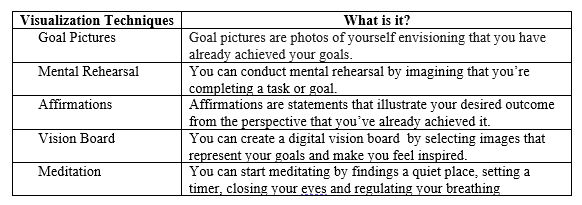
Predoui et al. (2020) suggested that visualization techniques include the five major senses (touch, hearing, sight, smell, and taste) to achieve the best results.
In conclusion, visualization is a powerful and scientifically supported technique crucial to personal and professional development. By engaging in vivid mental imagery, individuals can enhance their performance, boost their confidence, and achieve their goals more effectively. Visualization is not merely a passive daydream but a purposeful exercise that prepares the mind and body for success. Whether it’s improving athletic performance, managing anxiety, enhancing learning, or strengthening goal-setting and planning, the benefits of visualization are vast and varied.
This mental practice, grounded in neuroscience, psychology, and epigenetics, proves that the mind can be trained to influence real-world outcomes. By incorporating visualization into your daily routine, you can cultivate a mindset of resilience, focus, and determination, ultimately transforming your aspirations into reality. As the evidence shows, those who visualize see their goals more clearly and find the motivation and strategies necessary to reach them. Therefore, embracing visualization is an option and a valuable tool for anyone committed to self-improvement and achieving their fullest potential.
The Crucial Connection Between Goal Setting and Planning

“Our goals can only be reached through a vehicle of plan, in which we
must fervently believe and upon which we must vigorously
act. There is no other route to success.”
– Pablo Picasso
In discussions of the term “goal,” it is difficult not to mention “plan” alongside it. These two constructs are seemingly conjoined like Siamese twins. Even in their definitions, goals and plans are intertwined: a goal is defined as the end toward which an effort is directed, while a plan is a method for achieving that end. When goals and plans are perfectly aligned, they create a synergy that leads to success. Thus, goal-setting and planning are critical for personal growth and development. Those who embrace self-improvement must prioritize these two essential practices.
Locke and Latham (2002) describe a goal as an idea of the future or desired result that a person or a group of people envisions, plans for, and commits to achieving. Goals are the object or aim of an action, such as attaining a specific standard of proficiency, typically within a specified time frame. In contrast, a plan is defined as “a set of actions that have been thought of as a way to do or achieve something” (Britannica, n.d.). Both goals and plans often come with deadlines, underscoring their interconnectedness.
Goal setting is the process of defining goals, and planning identifies the actions necessary to achieve those goals effectively. In reality, goal-setting and planning are inseparable. Setting goals without corresponding plans or making plans without anchoring them to specific goals is futile. Goals without a plan are like knowing where you want to go without knowing how to get there while planning without an identified goal is like setting out on a journey without a specific destination. Goal setting is the first step in the planning process; once you have established your desired goals, you can create a plan to achieve them. Planning, in turn, creates a roadmap that guides you toward achieving your goals.
To further illustrate the relationship between goal-setting and planning, we can examine the goal-plan paradigm developed by Simon Sinek, known as the Golden Circle Model. This model effectively represents the connections between these constructs and highlights their significance. The Golden Circle consists of three layers: “Why” at the core, “How” in the middle layer, and “What” at the outermost part. This paradigm emphasizes the importance of identifying the underlying purpose (“Why”) before establishing the process (“How”) and the outcome (“What”).

In this model, the “Why” represents the goal—the purpose or desired outcome that forms the basis for all actions. The “How” corresponds to the plan and the organized efforts necessary to reach the goal. Finally, the “What” represents the specific outcomes or results from carefully executing the goals and plans. Although the terms “Why” and “What” might seem interchangeable, Sinek clarifies that the “Why” refers to the underlying purpose or reason for wanting to achieve an outcome. In contrast, the “What” refers to the tangible results.
Sinek strongly argues that understanding the “Why” is crucial, particularly at the organizational level. Most organizations and leaders know what they do and how they do it, but they often struggle to articulate why they do it. The “Why” is vital because it inspires and motivates leaders and followers. This insight also applies to individuals: the “Why,” or the goal, is the source of passion and commitment, providing a definite direction for organizations and individuals.
To illustrate his assertions, Sinek’s example was Apple’s Why, How, and What.

This example demonstrates that an organization’s “What”—the products or services it offers—is not the goal itself but rather the outcome of an apparent “Why.”
Setting goals and making plans are crucial to achieving success in both personal and professional realms. As Berkman (2018) explained, “Setting goals is easy; achieving them is hard.” While achieving goals may be challenging, it is not impossible. Effective planning makes goal achievement possible.
You have probably heard about SMART goals already. Goal setting involves defining specific, measurable, achievable, relevant, and time-bound objectives that individuals or organizations want to achieve. This is the golden rule of goal-setting.
When goals are specific, it means they are clear. They answer the questions of who, what, where, when, and why. Making the goals measurable means their progress can be tracked. Several other clear indicators are involved. Achievable goals are realistic and attainable given your current situation, resources, and time, while relevant goals are worthwhile or worth pursuing. Their purpose is clear. Time-bound means a specific deadline or timeframe for achieving the goal.
Chowdhury (2019) mentioned that researchers have made the “SMART” rule “SMARTER.” The letters E and R are appended to SMART, with the E standing for evaluative or ethical and R rewarding. He explained that interventions and executing ethical goals follow professional and personal ethics. Rewarding means that the results or goal setting brings the user a positive reward and a feeling of accomplishment.
By using the SMART/SMARTER framework, individuals and organizations can rest assured that their goals are well-defined, making it easier to plan, execute, and achieve them successfully.
After setting goals comes planning. As Antoine de Saint-Exupery says, “A goal without a plan is just a wish.” Without a plan, even the best goals will not come to fruition.
The activities required to achieve desired goals must be identified and organized. The planning process involves drawing a specific course of action that identifies what needs to be done, when, how, and by whom.
A good plan provides a clear roadmap. It helps simplify complex tasks and make them more manageable. It also promotes efficient use of the M resources—manpower, machinery, materials, and money. Planning enables you to foresee what resources are needed and when. It ensures that your decisions are aligned with the goals, reducing the likelihood of making decisions impulsively.
The best part of indulging in planning is that it helps you achieve work-life balance. It allows you to pursue your professional and personal endeavors without sacrificing one over the other.
The interplay between goal setting and planning is fundamental in pursuing success in both personal and professional Endeavors. Goals provide the direction, the “Why,” while plans provide the roadmap, the “How.” The synergy they create ensures that the “What”—the tangible outcomes—is achieved efficiently and effectively. When goal-setting and planning are done correctly, they transform dreams into reality and make success not just possible but inevitable.
 M.A.D. LIGAYA


 M.A.D. L I G A Y A