Blog Archives

The Pursuit of Well-Being (Part 1)

“Wellness is the complete integration of body, mind, and spirit – the realization
that everything we do, think, feel, and believe has an effect
on our state of well-being.”
~ Greg Anderson ~
To most people, being healthy is seemingly inconsequential–not a big deal. It’s not considered an achievement worthy of praise and deserving of a spot on social media. As someone once quipped, “Being healthy is a success that many people forget to celebrate.” They don’t consider not being stricken by any kind of disease or burdened by stress and anxiety a victory–a huge blessing that they should thank God for (if they believe He exists).
Virgil’s assertion that the greatest wealth is health is often disregarded. Only when we get sick and bedridden do we start to pay attention to our health or well-being. In some instances, we only do so when it’s too late, and the condition is already either difficult to reverse or not reversible at all.
Let’s not forget that pursuing your personal and professional endeavors is difficult if you’re not healthy—mind, body, and soul. Nurture your well-being before you can embark on a journey towards achieving your dreams and ambitions.
The Oxford Dictionary defines well-being as the “state of being comfortable, healthy, or happy (Oxford, n.d.). Merriam-Webster defines the construct in almost the same way except that instead of “comfortable,” it uses “prosperous” as an adjective used to explain the construct further. As Purcell (2018) explained, this concept embraces more than just physical health. It considers the entire person, both body and mind [and more]. It indicates not just the absence of illness but also the presence of positive mental states, emotions, and moods.”
Ruggeri et al. (2020) gave a more comprehensive definition of well-being. They explained that well-being is the combination of feeling good and functioning well, experiencing positive emotions such as happiness and contentment, developing one’s potential, having some control of everyone’s life, having a sense of purpose, and experiencing positive relationships. This shows that well-being goes beyond the pursuit of a healthy body. It encompasses various aspects of a person’s life, including physical, mental, emotional, spiritual, and social. A person is a physical, emotional, mental, and a spiritual being.
Engaging in activities that promote wellness can nurture well-being. Good wellness habits can contribute to a sense of well-being. This article will delve into the various wellness activities that can lead to well-being.
Wellness is the active pursuit of activities, choices, and lifestyles that lead to holistic health (Wellness Defined, n.d.). The enhancement of one’s overall well-being is the ultimate goal of engaging in activities that promote wellness.
Swarbrick (2012) explained that wellness is a conscious, deliberate process that requires a person to become aware of and make choices for a more satisfying lifestyle. She proposed a model that has been used to craft a practical framework for the pursuit of overall health. Her ‘wellness model’ (see Figure 1) is considered the gold standard for a comprehensive well-being program. Well-being programs found on the Internet have adopted this program in one way or another, wholly or in part.
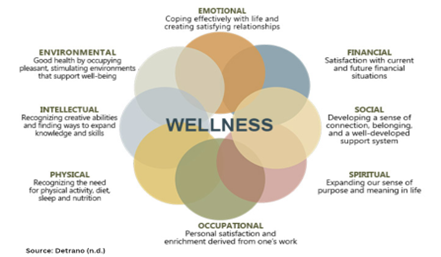
Figure 1 – Eight Dimensions of Well-Being
The model illustrates the different dimensions interlocked in circles to demonstrate their connection and interdependence. Swarbrick proposed that wellness should be approached holistically. You should not focus solely on specific dimensions while neglecting others. A meaningful wellness program aimed at maximizing your overall well-being requires that each dimension be given due consideration. You need to become familiar with each dimension and give them proper attention.
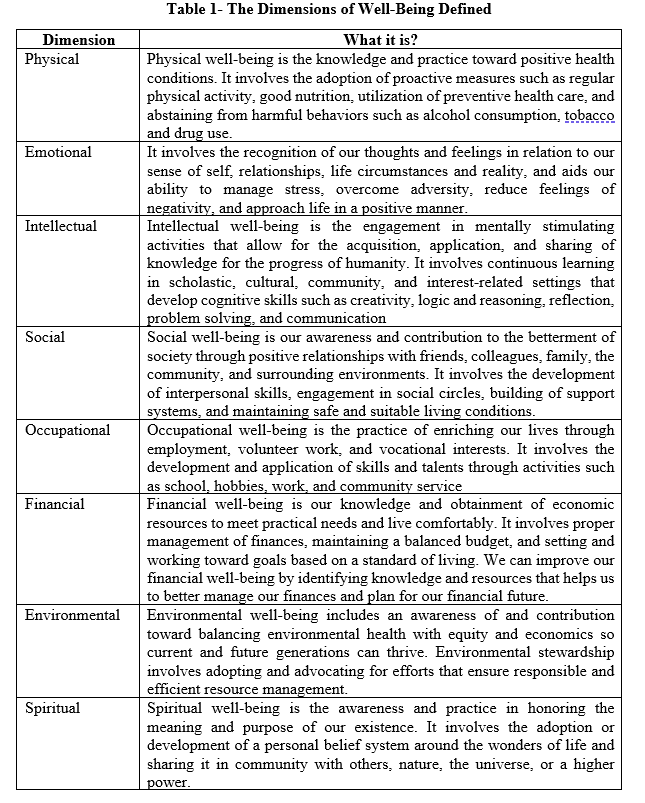
The definitions/explanations of each dimension shown in Table 1 were compiled by the University of Pittsburg on its website, which caters to well-being.
While all eight dimensions are equally important and should receive proper attention, overall well-being should begin with the physical aspect—by taking good care of your body. You must be strong and healthy before pursuing your dreams and ambitions. Regular exercise, a balanced diet, and adequate sleep are the usual advice to achieve physical well-being. It would behoove you to also take regular check-ups and preventive care.
Mahindru et al. (2023) asserted that physical activity also positively affects mental health in addition to the apparent physical health benefits. They mentioned specifically that consistent physical activity may also significantly improve sleep quality. The researchers cautioned that physically inactive individuals have been reported to have higher rates of morbidity and healthcare expenditures. Taking good care of your physical well-being also requires avoiding alcohol, cigarettes, or cigars and using prohibited drugs. Government and health authorities issue warnings against these substances, but surprisingly, there are no high-profile precautions against sugar, another substance that, when abused, will cause illnesses. Just like smoking, excessive sugar consumption leads to debilitating diseases like diabetes, obesity, and heart disease. So, if you genuinely care about the physical aspect of your well-being, be sure to include sugar in the list of substances to avoid.
__________
Emotional wellness has been proven to be directly tied to physical health. When you experience tremendous stress and negative emotions and fail to overcome them, you are bound to develop health problems. You need to develop techniques to manage stress. You probably have often heard how mindfulness practices and meditation help reduce stress and enhance focus.
Mental health professionals suggest staying connected with people in our lives to safeguard our emotional and mental well-being. They also recommend striking a balance between life and work. Thus, you must leave your work in the office so you will have fun and enjoy yourself when you’re with your family and friends. Additionally, cultivating a positive mindset and practicing gratitude are essential. Most importantly, do not hesitate to seek professional help when necessary.
The activities or things you can do to nurture your emotional well-being include exercising, eating well, and getting good sleep. In addition, the CDC (n.d.) offered tips to improve the emotional aspects of your well-being. You get outside to take a nature walk or a city hike. Be active, too. Take a dance break. You can also go to the gym to lift weights or do push-ups or sit-ups. You can also channel your energy into quick cleaning or spending an hour at home. You may also practice relaxation techniques. You can close your eyes, take deep breaths, stretch, do yoga, or meditate. In addition, they suggested that you embrace self-care, check it with yourself, practice gratitude, laugh, consider a new hobby, find an inspiring song or quote, maintain or build your social network, and connect with your faith through prayer or reach out to a member of your faith community.
The Pursuit Of Lifelong/Lifewide Learning

““The key to success is dedication to lifelong learning.”
~ S.R. Covey ~
Jim Rohn had a very unique perspective on success. He said it is not to be pursued but instead attracted by the person you become. He probably meant that success is like a fruit and you are a fruit-bearing tree. How long does it take before a tree bears fruit from the day its seed is planted? Not overnight, not a week or two, not even months, but years. A tree has to grow and mature before it can bear fruit. You must grow, mature, and attain your full potential like a tree. Focus on becoming a sturdy, full-grown tree; the fruits naturally come out of your branches when the proper time comes.
When you become the best you, success comes knocking at your door. However, reaching your full potential or becoming the best you is a long and arduous process. It requires continuous striving, an unending quest for learning. Succeeding requires becoming better every day. As S.R. Covey asserts, “The key to success is dedication to lifelong learning.”
Lifelong learning kicks off when a person starts breathing until their last breath. This means that learning is a continuous process that begins as a newborn infant and progresses throughout your life. Learning doesn’t stop when you’re done schooling. A graduation ceremony is called a commencement exercise because it marks the beginning of a new chapter in a person’s life. The graduate can decide to work or pursue further education. They may do both – work and study again. The world is changing rapidly, with industries improving fast due to technology continuously evolving. That evolution even became faster with the rise of Artificial Intelligence. To keep pace and stay relevant, it is necessary that you constantly learn and embrace changes. You need to adapt and go with the flow of innovation lest you risk becoming obsolete with outdated knowledge, skills, and values.
Lifelong learning is often misconstrued as “lifelong schooling.” It draws a negative subjective feeling to some. Perhaps it conjures up in their minds the image of an inmate serving a lifelong sentence in jail. However, the term should not be misunderstood to mean going to school until all your hair is gray and all your bones are brittle, although I believe there is nothing wrong if one wants to be a perennial student. It is perhaps the negative connotations that the term “lifelong learning” draws that lead to the birth of a similar concept, “lifewide learning.”
Lifewide learning refers to learning in various settings, including formal, informal, and non-formal, and occurs in spaces the learner simultaneously inhabits – work, school, home, etc. Barnett (2010) clarifies that if lifelong learning occupies different spaces through the lifespan – ‘from the cradle to the grave’ – lifewide learning is learning in different spacers simultaneously. The former runs vertically, while the latter runs horizontally.
Introducing “lifewide learning” doesn’t imply that “lifelong learning” is erroneous. Skolverket (2000) explained that the “lifelong” dimension is non-problematic. What is essential is that the individual learns throughout life. He clarified that the “lifewide” dimension refers to learning in various environments and situations and is not only confined to the formal education system. Ates & Alsal (2012) explained that lifelong learning is lifewide, voluntary, and self-motivated pursuit for personal and professional reasons. They argued that it enhances social inclusion, active citizenship, and individual development and increases competitiveness and employability.
Whichever is used to describe learning, lifelong or lifewide, it is an activity that contributes to your personal growth and development. Even if lifelong learning and lifewide learning are to be viewed separately in the context of how they are technically defined, their objectives are the same – to help you achieve your full potential and become the best you.
Schuller et al. (2007) argue that learning does not occur just in school – it is both lifewide (occurring in multiple contexts, such as work, at home and in our social lives) and lifelong (starting from the cradle to the grave). These different types of learning affect each other in various ways. Their impact in terms of the outcomes of learning is equally complex – whether it is in the economic and social spheres, the individual and collective, the monetary and the non-monetary.
Embarking into lifelong/lifewide learning (or continuous learning) is obviously a worthwhile endeavor. The benefits you get from it are aplenty.
Continuous learning leads to acquiring new (or additional) knowledge and skills needed to become a productive person and a competent professional. Not stopping to learn will prevent you from becoming irrelevant in your chosen field. Remember that changes are inevitable. Those who refuse to innovate and update their competencies will find themselves jobless or bankrupt. Conversely, those who actively engage in continuous learning, as Mascle (2007) reiterated, will have a better chance of getting a fatter paycheck. He added that job promotions go to smart people who keep up with the latest innovations in information and technology. Tamborini et al. (2015) revealed that men and women can expect to earn 655,000 US$ and 455,000 US$ more during their careers with a bachelor’s degree than with a high school degree, and graduate degrees yield further gains.
If you keep learning, it will also broaden your perspectives leading you to make well-informed decisions. You will gain a better understanding of how things work and how things are done. The new skills you acquire through continuous learning will boost your problem-solving abilities and critical thinking. It will allow you to look at issues more judiciously and prevent you from saying or doing anything mindlessly. Nordstrom (2006) even contend that it increases wisdom. Continuous learning will allow you to put your life in perspective, increase your understanding of previous successes and failures, and help you understand yourself better. He added that learning continuously will help you fully develop your natural abilities.
Continuous learning is also beneficial to your well-being. The mere reading you do while pursuing lifelong/lifewide learning will keep your brain active. Brain experts ascertained that continuous learning helps improve cognitive functions and prevent brain diseases like dementia and cognitive decline. The more frequently the brain is used, the better, especially when you grow older. Additionally, acquiring new knowledge and skills will give you a sense of self-worth and boost your self-esteem and confidence. You can also read a lot of health-related materials that will inspire you to live a healthy and stress-free life. If you learn about the importance of meditation, a nutritious diet, and regular exercise, you could be motivated to try them. Cutler & Lleras-Muney (2006) even explored the relationship between longevity and education. They revealed that the better educated have healthier behaviors along virtually every margin, although some may also reflect differential access to care.
There are many reasons to continue learning and the collective weight of the evidence presented in many studies on the subject indicate that lifelong/lifewide learning is essential in an individual’s quest to attain full potential. The only way to becoming the best you is through lifelong/lifewide learning.
However, the journey to continuous learning can be challenging and troublesome. Different kinds of barriers, whether imposed by circumstances or self-imposed, can hinder your path.
Topping the list of reasons for the inability of some people to continue learning is their busy schedule. They reason that juggling work (or business), family, and other responsibilities is tricky and consumes a lot of their time. More is needed for personal growth and development activities. But if you embrace the idea that a better self leads to a better life, you must prioritize self-improvement. It would help if you allocated time to pursue lifelong/lifeward learning and consider it not an extra burden but rather an investment.
Aside from time constraint, financial limitations can be a significant barrier also in the pursuit of continuous learning. Enrolling to degree or certificate courses or attending seminars for further studies and career advancement come with a cost. But as I said previously, self-improvement is an investment. If you want to attain your full potential, you must be willing to pay the price. Success will not be served to you in a silver platter.
There are other kinds of constraints like unavailability of learning materials. There are still some parts of the world that are undeveloped. Attaining personal growth and development is more challenging to people who live in those areas where internet connectivity and resources in libraries are limited (or worse – no libraries at all).
The foregoing are only few of the circumstances that can hinder continuous learning. But take it from George Herbert who said: “To him that will , ways are not wanting.” If you are strongly motivated and committed to succeed, you will do whatever it takes for that to happen.
—–
Ates, Haydar & Alsal, Kadir. (2012). The Importance of Lifelong Learning has been Increasing. Procedia – Social and Behavioral Sciences. 46. 4092-4096. 10.1016/j.sbspro.2012.06.205.
Barnett, Ronald. (2011). Lifewide education: a new and transformative concept for higher education? http://lifewideeducation.co.uk/.
Cutler, David & Lleras-Muney, Adriana. (2006). Education and Health: Evaluating Theories and Evidence. Making Americans Healthier: Social and Economic Policy as Health Policy. 12352. 10.3386/w12352.
Mascle, D. (2007, Mar. 27). No Adult Left Behind: 5 Big Benefits of Lifelong Learning. Article Alley, UK. http://deannamascle.articlealley.com/no-adult-left-behind-5-big-benefits-of-lifelong-learning-139607.htm
Nordstrom, N. M. & Merz, J. F. (2006). Learning later, living greater; the secret for making the most of your after-50 years. Colorado; USA, Sentient Boulder CO Publishing.
Schuller, Tom; Desjardins, Richard (2007). Understanding the Social Outcomes of Learning (PDF) (Report). OECD. http://ul.fcpe.rueil.free.fr/IMG/pdf/9607061E.pdf.
Skolverket. 2000. “Lifelong Learning and Lifewide Learning.” Stockholm:The National Agency for Education.
Tamborini CR, Kim C, Sakamoto A. Education and Lifetime Earnings in the United States. Demography. 2015 Aug;52(4):1383-407. doi: 10.1007/s13524-015-0407-0. PMID: 26100983; PMCID: PMC4534330.



 M.A.D. L I G A Y A