Category Archives: Planning
Power of Visualization: Achieving Goals and Enhancing Performance

“Formulate and stamp indelibly on your mind a mental picture of yourself as succeeding.
Hold this picture tenaciously and never permit it to fade. Your
mind will seek to develop this picture.”
– Norman Vincent Peale
The desire to become the best version of oneself is a powerful driving force for those committed to self-improvement. This desire propels individuals on a quest to reach their full potential, both personally and professionally. If you aspire to improve continuously, you must embrace this journey. Striving for excellence and optimizing your performance in all areas of life should be an ongoing pursuit.
Achieving your best self does not come through shortcuts or magic solutions. The path to self-improvement is challenging, but it is far from impossible. Success in reaching your dreams and goals is attainable, but how can you get there?
Various methods and techniques can help you succeed in your endeavors. In the previous chapter, we discussed the initial steps in achieving your goals: setting clear objectives and creating actionable plans. Experts in Positive Psychology also emphasize the importance of cultivating the right mindset, executing your plans, maintaining work-life balance, adapting to change, finding a mentor, and visualizing success.
This discussion will focus on one particularly powerful technique: visualizing success.
Visualization involves creating vivid and detailed images or scenarios in your mind to help you achieve your dreams and goals (Hook, 2024). Roychowdhury (2023) defines visualization as the “creation of detailed mental images that mimic real-life experiences. It involves engaging multiple senses, such as visual, auditory, and kinesthetic, to create a comprehensive mental representation.”
This mental technique taps into the power of imagination to mentally rehearse success, influencing your mindset and behavior. Visualization is closely related to mental imagery, explicitly focusing on creating or recalling visual images. According to Roychowdhury, the critical components of visualization include imagery control (the ability to manipulate images), imagery vividness (the clarity and detail of the images), and imagery duration (the ability to sustain the images over time).
Visualization is used in sports, therapy, and personal development to rehearse scenarios and achieve desired results. An anonymously written article explains that “visualization goes beyond mere daydreaming; it’s a focused and purposeful exercise that prepares the mind, much like physical practice prepares the body.” The article also reveals that brain studies show the same neural pathways are activated when a weightlifter lifts heavy weights and when they only imagine lifting.
An AI model explains that “visualization is a powerful tool for achieving your dreams. By mentally rehearsing success, you prepare your mind and body to perform at their best, increase your confidence, and stay focused on your goals. When combined with consistent action, visualization can be a key factor in turning your dreams into reality” (OpenAI, 2024).
Skepticism often surrounds visualization, as it may seem implausible that merely imagining success can lead to actual achievement. However, visualization is supported by scientific research, which validates its effectiveness. Hook (2024) identified Neuroscience, Epigenetics, and Psychology as the scientific foundations of this technique. Neuroscientific studies have shown that visualization activates the same brain regions as actual physical performance, affirming the claims mentioned in the earlier article. Additionally, research in epigenetics indicates that positive mental practices, like visualization, can influence gene expressions related to stress, resilience, and overall well-being. In cognitive psychology, techniques like guided imagery and mental rehearsal have been used to treat anxiety and improve self-confidence.
The notion that visualization or mental imagery can enhance an athlete’s focus, reduce anxiety, and improve cognitive performance is not just anecdotal. Scientific studies support these claims. For example, Predoiu et al. (2020) explained that visualization techniques can improve motor skills, increase muscle strength, boost self-confidence, enhance concentration, and reduce anxiety. They also noted that imagery can aid in pain management, endurance, performance motivation, and physical performance in athletes. Markova et al. (2024) found that visualization is also effective in overcoming anxiety and nervous tension, as well as reducing symptoms of depression and stress. Their research showed that adaptive coping strategies are closely linked to self-knowledge, revaluation of values, positive self-attitude, and visualization.
Visualization can also enhance learning and memory. Kosslyn et al. (2001) reviewed various findings on how mental imagery activates neural pathways similar to real perception. They concluded that visualization could be a powerful tool for enhancing memory retention and learning, especially when combined with actual practice. Fishback et al. (2003) examined whether students who visualized themselves performing well on exams were more likely to achieve their academic goals. They found that students who visualized themselves successfully completing specific tasks (e.g., studying for an exam) were likelier to engage in behaviors that led to academic success.
The literature clearly presents the variety of benefits that visualization brings. At the top of the list is enhanced performance. Athletes often turn to visualization to achieve better results in competitions. Practicing this mental technique not only improves competence but also boosts confidence. As mentioned earlier, even cognitive functions benefit from visualization. Both your body and mind perform better when you embrace this method. So, why not give it a try?
The benefits of visualization extend beyond physical and mental improvements. This mental practice can also provide emotional relief, particularly for those suffering from anxiety and depression.
The great things you will gain from visualization are not just physical and mental. You can get emotional relief from this mind practice as well if you are suffering from problems like anxiety and depression.
Moreover, visualization can significantly enhance goal setting. Several studies have explored the connection between these two constructs. For instance, Pham & Taylor (1999) compared the effects of two visualization types—outcome visualization and process visualization—on goal attainment. Outcome visualization involves picturing the successful outcome, while process visualization focuses on the steps required to achieve the goal. Their study revealed that process-oriented visualization was more effective in helping participants achieve their goals. The researchers explained that those who visualized the process were likelier to succeed than those who only visualized the outcome. Scheier & Carver (1985) found that “individuals who engaged in positive visualization were more likely to set challenging goals and persist in achieving them.” Positive visualization enhances self-efficacy and increases the likelihood of achieving challenging goals by fostering a proactive mindset and a belief in one’s ability to succeed.
The process of visualization enhances goal setting and what comes next: planning. This mental activity clarifies your vision, builds your confidence, and heightens your motivation. When setting goals, part of the process involves preparing a plan that outlines the techniques and strategies needed to pursue them. Visualization plays a role in anticipating potential challenges and responses, helping you develop the confidence to face obstacles and stay motivated in your pursuit.
Visualization is also linked to effective planning, as established by several studies. These studies have shown how visualization improves problem-solving, decision-making, and strategic thinking—key aspects of planning. Dela Sala et al. (2010) studied how individuals use mental imagery to simulate future scenarios and plan accordingly. They found that individuals who frequently engage in visualization are better at planning and decision-making because they can mentally simulate different scenarios and outcomes, leading to more informed and strategic choices. Klein (1998) observed that “visualization is crucial in planning, especially under conditions of uncertainty, as it helps individuals mentally test and refine their strategies before implementation.” This finding was based on real-world observations of decision-makers who experienced how visualization aids in developing more effective and adaptive strategies. Sheehan & McConkey (1982) concluded that this mental process enhances the ability to organize and execute complex plans by providing a mental rehearsal space where details can be worked out before action.
The following table shows some of the visualization techniques that are being used.
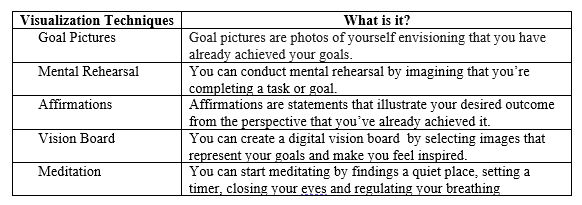
Predoui et al. (2020) suggested that visualization techniques include the five major senses (touch, hearing, sight, smell, and taste) to achieve the best results.
In conclusion, visualization is a powerful and scientifically supported technique crucial to personal and professional development. By engaging in vivid mental imagery, individuals can enhance their performance, boost their confidence, and achieve their goals more effectively. Visualization is not merely a passive daydream but a purposeful exercise that prepares the mind and body for success. Whether it’s improving athletic performance, managing anxiety, enhancing learning, or strengthening goal-setting and planning, the benefits of visualization are vast and varied.
This mental practice, grounded in neuroscience, psychology, and epigenetics, proves that the mind can be trained to influence real-world outcomes. By incorporating visualization into your daily routine, you can cultivate a mindset of resilience, focus, and determination, ultimately transforming your aspirations into reality. As the evidence shows, those who visualize see their goals more clearly and find the motivation and strategies necessary to reach them. Therefore, embracing visualization is an option and a valuable tool for anyone committed to self-improvement and achieving their fullest potential.
The Crucial Connection Between Goal Setting and Planning

“Our goals can only be reached through a vehicle of plan, in which we
must fervently believe and upon which we must vigorously
act. There is no other route to success.”
– Pablo Picasso
In discussions of the term “goal,” it is difficult not to mention “plan” alongside it. These two constructs are seemingly conjoined like Siamese twins. Even in their definitions, goals and plans are intertwined: a goal is defined as the end toward which an effort is directed, while a plan is a method for achieving that end. When goals and plans are perfectly aligned, they create a synergy that leads to success. Thus, goal-setting and planning are critical for personal growth and development. Those who embrace self-improvement must prioritize these two essential practices.
Locke and Latham (2002) describe a goal as an idea of the future or desired result that a person or a group of people envisions, plans for, and commits to achieving. Goals are the object or aim of an action, such as attaining a specific standard of proficiency, typically within a specified time frame. In contrast, a plan is defined as “a set of actions that have been thought of as a way to do or achieve something” (Britannica, n.d.). Both goals and plans often come with deadlines, underscoring their interconnectedness.
Goal setting is the process of defining goals, and planning identifies the actions necessary to achieve those goals effectively. In reality, goal-setting and planning are inseparable. Setting goals without corresponding plans or making plans without anchoring them to specific goals is futile. Goals without a plan are like knowing where you want to go without knowing how to get there while planning without an identified goal is like setting out on a journey without a specific destination. Goal setting is the first step in the planning process; once you have established your desired goals, you can create a plan to achieve them. Planning, in turn, creates a roadmap that guides you toward achieving your goals.
To further illustrate the relationship between goal-setting and planning, we can examine the goal-plan paradigm developed by Simon Sinek, known as the Golden Circle Model. This model effectively represents the connections between these constructs and highlights their significance. The Golden Circle consists of three layers: “Why” at the core, “How” in the middle layer, and “What” at the outermost part. This paradigm emphasizes the importance of identifying the underlying purpose (“Why”) before establishing the process (“How”) and the outcome (“What”).

In this model, the “Why” represents the goal—the purpose or desired outcome that forms the basis for all actions. The “How” corresponds to the plan and the organized efforts necessary to reach the goal. Finally, the “What” represents the specific outcomes or results from carefully executing the goals and plans. Although the terms “Why” and “What” might seem interchangeable, Sinek clarifies that the “Why” refers to the underlying purpose or reason for wanting to achieve an outcome. In contrast, the “What” refers to the tangible results.
Sinek strongly argues that understanding the “Why” is crucial, particularly at the organizational level. Most organizations and leaders know what they do and how they do it, but they often struggle to articulate why they do it. The “Why” is vital because it inspires and motivates leaders and followers. This insight also applies to individuals: the “Why,” or the goal, is the source of passion and commitment, providing a definite direction for organizations and individuals.
To illustrate his assertions, Sinek’s example was Apple’s Why, How, and What.

This example demonstrates that an organization’s “What”—the products or services it offers—is not the goal itself but rather the outcome of an apparent “Why.”
Setting goals and making plans are crucial to achieving success in both personal and professional realms. As Berkman (2018) explained, “Setting goals is easy; achieving them is hard.” While achieving goals may be challenging, it is not impossible. Effective planning makes goal achievement possible.
You have probably heard about SMART goals already. Goal setting involves defining specific, measurable, achievable, relevant, and time-bound objectives that individuals or organizations want to achieve. This is the golden rule of goal-setting.
When goals are specific, it means they are clear. They answer the questions of who, what, where, when, and why. Making the goals measurable means their progress can be tracked. Several other clear indicators are involved. Achievable goals are realistic and attainable given your current situation, resources, and time, while relevant goals are worthwhile or worth pursuing. Their purpose is clear. Time-bound means a specific deadline or timeframe for achieving the goal.
Chowdhury (2019) mentioned that researchers have made the “SMART” rule “SMARTER.” The letters E and R are appended to SMART, with the E standing for evaluative or ethical and R rewarding. He explained that interventions and executing ethical goals follow professional and personal ethics. Rewarding means that the results or goal setting brings the user a positive reward and a feeling of accomplishment.
By using the SMART/SMARTER framework, individuals and organizations can rest assured that their goals are well-defined, making it easier to plan, execute, and achieve them successfully.
After setting goals comes planning. As Antoine de Saint-Exupery says, “A goal without a plan is just a wish.” Without a plan, even the best goals will not come to fruition.
The activities required to achieve desired goals must be identified and organized. The planning process involves drawing a specific course of action that identifies what needs to be done, when, how, and by whom.
A good plan provides a clear roadmap. It helps simplify complex tasks and make them more manageable. It also promotes efficient use of the M resources—manpower, machinery, materials, and money. Planning enables you to foresee what resources are needed and when. It ensures that your decisions are aligned with the goals, reducing the likelihood of making decisions impulsively.
The best part of indulging in planning is that it helps you achieve work-life balance. It allows you to pursue your professional and personal endeavors without sacrificing one over the other.
The interplay between goal setting and planning is fundamental in pursuing success in both personal and professional Endeavors. Goals provide the direction, the “Why,” while plans provide the roadmap, the “How.” The synergy they create ensures that the “What”—the tangible outcomes—is achieved efficiently and effectively. When goal-setting and planning are done correctly, they transform dreams into reality and make success not just possible but inevitable.
The Decision

One of my favorite poems is W.E. Henley’s “Invictus.” The part I love the most are the last two lines – “I am the master of my fate: I am the captain of my soul.” It taught me one very simple yet strong guiding principle in life – that I am in-charge of my own destiny. It influenced me to subscribe strongly to the notion that “man’s destiny is the sum total of all the decisions he makes.” Thus, I never decide hastily.
Just like when I made a very important career decision, I knew I couldn’t afford to take risks. For the skeptics among my loved ones and friends, it was a very unpopular move. For me, it was something that I ought to do, something carefully planned. It seemed to be a leap of faith. The outcome, however, is something that I did not regard as unknown. Thinking of the unknown is to expect the possibility of not succeeding. I don’t have that luxury anymore – to consider failure as an option.
*****
“Why turn your back from a tenured position and a good salary?”
That was the common question my colleagues, friends, and loved ones asked me after hinting that I wanted to leave an institution ran by one of the country’s largest religious congregations. They didn’t seem able to tell me directly to my face that I was a fool. My wife did not disappoint me however. “You’re out of your mind.” Those were her exact words. “Why not wait another year so you can get the school’s share of the retirement fund?” she suggested.
I knew where my wife was coming from. She’s a very practical person. I was nearing the end of my ninth year in a Catholic institution at that time. Leaving the school without completing at least ten years would entitle me only to a refund of the total amount deducted from my salary over the years I had stayed there with nothing from the organization.
On top of that, travel time from our house to the workplace was only less than 20 minutes. That convenience I may be giving up should I leave and not find a work in the same area.
She told me, “Just for once put aside your pride.” My response was, “NO! This has nothing to do with pride.” Then we had a lengthy debate about the financial ramifications of my decision and the corresponding uncertainties it would bring. I had a full understanding of the decision I was about to make and what the consequences would be. At that moment there was something I valued more than convenience and money – my dignity as a person and my role as a professional in my chosen field as an educator.
What exactly brought me to the precipice of this major decision?
I had a lot of issues with none other than the head – the Sister President – of the congregation school where I thought I would be staying until my retirement age. It’s a conflict between the religious and the “not-so-religious” me.
As a I was leaving the Cashier’s Office one morning our paths crossed. “Good morning, Sister. I greeted her warmly. “What’s good in the morning!” She answered grouchily. You see! You might say that it’s just a minor incident. Maybe I got out of bed on the wrong side that morning, or maybe it was that this slight was just the last in a long line. Her response and attitude irked me. It confirmed what I thought were just hearsays about her shrewish tendencies. Images from History class about the abusive clergy during the Spanish occupation flickered through my mind – so long gone, or so I thought. She had hit me hard where it hurts.
That response was cliche for me. I had read it in stories and even heard it said many times. I never thought somebody would actually blurt it out right in my face. Those words were delivered not jokingly. At that moment she was like a boxer swinging a mean uppercut to my unsuspecting jaw with the intention of knocking the living daylights out of me. She almost succeeded. It was not quite a knock-out-punch. I didn’t crumble to the ground but rather stood there momentarily stunned at how rude a woman wearing a habit could be. By the time all of this transpired she was already a meter or so past me. Before the referee could finish the standing eight count, I regained my composure and some small shred of my pride. I was deemed fit to continue to fight. I followed the Sister to her office.
The secretary tried to stop me from entering the President’s office for protocol requires that I should have a prior appointment before I could see the head of the institution. That day nobody could prevent me from doing what I wanted to do. I ignored her and went straight inside. The Sister President was seemingly surprised to see me standing in front of her. We entered into a tepid discourse.
I refused when she asked me to sit down. “What’s the problem, sister?” I asked calmly but emphatically. “Why did you respond to me that way in the hallway earlier?”
“Sir,” her use of the honorific successfully retained the ambient temperature of our conversation, “I was just trying to discourage you from discussing any matter earlier. You’re holding a stack of paper so I thought you would talk to me.” I responded by saying that common sense dictates to me that I should not discuss any matter with persons in authority in the middle of nowhere unless they otherwise ask me to do so.
When she told me I was so sensitive, I said, “I am Sister. Please don’t do that to me again.” That was my own version of a mean uppercut and I added the following as if delivering an overhand punch for a coup de grace, “I’ve got job to do. I must go. Thanks for your time Sister.”
I saw how her face turned crimson as I delivered those parting shots.
I knew I had just voluntarily written my name on her list of endangered species – that I had become a marked man, but I had to do what I ought.
Our encounter that day became news all over the campus. Somebody told somebody who told somebody else. It wasn’t me. It was either her or the secretary… or perhaps there was a hidden CCTV camera that caught the action and beamed the drama live all over the campus.
Later, one of my colleagues gave me an unsolicited advice, “Bear in mind that the sisters don’t stay in a particular school forever. Sooner or later they will be transferred to other schools within their congregation. Just learn to co-exist with that sister until such time she leaves.”
That I know. She may be transferred to another school – or get an extension of another three years (and maybe a bonus of an extra year) just like her predecessor, whom I wish had not been replaced.
I found myself responding, “I can’t bear another year with her. What if she gets a term extension of three years?” For me, that would be like an eternity.
I felt like I stopped growing personally and professionally since she took over as head of the institution. Her leadership style and interpersonal skills, for me, was plain awful and downright unacceptable. I could not stay longer and expect to be productive and effective in the performance of my job. I kept questioning her policies and her moral ascendancy to lead. So, one of us ought to go. And of course, it wasn’t her.
*****
“Where do you go from here?”
That was another question I repeatedly heard. My better half asked me another question in her pointed and direct fashion, “What will happen to us when you leave that school?” It seemed that my wife had forgotten that I don’t make hasty decisions when it comes to anything that would affect my family and my career. That’s the thing about major decisions. I know it would affect not only me but also my loved ones.
I also have parents depending on me so I could not afford to mess up. Even my siblings come to me once in a while to ask for help. In short, I always need to be gainfully employed. To ensure that, I need to have set goals and a definite plan of action to achieve them. I always tell my students and friends that planning on anything involves the preparation of possible alternatives so that when, for example, plan A doesn’t work then you still have a plan B or a plan C. The more alternatives the better.
I have a three-pronged career path to follow. Such is the offshoot of my dreams, education, training and experience.
First – run a school of my own. That’s my dream. I want to have a school of my own. That, I guess, is the dream of many educators.
Second – occupy the highest academic position… Dean of a department… College Dean… or probably higher such as University President. I am not ashamed to admit that I want to occupy any of the said positions. I want to supervise at a school and, yes, teach at the same time. I simply cannot be divorced from teaching.
Third – work overseas as an English teacher.
“Trust me. I know what I am doing.” That’s the way I reassured my wife when she got too worried about me leaving the Catholic institution. Any of my decisions relative to work should always fall within the sphere of my career path, and include those other things important to me. I did not veer away from that path with the important decision I was about to make.
I walked the career path I paved for myself. I became a part of the management teams of the schools where I worked during my mid-20’s. The first administrative position I had was director of academic and student affairs. But my dream school remained in the pipeline. I needed an investor for it to become a reality. What I envisioned was a tandem of capitalist and industrialist partners with the latter being me. Most of my friends who have their own schools either inherited them from their parents or they opened schools supported financially by their moneyed parents or siblings. This was not an option for me.
I have no rich parents or affluent siblings or relatives capable of financing my project. The most viable option for me was to find capitalist partners. I actively searched for people I could convince to finance my dream school. All they needed to do was invest their money and I would take care of everything else, or so I thought!
During the early 1990s, the town adjacent to my father’s birthplace was a good site for a computer school. There were none there then. With information technology starting to take a hold in the world at that time, there was strong demand for expertise and skills related to computers and IT. That was the time when computer schools started to mushroom all over the country. It was the best chance for my dream to have a school of my own to become a reality. I created a feasibility study and presented it to several people I knew had money. Unfortunately, I wasn’t able to convince any of them.
Just a couple of years after that, a local businessman opened the first computer school in that locality. The big players in computer education also opened branches soon after.
The school I wanted to have was not within reach. I would have a couple more rejections after that. So, I focused on my teaching and supervisory job and put my dream of having a school of my own on the backburner for a while.
Then I received an invitation from a religious to join her team and lead their Education department. It was an offer so difficult to refuse – salary and opportunity-wise. I resigned from my job and decided to work in the school ran by sisters.
Under the tutelage of the first Sister President I worked with, I learned so much. I swear that I learned from her much more than I had learned from several years in Graduate school. She was my mentor… one of the best, if not the best education supervisor I worked with. The seven years we were together were my Golden Age. She set the standards that unfortunately her successor could not measure up to. I felt that that institution had entered its Dark Age when my mentor left and before I could completely revert back to my barbaric ways I seriously considered leaving the school.
When the next Sister President came, with all the negative information about her circulating in the campus, I was afraid that things wouldn’t be good. I suddenly actively pursued my dream of having my own school again. I targeted a school site in a town in the province where I had settled down with my family. I created another feasibility study and started presenting it to prospective capitalist partners.
My most heartbreaking experiences came a couple of years before the resignation I was planning to make. I came so close to the realization of my dream – so close and yet so far.
In 2009, I presented my proposal to a Briton. I was able to convince him of the merits of my plan and he asked me to start doing both the legwork and the paperwork, which I did. We were supposed to start operating the school June, 2010. He promised to provide the initial investment in November, 2009. Finally, my dream school would become a reality… or would it? The Briton lost his job in Oman in October, 2009. Much to my consternation, he decided to back out from our project.
Of course, I was so disappointed. I did not give up on my dream though. I had already laid out the plan and been working on the paperwork. I had also already talked to the owner of the building we were targeting as a site for the school, so I searched for another capitalist partner. I found another one, an Australian, who was working in a bank in his country and was the fiancée of one my friends in a local gym. He agreed to finance the project.
Unfortunately, I did not find the terms he set for the partnership acceptable. He wanted the initial profit sharing to be 80-20 with him getting the lion’s share. He also demanded that he got back in full whatever amount he invested after five years. I did not agree, even when he added that my share in the profit would increase annually until the profit-sharing became 60-40. My offer was nothing less than 50-50 and that he was not supposed to get back the amount he had invested. That was to be his investment. Mine would be to get the school up and running and operating successfully. Neither of us budged. Thus, even though I knew I was letting go of a dream that was about to come true, I did not pursue the project with him.
That was the closest I got to having my dream school.
Those were heartbreakers, but life has to go on, I moved on and vowed that I will just keep trying. My dream to have a school of my own did not die. For as long as I am breathing, that dream will remain alive. This brings me back to the Catholic institution and the important, possibly life-changing, decision I was about to make.
*****
“Do you think you can still find a better school?”
That was my mother. She added, “Leaving that school was like letting go of a very stable job to face the uncertainties of finding a new one.”
When she told me those things, it became apparent that my wife asked her to convince me not to resign. In that moment I recalled what I had once read – “If opportunity doesn’t knock, build a door.” I never doubted my chances of finding another job should I really decide to leave.
I had to explain the situation to my mother and at the end made this request – “Just pray for me mother dear.”
I revisited my career path. I looked at the different directions I set seemingly so long before.
It’s clear that the opportunity for the realization of my dream to have my own school had not come knocking yet. So I thought of building a door where opportunity could knock. I thought it was time for me to consider working as an English teacher overseas so I could earn more and save money for my dream.
Thus, I set my mind on pursuing a teaching career abroad. I was told that it would be easier for me to be employed as an English teacher overseas if I was certified in “Teaching English to Speakers of Other Languages (TESOL).” I searched the Internet for institutions that offered TESOL training and started looking for job openings for ESL teachers abroad.
My search for ESL jobs abroad validated what my friends had been telling me all along – that most schools abroad, particularly in Japan and South Korea, hired only native English speakers as teachers. But I knew that there were also Filipinos teaching English in the aforementioned countries. If they got hired, I thought I would also have a chance to get hired.
I got the information I needed for the TESOL training I was planning, and a bonus – I saw the advertisement that had been posted by a city college searching for a College Dean. I had the necessary educational qualifications and experience for the position, so I took the plunge. The college was run by a city government which meant that should I get hired I would become a part of the public school system. Not a bad idea considering the fact that private school teachers were starting to flock to government schools because salaries and benefits in public schools were beginning to get better. Public schools offer teachers better opportunities and a more secured future. My plan A was now to find ESL positions abroad with plan B being to find administrative positions in other colleges or universities. It seemed plan B was shaping up.
I happened to be on the dance floor when an opportunity was looking for a dance partner. I offered my hand.
While pursuing my application to that city college, I enrolled for a 120-hour TESOL training program.
“You are resigning from your present job then you will be spending money for that training?”
My wife again! I just nodded in response. I knew what she was trying to drive at. She wanted us to save money. After all, if I was really quitting my job just how sure was I that I could immediately find my next source of income? My wife knew however, that even if she disagreed with my plans I would still push through with them.
I enrolled for the TESOL-certification program. I also applied on-line for ESL jobs in South Korea, Indonesia and the Middle East. Then I was invited by the city college and two prospective employers from the Middle East for an interview, all of those in the same week. All these opportunities presented themselves while I was still finalizing my decision to cut ties with the school headed by the religious order.
Bright lights lit up the directions I had paved for my prospective career paths. It was very clear. If I decided to leave, I could either work as a teacher overseas (plan A) or be the College Dean in the city college (plan B). But what if I failed in all three interviews? Should I opt to forego of my plans to resign?
*****
“Is your decision final?”
That again was my wife making a last-ditch effort to sway me from making that decision. She asked me that question when she saw me sifting through a box of documents I brought home that night. She noticed that I was already slowly bringing home my personal belongings from my office.
Then again I gave my wife what became my classic response – “Trust me. I know what I am doing.”
While going through the files in that box, I came across the printed materials of a lecture delivered by a certain Dr. Bien. I recalled how prolific he was as a speaker. I started reading the materials he discussed during that seminar. I began to wonder why those materials did not affect me when I heard them delivered and expounded by Dr. Bien personally in the same way that they did when I read them. Perhaps I was not focusing on his talk that time.
Reading those old lecture notes made me finally see something that was kept from my view in the many years I had been teaching in that institution – the enormity of the role of a Catholic educator. It was not as simple as I thought. It is a difficult responsibility, something transcendental. It is not the subject areas that are being taught, it is the Gospel. It is not fusing the Gospel into a subject but the other way around.
I began to question what I had done in all those years I spent in that Catholic school. Those lecture notes made me feel uncertain as to whether or not I deserve to be a Catholic educator. The materials I read made me realize that only those who possess the fruits of the Holy Spirit can be efficient in carrying out the functions of a true Catholic educator. Honestly, I didn’t think I bore the fruits of the Spirit. I did and said things that made me unworthy to be a teacher and administrator in that institution.
I was eaten up by the hatred that I had fermented towards the Sister President. My deeds and words, and my ways of thinking about and doing things make me unworthy to be a torchbearer in Christian education. I couldn’t be “the blind leading the blind.” Pretense and hypocrisy tore my soul apart. Suddenly, my decision to leave just became final. I had to leave not because I don’t have faith in that religious as head of the institution but because I am weak. I am sinful.
Two months before the end of the school year I filed my resignation. There was no more turning back.
A week after filing that resignation letter, I received e-mails informing me that the universities in the Middle East decided not to hire me because I was not yet TESOL-certified. Those rejections came two weeks before I completed my TESOL training.
It was not meant to be. I did not inform my wife about it because she was already so disheartened when I resigned from my job. Telling her that my first two applications abroad ended up in failure would make her even more worried.
Then a few days before my resignation from the Catholic institution officially became effective, I received a call from the city college where I applied as College Dean. I was home at that time watching TV with my wife. After hearing the first sentence from the one who called, I was already sure of what he would say next. I asked him to give me a second. I told my wife to turn the TV off while I turn on the speakerphone. I wanted her to hear something special.
“Please continue sir.” I said.
“The President would like you to know that we have decided to hire you. Can you come here tomorrow?”
My wife smiled. She tried unsuccessfully to prevent tears to roll from the edges of her eyes. The opportunity that knocked on the door I built was not a chance to work overseas as ESL teacher but to continue as school administrator.
*****
“Lord, how many times shall I forgive my brother when he sins against me? Up to seven times?
That’s Peter in Matthew 18:21 asking the Lord Jesus Christ.
As the school year (and my nine-year stay with the Catholic institution) drew to a close, I attended my last Basic Ecclesial Community (BEC) activity. BECs in the congregation schools are intended to make the faithful live in communion with God and with one another. Such activities are like mini-retreats. They are designed to make the participants examine their conscience and reflect on their relationships with the Almighty and their fellowmen.
The central theme of that particular BEC activity was forgiveness.
Chance would have it that I and the Sister President shared the same table. She was already there when I came. I wanted to think that the organizers of that particular BEC set us up.
Courtesy dictated that I should acknowledge her presence.
“Good morning, Sister.”
Then I added the standard greetings of the congregation.
“Praised be Jesus and Mary.”
“Hello sir. Praised be Jesus and Mary.”
I could see how my friends and colleagues on that table were smiling on the pleasant exchange between me and the Sister President. I wasn’t sure if those smiles were expressions of amusement or happiness seeing that I and the religious matriarch were at the same table and talking. They knew everything that had transpired between me and the Sister President. They knew that I supported the formal complaint lodged against her, a complaint that reached the office of the Education Ministry of the congregation.
I didn’t use any camouflage in expressing my dissent against her during those times. I don’t operate that way. I don’t like stabbing my opponents on the back. I want them to see when I draw my sword to give them a chance to prepare for my assault. I openly talked to the teaching and non-teaching personnel she had offended in one way or another. I encouraged them to complain. She had loyalists in our ranks and I was almost certain that through them she came to know about what I was doing. She summoned me one time to her office and asked me to explain. We had an unpleasant exchange then.
Then the head of the congregation’s Education Ministry came to listen to the first-hand accounts of the people complaining against the Sister President. That was a week after I read Dr. Bien’s handouts. I told her everything I needed to say – how ill-tempered she was and how her grumpy ways led me to wonder if indeed she was a senior representative of a religious order. After hearing my litany, she asked me point blank.
“What do you want us to do with her?”
I wasn’t able to respond immediately.
I was not really surprised by the straightforwardness of the question but by the response I wanted to give. I thought I hated her and her ways so much that I wanted her removed from her office.
There seemed to be an eternity between the question and the answer I gave. I knew I was not the only one the head of the congregation’s Education Ministry had talked privately with about the Sister President. I wondered what they had said when asked the same question?
Before I responded I recalled how she took time to accompany me to the office of the congregation’s lawyer when I needed an attorney for my defense in a case filed against me by two students who felt offended when I just tried to carry out my concurrent function as prefect of discipline dutifully. The case was eventually dismissed for lack of merit. Nonetheless; at the moment when I was faced by that question I realized that it was difficult to just dismiss the fact that the Sister President could have decided to simply endorse me to the lawyer by calling him. But she had opted to accompany me personally. I recalled her reason.
“Sir, I wanted to make sure that everything would go well. I noticed how troubled you have become after learning about the case.”
That happened before we had that encounter in the hallway. I was hurt by that so much so that all I could see from then on was everything bad about her. I chose not to consider the good things she was doing for the institution. She may not be as good as her predecessor, she may be ill-tempered, but she was very much a capable administrator. It was when she took over as Sister President that the department I was leading had more students.
“Is that question difficult to answer?”
I apologized to the sister talking to me for taking too long to respond. Then I said what I had to say.
“She has been trying her best to lead the school sister. Just please tell her to improve a bit on her interpersonal skills and avoid hurting people with her words.”
Then came that BEC that day.
“Congratulations sir on your new job! You deserve it.”
That was the Sister President. Apparently, somebody had whispered to her that I had already been hired by another school. I told only a few of my friends about it. They may have told their friends too until the information reached the President’s office.
“Thank you sister” I replied.
I heard a lot of stuff about forgiveness that day. More importantly, I experienced it.
As a culminating activity, the BEC coordinator that day gave each of us ¼ sheets of short bond papers then instructed us to write there the name of the persons who hurt us and what they did.
I guess I need not say whose name I wrote on that paper and what she did. The final instruction given was to fold the paper and approach the table where there was a candle burning. We would set the paper on fire, throw it into the urn beside the candle then watch it burn.
“Sir, let’s do this together,” said the Sister.
I obliged.
“It’s my pleasure sister.”
The Sister President and I approached the table where the candle was. The aromatic scent wafting from the candle wrapped us as together we made the pieces of paper we’re holding kiss the candle’s lighted wick. We watched silently as the flame consumed the paper in the urn. It turned from white to black… then gray. It turned to dust the way I would long after I breath my last.
“Sister, sorry for all my shortcomings.”
I said sorry for I know I offended her in many ways. I said sorry for I know that I did not do well as a Catholic educator. The Sister President smiled and laid a hand on my shoulder and let it stay there as we walked back to our seats.
I left the institution I served for nine years without any emotional baggage. That was the more important decision I made… more important than my moving to another job. That way I found it easier to turn the pages to the next chapter of my life.
Fast forward…
One morning, seven years after I left that congregation school, I was at the Incheon International Airport waiting for the bus going to the university where I’m currently working.
Yes, eventually I was hired as an ESL teacher by a university here in South Korea. What happened? I worked only for one year as the College Dean in the tertiary institution where I transferred after leaving that congregation school. Thereafter, I became a Principal in a basic education school.
Those two schools were so unlike the Catholic institution where I worked. The systems, the values, and the people were totally different. Honestly, I experienced a “culture shock.” The pay may be higher and I had lesser work, especially when I was a Principal, but I missed the professionalism, the strong sense of direction, the personal and professional development, and the academic ambiance that I got accustomed to for nine years. That resulted to job burnout and identity crisis. I must admit – I started to regret leaving the congregation school. I didn’t tell my wife about it because I know what she would tell me. I did not tell my mother that I failed to find a better school. I faced a dead end.
The job burnout and the subsequent identity crisis took a lot from me. It led to personal problems that were seemingly spinning out of control. Then came the answer to a prayer – I got a call from a university here in South Korea. That was just what the doctor ordered. A chance to teach in another country was the fresh start that I needed. Here in South Korea, I had the career reboot I wanted. There was even an unexpected bonus – I rediscovered my passion for writing.
While enjoying a cup of hot caramel macchiato at the airport, I tried to look back at my long career as a teacher. That morning I just came back from the Philippine where I spent my winter break. At that moment, my heart was drowned with gratitude at the thought that I am so blessed to be given the opportunity to become an ESL teacher in another country. Then suddenly I recalled that incident that morning when the Sister President rudely responded to my greetings. Had she not done that, would I consider resigning? Would I be here in South Korea?
While as I was thinking about all those things, something hard to believe happened. A familiar face entered the coffee shop. It was the Sister President. Indeed, ours is just a small world. I could have easily decided to just pretend I didn’t see her but I just found myself standing from my seat and allowed that our paths cross again.
“Good morning, sister!” I warmly greeted her the way I did on that fateful morning many years ago when we had that unfortunate encounter. She did not respond grouchily the way she did then instead she called out my name so loudly and excitedly that she drew the attention of the other people in that coffee shop.
I gently put her hand on my forehead. After that she embraced me.
She was both surprised and delighted to see me there.
While her companion went to the counter to order, we stood there excitedly chatting, just like two old friends who have not seen each other for a very long time. How I wish they had no bus to catch that time so I could be with the Sister President longer.
Before the Sister President and her companion left, we both took pictures of that special moment we were together. She hugged me one more time before she left.



 M.A.D. L I G A Y A