Blog Archives
Power of Visualization: Achieving Goals and Enhancing Performance

“Formulate and stamp indelibly on your mind a mental picture of yourself as succeeding.
Hold this picture tenaciously and never permit it to fade. Your
mind will seek to develop this picture.”
– Norman Vincent Peale
The desire to become the best version of oneself is a powerful driving force for those committed to self-improvement. This desire propels individuals on a quest to reach their full potential, both personally and professionally. If you aspire to improve continuously, you must embrace this journey. Striving for excellence and optimizing your performance in all areas of life should be an ongoing pursuit.
Achieving your best self does not come through shortcuts or magic solutions. The path to self-improvement is challenging, but it is far from impossible. Success in reaching your dreams and goals is attainable, but how can you get there?
Various methods and techniques can help you succeed in your endeavors. In the previous chapter, we discussed the initial steps in achieving your goals: setting clear objectives and creating actionable plans. Experts in Positive Psychology also emphasize the importance of cultivating the right mindset, executing your plans, maintaining work-life balance, adapting to change, finding a mentor, and visualizing success.
This discussion will focus on one particularly powerful technique: visualizing success.
Visualization involves creating vivid and detailed images or scenarios in your mind to help you achieve your dreams and goals (Hook, 2024). Roychowdhury (2023) defines visualization as the “creation of detailed mental images that mimic real-life experiences. It involves engaging multiple senses, such as visual, auditory, and kinesthetic, to create a comprehensive mental representation.”
This mental technique taps into the power of imagination to mentally rehearse success, influencing your mindset and behavior. Visualization is closely related to mental imagery, explicitly focusing on creating or recalling visual images. According to Roychowdhury, the critical components of visualization include imagery control (the ability to manipulate images), imagery vividness (the clarity and detail of the images), and imagery duration (the ability to sustain the images over time).
Visualization is used in sports, therapy, and personal development to rehearse scenarios and achieve desired results. An anonymously written article explains that “visualization goes beyond mere daydreaming; it’s a focused and purposeful exercise that prepares the mind, much like physical practice prepares the body.” The article also reveals that brain studies show the same neural pathways are activated when a weightlifter lifts heavy weights and when they only imagine lifting.
An AI model explains that “visualization is a powerful tool for achieving your dreams. By mentally rehearsing success, you prepare your mind and body to perform at their best, increase your confidence, and stay focused on your goals. When combined with consistent action, visualization can be a key factor in turning your dreams into reality” (OpenAI, 2024).
Skepticism often surrounds visualization, as it may seem implausible that merely imagining success can lead to actual achievement. However, visualization is supported by scientific research, which validates its effectiveness. Hook (2024) identified Neuroscience, Epigenetics, and Psychology as the scientific foundations of this technique. Neuroscientific studies have shown that visualization activates the same brain regions as actual physical performance, affirming the claims mentioned in the earlier article. Additionally, research in epigenetics indicates that positive mental practices, like visualization, can influence gene expressions related to stress, resilience, and overall well-being. In cognitive psychology, techniques like guided imagery and mental rehearsal have been used to treat anxiety and improve self-confidence.
The notion that visualization or mental imagery can enhance an athlete’s focus, reduce anxiety, and improve cognitive performance is not just anecdotal. Scientific studies support these claims. For example, Predoiu et al. (2020) explained that visualization techniques can improve motor skills, increase muscle strength, boost self-confidence, enhance concentration, and reduce anxiety. They also noted that imagery can aid in pain management, endurance, performance motivation, and physical performance in athletes. Markova et al. (2024) found that visualization is also effective in overcoming anxiety and nervous tension, as well as reducing symptoms of depression and stress. Their research showed that adaptive coping strategies are closely linked to self-knowledge, revaluation of values, positive self-attitude, and visualization.
Visualization can also enhance learning and memory. Kosslyn et al. (2001) reviewed various findings on how mental imagery activates neural pathways similar to real perception. They concluded that visualization could be a powerful tool for enhancing memory retention and learning, especially when combined with actual practice. Fishback et al. (2003) examined whether students who visualized themselves performing well on exams were more likely to achieve their academic goals. They found that students who visualized themselves successfully completing specific tasks (e.g., studying for an exam) were likelier to engage in behaviors that led to academic success.
The literature clearly presents the variety of benefits that visualization brings. At the top of the list is enhanced performance. Athletes often turn to visualization to achieve better results in competitions. Practicing this mental technique not only improves competence but also boosts confidence. As mentioned earlier, even cognitive functions benefit from visualization. Both your body and mind perform better when you embrace this method. So, why not give it a try?
The benefits of visualization extend beyond physical and mental improvements. This mental practice can also provide emotional relief, particularly for those suffering from anxiety and depression.
The great things you will gain from visualization are not just physical and mental. You can get emotional relief from this mind practice as well if you are suffering from problems like anxiety and depression.
Moreover, visualization can significantly enhance goal setting. Several studies have explored the connection between these two constructs. For instance, Pham & Taylor (1999) compared the effects of two visualization types—outcome visualization and process visualization—on goal attainment. Outcome visualization involves picturing the successful outcome, while process visualization focuses on the steps required to achieve the goal. Their study revealed that process-oriented visualization was more effective in helping participants achieve their goals. The researchers explained that those who visualized the process were likelier to succeed than those who only visualized the outcome. Scheier & Carver (1985) found that “individuals who engaged in positive visualization were more likely to set challenging goals and persist in achieving them.” Positive visualization enhances self-efficacy and increases the likelihood of achieving challenging goals by fostering a proactive mindset and a belief in one’s ability to succeed.
The process of visualization enhances goal setting and what comes next: planning. This mental activity clarifies your vision, builds your confidence, and heightens your motivation. When setting goals, part of the process involves preparing a plan that outlines the techniques and strategies needed to pursue them. Visualization plays a role in anticipating potential challenges and responses, helping you develop the confidence to face obstacles and stay motivated in your pursuit.
Visualization is also linked to effective planning, as established by several studies. These studies have shown how visualization improves problem-solving, decision-making, and strategic thinking—key aspects of planning. Dela Sala et al. (2010) studied how individuals use mental imagery to simulate future scenarios and plan accordingly. They found that individuals who frequently engage in visualization are better at planning and decision-making because they can mentally simulate different scenarios and outcomes, leading to more informed and strategic choices. Klein (1998) observed that “visualization is crucial in planning, especially under conditions of uncertainty, as it helps individuals mentally test and refine their strategies before implementation.” This finding was based on real-world observations of decision-makers who experienced how visualization aids in developing more effective and adaptive strategies. Sheehan & McConkey (1982) concluded that this mental process enhances the ability to organize and execute complex plans by providing a mental rehearsal space where details can be worked out before action.
The following table shows some of the visualization techniques that are being used.
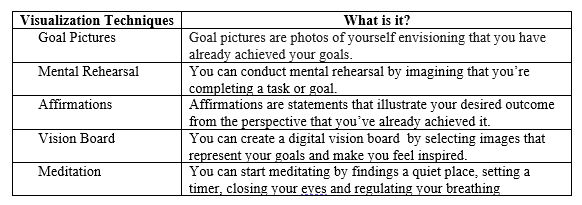
Predoui et al. (2020) suggested that visualization techniques include the five major senses (touch, hearing, sight, smell, and taste) to achieve the best results.
In conclusion, visualization is a powerful and scientifically supported technique crucial to personal and professional development. By engaging in vivid mental imagery, individuals can enhance their performance, boost their confidence, and achieve their goals more effectively. Visualization is not merely a passive daydream but a purposeful exercise that prepares the mind and body for success. Whether it’s improving athletic performance, managing anxiety, enhancing learning, or strengthening goal-setting and planning, the benefits of visualization are vast and varied.
This mental practice, grounded in neuroscience, psychology, and epigenetics, proves that the mind can be trained to influence real-world outcomes. By incorporating visualization into your daily routine, you can cultivate a mindset of resilience, focus, and determination, ultimately transforming your aspirations into reality. As the evidence shows, those who visualize see their goals more clearly and find the motivation and strategies necessary to reach them. Therefore, embracing visualization is an option and a valuable tool for anyone committed to self-improvement and achieving their fullest potential.
The Crucial Connection Between Goal Setting and Planning

“Our goals can only be reached through a vehicle of plan, in which we
must fervently believe and upon which we must vigorously
act. There is no other route to success.”
– Pablo Picasso
In discussions of the term “goal,” it is difficult not to mention “plan” alongside it. These two constructs are seemingly conjoined like Siamese twins. Even in their definitions, goals and plans are intertwined: a goal is defined as the end toward which an effort is directed, while a plan is a method for achieving that end. When goals and plans are perfectly aligned, they create a synergy that leads to success. Thus, goal-setting and planning are critical for personal growth and development. Those who embrace self-improvement must prioritize these two essential practices.
Locke and Latham (2002) describe a goal as an idea of the future or desired result that a person or a group of people envisions, plans for, and commits to achieving. Goals are the object or aim of an action, such as attaining a specific standard of proficiency, typically within a specified time frame. In contrast, a plan is defined as “a set of actions that have been thought of as a way to do or achieve something” (Britannica, n.d.). Both goals and plans often come with deadlines, underscoring their interconnectedness.
Goal setting is the process of defining goals, and planning identifies the actions necessary to achieve those goals effectively. In reality, goal-setting and planning are inseparable. Setting goals without corresponding plans or making plans without anchoring them to specific goals is futile. Goals without a plan are like knowing where you want to go without knowing how to get there while planning without an identified goal is like setting out on a journey without a specific destination. Goal setting is the first step in the planning process; once you have established your desired goals, you can create a plan to achieve them. Planning, in turn, creates a roadmap that guides you toward achieving your goals.
To further illustrate the relationship between goal-setting and planning, we can examine the goal-plan paradigm developed by Simon Sinek, known as the Golden Circle Model. This model effectively represents the connections between these constructs and highlights their significance. The Golden Circle consists of three layers: “Why” at the core, “How” in the middle layer, and “What” at the outermost part. This paradigm emphasizes the importance of identifying the underlying purpose (“Why”) before establishing the process (“How”) and the outcome (“What”).

In this model, the “Why” represents the goal—the purpose or desired outcome that forms the basis for all actions. The “How” corresponds to the plan and the organized efforts necessary to reach the goal. Finally, the “What” represents the specific outcomes or results from carefully executing the goals and plans. Although the terms “Why” and “What” might seem interchangeable, Sinek clarifies that the “Why” refers to the underlying purpose or reason for wanting to achieve an outcome. In contrast, the “What” refers to the tangible results.
Sinek strongly argues that understanding the “Why” is crucial, particularly at the organizational level. Most organizations and leaders know what they do and how they do it, but they often struggle to articulate why they do it. The “Why” is vital because it inspires and motivates leaders and followers. This insight also applies to individuals: the “Why,” or the goal, is the source of passion and commitment, providing a definite direction for organizations and individuals.
To illustrate his assertions, Sinek’s example was Apple’s Why, How, and What.

This example demonstrates that an organization’s “What”—the products or services it offers—is not the goal itself but rather the outcome of an apparent “Why.”
Setting goals and making plans are crucial to achieving success in both personal and professional realms. As Berkman (2018) explained, “Setting goals is easy; achieving them is hard.” While achieving goals may be challenging, it is not impossible. Effective planning makes goal achievement possible.
You have probably heard about SMART goals already. Goal setting involves defining specific, measurable, achievable, relevant, and time-bound objectives that individuals or organizations want to achieve. This is the golden rule of goal-setting.
When goals are specific, it means they are clear. They answer the questions of who, what, where, when, and why. Making the goals measurable means their progress can be tracked. Several other clear indicators are involved. Achievable goals are realistic and attainable given your current situation, resources, and time, while relevant goals are worthwhile or worth pursuing. Their purpose is clear. Time-bound means a specific deadline or timeframe for achieving the goal.
Chowdhury (2019) mentioned that researchers have made the “SMART” rule “SMARTER.” The letters E and R are appended to SMART, with the E standing for evaluative or ethical and R rewarding. He explained that interventions and executing ethical goals follow professional and personal ethics. Rewarding means that the results or goal setting brings the user a positive reward and a feeling of accomplishment.
By using the SMART/SMARTER framework, individuals and organizations can rest assured that their goals are well-defined, making it easier to plan, execute, and achieve them successfully.
After setting goals comes planning. As Antoine de Saint-Exupery says, “A goal without a plan is just a wish.” Without a plan, even the best goals will not come to fruition.
The activities required to achieve desired goals must be identified and organized. The planning process involves drawing a specific course of action that identifies what needs to be done, when, how, and by whom.
A good plan provides a clear roadmap. It helps simplify complex tasks and make them more manageable. It also promotes efficient use of the M resources—manpower, machinery, materials, and money. Planning enables you to foresee what resources are needed and when. It ensures that your decisions are aligned with the goals, reducing the likelihood of making decisions impulsively.
The best part of indulging in planning is that it helps you achieve work-life balance. It allows you to pursue your professional and personal endeavors without sacrificing one over the other.
The interplay between goal setting and planning is fundamental in pursuing success in both personal and professional Endeavors. Goals provide the direction, the “Why,” while plans provide the roadmap, the “How.” The synergy they create ensures that the “What”—the tangible outcomes—is achieved efficiently and effectively. When goal-setting and planning are done correctly, they transform dreams into reality and make success not just possible but inevitable.
Becoming Purpose-driven

“Find your why and you’ll find your way.”
– John C. Maxwell
Purpose-driven is referred to in this article as the desire to find your WHYs and knowing what to do afterward.
**********
“What is your why? Why did you even get out of the bed this morning? Why did you eat what you ate? Why did you wear what you wore? Why did you come here?” These are the questions Howard Inlet, the character played by Will Smith, asks his employees at the beginning of the movie “Collateral Beauty.”
Should you be asked the same questions, would you be able to answer unequivocally? Do you have definite answers, at least, to the first two questions? If your answer is yes, good for you. Way to go! I wouldn’t be surprised if eventually you’ll succeed in your personal and professional pursuits, or you might have already done it. But if your answer is no, I would suggest you do some soul searching because seemingly you have been cruising through life aimlessly. It is very likely that you don’t know your purpose. You may not be living your life knowingly.
Purpose is a powerful driving force in our quest for a better self and a better life. It is the reason why we do what we do and why we exist. They help us have a meaningful existence. Thus, we should strive hard to know (or establish) our purpose and be driven by it. We need to live life with definite intentions.
The question is how. How to live life purposely?
Simon Sinek gave the following suggestion – “Start with why” (which is also the title of probably the most popular among the books he has written). Although the said book focuses on organization and leadership and how having a WHY helps the leader succeed in bringing success to the organization, the WHY principles that Sinek articulated apply to individuals as well. He (Sinek) said that your WHY is your purpose, cause, or belief.
It’s not only organizations and leaders who should have (and be very clear with their) WHYs. Every person should have them, whether or not they belong to an organization, whether or not they are leaders. Each individual needs to determine and establish their purpose, cause, and belief. It’s not only organizations and leaders who should know why they do what they do and why they exist. Each of us should also have a clear understanding of these things.
Two of Howard Inlet’s questions – “Why did you eat what you ate?” and “Why did you wear what you wore?” – may, at first glance, be considered inconsequential. But as one of the owners of that advertising company in that story, Inlet wants to drive home a very important point – that every member of that organization should be aware of the reasons why they do what they do.
This is one thing we ought to be doing even in a personal level also. We ought to be asking ourselves why we do what we do.
I presume (and I hope my presumption is right) that you have set goals in the different areas of life – family and relationships, career and business, personal growth and development, and fun and recreation. The foregoing are the areas with which I subdivided my life into. It is possible that you may have subdivided your life differently from the way I did. But one thing for sure, just like me, you have goals in the different aspects of your life no matter how you may have structured it. Those goals are the manifestations of your purpose or purposes in life, causes you advocate, and the beliefs you uphold.
The answer to the question “Why did you even get out of the bed this morning?” should be as simple as – to pursue the goals you set in the different areas of your life. Right?
But how many out of 10 people set goals (and are you one of them)? How many do live a life driven by a definite purpose? That is difficult to answer with absolute certainty. The one thing I noticed though about estimates on how many percent of people in a particular country succeeded in their chosen endeavors and fields of expertise is that none of the statistics went above 10%. Actually, majority of the articles I read on the topic claimed it’s only 2% to 5%. So, if goals correlate to success, given all the aforementioned numbers, is it safe to assume that approximately only 1 out of 10 set goals?
Granting that my estimation is accurate, only 1 out 10 people know their purpose, cause, and belief. The great majority of human beings wake up in the morning not knowing what are they going to do and where are they headed to. I hope that you’re not one of them.
And those questions that I said earlier are seemingly inconsequential are necessary questions to ask to remind you that even the simplest things you do everyday should contribute to the attainment of your big goals.
What sets apart purpose-driven people from those who are not is that the former constantly ask themselves this question – what consequences do my words, actions, and thoughts bear on the goals that I set.
Your WHY is your north star. It gives you a sense of direction. Not having it is like walking aimlessly not knowing where to go. Not knowing it is like looking for something that you don’t know. You’ll never find it. It’s like living life randomly, not purposely.
Knowing your WHY allows you to clearly identify your goals… goals that as previously mentioned, are the manifestations of your purpose or purposes in life, causes you advocate, and the beliefs you uphold.
But knowing your WHY is only the beginning. It’s like you getting ready at the starting line of a marathon you decided to join. Eventually, you will start running and you know what it takes to succeed in this kind of competition – physical and mental toughness.
There are character traits too required for one to become truly purpose-driven. These are passion and perseverance.
What do you do after setting your goals? Answer: Pursue them with passion and perseverance. After establishing your goals and setting the plans for their pursuit, obstacles and challenges will lie in the path to their accomplishment. It’s not easy climbing Mt. Everest. The things you want to possess, to become, and to accomplish will not be delivered to you in a silver platter. You have to work hard to get them. Whatever you want – wealth, power, fame, success, health, and happiness – will not come knocking at you door. You’ll have to go out and seek for them. And in the process of seeking them out, you need passion and perseverance.
Cambridge defines passion as “an extreme interest in or wish for doing something, such as hobby, activity, etc.” and perseverance as “continued effort and determination.” Both traits, obviously, are needed by those who want to have their hands raised in the podium of winners. You cannot afford to be half-hearted in your undertakings. Be consumed by a burning desire to achieve your goals and realize your dreams. And even when the going gets rough, you’re not supposed to give up so easily. You have to persevere. What’s the use of knowing your why and set goals after if you don’t pursue them vigorously. When you run a race, make sure you finish it.
Duckworth (2016) packaged these two constructs, passion and perseverance, into one concept – GRIT. Duckworth, as cited by Fessler (2018), defines the term “as passion and sustained persistence applied toward long-term achievement, with no particular concern for rewards or recognition along the way. It combines reliance, ambition, and self-control in the pursuit of goals that take months, years, or even decades.”
Studies on grit time and again have proven that people holding steadfast to their goals which they set through time succeed. So, learn to stick with your goals notwithstanding the difficulties and challenges you face.



 M.A.D. L I G A Y A