Surviving The Workplace Jungle
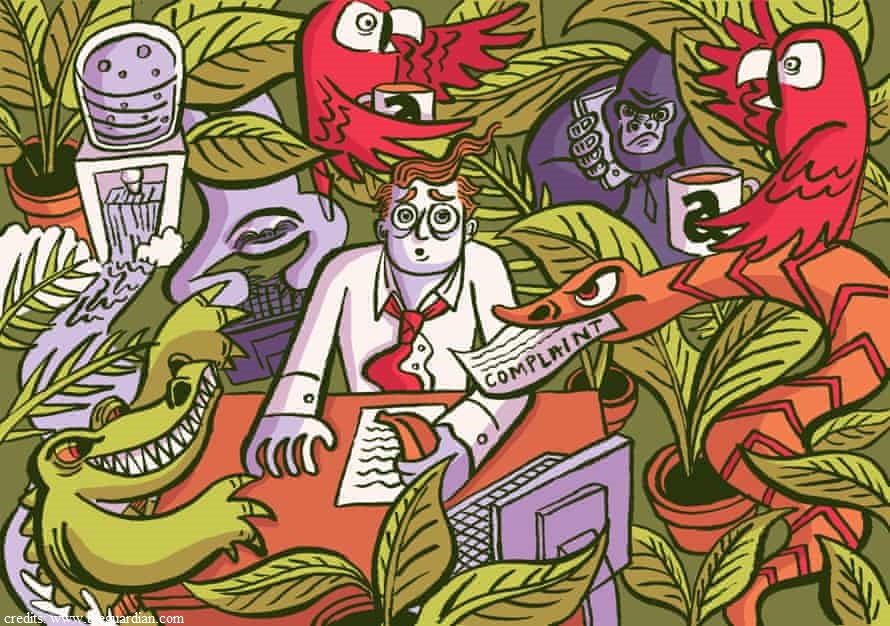
I couldn’t agree more whenever people describe the workplace as “a jungle.” I have been working long enough – thirty years in eight different institutions in two countries – that I could cite a thousand or two reasons why I consider that description accurate in the metaphorical sense. There are uncanny similarities in the behavior of people inhabiting the working environment and the animals in the forest. Even the patterns of relationships between people in the field of work resembles the way the living creatures in the wild treat each other. Thus, they say, in the workplace “only the fittest survive.”
I have been in this jungle called workplace for more than three decades now. Here I am, still standing and breathing. I managed to hold my own against the different animals I cross paths with as I searched for greener pastures and overflowing water holes. I experienced being stared down by a lion, stalked by an eagle, ambushed by a crocodile, bitten by a snake, clipped by a crab, and stung by a bee. Attacks that left me scarred. Nevertheless, I survived. I am still alive… ready to fight or flee to live and fight another day.
How did I do it? How did I live to tell the tale?
I simply took a cue from Charles Darwin who theorized that “species with useful adaptations to the environment are more likely to survive.” Adaptation is the name of the game. That exactly is what I have been doing (and what you should also be doing if you intend to stay alive and sane in your workplace) – ADAPT.
If you wish not to be dinner for the predators it would behoove you to study carefully the environment of the workplace where you belong. Know what kind of animals you are dealing with. Study them carefully. You also need to put your survival instincts into full gear.
Predators lurk in the shadows. It could be a big cat hiding in the bushes or a mighty bird hovering above. These predators could be the “people upstairs” or somebody from among you “downstairs.”
Don’t get me wrong. I don’t mean that all bosses who succeeded in their business endeavors did it at the expense of the people in the rank and file – like predators slaying their preys and eat them. It could be just a few, or half, or most of them. Nobody knows for sure. But definitely not all. Perhaps a majority of them (I hope) consider themselves rhinos and the people they hire oxpeckers whom they allow to freely land on their backs to feast on the insects pestering them.
The point I wish to drive at when I posited that they (the bosses) are predators is that they are at the top of the food chain and like it or not, when you agreed to work for them, you entered their territory. They dictate the terms and conditions of your employment. That doesn’t sound good but it’s the reality in the workplace.
The ones who own or manage the workplace are the alpha males. You need to have a full understanding of how they think and operate. Better if you could dig deeper and try to know what they like and dislike. If it is not too much for your dignity (or should we say EGO) to adapt to their whims and fancies then stay in the pack. These whims and fancies could be the policies that you consider disagreeable. You’ve got to make a choice whether to follow these policies or not. For not following, of course you are not naïve not to understand that there are consequences. Following the terms and conditions of your employment is not equivalent to flopping onto your back to show that you submit to the alpha males. It is simply like the chimpanzees presenting their backs, crouching, bowing and bobbing in order to show deference to the alpha in their group.
If not, if you are tired of being an omega, if your ego clashes with that of the alpha, the wisest thing to do is leave. Find another pack, or better still, be a lone wolf. Don’t be employed. Establish your own business and be your own boss. If you succeed and your business grows big, hire people. That is your chance to be the alpha and see for yourself if you are a better one than your former bosses or… worse than them.
Believe me, you cannot afford to take too much bravado and think you are that brave “angry bird” who would tweet your disagreement and not expect dire consequences. Your chirps will not go unheard and before you know it the eagle will swoop down on your nest and tear you apart with its powerful beaks.
More often than not, or almost always, that locking horns with the “powers that be” in the workplace is like a deer thinking it could take on a full-gown lion. It’s a losing proposition.
Of course not all bosses are saints. Some of them would take advantage of the people they hire in different ways. That you’d discover (hopefully) in time. So, why stay on a watering hole when you know that there are crocodiles under the mud waiting in ambush? Move out. You’re not a tree! You have limbs. Run, walk or crawl from out of there.
What about the predators among you “downstairs”.
Wherever you work, you’ll encounter malevolent individuals. So, be careful. Beware of the wolf in sheep’s clothing. These are co-workers who camouflage themselves as your friends but would stab you in the back when they have the chance.
Okay. Let’s talk more about the different animals in the workplace. You’ve got to be able to identify them if you really want to survive the wild called the workplace.
We have already mentioned about the big cats and the mighty birds. Yeah, including the wolves pretending to be sheep.
Are there other animals you ought to be wary of?
Yes, there are!
Watch out for them. Better watch them like a hawk.
Be careful of the buzzing bees called the rumormongers.
Thinking that they are your friends and therefore could be trusted, you share with them your darkest secrets. Letting the cat out of the bag is the biggest mistake you commit with this type of animals. Later you’ll just discover that the entire workplace is talking about the skeletons you’ve tried so hard to keep in your closet for so long.
Gossiping is a deadly disease in the workplace. It kills reputation and trust. It ruins relationships and careers. So widespread it is that even the people who consider themselves as professionals and who think of themselves as decent individuals spread gossips – both personal and work-related – unmindful of the pain and shame their traitorous act might inflict on their victims.
Identify who among your co-workers are fond of tittle-tattling. Don’t say anything negative to them about the work, co-workers, much less personal matters. Just listen when they talk. Don’t fall into their trap. They will quote you without batting an eyelid. But here is the best way to deal with them – avoid them like the plague. They sometimes appear as if they wouldn’t hurt a fly. That’s their facade. The truth is – they are dogs that eat dogs.
Among your co-workers, you should also be able to spot the crabs.
Why?
Do you know what happens when you put crabs in a bucket? They’ll try to escape by pulling back down others effectively preventing anyone of them from climbing out of the bucket.
That’s the origin of the proverbial “crab mentality.” The philosophy of the malevolent among your co-workers is “if they can’t have a promotion or an incentive, neither can you.” Some people in workplaces just don’t want to see their co-workers succeeding. They so hate it when somebody climbs up the ladder especially if they’ve been there longer. These are the snakes who would bite you with intrigues and gossips when they see you work harder than they do. They would accuse you of being a leech trying to suck the attention and favor of the people upstairs.
Don’t allow the venom of the snakes get through your nerves. Let them not succeed in getting your goat. Continue to work as hard as your personal values would allow you. Don’t be pig-headed like them.
That’s just the reality in the workplace – that generally there are two types of workers – the ants and the termites.
And with who would you rather be associated – with the ants in the workplace who keep themselves busy working and helping one another in order to achieve the goals of the organization or with the termites, whose actions and pronouncements, deliberate or otherwise, are damaging – not only to the organization but more so to themselves?
They are basically a negative bunch that should be avoided at all cost. The termites hold a grudge against the people upstairs for one reason or another and they think that by not doing their jobs the way they ought to and by behaving oddly, they could get even. They spin tales about the current state of the organization basically for the purpose of demotivating people. Be aware that the termites could also sow dissension among their co-workers.
Nonetheless, the people upstairs are not naïve. They could easily detect the existence of termites and they get them exterminated.
Watch out also for the parasites in the workplace.
The parasites seem to have special training in detecting generosity. Once they have spotted a kind-hearted co-worker who wouldn’t say no when asked for favors then they will have a field day. They would ask you to solve their work-related problems and sometimes even seek personal favors.
So, be careful. Learn to say no when you have to or else they would eat up your time and resources. They won’t hesitate to abuse you.
It’s okay if they return the favor. The problem is the word “reciprocate” is not in their vocabulary.
They also tend to exhibit that selfish attribute in their work. You could neither expect them to walk an extra mile for the organization nor perform their duties and responsibilities as stipulated in their contracts. They care for nothing but their salaries.
For the workplace to prosper, the relationship between the people and the organization should be symbiotic.
Let’s consider the relationship between the clownfish and the sea anemone. It’s a perfect example of a symbiotic mutualistic relationship. While the fecal matter from the clownfish serve as nutrients for the sea anemone, the latter provide the former with protection from its predators.
You can choose between becoming a parasite or a clownfish.
The workplace gives you a venue for professional growth and a source of livelihood. You need to keep it afloat. Your organization needs your help for it to succeed and continue existence. You may have disagreements with the people upstairs but you need to bear in mind that commitment to job and organization is different from commitment to your employers.
Lastly, in order to survive in the forest, you need to clearly determine where you rank in the food chain. Identify the different kinds of animals there. And most importantly – don’t stand in the path of your predators.
It’s as simple as knowing your designated place in the organization, being mindful of your words and actions, and being careful with how you deal with everyone. And remember that the most foolish thing to do is to offend your employers.
You have to study the culture of the workplace. Again… ADAPT. Remember what Charles Darwin said, “It’s not the strongest species that survive, nor the most intelligent, but the ones most responsive to change.
If you can’t adapt, if you feel so disrespected and gravely offended, if you think you are no longer growing professionally – what are you waiting for? It’s time to migrate to another forest.
If you think that your current workplace is (as described by Simon Sinek) “like a tree full of monkeys where everyone at the top, looking down, sees only smiles but everyone at the bottom, looking up, sees only asses” then you should leave as soon as possible. Unless you could stomach looking at the same “asses” everyday when you go to work.
And when you’re finally out and begin looking for a new workplace, don’t ever expect that you’ll find a perfect workplace. That’s a wild goose chase. You’ll never find one. You’ll see the same animals.
On Stories and Storytelling (3)
(Last of 3 Parts)

One subject that I miss teaching is Creative Writing. As an English and literature teacher, I consider it an ultimate challenge to teach the subject. It is quite challenging to lead a study of the different forms of discourse to develop the student’s ability to write narrative, descriptive, expository, and argumentative compositions. What adds to the challenge is making the students understand the principles of stylistics, literary criticism, and linguistic and literary devices. As course requirements, I required them to submit a movie review, a short story analysis, two essays, and a short story.
When I created the syllabus for the course, I intentionally did not include poetry. It wasn’t just possible for me to cover both prose and poetry in one semester. It would be difficult for them had I included a poem among those they should submit at the end of the term.
My students had struggles with writing stories. It was easier for them to produce essays. They just toyed with the movie review and short story analysis. Yes, it was easy for them to deconstruct a story and break it into its different parts – the so-called elements of fiction. But most of them had difficulty putting those component parts to construct their own stories.
I told them that I had the same struggles when I began writing. My first stories then were terrible (I hope they are better now.) Writing a story is a skill that would require time to develop. I explained to them that the most famous and talented writers had to hone their craft over a period of many years. I didn’t have statistical data to support that statement, but it was (and still is) safe to assume that the literary greats had “burned oil in many midnights” before they attained their greatness.
I did not mention Gladwell’s 10,000-hour rule, for it might instantly extinguish any flickering hope of any of them to become a writer. Perhaps some of them may have bumped into that idea later on. If, during those times, I had already known about Kaufman’s 20 hour-rule, I would not be mentioning it either, for I don’t like to give them false hope that it would take that so short a time to become good at writing stories.
To become good at writing stories, you have to attain a certain degree of fluency or proficiency in the language you are using to write your stories. If saying that your sentences should be syntactically correct is a mouthful, then let me just say that they (your sentences) should be correct and comprehensible.
You already have an advantage if the language you intend to use to write your stories is your native language. You very well know how important vocabulary is in writing. Consider this: Native-level fluency (this is from Wikipedia) is estimated to require a lexicon between 20,000 to 40,000 words.
But it doesn’t mean that being a native speaker of that language automatically makes one a good writer. If so, we could have had lots of Shakespeares, Hemmingways, Tolstoys, Hugos, Tagores, Xuns, and Rizals. Many native speakers of their own languages could not write a simple story or a poem.
Proficiency in a language is only one of the many skills you have to develop. There are other skills necessary to write well, including choosing the right words to develop related ideas, organizing those ideas into a cohesive whole, and creatively combining and contrasting those ideas. And as I reiterated in part 1 of this 3-part series… “Writing stories require that you should be able to knit together the elements of fiction within the frame of the plot, to make sure that the most important element of fiction – conflict – is laid down clearly and passes through exposition, complication, crisis, falling action, and resolution.”
In short, writing stories is an art, and I doubt anybody could learn it in just 20 hours. Just developing proficiency in a language, if you are not a native speaker of that language, is not achievable in 20 hours. However, you might think spending 10,000 hours to develop a specific skill would probably be too much – unless you want to acquire true expertise in a specific field. If you do it for 5 days a week, because you might need a 2-day break, that’s 4 hours a day in nine years.
You probably would like to start developing your writing skills for at least one hour each day. That’s what I have been doing. It works for me.
Before writing the short story, I would require my students to submit a 10-sentence storyline of the story they plan to write. One time, when I was giving them examples of storylines off the top of my head, one of them asked me where am I getting ideas for my stories.
Before answering that question, I asked them to, again, define literature. Then one of them gave exactly the definition upon which I intended to anchor my answer to the question one of them asked – “Literature is a faithful reproduction of life executed in an artistic pattern.”
I explained that what we read in stories mirrors the things happening in real life. Writers draw ideas for their stories from the experiences of people around them and from theirs as well. That’s how I do it.
“Literature,” I added, “is an artistic expression of significant human experiences.” (I can’t recall anymore who said that.) That’s why when we read stories or watch movies, we feel like it’s our personal story being told.
I told my students I rarely borrow someone’s experience to write a story because my life is a fountain of many storylines.
As I wrote the last part of this article, I could hear Fortunato saying, “For the love of God, Montressor.” Fortunato hoped those words would stop his friend from slowly walling up the niche where he was being buried alive.
On Stories and Storytelling (2)
(Second of 3 Parts)

Obviously, the conflict is the problem to be resolved in a story. If you are familiar with the literature, you know that there are three categories of conflict – man vs. man, man vs. nature, and man vs. himself. Janet Burroway proposed that the following should be included – man vs. society, man vs. God, and man vs. machine. We may also refer to them as sources of conflict.
In one of my literature classes in the Philippines, I told my students to watch the movie “Titanic.” That was when our topic was “elements of fiction.” Students would prefer watching movies over reading short stories or novels when dissecting stories.
When I asked them to identify the story’s central conflict, most answered “man vs nature.” You would understand why that was the answer they gave –Jack and Rose (and all the rest of the passengers) have to survive the ship’s sinking. They were surprised when I told them that there was a dual conflict in the story. There are two sources – “man vs nature” and “man vs man.” While the star-crossed lovers try to figure out how to stay away from the icy water of the ocean, they also have to contend with an extremely angry Cal and his loyal minion Lovejoy.
That’s how clever some writers are. They push their readers or audience closer to the edge of their seats – to the edge of the cliff of excitement – by inserting a conflict within a conflict. With that, they make the “rising action” more intense. When a writer uses multiple sources of conflict, with all the conflicts equally significant, I call it “layered conflict.” (I am not sure if I was the first to call it this way.)
What if the one who wrote the script for The “Titanic” added an extra layer of conflict? Let’s say somebody steals the necklace (“Heart of the Ocean”), and Rose asks Jack if they have to do everything to return it. Let’s say that the thief is a hardened criminal who is willing to kill just to keep what he has stolen. Would the story be more exciting if, while the lovers are trying to survive the unfolding sea tragedy, they have to pursue the one who took the expensive jewel and at the same time hide from Cal and Lovejoy?
I told my students that it would be easier to explain a story’s conflict by starting with a guide question. In the case of the dual conflict in The Titanic, the questions should be: Will Jack and Rose survive the anger of Cal? Will they (also) survive the sinking of the ship?
In another class – Literary Criticism – I taught my students how to trace symbolism in stories. I also used the movie Titanic for the activity. It was easy for them to pick the necklace and explain its symbolism – that the jewel symbolizes Rose’s heart and her love for Jack. They gave nothing more about symbolism after the necklace.
So, I told them that they should not focus only on objects for symbolism. The story – the writer – may try to convey meaning through events in the story. For example, I asked them if they could see any meaning beyond the band continuing to play while the ship was sinking. What about the sinking of the Titanic? What does it convey?
I told them that the decision of the band to continue playing while the ship sinks conveys two things. Firstly, it shows the resilience of the human spirit in the face of tragedy. Secondly, there are people who when confronted by whatever is inevitable, could face it courageously.
And what does the sinking of the mighty “Titanic” symbolize? It shows how helpless mankind is against the forces of nature.
On Stories and Storytelling (1)
(First of 3 Parts)
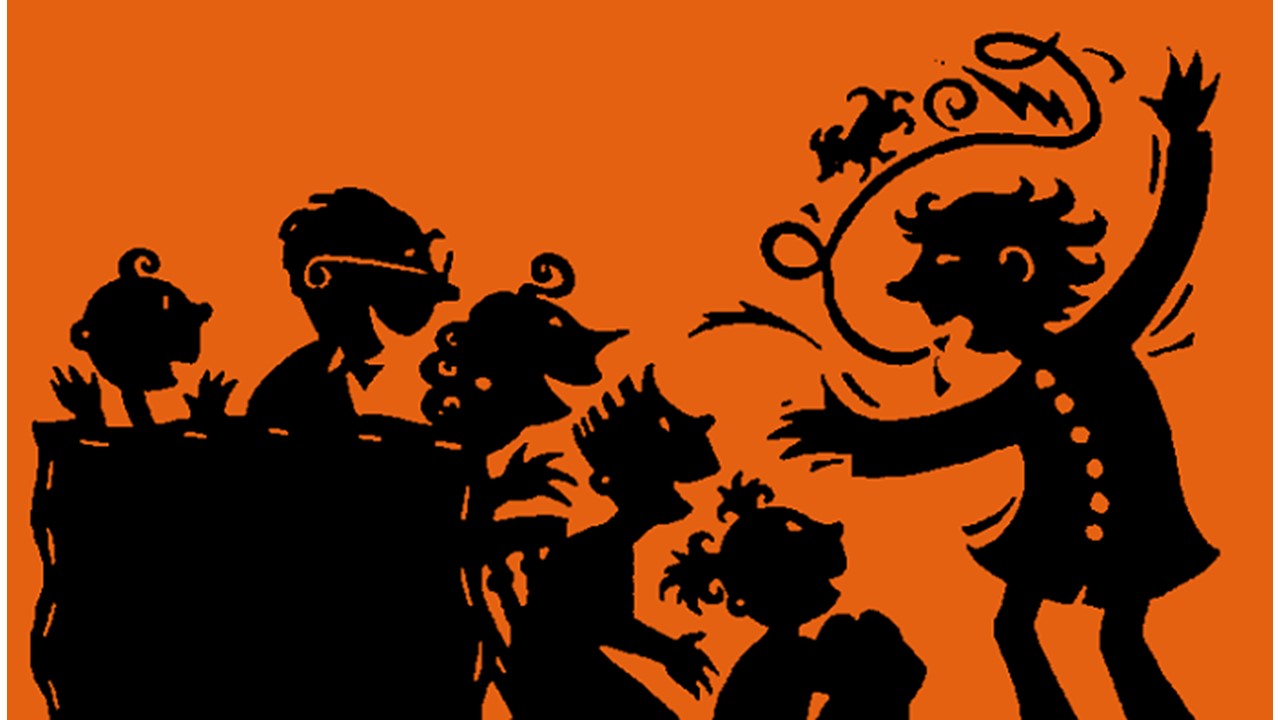
Do you really know what a story is?
Answer the question before sliding your eyes down to the next line.
Done?
Okay, read on.
Just like you, I know what a story is. I can assure you of that.
Let me begin by saying that I love stories. I am so fascinated by them. Very likely that my having earned the degree Bachelor of Arts in English and my having completed the academic requirements for the degree Master of Arts in English contributed to that. The two main fields of studies (major) in both degrees are English language and literature, but more on literature. We studied, among other things, the different forms of literature – prose and poetry, the body of literature of selected countries, literary criticism, philosophy of literature, and creative writing. Just imagine how many stories I had to read when I was enrolled for subjects like Short Story, Novel, Drama, and Shakespeare. To enhance my understanding of the stories I was reading then, I had to watch their screen adaptation (especially of Shakespeare’s famous plays) if they happened to be available. In short, I became interested with stories, not as a hobby. I studied them. I taught Literature and Literary Criticism when I was teaching in the Philippines. By the way, I worked so hard to become a writer as well. I write dramatic monologues, short stories, novels, and plays. Check my website for some of my works – madligaya.com.
I am so fascinated by the art of knitting together the elements of fiction within the frame of a plot – of how to make sure that the most important element of fiction – conflict – is laid down clearly and passes through exposition, complication, crisis (commonly known as climax), falling action, and resolution. Gustav Freitag, a nineteenth-century German critic, laid this down in what came to be known as the Freitag Pyramid. Crisis – or climax – is at the top of the pyramid. The exposition and complication constitute the rising action which ultimately leads to the crisis. Thereafter is the falling action which leads ultimately to the resolution or the denouement. There are stories (movies) that abruptly ends when the climax is reached. In cases like this the crisis implies the resolution. The resolution is left for the readers to deduce.
When a series of events is not laid down in the conflict-crisis-resolution arc, they are but just that – series of events, not a story. Conflict, crisis, and resolution (call them together as plot) are the necessary features of a story. A narrative, to be classified as a story, requires more than setting, character, theme, point-of-view, tone, and style. No matter how short or long a story is, there should be a conflict, conflict that progresses from the time it is revealed (exposition), becomes complicated, reaches a climax (referred to as crisis earlier), slows down to a falling action, and makes a full stop at the juncture called resolution. Am I right? A writer, as I articulated earlier, may stop raising the action right after reaching the climax to let readers imagine how it ends or create the kind of ending they desire.
In movies (or films), cliffhanger endings have become so popular. In cliffhangers, it can be argued that the story does not immediately end after the climax but somewhere between the falling action and the resolution. There was no clear resolution. It can be argued also that cliffhanger endings are applicable only in the case of standalone movies, not of the serialized ones like the Star Wars, Avengers, and the like. When for example Thanos (in Avengers: Infinity War) snapped his fingers and some of the Avengers were reduced to dust, we were like left hanging and wondering why all those heroes we used to seeing alive and victorious in previous Marvel movies died or disappeared. But it’s not a cliffhanger ending per se because we know that that movie is the 3rd part of the main 4-part Avengers series. We know that the last part of the series is forthcoming. All the Avenger movies, together with all the other standalone Marvel hero movies in previous years, are all part of one whole story.
You might ask, “Where are the events in Avengers 3 located in the Freitag (plot) Pyramid?” It’s in the complication (or rising action part), far away yet from the climax. Your next question might be – “Which part of Avengers 4 is the climax?” It started the moment Tony Starks snapped his fingers and said “I am Iron Man” and culminated at the moment Thanos slowly turned to dust. All the events that followed are parts of a very clear falling action and resolution.
What do you think, am I right not to consider the endings of serialized stories as cliffhanger endings (because of the imaginary “To be continued”)?
An example of a movie that had a climax and a falling action but the resolution was not clear and the audience need to decide what to think about it is the way the movie “Don’t Breathe” ends. (I hope you have watched that movie too… and in case you haven’t, I am sorry if this part of my article will now serve as a spoiler. Just skip reading the rest of this paragraph and proceed to the next one instead in case you’re planning to watch the movie.) The climax of that movie came at exactly the 1:20:43 mark. The blind man, after Rocky hits him repeatedly in the head with a crowbar, falls from the 1st floor of the house to the basement. Part of the falling action shows Rocky coming out of the house alive with the blind man’s money. Later she could be seen with her sister leaving Detroit for California. The movie ends showing that the blind man alive. He survived. And I was left formulating my own resolution… or is a sequel (or a prequel) being planned?
I used to teach Literature, Creative Writing and Literary Criticism in the Philippines. One of my students once asked this question: Should all stories have conflict?
If you were me then, how would you answer?
Do you think a series of events stitched up together in any form can be considered a story without a central conflict?
From Janet Burroway’s “Writing Fiction: A Guide To Narrative Craft”:
“And story is a form of literature. Like a face, it has necessary features in a necessary harmony… Every face has two eyes, a nose between them, a mouth below; a forehead, two cheeks, two ears, and a jaw. If a face is missing one of these features, you may say, ‘I love this face in spite of its lacking nose’, but you must acknowledge the in spite of. You can’t simply say, ‘This is a wonderful face.’
The same is true of a story. You might say, ‘I love this piece even though there’s no crisis action in it.’ You can’t say, ‘This is a wonderful story.’
Fortunately, the necessary features of the story form are fewer than those of a face. They are conflict, crisis, and resolution.
Conflict is the first encountered and the fundamental element of fiction, necessary because in literature, only trouble is interesting.”
Let the foregoing paragraphs be my answer to the question “Should all stories have conflict?”
If a narrative has no conflict, don’t call it a story. Call it a face without any part that should be there – eyes, nose, mouth, cheeks, or forehead.
Road to Self-Improvement: The Road Not Taken

“When we strive to become better than we are,
everything around us becomes better too.”
– Paulo Coelho
“Two roads diverged in a yellow wood…”
That’s the first line in Robert Frost’s poem entitled “The Road Not Taken.”
Each time you wake up in the morning, you stand at a fork in a road – one path leads to self-complacency and the other to self-improvement.
“And sorry [you] could not travel both
And be one traveler, long [you] stood
And looked down one as far as [you] could
To where it bent in the undergrowth;”
You wouldn’t be able to see what lies ahead because the forest of life is dense and the road is not straight. All I can tell you is you will either bear the consequences or enjoy the results of choosing which way to go. And you were not born yesterday not to know the repercussions of self-complacency and the wonderful effects of self-improvement. You know which direction leads to ruin and which one winds through the valley of success and happiness.
But the road to self-improvement is either not taken or the one less traveled because it is easier, if not intuitive for people, to be complacent. Well, according to neuroscientists, we should blame our brain for this. And this is where we’re good at – putting the blame on someone or something else. Would you now add your brain to the list of what or who is to blame for your failures?
Neuroscientists say that we are naturally wired to prefer either lying on the couch or sleeping. We are naturally lazy. We hate getting out of our comfort zones. We want things to be given to us on a silver platter. Thus…
“Then took the other, as just as fair
And having perhaps the better claim,
Because it was grassy and wanted wear;”
We don’t want to read or to do any personal growth and development program dropping as our excuse the lack of time to do it. We don’t like to undertake fitness programs saying they’re too difficult to commit to. We don’t believe in the value of proper nutrition reiterating that we have the right to eat whatever and whenever we want.
What we want is a magic pill that we can take to magically unlock our full potential and transform us into the best version of ourselves. The bad news is – there’s no such pill and there will never be. Self-improvement is not a magic pill to take but a Mt. Everest to climb.
Sometimes, when you feel like finally wanting to walk the path to self-improvement. You say…
“Oh I kept the first to another day!”
But having enjoyed your journey in the lane of self-complacency, you would exclaim…
“Yet knowing how way leads on to way,
I doubted if I should ever come back.”
Well, God has given us free will. We live life the way we want. Nobody could ever coerce us into doing what we don’t like. Just don’t forget that whatever becomes of you when you get to the end of the path you decided to take when you came to that fork in the road is your personal choice. “Life is a sum of all your choices.” That’s from Albert Camus.
As I said in another article I wrote about self-improvement, “We indeed have the freedom to choose. It is just unfortunate that some people would choose not to make themselves better.” Free will is both a boon and a bane.
But should you decide to take the road not (or less) traveled – the road to self-improvement – this is what you would say when every strand of your hair turns gray…
“I shall be telling this with a sigh
Somewhere ages and ages hence:
Two roads diverged in a wood, and I –
I took the one less traveled by,
And that has made all the difference.”
Enlightened Perspective

“It is a narrow mind which cannot look at a subject
from various points of view.”
– George Eliot
I do have a friend who would usually be mistakenly identified as me. There were many instances that people in the university where both of us are teaching called me by his name and him by mine. Why? I am not a dead ringer for him but very likely that our similar built, height, and rounded face would make people commit that mistake.
Seemingly bemused, he asked me one time, “Why would they think I am you? Do I look as old as you are?” I paused for a while, smiled then told him jokingly, “No, I think I just look as young and handsome as you are.”
As my friend laughed at my response, I thought that the contrasting way we looked at the issue has opened an opportunity for me to revisit the topic “perspective.”
Perspective – our tendency to look at the same things, events, issues, and concepts differently – is one of the most amazing things about us humans. According to Duffy (2019), “perspective is arguably the single greatest aspect of our uniqueness and that each of us has a uniquely valuable perspective of life – a lens through which we interpret our lives.” She (Duffy) explained that we can expand our perspective through a tool called perspective taking – learning from the way others see life.
In this book we will refer to perspective taking without consideration of the way others see things, events, issues, and concepts. Yes, there is a need to respect and learn from the way others view life but are those views correct? Are those views not inimical to our interest and wellbeing.
The kind of perspective taking that I think we should be doing is choosing the best vantage point of looking at things, events, issues, and concepts according to their own merits and not according to the socio-cultural frames set by anybody. Are they positive or negative the way that they are and not the way anybody wants to see them/or the way you want to see them?
Anything in this world can be viewed from different perspectives. We get to decide at what vantage point we would look at circumstances, problems, events and even objects using lenses that are uniquely ours. We tend to measure and interpret those things using our own value system. We label and define them according to our beliefs. We react to them according to our attitudes. Those beliefs and attitudes, as I explained (in my other self-improvement articles which I hope you have read), are shaped by the way we were raised by our parents, trained by our teachers, influenced by the people around us, and conditioned by our culture. Two persons could look at the same window one morning and one would see the speck in the window instead of the sun rising. It is in this context that I wish to discuss enlightened perspective.
The sum total of the experiences we accumulated since birth and the amount and quality of information we gathered through the years from different sources are the factors that contribute to the kind of perspectives we develop as persons. Our way of viewing things depends on the value system that those experiences and information impressed upon us.
Each person is entitled to embrace a particular attitude towards something. There are no specific measurement to determine the rightness and wrongness of perspectives. Only the consequences of a person’s action (or the lack of it) as a result of embracing certain perspectives could perhaps be labeled as right or wrong.
When we are about to take a perspective it’s like we’re positioning ourselves in the number scale and decide whether to go north or south. We can either be positive or negative with our perspective. Those are the only directions we could take when we look at issues and circumstances confronting us. It’s a matter of choice. If you want more choices, imagine perspective as the Cartesian plane.
When viewing an issue, an event, or a circumstance and you’re about to make a decision about it, place yourself at the origin or the center of the Cartesian plane. Decide in which quadrant you would focus your lens on when making a decision – positive/positive, positive/negative, negative/positive, or negative/negative. What I mean is you can decide to view what is happening or what is about to happen purely as good, or purely bad, or you are objectively weighing both the good and the bad. There are always the pros and cons – the advantages and disadvantages. You have to carefully weigh both before making any decision or before passing your judgement.
An enlightened perspective is a perspective taking devoid of biases, prejudices, and preferences.
Your perspectives affect the decisions you make. They inform the things you think, say and do. Thus, while you are entitled to have any kind of perspective, in the same manner that we are entitled to our own opinions, you should bear in mind that we will bear whatever consequences there may be for embracing the perspectives we take.
You also need to understand that you could not assume that what you believe or see is definitive. Different people have different ways of looking at things. The perspective of the world that dictates the lens through which you see it is not the same for everybody. You need to develop the ability to see things also from another’s viewpoint. This is what I referred to earlier as perspective-taking. But while you try to understand and respect how others view things and issues, you don’t need to embrace them when you deem that that perspective is negative and contrary to the positive outlook that you are trying to develop.
Perspectives can either be broad or narrow.
Having a broad perspective means being able to see the bigger picture. `
I once had a conversation with another friend about working conditions. He bewailed the fact that a truck driver in his country earns more than what he is earning in a year as an expat teacher. After listening to his litany, I told him to pause for a while and dig deeper into his comparison and consider other factors like number of required work hours and the physical demands for the job. When computing the number of hours, I reminded him that we as teachers are not actually working during winter and summer breaks but we get paid in full by the university as stipulated in our contracts.
He realized at the end that his pay per hour is actually higher than the truck driver and his working conditions are much better.
It is not really hard to train the mind to look at the bigger picture. It is easy to look beyond the obvious if only we’re open-minded. It does not require a special kind of training. All we need is common sense.
There are a lot more that could be explored in the discussion of perspective. At the end, the thing that matters is the answer to the question, “How do our perspectives affect the way we live?”
If the lenses you are using to view the world have brought you success and happiness, why change them. We’ve been told many times, “If it ain’t broke, don’t fix it.” But what about if those lenses are seemingly broken and have caused you nothing but failure and misery? Is it time to visit an OPTIMIST?
Reference/s:
Duffy, J. (2019). The Power of Perspective Taking. Retrieved from https://www.psychologytoday.
com/blog/the-power-personal-narrative/201906/the-power-perspective-taking
Evolving Your Mindset

“Mind is a flexible mirror, adjust it,
to see a better world.”
– Amit Ray
Positive thinking, perspective, and mindset are often construed as similar concepts. But in previous articles I have written on these topics, I presented them as separate constructs. I have already articulated my takes on positive thinking and perspective in the said articles. I appended “enlightened” to perspective for the purpose of presenting the idea in the manner I intended to explain it. To mindset, I am using “evolved” as a descriptor to distinguish my ideas about this concept from Carol S. Dweck’s “growth mindset.” I would say though, to somehow connect my ideas to hers (Dweck’s), that it is difficult to convince people with a “fixed mindset” that their mindset is capable of evolving. Let me expound later.
(https://madligaya.com/works-in-english/essays/on_personal_development/)
Successful people whom we call winners are positive thinkers – they are full of optimism and hope. But let me reiterate that they are not just optimistic and hopeful. While they expect good things to happen, they don’t just sit idle and do nothing. They embark on a course of action, not just daydream when pursuing whatever it is that they wish to accomplish. They do everything that ought to be done in order to get the results they want.
They (the winners) also know that realizing their desired outcome entails good decision-making. And they are aware that all decisions they make, all assumptions drawn and conclusions arrived at in the process, should be based on facts and details gathered using not only the methods they have already proven effective (that’s why they are successful) but by applying their enlightened perspective.
What about evolved mindset? What is it?
Dweck (2006) defines mindset as a self-perception or self-theory that people hold about themselves. But my discussion of this idea will not be anchored on mindset as the way a person perceives themselves or what belief they hold about themselves. These are notions similar to what I have previously discussed in an article on “self-belief.” The way I presented mindset here is also different from the way I discussed mindset in an article entitled “Cultivating Mindset.”
In addition to Dweck’s, if you check online dictionaries, you will see the different definitions of mindset. Cambridge defines it as “a person’s way of thinking and their opinion.” Oxford’s goes “the established set of attitudes held by someone.” And here is Merriam-Webster’s – “a mental attitude or inclination.” It is from the perspective of the third definition (Merriam-Webster’s) that I will explain mindset and why it is a vital component of the value system of successful people. I will dwell more on the “inclination” part of the definition.
Inclination is defined as a person’s natural tendency or urge to act or feel in a particular way (Lexico, n.d.). Whenever you receive any kind of stimuli from the environment, you respond in the way you do. That’s your inclination.
There are only two ways to categorize your inclinations – positive or negative. Your inclinations are either good or bad. They are either helping you establish a good future or they are ruining it. Your inclinations will determine whether you will end up a winner or a loser in the game we call life. Consider your inclinations a web of your modes and patterns. In that web, are you the spider or a trapped insect?
You react by thinking, saying, or doing something. Doing nothing is in itself a reaction. Inclinations are established sets of behavior that dictate the way we respond to an event, idea, circumstance, or what have you. The question is – are you consciously making those responses? Very likely that you’re not. Very likely that you are responding reflexively. You are not mindful of your inclinations. Usually, after you do or say something, it is only when you would realize that it’s not the proper thing to say or do. That realization, more often than not, comes right after you are already staring at the consequences of whatever you have said or done.
Sigmund Freud theorized that there are three levels of awareness – the conscious, preconscious, and unconscious. The unconscious mind is a reservoir of feelings, thoughts, urges, and memories that are outside of our conscious awareness. The unconscious contains contents that are unacceptable or unpleasant, such as feelings of pain, anxiety, or conflict (Cherry, 2020). It is in the unconscious mind where our inclinations reside.
People do respond differently to the same stimuli.
How do you respond when somebody curses you or calls you names? You might get angry and retaliate or you will choose to keep your cool and just walk away. How do you respond when your personal and professional pursuits fail? You might never try again or keep trying until you succeed. The foregoing are just a few examples of stimuli that confront as every day and how we react.
Your mindset (or your inclinations) could be affected by the culture you have grown into. Factors related to family, school, and environment are considered determinants of the kind of inclinations that you would end up having.
The inclinations or tendencies of a person depends on the kind of “wiring” their immediate family or society at large set on their minds. How such elements affect them as they grow older could be gleaned from the way they naturally react on just about anything later on in life. It will manifest in the way they think, talk, and behave. They are, in effect, programmed to think, talk, and behave in a certain way. In the deep recesses of their unconscious minds are their default responses to stimuli that they receive from the environment.
A person’s mindset could evolve. We can overcome our default mindset and get rid of our destructive default modes and patterns. We can, if we want, reprogram our minds. This begins by identifying which of our inclinations need to change. We need to be aware of our inclinations so we can educate ourselves how to properly respond to the stimuli we receive every day in our lives. Identifying whatever negative inclinations we have then correcting them is how the mindset transforms. When we succeed in doing so, when we succeed in either controlling or eradicating our bad inclinations, we achieve the state of an evolved mindset.
Uncontrolled negative inclinations could lead to failures in both personal and professional undertakings. It could ruin relationships and reputation. Negative inclinations are the biggest roadblock to sound decision making.
At this point, let me present Dweck’s notion of mindset. She (Dweck) categorized mindset into two – “fixed mindset” and “growth mindset.” She explained that “In a fixed mindset students [people] believe that their abilities, their intelligence, their talents, are just fixed traits. In a growth mindset, students [people] understand that their talents and abilities can be developed through effort, good teaching, and persistence.”
The danger is that if a person has what Dweck refers to as a “fixed mindset” they, as you might expect from people with that kind of mindset, have already embraced that they are who they are and whatever behavior and characteristics they possess are permanent and can no longer be changed. Winners are different. They do possess a “growth mindset.” They believe that inclinations can be changed in the same way that they think that talents can be developed. Inclinations are not fixed characteristics. If you decide to, you can identify which of them are bad and either control or completely eradicate them. Obviously, you should nurture the good ones.
Winners are mindful of what they think, say, and do. Being aware of their negative inclinations enables them to have restraints and make the right decisions. That’s the reason they are in the podium with their hands raised.
Be the spider, not the trapped insect, in the web of your default modes and patters.
References:
Cherry, K. (2020). The Preconscious, Conscious, and Unconscious Minds. verywell mind https://www.verywellmind.com/the-conscious-and-unconscious-mind
Dweck, C.S. (2006). Mindset: The New Psychology of Success. New York: Ballantine Books.
Inclination. (n.d.). In lexico.com. Retrieved from https://www.lexico.com/definition/inclination
Mindset. (n.d.). In merriam-webter.com. Retrieved from https://www.merriam-webster.com/dicti
onary/mindset
Mindset. (n.d.). In dictionary.cambridge.com. Retrieved from https://dictionary.cambridge.org/ dictionary/english/mindset
Mindset. (n.d.). In lexico.com. Retrieved from https://www.lexico.com/definition/mindset
 M.A.D. LIGAYA


 M.A.D. L I G A Y A