Author Archives: M.A.D. LIGAYA
A Holistic Approach To Self-Improvement

Self-improvement is often treated as a collection of isolated goals—building confidence, learning new skills, developing better habits, or becoming more disciplined. But lasting transformation requires something more. It requires a holistic approach.
This book presents a practical framework that brings together the essential dimensions of personal growth into one integrated system. Rather than focusing on a single aspect of development, it shows how genuine and lasting change occurs when your beliefs, abilities, habits, and actions work together.
Through this book, you will discover how to:
• Build a strong value system that shapes your character and guides your decisions.
• Develop the competencies needed to navigate life’s personal and professional challenges.
• Establish a habit scheme that transforms good intentions into consistent action.
• Cultivate the self-discipline that binds every element into a sustainable way of life.
• Pursue lasting health, success, happiness, and fulfillment through balanced personal growth.
Grounded in research yet written in a clear and practical style, this book combines timeless principles, scientific insights, reflective exercises, self-assessments, and real-life examples to help you understand not only what to improve, but how meaningful transformation actually happens.
Whether you are a student, educator, professional, leader, entrepreneur, or simply someone seeking a more purposeful life, A Holistic Approach to Self-Improvement offers a complete roadmap for becoming your best self—one intentional step at a time.
Grow with purpose. Live with meaning.
Lessons on Perspective
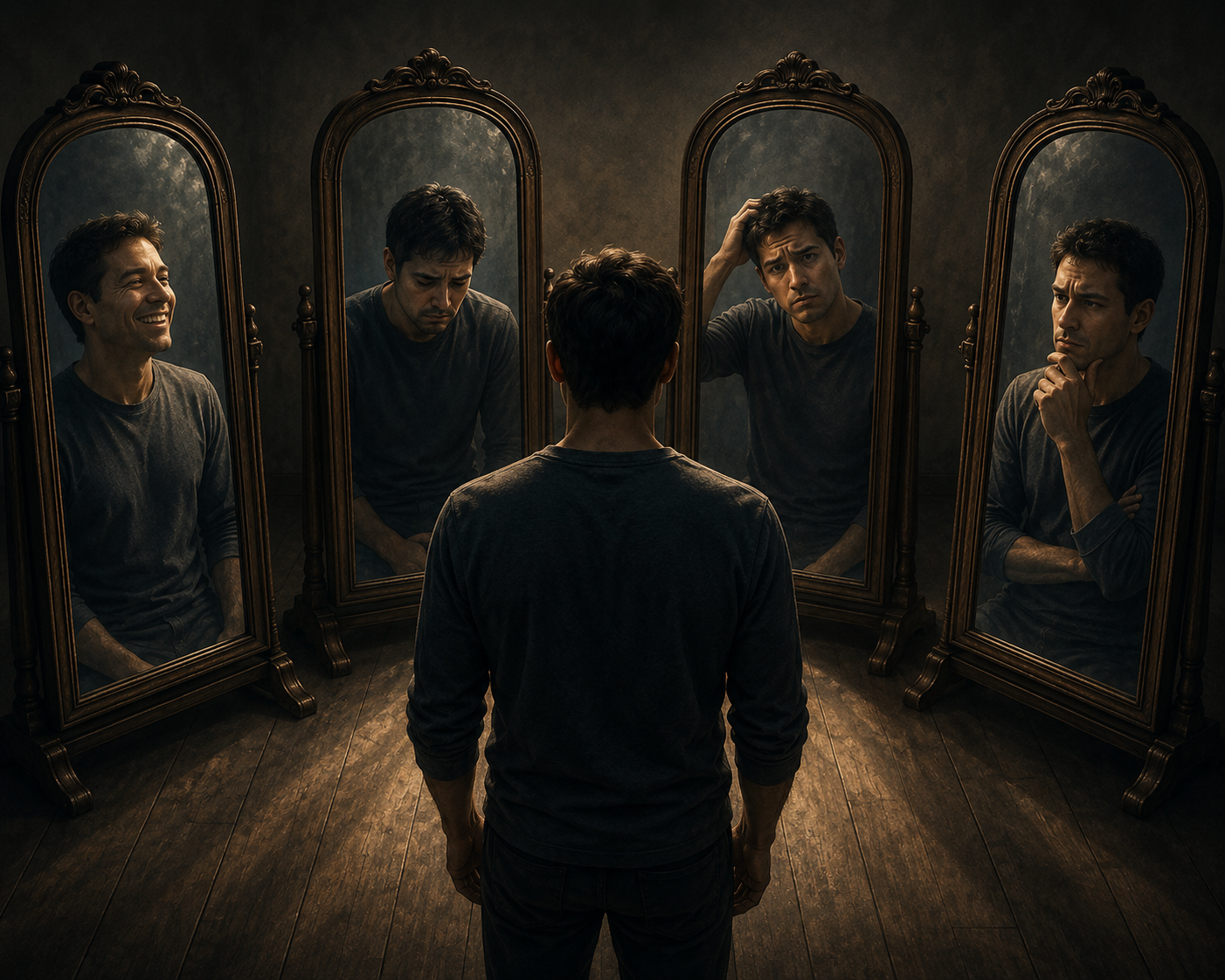
I have a friend who is regularly mistaken for me. We teach at the same university, share a similar build and height, and have the same rounded face — though I have a more defined nose and he has fairer skin. One day, visibly bemused, he asked me, “Why would they think I am you? Do I look as old as you?” I paused, smiled, and replied, “No. I look as young and handsome as you.” He laughed. And in that small exchange, I noticed something larger than the joke: the same mix-up, the same mistaken identity, had produced two completely different reactions in two different men. He heard an insult about age. I heard a compliment about my looks. Nothing about the situation had changed. Only the lens through which each of us chose to receive it.
That, I think, is the simplest definition of perspective — not what happens to you, but the angle from which you decide to look at what happens to you. Two people can stand at the same window on the same morning. One sees the smudge on the glass. The other sees the sun rising behind it. Neither is wrong, exactly. But one view will serve the viewer far better than the other.
I was reminded of this again in a conversation with a colleague, an expat teacher like me, who was frustrated about his salary. He told me, with some bitterness, that a truck driver back in his home country earned more in a year than he did. I listened, then asked him to slow down and look at the bigger picture. How many hours did that truck driver work to earn that figure? What were the physical demands of long-haul driving, year after year? And what about our own schedule — the fact that, as university teachers, we are paid in full through both winter and summer breaks, which together amount to five months of the year? During those five months, our only real obligations are a handful of meetings at the start and end of each semester. The rest of the time is simply ours.
When he ran the numbers on his actual hourly rate, his frustration lost its footing. He was earning more per hour than the truck driver, under incomparably gentler conditions. His complaint had been built on a true fact — the raw annual figure — but an incomplete picture. He was not wrong about the number. He was wrong about what the number meant because he had left out everything around it.
This is the most common failure of perspective, and the most forgivable one. We are not lying to ourselves on purpose. We simply stop looking before we have gathered the whole view. The fix is almost always the same: pause, and ask what else belongs in the frame.
But there is a second, less innocent failure of perspective, and a different colleague handed me a clear example of it. He told me, flatly, that he considered motivational quotes to be nonsense. To prove his point, he gestured at a small bulletin board bearing a quote that read, “Whatever you are, be good at it.” Then he delivered what he clearly believed was the knockout line: “So if you are a rapist, be a good rapist.”
I told him he had chosen the worst possible illustration he could have picked. More importantly, his example revealed the lens through which he had chosen to interpret the quote. You cannot be good at doing something that is, by its nature, an act of harm. Goodness and harm are not two settings on the same dial; one cancels the very premise of the other. I asked him the obvious question: Why a rapist, of all the things a person could be? Why not a teacher? A father? A leader? Each of those would have proven the quote’s point beautifully — that excellence, applied to a worthy role, elevates both the role and the person in it. Instead, he reached for the most grotesque example available, not because it was the most honest one, but because it was the most useful one for the argument he had already decided to win.
That is the difference between an incomplete perspective and a distorted one. My colleague with the salary complaint was missing pieces of the picture, but he was not hiding from the truth — he simply hadn’t gone looking for it yet, and once he did, he changed his mind. The man at the bulletin board was doing something else entirely. He was not missing information. He was selecting the most damaging frame available and presenting it as the obvious one, so that the quote — and perhaps optimism itself — would look foolish by comparison. One man’s perspective needed completing. The other man’s perspective needed correcting.
I think about these three exchanges together because they map out the territory so well. The mistaken-identity story is perspective in its lightest form — the same fact, received through two different temperaments, producing two different emotional outcomes, both harmless. The truck driver story is perspective in its most repairable form — a real grievance, resting on a partial view, that dissolves the moment the missing pieces are added back in. And the bulletin board story is perspective at its most dangerous — not an honest gap in the picture, but a deliberate choice of the worst possible angle, used to discredit something that did not deserve it.
Obi-Wan Kenobi was right when he said that many of the truths we cling to depend greatly on our own point of view. But that is not an excuse to pick whichever point of view is most convenient, most cynical, or most self-serving. It is an invitation to be honest about which direction you are choosing to look — and deliberate enough to ask whether you have actually seen the whole field before you decide what it means.
Perspective, in the end, is not something that happens to us. It is something we choose, conversation by conversation, frame by frame. The only real question is whether we are choosing it carefully — or just reaching for whichever lens lets us win the argument we already wanted to have.
The Color Game
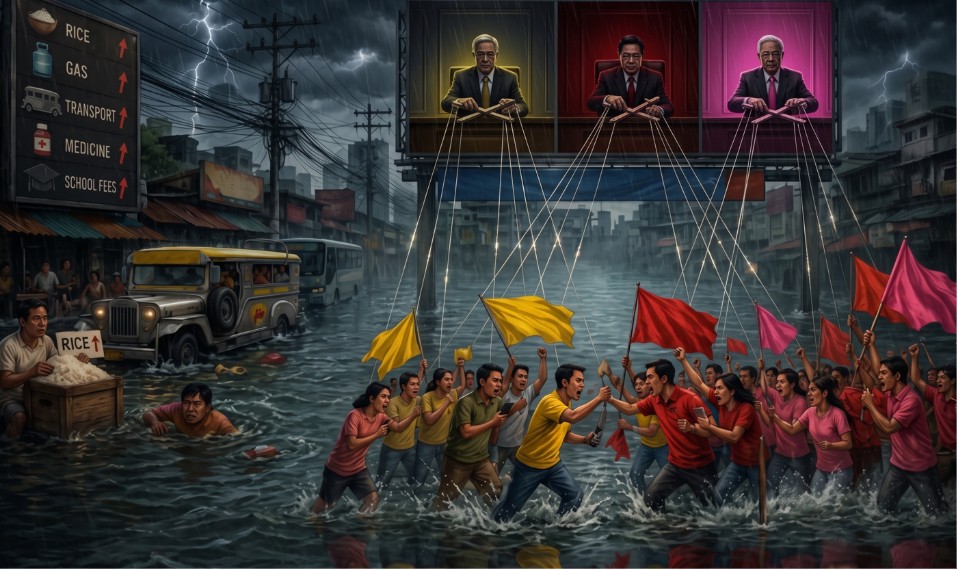
There is a game the Filipino people have been playing – and they are both the player and the prize.
It’s a color game, but not the kind played in peryahan.
It’s the dangerous variety of color game where they bet not a barya or buong isang daan or isang libo.
What they bet is their future and that of their children.
What they bet is the destiny of their nation.
They have chosen their color…
Red.
Orange.
Pink.
Yellow.
Are there other colors?
Which color is winning?
The color game they have been playing has continued for years. Like in peryahan, it’s loud, theatrical, and utterly consuming. The rules are simple: pick a color, wear it like a religion, and defend it with the ferocity you should have reserved for your children’s future. And just like in peryahan, there is always a crowd — excitable, passionate, absolutely certain that this time their color will land. There is always a string being pulled. And there is always an operator — calm, invisible, and smiling — who designed the game, controls the string, and goes home with the money regardless of which color it lands on.
The players change. The colors shift. But the game never ends. And while it rages — while you rage for it — the rice gets more expensive, the streets stay flooded, the hospitals stay broken, and the men and women you are fighting for, the ones called “honorable,” are already thinking about 2028.
They are always thinking about 2028.
You are thinking about winning an argument on social media.
Against those who denigrate the color you chose.
This is the color game. And it is eating the country alive — not from the top, where the operators sit in their comfortable certainty — but from the bottom, where you are. Where we are.
You know the colors by heart.
Yellow — the color of a promise, worn by those who believed that restoring democracy was the same as perfecting it, and discovered too late that it was not.
Red — the color of a fist, embraced by those who mistook loudness for leadership and force for order.
Orange — the color of a strongman’s campaign sunrise, bright and defiant, darkening as the years passed.
Pink — the color of a brief, beautiful hope, lit by millions of ordinary hands in 2022, then methodically extinguished by a machinery that had been perfecting itself for decades. And now the colors multiply, fragment, recombine — new shades for new seasons, new banners for old ambitions.
In a painter’s world, colors mixed together produce something new — something richer, something worth beholding. Yellow and red make orange, warm and alive. Red and pink deepen into something passionate and bold.
But in Philippine politics, when these colors bleed into each other, they do not produce beauty. They produce noise. They produce confusion. They produce a muddy, indistinguishable darkness that serves no one — except the ones holding the brush and palette.
The operators.
So tell me. What color have you painted your face with — Yellow, Orange, Red, or Pink?
The shade changes with every election cycle.
Poverty does not.
But perhaps the color game has endured this long because it taps into something deeper in the Filipino spirit — a tendency, born of centuries of uncertainty, to treat life itself like a peryahan. To believe that fate, not effort, determines outcomes. To bet rather than build. To cheer rather than question. The peryahan is loud and alive and for one electric moment, it makes you feel like you matter — like your barya could change everything.
It never does.
Because the color game in the peryahan was never designed for you to win. It was designed to keep you coming back. Hopeful. Distracted. Spending. Round after round, election after election, color after color — the string is pulled, the crowd roars, and the operator quietly counts his earnings. He does not care which color you choose. He owns all the colors. And win or lose, at the end of the night, he goes home with everything.
You go home with a color.
And an empty pocket.
And somehow, inexplicably, the hope that next time will be different.
In a spinning wheel, you can at least pretend the outcome is random. But in this color game, the operator’s hand is right there — pulling the string, controlling where it lands, deciding your fate — and you are watching him do it and calling it democracy.
Let us be honest about what this game costs.
It costs friendships.
It costs family dinners that turn into battlegrounds over people who will never sit at your table or attend your funeral if the color game you are playing suddenly turned fatal.
It costs the working hours of millions — hours spent sharing posts, crafting insults, fact-checking the other side while ignoring the failures of your own.
It costs the nation’s attention — that finite, precious resource — which should be trained on inflation, unemployment, crumbling infrastructure, and a generation of children being educated into irrelevance.
Instead, it is trained on who said what in a Senate hearing.
On who wore which color to which rally.
On who clapped, who sneered, and who walked out for the cameras.
The Senate — once the nation’s highest chamber of deliberation, where the most consequential questions of national life were supposed to be wrestled with — has become a peryahan of its own. The barkers are louder and better dressed, but they are barkers nonetheless — performing for the crowd, stirring the noise, keeping your eyes on the spectacle and away from your emptying pockets. The scripts are obvious. The performances are calculated. The actors know their audience and play to them perfectly — because their audience has been perfectly trained to applaud on cue, to hiss on cue, and to ask nothing in return.
Nothing. In. Return.
That is the arrangement. And you agreed to it.
And then there is the other half of Congress — the House of Representatives — quieter than the Senate, less theatrical, but no less complicit. If the Senate is the peryahan’s barker, loud and visible and working the crowd, then the House is its backroom — the place where the real transactions happen, away from the lights, away from the cameras, away from you. While senators perform for your attention, congressmen perform for each other — carving up budgets, protecting turfs, delivering pork to districts that will deliver votes in return. They are the ticket sellers of this peryahan: unremarkable, efficient, and absolutely essential to keeping the game running. They rarely trend. They rarely go viral. They do not need to. They have already been paid.
Ask yourself: when did your congressman last fight for something that mattered to your life? When did he author a law that changed your child’s classroom, your family’s hospital, your neighbor’s livelihood? Or has he been too busy — too busy attending the right political gatherings, wearing the right color, aligning himself with the powerful, and eliminating those who might stand in the way of their allies come 2028?
And above them all — setting the tone, managing the machinery, directing the entire peryahan from the main tent — sits the Executive. The President and his cabinet: the operators in chief. In a functioning democracy, the cabinet secretaries are the nation’s problem-solvers — the ones tasked with the grinding, unglamorous, essential work of making government actually work. Healthcare. Agriculture. Education. Infrastructure. Trade. These are not political abstractions. These are the departments whose decisions determine whether you eat well or poorly, whether your children learn or fall behind, and whether your country grows or stagnates.
But look at them now. Cabinet secretaries torn between serving the people and singing the political tune their appointer wants them to sing. Most of them are presidential allies — appointed not because they are believed to be capable of doing the job, but as payment for political favors — positioning themselves for the next election while the departments entrusted to them drift on autopilot.
The Executive branch — the most powerful instrument of governance in the land — being used not to solve the nation’s problems but to secure the political survival of those who sit atop it. The operators are not running the peryahan for your benefit. They are running it for their own. And the cabinet? They are the kargadors — setting up the stalls, rigging the lights, making sure the string is properly weighted — while the real work of the nation waits.
Then there is the Judiciary — the branch that was supposed to stand apart from the noise. The referee. The one institution whose entire legitimacy rests on its independence from the color game. And yet. When the flood control funds disappeared — when the corruption was not a rumor but a documented, reported, undeniable reality — where were the courts? Where were the swift, decisive interventions that could have stopped the bleeding before it became a hemorrhage? The wheels of justice turned — slowly, carefully, with great deliberation — while the evidence aged, the witnesses scattered, and the money finished finding its way into the pockets where it was always headed.
Justice delayed is justice denied. But in the Philippine peryahan, delayed justice is also convenient justice — convenient for the operators, who need only enough time for the crowd’s attention to move to the next spectacle. The Judiciary did not need to be corrupt to be complicit. It needed only to be slow. And slow it was, and still is.
And finally — standing at the edge of the peryahan, armed and watching — is the military. Trained. Disciplined. Bound by the Constitution to remain neutral in political affairs, to serve the state and not the politician, to protect the people and not the power. We respect that tradition. We understand its necessity. In a democracy, a military that takes political sides has chosen to become a weapon rather than a shield.
But neutrality, too, has its limits.
When the house is not merely in political dispute but structurally on fire — when the institutions meant to check power have been captured, when the people’s resources are being systematically plundered, when the color game has so thoroughly consumed the machinery of governance that the nation itself is being dismantled in plain sight — at what point does silence become complicity? At what point does standing down become standing aside while the people you swore to protect are robbed of their future? These are not questions with easy answers. But they are questions the military — and more importantly, the Filipino people — must eventually be willing to ask. A sword in its scabbard still has an obligation to the hand that forged it.
And then there is the clown. Every peryahan has one — not a fool, but a professional. His job is not to govern but to entertain. Not to solve but to distract. Not to lead but to make you laugh, make you gasp, make you watch — long enough that you forget to ask where the money went. In Philippine politics, the clown wears many faces. Sometimes he is bombastic. Sometimes he is outrageous. Sometimes he says the things that make you feel like finally, finally, someone is speaking your language. But while you are laughing, while you are cheering, while you are sharing his latest performance on your timeline — the operator is counting the night’s earnings. The clown does not get a cut. He gets your attention. And your attention is all the operator needs.
So here is the peryahan in its full form.
The Senate — its barkers.
The House — its ticket sellers.
The Executive — its operators.
The Judiciary — its security guard, looking away at precisely the wrong moment.
The Military — its silent giant at the gate, watching the crowd thin out, doing nothing.
Every booth is staffed. Every role filled. Every position occupied by someone who has, in some way, chosen a color — and the game that comes with it — over the country. And in the center of it all — the string, pulled endlessly, landing nowhere new — are you.
And who keeps the crowd gathered around the peryahan? The media — much of it owned by the very people who painted the colors, or by those who have chosen theirs. They broadcast the color game as though it were news. They amplify the noise and call it public discourse. They give the barkers a microphone, the ticket sellers a platform, and the operators a megaphone — and then wonder why the crowd never goes home. A free and fearless press could have been the peryahan’s greatest threat. Instead, for too many outlets, it became its most effective promoter.
There is a particular kind of pain in watching a Filipino fight for a politician.
Not the polite disagreement of people who see things differently. The savage, unrelenting, identity-staked warfare of someone who has confused a political patron with a personal savior. The kind of fighting where the goal is no longer truth — it is victory. Where the opponent is no longer a fellow Filipino with a different view — they are an enemy to be destroyed.
You have seen it. You may have done it.
And while you were doing it — while you were serving as the unpaid, unthanked attack dog of someone whose driver earns more than you — what was happening? You were playing the color game in the peryahan on their behalf, spending your energy, your time, your relationships — betting everything on their color — while they watched from a safe distance and calculated their odds for 2028.
The price of galunggong went up.
The peso weakened.
Your child’s classroom still had a leaking roof.
Your sick mother waited in a public hospital corridor for a bed that was not coming.
The politician you were fighting for didn’t notice any of it. Or rather, he noticed and calculated that it did not affect his numbers. He will notice everything once 2028 approaches. He will notice your barangay, your face, your vote. He will attend birthdays and wakes. Probably not the funerals — that might be too risky. He will arrive with a smile and a t-shirt in his color, reminding you of everything he stands for.
He will not mention what he failed to do.
And the cruelest part? You will probably forgive him. Because by then, those wearing different colors will have done something unforgivable — something real or manufactured, it no longer matters — and your loyalty will have been re-ignited, your attack dog instincts re-awakened, and the cycle will begin again. The string will be pulled. The crowd will roar. And the operator will smile.
This is not politics. This is a leash. And you are on it.
While the color game consumes us, the real emergencies accumulate quietly, patiently, like water rising in a room whose occupants are too busy arguing to notice the flood.
And what a flood it is. Not just the kind that swallows streets and living rooms every rainy season — the kind that has been swallowing them for decades while the flood control funds disappeared into pockets we were too distracted to check. Not just the kind that displaces families and destroys livelihoods — but the kind made of promises, millions of them, rising and rising, waterlogging every barangay, every household, every Filipino heart that dared to believe that this time would be different. Three kinds of flood. One country drowning. And the operators — dry and comfortable inside their tents — are on television arguing about colors.
Our economy is not where it needs to be for a nation of our potential. Our young people are leaving — not as temporary workers sending remittances home, but as emigrants, cutting the cord, choosing a country that will treat their talent as an asset rather than an export. Our agricultural sector struggles. Our fishermen are being pushed out of waters that are ours by law and ours by history. Our children rank among the lowest in the world in reading comprehension — a fact so devastating in its implications that it should have ended political careers and launched national emergencies.
It did not. Because we were busy with the color game.
These are not abstract problems. These are the slow, structural dismantling of a nation’s future — happening in plain sight, reported in the papers, discussed briefly, and then drowned out by the next political spectacle, the next hearing, the next viral moment from a senator, or a congressman, or the press secretary performing for a crowd that deserves so much better than a performance. The peryahan keeps running. The operator keeps winning. And the players keep losing — in ways that don’t show up in the night’s tally, but in the quiet devastation of lives that never quite got better.
The politicians pretending to be leaders know this. And they have made a calculation: as long as you are fighting each other, you are not fighting them. As long as you are watching the string being pulled, you are not watching the ledger. As long as the color game continues, the real questions — where is the money going, why are the poor still poor, what is the plan — never have to be answered.
The color game is not a distraction from politics.
The color game is the politics.
I know you.
You wake up before the sun. You stretch your money across the week like a tightrope walker, one wrong step away from falling. You want better for your children than you had. You are not stupid. You are not weak. You are, in fact, one of the most resilient and resourceful human beings on the planet — forged by centuries of hardship into something that should, by every measure, be unstoppable.
And yet here you are. Betting your future on someone else’s color. Playing in a peryahan where the string was never yours to pull.
I am not asking you to stop caring about your country. Caring about your country is an act of love, and love is never wasted. I am asking you to redirect that love — away from the operators of the peryahan who have weaponized it, and back toward yourself, your family, your immediate community.
Stop being an attack dog. Start being a builder.
The hours you spend in political warfare online — spend them on a skill that earns. The energy you pour into defending a congressman, a senator, a vice-president, a president who will never defend you back — pour it into your child’s homework, your small business, your neighbor who needs help. The loyalty you give so freely to people in air-conditioned offices — give it to your family, who are sitting right in front of you, needing you present and whole.
This is not surrender. This is not apathy. This is the most radical act available to an ordinary Filipino right now:
Refuse to be used.
Walk away from the peryahan.
Stop playing the color game.
The color game is not sustained by politicians. They are merely its operators. It is sustained by us — by every shared post, every tribal insult, every moment we chose the theater over our own lives.
And it will end the same way it is sustained — one person at a time, one quiet refusal at a time.
Not with a revolution. Not with a hero. Not with a new color to replace the old ones.
But with a father who turns off the political noise and helps his son with his homework.
With a mother who puts her energy into her livelihood instead of her timeline.
With a citizen who looks at a politician and thinks — not “he is my champion” — but “what, exactly, have you done for me lately? And what will you do tomorrow?”
And who, if the answer is nothing, simply turns away — and gets back to work.
The Philippines will not be saved by the right color.
It will be saved, if it is saved at all, by Filipinos who finally decided that their lives were worth more than someone else’s political survival.
That their children were worth more.
That their future was worth more.
The operator only wins as long as you keep pulling his string.
So pick up your tools, kapatid.
Put down the flag.
Walk away from the peryahan.
NOT BROKEN… BUT UNFINISHED (2)
(A Personal Essay)
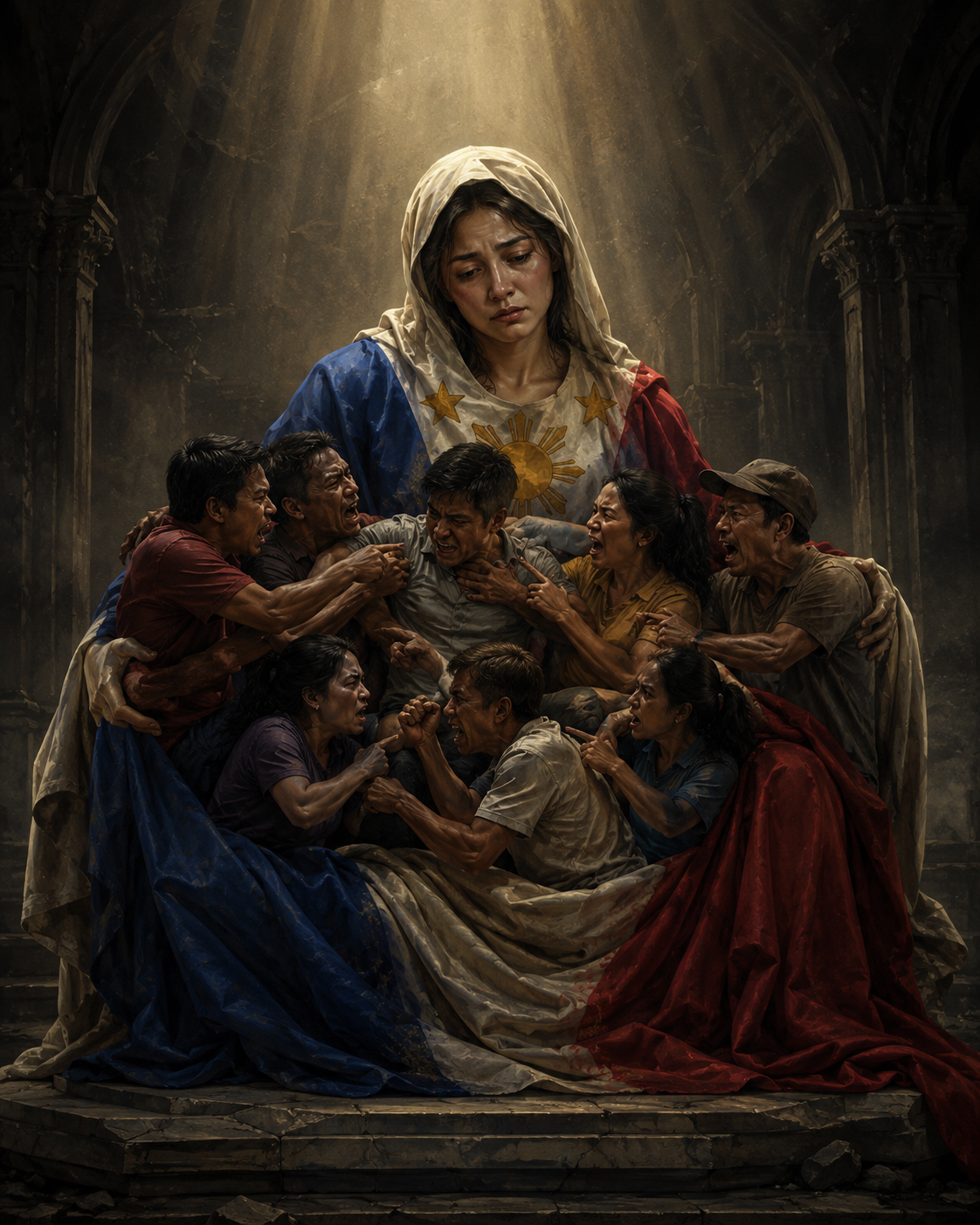
“Sometimes good things fall apart so better things can fall together.”
– Anonymous –
National Limbo: The History We Inherited Without Choosing
Growing up, I never understood why so many Filipinos carried a quiet heaviness when they spoke about the country. It wasn’t anger. It wasn’t despair. It was something older — a tired acceptance that things were the way they were, and maybe always would be.
I used to hear it from my father.
“Ganito talaga sa Pilipinas,” he would say when we watched the news on TV when I visited him in our hometown.
Not with bitterness. Not with outrage. But with resignation.
It wasn’t until I lived abroad that I understood the weight behind those words.
We were a nation interrupted. A people whose revolution was cut short. A country whose identity was never fully forged.
Our fragmentation did not begin in the present. It was shaped by centuries of divide‑and‑rule, a strategy that kept us scattered — not just in geography, but in identity. We were on the verge of becoming a unified people, only for that moment to be taken from us; our revolution was halted before it could fully forge a national self.
What might have been a defining victory against one colonizer became an unfinished chapter when another, more powerful, intervened — leaving behind not just a political scar but a psychological one, a lingering uncertainty about our capacity to shape our own destiny.
We inherited fragmentation — tribal, regional, political.
We inherited resignation — “pwede na,” “bahala na,” “ganito talaga.” We inherited a sense of “almost.”
Almost free. Almost united. Almost empowered.
But never fully.
We were not broken. We were unfinished.
Even the political theatrics I watched from afar were not anomalies; they were traces of an unfinished identity, performances formed by generations who had learned to survive uncertainty by turning it into spectacle.
We are an archipelago not just in geography, but in identity—a collection of over seven thousand islands intentionally scattered by a history of divide-and-conquer. Living in a country as hyper-connected as Korea, I see how our fragmentation has become a mental habit, a quiet belief that unity is a fantasy and that we are destined to remain an incomplete manuscript.
But an unfinished page is not a tragedy; it is simply a call for the writer to pick up the pen again.
And unfinished things can still be completed — but only if someone chooses to finish them.
The Turning Point: My Personal Purgatory
One afternoon in a small café in Seoul, while working on my book, I wrote a phrase about responsibility—a line I had written many times before.
I looked at the screen, at the Garamond typeface I had carefully chosen. It is a font that carries the organic stroke of the human hand, yet adheres to strict, classical rules of proportion. It occurred to me then how much I craved that balance for my own country; it stood in such sharp contrast to the handwritten chaos of our streets back home, where everything from jeepney signs to public discourse feels improvised and loud. I realized that if paradise is a discipline, it must look a lot like a well-set page: ordered, intentional, and respectful of the space it occupies.
I looked away from the monitor, the clean lines of the font blurring as I stared at my own reflection in the glass.
But that day, my writings talked back at me.
How could I write about responsibility when I had shunned my own? How could I speak of accountability when I had mistaken silence for neutrality? How could I talk about transformation when I had left my country rather than help it change?
I could not bear my own writing confronting me. The truth on the screen served as a reflection I wasn’t yet ready to face, but could no longer deny.
I closed my laptop—the gentle click sounding like an ending—and stared out the window.
Outside, the first hints of spring were beginning to touch the air — not warmth, not yet, but the suggestion of it.
People walked with purpose. Cars moved in clean lines. The city breathed with discipline.
And I realized:
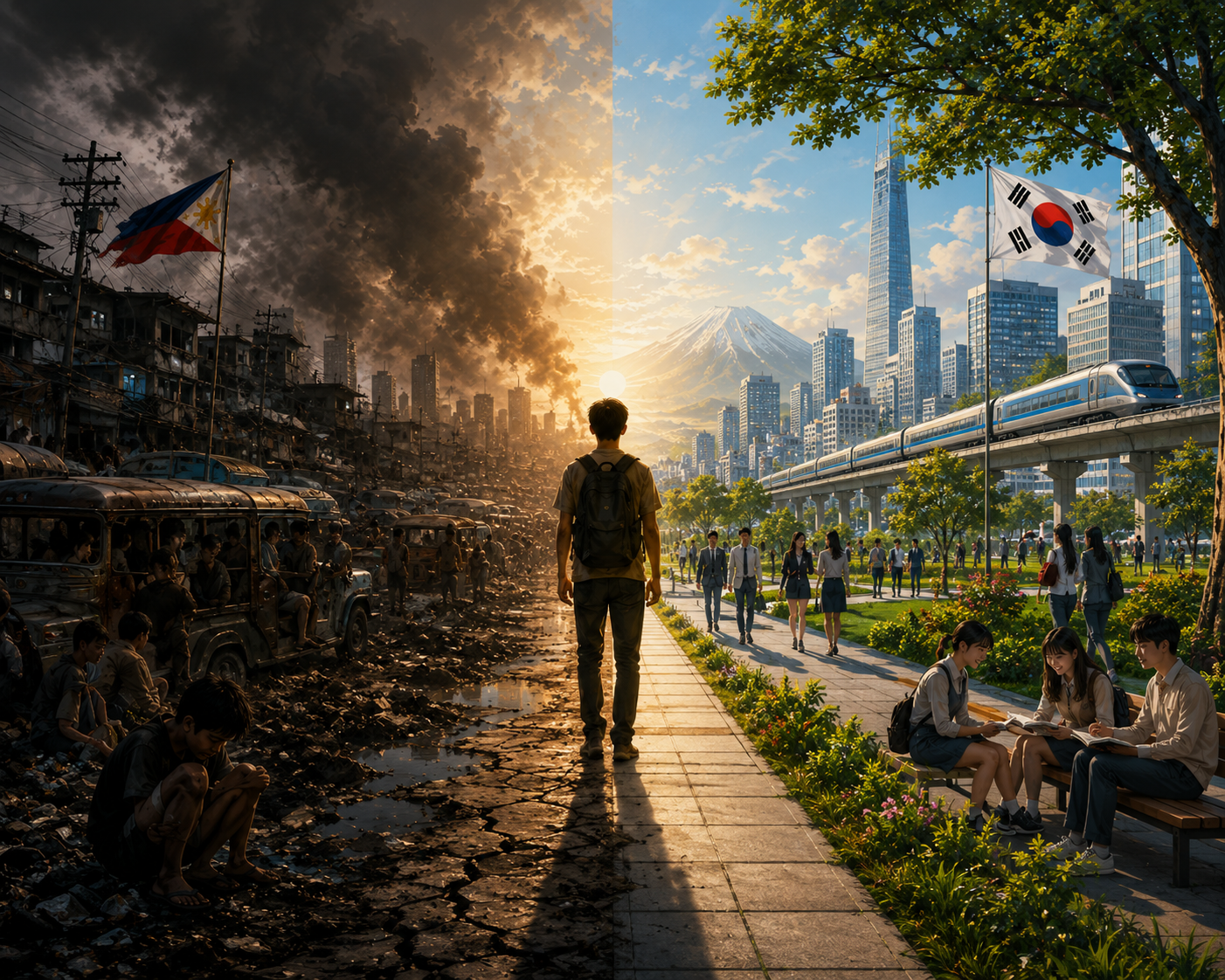
I had grown up in a country that taught me to endure, but I was now living in a country that taught me to improve.
That contrast broke something open inside me.
For the first time, I understood that my frustration with the Philippines wasn’t rooted in hatred — it was rooted in love.
At that moment, I made a quiet promise:
I will stop being a spectator. I will stop being a critic from afar. I will stop being part of the silence.
That was the beginning of my ascent.
The Ascent: What Paradise Means to Me Now
The hell I saw in our country wasn’t just political — it was spiritual. It was the result of millions of small choices, including mine.
I visualize a classroom where students speak without fear—not because they are confident, but because they are encouraged to try.
I imagine offices where people no longer feel the need to know someone just to be heard. I imagine elections where conversations are determined by ideas, not incentives.
I imagine a bus stop—not unlike the one in Haemi—where people line up not because they are forced to, but because they understand that order is not oppression. It is respect.
These are not impossible visions. They are habits waiting to be formed.
But habits do not emerge on their own. They are formed in moments so small they are often dismissed—moments when no one is watching, when no reward is guaranteed, when the easier choice is to look away.
They are formed when a student chooses honesty instead of convenience, even when cheating would go unnoticed. When a worker completes a task with care, even when no one will praise them for it.
When a citizen follows a rule, not out of fear of punishment, but out of respect for others.
These instances do not make headlines. They do not go viral. But they accumulate.
Quietly.
Consistently.
And over time, they shape something larger than themselves.
A culture is not built in bold proclamations. It is built in repetitions—of discipline, of restraint, of responsibility. It is built when the right choice becomes the natural choice.
And perhaps that is where we must begin—not with sweeping reforms or distant promises, but with the silent decision to do what is right, even when it feels insignificant.
Because in the end, nations do not rise via moments of brilliance alone. They rise through habits that refuse to break.
And if hell is built through choices, then so is paradise.
Paradise is not a place to be found. It is a culture. A discipline. A collective decision.
It is built when a citizen refuses a bribe. When a voter chooses integrity over popularity.
When a family teaches discipline instead of entitlement. When a community chooses unity over division. When a nation chooses accountability over excuses.
Paradise is not perfection. It is an effort.
And for the first time, I began to imagine what a Filipino paradise might look like:
A nation where we disagree without destroying each other. Where we demand better without waiting for saviors. Where we build systems that outlast personalities. Where we take pride not in slogans, but in discipline. Where progress is not a miracle — but a habit.
That is the paradise I now hold in my heart.
Not a fantasy. Not a dream. But a direction.
Returning to the Bus Stop
Months after that autumn morning in Haemi, I found myself at the same bus stop again. Students lined up as they always did, quiet and orderly.
Winter had passed. Most of my reflections had taken shape during those long, dark winter nights when silence made certain truths harder to avoid. It was already spring, but the air was still cold, sharp enough to sting my cheeks.
The bus arrived — on time, as always — and the driver gave me the same small nod.
But this time, something felt different.
I no longer felt grief. I felt responsibility.
As the bus rolled through the clean, orderly streets, the signs of Korea’s progress came into view again — quiet reminders of how far my own country had been left behind.
I no longer felt envy. I felt clarity.
I no longer felt like a Filipino escaping hell. I felt like a Filipino preparing to climb out of it. The thought of leaving had once tempted me, but now I understood that escape was not the same as ascent.
I am currently retitling a book I have written, a task that requires me to be a ruthless editor of my own thoughts. Just as a book suffers when an author protects a line that no longer serves the story, I’ve realized our nation fails when we protect partisan loyalties that don’t serve the truth. Revision is a form of purgatory—it is the painful, meticulous act of deleting the excuses and the ‘pwede na’ mentality to make room for something that actually works.
As the bus moved through the clean streets, I pressed my forehead against the window and watched the city pass by.
And I realized:
Paradise is not a destination waiting for us. It is a path we must choose to walk. And the first step is always taken within.
That morning, I made a quiet vow:
I will not abandon my country.
I will not abandon my people.
I will not abandon the possibility of our ascent.
Because hell is not permanent.
Purgatory is not hopeless.
And paradise is not impossible.
We only need the courage to begin.
And I have begun.
NOT BROKEN… BUT UNFINISHED (1)
(A Personal Essay)
“The darkest places in hell are reserved for those who maintain
their neutrality in times of moral crisis.”
~ Dante Alighieri ~
The Morning I Began to See
I still remember the exact moment something within me changed.
On a cold autumn morning in Haemi — the quiet South Korean suburb where I had been teaching for years — the sharp air and pale sky conspired to make everything feel unusually clear. At the bus stop, middle school students lined up in silence. No pushing. No shouting. Just an unspoken agreement about how shared spaces ought to be used.
The bus arrived on time. Students filed in calmly. I tapped my card; the driver gave me a small nod — not indifferent, not effusive, just a quiet acknowledgment that I was part of the system and the system had noted my presence.
The doors closed with certainty. No scrambling. No negotiation for space. Just an invisible agreement, honored without ceremony.
During the silent commute, my thoughts drifted home. I pictured the relentless noise: engines gunning, barkers shouting, horns bleating without pause. A system always on the brink — not of collapse exactly, but of something we had long mistaken for life.
And that was what unsettled me the most.
I remembered a different bus stop from years ago, back home. People pushed. The driver cursed. The day felt like something to survive, not something to trust. I remembered the heat, the dust, the impatience. Everything slightly off-balance — like a system not functioning but merely persisting.
What I felt then was grief. A quiet, hollow ache for a country I loved but now saw with terrible clarity: trapped — not by a single catastrophe, but by the slow accumulation of small disorders and smaller resignations. Not the scandals themselves, but the quiet expectation beneath them that nothing would change, and no one would be held to account.
The realization went deeper: we were not cursed. We were only accustomed to living with the fire.
As the bus passed streets where even the smallest details hinted at a nation steadily shaping its future, a question I had avoided for years finally surfaced:
How had we fallen so far behind?
More painfully:
What part had I played?
That quiet bus ride in Haemi was the beginning of a difficult journey — one that required me to confront not just my country’s failures but my own. And it set the stage for a deep-seated reflection.
The Stark Contrast
When I arrived in South Korea, I did not come with theories about governance or national identity. I was simply another Filipino abroad — carrying hope, fear, and the particular stubbornness of a person determined to make things work.
Korea became a mirror. It reflected truths I had spent years avoiding.
It started with small things — moments that accumulated quietly, each one altering my understanding a little more.
The first time I walked into a Korean government office, I braced myself for the familiar dread: the long lines, the missing forms, the irritated clerks. I felt the old instinct rising — the feeling that I was about to beg for something that should simply have been mine by right.
Instead, a woman smiled, bowed slightly, and asked how she could help. Her manner was calm, her movements efficient, her respect genuine. Fifteen minutes later, I stood outside with my documents already processed.
I paused on the sidewalk, papers in hand. Out of habit, I glanced around — looking for the fixers. Back home, they hovered outside government buildings, offering shortcuts for a fee, quiet reminders of how thoroughly we had normalized inefficiency. Here, there was nothing of the sort.
For a moment, I simply stood there waiting for something to go wrong.
Nothing did.
In that stillness, I understood something I had never articulated before: all my life, I had been conditioned to expect difficulty — even when none was required. Ease itself had become unfamiliar.
That night, I sat in my apartment staring at the papers on my table. It was not the efficiency that stayed with me. It was the dignity. For the first time in a long time, I had felt like a citizen — not a supplicant, not a burden, not a problem to be processed, not somebody to be taken advantage of.
That feeling followed me everywhere.
Into streets cleaned before dawn. Into lost wallets returned with every bill still inside. Into the way elders were treated as honored members of a community, not inconveniences to be managed. Into rules followed out of shared responsibility, not fear.
I remembered the first time I entered a Korean bank. No armed guards. No shotguns propped by the door. Just a middle-aged woman ushering customers with quiet warmth. Back home, two guards with shotguns stood outside every branch, a third positioned just inside. It was a small detail — but it revealed how differently each society imagined danger, trust, and the public space we all shared.
Once, I watched a man drop a piece of paper on the sidewalk. A teenager picked it up and returned it with a bow. Responsibility was not taught in that moment. It was lived.
Korea was not simply better because it was richer. It was because its people believed they deserved better — and acted accordingly.
Back home, resignation had become the norm. And if systems truly reflect the people who build them, then what did our systems say about us?
That question stayed with me long after the bus reached its stop.
A Tale of Two Citizenships
Living in Korea forced me to examine something I had never fully confronted back home: the quiet power of citizenship. Not the legal kind printed on a passport, but the lived kind — expressed in daily habits, in unspoken agreements, in the hidden threads that hold a society together.
In Korea, I saw how people behaved as if the public space belonged to them — and therefore, they were responsible for it. Streets were clean not because someone was watching, but because everyone believed they should be. Lines were orderly, not because of fear, but because of mutual respect. Even the smallest rules — recycling, queueing, returning trays in restaurants — were followed with a feeling of shared duty.
Back home, I had grown up with a different rhythm.
I grew up where rules were treated as suggestions, public spaces were battlegrounds, and people bent systems that rarely bent for them. I learned to expect delays, disorder, and disappointment. I navigated life with improvisation, instinct, and resilience—a Filipino’s armor.
But Korea showed me something I had never seen so clearly:
resilience is admirable, but it is not the same as progress.
In Korea, I came to trust systems: I believed things would work as designed, so I depended on established rules and processes. In the Philippines, I learned to trust people: I relied on relationships, favors, and personal networks to fill the gaps left by institutions.
“Kaylangang may backer.”
Neither culture was inherently superior; they were simply influenced by different responses to their circumstances. The contrast clarified what worked—and what didn’t—for each society.
Both were formed by history, by struggle, by circumstance.
But the contrast forced me to face a truth I had consistently ignored:
Systems are not built solely by governments.
They are built by citizens — by the habits we practice and the behaviors we tolerate.
And upon that realization, I saw my personal reflection more clearly than ever.
The more I came to understand Korea, the more I began to see the Philippines with new eyes. I did not see with judgment, but with a painful clarity I could no longer escape.
Watching the Philippines from afar, I experienced a familiar ache—not for specific events, but the patterns I recognized in myself. I heard exhaustion in voices, frustration in posts, resignation in jokes. Systems struggled, and citizens struggled to trust. Beneath it all was collective fatigue—a nation moving forward, weighed down by habits we never confronted. It was painful, not because it was new, but because I could no longer ignore it.
Reading the news about the Philippines often felt like watching a tragicomedy. It made me laugh at first, until I saw the humor was only masking something intensely painful. The public arguments, mudslinging, and the way people chose sides, with the intensity of sports rivalries, all seemed absurd and heartbreaking. What unsettled me most wasn’t the disagreements, but how quickly we turned them into spectacles. We forgot that under every insult and accusation were real people trying to make sense of a system they no longer trusted. It seemed as if the nation had become a stage. Frustration and entertainment blurred, and we’d grown so used to the noise that we hardly noticed its cost.
Meanwhile, Korea exported stories that fascinated the world—dramas made with discipline and imagination. At home, our screens showed stories that were loud, chaotic, and painful political theater. One nation entertained with fiction; the other was locked in a cycle of real-life drama that no longer entertained but quietly drained the spirit of its people.
And once I saw myself more clearly, the memories I had deeply buried started to emerge — not as distant recollections, but as images reflecting the habits we had normalized back home.
And as I saw my country more clearly, the memories I had buried began to surface.
The Descent: Memories That Haunt Me
And as if in answer, my past started to speak. The more comfortable I became with life in Korea, the more memories from home resurfaced — memories I had suppressed amid the noise of daily survival.
It was deep winter then, the kind that forces you inward. In those long, silent nights, memories I had suppressed amid the noise of daily survival began to thaw.
I remembered election day when I was younger. I stood nearby. The envelope passed quickly, almost as if it didn’t matter. My neighbor slipped it into his pocket, grinning as others laughed.
“Pang-ulam,” he said.
At the time, I laughed too — not because it was funny, but because everyone else did. It felt easier to belong than to question. I did not yet understand that moments like that were the architecture of the system we would spend the rest of our lives complaining about.
No one objected. No one spoke.
And neither did I. That silence would follow me.
I remembered a barangay captain distributing sacks of rice every Christmas — but only to those who attended his rallies. I remembered people lining up for hours, not out of belief, but because hunger does not negotiate with principles.
I remembered political arguments that tore families apart, destroyed friendships, and worse, had people getting killed. I remembered truth becoming optional. I remembered corruption becoming a punchline. I remembered how we defended politicians as though they were blood relatives, even as they failed us again and again.
And I remembered my own silence.
The times I shrugged. The times I said,
“Ganun talaga.”
The times I accepted dysfunction as the natural order. The times I laughed at what I should have condemned. The times I chose comfort over courage, and called it wisdom.
Those memories followed me like shadows through every clean street, every orderly queue, every moment of dignified efficiency I experienced in Korea. Every time I felt respected, I remembered what it felt like not to be.
We were not simply victims of a broken system. We were its authors. We wrote ourselves into the descent.
The Mirror: How I Realized I Was Part of the Problem
The mirror did not leave me. One night, alone in my apartment, scrolling through news from the Philippines, I experienced the familiar anger rising in me — the kind that blames, condemns, curses the government, curses the system, curses the country.
I had devoted months shaking my head at the tragicomedy unfolding back home, forgetting that I once had played my part in it — through silence, through resignation, through the small compromises I had convinced myself were harmless.
There was even a moment when I considered pursuing Korean citizenship — not out of disloyalty, but out of exhaustion. I felt I was tired of being Filipino, but what I was truly tired of was the helplessness that came with loving a country caught in its own cycles. It wasn’t my identity I wanted to escape; it was the pain of watching a nation I cared for stumble again and again.
But then something inside me burst.
I asked myself a question I had been avoiding for years:
“What have I done differently?”
The question lingered longer than any answer I could produce.
I had left the country. I had escaped the chaos. I had built a life elsewhere. But had I changed anything? Had I spoken when speaking was needed? Had I acted when action was required? Had I taken responsibility for any of it?
Or had I simply abandoned ship and watched it sink from a safe, comfortable distance?
That night, the truth arrived without mercy: I was angry at a nation I had quietly abandoned. I was disappointed in people whose flaws I shared. I was grieving a country I had not loved loudly enough or fought hard enough to save.
And that was the moment — the real beginning of my purgatory.
Honestly, I realized, it’s the first step out of hell.
THE NATION WE CREATED (Part 3)
The darkest places in hell are reserved for those who maintain
their neutrality in times of moral crisis.”
– Dante Alighieri –
WHERE ARE WE? PARADISE, PURGATORY, OR HELL?
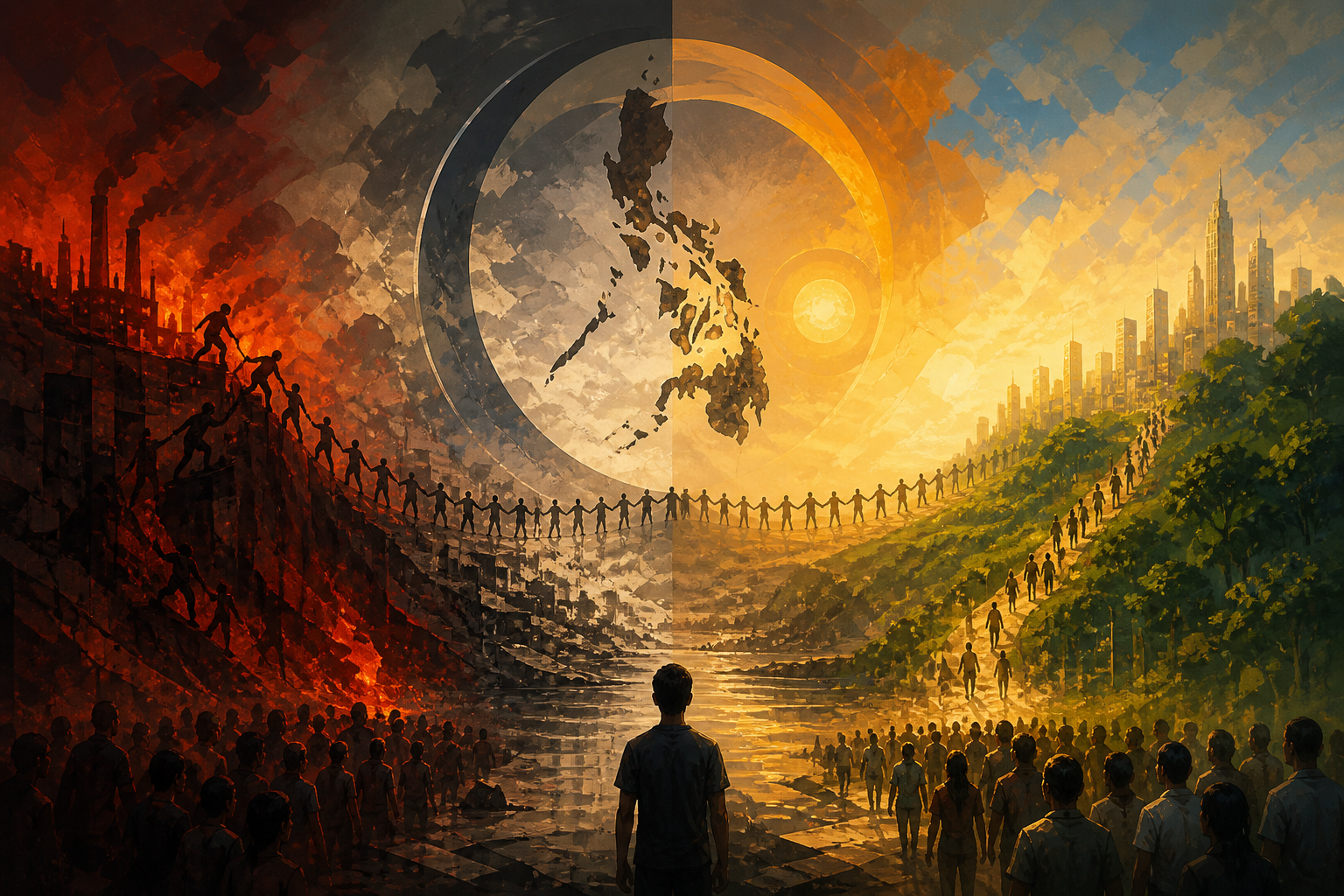
This brings me to the third question:
Where do we stand as a nation—paradise, purgatory, or hell?
Just as Dante was guided through the abyss by Virgil, I believe that if we are to find our way out of the “dark woods” of our national dysfunction, our Virgil must be a vigorous Faith in God. For me, this is not a passive faith that watches from the sidelines, but a demanding moral compass. It is the light that reveals the “ordered circles” of our descent and gives me the strength to finally begin the ascent.
I have long believed that a nation’s destiny rests on two foundations: the strength of its government and the character of its people. When both are strong, the nation thrives in a kind of paradise; when one falters, it drifts into purgatory; and when both fail, it descends into hell.
As I look at the current state of our institutions and reflect on the character of our collective civic behavior, the conclusion is one I can no longer avoid.
We are not in paradise, and I fear we are not even in purgatory. We are in hell.
Yet, my studies of the Divine Comedy have taught me that purgatory represents something fundamentally different from either extreme—it is not a place of final condemnation, but a state of transition. In Dante’s vision, purgatory is where the work of purification begins, and for me, that starts with the difficult step of recognizing our own faults. It is a place where vices aren’t just punished; they are purified as every spirit confronts the very weakness that led it astray. I’ve realized that any path toward our national renewal demands that we not only recognize our failures but also deliberately set out to correct them.
If hell is the result of both a failing government and an irresponsible citizenry, then I see purgatory as the pivotal moment when one side begins to change even as the other lags behind. To me, a nation in purgatory is not yet healed, but it has finally moved past denial; it is a society that has begun to acknowledge its shortcomings and is actively striving for something better.
In our own context, I believe purgatory would require a profound shift in our consciousness—a personal willingness to move beyond the easy comfort of blame and toward the harder path of accountability. It would mean a readiness within our institutions to rebuild trust through genuine reform. For me, this is the stage where we stop avoiding difficult truths and start confronting them; it is where our excuses finally give way to effort, and our passive observation transforms into active participation.
Though we have concluded that we are not yet in this state, the concept of purgatory is fundamental—not as a description of where we are, but as a vision of what lies between our current condition and the possibility of renewal. It reminds us that transformation is neither immediate nor effortless, but attainable through deliberate, sustained change.
To understand how we arrived here, we must recognize that this condition is not merely the result of present failures—it is also rooted in a past that still shapes our present. As a nation, we have long been fragmented—geographically, culturally, and politically—an archipelago not only in land, but in identity. Our colonial history reinforced this fragmentation. Through the divide-and-rule strategy, our colonizers kept us subdued, preventing unity and making sure that resistance remained scattered and ineffective.
Though political independence has long been achieved, the imprint of this division remains. We continue to see ourselves not as a united whole, but as competing factions. This fragmentation deepens further when political actors exploit these divisions, prompting citizens to defend them against one another rather than hold them accountable. In doing so, we become participants in our own disunity.
Over time, our prolonged inability to free ourselves swiftly from colonial rule cultivated a quiet resignation. A decisive moment came when the struggle against our conquistadores from the Iberian Peninsula was nearing victory, and a sense of national identity was beginning to take shape. Yet at that critical juncture, the Filipino people were denied the opportunity to complete their own struggle for liberation, as another power, emerging at the close of Spanish rule, intervened—marking a transition from one colonial master to the next.
What followed was not merely a political transition, but a period in which the natural development of nationalism was constrained, delaying the full emergence of a unified national consciousness and leaving a lasting imprint on how we perceive our collective identity and capacity for self-determination.
I often reflect on how a defining victory for our people—one that might have truly forged a sense of national pride and unity—was interrupted by forces beyond our control. To me, this left behind more than just a political scar; it created a psychological one. In place of a fully realized sense of self-determination, I feel a lingering uncertainty about our capacity to shape our own destiny.

I’ve come to think of this uncertainty as our national Limbo. Much like those in Dante’s First Circle who lived without the “baptism” of a completed purpose, I feel the Filipino spirit remains suspended in a state of “what could have been”. Because our revolution was interrupted and our liberation was eventually granted rather than fully seized, I believe we have inhabited a political twilight for over a century—not fully damned, but not yet free. We are haunted by the sighing of those who are hopeless in desire, longing for a national identity that we were never permitted to finish building for ourselves.
I’ve seen how people subjected to long periods of domination can begin to internalize limitation—a quiet belief that significant change is simply unattainable. This inherited mindset, which I find so damaging, weakens our collective will to act. Yet, I’ve realized this condition isn’t a chaotic fall; it is a structured descent, much like the ordered circles of Hell I read about in the Divine Comedy. Each layer reveals a deeper moral failure: from our negligence and apathy to corruption, and ultimately to the betrayal of public trust. What we experience today is not random misfortune, but the cumulative result of choices I see being made—and responsibilities I see being ignored—time and time again.
Even our natural environment has played a role in shaping our collective mindset. Living in a country frequently visited by destructive typhoons, I believe our repeated exposure to disruption has fostered both a beautiful resilience and a tragic resignation. While these conditions have certainly strengthened our capacity to endure, I worry they have also normalized crisis, reinforcing a tendency in us to merely respond rather than anticipate, and to recover rather than prevent.
I have come to realize that whatever factors or historical circumstances may have shaped our current condition, they do not absolve us of our personal responsibility for it. In my own reflections on self-improvement, I see that our national state is not a sudden collapse, but rather the cumulative result of choices we have made over time—each one contributing to a gradual descent.
**********
WHAT SHALL WE DO THEN?
As I’ve learned from my studies of Dante, recognition of the journey through Hell is only the beginning. What, then, should we do? In the Divine Comedy, the journey does not end in the abyss; there is a path upward to paradise, though I know it is a difficult one to walk.
In Dante’s journey, Hell is governed by a moral logic where every consequence reflects a prior choice. Similarly, I believe the dysfunction we endure as a nation is not without cause; it mirrors the decisions we make, the leaders we choose, and the responsibilities we so often neglect.
Although I do not believe we are yet in Purgatory, I believe we must understand its profound significance.
For me, Purgatory is not a place of perfection, but of transformation—it is the space where acknowledgment finally leads to change and responsibility replaces denial. It is the necessary passage between failure and renewal. I’ve realized this slow ascent requires the effort, discipline, and readiness to confront my own shortcomings that I strive to bring to my writing and my life.
Reaching such a state requires a profound shift in my own consciousness—a willingness to move beyond the habit of blame and toward true accountability. It is the point where effort begins, discipline is cultivated, and active participation finally replaces passivity. However, I’ve come to understand that this path requires a fundamental change in how I think about our development as a nation.
For too long, we have relied on a flawed model that assumes progress begins externally. It is time, therefore, to look inward. Just as Virgil guided Dante through darkness—not by force, but through the light of Reason and the mandates of the Divine—we too must rely on a Faith sharpened by clarity of thought and self-awareness to navigate our way out of this abyss.
The alternative path begins with the individual and extends outward—to the family, the community, and the nation.
If paradise is to be realized, it must be understood not merely as prosperity, but as the restoration of unity and the overcoming of fragmentation that has long defined us. A nation cannot reach its highest potential while divided. True progress demands cohesion and a shared sense of purpose that transcends regional, political, and ideological boundaries.
To arrive at such a state, we must consciously unlearn the divisions that history has imposed upon us. The legacy of divide et impera must no longer define how we relate to one another. Instead of allowing ourselves to be separated by difference, we must recognize that our strength as a nation lies precisely in our diversity—when it is bound together by a common commitment to the greater good.
A nation in paradise is not free from disagreement, but disagreement does not lead to division. It is a nation where citizens hold leaders accountable without becoming instruments of partisan conflict, and where public discourse is guided by a shared desire for national progress rather than hostility.
Ultimately, paradise is not granted; it is built. It emerges when individuals rise above narrow loyalties, families instill values of discipline and responsibility, and citizens view themselves as integral parts of a greater whole. Only through unity, grounded in shared values and mutual accountability, can a nation truly ascend to its highest form.
I have realized that the ascent from Hell in Dante’s journey is neither sudden nor effortless; it demands a kind of movement, struggle, and persistence that I try to channel into my own creative projects. One does not simply wake up outside of the darkness; you must climb out of it. At the end of that grueling climb, Dante shares a powerful image that stays with me: the moment he emerges “to see the stars again”. It serves as a personal reminder that no descent is final, and even from the deepest darkness I may feel, a path toward renewal remains.
Only then can we truly begin our ascent: from hell, through purgatory, and ultimately toward paradise. I’ve come to understand that the path to national transformation doesn’t begin in the halls of power, but in the quiet, daily decisions of individuals like me who choose to change.
In the end, I see that a nation is nothing more and nothing less than a reflection of its people. If I desire a better nation, I must first strive to become a better individual.
The journey out of the abyss is long, but I find comfort in the fact that Dante’s final word in every canticle remained the same: stelle, the stars. For me, those stars are not just distant celestial bodies; they are the three stars of our national emblem, which have felt obscured for so long by the smoke of partisan conflict. Like Dante emerging from the dark to behold them once more, I believe we, too, may rise if we choose not merely to hope for change, but to become its source. Only when we fix our gaze upward, guided by our Faith and our shared history, do we leave the darkness behind. In that rising, we do not merely find paradise; we build it.
THE NATION WE CREATED (Part 2)
The darkest places in hell are reserved for those who maintain
their neutrality in times of moral crisis.”
– Dante Alighieri –
ARE WE A RESPONSIBLE CITIZENRY?
This is an uncomfortable question—one that demands honesty.
Unfortunately, the answer is no. To claim otherwise would be to deny a truth we often avoid.
In my fourteen years of living abroad, I have come to realize that we cannot attribute our failure to reach our full socio-political and economic potential solely to the government. In many ways, we ourselves contribute to the very condition we lament—more often than we are willing to acknowledge. The consequences we face as a nation are a mirror of our own choices. I see this as our own national contrapasso—the principle from Dante’s vision where the punishment perfectly fits the nature of the sin.
I believe we often fail in our most fundamental civic duty: we do not choose our leaders wisely. From my perspective as an author who values the precision of every choice, it is painful to see elections reduced to popularity contests or questionable standards. When we elevate individuals who are unqualified or driven by self-interest, we are essentially drafting the very chapters of the dysfunction we later complain about.
This failure is most evident to me in the persistent cycle of vote-buying and vote-selling. It breaks my heart to see the sacred right of suffrage treated as a transaction rather than a responsibility. This is the contrapasso of the ballot: on the eve of elections, when an envelope changes hands for a day’s relief, it sets a narrative in motion. Years later, those same hands wait again for a change that never comes.
When we sell a vote for a single meal, we shouldn’t be surprised when we are governed by those who treat public office as a commodity to be exploited for years of profit. We are not simply victims of a corrupt system; I’ve come to realize that we are often the architects of our own deprivation. We are bound by a cycle where the short-term relief of a bribe becomes the long-term chains of our national poverty, and leadership is no longer measured by the integrity I strive for in my own life, but by the capacity to buy an advantage.
This dynamic feels like a modern staging of Shakespeare’s Coriolanus, where the titular general’s contempt for the public makes the process of seeking the people’s voice a hollow, transactional performance. In that chasm between a detached leader and a manipulated citizenry, the entire nation is swallowed.
In my view, what makes this cycle so destructive is how it fundamentally warps the meaning of representation. I’ve observed that when someone assumes office through monetary influence, they stop seeing their role as a public trust; instead, it becomes a private investment to be recovered—and, more often than not, multiplied.
In my own creative work, I strive for a “Holistic Approach” where every element serves the whole, but in this distorted system, governance becomes about the “return” on that investment. Decisions are no longer formed by the actual needs of the people, but by a desperate desire to recoup the costs of acquiring power. It makes me realize that corruption isn’t just an unfortunate accident in our story; it is embedded in the manuscript from the very first page.
Faced with this reality, I feel that our duty goes far beyond simply refusing to sell a vote; we must practice a deep, intentional discernment when choosing those we entrust with office. As someone who carefully evaluates every line of a poem or every margin of a 5×8 layout, I believe the right to vote is not just a procedure—it is a moral responsibility that demands our best judgment. We have to set personal standards that exceed the bare minimums of the law, evaluating candidates on their competence, their integrity, and their actual capacity to serve. Without these standards, I fear our voting becomes nothing more than an empty ritual, rather than the meaningful contribution to nation-building I know it can be.
This responsible exercise of our right is even more vital in a culture where we so easily mistake popularity for competence. I’ve often reflected that public office is not an extension of fame, and it shouldn’t be treated as a platform built on recognition alone. True leadership, like the mastery required for complex writing, demands the ability to understand intricate issues and make sound decisions in the public’s best interest. When we let popularity become our primary yardstick for success, I believe we inevitably diminish the very standards of governance we rely on to survive.
Worse still, I see us continuing to recycle the same traditional politicians or replacing them with members of their political dynasties, yet somehow expecting different results from these same tired choices. In doing so, we reinforce a system in which power remains concentrated within a limited circle, which I believe restricts opportunities for genuine reform and perpetuates the very conditions we claim to oppose.
What I often find overlooked, however, is that these political dynasties do not sustain themselves—they are maintained by our repeated electoral support. Leadership within these families persists not just because of their ambition, but because we, the electorate, continually permit it. In this sense, I’ve realized that dynasties are not simply imposed upon us; they are reproduced through our collective decisions.
As I watch positions of power pass from one family member to another, I feel governance becoming less about public trust and more about the perpetuation of control. This tendency narrows the variety of perspectives in our leadership and makes significant change feel increasingly out of reach. When I see the same names dominating our political landscape decade after decade, my expectations for a different outcome grow increasingly detached from reality.
Recognizing this reality highlights a profound personal responsibility for me. I know the means to make informed choices are within our reach; we can examine track records, assess qualifications, and critically evaluate platforms. To me, the ability to choose wisely doesn’t require extraordinary expertise—it only requires us to be attentive, thoughtful, and responsible with our votes.
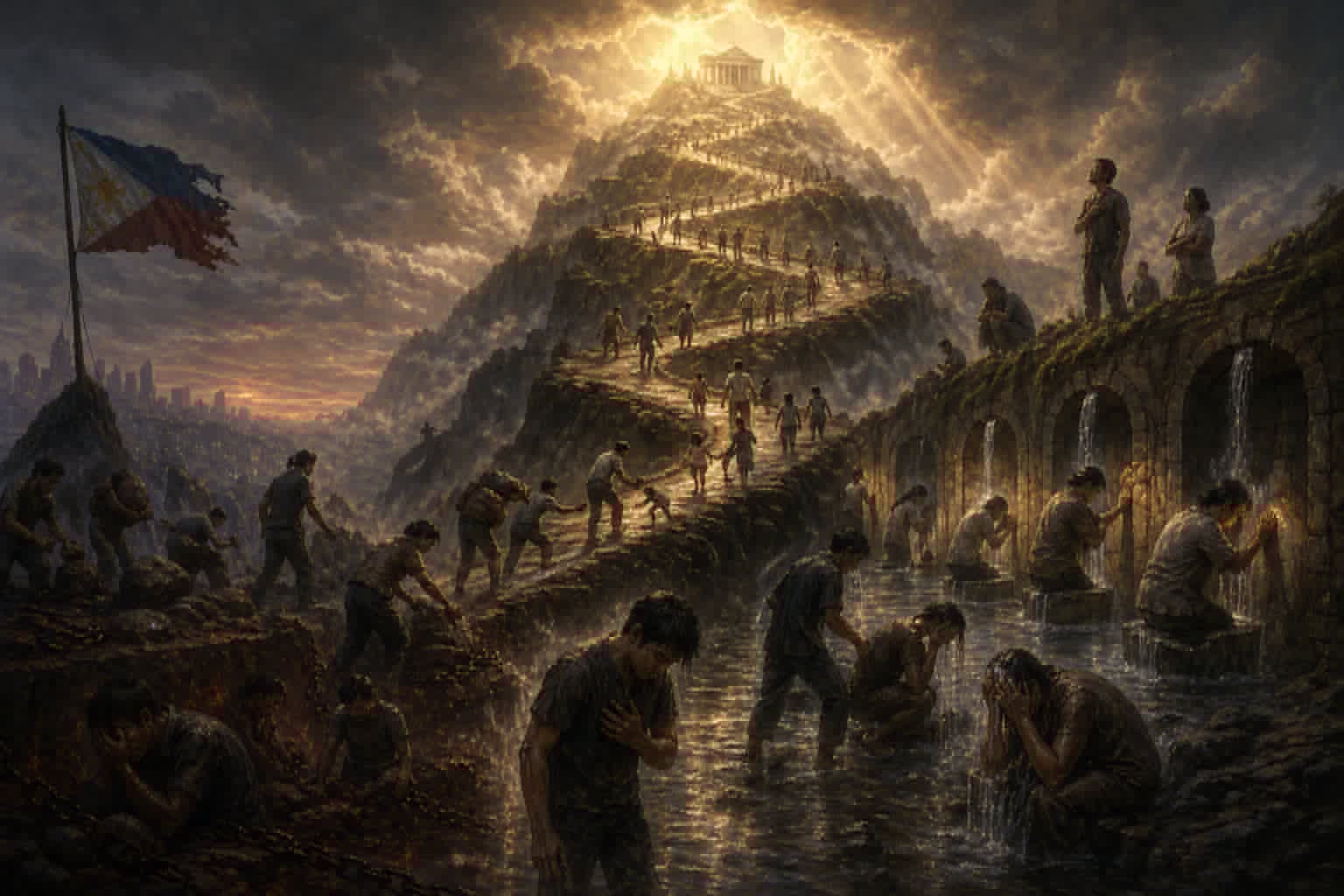
Beyond how we vote, I see a mindset of misplaced expectations, in which we believe the government is solely responsible for solving every societal problem. We often view our relationship with the state through a lens of entitlement, demanding benefits and services without fully recognizing our own vital role in nation-building. In many ways, our national psyche has become a staging of Samuel Beckett’s Waiting for Godot, where we sit by the side of the road, suspended in a state of ‘what could have been,’ waiting for a savior who never arrives. We remain rooted in place, expecting the government to deliver a transformation that can only be authored by our own hands.
I’ve noticed that this belief is often accompanied by a dangerous expectation: that those in power can single-handedly deliver national transformation, as if progress were the work of political saviors rather than a shared responsibility. In my own reflections on self-improvement, I see how such expectations reinforce patterns of dependence that go beyond mere perception and begin to actively shape our behavior.
This mindset is further reinforced by what we often call the ayuda mentality, reflecting a growing dependence on government assistance as a primary means of survival. While I recognize that aid is absolutely necessary during crises, it becomes deeply problematic when it fosters long-term reliance rather than empowerment.
Instead of being seen as temporary relief, I see assistance being regarded as an entitlement, which inevitably weakens our drive for self-reliance and personal initiative. Over time, this erodes the very values I believe are necessary for a responsible citizenry—hard work, discipline, and accountability. Even more concerning to me is how this assistance becomes entangled with political interests. Rather than serving as a mechanism for public welfare, I’ve seen it dangled as a reward for political favors, votes, and loyalty. This practice transforms aid from a tool of empowerment into an instrument of influence, reinforcing our dependency while distorting the democratic process I hold dear.
For me, this cycle of dependency mirrors Dante’s Third Circle, where the gluttons lie in a foul-smelling slush, eternally drenched by cold, ceaseless rain. Our gluttony is not for food, but for the ease of reliance. The contrapasso is evident: by choosing the temporary comfort of a handout over the challenging path of self-reliance, we condemn ourselves to remain in the mud of national stagnation. We are left perpetually waiting for a rain of ayuda that neither cleanses nor empowers, but keeps us mired in a situation of our own making.
The more we rely on external provision without cultivating self-reliance, the more we reinforce the very conditions that make such reliance necessary. It becomes a quiet echo of the same moral logic found in Dante’s vision, where consequences reflect the choices that give rise to them.
When citizens begin to associate public assistance with political allegiance, the relationship between the people and their leaders shifts from one grounded in accountability to one driven by patronage. Instead of evaluating leaders based on competence, integrity, and vision, some are compelled to support those who provide immediate material benefits, regardless of long-term consequences. In this way, assistance no longer uplifts—it conditions. It discourages initiative, weakens independence, and fosters a cycle in which both leaders and citizens become trapped: leaders in the pursuit of political survival through distribution, and citizens in the expectation of continued provision.
To be clear, assistance has a legitimate and necessary role—especially during crises, disasters, and periods of financial hardship. A compassionate government must provide safety nets for its most vulnerable citizens. However, when assistance evolves from temporary support into a permanent expectation, it ceases to empower and begins to weaken.
The issue, therefore, is not the aid itself but the mindset surrounding it. A society that depends primarily on external support, rather than cultivating internal strength, risks losing the qualities that sustain long-term progress: initiative, resilience, and self-reliance.
A nation cannot progress when its people are conditioned to wait rather than act, to receive rather than build.
I see this condition further compounded by a culture of blame that I encounter all too often. When we fail to reach our goals in our personal or professional lives, I’ve noticed how quick we are to point fingers at the government, our leaders, or our circumstances, rather than pausing to examine our own decisions. In doing so, I feel we absolve ourselves of responsibility and, more tragically, surrender the very agency we need for growth. Instead of the accountability I strive for in my own life and work, we resort to excuses.
It brings to mind the caution from Julius Caesar: “The fault, dear Brutus, is not in our stars, but in ourselves, that we are underlings.” In my own work on a holistic approach to self-improvement, I’ve had to confront this same truth—that we often stay suspended in limbo because we have inherited a mindset that change is something granted to us, rather than something we must seize
To me, this mirrors a recurring moral pattern where inaction—though it seems harmless—allows dysfunction to persist. I’ve come to believe that our silence as citizens serves as tacit permission for that dysfunction to continue, unchallenged and uninterrupted.
This is where I feel our Faith must move beyond mere ritual and into resolve. As I reflect on my own spiritual journey, I realize that claiming faith while remaining indifferent to the “hell” of corruption is a profound contradiction. True faith doesn’t offer me an escape from responsibility; it provides the mandate for it. If we are to be led by this “Virgil,” we must realize that God does not build nations—He empowers us to build them ourselves.
At its core, I see the problem as a lack of personal responsibility and civic discipline. Whether I am working on the second edition of my book or navigating life in South Korea, I am reminded that we often neglect the role we must play—not just as voters, but as individuals who must work diligently and contribute to society. Nation-building, I’ve realized, is not a task for the government alone; it is a shared responsibility that demands effort from everyone of us.