Blog Archives
NOT BROKEN… BUT UNFINISHED (1)
(A Personal Essay)
“The darkest places in hell are reserved for those who maintain
their neutrality in times of moral crisis.”
~ Dante Alighieri ~
The Morning I Began to See
I still remember the exact moment something within me changed.
On a cold autumn morning in Haemi — the quiet South Korean suburb where I had been teaching for years — the sharp air and pale sky conspired to make everything feel unusually clear. At the bus stop, middle school students lined up in silence. No pushing. No shouting. Just an unspoken agreement about how shared spaces ought to be used.
The bus arrived on time. Students filed in calmly. I tapped my card; the driver gave me a small nod — not indifferent, not effusive, just a quiet acknowledgment that I was part of the system and the system had noted my presence.
The doors closed with certainty. No scrambling. No negotiation for space. Just an invisible agreement, honored without ceremony.
During the silent commute, my thoughts drifted home. I pictured the relentless noise: engines gunning, barkers shouting, horns bleating without pause. A system always on the brink — not of collapse exactly, but of something we had long mistaken for life.
And that was what unsettled me the most.
I remembered a different bus stop from years ago, back home. People pushed. The driver cursed. The day felt like something to survive, not something to trust. I remembered the heat, the dust, the impatience. Everything slightly off-balance — like a system not functioning but merely persisting.
What I felt then was grief. A quiet, hollow ache for a country I loved but now saw with terrible clarity: trapped — not by a single catastrophe, but by the slow accumulation of small disorders and smaller resignations. Not the scandals themselves, but the quiet expectation beneath them that nothing would change, and no one would be held to account.
The realization went deeper: we were not cursed. We were only accustomed to living with the fire.
As the bus passed streets where even the smallest details hinted at a nation steadily shaping its future, a question I had avoided for years finally surfaced:
How had we fallen so far behind?
More painfully:
What part had I played?
That quiet bus ride in Haemi was the beginning of a difficult journey — one that required me to confront not just my country’s failures but my own. And it set the stage for a deep-seated reflection.
The Stark Contrast
When I arrived in South Korea, I did not come with theories about governance or national identity. I was simply another Filipino abroad — carrying hope, fear, and the particular stubbornness of a person determined to make things work.
Korea became a mirror. It reflected truths I had spent years avoiding.
It started with small things — moments that accumulated quietly, each one altering my understanding a little more.
The first time I walked into a Korean government office, I braced myself for the familiar dread: the long lines, the missing forms, the irritated clerks. I felt the old instinct rising — the feeling that I was about to beg for something that should simply have been mine by right.
Instead, a woman smiled, bowed slightly, and asked how she could help. Her manner was calm, her movements efficient, her respect genuine. Fifteen minutes later, I stood outside with my documents already processed.
I paused on the sidewalk, papers in hand. Out of habit, I glanced around — looking for the fixers. Back home, they hovered outside government buildings, offering shortcuts for a fee, quiet reminders of how thoroughly we had normalized inefficiency. Here, there was nothing of the sort.
For a moment, I simply stood there waiting for something to go wrong.
Nothing did.
In that stillness, I understood something I had never articulated before: all my life, I had been conditioned to expect difficulty — even when none was required. Ease itself had become unfamiliar.
That night, I sat in my apartment staring at the papers on my table. It was not the efficiency that stayed with me. It was the dignity. For the first time in a long time, I had felt like a citizen — not a supplicant, not a burden, not a problem to be processed, not somebody to be taken advantage of.
That feeling followed me everywhere.
Into streets cleaned before dawn. Into lost wallets returned with every bill still inside. Into the way elders were treated as honored members of a community, not inconveniences to be managed. Into rules followed out of shared responsibility, not fear.
I remembered the first time I entered a Korean bank. No armed guards. No shotguns propped by the door. Just a middle-aged woman ushering customers with quiet warmth. Back home, two guards with shotguns stood outside every branch, a third positioned just inside. It was a small detail — but it revealed how differently each society imagined danger, trust, and the public space we all shared.
Once, I watched a man drop a piece of paper on the sidewalk. A teenager picked it up and returned it with a bow. Responsibility was not taught in that moment. It was lived.
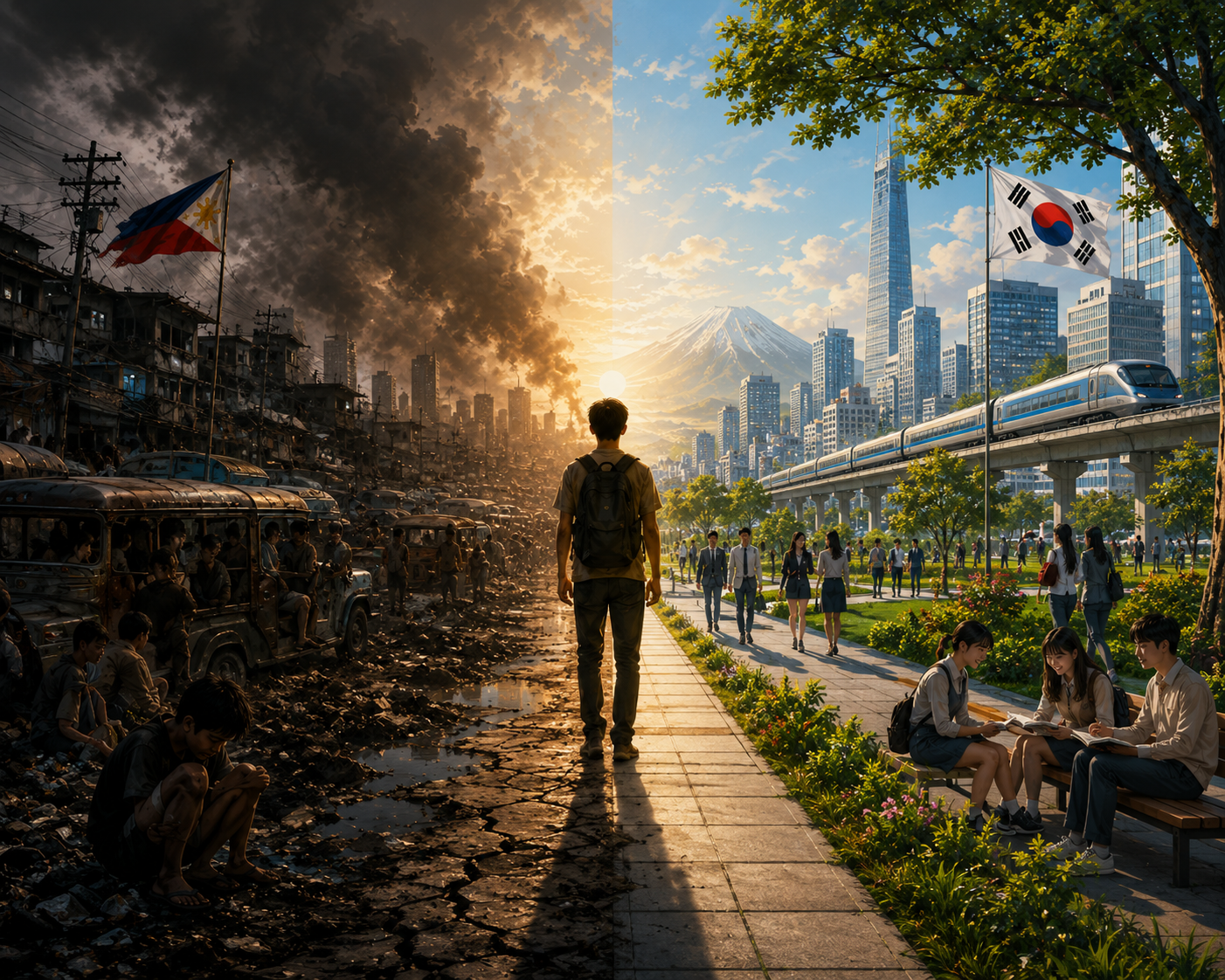
Korea was not simply better because it was richer. It was because its people believed they deserved better — and acted accordingly.
Back home, resignation had become the norm. And if systems truly reflect the people who build them, then what did our systems say about us?
That question stayed with me long after the bus reached its stop.
A Tale of Two Citizenships
Living in Korea forced me to examine something I had never fully confronted back home: the quiet power of citizenship. Not the legal kind printed on a passport, but the lived kind — expressed in daily habits, in unspoken agreements, in the hidden threads that hold a society together.
In Korea, I saw how people behaved as if the public space belonged to them — and therefore, they were responsible for it. Streets were clean not because someone was watching, but because everyone believed they should be. Lines were orderly, not because of fear, but because of mutual respect. Even the smallest rules — recycling, queueing, returning trays in restaurants — were followed with a feeling of shared duty.
Back home, I had grown up with a different rhythm.
I grew up where rules were treated as suggestions, public spaces were battlegrounds, and people bent systems that rarely bent for them. I learned to expect delays, disorder, and disappointment. I navigated life with improvisation, instinct, and resilience—a Filipino’s armor.
But Korea showed me something I had never seen so clearly:
resilience is admirable, but it is not the same as progress.
In Korea, I came to trust systems: I believed things would work as designed, so I depended on established rules and processes. In the Philippines, I learned to trust people: I relied on relationships, favors, and personal networks to fill the gaps left by institutions.
“Kaylangang may backer.”
Neither culture was inherently superior; they were simply influenced by different responses to their circumstances. The contrast clarified what worked—and what didn’t—for each society.
Both were formed by history, by struggle, by circumstance.
But the contrast forced me to face a truth I had consistently ignored:
Systems are not built solely by governments.
They are built by citizens — by the habits we practice and the behaviors we tolerate.
And upon that realization, I saw my personal reflection more clearly than ever.
The more I came to understand Korea, the more I began to see the Philippines with new eyes. I did not see with judgment, but with a painful clarity I could no longer escape.
Watching the Philippines from afar, I experienced a familiar ache—not for specific events, but the patterns I recognized in myself. I heard exhaustion in voices, frustration in posts, resignation in jokes. Systems struggled, and citizens struggled to trust. Beneath it all was collective fatigue—a nation moving forward, weighed down by habits we never confronted. It was painful, not because it was new, but because I could no longer ignore it.
Reading the news about the Philippines often felt like watching a tragicomedy. It made me laugh at first, until I saw the humor was only masking something intensely painful. The public arguments, mudslinging, and the way people chose sides, with the intensity of sports rivalries, all seemed absurd and heartbreaking. What unsettled me most wasn’t the disagreements, but how quickly we turned them into spectacles. We forgot that under every insult and accusation were real people trying to make sense of a system they no longer trusted. It seemed as if the nation had become a stage. Frustration and entertainment blurred, and we’d grown so used to the noise that we hardly noticed its cost.
Meanwhile, Korea exported stories that fascinated the world—dramas made with discipline and imagination. At home, our screens showed stories that were loud, chaotic, and painful political theater. One nation entertained with fiction; the other was locked in a cycle of real-life drama that no longer entertained but quietly drained the spirit of its people.
And once I saw myself more clearly, the memories I had deeply buried started to emerge — not as distant recollections, but as images reflecting the habits we had normalized back home.
And as I saw my country more clearly, the memories I had buried began to surface.
The Descent: Memories That Haunt Me
And as if in answer, my past started to speak. The more comfortable I became with life in Korea, the more memories from home resurfaced — memories I had suppressed amid the noise of daily survival.
It was deep winter then, the kind that forces you inward. In those long, silent nights, memories I had suppressed amid the noise of daily survival began to thaw.
I remembered election day when I was younger. I stood nearby. The envelope passed quickly, almost as if it didn’t matter. My neighbor slipped it into his pocket, grinning as others laughed.
“Pang-ulam,” he said.
At the time, I laughed too — not because it was funny, but because everyone else did. It felt easier to belong than to question. I did not yet understand that moments like that were the architecture of the system we would spend the rest of our lives complaining about.
No one objected. No one spoke.
And neither did I. That silence would follow me.
I remembered a barangay captain distributing sacks of rice every Christmas — but only to those who attended his rallies. I remembered people lining up for hours, not out of belief, but because hunger does not negotiate with principles.
I remembered political arguments that tore families apart, destroyed friendships, and worse, had people getting killed. I remembered truth becoming optional. I remembered corruption becoming a punchline. I remembered how we defended politicians as though they were blood relatives, even as they failed us again and again.
And I remembered my own silence.
The times I shrugged. The times I said,
“Ganun talaga.”
The times I accepted dysfunction as the natural order. The times I laughed at what I should have condemned. The times I chose comfort over courage, and called it wisdom.
Those memories followed me like shadows through every clean street, every orderly queue, every moment of dignified efficiency I experienced in Korea. Every time I felt respected, I remembered what it felt like not to be.
We were not simply victims of a broken system. We were its authors. We wrote ourselves into the descent.
The Mirror: How I Realized I Was Part of the Problem
The mirror did not leave me. One night, alone in my apartment, scrolling through news from the Philippines, I experienced the familiar anger rising in me — the kind that blames, condemns, curses the government, curses the system, curses the country.
I had devoted months shaking my head at the tragicomedy unfolding back home, forgetting that I once had played my part in it — through silence, through resignation, through the small compromises I had convinced myself were harmless.
There was even a moment when I considered pursuing Korean citizenship — not out of disloyalty, but out of exhaustion. I felt I was tired of being Filipino, but what I was truly tired of was the helplessness that came with loving a country caught in its own cycles. It wasn’t my identity I wanted to escape; it was the pain of watching a nation I cared for stumble again and again.
But then something inside me burst.
I asked myself a question I had been avoiding for years:
“What have I done differently?”
The question lingered longer than any answer I could produce.
I had left the country. I had escaped the chaos. I had built a life elsewhere. But had I changed anything? Had I spoken when speaking was needed? Had I acted when action was required? Had I taken responsibility for any of it?
Or had I simply abandoned ship and watched it sink from a safe, comfortable distance?
That night, the truth arrived without mercy: I was angry at a nation I had quietly abandoned. I was disappointed in people whose flaws I shared. I was grieving a country I had not loved loudly enough or fought hard enough to save.
And that was the moment — the real beginning of my purgatory.
Honestly, I realized, it’s the first step out of hell.