Author Archives: M.A.D. LIGAYA
FATHER’S PORTRAIT (3)
(Last of Three Parts)
It was hard to believe what I was seeing. His expression kept changing. The emotions on his face shifted again and again. I knew what I was seeing. I wasn’t crazy. Maybe my eyes were just tired. Maybe my mind had been filled too much with the stories my aunts used to tell about this portrait. I even thought I saw him wink when he liked what I said.
Too bad my siblings weren’t there yet. The youngest would probably scream. She was always the frightened one.
If it was true that once the mourning period ended, the soul of the dead finally moved on, then I wanted to make the most of this night. Even if it was frightening, at least I could feel that he was with me.
“Pa, thanks for pushing me to teach overseas. I should have done it a long time ago.”
It was really my father who pushed me to pursue teaching abroad. I just laughed the idea off before because I insisted I did not need to do it. I had a wonderful career as an educator here, and the pay was not bad. I was satisfied. Until I felt job burnout and the need to slay some personal demons, which made me leave the country for a while.
It was supposed to be just for a year.
But when I saw what one year of teaching overseas did for me personally and professionally, I realized my father had been right.
The liquor and my longing for my father drowned whatever fear I had left.
I raised my glass again.
“Another toast, Papa. I can drink now. I can keep up with you. My liver’s strong these days.”
I stared at the portrait again. It felt as if he were staring back.
“Pa, I didn’t bring my wife. There’s a storm coming. Kuya and our youngest will arrive tomorrow. Hay naku, Pa… those two are still the same. Life is hard for them. They did not take their studies seriously, that’s why. I help them sometimes, but it can’t always be like that. They have to find their own way.”
I raised my glass once more, then paused and looked at his portrait again, as if waiting for him to respond.
“I asked Mama to come, just this once, but she refused. But you know what, Pa? Even if she won’t admit it, she still loves you very much. She’s just too proud. I’m sure she’s praying for you right now, asking the Lord to take you to Him and not to the Devil. Haha… just kidding, Pa. If the lifting of mourning weren’t being held here, she might have come. You know how she never got along with the aunts.”
For a while, I just sat there, looking at his face, as if he were really listening.
“That’s life. Nothing we can do. I love them all… but of course, I love Mama more. She’s my mother. And they understand that. They know that in front of me, no one is allowed to speak badly about her. We’d end up fighting. She’s not perfect… but no one gets to disrespect her in front of me.”
I took another drink and looked at the portrait.
“You understand that, don’t you, Pa?”
It seemed that my father’s head in the portrait slowly lowered.
I must have been drunk.
I was seeing things again.
“It’s really a shame you and Mama separated. Maybe if you were together that day… maybe you would’ve made it to the hospital. And Ate Lea… when you started getting sick, that’s when she left you alone.”
Unbelievable, but I think my father was nodding his head.
“Wait… wait… this is getting too sad. Change topic. Ah… okay… time for a photo. Let’s have a twofie pa.”
I took out my phone, stood beside the portrait, and kept pressing the camera.
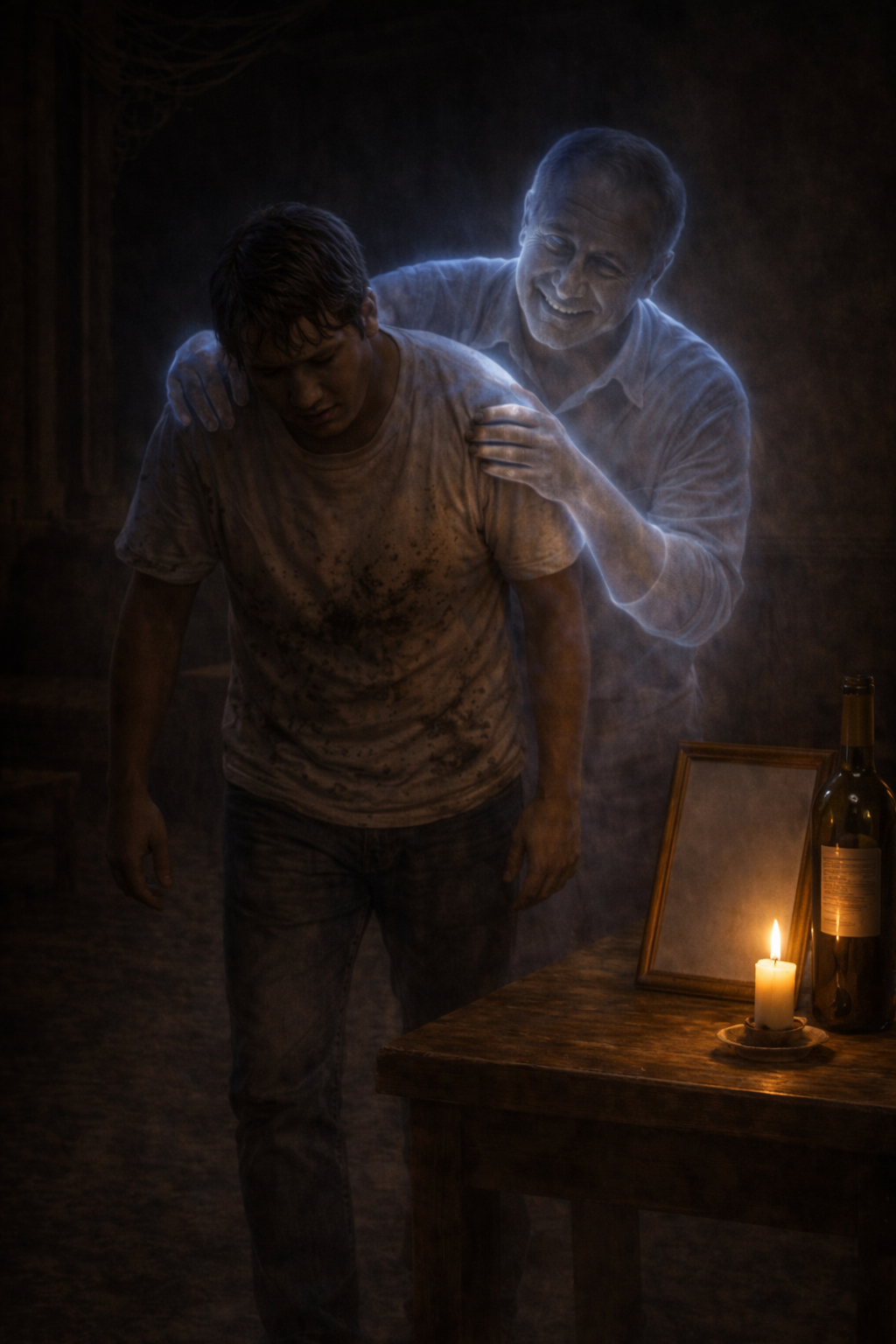
For a moment, I felt something cold resting on my shoulder.
Either it was the wind…
or it was him.
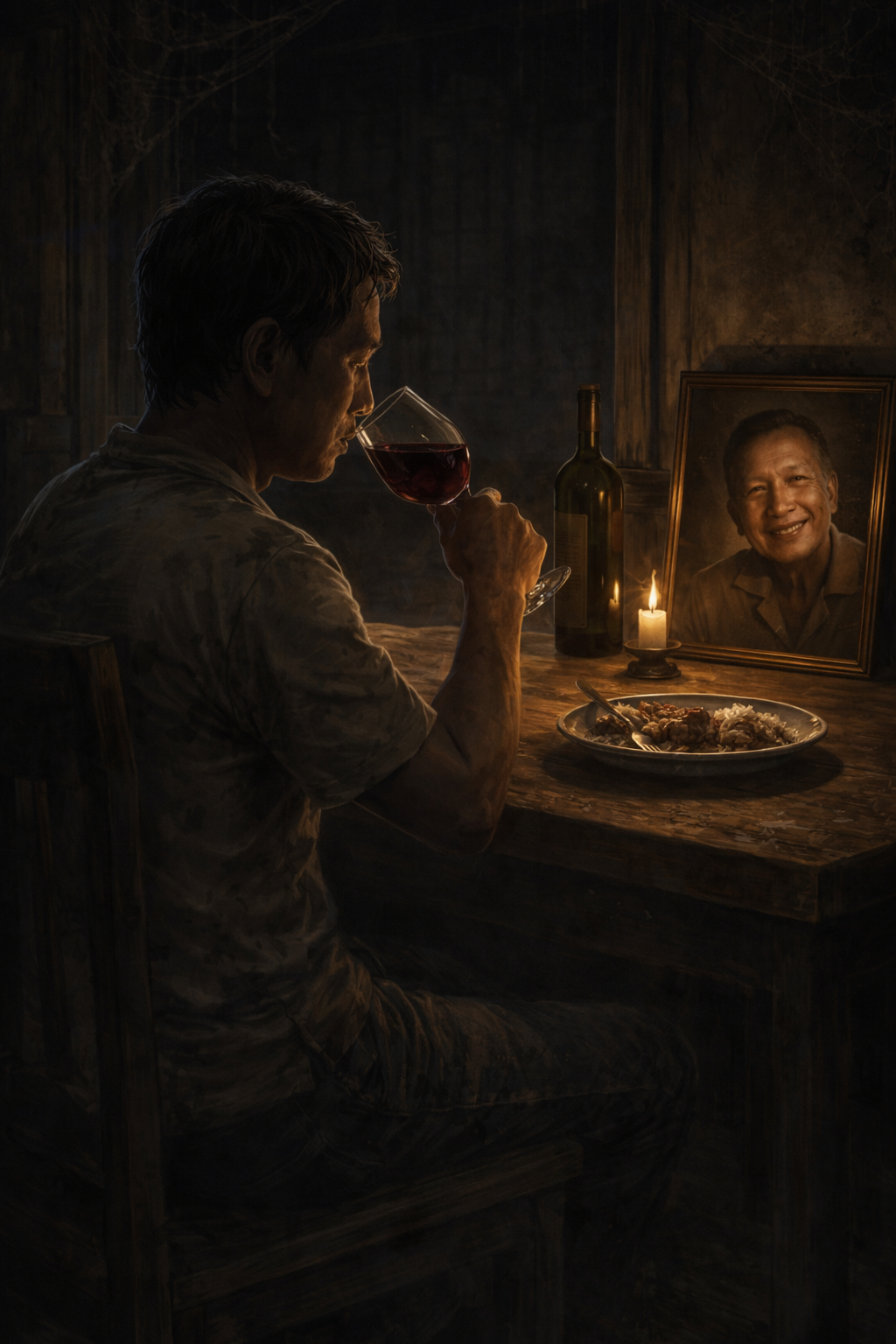
“One more toast, Papa. This bottle’s almost empty. See? Because you laughed at me that time, I practiced drinking in Japan. Whisky now, Papa. You can be proud of me.”
I glanced at his glass.
It was empty.
I frowned.
Maybe I drank it myself. Maybe I knocked it over. But the table wasn’t wet.
I couldn’t remember anymore.
I filled it again.
“But Pa… why was it always like that? You and Mama were never together at my important moments. Elementary graduation — neither of you. High school and college — only you. Graduate school — neither of you. My wedding — Mama wasn’t there again. I’m not complaining… I’m just saying.”
I knew I was drunk now. I couldn’t stop talking.
“Papa… thank you. For everything you and Mama did. Especially for putting me through college. I wouldn’t be where I am now without you two. Not bad, huh? My English. I got that from you. Especially when I’m drunk.”
I stood up and took the portrait in my hands.
“You’re the greatest father on earth, Papa. The greatest.”
I kissed the picture and set it back on the table.
“Even if you and Mama separated… you’re still the best parents in the world for me. No one can match what you did for us. I love you both. So much.”
After that, everything blurred.
My head spun.
The last thing I remembered was looking at the portrait.
The frame was there.
But his face…
was gone.
Blank.
Impossible.
I must have been too drunk. My vision must have failed.
Then I heard something from the bathroom.
A rustling sound.
Like someone urinating.
I laughed weakly.
“So that’s where you went, Papa… to the bathroom… that’s why you disappeared from the picture.”
I tried to lift my glass again.
Too heavy.
My eyelids felt heavier.
I wanted to stand up and go to the bedroom, but my body wouldn’t move.
Everything slowly went dark.
Before I completely lost consciousness, I felt cold arms rest on my shoulders…
as if someone was trying to help me stand.
Or maybe…
I only imagined it.
**********
“Marco… Marco! Wake up!”
I opened my eyes.
The room was spinning.
“Marco! Get up! It’s almost noon!”
It was Aunt Cecille.
My head hurt, but I forced myself to sit up.
“Wake up. The people for the prayers will be here soon. We still have to fix the living room.”
“Yes, Auntie…”
She looked at me and shook her head.
“There you go. Hangover again. Just like your father. Both of you are intelligent, both handsome, both smooth talkers… and both drunkards.”
She walked into the kitchen. I followed.
“Auntie… who carried me to the bed? I remember falling asleep at the table.”
“How would I know? No one came here last night. It was raining. Boyet said he might come, but he got lazy because of the weather.”
I scratched my head.
Then I looked for the portrait.
“Auntie… where’s Papa’s picture? I left it here.”
“Good Lord. It’s right there. Hanging on the wall. You were so drunk you don’t remember what you did.”
I stared at it.
“I didn’t put that back there.”
“Oh sure. Maybe the picture walked by itself. Crawled up the wall and hung itself. STOP IT, MARCO. Don’t scare me.”
She lifted two empty bottles of Chivas.
“You finished two.”
“No… I only opened one…”
She just shook her head and went to the living room.
She looked up at the portrait.
“Kuya… even with your own son, you’re still playing tricks. Make the most of it. It’s your last day here on earth. But not with me anymore, ha. With Marco only. You’ve already used up all my fear.”
I just listened as my aunt said those.
“Wait… your smile… that’s different. You look happy today. You weren’t smiling like that yesterday. You did another miracle, didn’t you? Don’t change that smile anymore. Keep it like that. Later, you depart in peace, ha. Go up to heaven. With all the prayers we offered, you might even pass heaven. Say hello to Saint Peter for us.”
I suddenly remembered the photo on my phone.
I searched for that photo.
I looked closely.
It was true.
The smile on my father’s face in the portrait on the wall was different from the smile in the twofie that I took the previous night.
FATHER’S PORTRAIT (2)
(Second of Three Parts)
There were many other stories—things that sounded almost supernatural—connected to my father’s portrait. I brushed them all aside. I was used to hearing stories like that whenever someone had died, and the family had not yet formally ended the mourning period.
“I just got back, Pa. I won’t be returning to Japan until next month. I’ve missed you so much.”
That was what I usually did whenever I visited my father’s house. I would take his portrait down, hold it in my hands, and talk to him. I made sure no one else could hear me, or they might think I was losing my mind. My aunts probably knew I did it. I even kept the picture beside me while I slept and carried it into the kitchen whenever I ate. I only hung it back on the wall when I was about to leave.
“Your house is terribly dirty, Pa. Cleaning it wore me out. Now I’m hungry. Come on, let’s go to the kitchen. I’m going to boil some water. We’ll have coffee, and I’ll let you taste these super spicy noodles I brought home.”
My father’s expression in the portrait seemed to brighten after I said that. I shrugged it off, thinking that maybe I was only tired and hungry, and that was why it looked as if the face in the picture had changed.
It was also possible that my mind had been influenced by all the stories they kept telling about the portrait, so I imagined things even when nothing had really changed.
“You’re all show, Pa. You keep making your presence felt, but you don’t actually want to appear. Come on, let’s go to the kitchen.”
I set the portrait on the table and propped it upright against the wall, facing the chair I sat in.
“Now just relax there, Pa. I’ll do the cooking. You’re a bit unfair, you know. Back then, you were always the one who cooked whenever I came here. So what now? You won’t get to taste the longganisa I brought. Sorry about that. But I suppose you can still smell it.”
It was already dark, so I turned on the kitchen light. Outside, the rain and the wind grew stronger.
A sudden gust of wind rushed through the house. Something slammed hard, and the light went out. When I turned toward the table, I saw in the dim light that the portrait of my father that I had placed there was now lying facedown.
The bulb must have blown out.
I went to the living room. Luckily, there was a spare bulb in the toolbox my older brother had left behind. When I returned to the kitchen, I replaced the bulb. As soon as the light came back on, I froze.
The portrait of my father—which had fallen face down just moments ago—was standing upright again.
The chill that ran through me this time was much stronger.
It was unsettling to see the portrait standing there as if nothing had happened. I took a deep breath, the way I always did when I was flustered and couldn’t think straight. I looked to my left, then to my right. Even behind me.
No one was there.
Slowly, I forced myself to walk toward the portrait.
The smile on my father’s face had vanished. He seemed to be staring at me with a serious expression. Was he annoyed that I had challenged him to appear, and now that he was only making his presence known, I was already getting scared?
Suddenly, I remembered something my grandmother used to say — that until the mourning period had been formally ended, the soul of the dead lingered around the house and made its presence felt to the people they loved.
“Oh, come on, Papa. You’re scaring me. Keep that up, and I’ll go home. You’ll be left here all alone.”
I said it jokingly, just to ease the fear that was beginning to creep over me. For a moment, I even thought of calling someone to come over. I wanted to call my cousin Boyet and ask him to keep me company.
“You must really want coffee, huh? That’s why you’re frowning. All right, just wait a bit, Pa. I’m fixing things up now.”
The gas tank and stove my father used to cook with were no longer there, so I boiled water using the old clay stove instead. Luckily, there was still firewood stacked underneath, and the rain hadn’t soaked it.
I washed the glasses and plates that had probably been sitting in the rack for a long time. Everything in my father’s kitchen had grown old.
Every now and then, I glanced back at the portrait while I worked. I kept waiting for something to happen. Maybe one of my cousins was playing a prank on me. Some of them loved fooling around just as much as I did. One of them must have stood the portrait back up. I even thought it might be Boyet.
“Boyet!… Boyet!… Cousin, come out now. Join Papa and me here.”
I waited.
No one came.
I made coffee — one cup for me, one for my father.
“Here you go, Papa. Your coffee. Good thing there was still some coffee and sugar left in your cabinet. The noodles are cooking too. Oh, wait, Pa — I need to get something from inside.”
I hurried to my bag and came back to the kitchen.
“Here, Pa. This is my gift for you. Chivas Regal. I bought it at the Duty Free. Two bottles. One for each of us. It’s eighteen years old, Pa — not twelve — so no complaints. Hehe.”
I was no longer as nervous when I noticed that the smile seemed to return to my father’s lips in the portrait. Again, I told myself my eyes were just playing tricks on me.
“Did you like the coffee, Pa? Oops… there’s a leak here too. I’m embarrassed I still haven’t had your house repaired. I don’t want my older brother and his drinking buddies turning this place into their hangout.”
At once, my father’s expression changed again. His forehead seemed to wrinkle, and the smile disappeared the moment I mentioned my brother. Our father had always hated it whenever my brother came here just to drink with his friends.
There really was something strange about that portrait.
His brow looked genuinely furrowed. Maybe those lines had always been there, and I just never noticed them before.
A few minutes more passed, and I just felt my fear had begun to fade. I was almost getting used to whatever was unusual I noticed in my father’s portrait.
“Aha, you cannot scare me anymore, alligator.” I jokingly said while glancing at the portrait.
When the noodles were done, I fried the Spam I had brought.
“Let’s eat first, Pa, before we start drinking. We’ve got a long conversation ahead of us tonight.”
“Marco… Marco… Is that you in there?… Marco.”
“Yes, Auntie. I’m here in the kitchen.”
It was Aunt Cecille.
She came in, and I took her hand, kissed it, then kissed her on the cheek.
“I thought it was your older brother again.”
My aunt wrapped her arms around my shoulders.
“Well, look at this — Chivas Regal, and two bottles at that. What about us?”
“Of course, I brought something for you too, Auntie — red wine. It’s inside.”
“But who were you talking to? I could hear you talking to someone.”
“There he is behind you, Auntie. Say hello to Papa.”
“Hah!”
She turned toward the table, then suddenly straightened up.
“Jesus, Mary, and Joseph! You startled me. You know how easily frightened I am. Now I won’t be able to go home by myself. You’ll have to walk me back.”
“Really?” I laughed.
“Go on, laugh.”
“There, have Papa escort you.”
“Oh, Marco, now you’re scaring me even more. I might not be able to sleep well. Just make sure you walk me home.”
I was still laughing. When I glanced at my father’s portrait, it looked as though he was smiling too.
“So you can also take the ginataang tulingan I cooked for you.”
“Wow! All right then, Auntie, I’ll walk you home. By the way, could you get the gifts I brought for all of you? They’re in the bedroom, inside the red plastic bag. Just divide them among yourselves. Are Aunt Claire and Aunt Carol there too?”
“Yes. They’ve been waiting for you for quite a while.”
Aunt Cecille went inside to get the gifts. I placed some of the cooked noodles into a bowl.
“You brought us a lot, Marco. Thank you.”
“Here, Auntie, try some of these Japanese noodles too.”
“Oh no, I can’t handle anything that spicy. Your aunt may be greedy when it comes to food, but not that greedy.”
“Auntie, I read your message earlier. Why don’t you want us to prepare something for tomorrow’s “babaang luksa”? I have a budget for it.”
“No need. Pancit palabok and bread will be enough. Let’s be practical. Besides, it’s rainy, people are busy, and no one wants to cook. There might not even be many visitors tomorrow with the storm coming. The food will only go to waste.”
“All right then. Just tell everyone that after the prayers tomorrow, we’ll have lunch at your favorite restaurant before I leave.”
“That’s exactly what we were hoping you’d say. Hehe.”
“Come on, Auntie, I’ll walk you home first. Papa, just wait for me, all right?”
“Oh, all right. Sorry for interrupting your father-and-son bonding. Hehe. Bye, Kuya.”
I noticed that Aunt Cecille didn’t look at my father’s portrait, which my father probably didn’t like, because in the picture, he seemed to be frowning again.
When I came back, I brought the ginataang tulingan my aunt had cooked, along with some rice.
“There we go — noodles, rice, ginataang tulingan… and Spam too.”
I poured Chivas into two glasses.
“This is for you, Papa… and this one’s for me. Cheers.”
After finishing my first shot, I took a bite of the ginataang tulingan and some rice. It tasted wonderful. It had been almost a year since I last ate that kind of fish.
I picked up a slice of the Spam I had fried.
“Here, Pa. You always told me to bring you Spam whenever I came home.”
I let myself pretend that my father was alive, sitting there with me, happy that I had come. He used to be like that whenever I visited him — lively, talkative, full of jokes. I placed a small saucer with tulingan and Spam beside his portrait.
Only then did I realize that tears were already welling from my eyes.
“You see, Pa? I’m still a crybaby, even now. It’s your fault. You left us too soon. All right… another shot. Finish yours, too.”
After more than an hour, half the bottle was gone.
“Papa, do you remember the time you visited us? I couldn’t find San Mig Light, so I only bought Red Horse. Four bottles. One for me, three for you. Damn… you laughed so hard at me that night. I hadn’t even finished one bottle when I ended up vomiting and shitting my guts out. After that, I never touched Red Horse again. That thing kicks like a horse.”
I looked at my father’s portrait.
I could see the happiness on his face — or at least it seemed that way — as I drank. As we drank. He looked as though he was smiling, almost teasing me, every time I spoke, every time tears slipped from my eyes.
FATHER’S PORTRAIT (1)
(First of Three Parts)
I lost count of how many hours it took before I reached the small village where my father had been born. I kept checking my watch, but the hands hardly seemed to move. After a while, I sighed, leaned back in my seat, and stopped looking at the time. I closed my eyes and tried to sleep instead.
I had already taken two buses and a jeep, yet I still had not reached my destination. For the last stretch of the trip, I even had to ride a tricycle.
Long journeys never really bothered me, but this time the rain would not stop. A storm was coming. The roads were flooded and muddy, making it difficult and exhausting to transfer between vehicles. That was why I decided not to bring my wife with me. She easily gets dizzy during long rides and quickly loses patience. With the way the vehicles crawled along, painfully slow, she would not have stopped complaining.
The last part of the trip turned out even worse. The tricycle driver must have forgotten to put up the rain cover, or maybe he was simply too lazy to bother, so I had to use the umbrella I brought to shield my bag and the gifts I was carrying. I let the rain fall on my face. Even my pants were soaked. Instead of getting irritated, I found myself enjoying the rainwater washing over me. It had been a long time since I last got drenched like that. I just hoped I wouldn’t catch a cold because of it.
When I was about to get off, the rain eased a little. It was already dusk. The windows and doors of my aunts’ houses were shut tight because of the wind and rain, but I could tell there were people inside. The lights were on, and shadows moved behind the curtains. I decided not to disturb them yet. I was soaked, and I needed to change clothes and boil some water first. A hot cup of coffee would have been perfect at that moment. Instead, I went straight to my father’s house.
The surroundings were quiet. The only sounds I could hear were raindrops striking the rooftops and the leaves rustling under the force of the wind. I could already see the house from a distance. Only then did I notice that, in the dim light, it looked strangely unsettling. As if a stranger passing by for the first time, you would feel a chill and hesitate before coming closer.
I stepped into the yard. The bamboo fence in front had almost collapsed to the ground. A rusty sheet of metal served as the only barrier. The grass around the house had grown long, and dry leaves were scattered everywhere. As I climbed the terrace, a spider web suddenly brushed across my face. I hadn’t seen it stretched across my path. A small butterfly caught in the web nearly went straight into my mouth.
When I finally stood in front of the door and reached for the knob, I realized I didn’t have the key. I should have borrowed it from Aunt Cecille, my father’s youngest sister. I was about to go to her house when, before I could even take a step away, the door slowly opened by itself.
I had seen scenes like this too many times in horror movies.
The hairs on the back of my neck stood up. I hesitated to go in. Then I told myself that maybe someone had simply forgotten to lock the door the night before when Aunt Cecille asked someone to turn on the terrace light. It must have opened because of the wind.
My aunt once told me that they kept the terrace light on every night so the house wouldn’t look abandoned. No one lived there anymore. My stepmother, Lea, no longer stayed there either. Ever since my father got sick, his second wife has rarely visited him. When he died, and she tried to live there again, my aunts refused to let her. I wouldn’t have allowed it either.
I accepted her as my stepmother and treated her with respect, but the affection I once had for her slowly faded when she allowed my father to live alone in that house. I did not want to blame her, yet I sometimes could not help wondering whether he might have been taken to the hospital in time had she been there when he suffered a heart attack. And if it was true that he had choked while eating, someone might have recognized what was happening, tried to help him, or called for emergency assistance. I knew that no one could say with certainty whether his life would have been saved—but the possibility that he might not have died alone was difficult for me to let go.
Maybe he would still be alive today.
When I finally stepped inside, I winced as a mixture of musty odor greeted me — damp wood, dirty walls, and, if I wasn’t mistaken, the smell of cat droppings. I immediately opened the window to let the air circulate.
It was dark. I had to turn the lights on. I struggled to move around while reaching for the switches.
Cobwebs hung everywhere. The floor was wet and filthy. The nipa roof had long been damaged. It leaked whenever it rained and was badly in need of replacement. The house had not been repaired for a long time. My siblings and I only visited it occasionally after our father died. As for me, I worked in Japan and came home only once a year.
In truth, it would not have cost much to fix the roof. Even while my father was still alive, I wanted to replace it with galvanized iron sheets, but he refused. He said the nipa made the house cooler. Whenever I pointed out the small holes in the roof, he would tell me to leave them alone so he could see the sky while lying in bed. Once, he even joked that the holes were useful because he could peek at stewardesses whenever an airplane passed overhead.
That was my father. He could make a joke out of things that others would consider problems.
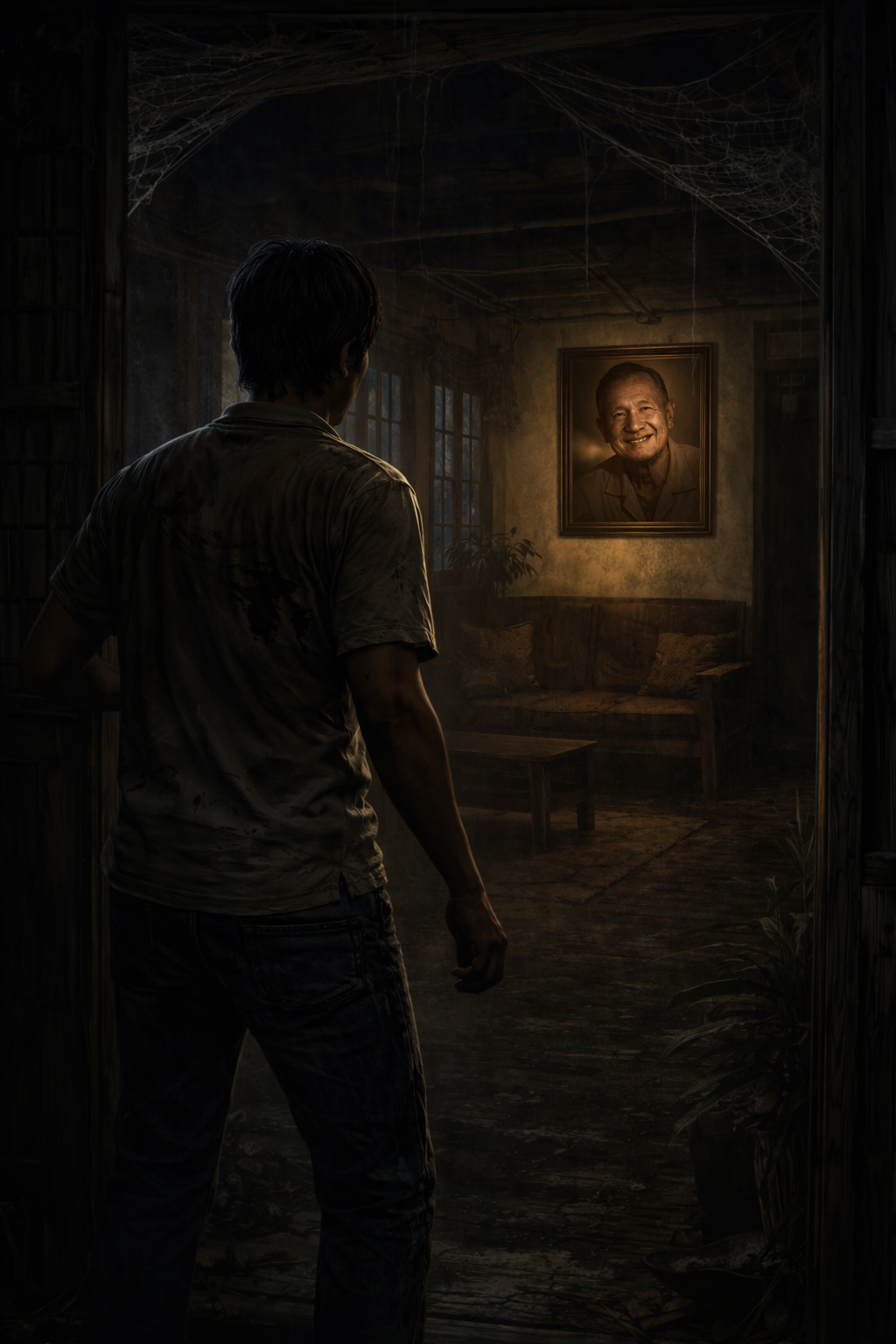
Just then, I heard a faint whistling sound, as if someone were calling my attention. I paused, slightly startled, as a strange uneasiness crept over me. I looked around the room, expecting to see someone. For a moment, I thought it might be one of my cousins sneaking around the house, hoping to startle me. But there was no one there — nothing but my father’s portrait hanging on the wall.
I exhaled slowly and forced a faint smile. Silly of me to feel startled in my own father’s house.
“Oh, so it’s you, pa, calling my attention. Give me a second. Let me just settle down.”
I approached my father’s portrait, bowed, and mumbled, “Mano po, Pa.”
I closed my eyes, only to open them quickly when I felt a faint whiff of air brush against my forehead.
For a moment, I thought his expression had changed… but I quickly told myself it was only my imagination, and that the air I felt was nothing more than a simple draft.
I collected myself and spoke to the portrait as if my father were really there.
“I’ll be back later, Pa. I just need to settle down first. See you later, alligator.”
In my mind, I could almost hear him answer, “After a while, crocodile,” the way he used to.
I left the portrait hanging where it was and continued looking around the house. There was still a lot I needed to check after being away for so long.
I continued looking around the house, taking in everything I had not seen for a long time.
I could have repaired the house after my father died. I even had the living room repainted and the terrace reinforced with concrete instead of bamboo. But I knew that if the house became too nice, my eldest brother would turn it into a hangout for himself and his drinking buddies. It would become a place for drinking, and who knew what else they might do there.
So I left the house as it was.
Another reason was that if the house became comfortable, my eldest brother might move in permanently with his family. That wouldn’t be fair, because our youngest sister was also looking for a place to stay. To avoid trouble, I decided that none of the three of us siblings would live there. I promised them that once I had enough money, I would pay them their share of the house and the small piece of land our father left behind.
I had always believed that my father’s share of the land was bigger, based on what he and one of my uncles had told me. But after he died, my aunts said that was all he really owned. I wasn’t the kind of person who chased after things that weren’t meant for me, so I let it go. Maybe that really was his share. Maybe not. Only my aunts — and God — knew the truth.
Sometimes I wondered why my two siblings never tried to build their own house. Perhaps they never learned from the years when our family moved from one place to another. Once, we were even driven out of a house by a relative. I never knew why, and I never wanted to know. Maybe I misunderstood what happened because I was still a child.
I never held a grudge, but the memory stayed with me. It became one of the reasons that pushed me to work hard. I studied. I persevered. I forced myself to have a house and land of my own.
But my greatest inspiration was my father.
From him, I learned how to work hard, how to stand on my own feet, how to trust myself and not depend on others. He was intelligent, resourceful, and quick-witted. People often said I took after him.
The next day, my two siblings were expected to arrive. It would be the lifting of mourning for our father. Almost a year had passed since he died. I knew there would be endless questions again about when I would pay them their share of the house and land. They would insist that we sell it because they needed money and capital for their business, as if that were their only way to survive.
But I did not want my father’s house and land to end up in someone else’s hands.
They would have to wait.
I didn’t even want to rent the place out.
The house was small and already falling apart, and the land was not even that big. But it was my father’s memory. It was our connection to the family we came from. I would never let it belong to anyone else.
After turning on all the lights and sweeping the living room a little, I went into the bedroom and placed my things on the small table beside the bed. I spread the folded mat and blanket on the bed. Luckily, they had been wrapped in plastic, so they were still clean. Even so, I shook them several times before laying them down.
**********
I changed my clothes. Then, as I always did whenever I visited the house, I took my father’s portrait from the wall.
The picture showed his face down to his chest, up to the last button of the polo shirt he was wearing. The portrait hung above an old television set, like a silent guardian watching over the house.
I brought the picture into the bedroom and wiped it with the towel I had used earlier.
When it was clean, I lifted it and looked at it closely.
For a moment, I thought I saw my father’s lips move.
It seemed as if he smiled at me.
I couldn’t even remember if he had really been smiling in that picture. Maybe my eyes were just playing tricks on me again. I was tired, still dizzy from the long trip.
“How are you, Pa? I’m sorry, alligator, that this crocodile took so long to come back to your swamp.”
After I said that, the smile seemed to fade, as if he were sulking. A chill crawled over my skin, and the hairs on my arms stood on end.
“Well, Pa… are you making your presence felt?” I said, forcing myself to sound brave.
“Go on… show yourself. Come on, Pa.”
I believed in ghosts, but I had never seen one. I didn’t know if I was afraid of them or not. But if it were my father who appeared to me, I might even hug him. I missed him terribly. He was always so funny, always full of jokes. I wanted to hear them again —
even if only as a ghost.
I stared at the portrait again.
When I thought about it, there was a reason I had felt startled earlier when I saw my father’s portrait after hearing the whistling sound. My aunts had told many strange stories about that picture. Sometimes, they said, it would suddenly appear in the living room of one of their houses. I always dismissed it, thinking one of my mischievous cousins must have been playing tricks on them.
One of my relatives even said that when Aunt Cecille once asked him to turn on the terrace light, he saw that my father’s picture was blank — and heard a sound in the bathroom, like someone urinating. He ran away in fear and refused to go back there again.
I never believed that story.
I thought he must have been drunk.
But they insisted he wasn’t.
Grace In A Foreign Land
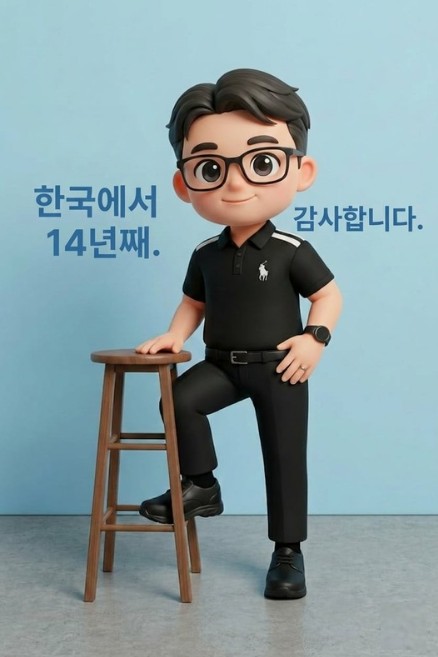
Today, I begin my 14th year here in South Korea.
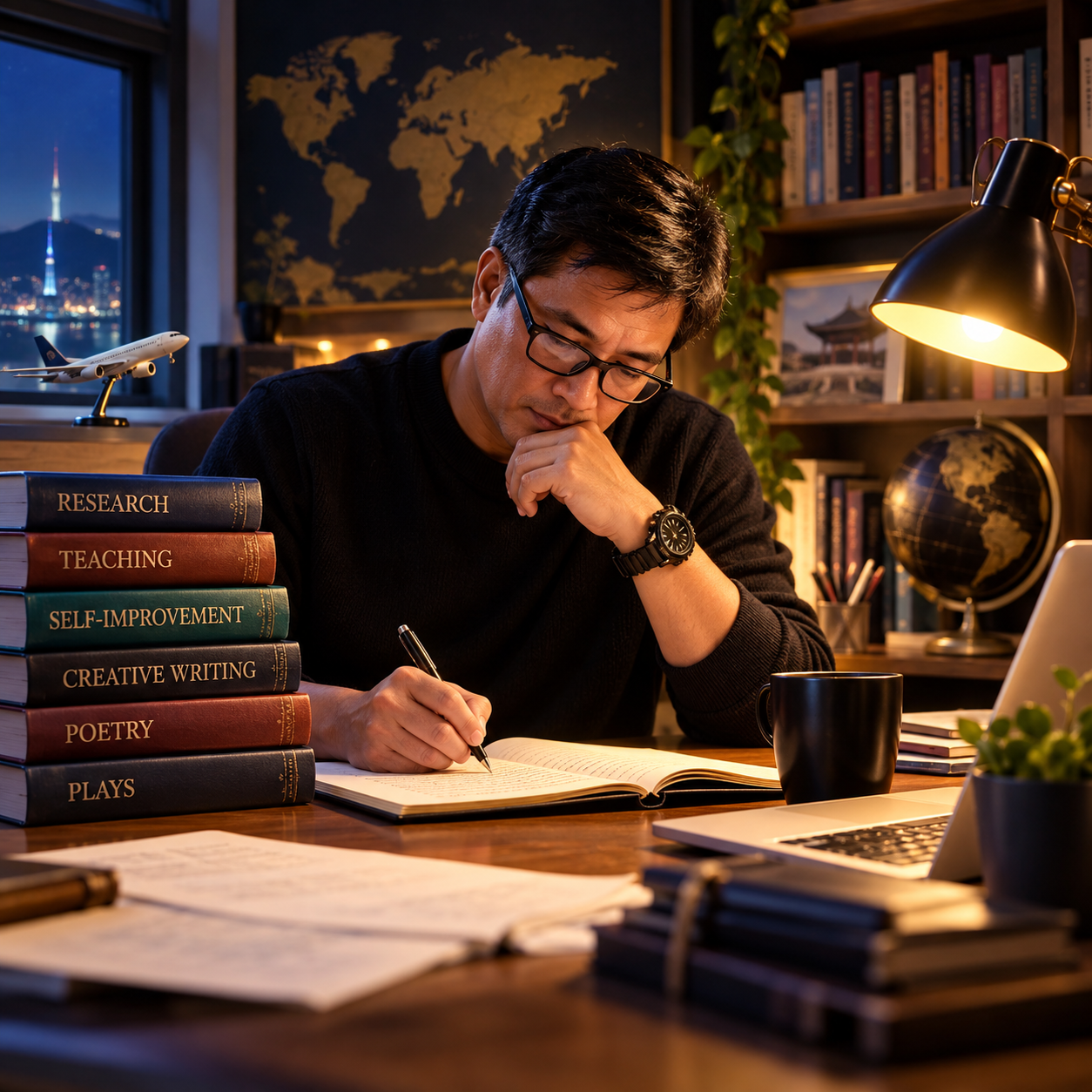
Fourteen years ago, I boarded a plane carrying more than luggage. I carried questions. I carried fear. I carried unfinished conversations with the people I loved. And yet, above all, I carried conviction — the kind that whispers, Go. There is more waiting for you.
Time has a way of softening distances and turning foreign places into familiar ground. What was once unknown has become part of my story. What once felt like exile became expansion. And in all these years, I have come to understand that certain decisions do not merely change your address — they change your direction.
South Korea did not simply become my workplace; it became a refining ground. Here, I grew not only as an educator but as a thinker, a writer, and a man of faith. The classrooms sharpened my discipline. The solitude deepened my introspection. The unfamiliar culture stretched my perspective. This land became the platform on which I learned to rebuild, rediscover my purpose, and pursue excellence beyond the limits of my former comfort zone.
I thank the Lord for sustaining me through every season — through doubt, through growth, through silent battles no one else saw. And I thank this country for serving as the backdrop to one of the most defining chapters of my life.
But every long journey has a beginning. Every transformation has a first trembling step.
And mine began with a single day — a day marked by cold air, empty rooms, unanswered calls, unexpected kindness, and a faith that refused to collapse.
That first day in South Korea is something I will never forget.
It was in the early dawn of March 2, 2013 when I left the Philippines aboard Asiana Airlines. Around eight in the morning, the plane landed at Busan International Airport. At that time, Mr. Kenn Lachenal was with me. We were both headed to South Korea to teach English at Gyeongju University.
I admit that during that time, I was overwhelmed — not because of drugs, but because of the many thoughts about my loved ones and the anxiety over the new challenge I had chosen to face.
It was against my will to leave my loved ones behind, but it was necessary. I also did not want to step away from the school I had served as Principal for almost a year. Yet I have always refused to be ruled by my emotions. I did not want to avoid a decision simply because I surrendered to feelings. I carefully thought through my decision to go to South Korea to teach. It was not impulsive. It was part of my plans — a long-considered intention whose time had finally come. I would not allow my emotions to stop me.
It was not the desire for a higher salary that drove me abroad. I was already earning well as a principal. On top of that, I was working as an academic consultant at a technical school and as a part-time college instructor. Financially, I was stable. I had even built a house. The problem was this — I was no longer comfortable in my comfort zone.
I had grown weary of supervising teachers and employees. It felt stagnant — no longer challenging. Something was missing — something I longed to find. Personal issues that needed resolution did not help either. It became clear to me that I needed a radical change in my life if I wanted to preserve my sanity. I had to go somewhere new for a fresh beginning.
I felt as though I was at a dead end — yet I knew there was a world beyond dead ends. That was the world I wanted to reach… to explore.
As Jake Sully, the main character in Avatar, once said, “Sometimes your whole life boils down to one insane move.” Like Jake, though I felt fear, I was certain of my decision before I jumped to wrestle and tame my own “Toruk.”
I brought only two things with me to South Korea — self-confidence and faith in God. That combination has always been my shield against trials and my hook for reaching whatever I aspire to achieve.
I was not seeking luck in this country; I do not believe in luck. I believe that “God gives mercy, but man must act.” My purpose was to write a new chapter of my life here — a new phase in the destiny I believe I must draw for myself.
It was my first time traveling abroad, and I was fortunate to be with Mr. Lachenal. Aside from being helpful, he was experienced in overseas travel. Since we were both headed to Gyeongju University, I was confident I would not get lost.
When we arrived at Busan International Airport, I was shocked by the cold. It pierced through my jacket. I had assumed that since winter had ended and spring was beginning, the weather would be like Baguio. Thankfully, the bus we took to Gyeongju-si had its heater running. Though I was sleepy, I could not fall asleep during the ride. I kept looking at every place we passed. I said to myself, “Here I am in South Korea.”
After nearly two hours, we arrived in Gyeongju-si. Mr. Mark Celis welcomed us. He brought us to the apartments where we would stay — Mr. Lachenal to the “white house,” and me to the “blue house.” Not the White House of Washington D.C., nor any political residence in Seoul — those were simply the names given to the apartments provided by Gyeongju University for foreign professors. They were named after their paint colors. There was also a “yellow house” and a “green house.”
Before leaving, Mr. Celis ensured that my unit was in order and introduced me to another Filipino professor at Gyeongju University — Dr. Randy Tolentino, who also lived in the “blue house.”
When I entered my room, I felt for the first time what it truly meant to be alone — far from loved ones, in an unfamiliar place. I simply stood there, unsure of what to do first.
After regaining composure, I opened my suitcase and slowly arranged my belongings.
The surroundings were silent. I heard nothing but my own footsteps. I could even hear my heartbeat and the sound of my swallowing. After arranging my clothes and things, I suddenly felt the intense cold again — and hunger. The refrigerator was empty. There was a gas stove, but nothing to cook. I made do with the biscuits I had brought from the Philippines.
Then I remembered I needed to call my loved ones to inform them I had arrived safely. When I reached for my cellphone, I realized I had not activated roaming on my SIM card. I felt foolish. I cursed under my breath. I could not call anyone; my phone was nothing more than a music player.
I admit that at that moment, deep sadness overwhelmed me. I was still hungry despite finishing almost all my biscuits. I was shivering from the cold. The silence felt deafening. I was alone, with no one to talk to. I also worried that my loved ones were already anxious, waiting for news from me.
In that moment, I understood the true meaning of HOMESICKNESS — just hours after landing in South Korea.
But amid that sadness, I looked up to heaven and remembered that I had prayed many times for the chance to come to this country. I do not know why, but as far as I know, He has never ignored my prayers. I even wrote a poem about it in English — seven syllables only:
He answers.
Just wait.
Have faith!
I was about to lie down to drown my hunger and sadness in sleep when I heard knocks at my door. It was Randy.
He came in and talked with me. He was from Iloilo. At least I had someone to speak with now. While we talked, he looked at my stove and showed me how to operate it. He must have noticed I was cold, because he also taught me how to use the floor heater. I felt somewhat relieved by his help. He opened the kitchen drawers and found a few cans of food left behind by the previous tenant. He left briefly and returned with packs of noodles and some 3-in-1 coffee.
I was surprised by the generosity Randy showed, whom I would later call Sir Randy. It was as though he had known me for years. He stepped out again and returned, saying, “Come on, bro, my girlfriend has cooked. Let’s eat.”
I followed him to his unit. I was surprised, but I did not hesitate — not because I was desperately hungry, but because I felt the sincerity of his invitation. It would have been embarrassing to refuse.
The food was warm, but warmer still was the care shown to me by Sir Randy and his girlfriend, Nikki, who was from China. I was about to take my first bite when Sir Randy offered a prayer of thanksgiving. My respect for him deepened at that moment. At my first bite, tears welled up in my eyes — moved by their kindness and by how God answers prayers. When the couple looked at me, I casually said I must be catching a cold — that was why my eyes were watery. I do not know if they believed me.
After dinner, Sir Randy walked me back to my unit, carrying some cooked food. I said, “This is more than enough, bro!” He smiled and explained they were leaving for Daejeon and just wanted to make sure I had food until the next day. He then returned to his unit and brought me a pot, a pan, a kettle, and some coffee sticks. I did not know what to say. I wanted to hug him for all the help he was giving.
His kindness did not end there. When he learned I could not use my SIM card, he lent me one of his smartphones and his iPod before they left, and he kept his Wi-Fi open so I could use the internet. Our units were only meters apart, so I could access his connection from my room.
I had no words left. “Thank you” felt worn out from repetition. I wanted to hug him, but he was in a hurry to leave. After he stepped out of my unit, I simply closed my eyes and silently thanked Him. I am not a good person. I am weak and sinful. It is simply that the Lord is gracious and loving to those who call on Him.
I am truly fortunate that on my very first day in South Korea, I met friends like Randy and Nikki. They are more than friends — they are siblings from different wombs. They are the reason my first day in South Korea is so special.
Randy and Nikki are living testimonies of God’s goodness.
MAD’S WORKSHOP
My Main YouTube Channel
MAD’s Workshop is my virtual studio. It is where I blog, vlog, and scratch my creative itch. I have diverse interests, including prose and poetry, education, research, language learning, and sports (basketball and boxing). But I consider self-improvement as my primary advocacy.
I blog and vlog about my interests and advocacies. I create content in English and Filipino. I have two other active YouTube channels:
M.A.D. Ligaya (The Road To Self-improvement): https://www.youtube.com/@madligaya-2
Mukhang_Poet: https://www.youtube.com/@madligaya-3
This channel is the repository for all my videos on my social media accounts.
You can check my research works here:
https://www.researchgate.net/profile/...
Please check my websites also:
https://chingligaya.wordpress.com/
You can read some of my stories here:
https://wattpad.com/user/madligaya
You can see the PINS of the poems I have written here:
An Invitation (YouTube Channel Teaser)
Is self-improvement an end in itself or a means to achieve an end?
By introducing a comprehensive paradigm for self-improvement, I do not seek to complicate the process of personal growth, but rather to present a realistic framework that brings together the many constructs essential to it. There are two serious loopholes in self-improvement schemes promoted nowadays. The first one is the promise of becoming the best version of yourself in a few days or weeks. And the second is the attainment of full potential, being floated as a goal to be achieved rather than a process to be undergone.
Self-improvement is not an end in itself but rather a means to achieve an end. It is not a destination. It is the path to reach a desired destination.
I believe that there is no shortcut, no magic pill, and no single technique that can instantly transform one’s life. Genuine growth requires cultivating the right attitudes and beliefs, developing essential skills and abilities, and consistently practicing positive habits and activities. This holistic approach recognizes that lasting change arises from deliberate effort across multiple areas of life.
Quezon’s Curse
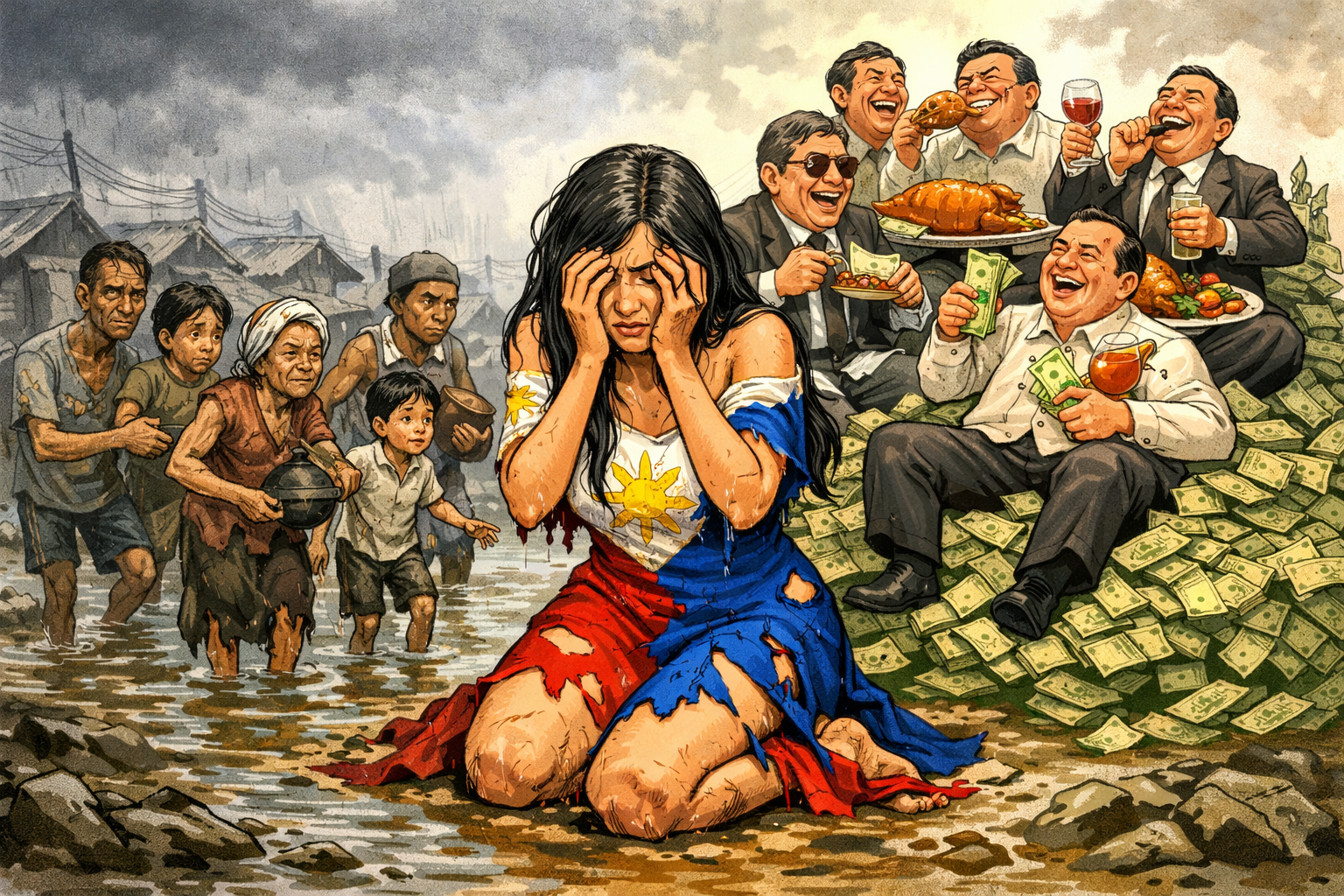
Did Manuel L. Quezon, the second president of the Philippines who served from 1935 to 1944, unknowingly curse the nation when he declared, “I would rather have a government run like hell by Filipinos than a government run like heaven by Americans”?
The Americans eventually ceased governing the Philippines by force after the Second World War. It was not independence that the Filipinos were granted on July 4, 1946, but freedom. The Americans did not save the Philippines from Spain, as some uninformed Filipinos and the rest of the world wrongly thought. The US coerced Spain into selling the island to them. So, the Philippines was passed by a colonial tyrant to another… to a more powerful and ruthless tyrant.
Let this be clear… The US did not save the Philippines from Spain. The former forcibly grabbed our nation from the latter.
When the Americans finally turned over the reins of government to Filipinos, Quezon could have been the happiest man alive had he lived to witness it. At last, the Philippines had a government run by its own people.
But as the saying goes, “Be careful what you wish for.”
Our country has since been governed by Filipino politicians. Given the Philippines’ governance over the decades, how would we assess the performance of those who have served in the different branches of government since the Americans passed the baton of leadership?
Only the blind — and those who benefit from the system — would deny how badly the nation has deteriorated. Only the naïve would refuse to see that the Filipino spirit seems lost. Like a dried leaf in autumn, it drifts wherever the wind blows. The Filipino identity has become like a shattered mirror. Each broken piece reflects a different truth, yet none shows the whole picture of who we once were or what we should be as a people.
As a nation, we are as fragmented as the islands that form our archipelago. The colonial strategy of “divide and conquer,” once used to weaken and subjugate us, continues to linger in our society. Even today, it keeps us deeply divided.
And all this appears to trace back to what now feels like Quezon’s curse — “a government run like HELL by Filipinos.”
For how long have we been led by politicians who seem to have descended from hell itself? Would it be unfair to describe members of the executive and legislative branches as soulless demons who take turns plunging their hands into the nation’s coffers, depriving the people of the services and opportunities they deserve? And what of those in the judiciary and the military who appear to look the other way?
One cannot help but recall the countless anomalous “flood control projects” — billions poured into programs meant to protect communities, yet every year, towns and cities continue to drown while only a select few grow richer. What was supposed to shield the people from disaster has instead become another avenue for plunder.
The sad reality is that the Filipino people cannot simply play the victim. It was Filipinos themselves who summoned these demons from the depths of hell and enthroned them in Malacañang and in Congress. In short, they voted for them. And the sadder part is that even now, when it is clear as day that the devils they have chosen are guilty of corruption, many still continue to support them.
Thus, Quezon’s pronouncement refers not only to Filipino politicians but also to the Filipinos who placed them in power.
“Kawawang Inang Bayan.”
Would we not, at times, be tempted to think that perhaps we would have been better off had the Americans continued to run our government?
Would we not be tempted to accept their old justification for staying on Philippine soil — that Filipinos were not ready for self-governance?
Yet perhaps Quezon did not curse us at all.
Perhaps what he offered was not a prophecy of doom but a challenge — a declaration of faith in the Filipino people’s capacity to govern themselves, to learn from their mistakes, and to shape their own destiny. The tragedy is not that Filipinos were given the reins of government. The tragedy is that, over time, many surrendered vigilance, traded principles for convenience, and allowed power to fall into the hands of the few.
A government “run like hell by Filipinos” was never meant to be permanent. It was meant to be corrected by an awakened citizenry. Democracy was supposed to be a system in which bad leaders could be removed, corruption punished, and the people remain the true sovereign.
But when a nation grows tired, when poverty silences voices, and when hope is repeatedly betrayed, tyranny does not need foreigners to thrive. It is cultivated from within.
Quezon’s words were not a curse. They were a warning wrapped in hope.
What turned that hope into hell was not Filipino governance itself, but Filipino complacency. We allowed demons to rise not because we were incapable of self-rule, but because we stopped guarding it fiercely.
In the end, the real question is not whether Quezon cursed us.
The real question is whether we, as a people, abandoned the responsibility that freedom demanded.