Blog Archives
“Please Teach Me English!” (1)
(First of Three Parts)

“I don’t speak English well… please teach me.” One or two of my Korean students would tell me this (or a similar statement) in broken English at the end of our first meeting or any class as the semester progressed. Their voice and how they said it straddled between surrender and supplication. I cannot recall a semester where I did not hear something similar to that sentence. It reminds me of the first Korean movie I watched, “Please Teach Me English,” a romantic comedy film. It was recommended by the instructor who supervised the Teaching English to Speakers of Other Languages (TESOL) short course that I took when I decided to include teaching English overseas as one of my career options. Each enrollee in that program was given a VCD copy of the movie. Well, I watched the film not because of TESOL-related intentions but because of the increasing popularity of K-Drama and K-Pop, with which I got hooked. Little did I know that watching that movie would later influence my career path.
There is no shame in admitting that I am one of the millions who became obsessed with Korean cultural content. In short, I got drowned by the Korean Wave (Hallyu) that reached the shores of the Philippines at the turn of the 21st century. Like many of my compatriots (and people from other parts of the world), I became enamored with K-pop and K-drama. Therefore, even if our TESOL supervisor did not mention that the movie provides plenty of tips for foreign English teachers, I would watch the movie. I even revisited the film before completing the program. However, the movie only came back to my mind during my first semester of teaching here in South Korea when my students started approaching me and saying sentences similar to the movie’s title. It prompted me to vividly recall the scenes between the English teacher and her students and made me rewatch the film.
Since then, when students confide in me about their difficulties in learning English, I am reminded of the main characters, Young-ju and Jang-hyuk, in the movie. These characters embody the excitement and struggles many Koreans face while learning English. One scene that particularly stands out is when Young-ju is seen eating pages from a dictionary in hopes of improving her vocabulary. This desperation is a testament to the lengths that some Koreans will go to master the English language.
The English teacher in the story is named Catherine, a native speaker of English from Australia. After watching the movie again, her interactions with students came to mind when I held my classes. Catherine tried to speak Korean to communicate better with her students, which is something I struggle with.
The movie provides insight into the English education system in South Korea. It sheds light on how Koreans perceive English learning and interact with English-speaking foreigners. The film also reveals the differing opinions on the necessity of learning the language. Despite being released in 2003, it still accurately portrays the current realities of English education in South Korea and their belief that English is essential for upward social and economic mobility. It also gave me a deeper understanding of life in Korea and the Korean psyche. The movie succeeded in reconfiguring my “Korean Dream.”
My “Korean Dream”
The constant influx of Korean content in my country’s print and broadcast media sparked a deep interest in the history and culture of South Korea within me. In addition to watching K-dramas on TV, I actively sought out Korean-related materials on the internet and read encyclopedia entries about the country south of the 38th parallel line. Gradually, I found myself becoming more and more immersed in Korean culture. Instead of using traditional greetings like “hello” and “thank you,” I began using “annyeonghaseyo” and “gamsahamnida.” When expressing deep affection, I started saying “saranghaeyo” instead of “I love you.” I even began singing Korean songs and desired to try their food, particularly the legendary Kimchi. Over time, my interest in everything related to Korea grew.
The cultural influences of South Korea on my homeland have ignited a strong desire within me to visit the country and explore the locations featured in TV shows and movies. I have always wanted to come here to fulfill that desire. I had many plans for my trip, such as riding the subway system in Seoul, strolling through Myeongdong at night and trying street food, spending my summer vacation on the beautiful island of Jeju, tasting soju and maekju, and trying the unique combination of the two, known as somaek. I also looked forward to savoring Korean dishes prepared by local chefs, wearing traditional hanbok outfits, and immersing myself in the culture by interacting with native Korean people. This is how my dream of experiencing Korea began and has become deeply rooted in my mind.
After watching the movie “Please Teach Me English,” I dreamt of teaching English in South Korea. Initially, I wanted to teach English at a university in the Middle East, but then I started thinking, why not teach in the country I have been fascinated with for so long? My dream of visiting South Korea as a tourist turned into a desire to live and work here.
When I was training for TESOL, I was then experiencing severe burnout from years of work as a school administrator. It did not help that I was confronted by personal demons at the same time. That personal circumstance required that I make not only a change in my career but also in my environment. That’s when I decided to apply for a position as an English teacher here in South Korea. This country is a popular destination for English teachers due to the attractive salaries and excellent benefits. However, there is intense competition among native English speakers for teaching positions in schools and hagwons (private academies). Non-native English speakers encounter even more tremendous obstacles in securing these positions, and their prospects of landing a teaching role in the language department of a South Korean university are slim. It’s like trying to find a needle in a haystack. If you’re not a citizen of a country that belongs to the inner circle of the concentric circles model of the English language, it’s nearly impossible to get hired.
I couldn’t believe it when, for the first time, I read in an advertisement for ESL/EFL teachers the lines “Only native speakers of English may apply!”. I thought it was a prank. But it wasn’t. Why native speakers of English are accorded that preference or almost an exclusive right to teach Korean students is unfathomable. Fortunate and privileged are the “Catherines” of the world.
Blessed “Catherines”
When I began searching for teaching positions abroad, I noticed numerous job openings for English teachers in South Korea. However, I was disappointed to find very few opportunities for non-native English speakers like myself, while there were many for native speakers like the character named Catherine in the movie. I couldn’t help but grudgingly think that being a “Catherine” in this world is a privilege. I was surprised to learn that many universities in Asian countries such as South Korea, China, Japan, Vietnam, and the Middle East only preferred to hire native English speakers to teach the language. I realized this policy existed when I started looking for teaching positions abroad. I never thought that native-speakerism was a real thing. In a world as diverse as ours, it seems unfair that only native English speakers can teach the language.
Is the “only native speakers of English may apply” policy fair, just, and acceptable? If I get to respond to the question, the answer is already apparent. So, I decided to seek the opinion not of a non-native English speaker or a native speaker of the language but of a neutral entity – ChatGPT.
ChatGPT explains that “being a native speaker does not necessarily equate to being a skilled language teacher. Teaching requires specific training and expertise in pedagogy and language instruction, which native speakers may not possess. Additionally, non-native speakers who have learned English as a second language often have firsthand experience with the challenges that learners face, making them empathetic and effective teachers.” It added that “the effectiveness of language teaching depends on various factors, including the qualifications, experience, and teaching approach of the instructor, rather than solely on their native speaker status. Therefore, a more inclusive approach that values expertise and diversity in language education may be a wiser policy in promoting effective language learning for all students.”
I have worked with English teachers from specific countries over the years and observed their personalities and levels of professionalism. Additionally, as a member of the hiring team at the university where I currently teach, I have gained insight into job applicants’ educational qualifications and training. As shown in their CVs, some who tried to apply for a teaching position in our university are legitimate and qualified ESL/EFL teachers, but some were hired mainly because of their country of origin. They have been teaching in South Korea for a long time but are not English majors and have not graduated from courses aligned with education and language teaching. If only I could take the liberty to spill (all of) the beans.
It’s puzzling why most universities in South Korea and other Asian countries prefer to hire only native English speakers to teach the language. This practice is a form of discrimination, and, ironically, Asians themselves deny their fellow Asians equal job opportunities. However, I didn’t give up my dream of living and working as an English teacher in South Korea. Some universities here understand that accent and country of origin should not be the criteria for hiring ESL/EFL teachers. I hoped that some universities would prioritize qualifications, training, language proficiency, and pedagogical skills over accent and country of origin when hiring English teachers.
I was right! Although few and far between, some universities in South Korea do not discriminate against non-native English speakers. I sent an application to all of them. After a challenging application process, a university offered me a teaching contract, even though I am not a “Catherine.” My dream of living and working in this country became a reality. I have been plying my trade here as an English teacher for over ten years.
If there is something else significant that the movie “Please Teach Me English” taught me, it is understanding more about the Young-jus and Jang-hyuks and how to deal with them.
My Continuing Journey In South Korea
When I quit my job as a school administrator in Bulacan to pursue ESL teaching in South Korea, my loved ones and friends strongly advised me to reconsider. They reminded me that I already had a solid career in the academe in the Philippines, and the pay was decent. But as Jake Sully says in the movie Avatar, “Sometimes your whole life boils down to one insane move.”
So, in 2013, I flew to South Korea. But it wasn’t an insane move, rather a calculated risk. I have no regrets, as coming here was one of the best decisions I’ve made in my life. Working here has been an enormous blessing. This country is a beautiful place to live. When I arrived, I could confirm the impressions created by the Korean dramas and movies I had watched. Indeed, South Korea is progressive and beautiful, and its citizens are competitive, hard-working, and health-conscious.
Beyond providing financial stability for me and my family, my time in South Korea has fostered tremendous personal and professional growth. The working conditions at the university where I am currently employed are excellent. At first, I could hardly believe that I only needed to work less than 20 hours over four days. We must work only seven months but are paid for the entire year. This arrangement has given me ample time to connect virtually with my family and pursue my other passion—writing. Additionally, our university offers performance points and cash incentives for research projects, further enhancing my love for writing.
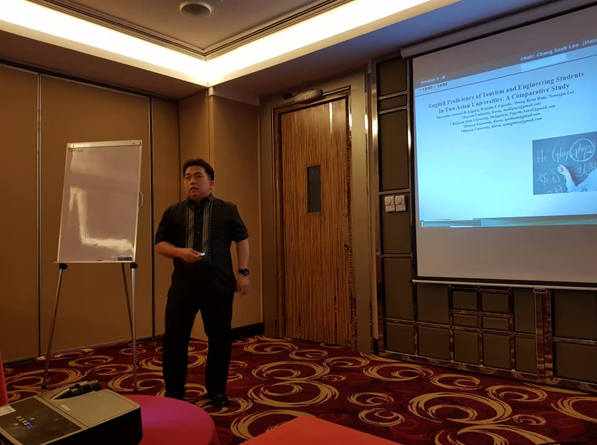
I mainly teach English subjects. There have been semesters when I was asked to teach at the graduate school and serve as an adviser to graduate students working on their dissertations. When I’m not engaged in academic work, I dedicate time to writing stories, poems, plays, and scholarly studies, many of which are published on my personal website. Several of my research studies have been presented at international conferences and published in internationally indexed journals. I have genuinely found fulfillment as a writer in this country.
I can’t imagine having any other “job cum hobby” besides teaching and writing. You may ask why. As Seth Godin said, “Do what you love and love what you do.” What I do and love is teaching, and what I love and do is writing. I use the expression “job cum hobby” because, when I engage in these activities, I don’t feel like I’m working; it feels more like pursuing hobbies.
My greatest challenge as a teacher is overcoming the cultural barrier between myself and my Korean students. I address this by building a good rapport with them and diligently fulfilling my responsibilities. Being a Filipino in ESL/EFL teaching places me and my fellow countrymen at a disadvantage. There is a common misconception that only native English speakers can teach the language, and even some of our Korean students believe this. It is something that Filipino English teachers like me must work to dispel. If I were to identify my most significant contribution as a Filipino in my profession, it would be demonstrating to the academic community in South Korea that one doesn’t need to be a native English speaker to be an effective ESL/EFL teacher.
I can’t think of anything negative about my current job; I have nothing but gratitude. I enjoy a harmonious relationship with my coworkers, both Korean and foreign. Although I occasionally clash with fellow foreigners over policy matters and work attitudes, we adhere to the principle of disagreeing without being disagreeable, which helps us maintain mutual respect.
My best advice for my fellow Filipinos working in South Korea is to work hard and respect everyone. Hard work leads to success as expat workers, while respect for others, regardless of citizenship, helps them stay out of trouble. It’s also important to abide by the laws of our host country.
Reflecting on my 12 years here, I see that what began as a leap into the unknown has become the most fulfilling chapter of my life. Teaching and writing—my two greatest passions—have flourished in this country. Embracing new challenges reminds me why I took that “calculated risk” in 2013. South Korea has provided me with opportunities to improve my overall well-being and has reaffirmed my belief that staying true to what you love leads to rewarding outcomes.



 M.A.D. L I G A Y A