Blog Archives
Health

Health is not something to spend in pursuit of success and recover later. It is part of the foundation
that makes every worthwhile pursuit sustainable.

The wealthy, the famous, and the powerful—are they sleeping peacefully? Are their relationships intact?
When we speak of health, many of us immediately picture its physical dimension: a reassuring medical report, a fit body, enough energy to get through the day, and the absence of serious illness. Physical health matters enormously. But it is not the whole picture.
A person can appear physically strong while being emotionally depleted, mentally exhausted, socially isolated, or trapped in relationships that are deteriorating. That is why some of the more revealing questions about a successful life cannot be answered by a weighing scale or laboratory result. Do you sleep peacefully? Do you still have people with whom you can be completely yourself? Can you stop working without feeling that your worth has disappeared?
The pursuit of success can sometimes exact costs that do not appear on a medical chart until much later. Chronic pressure, neglected relationships, inadequate rest, and the constant demand for more can quietly erode the well-being that achievement was supposed to improve. A person may gain income, status, or recognition while losing sleep, peace, connection, or a sense of self.
Health, then, is better understood holistically: physical, mental, emotional, and relational well-being influencing one another. We will not keep every dimension in perfect condition at every moment, nor can every health outcome be controlled by lifestyle. But we can refuse to treat health as an expendable resource to be sacrificed indefinitely for another goal.
Protecting health requires intentionality: adequate rest, movement, nourishing food, relationships that receive time rather than leftovers, attention to emotional strain, and the humility to seek appropriate help when needed. Success becomes easier to enjoy when we are healthy enough—in the broadest sense—to be present for it.
Pause and Reflect
Beyond how healthy you look, how healthy does your life actually feel—physically, mentally, emotionally, and relationally?
One Step Forward
Identify one dimension of health you have been neglecting. Write one realistic boundary or practice that can protect it this week.
Explored in full in Part 3, Section II — Fulfillment (Redefining Health) of A Holistic Approach to Self-Improvement.
Consistent Daily Routine
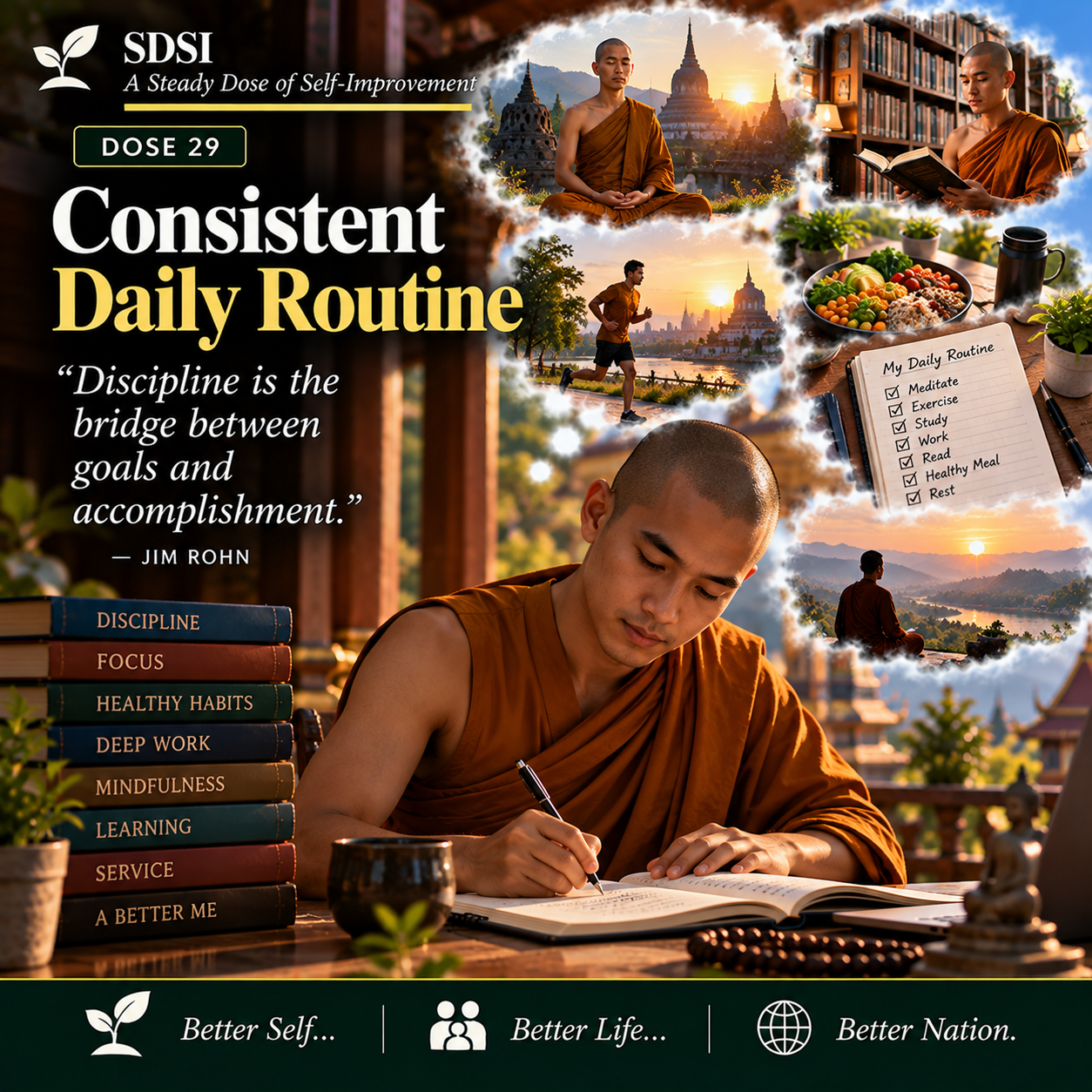
A well-designed routine isn’t a cage — it’s daily proof that you’re authoring
your life instead of drifting through it.

Are you more like a homing pigeon, or driftwood?
Are you more like a homing pigeon—or driftwood?
Whether we notice it or not, much of life is built from repetition. What we habitually do—or repeatedly fail to do—shapes our health, competence, relationships, and progress. Significant results rarely come from one dramatic burst of effort. More often, they emerge from small actions performed often enough to become part of who we are.
A daily routine gives those actions a place to live. It is a deliberate pattern of activities that supports the things we say matter to us. Without some structure, we can become like driftwood—moved by whatever demand, distraction, mood, or circumstance happens to arrive. With direction, we become more like a homing pigeon: still affected by wind and distance, but oriented toward home.
Benjamin Franklin famously organized his day around work, reading, meals, reflection, and rest. He began the morning by asking what good he would do that day and ended by examining what good he had done. Maya Angelou also created a remarkably consistent writing practice, regularly leaving home to work in a plain hotel room for hours. Neither routine was glamorous. Both reduced the need to renegotiate important work every day.
I have experienced the same principle in my own life. The routines I have developed in South Korea—morning preparation, teaching, writing and research during available periods, reading and reflection, and attention to physical well-being—have contributed enormously to what I have been able to produce. The individual actions often feel ordinary. Their accumulated effect is not.
A useful routine should serve your life, not imprison it. It must leave room for rest, relationships, emergencies, spontaneity, and change. But when the essentials are given a dependable place in the day, progress no longer depends entirely on whether motivation happens to show up.
Pause and Reflect
How intentional is your daily routine? Do the things you repeatedly do actually support the person you say you want to become?
One Step Forward
Choose one deliberate morning ritual and one evening wind-down activity. Try both tomorrow, then decide whether they deserve a permanent place in your routine.
Explored in full in Chapter 20 — Consistent Daily Routine of A Holistic Approach to Self-Improvement.
Pursuing Longevity
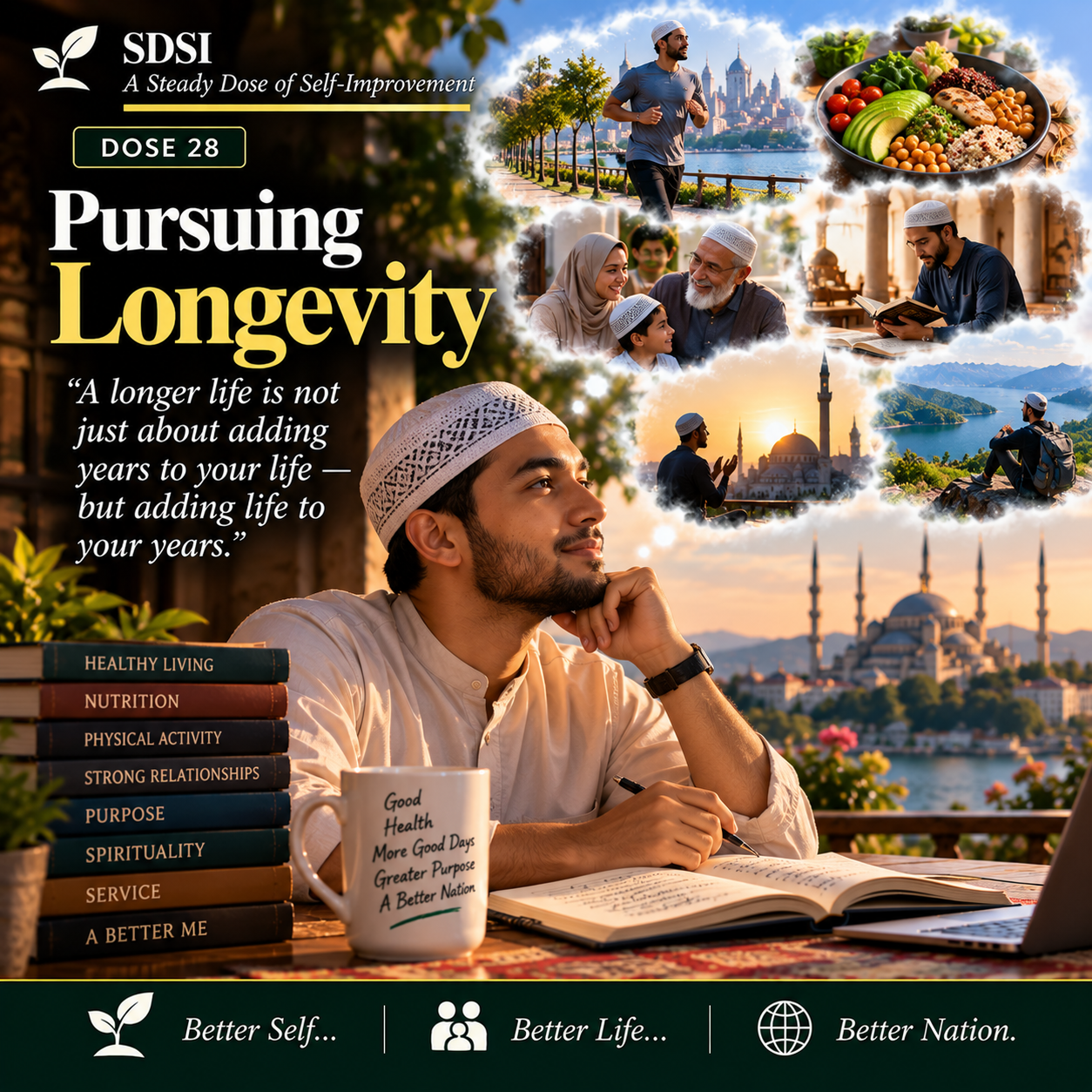
Longevity isn’t just physical survival — true longevity harmonizes the physical, mental, emotional, social,
and spiritual dimensions of who you are.

“I have signed up for what I call the Race to 100.”
I have signed up for what I call the Race to 100. I want to celebrate my 100th birthday on my feet—still able to move, think, laugh, create, and perhaps dance while surrounded by people I love. Reaching a number is not the entire goal. I want the years themselves to remain worth living.
That is why longevity should not be understood as physical survival alone. A long life becomes more meaningful when physical health is accompanied by mental engagement, emotional resilience, social connection, spiritual depth, and a continuing sense of purpose. The aim is not simply to stay alive longer, but to preserve as much capacity for living as circumstances allow.
Studies of long-lived populations repeatedly point toward familiar patterns: regular movement, nourishing food, strong relationships, purpose, and social engagement. None offers a guarantee. Genetics, environment, healthcare, chance, and many other factors also matter. Longevity is not something we can completely control—but we can influence some of the conditions under which we age.
Our beliefs about aging may matter too. In a well-known longitudinal study, older adults with more positive self-perceptions of aging lived, on average, several years longer than those with more negative perceptions, even after researchers accounted for several other factors. That does not mean positive thinking can defeat biology. It does suggest that the way we approach aging may influence the behaviors, motivation, and resilience with which we live it.
So I choose to treat aging not as a countdown but as a continuing project. I can strengthen my body. I can keep learning. I can protect relationships. I can pursue purpose. I can make choices today that my older self may one day be grateful for. The finish line is uncertain for all of us. But the way we run the race is still partly ours to shape.
Pause and Reflect
What does longevity mean to you: simply living longer, or remaining capable of living well for as long as possible? Is your present lifestyle moving you toward that picture?
One Step Forward
Imagine yourself 30 years from now. Write down one specific change that future version of you would thank you for beginning this week.
Explored in full in Chapter 19 — Pursuing Longevity of A Holistic Approach to Self-Improvement.
Pursuing Well-Being
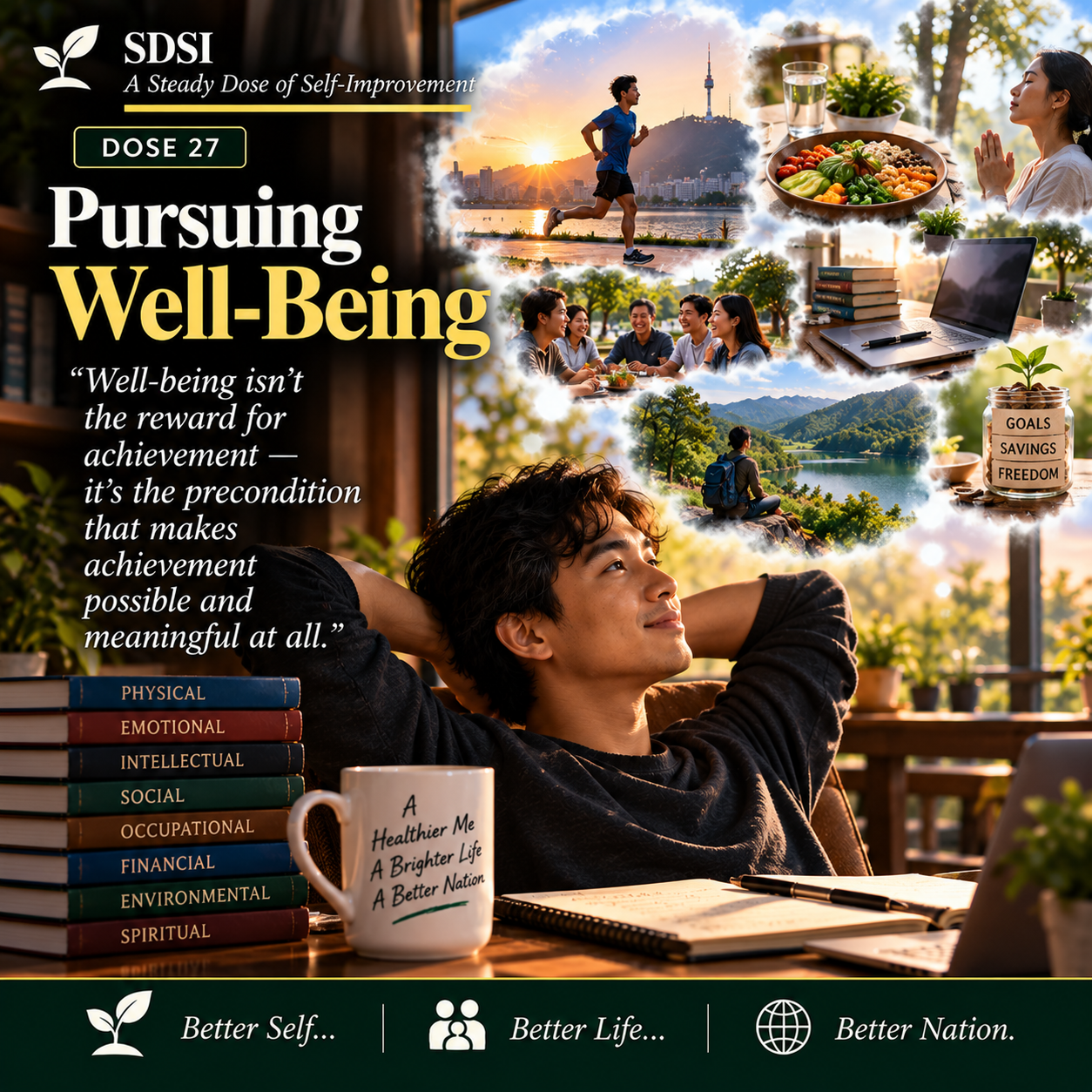
Well-being isn’t the reward for achievement — it’s the precondition that makes
achievement possible and meaningful at all.

Most people think of well-being as the absence of illness. It is far more than that.
Well-being is often reduced to physical health: no illness, no pain, a reasonably fit body. But genuine well-being reaches much further. It involves how we feel, how we function, how we relate to others, how secure and purposeful our lives feel, and whether the different parts of our lives support rather than constantly undermine one another.
One useful way of viewing well-being is through several interconnected dimensions: physical, emotional, intellectual, social, occupational, financial, environmental, and spiritual. The categories may overlap, but that is precisely the point. Human life is not divided into sealed compartments. Neglect one area long enough and the effects often spill into the others.
Research on exceptionally long-lived populations offers an interesting illustration. Communities studied for unusual longevity have often been associated with patterns such as regular movement, plant-rich diets, meaningful social connections, and a sense of purpose. Researchers continue to debate how broadly the popular “Blue Zones” framework should be applied, but the larger lesson remains useful: well-being is rarely the product of one habit. It is usually built from a pattern of living.
My own experience in South Korea has made that lesson personal. A manageable teaching schedule has given me room not only to work, but also to write, read, exercise, reflect, spend time with family, and pursue projects that matter to me. I have learned that having time outside work does not necessarily reduce productivity. Used deliberately, it can make productive work more creative, focused, and sustainable.
The goal, then, is not perfect balance every day. Life will sometimes demand more from one dimension than another. The goal is awareness: knowing when one part of yourself has been neglected for too long and having the courage to restore it before the deficit becomes a crisis.
Pause and Reflect
Which dimension of your well-being—physical, emotional, intellectual, social, occupational, financial, environmental, or spiritual—needs the most attention right now?
One Step Forward
Rate the eight dimensions from 1 to 10. Choose your lowest score and identify one small action you can take this week to strengthen it.
Explored in full in Chapter 18 — Pursuing Well-Being of A Holistic Approach to Self-Improvement.
WORK-LIFE SYNERGY: When Work Becomes Play
(A PERSONAL ESSAY)

People often talk about work-life balance. In fact, striking that balance is something I advocate in my book: A Holistic Approach to Self-Improvement. As we pursue professional growth, success, and financial security, we should not allow work to consume the other parts of life that make it worth living—our family, relationships, health, and time for ourselves. But lately, I have found myself wondering about another possibility. What happens when the line between work and life becomes blurred, not because work has invaded life, but because the work itself has become part of a life one genuinely enjoys? What happens when the two no longer seem to compete for time and attention, but instead become integrated—each enriching the other, with neither necessarily being sacrificed? Perhaps, in such a life, the challenge is no longer simply to maintain work-life balance, but to discover something beyond it: work-life synergy.
PART 1
PART 2
PART 3
Pursuing Continuous Learning
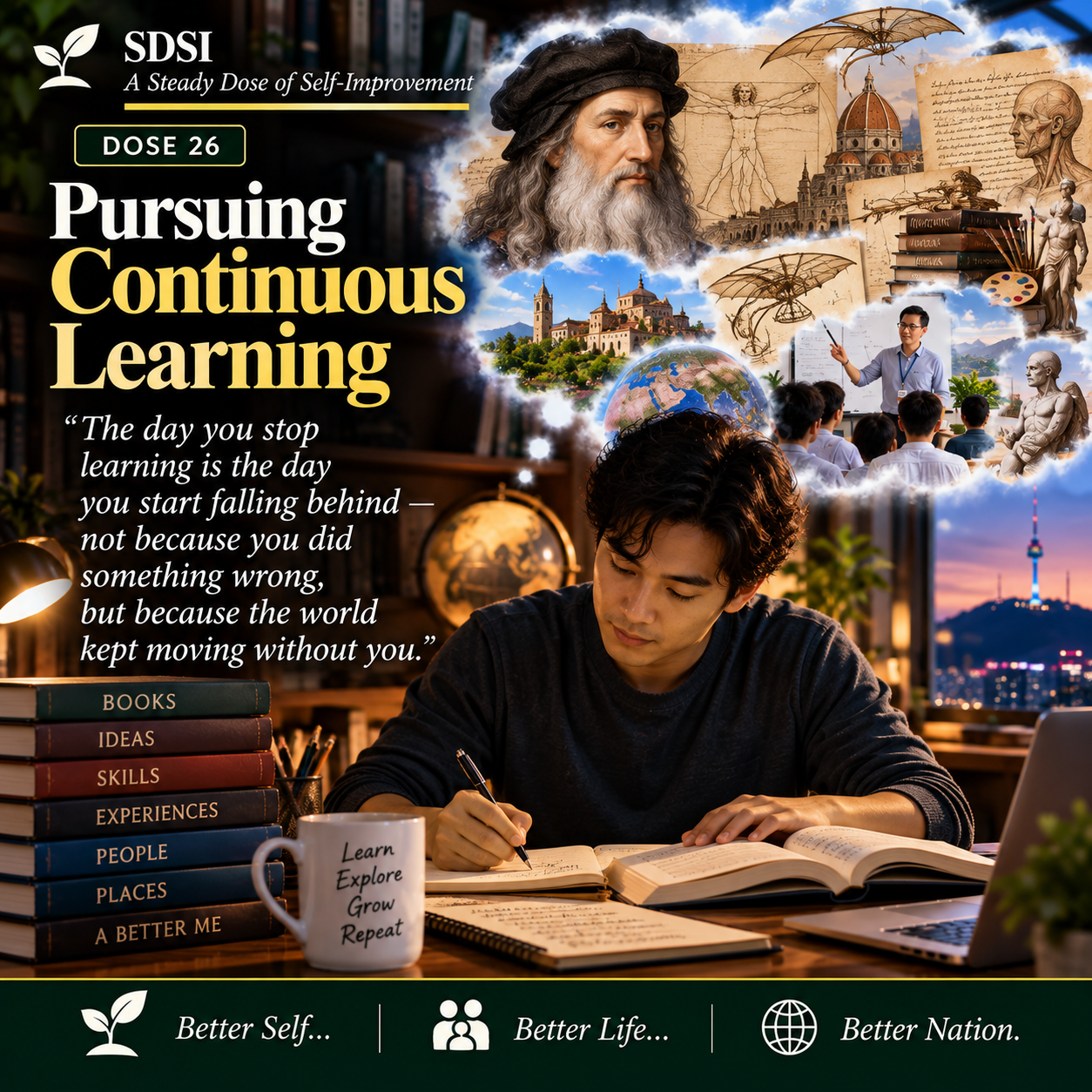
The day you stop learning is the day you start falling behind — not because you did something wrong,
but because the world kept moving without you.

Leonardo da Vinci moved freely among art, anatomy, engineering, mathematics, music, and the natural sciences.
Continuous learning is the ongoing pursuit of knowledge, skills, and experiences throughout life. It is not confined to classrooms, degrees, or certificates. It begins with a simple recognition: the world does not stop changing when our formal education ends. If we want to keep growing, adapting, and contributing, learning must remain part of the way we live.
Leonardo da Vinci remains one of history’s most striking examples of this spirit. Painter, sculptor, engineer, anatomist, inventor, musician, and observer of nature, he refused to confine his curiosity to a single field. His notebooks reveal a mind constantly asking questions, making connections, and investigating how things worked. He learned not merely for credentials or recognition, but because curiosity had become a way of life.
Warren Buffett offers a modern example from a very different field. He has repeatedly emphasized the importance of reading and thinking, and once advised students to read hundreds of pages a day, comparing the accumulation of knowledge to compound interest. The number itself is less important than the principle: what we deliberately learn today expands what we are capable of seeing and doing tomorrow.
Coming to South Korea opened a learning journey I had not fully anticipated. University teaching, advising students, presenting at international conferences, conducting research, and publishing scholarly work were not all part of my original plan. Many of those opportunities became possible because I kept learning. Each new competency revealed a door I could not have seen from where I started.
Continuous learning does not require us to return to school every year. It requires something both simpler and more demanding: remaining teachable. Read. Ask. Listen. Experiment. Learn from people younger and older than you. Learn from mistakes. Learn from unfamiliar places. The moment we decide we already know enough, we place a ceiling over the person we can still become.
Pause and Reflect
When did you last learn something significant outside a formal school setting—and how did it change what you could do or understand?
One Step Forward
Dedicate 20 minutes today to deliberate learning: read a chapter, listen to a thoughtful lecture or podcast, or practice a new skill. At the end, write down one thing you learned.
Explored in full in Chapter 17 — Pursuing Continuous Learning of A Holistic Approach to Self-Improvement.
Habit Scheme: Practices and Activities
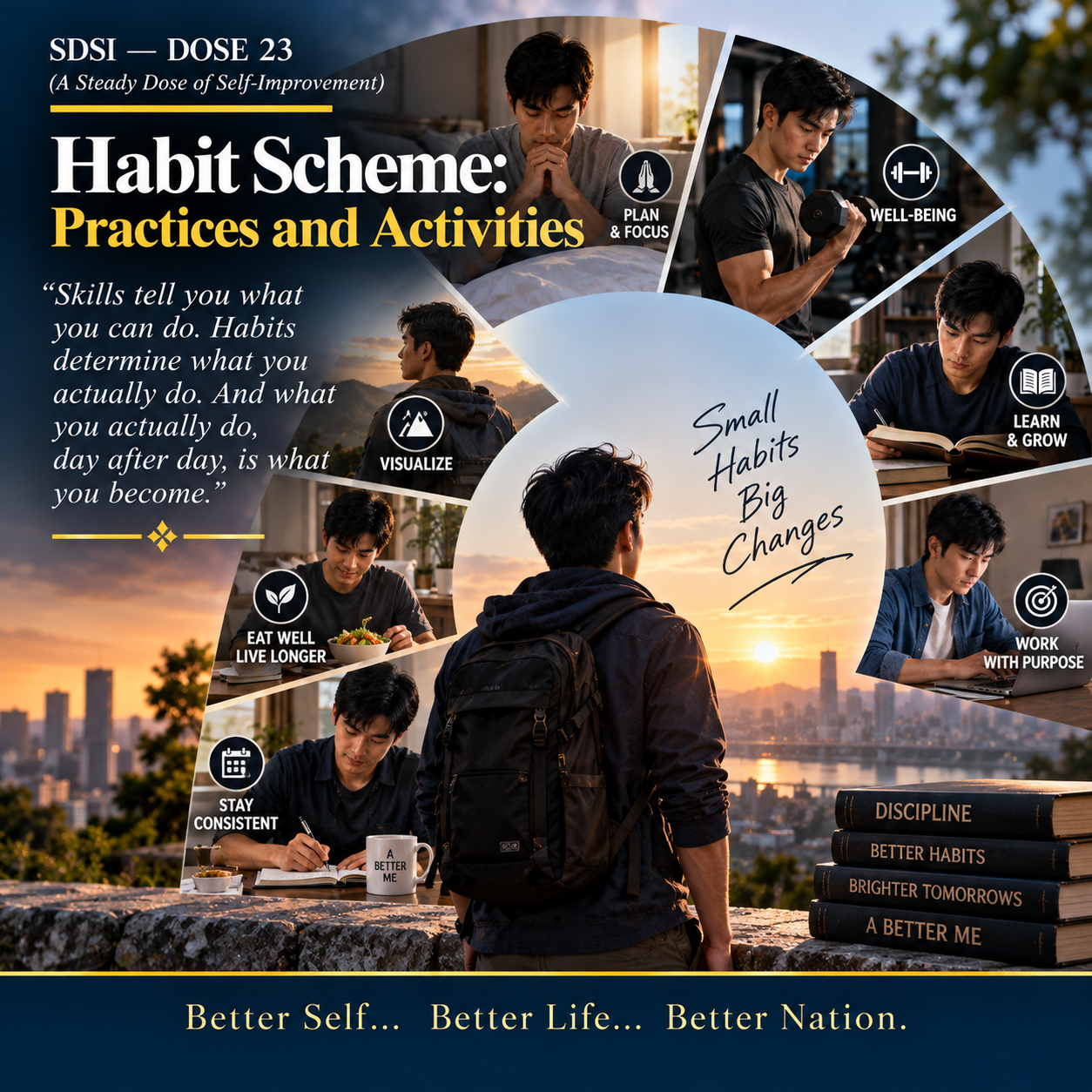
Skills tell you what you can do. Habits determine what you actually do. And what
you actually do, day after day, is what you become.

Knowing what to do means little if you rarely do it.
The Value System gives self-improvement its foundation. The Competence Framework develops the skills and abilities needed to act on it. But neither beliefs nor abilities, powerful as they are, complete the process. Knowledge and capability must be translated into consistent action before they can produce lasting results.
That is where the Habit Scheme comes in.
There is a profound difference between knowing what to do and actually doing it—especially on the days when you do not feel like doing it. That difference is often habit.
More than two thousand years ago, Aristotle argued that character and excellence are cultivated through repeated action and habituation. Centuries later, Will Durant captured that idea memorably while explaining Aristotle: “We are what we repeatedly do. Excellence, then, is not an act but a habit.”
Excellence, then, is rarely the product of one dramatic act. More often, it is the accumulated result of small, intentional actions repeated consistently over time.
This is why motivation alone is unreliable. Motivation can provide the initial spark, but it rises and falls. Habits reduce our dependence on feeling motivated every time action is required. We build routines, systems, and environments that make productive behavior easier to repeat.
The important question, therefore, is not whether you have habits. You do. The question is whether your habits are carrying you toward the person you want to become—or quietly pulling you away from that person.
Six practices comprise the Habit Scheme: goal setting and planning, visualization, continuous learning, well-being, longevity, and a consistent daily routine—all held together by self-discipline.
I learned the power of the Habit Scheme most clearly by living it. The attitudes and beliefs I developed gave me the foundation to make the leap to South Korea. The skills I had acquired enabled me to perform once I arrived. But it was what I repeatedly did—reading, writing, researching, exercising, reflecting, and continuing to learn—that ultimately determined the quality of what I produced.
Without those habits, my beliefs and abilities might have remained little more than potential.
Beliefs provide the foundation. Skills provide the capability. Habits turn both into a way of life.
Pause and Reflect
Which of your daily habits, if you are completely honest with yourself, is quietly working against a goal you say matters to you?
One Step Forward
Identify one automatic habit that is no longer serving you. Then choose one small behavior to replace it with this week. Do not try to transform your entire routine. Change one repeated action.
Explored in full in Part 2 — Foundations of Holistic Self-Improvement, Section III: Habit Scheme (Practices & Activities) of A Holistic Approach to Self-Improvement.