Category Archives: Creative Writing
On Stories and Storytelling (2)
(Second of 3 Parts)

Obviously, the conflict is the problem to be resolved in a story. If you are familiar with the literature, you know that there are three categories of conflict – man vs. man, man vs. nature, and man vs. himself. Janet Burroway proposed that the following should be included – man vs. society, man vs. God, and man vs. machine. We may also refer to them as sources of conflict.
In one of my literature classes in the Philippines, I told my students to watch the movie “Titanic.” That was when our topic was “elements of fiction.” Students would prefer watching movies over reading short stories or novels when dissecting stories.
When I asked them to identify the story’s central conflict, most answered “man vs nature.” You would understand why that was the answer they gave –Jack and Rose (and all the rest of the passengers) have to survive the ship’s sinking. They were surprised when I told them that there was a dual conflict in the story. There are two sources – “man vs nature” and “man vs man.” While the star-crossed lovers try to figure out how to stay away from the icy water of the ocean, they also have to contend with an extremely angry Cal and his loyal minion Lovejoy.
That’s how clever some writers are. They push their readers or audience closer to the edge of their seats – to the edge of the cliff of excitement – by inserting a conflict within a conflict. With that, they make the “rising action” more intense. When a writer uses multiple sources of conflict, with all the conflicts equally significant, I call it “layered conflict.” (I am not sure if I was the first to call it this way.)
What if the one who wrote the script for The “Titanic” added an extra layer of conflict? Let’s say somebody steals the necklace (“Heart of the Ocean”), and Rose asks Jack if they have to do everything to return it. Let’s say that the thief is a hardened criminal who is willing to kill just to keep what he has stolen. Would the story be more exciting if, while the lovers are trying to survive the unfolding sea tragedy, they have to pursue the one who took the expensive jewel and at the same time hide from Cal and Lovejoy?
I told my students that it would be easier to explain a story’s conflict by starting with a guide question. In the case of the dual conflict in The Titanic, the questions should be: Will Jack and Rose survive the anger of Cal? Will they (also) survive the sinking of the ship?
In another class – Literary Criticism – I taught my students how to trace symbolism in stories. I also used the movie Titanic for the activity. It was easy for them to pick the necklace and explain its symbolism – that the jewel symbolizes Rose’s heart and her love for Jack. They gave nothing more about symbolism after the necklace.
So, I told them that they should not focus only on objects for symbolism. The story – the writer – may try to convey meaning through events in the story. For example, I asked them if they could see any meaning beyond the band continuing to play while the ship was sinking. What about the sinking of the Titanic? What does it convey?
I told them that the decision of the band to continue playing while the ship sinks conveys two things. Firstly, it shows the resilience of the human spirit in the face of tragedy. Secondly, there are people who when confronted by whatever is inevitable, could face it courageously.
And what does the sinking of the mighty “Titanic” symbolize? It shows how helpless mankind is against the forces of nature.
On Stories and Storytelling (1)
(First of 3 Parts)
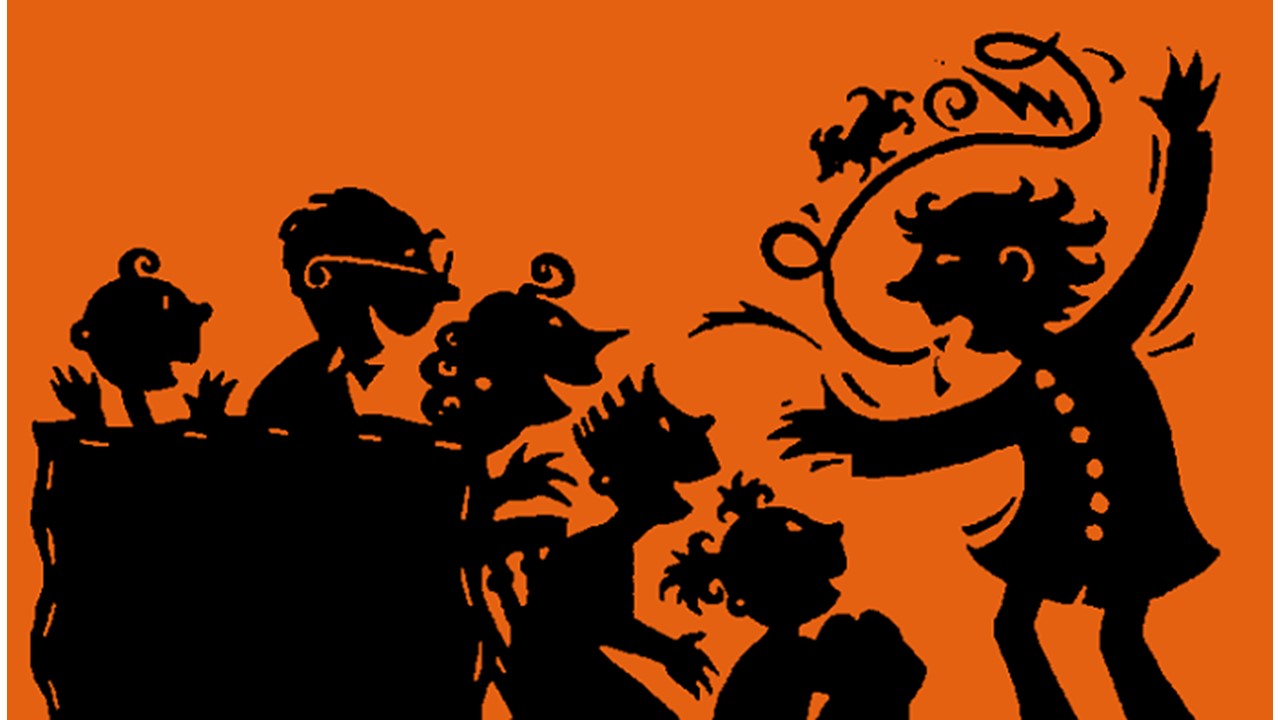
Do you really know what a story is?
Answer the question before sliding your eyes down to the next line.
Done?
Okay, read on.
Just like you, I know what a story is. I can assure you of that.
Let me begin by saying that I love stories. I am so fascinated by them. Very likely that my having earned the degree Bachelor of Arts in English and my having completed the academic requirements for the degree Master of Arts in English contributed to that. The two main fields of studies (major) in both degrees are English language and literature, but more on literature. We studied, among other things, the different forms of literature – prose and poetry, the body of literature of selected countries, literary criticism, philosophy of literature, and creative writing. Just imagine how many stories I had to read when I was enrolled for subjects like Short Story, Novel, Drama, and Shakespeare. To enhance my understanding of the stories I was reading then, I had to watch their screen adaptation (especially of Shakespeare’s famous plays) if they happened to be available. In short, I became interested with stories, not as a hobby. I studied them. I taught Literature and Literary Criticism when I was teaching in the Philippines. By the way, I worked so hard to become a writer as well. I write dramatic monologues, short stories, novels, and plays. Check my website for some of my works – madligaya.com.
I am so fascinated by the art of knitting together the elements of fiction within the frame of a plot – of how to make sure that the most important element of fiction – conflict – is laid down clearly and passes through exposition, complication, crisis (commonly known as climax), falling action, and resolution. Gustav Freitag, a nineteenth-century German critic, laid this down in what came to be known as the Freitag Pyramid. Crisis – or climax – is at the top of the pyramid. The exposition and complication constitute the rising action which ultimately leads to the crisis. Thereafter is the falling action which leads ultimately to the resolution or the denouement. There are stories (movies) that abruptly ends when the climax is reached. In cases like this the crisis implies the resolution. The resolution is left for the readers to deduce.
When a series of events is not laid down in the conflict-crisis-resolution arc, they are but just that – series of events, not a story. Conflict, crisis, and resolution (call them together as plot) are the necessary features of a story. A narrative, to be classified as a story, requires more than setting, character, theme, point-of-view, tone, and style. No matter how short or long a story is, there should be a conflict, conflict that progresses from the time it is revealed (exposition), becomes complicated, reaches a climax (referred to as crisis earlier), slows down to a falling action, and makes a full stop at the juncture called resolution. Am I right? A writer, as I articulated earlier, may stop raising the action right after reaching the climax to let readers imagine how it ends or create the kind of ending they desire.
In movies (or films), cliffhanger endings have become so popular. In cliffhangers, it can be argued that the story does not immediately end after the climax but somewhere between the falling action and the resolution. There was no clear resolution. It can be argued also that cliffhanger endings are applicable only in the case of standalone movies, not of the serialized ones like the Star Wars, Avengers, and the like. When for example Thanos (in Avengers: Infinity War) snapped his fingers and some of the Avengers were reduced to dust, we were like left hanging and wondering why all those heroes we used to seeing alive and victorious in previous Marvel movies died or disappeared. But it’s not a cliffhanger ending per se because we know that that movie is the 3rd part of the main 4-part Avengers series. We know that the last part of the series is forthcoming. All the Avenger movies, together with all the other standalone Marvel hero movies in previous years, are all part of one whole story.
You might ask, “Where are the events in Avengers 3 located in the Freitag (plot) Pyramid?” It’s in the complication (or rising action part), far away yet from the climax. Your next question might be – “Which part of Avengers 4 is the climax?” It started the moment Tony Starks snapped his fingers and said “I am Iron Man” and culminated at the moment Thanos slowly turned to dust. All the events that followed are parts of a very clear falling action and resolution.
What do you think, am I right not to consider the endings of serialized stories as cliffhanger endings (because of the imaginary “To be continued”)?
An example of a movie that had a climax and a falling action but the resolution was not clear and the audience need to decide what to think about it is the way the movie “Don’t Breathe” ends. (I hope you have watched that movie too… and in case you haven’t, I am sorry if this part of my article will now serve as a spoiler. Just skip reading the rest of this paragraph and proceed to the next one instead in case you’re planning to watch the movie.) The climax of that movie came at exactly the 1:20:43 mark. The blind man, after Rocky hits him repeatedly in the head with a crowbar, falls from the 1st floor of the house to the basement. Part of the falling action shows Rocky coming out of the house alive with the blind man’s money. Later she could be seen with her sister leaving Detroit for California. The movie ends showing that the blind man alive. He survived. And I was left formulating my own resolution… or is a sequel (or a prequel) being planned?
I used to teach Literature, Creative Writing and Literary Criticism in the Philippines. One of my students once asked this question: Should all stories have conflict?
If you were me then, how would you answer?
Do you think a series of events stitched up together in any form can be considered a story without a central conflict?
From Janet Burroway’s “Writing Fiction: A Guide To Narrative Craft”:
“And story is a form of literature. Like a face, it has necessary features in a necessary harmony… Every face has two eyes, a nose between them, a mouth below; a forehead, two cheeks, two ears, and a jaw. If a face is missing one of these features, you may say, ‘I love this face in spite of its lacking nose’, but you must acknowledge the in spite of. You can’t simply say, ‘This is a wonderful face.’
The same is true of a story. You might say, ‘I love this piece even though there’s no crisis action in it.’ You can’t say, ‘This is a wonderful story.’
Fortunately, the necessary features of the story form are fewer than those of a face. They are conflict, crisis, and resolution.
Conflict is the first encountered and the fundamental element of fiction, necessary because in literature, only trouble is interesting.”
Let the foregoing paragraphs be my answer to the question “Should all stories have conflict?”
If a narrative has no conflict, don’t call it a story. Call it a face without any part that should be there – eyes, nose, mouth, cheeks, or forehead.
The Eulogy
(A Dramatic Monologue)
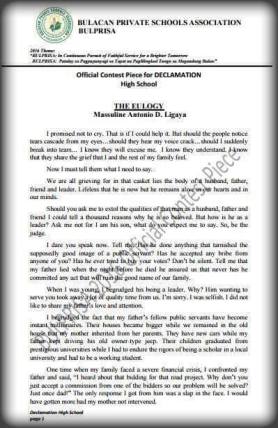
I promised not to cry. That is if I could help it. But should the people notice tears cascade from my eyes…should they hear my voice crack…should I suddenly break into tears… I know they will excuse me. I know they understand. I know that they share the grief that I and the rest of my family feel.
Now I must tell them what I need to say…
We are all grieving for in that casket lies the body of a husband, father, friend and leader. Lifeless that he is now but he remains alive in our hearts and in our minds.
Should you ask me to extol the qualities of that man as a husband, father and friend I could tell a thousand reasons why he is so beloved. But how is he as a leader? Ask me not for I am his son, what do you expect me to say. So, be the judge.
I dare you speak in this gathering now. Tell me. Divulge in this assembly. Has he done anything that tarnished the supposedly good image of a public servant? Has he accepted any bribe from anyone of you? Have you received five hundred pesos or a thousand from him so you would write his name in the ballot? Don’t be silent. Tell me that my father lied when the night before he died he assured us that never has he committed any act that will ruin the good name of our family.
I have to admit that there were many times when I was young that I begrudged his being a leader. Why? Him wanting to serve you took away a lot of quality time from us. I’m sorry. I was selfish. I did not like to share my father’s love and attention.
I begrudged the fact that the families of my father’s fellow public servants have gone from rags to riches…instant millionaires. Their houses became bigger while we remained in the old house that my mother inherited from her parents. They have new cars while my father kept driving his old owner-type jeep. Their children graduated from prestigious universities while I had to endure the rigors of being a scholar and a working student in our state university. How I almost hated my father when he refused the offer of the university president that I become a scholar without taking any examination. He said that just like everybody else I have to go through the process. It’s a scholarship. I must have it only if I deserve it.
One time when my family faced a severe financial crisis, I confronted my father and said, “I heard about that bidding for that road project. Why don’t you just accept a commission from one of the bidders so our problem will be solved. Just once dad!” The only response I got from him was a slap in the face. I would have gotten more had my mother not intervened.
Then from being the head of this town your urged him to lead the whole province. He accepted the challenge. Then he rocked the boat. What he did in our town he promised to do to the province…rid it of illegal gambling, drugs and corruption…stop the quarrying being done in the mountains and rivers…bring our province back to the map of significance.
The latest surveys show him leading by a mile. His opponents got very nervous.
Then a week ago, while talking to some supporters, a visitor came to our house, a man accompanied by a slew of bodyguards. One of them was carrying a large travelling bag. He wanted us to just call him Mr. Chua. The supporters of my father went out when the talk started. I stayed. I was requested to open the travelling bag and there I saw bundles of crispy thousand bills.
“Withdraw from the race and you’ll have all of these. There’s another travelling bag in my van, if that is not enough. Refuse it and you know what will happen.” Mr. Chua said.
My father looked at me. He stood and approached Mr. Chua then slapped him. “How dare you bribe me in my house and in front of my son.”
As Mr. Chua wiped the blood from his lips he said, “You made your choice.”
The visitors left with their money.
The following day, while delivering a talk in a meeting… what I considered inevitable… what I feared was certain to happen… came to past. My father met his tragic end. A hail of bullet reportedly from two gunmen killed him.
Now we are grieving. Crying. Lost. A flock left by a shepherd. You asked me if I could continue my father’s fight. I told you that my father asked me never to follow in his footsteps.
But for the first time in my life that I will go against my father’s desire. Forgive me father…but I feel obliged to continue what you started. They killed you but the flame of change which you kindled will not be extinguished by the bullet they sprayed on you. Your blood spilled is not a water doused on that flame but a gasoline that will keep it burning.
My father will not bring to his grave the reforms he sought. His visions for a better life for all of us in this province will not die with him.
Ako’y Alipin Mo
Ika’y pintig na sa puso ko’y tumibok
Lakas na sa mundo ko’y nagpapaikot
Ngunit ang ngiti mo sa akin ang dulot
Isang laksang saya’t labis-labis na lungkot
Ikaw ay kaligayahang dapat damhin
Gayon ma’y mabigat ka ring suliranin
Ika’y kayamanan kung aking ituring
At kabayarang dapat na balikatin
Ika’y amihang ginhawa sa tag-init
Hatid mo ri’y init pag gabi’y malamig
Kandungan mo’y itinuturing kong langit
Bilangguan nang inaliping pag-ibig
Ang ibigin ka’y parusa kung ituring
Ngunit takda ko’y maging iyong alipin
Hagupit ng pagmamahal tatanggapin
Kung ito ay sa puso mo manggagaling
Talinghaga kang mahirap na arukin
Palaisipang ‘di ko kayang sagutin
Magkaganun man ikaw ay mamahalin
Magpakaylan man ‘di kita lilimutin
Pangako mo ma’y mahirap panghawakan
Madali mang sa iyo na ako’y iwanan
Ang mahalin mo kahit panandalian
Dulot ay ligayang walang katapusan
Hanggang Sa Kawalang-Hanggan

Kita’y katabi, tag-araw o tag-lamig
Kaulayaw ka maging sa panaginip
Mga puso nating iisa ang pintig
Binigkis tayo sa tunay na pag-ibig
Sinamahan akong maglakbay sa dagat
Bangka ko’y nilagyan ng katig at layag
Araw kang sa umaga ko ay sumikat
Sa buhay naging sandigan ko’t lakas
Lagi kang nandoon, ‘di ako iniwan
Handa ka palagi na ako’y damayan
Matindi mang dagok sa buhay dumaan
Sa lungkot at saya ako’y sinamahan
‘Di ako iniwan, lagi kang nandoon
Buhay mo tila sa akin nakatuon
Kasama kita sa paglipas ng panahon
Mga pagsubok, sabay nating sinuong
Ano man ang ating mga pinagdaanan
Kamay ko ay mahigpit mong hinawakan
Pagmamahal mong sa aki’y pinaramdam
Ang ligayang dulot walang mapagsidlan
Pagmamahal mo ri’y tila isang paham
Gurong araw-araw akong tinuturuan
Kay daming aral sa ‘yo ko natutuhan
Pintig ng puso mo ako’y ginagabayan
Napakaraming taon man ang lumipas
Pagmamahal mo nanatiling matingkad
Tamis ng ngiti mo ay hindi kumupas
Hindi ko nanaising ito’y magwakas
Pag-ibig ko sa ‘yo, mananatiling wagas
Daang taon man sa panaho’y malagas
Mga kamay mo’y mananatiling hawak
Kawalang-hanggan ma’y marating ang wakas
Inggit

Bakit kung kapwa’y may biyayang nakamit –
Noo’y kumukunot, mata’y naniningkit?
Bakit ang dibdib mo’y biglang naninikip?
Apdo mo’y sasabog sa tindi ng inggit!
Ang inggit ay parang nagbabagang uling
Serenidad mo’y kaya nitong tupukin
Ipagpag ito’t ibaon sa buhangin
Sa isipan mo’y huwag itong pagapangin.
Inggit ay dalahing mabigat sa isip,
Parang tinik na bumabaon sa diddib.
Ito’y hadlang upang ika’y matahimik
Iwaksi ng ligaya’y iyong makamit.
At alalahaning inggit ay kabilang
Sa pitong nakakamatay na kasalanan
Kaya’t pananaghili mo na’y tigilan
Kinimkim mong inggit iyo nang bitiwan
Kung kapwa’y nagtagumpay, ‘wag managhili
Sa halip ay samahan silang magbunyi
Huwag kang magalit at manggalaiti
Kamayan mo sila’t bigyan ng papuri.
Magdiwang kung kaybigan mo’y umaangat
Tularan ginawa nilang pagsisikap
Pananaghili’y sagabal sa pagunlad
Taong mainggiti’y walang dignidad.
Magalak sa nakamit nilang tagumpay
Huwag dahil sa inggit, ika’y maglupasay
Bagkus magpunyagi’t piliting magsikhay
Sikaping iangat antas ng ‘yong buhay.
Bolero

Gabi noon nang umuwi si mang Teban
Itong si Bebang sa pinto nakaabang
At nang asawa’y pumasok sa pintuan
Pinadapo’y hampas sa kanyang bumbunan.
Sa nakita’y natawa anak na si Juan
Amang napaluhod siya’y sinimangutan
At nang makatayo lumapit kay Bebang
At siya’y tinanong, “Bakit ngayon ka lang?”
“Darling… sorry ako kasi’y nagovertaym.”
“Hoy… hoy kalbo luma na ang tugtuging ‘yan
Kung ‘di OT… traffic ang idadahilan
Gasgas na ang mga palusot mong ‘yan.”
Alam mo ba Bebang na A-B-C-D ka,
Sa totoo lang eh E-F-G-H ka pa.
Ika’y I-J-K, maniwala ka sana.”
Si Bebang ay natahimik… takang-taka.
A – as in AWESOME… B… Bebang you’re a BEAUTY,
Bilang asawa ika’y napakabuti,
C – you’re CHARMING, taglay mong ganda ay matindi,
D – so DAZZLING, wala na akong masabi.
“Matandang kalbo ako’y tigilan mo na,
Ika’y diyan magaling… sa pambobola.”
Ngunit halatang si Bebang… kinilig na,
Habang si Juan sa gilid… tawa nang tawa.
“E – EXCITING, oh kay sarap mong kasama,
F – FAITHFUL, sa akin Bebang ay tapat ka,
G – I’m GLAD ika’y aking napangasawa,
H – You’re so HOT Bebang, sa kuwarto’y tara na.”
Hetong si Juan, sa nangyari’y takang-taka
Animo’y na-hypnotize ang kanyang ina
Ina’y sinundan ang nagbubunying ama
Silid nila’y magdamag na nakasara.
Kinabukasan nang sila’y nagsigising
Naisipan ni Juan na ama’y tanungin –
“I-J-K… ano po ang ibig sabihin?”
Bulong ni Teban … “I’M JUST KIDDING.”
 M.A.D. LIGAYA


 M.A.D. L I G A Y A