Each meeting with my students is important but it’s the first day that I consider very special – the most strategically important. It’s the day that I would attempt to accomplish one of the hardest things to do in education – to shatter the students’ image of the classroom as a prison cell, with them as prisoners and the teachers as nasty prison guards. It’s the day when I begin to lay the foundations of what every teacher should endeavor to forge between them and their students – a good rapport.
The entire semester is a long haul and I know that winning their hearts would make our journey together as enjoyable and productive as it could be. If I succeed in making them trust me, half-of-the battle is already won. Earning the trust of my Korean students is very important to me as an expat teacher teaching English. What makes that task of earning their trust not only necessary but also (doubly) challenging is the fact that I maybe an ESL teacher with the proper qualifications and training but I am not from any of their preferred native English-speaking countries.
There’s nothing very special about the way I conduct my first meeting with my new students here in South Korea. It’s just a bit unconventional.
My introduction would always include telling my students the nickname which I adopted with the intention of eliciting laughter whenever I deliver a talk – Tonitonipoponibananananapoponinomimayfofoni. (That’s inspired by the song “Name Game.”) Amazingly, when I tell my students that and jokingly threaten them to memorize it if not they would fail in my subject, they would try very hard to repeat it after me and laugh at themselves if they wouldn’t be able to say it.
Then I would add, “Whoever could say my nickname correctly will get an A+.” I don’t mean it of course. Luckily, up until this time, no one among those who tried succeeded. It was I who would always succeed – in getting their attention.
From there, I would give them the necessary information about me as their teacher. The most significant of which (as far as I am concerned) is the number of years I have been teaching. It’s 34 years. The point I wish to drive home for highlighting to my students how long I have been teaching is – I wouldn’t stay this long in the academe if I don’t love my job.
The next part of my first-day-of-class script would touch on the boundaries of philosophy.
I would be delivering something like an“eve-of-battle” speech. The way they do it in movies.
I would ask my first question: “Why am I a teacher?”
Puzzled, the students would grope for an answer.
I would give follow-up questions after that – Would you call a woman a mother without a son or a daughter? Are your mothers and fathers mothers and fathers without you as their children?
Amid their “aahs” and nods I would then say, “I am a teacher because of the students. My reason for being a teacher is each of you. Without you, I am just a person – not a teacher.”
That’s my way of telling my students that the most important stakeholder in a school are them. Schools exist because of them. School administrators and teachers have work because of them.
That’s my way of telling them that I exist (as a teacher) to serve their interests.
I would end that part with the following statement: “Thank you for having me as your teacher.”
After that, I would show them a video clip from the movie “Collateral Beauty” – that part where Howard Inlet, the character played by Will Smith, delivered a speech in a gathering of his employees at the beginning of the movie.
“What is your why? Why did you even get out of bed this morning? Why did you eat what you ate? Why did you wear what you wore? Why did you come here?”
I would pause the video clip after each question and would ask them to give an answer.
Then I would ask them follow-up questions. (These were the only questions I asked when I was not yet using that movie clip.)
Why are you here in school?
Why do you want to finish your studies?
The last question I would ask is– Why did you enroll in this class?
I never failed to ask the said questions because I want my students to understand that for them to succeed not only in their studies but in all their present and future endeavors, they need to set goals. They ought to know their whys. They must know the reasons why they do what they do, say what they say, and think what they think.
I would tell them also that the worst “why” to have for studying is to get A+ – that grades are not the be-all and end-all of schooling.
All of the foregoing would be finished in twenty to thirty minutes.
I would then ask the student to introduce themselves.
After all of the foregoing, I would proceed to the presentation of the course syllabus – explain the course objectives, give the topics to be discussed weekly, and tell them what activities will be done in the class and how are they going to be graded.
In explaining discipline in the class, I would simply ask this question – “Are you small children?” They would of course say “NO.” Then I would tell them this – “I, therefore, expect you not to speak and behave like small children.”
Then we proceed to the finale – the presentation of course requirements.
It’s not surprising to see the students frown when they see the course requirements on the last page of the syllabus. That’s the time that I would deliver the last part of my “eve-of-battle” speech.
I would ask – “Is learning fun?”
As expected, majority would say “no.”
My next question would be – “Is work fun?”
Of course the students would say “no” again. And every time I would ask that, one or two would say “There were many times I heard my father complained about his job.”
Then I would go on and tell them the following:
“Nothing is to be given to you in a silver platter. You need to work hard to achieve your dreams. Studying and working would require effort – you have to exert mentally, emotionally and physically. But something could make studying and working fun – your attitude. Your attitude towards studying will be dictated by your whys. Your whys put together is your philosophy.”
I told my students that I would be lying should I tell them that studying is easy. Then I added the following…
“Going to the gym to exercise is not also easy. Doing all forms of exercises… lifting barbells and dumbbells is stressful. You stress your muscles. But what would be the result? Your body will look better and you will be healthier. That kind of stress is good. But you have not only a body but a mind as well. You need to develop both. Now, imagine the books as barbells and dumbbells. You read them to exercise, not your body, but your brain. Reading… studying… that’s the way you develop your mind.”
I would spend another minute or two to explain something about “personal philosophy.” At the end I would tell them that each teacher has a personal teaching philosophy and mine is as follows:
“The classroom is my playground. The students are my playmates. The subject is our toy.”
How surprised they would be whenever I say that when I come to class I don’t work, I play. Work is hard. Play is fun.
As we end the first meeting I would tell them, “Come back next week and let’s play.”
The 2nd of March (2023) marks the completion of my first decade here in South Korea. My heart is bursting with gratitude for having been given the chance to work and live here for the past ten years. I could not thank God enough for guiding me and helping me find a niche most suitable for my personal and professional growth. I am forever indebted to Dr. Mark Celis and Dr. Larry Chong for considering me qualified to teach paving the way for my entry to this country via Gyeongju University. A lot of thanks also to Dr. Sheri Slick and Mr. Damon Osburn for opening the doors of Hanseo University (where I have been teaching since 2014) for me.
Salute to the universities aforementioned for believing that teaching English should not be made exclusive to citizens from native English-speaking countries. Thanks to the universities here in South Korea for believing that Filipinos like me can teach English. In my 10 years here in South Korea, I did a “quiet comparative analysis” of ESL teachers from those “seven countries” and mine. I focused my comparison on the areas of pedagogy, professionalism, and attitude. My findings… universities here in South Korea and elsewhere should seriously reconsider their policy of hiring teachers from the said countries only.
Teaching overseas is in the list of my career choices ever since. It was part of my career pathing. I prepared and trained for it. Eventually, I decided to take this path for three reasons – “greener pasture,” job burnout, and a personal demon that I had to slay.
Many of my loved ones and friends considered my going to South Korea a bad move. I had a great career in my country and the pay was not bad. I had other sources of income as well. They considered it unwise for me to still want to work here. But as I said, I wasn’t just seeking financial stability. I really got tired of my previous jobs supervising people and doing administrative work. I wanted to just teach and pursue my other passion – writing.
I was really at the crossroads of my career at that time and it did not help that I was also suffering from a personal crisis. I felt I had to do something. I had to do one life-altering decision. I was like Jake Sully, the main character in the movie “Avatar” saying, “Sometimes your whole life boils down to one insane move.” So, I made the move. I decided to come here. As it turned out, this country is the perfect place for me tame a “toruk makto.” Not that mythological creature in the movie but MYSELF.
Honestly, the past ten years were the most productive years of my life personally and professionally speaking. God willing, I would still like to spend the next ten years of my life here. This country has become my second home. It has been a channel of blessings for me and my family. I have nothing but respect and gratitude for this country, its people, and the two universities that granted me the opportunity to serve.
We are required to render only 19 hours of work weekly staggered in a 4-day period. There are 168 hours in a week. Imagine the amount of free time that we teachers have here in the university where we are teaching. We don’t even work for a total of roughly 5 months (but we still get paid) because of the winter and summer breaks. So, how did I spend my free time in the past 10 years?
Given all the free time that I had in the years past, I was able to pursue my other passion vigorously – writing. I was able to create not just 1 but 3 websites. Last year, I created 2 YouTube channels. Those websites and channels are my workshops – they serve as my training ground and a haven for self-expression. In addition, almost yearly that I was able to finish research works that were either presented in international conferences or published in indexed journals (or both). Those free time also allowed me to pursue “self-improvement” both as a personal activity and advocacy and… to count my blessings.
My journey will continue. I will tread the same path that I have been treading in my next years here in South Korea. My desire to achieve my full potential as a person and as a professional is a torch that will remain lit to brighten that path.
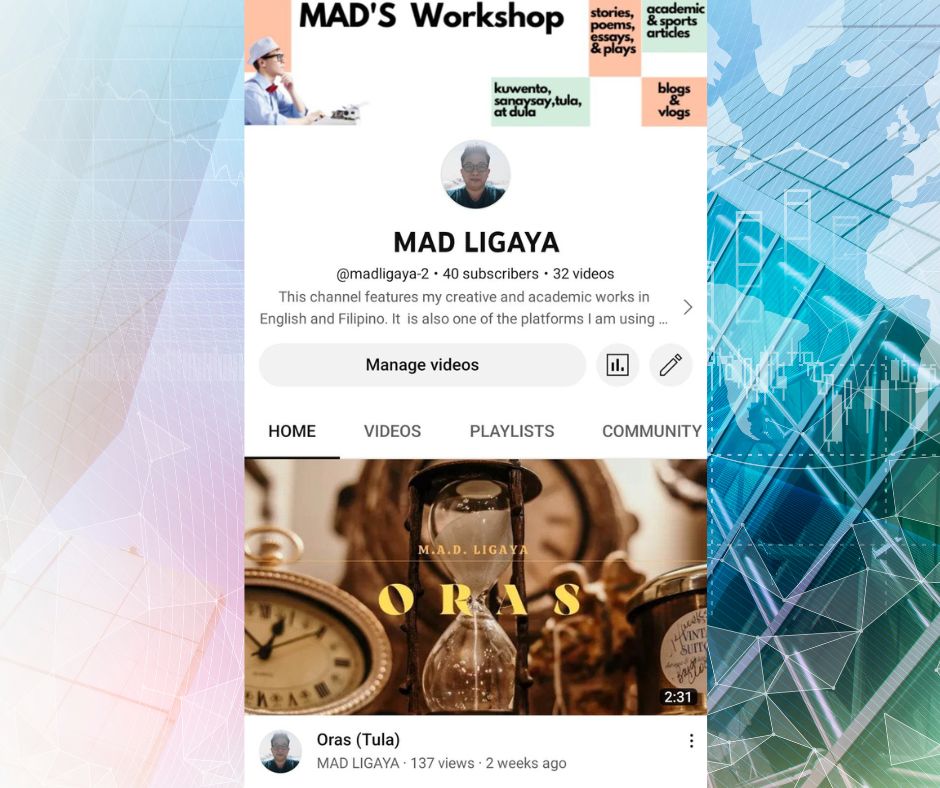
MAD’s Workshop is the new name of my other YouTube channel, the same name I adopted for my Facebook page, websites, and other social media platforms I am using. A workshop is a place where artists and artisans go to either create or hone their skills. My YouTube channels and websites are my workshops.
This channel features my creative and academic works in English and Filipino. It is also one of the platforms I am using in sharing my expertise as a teacher as well as my experiences as an expat working and living in South Korea. I also post here videos of my lectures in subjects I teach and video recordings of my talks/speeches in seminars/conferences where I get invited as speaker/discussant/lecturer.
I have varied interests – language, literature, education, educational management, social sciences, research, and personal growth and development. I write stories, poems, essays, plays, academic and sports articles, movie reviews, and social commentaries. I also create videos for some of my written works in English and Filipino. They are the ones I publish on this channel. I also publish here the same videos I post on my other YouTube channel – “The Road to Self-improvement.”
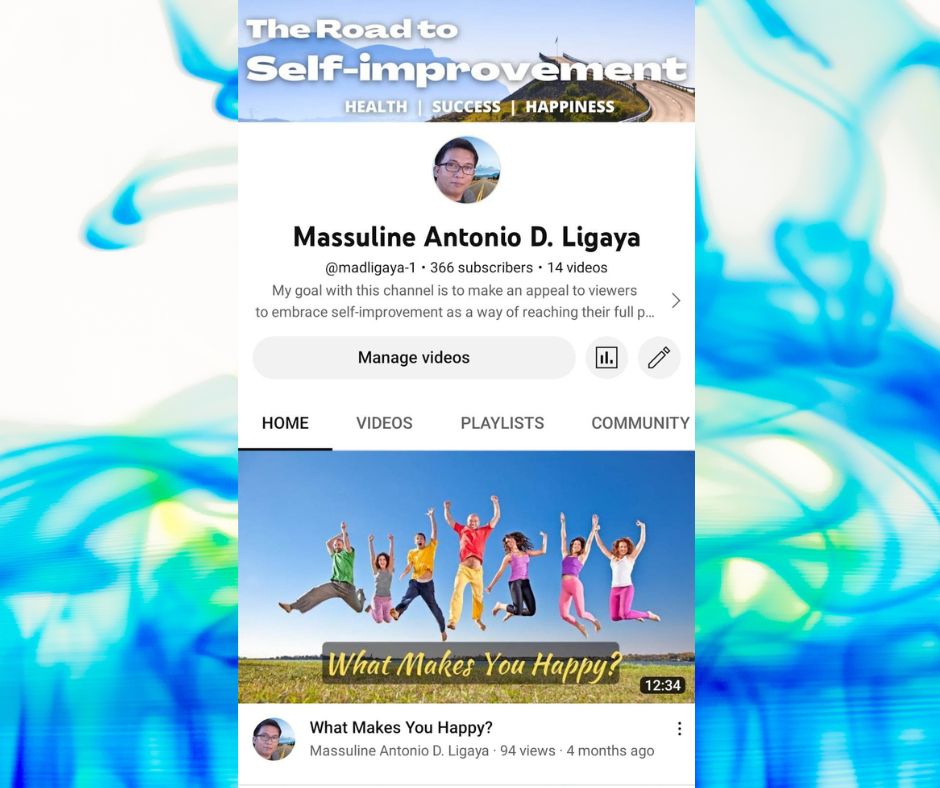
After 365 days, my first YouTube channel – “The Road to Self-improvement” – attracted 366 subscribers only.. I would love to have more but my goal for putting up the channel is not to have as many subscribers as possible but to advance one of my advocacies – SELF-IMPROVEMENT.
My goal with this channel is to make an appeal to viewers to embrace self-improvement as a way of reaching their full potential. I do believe that people will achieve success, have good overall health, and find happiness only when they become the best version of themselves. To strive to be the best one can be is a perfect duty toward oneself, family, and country.
I strongly believe that self-improvement is a prerequisite for national development. Only when citizens succeed in their personal undertakings and professional endeavors that they can contribute to the betterment of their country. The goal in the pursuit of personal undertakings is achieving good health, success, and happiness. For professional endeavors, it is to succeed in either work or business… or both. When people achieve their goals in both their personal undertakings and professional endeavors, there is no way for a country to go but be peaceful and progressive.
Some of my videos are delivered in Filipino because I intend to reach out to more of my countrymen and help raise among them an awareness of the importance of self-improvement.
You can love LeBron James or hate him, but you can’t ignore his greatness. “The kid from Akron” has accomplished much, not just as an athlete but as a businessman, that even his staunchest critics and haters, the “Skip Baylesses” of the world, could not help but sing praises.
The list of his career highlights and awards is long. On top of that list are 4 NBA championship rings and the same number of NBA Finals MVP trophies. He was also voted NBA MVP 4 times. His critics would be quick to mention that Michael Jordan has more rings and trophies than Bron and therefore is a greater player… and the greatest of all time. Bill Russel won more championships than Jordan and Lebron combined. So, should he be the GOAT? I could almost hear basketball pundits calling me names for asking that question. They might even say that I know nothing about basketball for not agreeing that MJ is the GOAT.
For the record, I don’t buy the idea of declaring a basketball player as the GOAT. Each of the aforementioned players is/was great. The list of great players who showcased their superb talents and have brought us entertainment through the years is long. The GOAT debate is just like a championship ring. It is rounded and has no beginning or end. Discussions about it would always end in a stalemate. Nobody could definitively say who among past and present basketball players is the greatest of all time. Nobody could claim that they have a statistically sound metric to objectively determine who among those basketeers should be declared the best. Not because ESPN’s Stephen Smith says that Michael Jordan is the greatest hooper that everybody in the basketball universe would already accept it as the truth.
We cannot disregard the greatness of a certain athlete by saying that another one is better. We should not diminish LeBron’s greatness by saying that Jordan (or anyone else) is a better cager. We should learn to appreciate the accomplishments of players individually, not comparatively.
I find it amusing how the LeBron doubters would eagerly await that he fails at something or his team would not perform as well as expected for them to have something to say against him. Is it because they expect too much from him or do they just hate to see him succeed? They won’t consider him helping bring his teams (Miami & Cleveland) to eight straight finals as an accomplishment but rather a monumental failure having succeeded only thrice in those multiple trips to the NBA finals. They refuse to give him credit for leading the Cleveland Cavaliers to come back from a 1-3 deficit and win the championship citing as the reason the suspension given to Daymond Green in Game 5 of that series. They also considered the championship he won with the Lakers as insignificant because the 2020 NBA season was shortened and disrupted by the COVID-19 pandemic. In short, his critics would always find a way to either downgrade or disregard his greatness.
But no matter what the fault-finders say, LeBron remained steadfast in his quest for greatness. At the age of 38, he remained competitive. I don’t know if any player could beat him in the category of longevity. And it is not just a matter of playing as long as they could but playing at a level the way Lebron has been doing it.
Whether he could play as long as Kareem Abdul Jabbar (who retired at the age of 42) remains to be seen. But what is certain to happen is him passing Kareem as the NBA’s all-time leading scorer. As of today (01-04-23), Lebron has 37,903 points. He needs just 485 more points. He is therefore at the precipice of another great milestone. Estimates have it that sometime in February, 2023 the “Kid from Akron” will be breaking the said record that stood since 1984.
King James, for me, is an epitome of a person “aging like fine wine.” At the age of 37, (according to Forbes) LeBron James is the first active NBA player ever to become a billionaire. At the age of 38, he is about to become NBA’s all-time leading scorer. By the way, among the top 5 all-time leading scorers, he has the highest number of assists and is third in total rebounds.
We don’t know if those who despise Lebron so much would be happy to see him add all those feathers to his cap. They may be. Skip Bayless said he is. I have no reason to doubt Skip… or should I?
Those who assume that the academe is an ideal workplace where everybody thinks, acts, and talks within the bounds of professionalism and fair play are in for a big disappointment. It is a mistake to think that the school is an organization without faults and that those who work there are infallible. Schools are similar to all other institutions in our society. They are not perfect. And the people who work there – as educated as you may think they are – are human beings susceptible to human frailties.
The foregoing are the things I discovered having served in 8 different schools in 2 different countries. If years were feathers on a cap called an academic career, I already have more than 30 of them. Those years I spent in the academe, both as a classroom teacher and as a school administrator, gave me the opportunity to mingle with different kinds of students (and their parents), teaching and non-teaching personnel, administrators, and school owners.
Imagine the wealth of experience I gained during those years supervising teachers and being one of them. Indeed, I experienced a lot, both good and bad. On top of being able to hone my pedagogical skills, I learned how to deal with different personalities, both good and bad. I obtained a lot of insights about school operations and organizational behavior… insights that could not be read in books.
I learned a lot of lessons, very valuable ones. One of the most significant lessons I learned from the past years of my stay in the academe is “Be not a Don Quixote.”
In case you don’t know him, Don Quixote is a fictional character introduced to the world by the Spanish author Miguel de Cervantes through his epic novel “The Ingenious Gentleman Don Quixote of La Mancha.”
For you to know him better, let me (not paraphrase but) give you exactly how sparknotes.com describes the character.
“The novel’s tragicomic hero. Don Quixote’s main quest in life is to revive knight-errantry in a world devoid of chivalric virtues and values. He believes only what he chooses to believe and sees the world very differently from most people. Honest, dignified, proud, and idealistic, he wants to save the world. As intelligent as he is, Don Quixote starts out as an absurd and isolated figure, becoming a pitiable and lovable old man whose strength and wisdom failed him.”
In any workplace, people are classified as employees, middle managers, and employers. Let me call the employees “people downstairs” and the middle managers and employers “people upstairs.” Most of the time, in the schools where I served in the Philippines, I was “upstairs.” Here in South Korea, “downstairs.”
We all dream of belonging to an organization where everybody from downstairs to upstairs coexist peacefully. But out of 10 organizations, how many have fostered a harmonious coexistence among all members? It’s hard to guess.
I know both sides of the fence are seemingly locked in the ancient battle between good and evil. Whatever side is good… and evil… is anybody’s guess. The relationship between employees and those supervising them is analogous to the relationship between the administration party and the opposition in the realm of governance. They are in perpetual disagreement.
Usually, the point of disagreement between subordinates and their superiors (in the academe.. between teachers and school administrators) emanates from the creation of new policies and the corresponding changes they create.
Naturally, people abhor changes. Anything that displaces us from our comfort zone makes us anxious and uncomfortable. Our comfort zones are like territories we will defend at all costs. This is because we are hardwired to resist change. Psychologists found out that the part of the brain called the amygdala interprets change as a threat and prompts the body to release the hormones for fear, fight, or flight.
But some changes are inevitable in organizations, in the business world, or in the academe. We could resist them all we wanted, but they would happen whether we liked it or not. We can howl our disagreement as loud as we can, but that will not prevent changes from happening.
In a related essay that I wrote, I pointed out the following…
“What employees (teachers) need to bear in mind is that employers (school administrators) have to do what they need to do for their business to prosper or simply survive. They must implement changes and tweak policies at a certain point, sometimes when the employees least expect them. Notwithstanding disagreements from downstairs, changes people upstairs want to make will be implemented.
When changes are implemented and policies get tweaked, the employees should not take them personally. Changes in the workplace happen when they are due. It is something inevitable. They need to get used to it. Employees need to be ready to make decisions when they happen. There are available options that they are free to exercise. They may simply embrace the changes and move on. They may accept organizational shake-ups, policy modifications, and what-have-you, then continue working. Either they view the changes as necessary or accept that they could do nothing to prevent them from happening.”
Those who consider such changes unacceptable… those who think they are being taken out of their comfort zones… those who feel being taken advantage of… do have two possible courses of action. They can either resign and continue their quest to find a perfect workplace, or they may stay and do a Don Quixote.
Expat teachers who think they could dissuade their employers who hired them from making the changes the former wants to implement are as delusional as Don Quixote. We could possibly do it in our own countries. But in a country where we are foreigners and work on a contractual basis, it’s a QUIXOTIC endeavor. It’s like “fighting the windmills.”
It frustrates me when I have colleagues who cannot understand that if the management wants to exercise their prerogatives, they could and would, whether the people downstairs want it.
When, in one meeting, a colleague stood and gave a long speech against a policy our university was about to implement, I felt obliged to cordially beg him to stop his litany because whatever he was saying then would all be in vain. Additionally, I told him that he was just unnecessarily prolonging the meeting and wasting my time and that of those uninterested in what he was saying. I also advised him that if he wanted, he should set an appointment with the university officials and tell them about his protestations. Don Quixote did not realize that he could not force anybody to join his cause, especially those who considered changes necessary and inevitable. What he was trying to do at that time was force everybody in the room to listen to his whinges and whines.
The Don Quixotes should not expect their colleagues to look at things and issues in the organization like they do. People in organizations do not have the same perspectives. Even their circumstances are different. People are also driven by sets of motivations that might be entirely different from one another. If the Don Quixotes came to South Korea to fight against what they perceived as injustice, I did not. I just want to do my work and earn a living for my family.
One thing that the “Don Quixotes” should realize is that locking horns with the bosses is a difficult struggle and a lonely battle. Yes, the legality of new policies employers might implement can be contested. But employers are always careful with the decisions they make. Only the ignorant ones would risk getting hauled to court by effecting changes or making moves contrary to established laws and ordinances. Most employers are wise. One of the things employers or businessmen worth their salt do is study the laws and regulations that govern their business endeavors. It’s hard to catch them off-guard in legal matters. They know what buttons to push when “push comes to shove.” In addition, they also consult lawyers to make sure that they face no legal impediments with anything that they do.
There are still Don Quixotes in our rank. It’s annoying to hear them repeatedly complain about the policies and practices of our employers. They have been doing it for as long as I can remember. The funny thing is every time they are presented with a new contract when a new school year begins, they accept it and sign their names on the dotted lines. They agree to work for the employers whose policies and practices they don’t like. Is that what you call “idealism?”