Author Archives: M.A.D. LIGAYA
Pursuing Continuous Learning
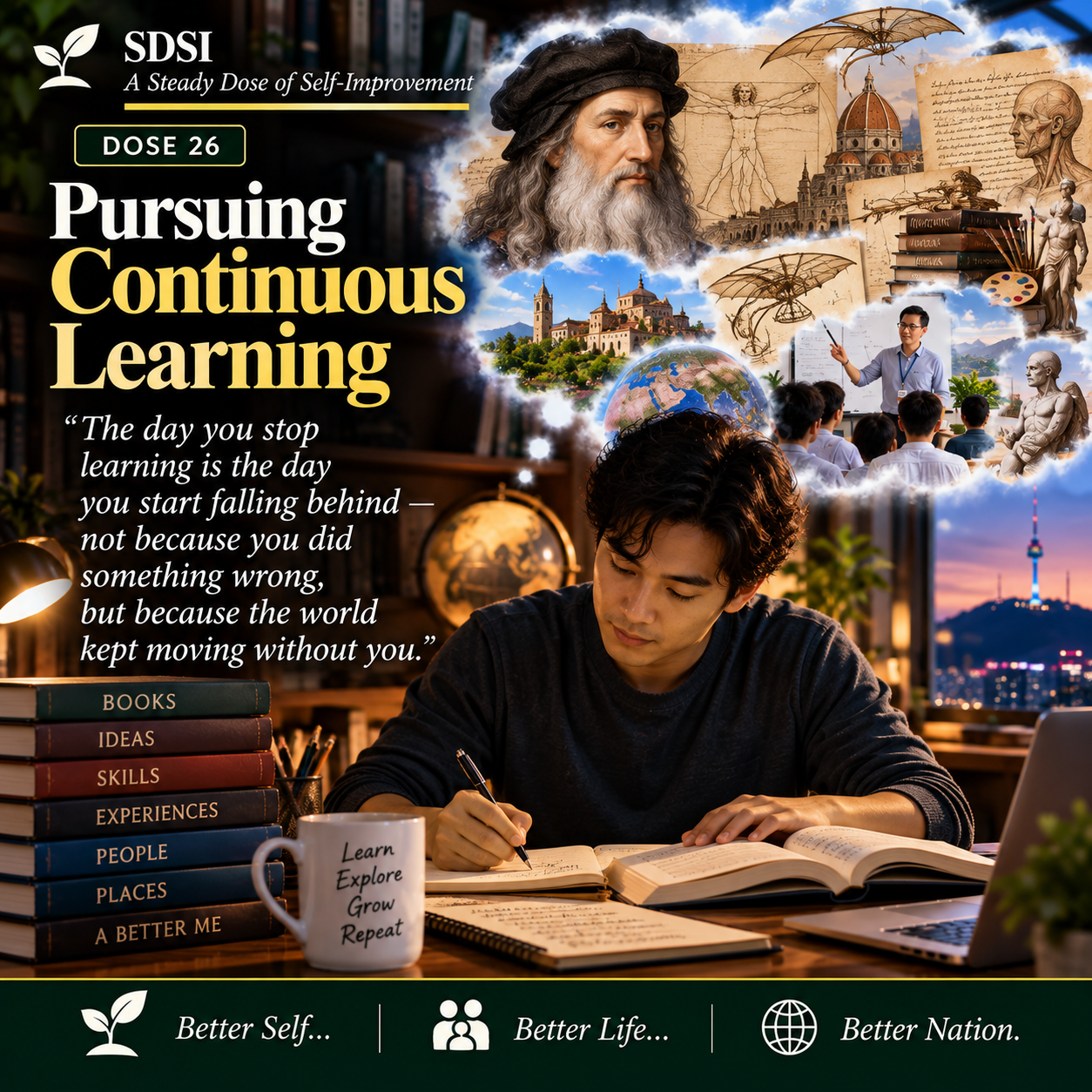
The day you stop learning is the day you start falling behind — not because you did something wrong,
but because the world kept moving without you.

Leonardo da Vinci moved freely among art, anatomy, engineering, mathematics, music, and the natural sciences.
Continuous learning is the ongoing pursuit of knowledge, skills, and experiences throughout life. It is not confined to classrooms, degrees, or certificates. It begins with a simple recognition: the world does not stop changing when our formal education ends. If we want to keep growing, adapting, and contributing, learning must remain part of the way we live.
Leonardo da Vinci remains one of history’s most striking examples of this spirit. Painter, sculptor, engineer, anatomist, inventor, musician, and observer of nature, he refused to confine his curiosity to a single field. His notebooks reveal a mind constantly asking questions, making connections, and investigating how things worked. He learned not merely for credentials or recognition, but because curiosity had become a way of life.
Warren Buffett offers a modern example from a very different field. He has repeatedly emphasized the importance of reading and thinking, and once advised students to read hundreds of pages a day, comparing the accumulation of knowledge to compound interest. The number itself is less important than the principle: what we deliberately learn today expands what we are capable of seeing and doing tomorrow.
Coming to South Korea opened a learning journey I had not fully anticipated. University teaching, advising students, presenting at international conferences, conducting research, and publishing scholarly work were not all part of my original plan. Many of those opportunities became possible because I kept learning. Each new competency revealed a door I could not have seen from where I started.
Continuous learning does not require us to return to school every year. It requires something both simpler and more demanding: remaining teachable. Read. Ask. Listen. Experiment. Learn from people younger and older than you. Learn from mistakes. Learn from unfamiliar places. The moment we decide we already know enough, we place a ceiling over the person we can still become.
Pause and Reflect
When did you last learn something significant outside a formal school setting—and how did it change what you could do or understand?
One Step Forward
Dedicate 20 minutes today to deliberate learning: read a chapter, listen to a thoughtful lecture or podcast, or practice a new skill. At the end, write down one thing you learned.
Explored in full in Chapter 17 — Pursuing Continuous Learning of A Holistic Approach to Self-Improvement.
Visualization
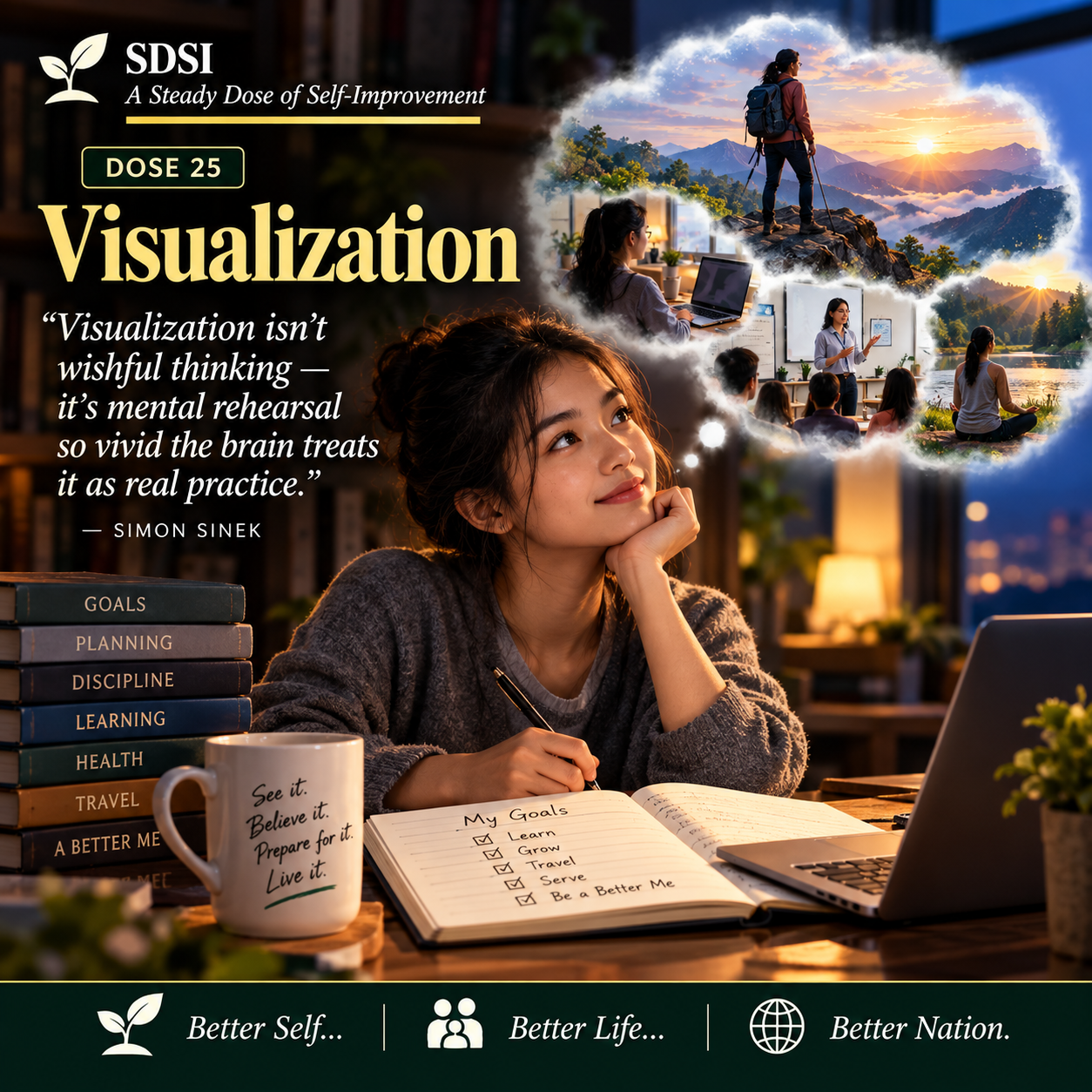
Visualization isn’t wishful thinking — it’s mental rehearsal. By vividly rehearsing an action or experience
in the mind, we can prepare ourselves for performing it in the real world.

At the 2008 Beijing Olympics, Michael Phelps’s goggles filled with water mid-race, leaving him unable to see clearly.
Visualization is one of the most powerful—and perhaps most underestimated—tools in the self-imprOvement toolkit. Like positive thinking, it is sometimes dismissed as little more than imagining success instead of working for it. But effective visualization is not a substitute for action. It is preparation for action.
Visualization involves creating vivid and detailed mental representations of an action, process, or desired outcome. Rather than merely seeing an image in the mind, effective visualization can engage multiple senses: what you see, hear, feel, and even how your body moves. Research on mental imagery suggests that imagined and actual actions can engage overlapping neural processes, helping explain why mental rehearsal has long been used in sports and other performance settings.
At the 2008 Beijing Olympics, Michael Phelps faced exactly the kind of situation he had mentally prepared for. During the 200-meter butterfly final, his goggles filled with water, severely limiting his vision. Yet he continued swimming, relying partly on his practiced stroke count and preparation, and won the race in world-record time. His longtime coach, Bob Bowman, had taught him to mentally rehearse races—to “watch the videotape” in his mind, including situations in which things did not go perfectly.
That detail matters.
Effective visualization is not simply seeing yourself standing triumphantly at the finish line. It is rehearsing how you will get there—and how you will respond when something goes wrong.
Research by Pham and Taylor similarly highlighted an important distinction between visualizing an outcome and visualizing the process required to achieve it. Imagining yourself receiving the diploma, losing the weight, publishing the book, or crossing the finish line may inspire you. But mentally rehearsing the studying, training, writing, decision-making, and persistence required to get there can better connect the vision with action.
Before deciding to pursue ESL teaching in South Korea, I spent considerable time imagining what that life might look like: the classroom, the students, the research opportunities, and the life I hoped to build. That mental picture did not magically bring me to South Korea.
Visualization did not get me here. But it helped make the destination real enough for me to move toward it.
And perhaps that is visualization’s greatest value. It allows us to visit a possible future before we arrive there—not so that we can escape into it, but so that we can return to the present knowing more clearly what we need to do next.
Pause and Reflect
What future have you repeatedly imagined for yourself—and what would you need to start doing today to move closer to it?
One Step Forward
Set aside 10 minutes today. Close your eyes and visualize not only achieving one of your important goals, but taking the next concrete steps toward it. See the environment. Hear the sounds. Feel yourself doing the work. Then open your eyes—and take one of those steps.
Explored in full in Chapter 16 — Visualization of A Holistic Approach to Self-Improvement.
Goal Setting and Planning
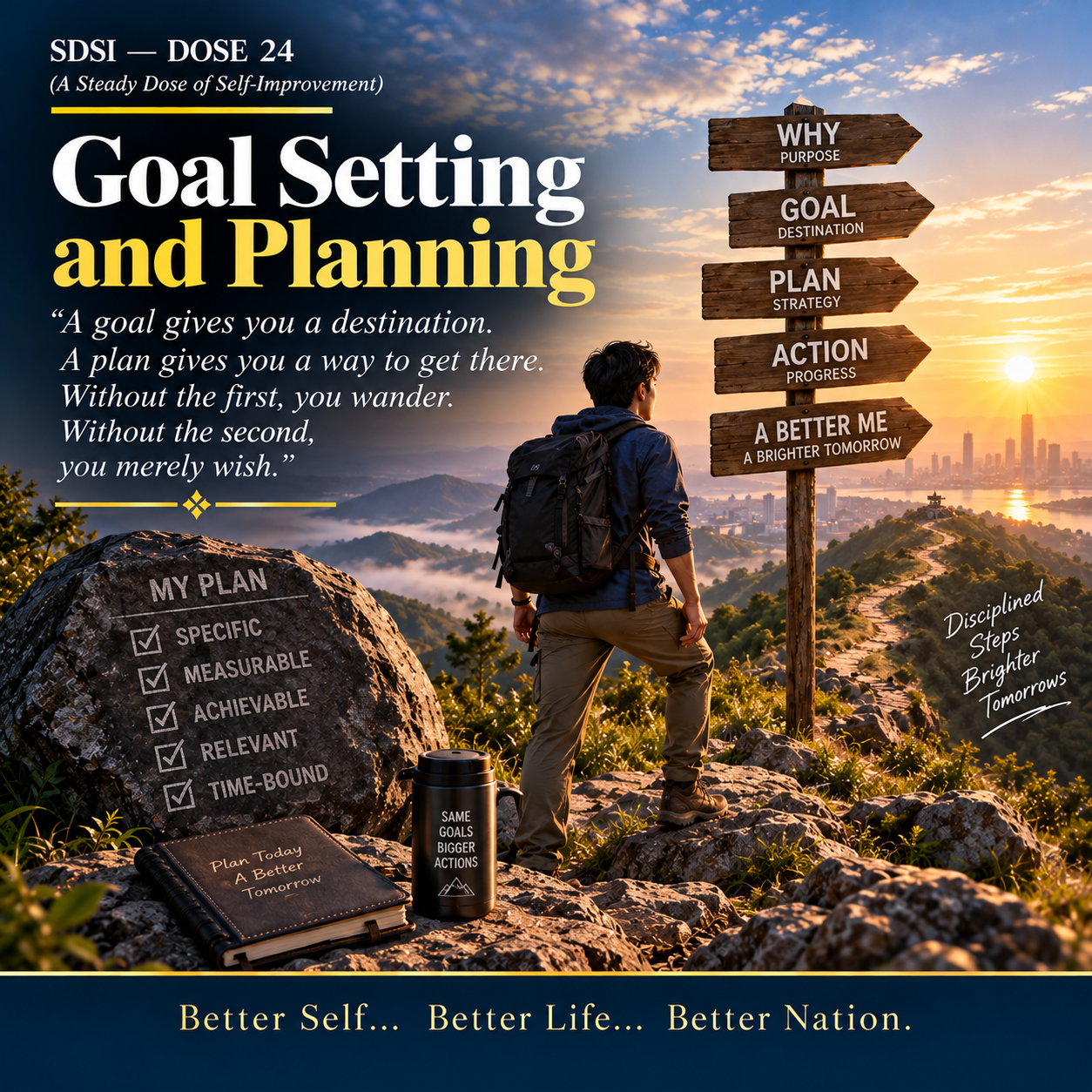
Goals give direction. Plans turn direction into movement. A goal without a plan remains a wish—
and a plan without a goal is motion without a destination.

Apple doesn’t begin with what it makes. It begins with why it exists.
Goal setting and planning are indispensable to any self-improvement program. A goal identifies where you want to go; a plan determines how you intend to get there. The two are inseparable. The goal provides direction. The plan provides the pathway.
But before asking what you want to accomplish or how you intend to accomplish it, there is an even more fundamental question:
Why?
Simon Sinek’s Golden Circle offers a useful way of thinking about this. At its center is Why, followed by How, and finally What. In Sinek’s well-known illustration, Apple communicates not merely what it makes—computers and other technology—but the belief that drives what it does. Whether applied to organizations or personal development, the principle is valuable: a meaningful goal begins with understanding why it matters to you.
Once the Why is clear, the goal itself needs structure. One of the most familiar frameworks is SMART: Specific, Measurable, Achievable, Relevant, and Time-bound. Variations extend it to SMARTER by adding criteria such as Evaluated and Reviewed. Whatever version we use, the principle remains the same: vague intentions become more actionable when they are translated into clearly defined goals that can be pursued, monitored, and adjusted.
Long before modern goal-setting frameworks existed, Benjamin Franklin demonstrated the value of systematic self-improvement. As a young man, he identified 13 virtues he wanted to cultivate and developed a method for tracking his behavior. He concentrated on one virtue at a time while recording his progress across all thirteen. His system was not SMART goal-setting in the modern sense, but it embodied something equally important: personal improvement becomes more deliberate when aspirations are converted into specific practices that can be observed and reviewed.
I learned this lesson in my own life.
When I decided to pursue ESL teaching in South Korea, the decision may have appeared bold from the outside. But it was not a sudden leap. I researched opportunities, strengthened my qualifications, obtained TESOL certification after initial rejections, built my research portfolio, and prepared financially for the transition.
I knew where I wanted to go.
Then I began building the road that could take me there.
Dreams tell us what might be possible. Goals give those dreams direction. Plans give them structure. But ultimately, action is what carries us forward.
Pause and Reflect
Is there a goal you have carried in your mind for a long time but have never turned into a concrete plan? What has kept it a wish rather than a goal?
One Step Forward
Choose one important goal and write it down today. Make it Specific, Measurable, Achievable, Relevant, and Time-bound. Then identify one concrete action you can take within the next 24 hours to begin moving toward it.
Explored in full in Chapter 15 — Goal Setting and Planning of A Holistic Approach to Self-Improvement.
Better Self… Better Life… Better Nation.
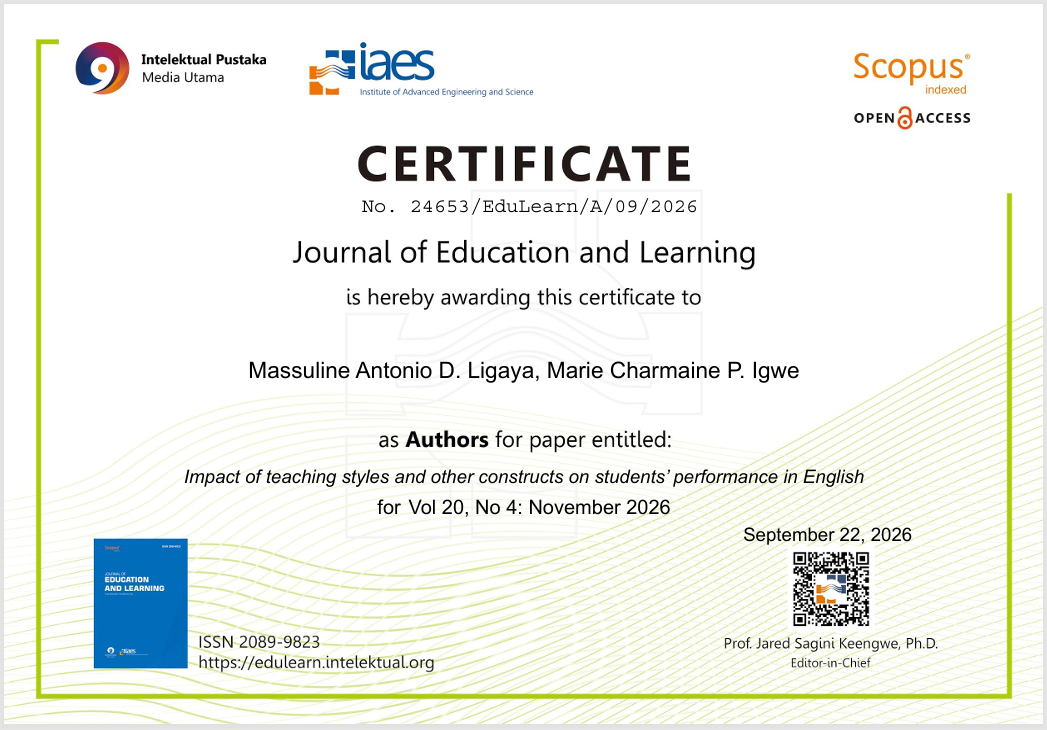
Impact of Teaching Styles and Other Constructs on Students’ Performance in English
A research paper published in a Scopus-indexed journal
Massuline Antonio D. Ligaya and Marie Charmaine P. Igwe
Journal of Education and Learning (EduLearn)
Vol. 20, No. 4, November 2026, pp. 2321~2335
ISSN: 2089-9823, DOI: 10.11591/edulearn.v20i4.24653
Research Summary
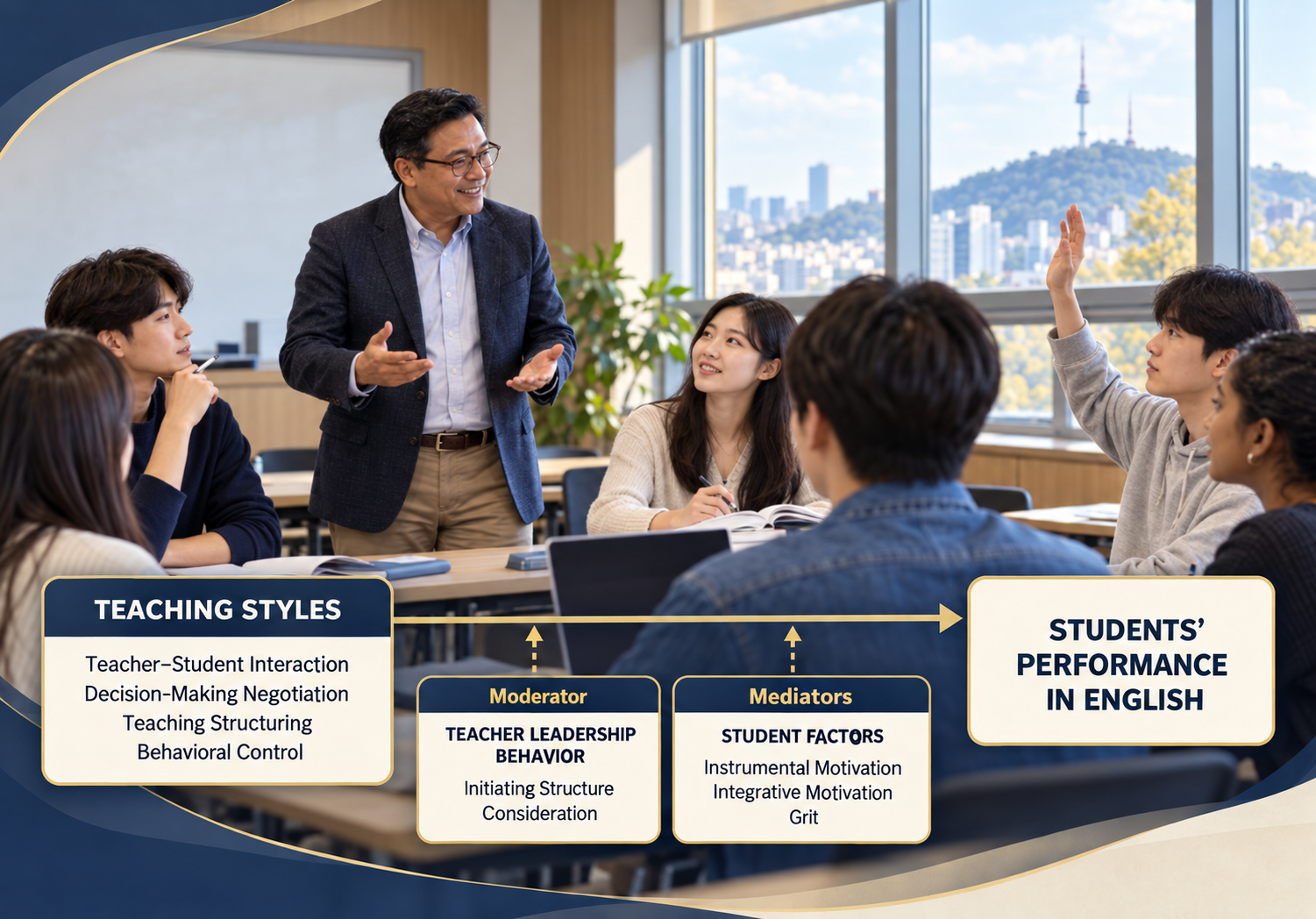
This study examined how teaching styles and selected teacher- and student-related factors are associated with university students’ performance in English. Specifically, it investigated the relationship between teachers’ teaching styles and students’ English performance, the moderating role of teachers’ leadership behavior, and the mediating roles of students’ motivation to learn English and grit.
The participants were 385 students and 22 foreign English teachers from a university in South Korea. The students assessed their teachers’ teaching styles and leadership behaviors and reported their own motivation and grit. Their English proficiency was measured using a 25-item test covering vocabulary, correct grammar form, answering questions, sentence combination, and word sequencing. The data were analyzed through descriptive statistics, correlation, regression, moderation, and mediation analyses.
The students were found to be moderately proficient in English. They demonstrated high motivation to learn the language, with integrative motivation exceeding instrumental motivation, while their level of grit was moderate. Teachers frequently exhibited all four dimensions of teaching style and demonstrated consideration leadership behavior slightly more strongly than initiating structure.
Teaching style and its dimensions were positively but weakly associated with English performance. Among the teaching-style dimensions, decision-making negotiation emerged as the most consistent predictor, although it explained only a small proportion of the variation in students’ performance. Teachers’ leadership behaviors also showed weak positive relationships with English performance but did not significantly moderate the relationship between teaching style and student performance.
The mediation analysis revealed that instrumental and integrative motivation produced significant but opposing indirect effects. Integrative motivation showed a positive mediating effect, whereas instrumental motivation showed a negative one. Grit did not significantly mediate the relationship. When all three mediators were considered collectively, the total indirect effect was not statistically significant.
Overall, the findings indicate that teaching practices contribute to English performance, but their effects are modest. Interactive approaches that give students a voice in classroom decisions may support engagement and learning. The results also highlight the importance of integrative motivation, meaningful engagement with English-speaking cultures, and attention to students’ psychological well-being. Language achievement depends not only on what teachers do but also on the motivational, personal, and contextual conditions under which students learn.
Research Contribution
The study contributes to English-language education by integrating teaching styles, teachers’ leadership behavior, motivation to learn English, grit, and English performance within a single analytical framework. It extends previous research by examining leadership behavior as a moderator and motivation and grit as parallel mediators among South Korean university EFL learners. Its findings also emphasize that statistically significant instructional factors may have limited practical influence when considered apart from broader learner-related and contextual conditions.
Keywords
Grit; leadership behavior; motivation; students’ performance in English; teaching style
Full Text
The complete published article is available through the DOI link above.
To God Be The Glory!
Ragnarok: When Gods Become Human
A REVIEW

Three days ago, I was looking for a movie to watch on Netflix while eating my brunch. The first one I saw in the gallery was Ragnarok.
I clicked “Watch,” turned my back on the TV, and started eating.
By the time I realized that it wasn’t actually a movie but a series, it was too late. I was already so hungry that taking my first bite seemed more important than looking for something else to watch.
As much as possible, I avoid watching series. I know myself too well. Once I start with the first episode and like what I am seeing, my strange disease of not wanting to stop until I get to the end kicks in. Before I know it, my behind is glued to the couch and whatever plans I had for the day begin negotiating for survival.
And true enough, within the first fifteen minutes of Episode 1, the storyline beginning to emerge had already tickled my curiosity.
It reminded me of an essay I had written years ago about “reconfiguring mythology.” The series I had accidentally started watching seemed to be doing exactly that—retelling Norse mythology in a way I had never seen before.
I was in trouble.
I did not plan to binge-watch the three-season Netflix series Ragnarok, which ended in 2023.
In fact, I did not even plan to give it my full attention.
Over the next three days, I placed my phone at the bottom of my computer monitor and watched the series while doing what I call “light work.” I watched while eating, while taking breaks from work, and even while exercising. It was supposed to be something playing in the background while I went about my usual routine.
Then the damned story ambushed my attention.
Somewhere along the way, Ragnarok moved from the bottom of my computer monitor to the front of my mind.
And I do not regret a minute of it.
For three days, the series recharged my creative batteries in two of the areas in which I have always been deeply invested: literature and literary criticism. I found myself thinking about mythology, power, love, family, identity, environmental destruction, social inequality, war, and the eternal human tendency to become the very thing we once despised.
Not bad for something I intended to watch while doing other things.

PART 1

PART 2

PART 3

Habit Scheme: Practices and Activities
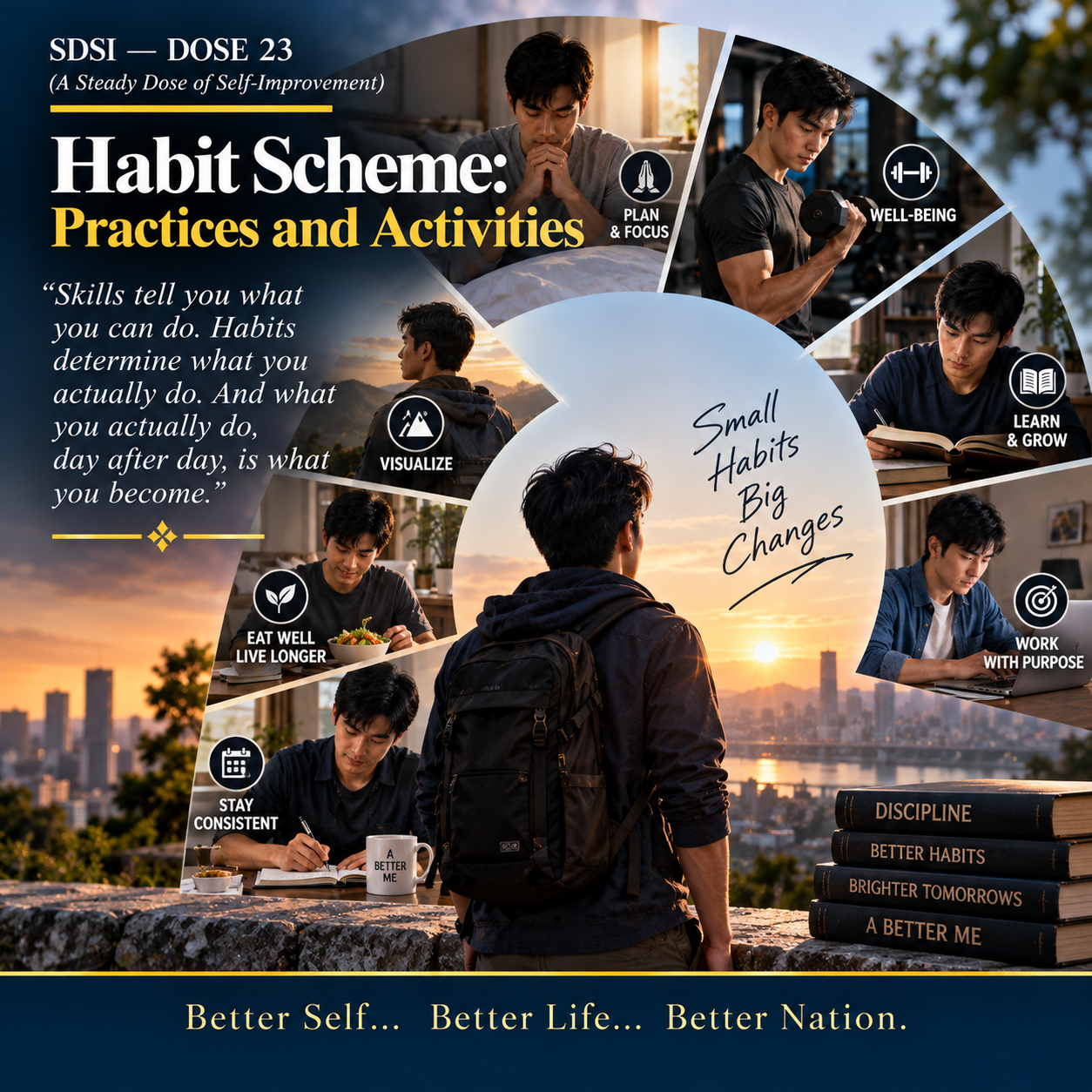
Skills tell you what you can do. Habits determine what you actually do. And what
you actually do, day after day, is what you become.

Knowing what to do means little if you rarely do it.
The Value System gives self-improvement its foundation. The Competence Framework develops the skills and abilities needed to act on it. But neither beliefs nor abilities, powerful as they are, complete the process. Knowledge and capability must be translated into consistent action before they can produce lasting results.
That is where the Habit Scheme comes in.
There is a profound difference between knowing what to do and actually doing it—especially on the days when you do not feel like doing it. That difference is often habit.
More than two thousand years ago, Aristotle argued that character and excellence are cultivated through repeated action and habituation. Centuries later, Will Durant captured that idea memorably while explaining Aristotle: “We are what we repeatedly do. Excellence, then, is not an act but a habit.”
Excellence, then, is rarely the product of one dramatic act. More often, it is the accumulated result of small, intentional actions repeated consistently over time.
This is why motivation alone is unreliable. Motivation can provide the initial spark, but it rises and falls. Habits reduce our dependence on feeling motivated every time action is required. We build routines, systems, and environments that make productive behavior easier to repeat.
The important question, therefore, is not whether you have habits. You do. The question is whether your habits are carrying you toward the person you want to become—or quietly pulling you away from that person.
Six practices comprise the Habit Scheme: goal setting and planning, visualization, continuous learning, well-being, longevity, and a consistent daily routine—all held together by self-discipline.
I learned the power of the Habit Scheme most clearly by living it. The attitudes and beliefs I developed gave me the foundation to make the leap to South Korea. The skills I had acquired enabled me to perform once I arrived. But it was what I repeatedly did—reading, writing, researching, exercising, reflecting, and continuing to learn—that ultimately determined the quality of what I produced.
Without those habits, my beliefs and abilities might have remained little more than potential.
Beliefs provide the foundation. Skills provide the capability. Habits turn both into a way of life.
Pause and Reflect
Which of your daily habits, if you are completely honest with yourself, is quietly working against a goal you say matters to you?
One Step Forward
Identify one automatic habit that is no longer serving you. Then choose one small behavior to replace it with this week. Do not try to transform your entire routine. Change one repeated action.
Explored in full in Part 2 — Foundations of Holistic Self-Improvement, Section III: Habit Scheme (Practices & Activities) of A Holistic Approach to Self-Improvement.
Better Self… Better Life… Better Nation.
The Half-Truth Before Ecclesiastes
A Reflective Essay

I usually dedicate the first 60 minutes of my waking hours to a strict daily routine: make my bed, perform the usual bathroom rituals, drink lukewarm water with Himalayan salt, meditate and pray, exercise lightly for 10 to 15 minutes with Gospel songs playing in the background, and then, for the final activity, read for at least 10 minutes—or whatever remains of that first hour.
Phones and other gadgets are off-limits.
Yesterday morning, I reached for my 30-year-old Bible and read Ecclesiastes. It is a Devotional Study Bible, New International Version, that a pastor friend gave us as a wedding gift. I even brought it with me when I came to South Korea in 2013.
I opened the Bible to page 569. Before the first chapter of Ecclesiastes was a two-page introduction. I intended to skip it and go directly to the first verse, but its title ambushed my attention:
“When Life Seems Senseless.”
So I read on.
One paragraph told Howard Hughes’s story. It contrasted the poor who imagine that more money would make them happy with Hughes, one of the richest men in the world, who eventually withdrew from society and spent his later years secluded in darkened hotel rooms. It described his long hair and beard, overgrown fingernails, and emaciated body.
Honestly, in that instant, I could not recall anything about Howard Hughes. For a moment, I even wondered whether he was a fictitious character used simply to illustrate the lesson.
My curiosity got the better of my gadget-free morning rule. I had to know who this man was.
So I reluctantly reached for my phone and asked Gemini:
“Is Howard Hughes a fictitious character?”
Gemini promptly doused my ignorance with a bucketful of information. For a moment, I felt as though the AI application were telling me:
How can you know nothing about this great man, you stupid moron?
Then something clicked.
The Aviator.
Leonardo DiCaprio. Howard Hughes.
Suddenly, I remembered. I had actually watched the movie, and some of my students had even used it for their movie reviews in my literature class back in the Philippines.
The Martin Scorsese film starring Leonardo DiCaprio was based on Hughes’ life. Suddenly, the miserable recluse described in my Bible’s introduction acquired another identity: aviator, filmmaker, businessman, engineer, risk-taker, record-setter—a complicated and extraordinarily accomplished human being. The man I had wondered about only moments earlier might be a fictitious character, but he suddenly emerged as an almost larger-than-life figure. Hughes had set aviation records and contributed to aircraft development long before he became best known for the eccentricity and isolation of his final years.
And then another question occurred to me:
What happened between those two Howard Hugheses?
The introduction had told me about his enormous wealth at the beginning and his miserable condition near the end. But it had said almost nothing about the road between them.
That omission bothered me.
Perhaps the writer simply wanted Hughes to illustrate one of the central themes associated with Ecclesiastes: worldly wealth, achievement, and pleasure cannot guarantee meaning or happiness. Hughes certainly makes a powerful example. He possessed extraordinary wealth and accomplishment, yet neither protected him from suffering.
But a human life becomes dangerously easy to moralize when we remove its middle.
In 1946, while test-flying the experimental XF-11 reconnaissance aircraft, Hughes crashed into a residential area in Beverly Hills. He was pulled from the wreckage in critical condition. The accident was only one part of a complicated life, but it was no trivial footnote.
His later years were marked by worsening isolation, poor nutrition, heavy drug use, and deteriorating physical and psychological health.
Does the crash explain everything that happened to Howard Hughes afterward?
Probably not.
And this is precisely where I must be careful not to commit the same mistake I am criticizing. It would be unfair to replace one simplified Howard Hughes with another—to turn “the miserable billionaire” into “the great man destroyed entirely by one accident.”
Human beings are rarely that simple.
Hughes had his flaws. His psychological difficulties were complex. His wealth, power, personality, physical suffering, medications, relationships, choices, and circumstances all belonged to the same human story.
But that is exactly the point.
The whole story matters.
The introduction reduced that complicated story to an effective contrast: a man had tremendous wealth and nevertheless ended his life miserably.
As a sermon illustration, it works.
As an account of a human being, it leaves me uneasy.
There is a difference between saying something untrue and telling only the part of the truth that serves our argument. The passage about Hughes may not have lied about him. But by omitting important context, it made his decline appear almost like the inevitable moral consequence of wealth itself.
And perhaps that teaches a lesson quite different from the one the writer intended.
When we use real people’s lives to illustrate moral or spiritual truths, we owe those people fairness—even when they are long dead.
Their suffering should not become merely a convenient prop for our argument.
This realization also changed the way I looked at the pages in front of me.
I had initially thought: How ironic that a Bible should contain something I find so incomplete.
But then I realized that I needed to make another distinction.
The introduction was not Ecclesiastes.
It was not Scripture.
It was commentary written by a human being to help readers approach Scripture. Like every piece of human commentary—including this essay—it carries the writer’s choices, limitations, interpretations, and assumptions.
Perhaps that is another reason we should read carefully.
Not cynically.
Not suspiciously.
But carefully.
Faith does not require us to surrender critical thought. If anything, a commitment to truth should make us more reluctant to accept a convenient story simply because it supports a conclusion we already agree with.
And ironically, learning more about Hughes did not weaken the message of Ecclesiastes for me.
It deepened it.
Howard Hughes possessed things most people spend their lives pursuing: money, fame, influence, achievement, adventure. He flew aircraft others would not dare fly. He made movies. He built businesses. He broke records. Yet none of those things could make him invulnerable.
But perhaps the lesson is not simply:
Look at Howard Hughes. He was rich, and still he was miserable.
Perhaps the more compassionate lesson is:
Look at Howard Hughes. He was powerful, accomplished, wealthy—and still painfully human.
Money could not protect his body from injury.
Achievement could not guarantee peace.
Power could not make him immune to illness, dependency, isolation, or mortality.
And neither can ours.
That, to me, is closer to the haunting wisdom of Ecclesiastes.
Not that achievement is worthless.
Not that wealth inevitably corrupts.
Not that ambition makes life meaningless.
But that none of them can bear the weight of becoming the meaning of life itself.
Yesterday morning, I opened my old Bible intending simply to read Ecclesiastes.
Instead, before reaching its first verse, I found myself reading about Howard Hughes, reluctantly reaching for my phone despite my gadget-free rule, consulting artificial intelligence, remembering The Aviator, investigating a plane crash, questioning a Bible commentary, and eventually questioning my own first conclusions.
Quite a detour before Chapter 1.
But perhaps not a meaningless one.
Because before Ecclesiastes could remind me that life is complicated, Howard Hughes already had.