Ragnarok: When Gods Become Human – 2
A REVIEW – Part 2
The Most Dangerous Weapon
Power is not the only force capable of changing people in Ragnarok.
There is also love.
Vidar changes when Laurits becomes more than an inconvenient boy and becomes his son. Fjor tries to escape the world of the Jutuls because of Gry. Laurits, who spends much of the series belonging completely to neither of his families, desperately searches for someone—or something—that will choose him.
For a while, the poor fellow practically has only his gigantic worm.
Then there is Magne.
Mjölnir can frighten giants. It can smash things. It can make people reconsider whether irritating Thor is a sensible life decision.
But it cannot make Signy stay.
When Magne becomes arrogant and inconsiderate, she simply walks away.
Near the end, Signy says something that beautifully summarizes one of the quieter truths of the series: “Love is the most dangerous of all.”
Francis Bacon would probably have smiled.
In his essay Of Love, Bacon observed centuries ago something Ragnarok repeatedly shows us: love has a peculiar ability to make even intelligent and powerful people behave foolishly. The brightest among us are not necessarily immune. Sometimes they simply become more creative in finding ways to be stupid.
And Ragnarok gives us plenty of evidence.
Vidar, normally calculating and ruthless, becomes vulnerable when Laurits enters the picture as his son. Fjor is willing to turn his back on the Jutuls because of Gry. Magne, for all the power Mjölnir gives him, remains vulnerable to the people he loves. Even Saxa, whose motives are often difficult to separate from ambition and self-interest, discovers that relationships can complicate the clean calculations of power.
Perhaps that is what makes love dangerous.
It does not necessarily make us weak.
It makes us vulnerable.
It gives another person access to places that strength, money and even a magical hammer cannot protect.
And vulnerability can make wise people foolish, strong people weak, selfish people generous, and sometimes even cruel people surprisingly human.
After three seasons of worrying about Mjölnir, giants and the Midgard Serpent, perhaps the most dangerous weapon in Edda was never the hammer.
Perhaps Signy was right.
It was love.
Gods, Giants and the World We Actually Live In
For a story populated by Norse gods and giants, Ragnarok spends a surprising amount of time dealing with the very unmythological problems of the twenty-first century.
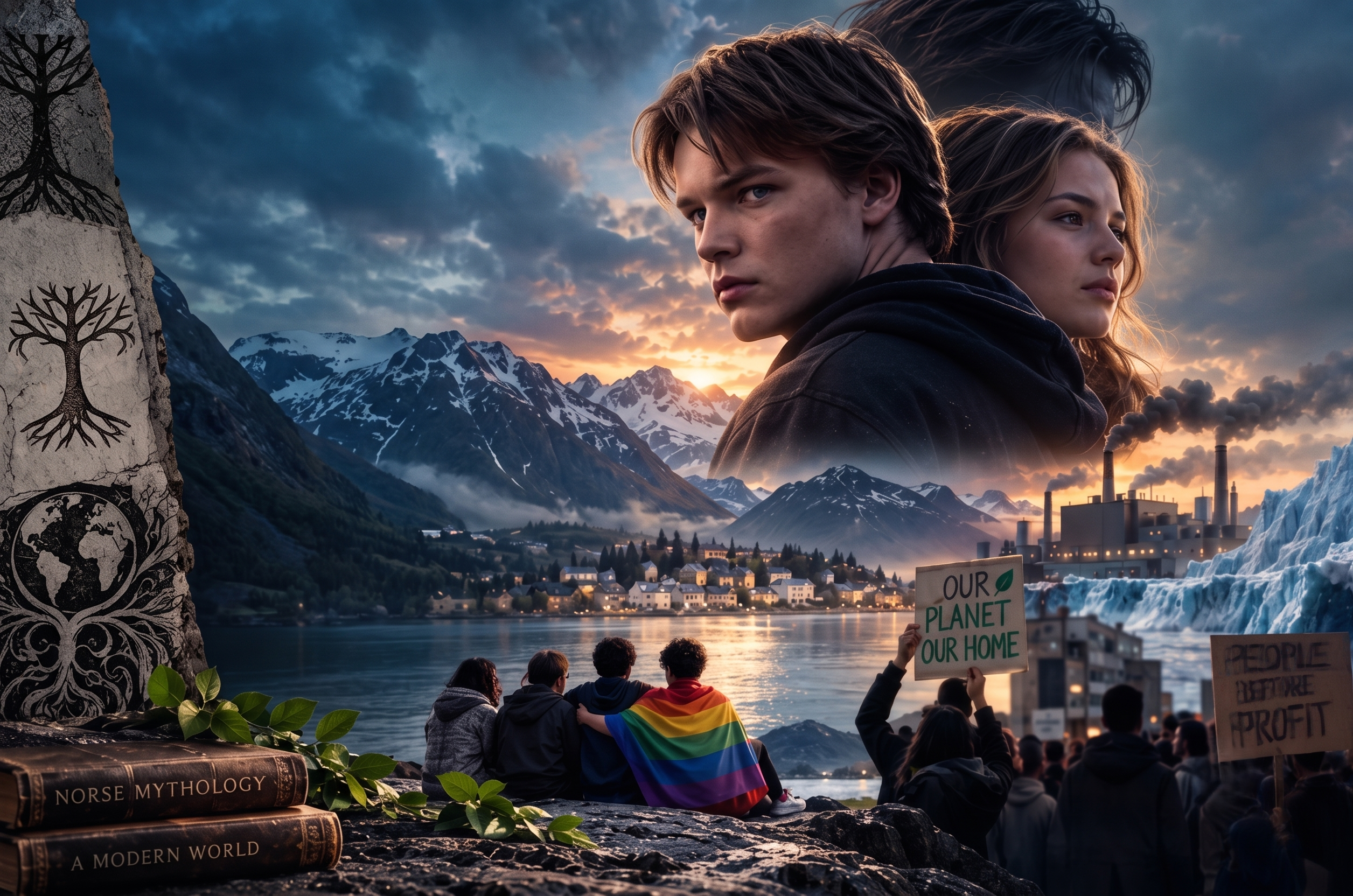
There is environmental destruction, of course. That is practically the backbone of the story. Edda’s water is polluted, the glaciers are melting, and a powerful corporation has prospered while nature and ordinary people pay the price.
The giants are not merely giants.
They are giants of industry.
But the series does not stop there.
There are LGBTQ+ relationships and characters trying to understand and live their identities. There are questions of gender and equality, with women such as Ran and Saxa wielding considerable authority rather than merely standing behind powerful men. There are moments that make us think about prejudice, racism and what it means to be regarded as an outsider. And there is the enormous distance between the lives of the wealthy Jutuls and families like Magne’s, reminding us that some people have considerably more power than others simply because of the families and circumstances into which they were born.
Even the environmental conflict is not as simple as I initially expected.
The factory pollutes the town, but the factory also employs people.
Shut it down and you protect the environment—but what happens to workers who need those salaries to put food on their tables?
Suddenly saving the world becomes considerably more complicated.
And perhaps that is another thing I appreciated about Ragnarok. Beneath all the talk of Thor, Loki, Odin, giants and the end of the world, the series quietly becomes a commentary on the world we already inhabit.
Sexual identity. Gender equality. Racism and prejudice. The widening distance between rich and poor. Corporate influence. Environmental destruction. Workers caught between earning a living and protecting the world in which they live. Young people demanding that older generations take responsibility for the world they are leaving behind.
And what-have-you.
The problems may be dressed in Norse mythology, but there is nothing mythical about them.



 M.A.D. L I G A Y A