Blog Archives
Goal Setting and Planning
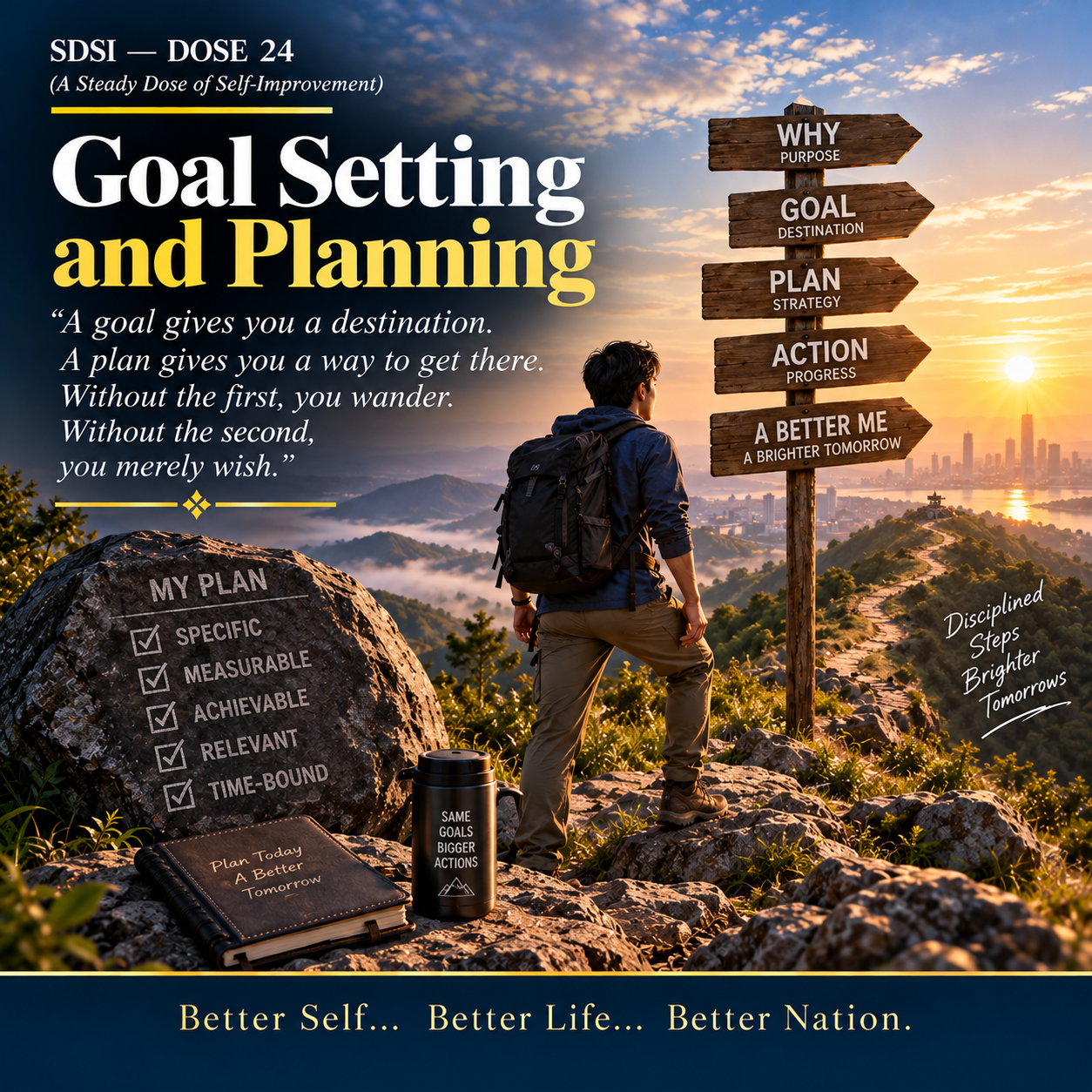
Goals give direction. Plans turn direction into movement. A goal without a plan remains a wish—
and a plan without a goal is motion without a destination.

Apple doesn’t begin with what it makes. It begins with why it exists.
Goal setting and planning are indispensable to any self-improvement program. A goal identifies where you want to go; a plan determines how you intend to get there. The two are inseparable. The goal provides direction. The plan provides the pathway.
But before asking what you want to accomplish or how you intend to accomplish it, there is an even more fundamental question:
Why?
Simon Sinek’s Golden Circle offers a useful way of thinking about this. At its center is Why, followed by How, and finally What. In Sinek’s well-known illustration, Apple communicates not merely what it makes—computers and other technology—but the belief that drives what it does. Whether applied to organizations or personal development, the principle is valuable: a meaningful goal begins with understanding why it matters to you.
Once the Why is clear, the goal itself needs structure. One of the most familiar frameworks is SMART: Specific, Measurable, Achievable, Relevant, and Time-bound. Variations extend it to SMARTER by adding criteria such as Evaluated and Reviewed. Whatever version we use, the principle remains the same: vague intentions become more actionable when they are translated into clearly defined goals that can be pursued, monitored, and adjusted.
Long before modern goal-setting frameworks existed, Benjamin Franklin demonstrated the value of systematic self-improvement. As a young man, he identified 13 virtues he wanted to cultivate and developed a method for tracking his behavior. He concentrated on one virtue at a time while recording his progress across all thirteen. His system was not SMART goal-setting in the modern sense, but it embodied something equally important: personal improvement becomes more deliberate when aspirations are converted into specific practices that can be observed and reviewed.
I learned this lesson in my own life.
When I decided to pursue ESL teaching in South Korea, the decision may have appeared bold from the outside. But it was not a sudden leap. I researched opportunities, strengthened my qualifications, obtained TESOL certification after initial rejections, built my research portfolio, and prepared financially for the transition.
I knew where I wanted to go.
Then I began building the road that could take me there.
Dreams tell us what might be possible. Goals give those dreams direction. Plans give them structure. But ultimately, action is what carries us forward.
Pause and Reflect
Is there a goal you have carried in your mind for a long time but have never turned into a concrete plan? What has kept it a wish rather than a goal?
One Step Forward
Choose one important goal and write it down today. Make it Specific, Measurable, Achievable, Relevant, and Time-bound. Then identify one concrete action you can take within the next 24 hours to begin moving toward it.
Explored in full in Chapter 15 — Goal Setting and Planning of A Holistic Approach to Self-Improvement.
Better Self… Better Life… Better Nation.