Category Archives: Teaching Style
THE DAY “FART” BECAME A TEACHING AID
When Grammar, Chemistry, and Childhood Mischief Met in My Classroom
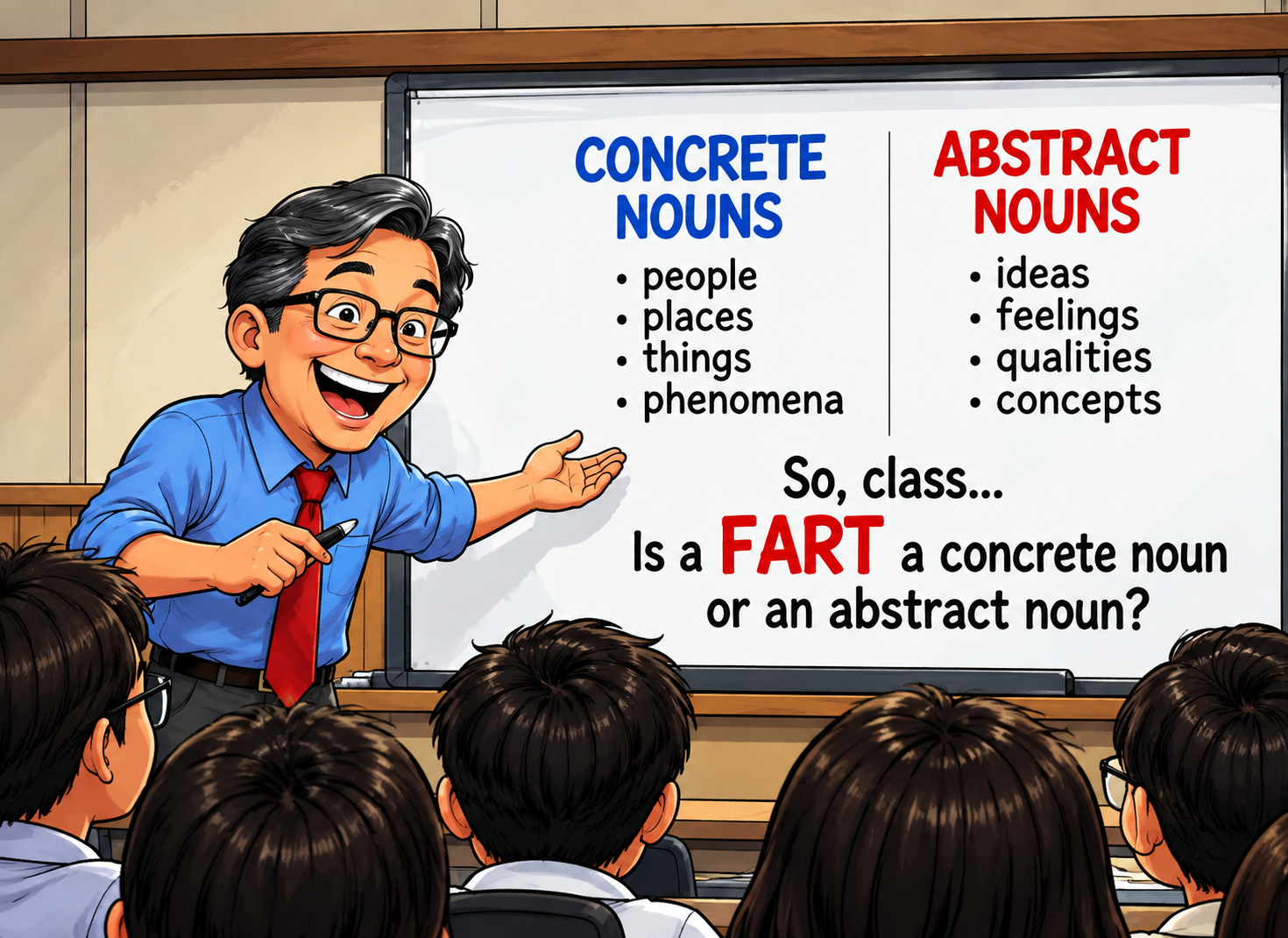
Nouns can be a very boring topic in grammar. After all, how much excitement can students possibly find in learning about the names of people, places, things, and ideas?
But the challenge for teachers like me is how to make even the simplest and seemingly most boring topics interesting, engaging, and, whenever possible, fun.
I once came across a saying suggesting that good teaching is one-fourth preparation and three-fourths pure theatre. I cannot remember its exact wording or who originally said it, but I have always appreciated the sentiment behind it.
Preparation provides the substance of a lesson. Theatre gives it life.
Of course, I do not enter my classroom intending to perform a comedy show. I prepare my lessons, identify my objectives, and think about how best to explain the concepts. Whatever theatrical elements emerge usually happen spontaneously.
Sometimes, even I am surprised by what comes out of my mouth.
And speaking of things coming out…
One day, while discussing nouns, I introduced the distinction between concrete and abstract nouns.
I explained that concrete nouns refer to physical things or occurrences you can perceive through the senses, whereas abstract nouns refer to concepts, qualities, feelings, and ideas.
After giving several conventional examples, I decided to test my students with a less conventional one.
“Class,” I asked, “is a FART a concrete noun or an abstract noun?”
There was a moment of hesitation.
“Yes class you heard it right… FART.”
The students looked at each other, some smiled, some laughed.
They I warned those who laughed, “Oops not too much… you might fart.”
More laughter came after that.
Then came the answers.
“Abstract, sir!”
Practically everyone agreed.
I could understand their reasoning. A fart is generally invisible. You cannot put it on a table, examine its shape, or display it like a book or a chair.
But I had other ideas.
“No!” I declared. “A fart is a concrete noun!”
The students looked puzzled.
And so, our grammar lesson unexpectedly became a chemistry lesson.
I explained that a fart involves releasing intestinal gases. These gases have physical existence. They occupy space, consist of matter, and can be detected through our senses.
“Just because you cannot see something,” I explained, “does not mean it does not exist!”
I thought that would settle the matter.
But then I decided to go further.
“Besides,” I told them, “who says you cannot hold a fart?”
That was when I remembered something from my childhood.
When I was a little boy, I was playing with my younger sister. At some point, I passed gas. Being the mischievous little creature that I was, I quickly cupped my hand near my behind, pretending to catch what had just escaped.
Before the gas could completely disperse, I brought my cupped hand close to my sister’s nose.
Then I opened it.
My poor sister!
She cried and immediately ran to our mother to report the terrible injustice she had suffered.
Mama, apparently finding the whole incident amusing despite my sister’s distress, gave me a light smack with her slipper, partly to reprimand me and partly to appease the offended little girl.
I had received my punishment.
My sister had received her justice.
And neither of us could have imagined that decades later, the incident would become part of a university grammar lesson in South Korea.
By the time I finished telling the story, my students were in stitches.
What began as an ordinary discussion of concrete and abstract nouns wandered through chemistry, human biology, childhood mischief, and a mother’s slipper.
And somehow, we were still discussing grammar!
But the laughter wasn’t over
Having established that a fart was a concrete noun, I decided to challenge my students further.
“Now, class,” I asked, “is fart a count noun or a non-count noun?”
Immediately, two students began debating.
“It’s non-count, sir!” one insisted.
“No, it’s count!” the other argued.
One student tried to defend his position by referring to our earlier discussion.
“Sir just said it’s concrete! Like a smartphone is concrete. You can say, ‘I have one smartphone!'”
His classmate was unconvinced.
“Come on!” he protested. “You can’t say, ‘I have one fart!'”
The classroom erupted in laughter again.
I could hardly have asked for a more entertaining grammatical disagreement.
When the laughter subsided, I explained that fart is indeed a countable noun. We can say a fart, two farts, or several farts. The issue wasn’t its countability but the choice of expression. In ordinary conversation, we generally say someone lets out a fart rather than has one fart.
I also clarified that concrete and countable describe two different noun characteristics. A noun can be concrete and countable, like chair, or concrete and uncountable, like water.
By then, we had explored two grammatical classifications using one rather unconventional example.
But something else had happened.
My students were no longer merely listening to an explanation. They were arguing, reasoning, challenging one another, and defending their answers.
One student had attempted to apply an earlier grammatical concept to a new question. Although the reasoning wasn’t entirely correct, it gave us another chance to clarify the distinction between the two classifications.
And all of this happened because of a fart!
When Preparation Meets Theatre…
Looking back, I find the experience amusing not merely because of the laughter it produced, but because the lesson unfolded so naturally.
I had not planned to tell that childhood story. It wasn’t in my lesson plan. There was certainly no instruction in my teaching materials that said, “At this point, introduce a childhood fart incident.”
The story simply emerged from our discussion.
But beneath the humor was a genuine learning opportunity.
My students had initially associated concrete with things they could see or hold. The unusual example challenged that assumption and encouraged them to reconsider what physical existence means.
The chemistry explanation supplied the conceptual clarification. The childhood anecdote made the discussion memorable.
The subsequent debate about countability created another learning opportunity. It required students to examine their assumptions, explain their reasoning, and distinguish between two different grammatical concepts.
Did the laughter guarantee that every student understood the lesson? Of course not. Understanding still needs to be checked through questions, examples, and opportunities to apply what has been learned.
But the laughter helped turn an otherwise ordinary lesson into an experience we could share.
I have always believed that teaching should be a serious undertaking without necessarily becoming a solemn activity.
A teacher can be academically rigorous without being intimidating. A lesson can be intellectually demanding without being joyless. And sometimes, a little spontaneity can encourage students to participate in ways a carefully prepared explanation alone might not.
Perhaps that is what the expression about preparation and theatre really means to me.
Preparation ensures that I know what I am teaching, why I am teaching it, and what I want my students to learn.
Theatre, whether intentional or spontaneous, helps me bring the lesson to life.
And when the two come together, the classroom becomes more than a place where information is delivered. It becomes a place where ideas are explored, mistakes are examined, questions are encouraged, and learning can be accompanied by laughter.
I have often described my philosophy of teaching this way:
“The classroom is my playground, the students are my playmates, and the subject is our toy.”
That particular day, our toy happened to be a fart.
And somewhere in the Philippines, my younger sister probably has no idea that her childhood suffering has contributed to the grammatical education of university students in South Korea.
Sorry, little sister.
But thank you for your contribution to science—and English grammar!
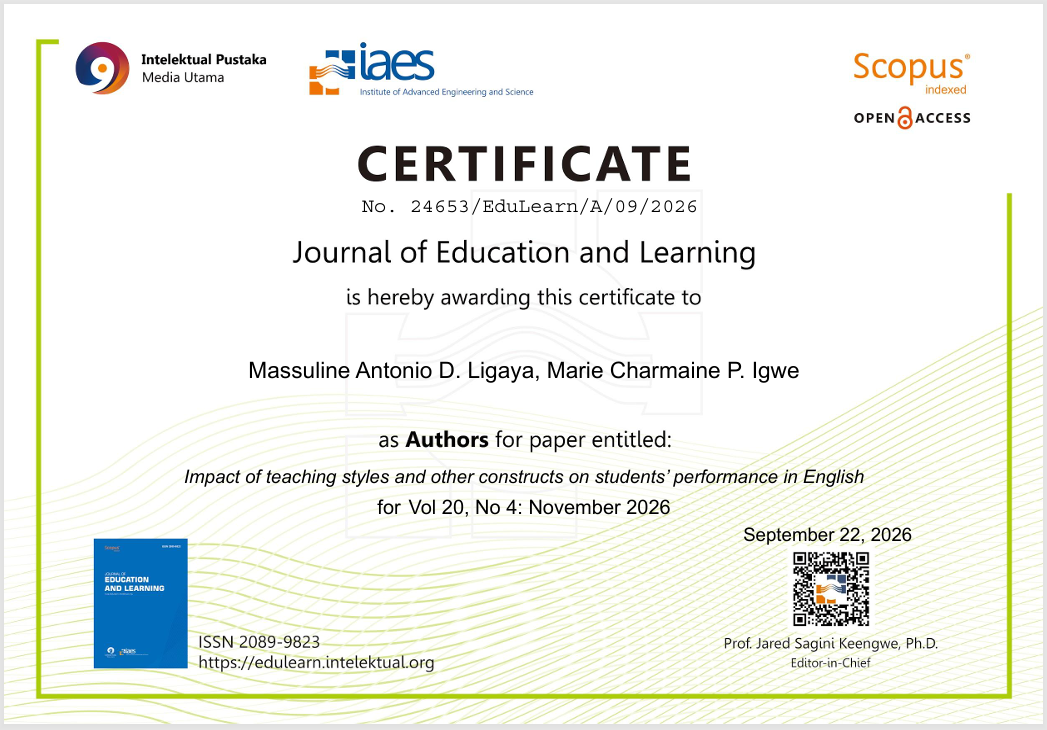
Impact of Teaching Styles and Other Constructs on Students’ Performance in English
A research paper published in a Scopus-indexed journal

Massuline Antonio D. Ligaya and Marie Charmaine P. Igwe
Journal of Education and Learning (EduLearn)
Vol. 20, No. 4, November 2026, pp. 2321~2335
ISSN: 2089-9823, DOI: 10.11591/edulearn.v20i4.24653
Research Summary
This study examined how teaching styles and selected teacher- and student-related factors are associated with university students’ performance in English. Specifically, it investigated the relationship between teachers’ teaching styles and students’ English performance, the moderating role of teachers’ leadership behavior, and the mediating roles of students’ motivation to learn English and grit.
The participants were 385 students and 22 foreign English teachers from a university in South Korea. The students assessed their teachers’ teaching styles and leadership behaviors and reported their own motivation and grit. Their English proficiency was measured using a 25-item test covering vocabulary, correct grammar form, answering questions, sentence combination, and word sequencing. The data were analyzed through descriptive statistics, correlation, regression, moderation, and mediation analyses.
The students were found to be moderately proficient in English. They demonstrated high motivation to learn the language, with integrative motivation exceeding instrumental motivation, while their level of grit was moderate. Teachers frequently exhibited all four dimensions of teaching style and demonstrated consideration leadership behavior slightly more strongly than initiating structure.
Teaching style and its dimensions were positively but weakly associated with English performance. Among the teaching-style dimensions, decision-making negotiation emerged as the most consistent predictor, although it explained only a small proportion of the variation in students’ performance. Teachers’ leadership behaviors also showed weak positive relationships with English performance but did not significantly moderate the relationship between teaching style and student performance.
The mediation analysis revealed that instrumental and integrative motivation produced significant but opposing indirect effects. Integrative motivation showed a positive mediating effect, whereas instrumental motivation showed a negative one. Grit did not significantly mediate the relationship. When all three mediators were considered collectively, the total indirect effect was not statistically significant.
Overall, the findings indicate that teaching practices contribute to English performance, but their effects are modest. Interactive approaches that give students a voice in classroom decisions may support engagement and learning. The results also highlight the importance of integrative motivation, meaningful engagement with English-speaking cultures, and attention to students’ psychological well-being. Language achievement depends not only on what teachers do but also on the motivational, personal, and contextual conditions under which students learn.
Research Contribution
The study contributes to English-language education by integrating teaching styles, teachers’ leadership behavior, motivation to learn English, grit, and English performance within a single analytical framework. It extends previous research by examining leadership behavior as a moderator and motivation and grit as parallel mediators among South Korean university EFL learners. Its findings also emphasize that statistically significant instructional factors may have limited practical influence when considered apart from broader learner-related and contextual conditions.
Keywords
Grit; leadership behavior; motivation; students’ performance in English; teaching style
Full Text
The complete published article is available through the DOI link above.
To God Be The Glory!
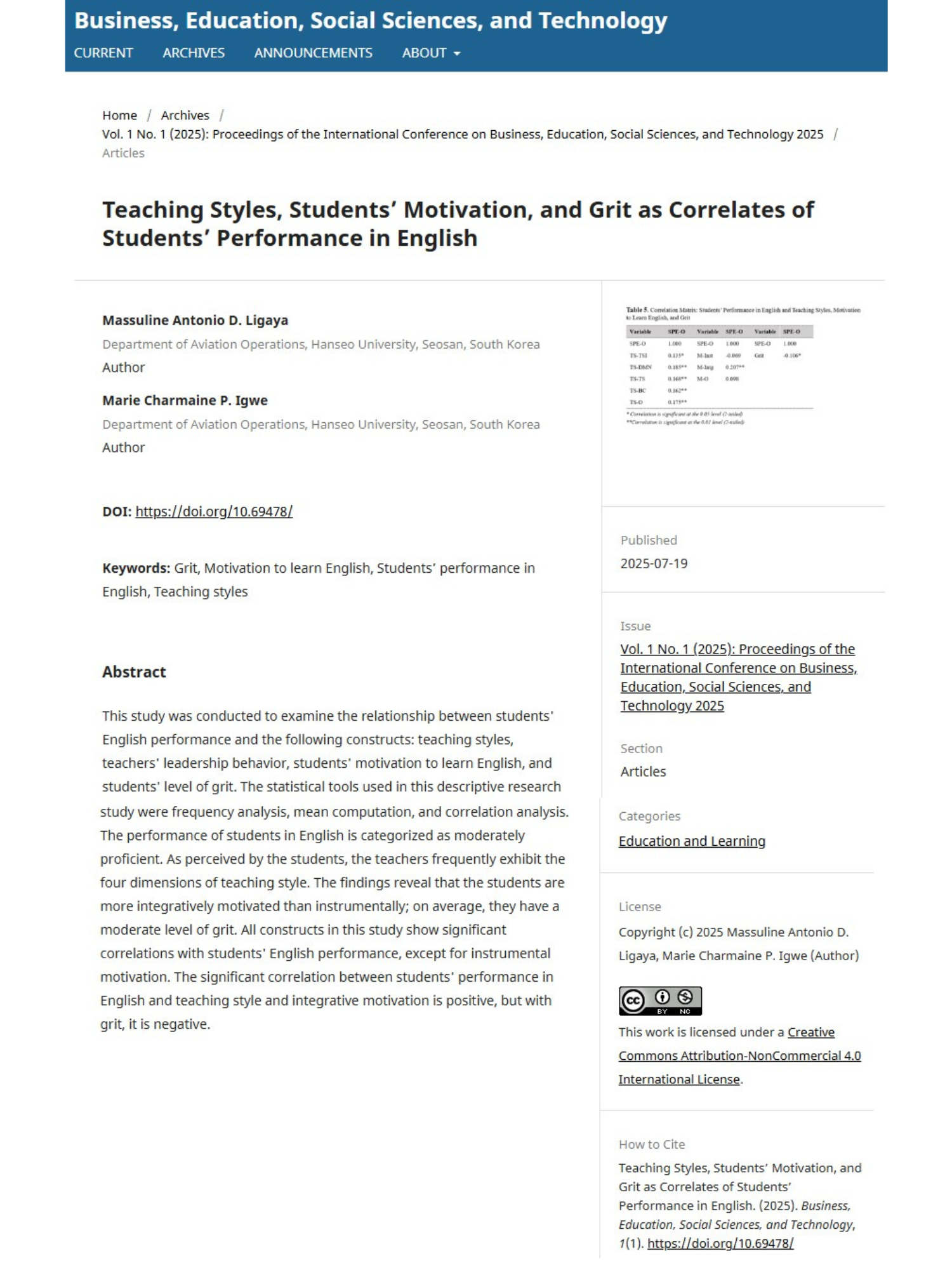
Teaching Styles, Students’ Motivation, and Grit as Correlates of Students’ Performance in English
A research paper presented as a conference paper and subsequently published in an academic journal

Teaching Styles, Students’ Motivation, and Grit as Correlates of Students’ Performance in English
Massuline Antonio D. Ligaya and Marie Charmaine P. Igwe
Business, Education, Social Sciences, and Technology, Vol. 1, No. 1, July 2025
DOI 10.69478/BEST2025v1n1a006.
Research Summary
Factors associated with both teachers and students influence the teaching and learning of English as a second or foreign language. This study examined several of these factors by investigating the relationships between teachers’ teaching styles, students’ motivation to learn English, students’ grit, and students’ English performance at a university in South Korea. The study conceptualized teaching style through four dimensions—teacher-student interaction, decision-making negotiation, teaching structuring, and behavioral control—and examined students’ motivation in terms of instrumental and integrative orientations. Grit was understood as students’ passion and perseverance in pursuing their goals despite challenges and setbacks.
The study employed a descriptive survey research design. Participants were students enrolled in mandatory English courses at a South Korean university and their foreign English teachers. The study invited two classes from each of 22 English teachers to participate, resulting in 385 student respondents from a potential pool of more than 600 students. Data were collected online through Google Forms using questionnaire items adopted from previously validated instruments. Students evaluated their own motivation and grit as well as the teaching styles demonstrated by their English teachers.
Unlike studies relying exclusively on students’ self-reported perceptions of their language ability, this research assessed English performance through a 25-item proficiency test covering five areas: vocabulary, correct grammar form, answering questions, combining sentences, and word sequencing. Frequency analysis and mean computation described the variables, while correlation analysis determined the relationships between English performance and teaching style, motivation, and grit. Statistical analyses were conducted using SPSS.
The results categorized the students’ overall English performance as moderately proficient, with an aggregated mean score of 2.32. Their strongest areas were vocabulary and answering questions, both classified as proficient. Correct grammar form and word sequencing fell within the moderately proficient range, while combining sentences emerged as their weakest area, with a mean score of 1.45 and a classification of less proficient. The results therefore suggested that although students demonstrated competence in selected aspects of English, important gaps remained, particularly in sentence construction.
Students generally perceived their teachers as frequently demonstrating all four dimensions of teaching style. Teaching structuring received the highest mean rating (4.45), followed by behavioral control (4.41), decision-making negotiation (4.35), and teacher-student interaction (4.32). The overall teaching-style mean of 4.38 indicated that these teaching behaviors were frequently observed across the English classes included in the study.
The findings also showed that students possessed a high overall level of motivation to learn English, although they were more integratively motivated than instrumentally motivated. Integrative motivation registered a mean of 4.27 compared with 3.84 for instrumental motivation. This indicated a stronger orientation toward learning English for engagement with English-speaking communities and cultures than toward purely practical benefits such as academic requirements, employment, or career advancement. The students’ mean grit score of 3.01, meanwhile, was interpreted as a moderate level of grit, with variation among students in their perseverance and passion toward their goals.
Correlation analysis revealed that all four dimensions of teaching style were significantly and positively associated with students’ English performance, although the relationships were weak. Teacher-student interaction correlated with English performance at r = .135, decision-making negotiation at r = .185, teaching structuring at r = .168, and behavioral control at r = .162. When the dimensions were combined, overall teaching style showed a significant positive correlation of r = .175 (p = .001) with students’ English performance. Among the teaching-style dimensions, decision-making negotiation exhibited the strongest relationship with English performance.
The two forms of motivation produced different results. Integrative motivation was significantly and positively correlated with English performance (r = .207, p < .001), the strongest positive correlation among the principal variables reported in the study. Instrumental motivation, however, was not significantly related to English performance (r = −.069, p = .176). When the study combined instrumental and integrative motivation into overall motivation, the resulting relationship with English performance was also not statistically significant. Thus, the findings suggested that motivation type, rather than motivation as a single overall construct, was relevant to students’ English performance in this sample.
One of the study’s most unexpected findings concerned grit. Students’ grit was significantly but negatively correlated with their English performance (r = −.106, p = .038). In other words, within this particular sample, higher grit scores were associated with slightly lower English-performance scores. This result contrasted with previous research cited in the paper reporting positive relationships among grit, motivation, and English-language performance. Given the weak magnitude and unexpected direction of the relationship, the study recommended further examination through replication, particularly to clarify the role of grit in English-language learning.
Overall, the study demonstrated that teacher-related and student-related factors were associated with English performance in different ways. Effective teaching-style dimensions showed consistent positive relationships with performance, while integrative—but not instrumental—motivation was positively associated with students’ English proficiency. The unexpected negative relationship involving grit highlighted the need for further investigation rather than assuming that perseverance necessarily translates directly into higher language-test performance.
The findings also carried practical implications for English-language instruction. Because students performed relatively well in vocabulary and answering questions but struggled particularly with combining sentences, the paper recommended interventions to strengthen grammatical and sentence-construction skills. Teachers were also encouraged to continue emphasizing effective classroom practices involving interaction, decision-making, lesson structuring, and behavioral management, while incorporating activities that strengthen students’ integrative motivation to learn English.
Research Contribution
The study contributes to research on English-language performance by examining teacher and learner variables within the same analytical framework. Rather than treating English achievement solely as a function of students’ abilities or motivation, it examined how teaching style, motivational orientation, and grit related individually to measured English performance among university students in South Korea.
A particularly useful contribution is the disaggregation of teaching style into four observable dimensions. The finding that teacher-student interaction, decision-making negotiation, teaching structuring, and behavioral control were all significantly and positively associated with English performance suggests that classroom teaching practices may be relevant across both the interpersonal and organizational dimensions of instruction.
The distinction between integrative and instrumental motivation is likewise significant. Although the students reported high levels of both, only integrative motivation demonstrated a significant positive relationship with English performance. This finding reinforces the value of examining different motivational orientations separately rather than treating motivation as a single undifferentiated construct.
Finally, the unexpected negative association between grit and English performance raises a question worthy of further investigation. Rather than providing definitive evidence that grit impairs language learning, the finding identifies an area requiring replication and more detailed examination of the conditions under which perseverance and sustained effort contribute to—or fail to translate into—English-language achievement. The paper itself explicitly recommends replication to ascertain this result.
Keywords: grit; motivation to learn English; students’ performance in English; teaching styles
Full Text
The full text of this publication is available upon request. Researchers, educators, students, and other interested readers who wish to obtain a copy may contact the author through this website or by email at madligaya@gmail.com.
Teaching Styles, Students’ Motivation, and Grit as Correlates of Students’ Performance in English
One of the constructs we examined in this study was “motivation to learn English.” Why do learners study the language? Gardner dichotomized motivation to acquire a second language into “instrumental” and “integrative.” To explain it, a person is instrumentally motivated to learn another language if their reason falls into one of two categories: academic (to achieve good grades or secure a certification) or economic (to ensure a better salary). If a person attempts to acquire proficiency in a language for personal or cultural reasons (to communicate effectively and integrate into the society or culture of the language’s speakers), they are integratively motivated.
I presumed (and you are probably also) that our Korean students, who served as respondents in this study, are instrumentally motivated. They study English for academic and economic reasons. I was wrong. The results of our research have shown that our students are more integrally motivated than instrumentally.
Being motivated to learn English instrumentally does not mean that you are not integratively interested in acquiring proficiency in the language, or vice versa. It means only that your motivation is stronger in one area over the other.