Visualization
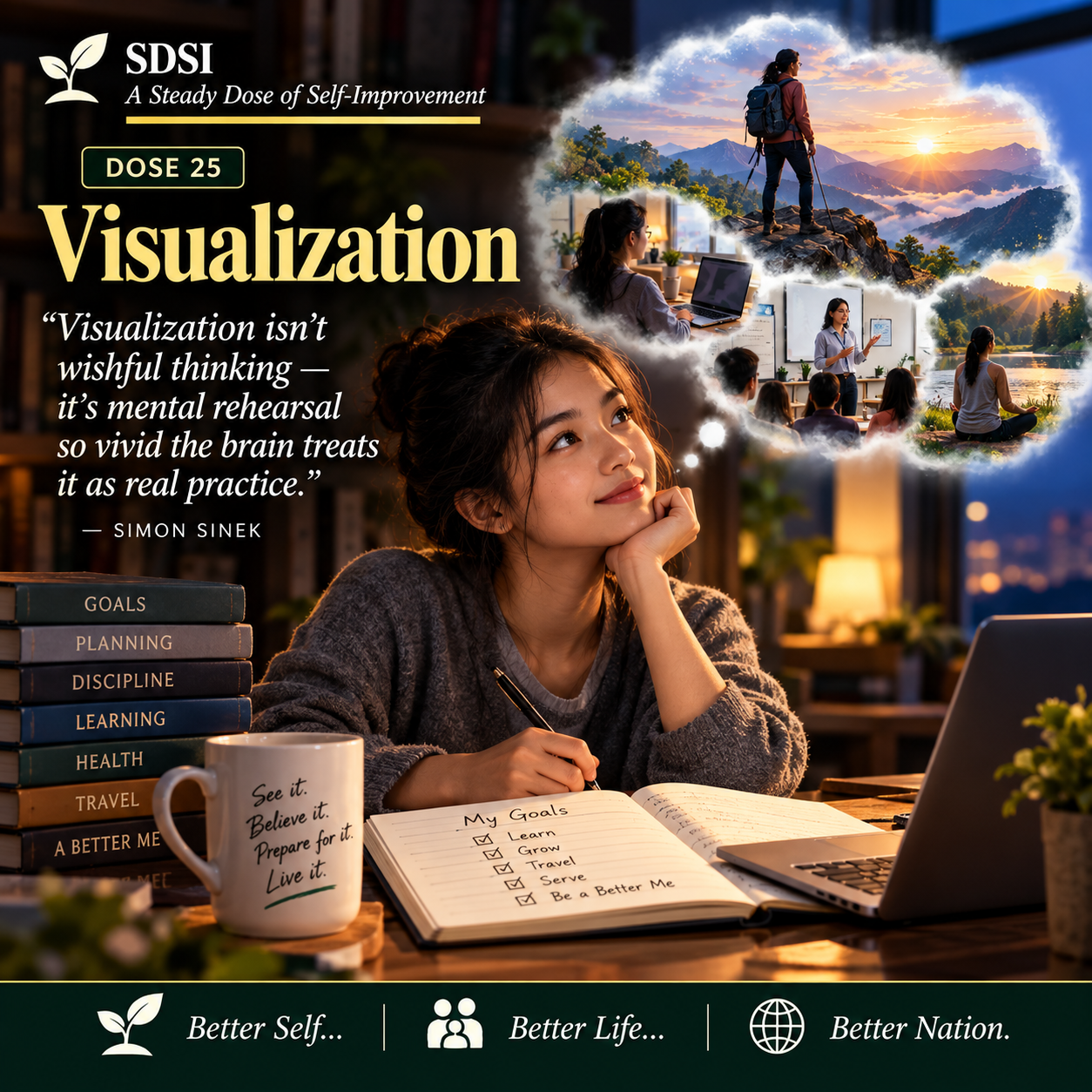
Visualization isn’t wishful thinking — it’s mental rehearsal. By vividly rehearsing an action or experience
in the mind, we can prepare ourselves for performing it in the real world.

At the 2008 Beijing Olympics, Michael Phelps’s goggles filled with water mid-race, leaving him unable to see clearly.
Visualization is one of the most powerful—and perhaps most underestimated—tools in the self-imprOvement toolkit. Like positive thinking, it is sometimes dismissed as little more than imagining success instead of working for it. But effective visualization is not a substitute for action. It is preparation for action.
Visualization involves creating vivid and detailed mental representations of an action, process, or desired outcome. Rather than merely seeing an image in the mind, effective visualization can engage multiple senses: what you see, hear, feel, and even how your body moves. Research on mental imagery suggests that imagined and actual actions can engage overlapping neural processes, helping explain why mental rehearsal has long been used in sports and other performance settings.
At the 2008 Beijing Olympics, Michael Phelps faced exactly the kind of situation he had mentally prepared for. During the 200-meter butterfly final, his goggles filled with water, severely limiting his vision. Yet he continued swimming, relying partly on his practiced stroke count and preparation, and won the race in world-record time. His longtime coach, Bob Bowman, had taught him to mentally rehearse races—to “watch the videotape” in his mind, including situations in which things did not go perfectly.
That detail matters.
Effective visualization is not simply seeing yourself standing triumphantly at the finish line. It is rehearsing how you will get there—and how you will respond when something goes wrong.
Research by Pham and Taylor similarly highlighted an important distinction between visualizing an outcome and visualizing the process required to achieve it. Imagining yourself receiving the diploma, losing the weight, publishing the book, or crossing the finish line may inspire you. But mentally rehearsing the studying, training, writing, decision-making, and persistence required to get there can better connect the vision with action.
Before deciding to pursue ESL teaching in South Korea, I spent considerable time imagining what that life might look like: the classroom, the students, the research opportunities, and the life I hoped to build. That mental picture did not magically bring me to South Korea.
Visualization did not get me here. But it helped make the destination real enough for me to move toward it.
And perhaps that is visualization’s greatest value. It allows us to visit a possible future before we arrive there—not so that we can escape into it, but so that we can return to the present knowing more clearly what we need to do next.
Pause and Reflect
What future have you repeatedly imagined for yourself—and what would you need to start doing today to move closer to it?
One Step Forward
Set aside 10 minutes today. Close your eyes and visualize not only achieving one of your important goals, but taking the next concrete steps toward it. See the environment. Hear the sounds. Feel yourself doing the work. Then open your eyes—and take one of those steps.
Explored in full in Chapter 16 — Visualization of A Holistic Approach to Self-Improvement.

Posted on September 24, 2026, in Better Self... Better Life...Better Nation, Competence Framework, Habit Scheme, Holistic Self-improvement, Personal Growth and Development, Self-Improvement, Value System, Visualization and tagged Better Self... Better Life...Better Nation, Perosnal Grwoth and Devlopement, Visualiztion. Bookmark the permalink. Leave a comment.



Leave a comment
Comments 0